Category Archives: alumni

Love, Loss, and Literature: Cataloguing the Papers of Irene Jessie Young

My name is Nancy Britten, and I’m in my fourth year of studying History at the University of Edinburgh. From January to April 2026, I had the wonderful opportunity to work with the Heritage Collections Team as an Archive Cataloguing Assistant. During this internship, I was working closely with the fascinating personal archive of Irene Jessie Young. I was especially excited to take on this role because it brought together two areas of interest for me within my own history studies: women’s history and modern European history, particularly the Second World War.
Nancy working on the collection in the Heritage Collections office.

The collection contains the personal papers of Irene Jessie Young (1919–2017), who was born in Edinburgh and later appointed to the Foreign Office at Bletchley Park during the Second World War. What makes this archive so interesting is the sheer range of material it includes, covering almost every stage of her life. Within the papers are personal letters, school records and certificates, university notes, diaries, autobiographical writing, and documents connected to her wartime memoir Enigma Variations. The collection also includes notebooks of verse, drafts and manuscript material, examples of Irene’s creative development as a writer.
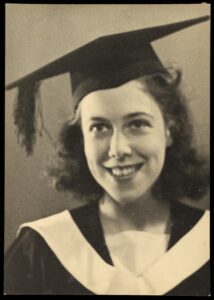
Graduation photograph of Irene J. Young, 1942

In October 1937, Irene matriculated at the University of Edinburgh and later graduated with an M.A. (Hons) in English Language and Literature on 3 July 1942. As an Edinburgh student myself, reading her lecture notes alongside her correspondence, particularly her descriptions of student life and the experience of working through papers and exams during the early years of the Second World War, was eye-opening.

Later in her life, Irene published a memoir about her wartime experiences. Enigma Variations: A Memoir of Love and War was published in 1990 and was one of the earlier accounts to describe what life was like at Bletchley Park. In the memoir, Irene describes her role in wartime intelligence, working as a codebreaker in Hut 6 and paints a vivid picture of everyday life at “Station X.” This is particularly valuable given how long Bletchley Park’s work remained classified, and it is striking to compare the frankness of her later memoir with her wartime correspondence in the archive, where only subtle references, and a great deal of reading between the lines, offer any indication of what she was involved in at the time. It is also a reminder of how much of Bletchley’s workforce consisted of women, who made up roughly three-quarters of staff at the peak of operations, but were often overlooked for decades in popular historical narratives.

Throughout the internship, my main responsibility was to create a detailed resource list of the collection using Excel. I worked from an earlier inventory as a starting point but updated and expanded it in line with current archival cataloguing standards, adding greater detail and clarity to the existing descriptions. After this, I worked in ArchivesSpace to create authority records for the key individuals and organisations that appear throughout Young’s papers, helping make the collection easier to navigate and more accessible for future researchers. One aspect of the training that I particularly enjoyed was the handling session, where I learned the correct way to work with fragile documents, bound volumes and photographs. It was especially interesting to discuss the practical steps involved in preserving these materials, and to gain a better understanding of the work carried out by preservation teams to protect and care for collections like this one.

My observations and themes from the collection:

One of the first things that stood out to me about this collection was that it had clearly already been thoughtfully organised before it reached us. Irene’s son, Dr Iain Gordon Brown, formerly Principal Curator of Manuscripts at the National Library of Scotland, had added a wealth of contextual information through printed labels, pencil annotations, and guiding notes throughout the papers. This proved helpful during the cataloguing process, particularly when trying to untangle nicknames, identify friends or understand the background to certain items. More than anything, it was a clear reflection of the time and care that had gone into preserving his mother’s papers.

A particularly good example of this can be seen in one of my favourite items in the collection: a bound volume of handwritten manuscript transcripts of Irene’s verse, which she created for her cousin, Gilbert Young Kennedy (1916–2020):
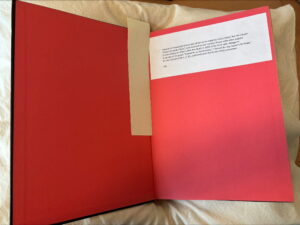
The printed white label in the front was added by Dr Iain Gordon Brown and provides helpful context.
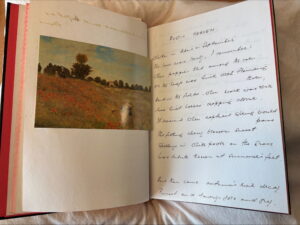
Some examples of the manuscript verse inside this volume.

Gilbert was Irene’s first cousin, and the two appear to have been extremely close. He later became Head of Cancer Research at the University of Sheffield, and during the Second World War he also played an important role working at the chemical warfare establishment at Porton Down. Despite their very different professional paths, Irene and Gilbert shared a creative streak and an appreciation for the arts—poetry in Irene’s case, and music (particularly organ-playing) in Gilbert’s. This volume of verse is a wonderful example of that shared interest, and includes a poem entitled, “Sonnet for my Cousin’s Birthday (for G.Y.K.)”  written for Gilbert.

Love during the war:

Another significant part of the collection is the correspondence between Irene and her first husband, Leslie George Cairns, who was later reported missing in action while serving with the Special Air Service (SAS) in France. Irene J. Young married Lieutenant Leslie George Cairns on 29 December 1943. Like Irene, Cairns had studied at the University of Edinburgh, graduating with an M.A. (Hons) in History (Unclassed War Privilege) in January 1944. He was commissioned into the Royal Artillery and served in the United Kingdom, Egypt, Libya, and Tunisia, before transferring to the Parachute Regiment and then to the Special Air Service Regiment (Army Air Corps). He was presumed killed in action in June 1944, aged 24, when the aircraft carrying him and his unit on a mission to east-central France was lost in circumstances that remain unclear.
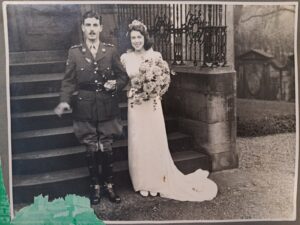
Irene and Leslie’s wedding photograph, 29 December 1943.

The archive contains hundreds of letters written from Leslie to Irene. Reading through these letters was one of the more distinctive aspects of the collection, not only because of their volume, but also because of what they leave unsaid. For the most part, the correspondence survives only on one side. Aside from a small number of unsent or returned letters, Irene’s replies are largely absent, which means that her side of the exchange has to be inferred from Leslie’s responses.

There are also noticeable limits to what is discussed in the letters themselves. Wartime censorship, as well as the nature of the work both were involved in, shaped what could be written. Leslie refers to this directly in one letter, noting, “I have to censor my men’s letters,” and, in another written early in the war while he was still serving as an army volunteer, he acknowledges the risks of disclosure:

“I am breaking rules by writing on this particular subject, and I don’t want you to have to burn this letter, so I know you’ll keep it well hidden and won’t even tell your mother and father the contents.”

Some letters bear censor markings, as demonstrated below, while others contain only brief or indirect references to his movements and activities. At the same time, there is little indication in the letters that Leslie fully understood the nature of Irene’s own wartime work, which remains relatively unspoken within their correspondence.
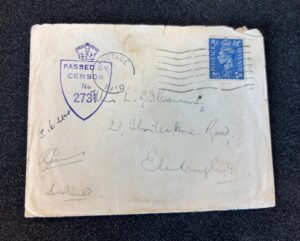
An example of an envelope in the collection that has been stamped to identify it as having been “passed by censor”
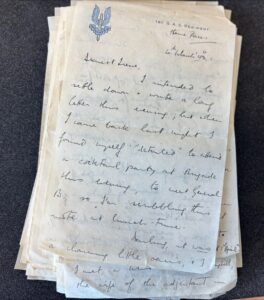
2. Some of the last letters written from Leslie G. Cairns to Irene J. Young in 1944, with the SAS letterhead.

One of the ways we are able to see more of Irene’s side of the relationship is through one of my favourite items in the collection: a small notebook kept by Irene as a record of things said by Leslie between the summer of 1938 and the spring of 1940, before he joined the army. She titled these recorded expressions “Words to remember always.” The notebook also contains other handwritten material, including poems and what appears to be an outline for an autobiography.

The entries themselves preserve brief fragments of conversation. For example, Irene records Leslie as saying, “I won’t go into the airforce if there’s a war, if you don’t want me to,” and “I can’t imagine you as anything but very much alive; we’re both alive and we know it too.”
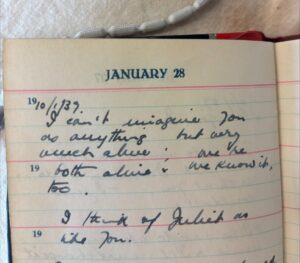
Page from the notebook kept by Irene J. Young to record things said by Leslie G. Cairns between 1938 and 1940.

The importance of literature:

I have briefly mentioned Irene’s appreciation of the arts and her own verse, but the prominence of literature throughout the collection deserves further attention, as it appears so consistently across different parts of her life and relationships.

Leslie and Irene frequently describe in detail the books they are reading at particular moments and often exchange books as gifts. A number of these volumes are preserved in the collection; some still bearing SAS ownership stickers, which I particularly liked as small traces of their shared history. On one occasion, Leslie decides to teach Spanish to fellow officers, prompting Irene to send him Spanish grammar books. In other letters, Irene includes quotations from poetry, often at moments when words of reassurance or encouragement seem needed.

These kinds of literary exchanges are not limited to Leslie. They appear in Irene’s correspondence with others across her life. For example, the collection includes a French encyclopedia sent to her by Dr Jean Ika Fiegelson, a French physician who assisted Irene in her search for Leslie. Similarly, books and reading form part of her correspondence with her Polish friend Roza Niedzwiedz, whom Irene had tutored in English towards the end of the war and who later became one of her closest friends. In a draft of one of her final letters to Roza in 1975, Irene includes a few lines of verse.

Later in life, Irene’s correspondence with Dr William J. Abel between 1995 and 1999 also centres in part on shared reading. In their letters, they reflect on questions of Christian faith and spirituality, and Dr Abel recommends a wide range of texts, from the selected poems of Rudyard Kipling to The Confessions of St Augustine and the seventeenth-century poem “The Desiderata.”

What all of these exchanges seem to show is how literature remained a steady part of Irene’s life, rooted in her background in English studies but continuing through her friendships and correspondence over many years. If I had the time, I would have loved to make a list of all the books, poems, and titles mentioned in the collection and start working my way through them.

Overall, working with this collection has been a really rewarding experience. It has been a privilege to spend time with Irene’s papers in such detail, and to play a small part in making them more accessible for future researchers.

The full catalogue of Irene J. Young’s Papers (Coll-1657) is available on ArchivesSpace: https://archives.collections.ed.ac.uk/repositories/2/resources/85781
John MacLeod Durward, Queen’s Scholar

Enquiries are very much central to what we do.  As well as helping others with their own research, enquiries are often the means by which we learn something new about our own collections. Recently we received one about a (potential) former student, John Macleod Durward, who was recorded in the 1861 as being a Queen’s Scholar.

Newspaper accounts supplied by the enquirer also listed John as having received received various class prizes at the University in 1864 and 1865, including in Moral Philosophy, Rhetoric and English Literature and Mathematics, along with him being from Arbroath. However, we were unable to find him amongst our graduates and the term Queen’s Scholar seemed to have no relation with the University (our initial investigations only uncovered it as something relating to Westminster School).

Nevertheless we persitsed as John had clearly been at the University and we should have some record of him.  We discovered that he had in fact matriculated in Arts for the academic years 1863/4 and 1864/5.  So, this all tiednicely with the newspaper accounts but what about Queen’s Scholar?

Our colleages at the UK National Archives proved to be a vital part of our deliberations.  Their online guide to records of Teacher Training states:

“At 18 pupil-teachers could apply for the Queen’s/King’s Scholarship Examination (later the Preliminary Examination for the Certificate). Successful scholars had the opportunity of attending training colleges for two or three years.”

The University of Edinburgh did not offer teacher training in this period but there were two institutions in Edinburgh which did, the Church of Scotland Training College and the Free Church of Scotland Training College.  Both were forerunners to Moray House College/Institute, which is now part of the University but then were independent entities.

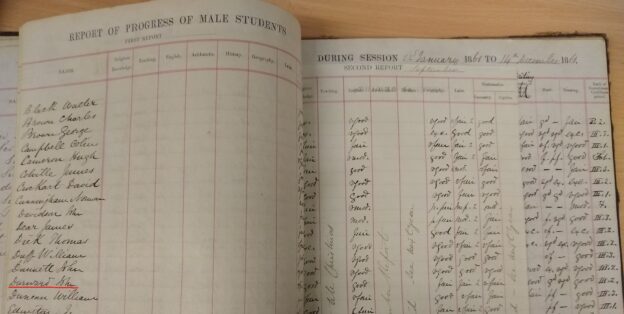
While the student records for the latter for this period have not survived, those for the former have.  Would we be lucky?  As you can see from the image below, we were.

Church of Scotland Training College: Report on Progress of Male Students

This places John at the Church of Scotland Training College in 1861 (the year he appeared on the census as Queen’s Scholar). John then attended the University for two years immediately after undertaking his teacher training.


‘Not a Varsity Bird’: William Soutar’s Student Years

100 years ago this week, one of Scotland’s best-loved poets became a student of Edinburgh University. On 13 October 1919, the 21-year-old William Soutar added his name to the university’s Matriculation Album as a first-year student of English Literature.

Extract from Matriculation Album (EUA IN1/ADS/STA/2)

Like many young men of his generation, Soutar’s student years were delayed by war service. On leaving school in 1916, he joined the Royal Navy and spent two years with the North Atlantic Fleet. By the time he was demobbed in November 1918, he was already suffering from as yet undiagnosed ankylosing spondylitis, a rare and exceptionally crippling form of arthritis, which would lead to almost complete paralysis by 1930 and contribute to Soutar’s early death in 1943. Following a month in hospital, Soutar recovered sufficiently to come to Edinburgh in spring 1919 with the initial intention of studying medicine. Soutar appears to have attended classes without matriculating but found the anatomical specimens so ‘gruesome’ that he abandoned medicine after a fortnight, resolving to switch to honours English after the summer vacation. He found time, however, to contribute a poem to the 21 May edition of The Student, ‘Orpheus’, a lushly Romantic piece heavy with echoes of Keats and Shelley.

Extract from ‘The Student’, 21 May 1919

Soutar did not enjoy a distinguished university career. The first two years of his honours English course passed smoothly enough. He enjoyed Professor Herbert Grierson’s lectures on the English classics, particularly appreciating Chaucer, Wordsworth, and Donne. He read widely, ranging far beyond the curriculum, and as his taste developed, was moved to destroy most of his own teenage production. He wrote prolifically, devoting three months of his first academic years to a long poem ‘Hestia, or the Spirit of Peace’ in a vain effort to win the university’s Poetry Prize. Although he continued to suffer from stiffness of the joints, he was still sufficiently vigorous to sit as a model for his friend James Finlayson’s painting of the warrior-hero Beowulf.

At the beginning of his third year, Soutar was dismayed to discover how prominent a role Anglo-Saxon would play in the Junior Honours curriculum. Finding linguistic studies ‘musty stuff’, he contributed a letter-article to The Student of 21 November, arguing that Anglo-Saxon should be optional. Although it offered a ‘large field to the specialist’, Anglo-Saxon contributed little to the average student’s knowledge and appreciation of the literature of his country’. It occupied far too many of the undergraduate’s studying hours which ‘ought to be given to the far more significant study of the great masters of English literature’.

Extract from ‘The Student’, 21 November 1921

Soutar reluctantly attended third-year Anglo-Saxon lectures but stepped up his campaign against the subject in his Senior Honours year. He was granted an interview with Professor Grierson on 23 October 1922, but failed to convert him to his cause. At his parents’ insistence, Soutar dropped his public opposition to Anglo-Saxon, but ceased attending classes, having been assured that he would still be permitted to sit his honours exam. Although Soutar increasingly devoted his evening hours to cinema-going and card-playing, his final year was nonetheless of vital importance for his development as a poet. His first volume, Gleanings of an Undergraduate, was published in his native Perth on 9 February 1923. Meanwhile, influenced by Hugh MacDiarmid, whom he had met during the 1922 summer vacation, he extended his knowledge of Scots verse beyond Burns to the medieval makars. His work began to appear in the MacDiarmid-edited journals Northern Numbers and The Scottish Chapbook, which spearheaded what came to be known as Scottish Literary Renaissance.

Title page of William Soutar’s first published volume, inscribed by the author (probably to art critic John Tonge) (JA 3537)

At the end of the spring term of 1923, Soutar fared disastrously in a preliminary exam on Shakespeare. When Professor Grierson subsequently remarked in a lecture that an honours course was not really for ‘Minor Poets, Geniuses or Journalists’, Soutar suspected that he was the target. Soutar’s final examinations were held on 15 and 19 June, and at the end of the month he learned that he had ‘scraped through’ with a third-class degree. Looking back, he suspected that aversion to Anglo-Saxon was not the sole reason for his low marks. In his exclusive passion for poetry, he had refused to read any of prescribed. It is also true that his medical condition, provisionally diagnosed as ‘rheumatics’, had worsened during his final year of study and may well have affected his academic performance. Soutar remained philosophical, reflecting: ‘I’m afraid I’m not a ‘Varsity bird’—one is apt to get cobwebs on one’s wings’.

Soutar graduated from Edinburgh University on 12 July 1923. Over the following months, his illness worsened, frustrating his hopes of becoming a journalist for The Scotsman. He began teacher training in October 1924 but had to return to Perth to begin treatment for his finally diagnosed ankylosing spondylitis. From then on, he was confined to his parents’ house, from which he would published a stream of slim volumes containing some of the finest Scots verse of the 20th-century. The best-known perhaps are the ‘bairn-rhymes’, or Scots children’s verse, collected in Seeds in the Wind. Soutar famously remarked that ‘if the Doric is to come back alive, it will come first on a cock-horse’.

For Edinburgh University’s collection of William Soutar manuscripts, see: Papers of Willam Soutar (Coll-796)

All quotations from: Alexander Scott, Still life: William Soutar, 1898-1943 (London: Chambers, 1958)

Paul Barnaby
Acquisition and Literary Collections Curator

James Miranda Steuart Barry and the Crimean War

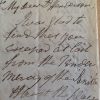
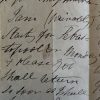
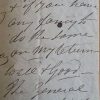
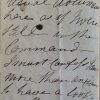
We recently became aware of a single letter from James Miranda Barry, written just before departure for Sebastopol shortly after its capture by the ‘allies’ in 1855. We acquired it in 1977.

Margaret Bulkley was born in Ireland: a bright, precocious child, she moved to London, with her mother in 1805 and there had access to General Francisco de Miranda’s library with ‘treatises such as might be considered to form a tolerably complete Medical Library for a private gentleman’. As her father had been declared bankrupt, she had no hope of a good marriage so it was decided she should go to university but this was not an option for a woman.

Taking the name of James Barry (after an uncle), Barry went to study medicine, at Edinburgh University, one of the most demanding and rigorous courses in Britain. Barry graduated with a MD thesis dedicated to patrons, General Francisco de Miranda and David Steuart Erskine, 11th Earl of Buchan (1742-1829). Then, even more extraordinary, after further training, Barry joined the army and travelled throughout the British Empire. There is no definitive version of Barry’s adopted name.

Read more about Barry on Our History

We knew about Barry’s matriculation and graduation records and MD thesis.  This letter, while recorded in our sheaf index to manuscripts, had not yet made its way into our online catalogue and was stumbled upon while looking for something else.  It makes interesting reading.

(Update: More recent scholarship has raised other perspectives in terms of Barry’s sex and gender.  The above has therefore been edited to remove references to gendered pronouns, other than for Barry’s childhood)

William Soutar’s Caricatures of Hugh MacDiarmid

A few days ago I gave a talk to the Friends of William Soutar in Perth on the friendship between Soutar and his fellow Scots poet Hugh MacDiarmid, as illustrated by letters in Edinburgh University Library’s C. M. Grieve Archive (MS 2960.18).

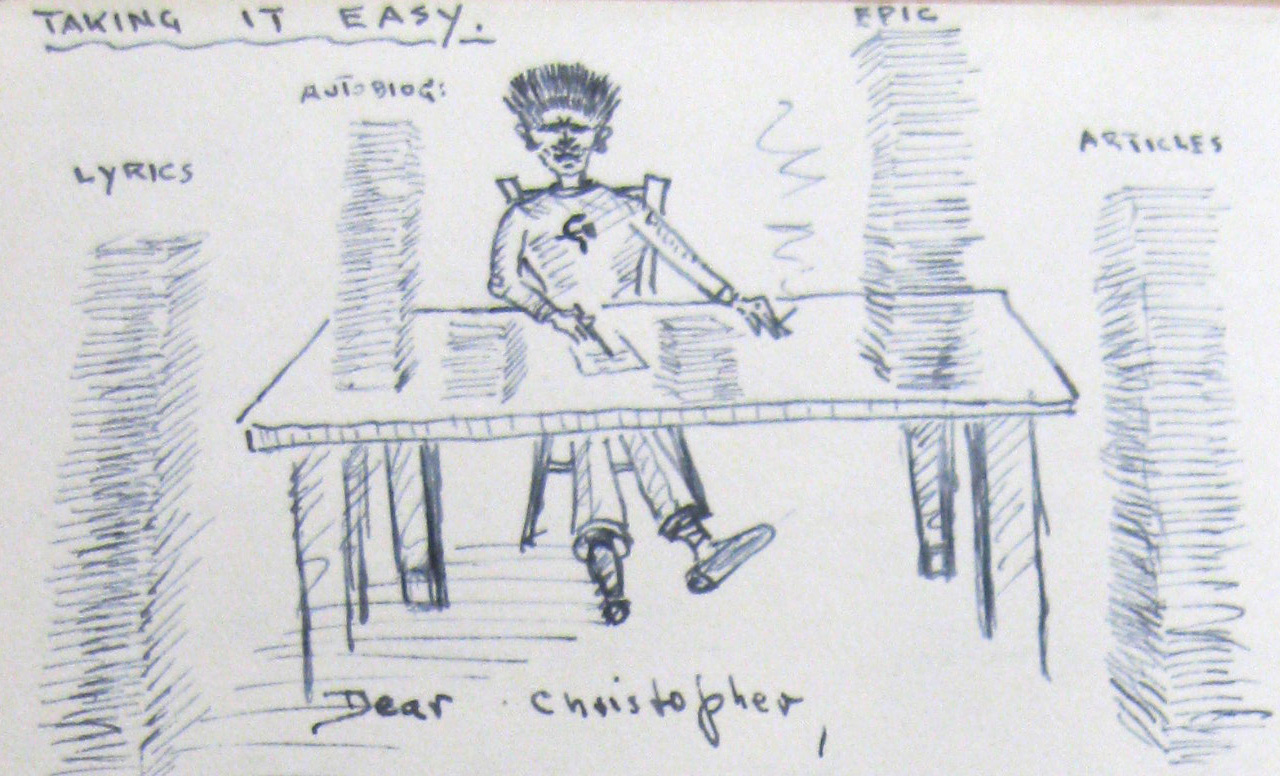
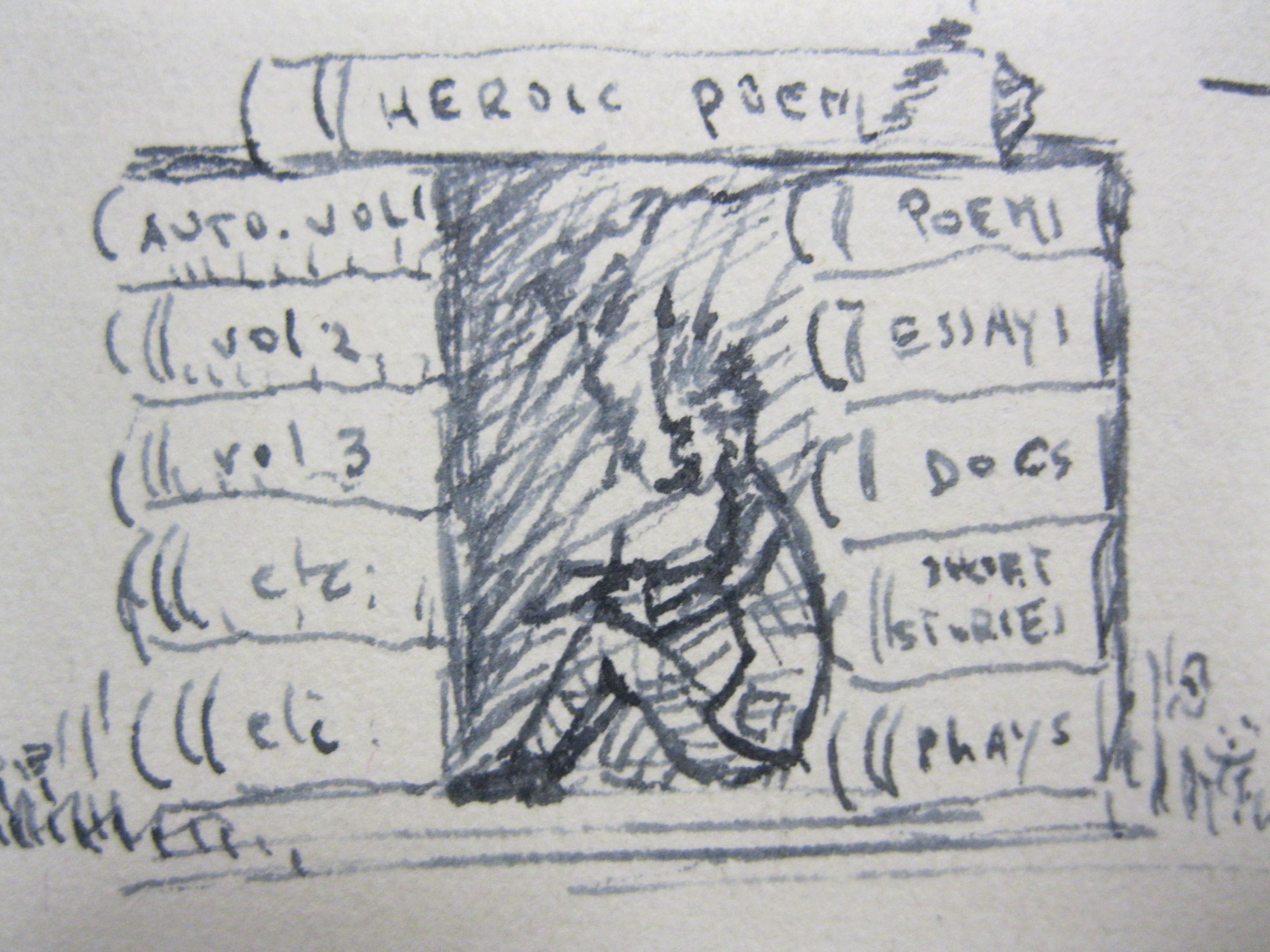
Soutar, confined to bed with a debilitating disease for the last 13 years of his life, adorned some of his letters with affectionate pen-and-ink caricatures of MacDiarmid (whom Soutar always addressed by his real forename ‘Christopher’). On 9 January 1937, he pokes gentle fun at the workaholic MacDiarmid’s idea of ‘taking it easy’, portraying him as a Marxist superman surrounded by piles of manuscripts headed ‘Lyrics’, ‘Autobiog.’, ‘Epic’, and ‘Articles’. When war breaks out, he suggests (19 December 1940) that the drafts of MacDiarmid’s works in progress will make a more than adequate bomb shelter.

IMG_1353IMG_1357

Soutar was an Edinburgh University student, matriculating in 1919, after serving in the Royal Navy during the First World War (an experience that turned him into a pacifist). He began a medical degree, but soon switched to English Literature, where he proved a notoriously difficult student. He refused to study both Anglo-Saxon and novels in general as he considered both irrelevant to his future career as a poet. He did, however, publish early verses in The Student, many of which reappeared in his first published volume Gleanings by an Undergraduate (1923).

For information on our holdings of William Soutar manuscripts and correspondence, see Scottish Literary Papers.

Paul Barnaby, Centre for Research Collections

1906 female medical graduates

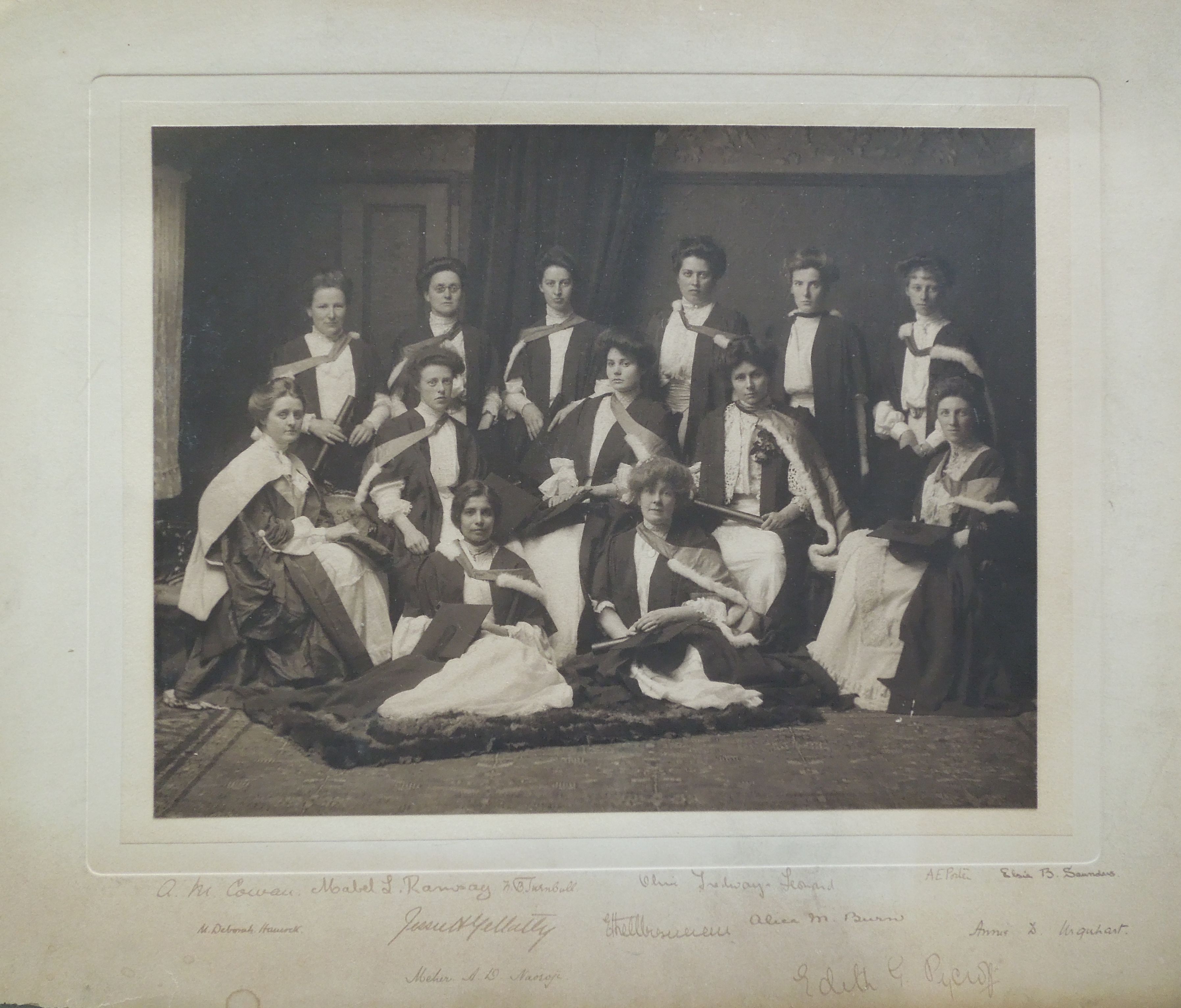
One of our earliest group photographs of female medical graduates depicts the MBChB class of 1906.  It shows 13 women and bears their signatures.

Female MBChB graduates 1906

Female MBChB graduates 1906

Alice Meredith BURN, New Zealand
Agnes Marshall COWAN, Scotland
Jessie Handyside GELLATLY, Scotland
M Deborah HANCOCK / Marjorie DUAKE-COHEN *
Olive TREDWAY-LEONARD, India
Meher Ardeshir Dadabhai NAHOROJI, India
Agnes Ellen PORTER, Scotland
Edith Gertrude PYCROFT, England
Mabel Lida RAMSAY, England
Elsie Blair SAUNDERS, England
Nettie Bell TURNBULL, Scotland
Annie Davidson URQUHART, England
Ethel WISEMAN, England

There was a further female MBChB graduate that year; Isabel HILL, Scotland, graduated in absentia.

* The signature for the student front row, furthest left, is given as M. Deborah Hancock (it may say Harcourt).  However no student of that name graduated.  The remaining student who whose name appears in the list of graduates is Marjorie Duake Cohen.  Her graduation record notes this as being her married name and has her also as Miss Averyl Harcourt.

Some online research has located a reference in the London Gazette, 31 Jan. 1930, to a Mrs Simha Duake Cohen, otherwise Marjorie Averyl Harcourt, who died in 1929.  It also refers to an Anthony Dowling, aka Vernon Harcourt.  The precise circumstances of name changes have not been determined but it does look likely that the remaining graduate in the photograph is Mrs. Duake Cohen.  Why her hood is a different colour to the others has not (yet) been determined.

UPDATE, 28 Nov.

The woman in the photograph is now thought to be Mary Deborah Hancock. Although not a MBChB graduate (which would account for her different hood), this is clearly a perfect match with the signature.

Further research into Marjorie Duake Cohen continues and, if sufficient information comes to light, she may feature in a future blog post.