My name is Nancy Britten, and I’m in my fourth year of studying History at the University of Edinburgh. From January to April 2026, I had the wonderful opportunity to work with the Heritage Collections Team as an Archive Cataloguing Assistant. During this internship, I was working closely with the fascinating personal archive of Irene Jessie Young. I was especially excited to take on this role because it brought together two areas of interest for me within my own history studies: women’s history and modern European history, particularly the Second World War.
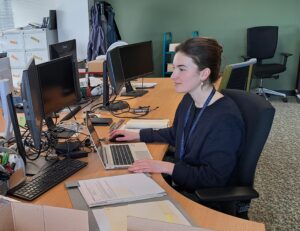
Nancy working on the collection in the Heritage Collections office.
The collection contains the personal papers of Irene Jessie Young (1919–2017), who was born in Edinburgh and later appointed to the Foreign Office at Bletchley Park during the Second World War. What makes this archive so interesting is the sheer range of material it includes, covering almost every stage of her life. Within the papers are personal letters, school records and certificates, university notes, diaries, autobiographical writing, and documents connected to her wartime memoir Enigma Variations. The collection also includes notebooks of verse, drafts and manuscript material, examples of Irene’s creative development as a writer.
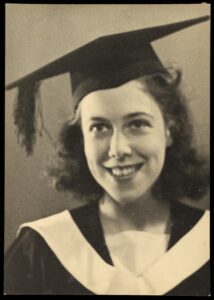
Graduation photograph of Irene J. Young, 1942
In October 1937, Irene matriculated at the University of Edinburgh and later graduated with an M.A. (Hons) in English Language and Literature on 3 July 1942. As an Edinburgh student myself, reading her lecture notes alongside her correspondence, particularly her descriptions of student life and the experience of working through papers and exams during the early years of the Second World War, was eye-opening.
Later in her life, Irene published a memoir about her wartime experiences. Enigma Variations: A Memoir of Love and War was published in 1990 and was one of the earlier accounts to describe what life was like at Bletchley Park. In the memoir, Irene describes her role in wartime intelligence, working as a codebreaker in Hut 6 and paints a vivid picture of everyday life at “Station X.” This is particularly valuable given how long Bletchley Park’s work remained classified, and it is striking to compare the frankness of her later memoir with her wartime correspondence in the archive, where only subtle references, and a great deal of reading between the lines, offer any indication of what she was involved in at the time. It is also a reminder of how much of Bletchley’s workforce consisted of women, who made up roughly three-quarters of staff at the peak of operations, but were often overlooked for decades in popular historical narratives.
Throughout the internship, my main responsibility was to create a detailed resource list of the collection using Excel. I worked from an earlier inventory as a starting point but updated and expanded it in line with current archival cataloguing standards, adding greater detail and clarity to the existing descriptions. After this, I worked in ArchivesSpace to create authority records for the key individuals and organisations that appear throughout Young’s papers, helping make the collection easier to navigate and more accessible for future researchers. One aspect of the training that I particularly enjoyed was the handling session, where I learned the correct way to work with fragile documents, bound volumes and photographs. It was especially interesting to discuss the practical steps involved in preserving these materials, and to gain a better understanding of the work carried out by preservation teams to protect and care for collections like this one.
My observations and themes from the collection:
One of the first things that stood out to me about this collection was that it had clearly already been thoughtfully organised before it reached us. Irene’s son, Dr Iain Gordon Brown, formerly Principal Curator of Manuscripts at the National Library of Scotland, had added a wealth of contextual information through printed labels, pencil annotations, and guiding notes throughout the papers. This proved helpful during the cataloguing process, particularly when trying to untangle nicknames, identify friends or understand the background to certain items. More than anything, it was a clear reflection of the time and care that had gone into preserving his mother’s papers.
A particularly good example of this can be seen in one of my favourite items in the collection: a bound volume of handwritten manuscript transcripts of Irene’s verse, which she created for her cousin, Gilbert Young Kennedy (1916–2020):
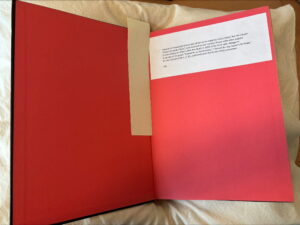
The printed white label in the front was added by Dr Iain Gordon Brown and provides helpful context.
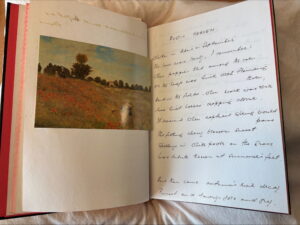
Some examples of the manuscript verse inside this volume.
Gilbert was Irene’s first cousin, and the two appear to have been extremely close. He later became Head of Cancer Research at the University of Sheffield, and during the Second World War he also played an important role working at the chemical warfare establishment at Porton Down. Despite their very different professional paths, Irene and Gilbert shared a creative streak and an appreciation for the arts—poetry in Irene’s case, and music (particularly organ-playing) in Gilbert’s. This volume of verse is a wonderful example of that shared interest, and includes a poem entitled, “Sonnet for my Cousin’s Birthday (for G.Y.K.)” written for Gilbert.
Love during the war:
Another significant part of the collection is the correspondence between Irene and her first husband, Leslie George Cairns, who was later reported missing in action while serving with the Special Air Service (SAS) in France. Irene J. Young married Lieutenant Leslie George Cairns on 29 December 1943. Like Irene, Cairns had studied at the University of Edinburgh, graduating with an M.A. (Hons) in History (Unclassed War Privilege) in January 1944. He was commissioned into the Royal Artillery and served in the United Kingdom, Egypt, Libya, and Tunisia, before transferring to the Parachute Regiment and then to the Special Air Service Regiment (Army Air Corps). He was presumed killed in action in June 1944, aged 24, when the aircraft carrying him and his unit on a mission to east-central France was lost in circumstances that remain unclear.
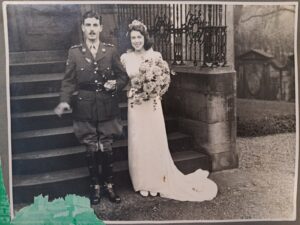
Irene and Leslie’s wedding photograph, 29 December 1943.
The archive contains hundreds of letters written from Leslie to Irene. Reading through these letters was one of the more distinctive aspects of the collection, not only because of their volume, but also because of what they leave unsaid. For the most part, the correspondence survives only on one side. Aside from a small number of unsent or returned letters, Irene’s replies are largely absent, which means that her side of the exchange has to be inferred from Leslie’s responses.
There are also noticeable limits to what is discussed in the letters themselves. Wartime censorship, as well as the nature of the work both were involved in, shaped what could be written. Leslie refers to this directly in one letter, noting, “I have to censor my men’s letters,” and, in another written early in the war while he was still serving as an army volunteer, he acknowledges the risks of disclosure:
“I am breaking rules by writing on this particular subject, and I don’t want you to have to burn this letter, so I know you’ll keep it well hidden and won’t even tell your mother and father the contents.”
Some letters bear censor markings, as demonstrated below, while others contain only brief or indirect references to his movements and activities. At the same time, there is little indication in the letters that Leslie fully understood the nature of Irene’s own wartime work, which remains relatively unspoken within their correspondence.
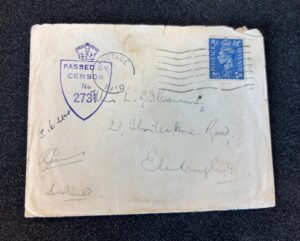
An example of an envelope in the collection that has been stamped to identify it as having been “passed by censor”
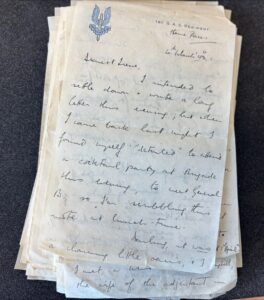
2. Some of the last letters written from Leslie G. Cairns to Irene J. Young in 1944, with the SAS letterhead.
One of the ways we are able to see more of Irene’s side of the relationship is through one of my favourite items in the collection: a small notebook kept by Irene as a record of things said by Leslie between the summer of 1938 and the spring of 1940, before he joined the army. She titled these recorded expressions “Words to remember always.” The notebook also contains other handwritten material, including poems and what appears to be an outline for an autobiography.
The entries themselves preserve brief fragments of conversation. For example, Irene records Leslie as saying, “I won’t go into the airforce if there’s a war, if you don’t want me to,” and “I can’t imagine you as anything but very much alive; we’re both alive and we know it too.”
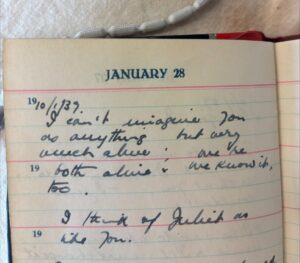
Page from the notebook kept by Irene J. Young to record things said by Leslie G. Cairns between 1938 and 1940.
The importance of literature:
I have briefly mentioned Irene’s appreciation of the arts and her own verse, but the prominence of literature throughout the collection deserves further attention, as it appears so consistently across different parts of her life and relationships.
Leslie and Irene frequently describe in detail the books they are reading at particular moments and often exchange books as gifts. A number of these volumes are preserved in the collection; some still bearing SAS ownership stickers, which I particularly liked as small traces of their shared history. On one occasion, Leslie decides to teach Spanish to fellow officers, prompting Irene to send him Spanish grammar books. In other letters, Irene includes quotations from poetry, often at moments when words of reassurance or encouragement seem needed.
These kinds of literary exchanges are not limited to Leslie. They appear in Irene’s correspondence with others across her life. For example, the collection includes a French encyclopedia sent to her by Dr Jean Ika Fiegelson, a French physician who assisted Irene in her search for Leslie. Similarly, books and reading form part of her correspondence with her Polish friend Roza Niedzwiedz, whom Irene had tutored in English towards the end of the war and who later became one of her closest friends. In a draft of one of her final letters to Roza in 1975, Irene includes a few lines of verse.
Later in life, Irene’s correspondence with Dr William J. Abel between 1995 and 1999 also centres in part on shared reading. In their letters, they reflect on questions of Christian faith and spirituality, and Dr Abel recommends a wide range of texts, from the selected poems of Rudyard Kipling to The Confessions of St Augustine and the seventeenth-century poem “The Desiderata.”
What all of these exchanges seem to show is how literature remained a steady part of Irene’s life, rooted in her background in English studies but continuing through her friendships and correspondence over many years. If I had the time, I would have loved to make a list of all the books, poems, and titles mentioned in the collection and start working my way through them.
Overall, working with this collection has been a really rewarding experience. It has been a privilege to spend time with Irene’s papers in such detail, and to play a small part in making them more accessible for future researchers.
The full catalogue of Irene J. Young’s Papers (Coll-1657) is available on ArchivesSpace: https://archives.collections.ed.ac.uk/repositories/2/resources/85781