The Academic Support Librarians are a learning team, who have attended professional development events in line with the prioritised themes in our team workplan. Ishbel Leggat attended the RLUK conference in Liverpool in March, where she learned “how colleagues at other institutions are embedding AI skills into the curriculum, how Generative AI is changing the HE landscape and how AI could be used to optimise library-related working practices”. The AI theme in our workplan was also explored by Anna Richards at the BIALL (British and Irish Association of Law Librarians) conference, with a view on how AI tools are being used in legal practice and library-led support. Jane Furness attended the CALC online conference in May which enabled her to “build my ability to contribute to and support the work of the ASL EDI group and in my support of ECA students and staff.” In June, SarahLouise MacDonald and Rania Karoula attended the SCURL Conference in Aberdeen which had an EDI focus, where they learned about “new avenues for research based on relevant presentations (specifically on radical hospitality and supporting diverse communities).” And Ruth Jenkins attended the LILAC Library Information Literacy conference in Cardiff, bringing back notes that were shared with team colleagues “… who picked up on different talks and themes so our conversations were different every time.” We share our learning with library colleagues in the ASL blog : https://libraryblogs.is.ed.ac.uk/asl/ Continue reading →
To add to our recent schedule of conference reports, last month several members of our
The ‘Sir Duncan Rice Library’, University of Aberdeen by Stanley Howe, CC BY-SA 2.0 <https://creativecommons.org/licenses/by-sa/2.0>, via Wikimedia Commons
team attend the Scottish Confederation of University & Research Libraries (SCURL) Conference on the 19th of June, which took place in the striking Duncan Rice Library at the University of Aberdeen.
We were delighted to see that the conference had such an interesting programme focused on the great work member teams are doing across the country to promote inclusivity and diversity of access. Sessions included topics such as ‘Radical Hospitality: how can academic libraries support seekers of refuge?’ and ‘Higher Education librarians and social class background’. There were poster presentations from various member libraries taking action in their own settings, and keynotes from Dr Rachel Shanks, Interdisciplinary Director for Social Inclusion and Cultural Diversity at the University of Aberdeen as well as Beth Hellen-Montague, Head of Library & Information Services, The Frances Crick Institute and author of Practical Tips for Equality, Diversity and Inclusion in Libraries (which is available as an ebook via DiscoverEd).
While all the talks were valuable, Beth spoke very knowledgeably on the practical work of becoming an EDI focused librarian, and while much of what she had to say regarding taking action (that all actions help, we don’t need one person doing inclusion perfectly but rather to take advantage of the positions, groups and access we already have), she also introduced new-to-us concepts such as the Academic Wheel of Privilege which we plan to consider in our future work. This can help us in making assessments regarding building our collections, but also how we approach the cultures around our educational systems and student backgrounds. It also links directly to the work Darren Flynn discussed in his session on social class in academic librarianship.
For more information about the Academic Wheel of Privilege and how it can be used for research, see the FORRT website.
We love to see a strong EDI strand in any conference we attend, and look forward to bringing our learnings from this event to discussions at our ASL EDI group and the wider L&UC EDI network too.
SarahLouise McDonald & Rania Karoula Academic Support Librarians
Critical Approaches to Libraries Conference poster
I attended the online CALC25 [Critical Approaches to Libraries] Conference from 13 – 15 May 2025. The programme, slides and recordings are available at https://sites.google.com/view/calcconference/calc2025 It was great to see Alice our Strathclyde placement student there too.
As you would expect from a conference on critical librarianship the programme topics were wide-ranging and diverse. Topics included professional identity, slow librarianship, supporting neurodivergent colleagues, information imperialism, and justice-orientated librarianship. I would highly recommend this affordable conference. It is £15 for 3 days and you can choose to donate a £15 entrance fee for another participant who can then attend for free. Most of the sessions were recorded and are on Youtube or the above website.
Computer17293866, CC BY-SA 4.0 , via Wikimedia Commons
On Tuesday 18 June, I flew half way around the world to attend the Atla conference in Long Beach, California. There were two questions that Atla delegates asked me that I had to pause and think about to answer. The first was ‘Why did you come such a long way to attend this conference?’ (the second was ‘Are you the library director? – well … no.). To answer the first, I was able to attend the Atla 2024 conference due to a generous travel grant from Atla itself, support from BETH (European Theological Libraries) and support from ABTAPL UK & Ireland. I was attending as a UK representative of BETH, but I also wanted to attend because of the unique theological library context, and because attending an international conference is a great learning experience. As at professional development events in the UK, AI dominated the agenda – here are some conference highlights.
As part of Black History Month at the Library, we have trial access to ProQuest Black Studies. Developed with faculty, scholars and librarians, ProQuest Black Studies brings together award-winning content into one destination that can be used for research, teaching, and learning.
ProQuest Black Studies combines primary and secondary sources, including leading historical Black newspapers, archival documents and collections, key government materials, videos, writings by major Black intellectuals and leaders, scholarly journals, and essays by top scholars in Black Studies. Continue reading →
I attended the CALC Conference on 24th and 25th May and can thoroughly recommend this annual event to other professionals interested in critical librarianship. The gathering was welcoming and introduced the day by stating “we will operate within a spirit of liberation at this conference”. If you have not heard of CALC before, their website states that “The Critical Approaches to Libraries Conference aims to provide a space to discuss all aspects of critical practice in libraries and librarianship including (but not limited to) decolonisation, critical pedagogy, equality, diversity and inclusion in library work and the representation of marginalised groups in the workforce, academia and literature.”
The 2 day conference was packed with a diverse range of topics and speakers, so I can only highlight a few here. At the end of the blog post I have included links to further reading.
Some of my key take-aways were:
When designing a support resource for ebook accessibility question your assumptions about students understanding of platforms, and co-design courses with students.
When investigating library ‘decolonisation’ initiatives there is no such thing as “neutral”. Be clear about your positionality and privileges. Find actionable recommendations to solve a problem (move beyond critiquing, to action). Look at Algorithms of Oppression book (on DiscoverEd).
In the Day 1 conference Keynote: Decolonising bibliographies, referencing and citational practices Dr Gurnam Singh shared so many important reflections for where we find ourselves right now, such as:
“Enlightenment belongs to humanity not to Europe!”
“Colonialism is an economic endeavour and is still happening”.
“Critiquing the canon means exposing the othering and silencing of people”.
Dr Singh discussed the various types of colonisation to be aware of such as settler colonisation, extractive colonisation, and plantation colonisation.
(Colonialism is generally classified by one of five overlapping types according to the practice’s particular goals and consequences on the subjugated territory and its indigenous peoples. These are: settler colonialism; exploitation colonialism; plantation colonialism; surrogate colonialism; and internal colonialism.)
Dr Singh then went on to compare the fixed hierarchies of arborescent thought versus rhizomatic thought’s interconnected multiplicity and networks of thought, which rejects fixed categories and sees connections and dialogues.
Some of his comments might be challenging to some people, such as “Citation rankings are monetised and racist, and so therefore is the REF [Research Excellence Framework]”. It is true that currently citation rankings perpetuate certain dominant authors and global voices, which position Western discourse as the most “valid” or important. Dr Singh said “When an article has 10 authors you just know its gaming the citation rankings – its fraud. The publishing industry is colonial – it’s based on colonial attitudes.”
“Decoloniality is about building a new humanity not going back to a “purer” time. This isn’t a specialist subject, its about being human. Maybe AI could release us to be humans and not robots?”
Other topics covered by other speakers included multilingualism in public libraries; using reflective practices to extend the impact of teaching in libraries; developing collaborative cataloguing codes of ethics; setting up Library Decol Working Groups in academic libraries; exploring working class roots of library staff and their experiences in the mostly middle class populations of HE library staff; being a neurodivergent librarian in HE; using critical race theory in medical curriculum decolonisation work; and using the Homosaurus for cataloguing in a public library consortium.
We were encouraged to develop the attitude that everybody brings something to the workplace – a richness of their own, rather than making assumptions about the limitations of people based on their assumed backgrounds, identities, or experiences of “othering”.
I can thoroughly recommend attending this very affordable and welcoming conference!
Our recent post on Decolonising and Diversifying the Library introduced the short seminar series the ASL team ran during lunchtimes in July. We’re delighted to be able to follow up that post with the news that recordings of all three sessions have now been added to Media Hopper. Please use the links below to access the videos:
For more information on these sessions or if you have ideas for what you’d like to see in future lunchtime seminars, please contact us by email or leave us a comment.
We held our first of three Decolonising and Diversifying the Library lunchtime seminars last week, on the topic of Diversity in First Year Scots Law Reading Lists. The recording (39 minutes) has been uploaded and is now available on our Media Hopper Channel.
We’ve got two more sessions scheduled in this mini series, starting with tomorrow’s look at Supporting diversity through the ECA Library Zine collection and Artists Books collection with Academic Support Librarian Jane Furness. Join Jane at 1pm on Thursday 14th July to hear about the ECA Library artists’ books and zines collections and the ways in which they celebrate the diversity of makers working in these fields today. Book usingthis link to the MyEd booking system.
The following week we have a special showcase of the work of our Equity, Diversity and Inclusion Digital Engagement intern, Tristan Craig: Diversifying your Reading from a Student Perspective : Digital Engagement (EDI) Internship Showcase
Promoting the use of a diverse range of sources has several pedagogical benefits. It encourages students to become more autonomous learners by going beyond their reading lists and to think critically about the types of sources they’re engaging with. It also prompts them to consider the historical biases inherent in the dissemination of knowledge and look for a variety of voices to conduct more balanced research.
In this presentation Tristan will reflect upon his experiences and discuss how staff can support students to become confident in finding and using diverse sources. To book for this session on Thursday 21st July at 1pm, use this link to the MyEd booking system.
For more information on these sessions or if you have ideas for what you’d like to see in future lunchtime seminars, please contact us by email or leave us a comment.
Last month, three of our Academic Support Librarians team attended the LILAC conference. LILAC is a conference for librarians and information professionals who teach information literacy skills, are interested in digital literacies and who want to improve the information seeking and evaluation skills of library users. You may have seen our previous post about LILAC 22 here.
Much of the conference covered issues of critical information literacy, including long and slightly intimidating words such as critical pedagogy and decolonisation, and it was great to have the space to explore what these mean.
Keynote speaker Marilyn Clarke, Director of Library Services at Goldsmiths, University of London, spoke on Decolonisation as a means to creating an equitable future.
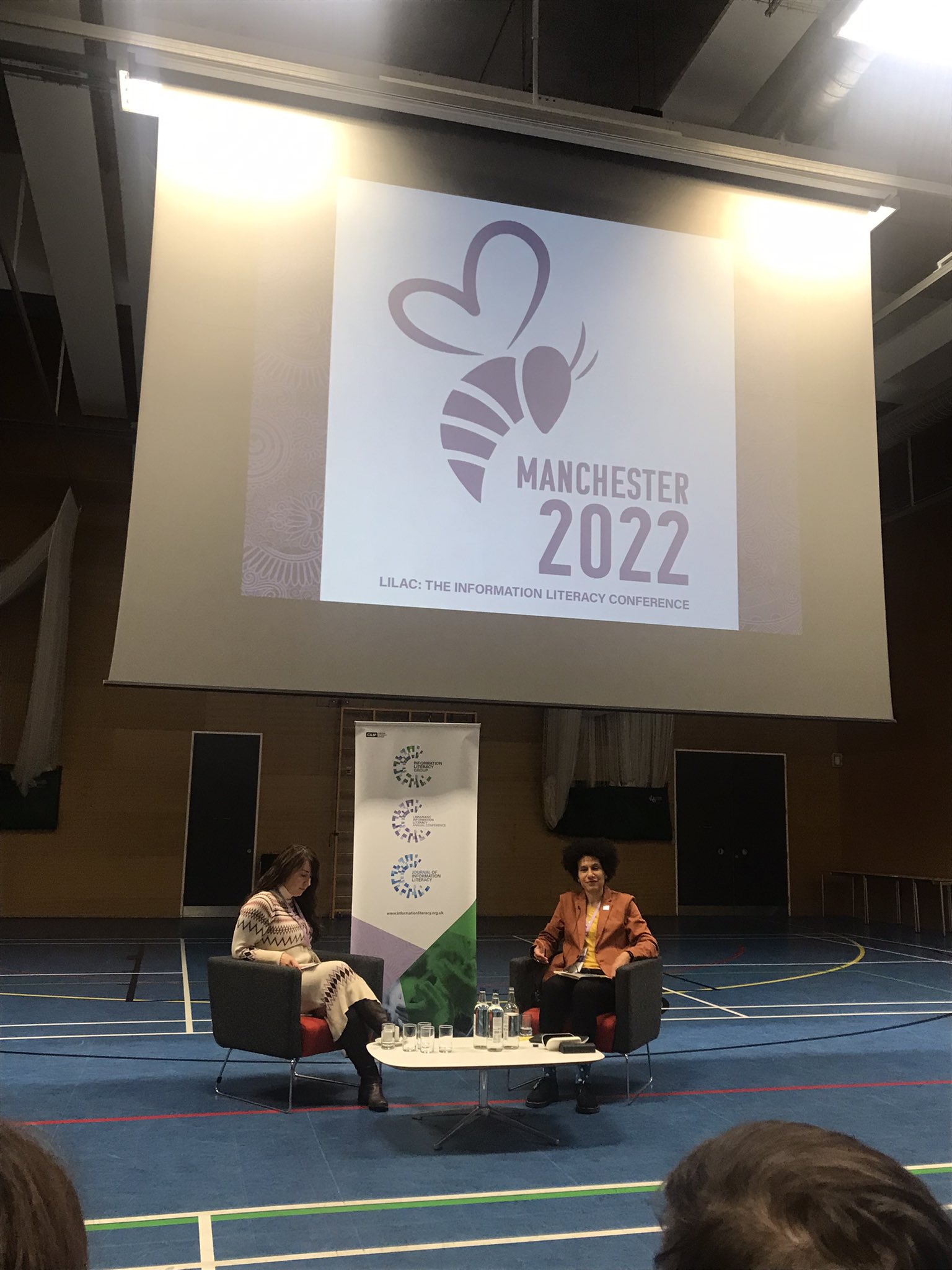
Marilyn Clarke with discussion chair Elizabeth Brookbank at LILAC 2022.
Marilyn clarified succinctly the difference between decolonising and diversifying library collections; diversifying ≠ decolonising, we need to ask the question why are these voices underrepresented?
She highlighted fantastic work at Goldsmiths to dismantle Eurocentric structures in the library and university, including funds for the ‘Liberate My Degree’ collection set aside for student book purchase suggestions to address gaps in the library collection. At the University of Edinburgh we have the Student Request a Book service which empowers students to request purchase of books and other resources to be added to the Library collections.
When cataloguing their Zines collection, librarians gather suggestions for keywords (used as a finding aid in the catalogue) from the authors themselves, to ensure the language used is representative. This is not just about addressing race, but also other systemic oppression such as LGBTQ+ and class.
In the final keynote of the conference, Emily Drabinski, Critical Pedagogy Librarian at the Graduate Center, City University of New York, explored how information literacy canreveal and challenge structures of power, and equip our students with tools to recognise and understand power dynamics.
By power, this mean the ability to change things, do things, influence things – we all have power in different ways and different situations. As librarians who help people find, use and understand information, we need to take societal values and power structures into account.
For example, who designed this database? With whom in mind? What is included in the database and what isn’t, and who makes those decisions? That feeling, where you get no results from a search, or too many, or their wrong – that’s not you, that’s the way the system is constructed with power.
Myself, I will be doing more to incorporate discussions of power into my teaching. It’s something I do when teaching literature searching for Systematic Reviews in medicine and biomedical sciences (these aim to find and synthesise all clinical evidence on a topic), where comprehensive searches and minimising bias are a core foundation of the review methodology – and as such, knowing what is included in a database, and crucially what is excluded, is crucial. But we can introduce this criticality earlier in students’ academic careers. I am not sure yet what that will look like exactly, but it’s exciting to consider.
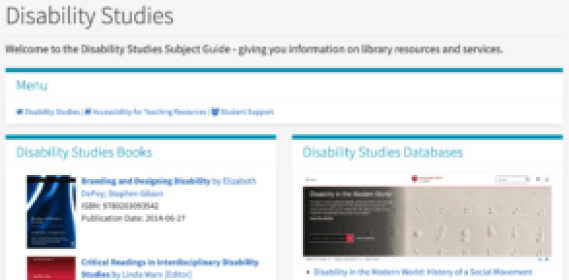
The Subject Guides are a useful tool in getting started with your research. Whether you’re an Engineer or a Classicist, they contain a wealth of information for navigating library resources, including journals, databases, and bibliographies, available to students here at the University of Edinburgh. Part of my role as Digital Engagement Intern involves reviewing and creating guides within the remit of Equity, Diversity, and Inclusion, and I’m delighted to share our newest Subject Guide in Disability Studies.
This guide has been created to both assist students in the academic study of Disability and highlight ways the University can support you with any additional learning needs you might have. We’ve included access information for students using the Main Library, advice on how to make your device more accessible, and details of several groups and societies for students to get involved with. As well as supporting students, we’ve also included various materials to assist staff in creating more accessible learning environments, signposting additional training and resources available at the University.
We hope that this guide will serve as a helpful tool for students and staff to access the support that’s available by bringing these resources together in one guide that will continue to grow over time. If you have any feedback or suggestions on ways this guide can be improved, then we would love to hear from you!