Home University of Edinburgh Library Essentials
September 29, 2026
Open Access Week at the University of Edinburgh
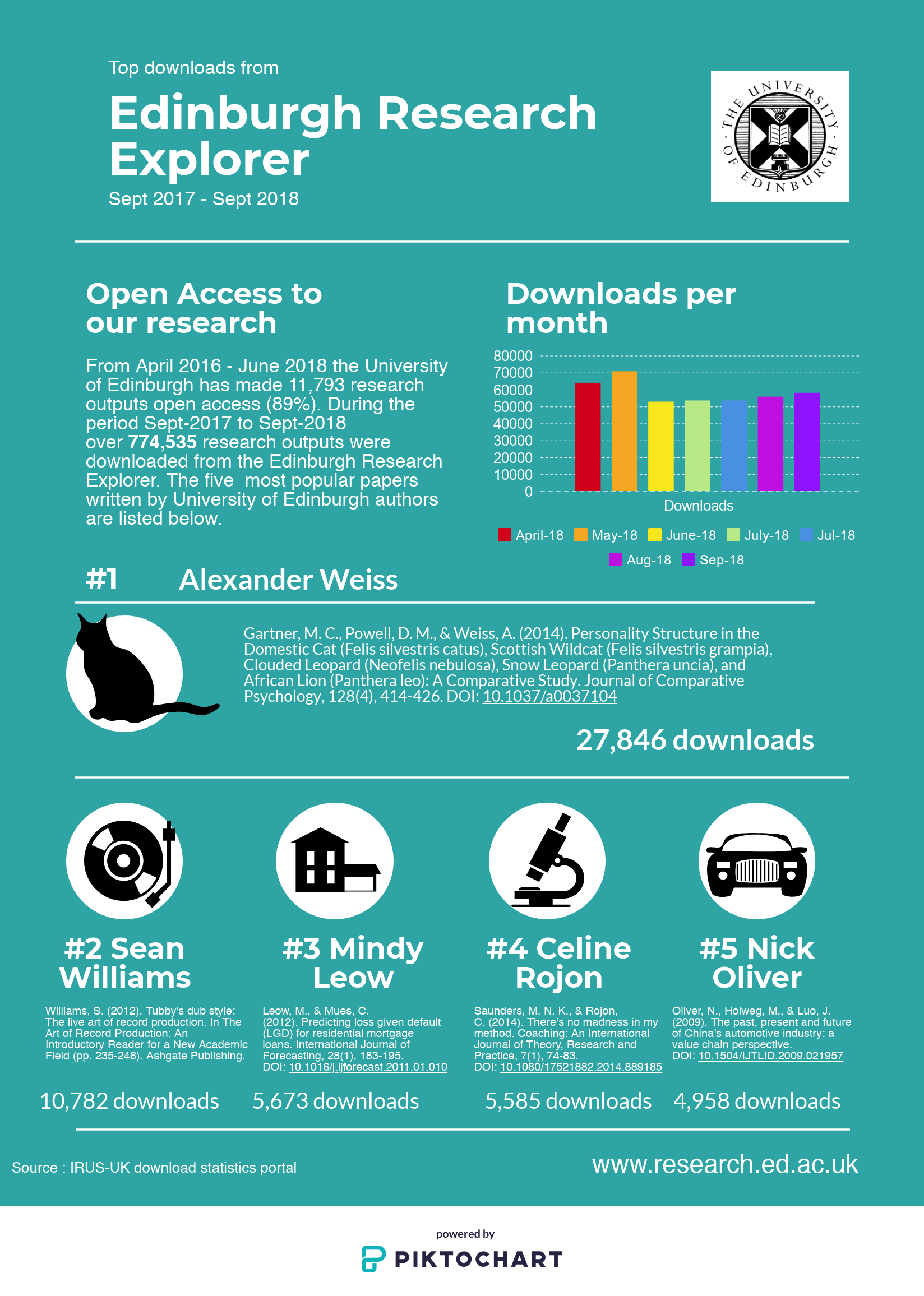
Every week is open access week at the University of Edinburgh. From April 2016 – June 2018 the University of Edinburgh has made 11,793 research outputs open access. This represents 89% of the research published that could be submitted to the REF2020 exercise.
During the period Sept-2017 to Sept-2018 over 774,535 research outputs were downloaded from the Edinburgh Research Explorer. This equates to nearly 65,000 downloads per month.
The five most popular papers written by University of Edinburgh authors are listed below:
| Title | Author(s) | ItemURL | Total downloads |
| Personality Structure in the Domestic Cat , Scottish Wildcat , Clouded Leopard, Snow Leopard and African Lion: A Comparative Study | Gartner, Marieke Cassia; Powell, David M.; Weiss, Alexander | http://hdl.handle.net/20.500.11820/fd973849-7ae1-48a8-833c-d4da8a7c9de3 | 27,846 |
| Tubby’s dub style :The live art of record production | Williams, Sean | http://hdl.handle.net/20.500.11820/510f47ca-8881-4691-a6a6-23dd5fcea473 | 10,782 |
| Predicting loss given default (LGD) for residential mortgage loans:A two-stage model and empirical evidence for UK bank data | Leow, M.; Mues, C. | http://hdl.handle.net/20.500.11820/485b5935-f0cc-4944-ab93-4abb2511e7fc | 5,673 |
| There’s no madness in my method: Explaining how your research findings are built on firm foundations | Saunders, Mark N. K.; Rojon, Celine | http://hdl.handle.net/20.500.11820/43a5d933-01fb-46f7-a2ec-a6691f157c6b | 5,585 |
| The past, present and future of China’s automotive industry: a value chain perspective | Oliver, N.; Holweg, Matthias; Luo, Jianxi | http://hdl.handle.net/20.500.11820/26a252cc-4c3d-437f-a645-a086f5e70303 | 4,958 |
On trial: Governing Africa
I’m happy to let you know that thanks to a request from a student in HCA the Library currently has trial access to a series of digital collections from British Online Archives, called Governing Africa: British records from African countries under colonial rule. The series includes 13 collections that between them have over 2,500 primary source documents, covering nearly 30 countries including Malawi, South Africa, Gambia, Sierra Leone, Uganda, Zimbabwe, Ghana, Kenya and Nigeria and have documents dating from 1808-1995.

As we’re currently in Black History Month and with the University’s Africa Week 2018 starting later this week it seemed an appropriate series for the Library to get on trial for staff and students.
You can access the database via the E-resources trials page.
Trial access ends 21st November 2018. Read More
Icky Sticky Tape
This week’s blog has been written by Lisa Behrens, a book and paper conservation student from Stuttgart in Germany, who spent four weeks at CRC’s conservation studio earlier this summer. In this post, Lisa describes a treatment she carried out on a bound volume in the Margaret Morris collection from the Fergusson Gallery in Perth. This collection is being catalogued and conserved at the CRC as a part of a collaborative Wellcome Trust-funded project entitled ‘Body Language’
If you don’t know the first thing about paper conservation, let me help you out: Do not, under any circumstances, use sticky tape. There you go, you now know the first thing.
I understand it’s tempting. When you first put it on, it looks neat. It mends that tear, it is easy to use and readily available. The problems start when it begins to age. Even if stored in optimal conditions, certain chemical reactions will inevitably take place. These will lead to discolouration of the adhesive, making the tape brittle and, worst of all, damaging and discolouring the object itself. Adhesive can also sink into the paper matrix and become so hardened that it’s almost impossible to remove.
During my three years of working and studying in this field I have come across a lot of adhesive tape, mostly used for tear repairs by well-meaning individuals over the last few decades. For example, this volume of sheet music from the Margaret Morris Collection, namely a ballet called The Forsaken Mermaid, had been repaired at least twice before, which is apparent from the use of different types of adhesive tape and kinds of thread for resewing.
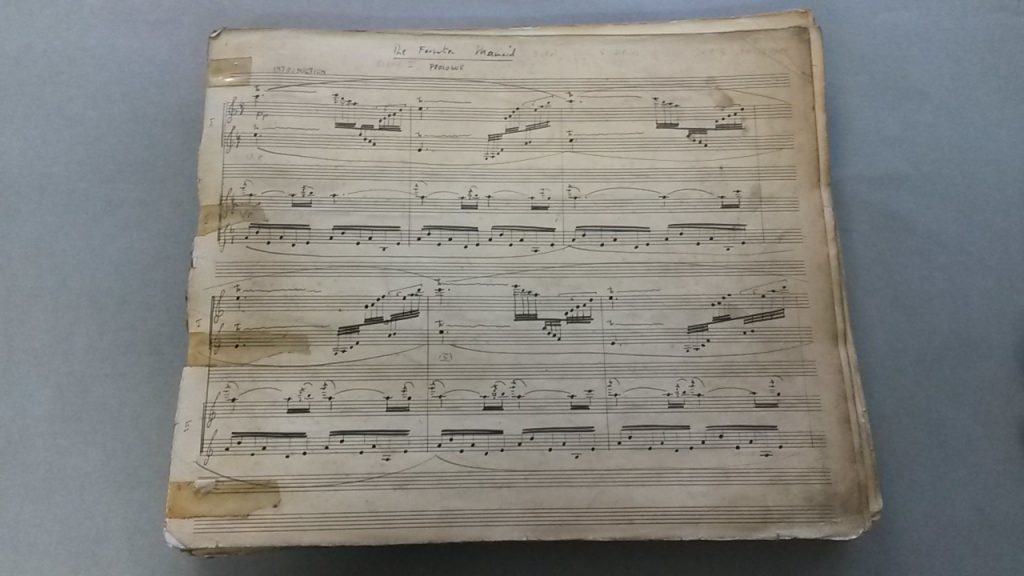
The Forsaken Mermaid, before treatment
Women in Scotland: the poor and women’s health
We continue with the theme of women in Scotland, this time focusing on poor women and what society did to help them, and women’s health.
Poor women
Many parishes reported a high number of poor women, especially older women or widows, who were unable, or even unwilling, to work.
Here are some figures given in the parish report for Campsie, County of Stirling:
| No. of paupers on our list, | 25 | |
| Of these there are females, | 16 | |
| Males, | 9 | |
| Above sixty years of age, | 19 | |
| The average of the years of their receiving charity, | 8 | |
| Of this number of paupers, there are no less than five facile in their mind, | 5 | |
| The higher sum given is per month, | 64 | |
| It would appear that it is only the hundredth part of the whole inhabitants who require public charity, of these twenty five paupers, eight are unmarried women. |
The lack of work available to women was a big factor in the high percentage of poor women. In Laurencekirk, County of Kincardine, “about one-fourth of the regular paupers are males, the others being chiefly aged women. The class of destitute women is rapidly increasing from the discontinuance of employments, by which females advancing in life were wont to earn some livelihood; yet such is the inevitable result of the extensive use of machinery.” (NSA, Vol. XI, 1845, p. 151) It was a very similar situation in Kings Kettle, County of Fife where “elder women and widows are generally employed in winding pirns; but for these there is a great want of employment since the lint-wheel failed them.” (NSA, Vol. IX, 1845, p. 109) and in Huntly, County of Aberdeen, where “employment in weaving worsted and in knitting stockings was got for many of the old women in the parish; but the former is entirely extinct, and the latter has also been withdrawn.” (NSA, Vol. XII, 1845, p. 1041)
Lack of employment sometimes meant women having to re-locate to try and find work, as reported in the parish report of Yetholm, County of Roxburgh.
“Single women unfit for farmers service, or an old widow with a daughter or two, most of them equally unfit, took refuge in these villages [of the parish], and earned their livelihood by spinning, perhaps someone of the family by hoeing turnips by the day, and hiring themselves in harvest; whilst the males hired themselves for herds, hinds, and farmers servants, and were in other parishes. This is not mere conjecture, for a great part of the paupers upon the list consist of such women, and I know of many more who still subsist by their own labour. Besides, some single women, or widows, after obtaining a settlement in other parishes, come to reside in these villages; because stout women, fit to be employed the whole season in every kind of out-work, are so scarce in proportion to the demand, that no farmer will let a cottage, but upon the condition of being furnished with a worker, for whom, even in the turnip-season, they pay 8 d. or 9 d. per day, without victuals.” (OSA, Vol. XIX, 1797, p. 612)

Little Beggar Girl and Woman Spinning, 1720s. Giacomo Ceruti [Public domain], via Wikimedia Commons.
The lack of employment was not the only reason given for the existence of poor women. In some cases, women were able to work, but chose to be beggars. In Auchindoir, County of Aberdeen, “there is no strolling beggar belonging to the parish; but we have great numbers of them from other parishes. Some of these, particularly the women, are young and healthy; and they are usually attended by several children of different ages, whom they train up to the same habits with themselves. If there be laws for remedying these and similar abuses, it is a pity they are not put in execution.” (OSA, Vol. XII, 1794, p. 500) In Glenshiel, County of Ross and Cromarty, “the swarm of sturdy beggars with which this country is infested is considered as no small disadvantage. They consist chiefly of stout able women, who, rather than engage in service are content to go about from house to house; but there is every reason to believe, the introduction of manufactures would effectually relieve the public of this burden.” (OSA, Vol. VII, 1793, p. 131)
It was pointed out in the parish report of Stirling, County of Stirling, that many women decided not to work rather than earn a pittance. “The low rate of female labour in Stirling, is another source of poverty. The utmost a woman can earn by spinning wool, is 3 d. a-day. With this they cannot maintain themselves, pay the rent of a house, and get other necessaries. Such small encouragement destroys industry. A female having so little prospect of advantage from her labour, is at no pains to be expert in it.” It then goes on to say that “the chief cause of the numerous poor in Stirling is the castle”! Find out why here: (OSA, Vol. VIII, 1793, p. 291).
So how did society try to help these disadvantaged, destitute women? As mentioned in the parish report of Wiston and Roberton, County of Lanark, there were poor women who did indeed try to help themselves. “It is sometimes necessary to press aid on the necessitous, such is their modesty. Sometimes two widows, or single women, join in one cottage, to save house-rent and fuel; and many, even such as are advanced in life, support themselves by spinning flax, and working in harvest, and at other times. The rent of a cottage is about 12 s. a year.” (OSA, Vol. VI, 1793, p. 309)
However, these women still needed help from society. In the report for Caputh, County of Perth, it was suggested that a philanthropist consider improving the situation of poor women as “the very fact that, of the 39 paupers supported by the kirk-session, 32 are old women, is sufficient to shew that the weaker sex, do what they will, if depending upon their own efforts for subsistence, must anticipate old age with feelings of the most painful solicitude! This is a sight for pity to peruse,
Till she resemble faintly what she views,
Till sympathy contract a kindred pain,
Pierc’d with the woes “these females feel in vain.”
Cowper” (NSA, Vol. X, 1845, p. 670)
Here are some ways in which society came to the aid of poor women.
- Creation of houses
In several parishes establishments were set up in which to house poor women, such as St Leonard’s Hospital and Pitreavie’s Hospital in Dunfermline, County of Fife, which took care of widows. (NSA, Vol. IX, 1845, p. 904) In Tinwald and Trailflat, County of Dumfries, “the Duke of Quensberry allows six free cottages to poor old women.” (NSA, Vol. IV, 1845, p. 50) and in Edinburgh, County of Edinburgh there was the House of Industry and Servants’ Home where “about 30 indigent females [were] received into this institution, where work is provided for them.” (NSA, Vol. I, 1845, p. 738)
- Societies set up to aid women
There are mentions of female societies in several parish reports, including that of Glasgow, County of Lanark (NSA, Vol. VI, 1845, p. 185), Aberdeen, County of Aberdeen, where the society derived its funds for the relief of aged and indigent females “from the subscriptions of its members, and occasional donations and bequests” (NSA, Vol. XII, 1845, p62), Markinch, County of Fife, where “the principal ladies connected with the parish patronize it” (NSA, Vol. IX, 1845, p. 687) and Stirling, County of Stirling (NSA, Vol. VIII, 1845, p. 440).
In Dalkeith, County of Edinburgh, “various other societies have been formed for the relief of the poor. The Indigent Sick Society was formed in 1808; the Old Women’s Society in 1814: the Clothing Society, for supplying work to industrious poor women, in 1837.” (NSA, Vol. I, 1845, p. 531)
In Kinross, County of Kinross, there was the Ladies’ Society, members of which “meet together monthly, when they distribute a certain quantity of oatmeal to each of those destitute women, whom they shall determine upon as the most suitable objects of relief. Their funds arise from a small subscription from each member of 5s. on her entrance; and of a penny a-week or 4s. 4d. a year; from occasional public collections; from the donations of individuals, &c. No small addition was made, two years ago, by the proceeds of a musical festival in Kinross mansion-house.” (NSA, Vol. IX, 1845, p. 23)
The effectiveness of these societies was not lost on the parish reporter for Dowally, County of Perth. “A Female Friendly Society should be established, on the same principle with the Cordiners and Weavers Society. Destitute women have always formed the most numerous lift of claimants on the public charitable funds. In 1755, when 14 persons were supplied weekly by the session, there were 10 women in the number; and there was no less a proportion than 40 women, out of 52 persons, supplied at an occasional distribution, in 1790.” (OSA, Vol. XX, 1798, p. 446)
- Parochial Funds
Parishes collected funds in order to support the poor. In Keig, County of Aberdeen, “the average number of persons on the poor roll for the last six years has been 9, mostly infirm old women without near relations able to support them, besides whom others in similar circumstances have been occasionally assisted.” (NSA, Vol. XII, 1845, p. 956) In Denny, County of Stirling, “there are a number of house-keepers in indigent circumstances, who receive occasional supplies from the collections, made at the church-doors on Sunday.” (OSA, Vol. II, 1792, p 421)
Figures are provided in the report for Cleish, County of Kinross. ” The number of persons at present receiving parochial aid is 6, at 1s. per week, one at 2s., and two orphan children at 1s. each per week. There is also a woman receiving 2s. 6d. as a temporary assistance, in consequence of her not being able to prove the father of her illegitimate child. The funds for their support are, the church collections, L. 21, 6s. 10d.; interest of L. 265, L. 10, 12s.; and mortcloth dues, which, since the parish procured a hearse by subscription, are merely nominal: these, at an average of seven years, amount to L. 31, 18s. 10d.” (NSA, Vol. IX, 1845, p. 51)
It is particularly interesting to read how the parish of St Mungo, County of Dumfries, offered various methods of support to the poor, including provision of employment and the putting in place of regulations to ensure that an individual or family did not become a burden to the parish. “The means of support collected under the direction of the session are applied to the support of the distressed. The session have also been in the habit of at times giving work to poor women in place of money, paying a house rent on condition their relatives shall in all other respects provide for them; or maintaining a poor person’s family at school, to prevent their becoming a burden on the parish. But, unless driven to it by necessity, direct payment of money from the sessional funds, except to the diseased and aged, has always been avoided… Poor women are also by the trustees employed in gathering stones and filling carts on the roads, at a fixed rate.” To find out more about the regulations established by the session look at NSA, Vol. IV, 1845, p. 216.
There is a great story found in the parish report of Gargunnock, County of Stirling. “An addition was made to the funds of the poor in 1784, by a very singular circumstance. Two old women, sisters, who lived in the village of Gargunnock, had for many years, every appearance of extreme indigence; though without making any application for assistance from the parish. One of them at last, applied to be received on the poor’s list; and as no doubt was entertained of her poverty, she received four shillings per month. ..”. Discover what happened next in OSA, Vol. XVIII, 1796, p. 113.
Women’s health
In several parish reports a direct link between women’s employment and ill health was observed. This included both work involving sitting for long periods of time and being out in all weathers.
- Leading a sedentary life
Here are some examples found in the Statistical Accounts of Scotland of the negative effects to women of undertaking jobs such as weaving and spinning. These include a couple of very interesting comments on the effect on health of wasting saliva when wetting thread!
Elgin, County of Elgin – “the women lead sedentary lives in spinning, from which arise obstructions, etc. that often terminate fatally; and from the same causes, difficult labours are more common than formerly.” (OSA, Vol. V, 1793, p. 17)
Nigg, County of Kincardine – “from the more sedentary life of women now, at knitting stockings, hysteric complaints are thought frequent.” (OSA, Vol. VII, 1793, p. 198)
Carmylie, County of Forfar – “This new employment [spinning flax] for young women cannot be so conducive to health, as the ordinary labours of female servants; and in the event of their becoming wives, forms no good training for their management of household affairs.” (NSA, Vol. XI, 1845, p. 371)

A bedridden sick young woman being examined by a doctor, acc. Engraving by F. Engleheart, 1838, after Sir D. Wilkie. [CC BY 4.0 (https://creativecommons.org/licenses/by/4.0)], via Wikimedia Commons
*The women, when engaged in spinning, especially in winter, sit by-the fire-side, and keeping, as their custom is, always the same station, the one side side is exposed to the chilling cold of the season, and the other is relaxed by the warm influence of the fire. Besides, in turning her lint-wheel, the person who spins, commonly employs but one foot, and uses chiefly the hand of the
same side, in making the thread. Thus the labour is very unequally divided, by which the health of the body must naturally be affected. Lastly, the waste of saliva in wetting the thread, must
deprive the stomach of a substance essential to its operations, whence, all the fatal consequences of crudities, and indigestion, may be expected.” (OSA, Vol. II, 1792, p. 282)
Forgan, County of Fife – “… the constant sitting at the wheel, and the immoderate waste of saliva, was by no means favourable to their health. Many of these people are employed in cutting down the corns in harvest. During this season they are uncommonly cheerful and healthy; but as this exercise in the field is an extreme entirely opposite to the sedentary life they generally lead through the rest of the year, disagreeable effects are sometimes felt after the harvest; however, the danger of this is not a little abated by their present manner of living during this season, which is upon oat bread and ale, which, when fresh and good, is a most wholesome diet.” (OSA, Vol. XVI, 1795, p. 95)
Auchtermuchty, County of Fife – “Comsumptions are the most prevalent distemper, particularly among young women, which perhaps may be attributed to their staying at home, spinning at two-handed wheels, and not enjoying that comfortable diet, and moderate exercise, the result of being in service.” (OSA, Vol. VI, 1793, p. 339)
Dron, County of Perth – “Many young women, who used to go into service, find it more advantageous to stay at home and spin for the manufacturer, or to purchase lint and dispose of the yarn. By this mode of life, they feel themselves independent, and more at their own disposal, which is no doubt an additional motive for preferring it. But they overlook the ill consequence of their choice to health and vigour of constitution, which is more than a balance for all their advantages. Their sedentary life, and want of proper exercise ; their eager application and scanty provision, are all circumstances which conspire to enfeeble the constitution, produce nervous disorders, and bring on sexual infirmities, which render life uncomfortable, and hurry them into premature old age.” (OSA, Vol. IX, 1793, p. 476)
Riccarton, County of Ayrshire – “A great proportion of the females in the parish are employed in sewing and embroidering muslin… The employment, we believe, is very injurious to the general health of those employed, but especially to, their chest and eyes.” (NSA, Vol. V, 1845, p. 612)
In the parish report of Avondale, County of Lanark, the effects of sedentary employment on the health of children was also commented on. “The great wages made by weaving, induces many parents to put their boys too early to that business, which stints their growth, occasions swellings about their legs, and hurts their morals, by rendering them too soon independent of their parents. The same temptation is presented to the girls by the flowering of muslin, which, by confining them too soon to a sedentary life, makes them pale and sickly, and is likely to subject them to nervous complaint all their lives.” (OSA, Vol. IX, 1793, p. 387)
- Working on the land
Women also experienced health issues from undertaking agricultural work, i.e. hard labour, or generally being outside.
Tillicoultry, County of Clackmannan – “The dysentery was unknown here for many years. It has, however, appeared of late three different times, and carried off a good many persons, chiefly women. As this alarming malady always broke out in the end of harvest, some have been apt to imagine, that, if it was not caught by infection, it arose from the colds and damps to which the people were exposed in reaping, or to a frequent use of potatoes not brought to a proper state of maturity.” (OSA, Vol. XV, 1795, p. 202)
Old or West Monkland, County of Lanark – “Several young women of this parish have fallen into consumptions by sitting too long on the damp ground at tent preachings.” (OSA, Vol. VII, 1793, p. 380)
Edzell, County of Forfar – “The most prevailing complaints are, asthma amongst the men, and hysterical disorders amongst the women, rheumatism in both sexes. These may, in part, be caused, or nor a little heightened, by poor diet, hard labour, and sorry lodging.” (OSA, Vol. X, 1794, p. 102)
All this being said, it must be noted that several parish reports mention both men and women who have lived to a ripe old-age, in some cases over a hundred! Examples include the parishes of Northmaving, County of Shetland (NSA, Vol. XV, 1845, p. 73), Castletown, County of Roxburgh (OSA, Vol. XVI, 1795, p. 64) and Crimond, County of Aberdeen (NSA, Vol. XII, 1845, p. 703).
In Halkirk, County of Caithness, even though the climate “often goes to extremes in the space of 24 hours; for it is not unusual to be visited here with all the coldness and rigours of winter, and the fervour and heat of a summer-day, in the space of 12 hours… There is no disease that can be called peculiar to it; neither are the distempers by which we are visited more frequent, or more fatal and violent, than in other countries, that are esteemed very healthy and salubrious.” (OSA, Vol. XIX, 1797, p. 12) In the Section on the county of Shetland from volume 15 in account 2 it was reported that “the women usually live to a greater age, and preserve their faculties better, than the men, it may be from having been less exposed to excessive and desultory labour.” (NSA, Vol. XV, 1845, p. 147)
Women and childbirth
Some parishes reported poor care for women giving birth as there were either no skilled midwives or no midwives at all. In Kiltearn, County of Ross and Cromarty, “another disadvantage which the poor women labour under here, which is, that they seldom have proper assistance when in child-bed, as there is no regularly bred midwife in the parish. This often proves of fatal consequence to women in that situation, which, of all others, require the most tender care, as well as skill.” (OSA, Vol. I, 1791, p. 288)
Fossoway, County of Perth – “Though the two parishes taken together, form a large and populous district, there is not a physician, nor a surgeon, nor a midwife in either. Women in child-bed have, however, good assistance at no great distance; and they are, in general, very fortunate. Good medical aid is also to be had from all the neighbouring towns. It is also reasonable to acknowledge with gratitude, that the united parishes lie under peculiar obligations to the Royal Infirmary of Edinburgh.” (OSA, Vol. XVIII, 1796, p. 453)
Jura, County of Argyle – “A great proportion of children die in infancy, and many of the mothers, though of a strong constitution, recover slowly in child-bed. Both these circumstances seem to be owing to unskillful treatment, for there is not a single bred midwife in the island.” (OSA, Vol. XII, 1794, p. 320)
Kilmorie, County of Bute – “The diseases here [include]… a great death of new-born infants, by the falling down of the jaws; and some women die in childbed, both which last two are attributed to the unskillfulness of midwives, who venture upon the practice from natural courage, without necessary and proper knowledge, there being none duly qualified in the island.” (OSA, Vol. IX, 1793, p. 166)
Incidentally, the fatal illness of new-borns, mentioned above, was also known as “the eight-day sickness’. It was reported in Kilbride, County of Bute, that “there is a disorder, no less fatal to children, which seems to be peculiar to this island, as it is seldom known any where else, called the eight-day sickness. Infants are seized with it the 8th day after birth, by the falling down of the jaw, attended with violent convulsions.” (OSA, Vol. VIII, 1793, p. 579) Thankfully, in the New Statistical Accounts report for the same parish this disease “which a few generations ago was so fatal to infants and children, is now never heard of, having disappeared along with its cause,– unskillful treatment on the part of self-taught midwives.” (NSA, Vol. V, 1845, p. 6)
Conclusion
It has been very interesting to find out both about the existence of poor women, its causes and what society did to help them, and about women’s health in 18th and 19th century Scotland. The parish reports are an important source of information not only of actual figures and descriptions of situations faced, but also opinions on causes and suggestions for solutions. This allows you to get an insight into how people thought and felt about what was going on around them. There are plenty more extracts you can find on these subjects in the Statistical Accounts of Scotland. We welcome you to take a look and make comments on our blog posts or to our twitter account.
Watch out for other posts on women in the future, or revisit our past posts on such topics as the influence of Scotland on the world, music and dance, and Scotland’s languages!
On trial: Area Studies – Japan, China and Southeast Asia
The Library currently has trial access to two primary source databases from Adam Matthew, Area Studies: China and Southeast Asia and Area Studies: Japan. These provide digital access to primary source materials spanning more than 500 years, selected from the extensive microfilm back catalogue of Adam Matthew Publications.

You can access both the databases via the E-resources trials page.
Access is available both on and off-campus.
Trial access ends 12th November 2018. Read More
On trial: East India Company digital archive
Thanks to a request from a student in HCA I’m pleased to let you know that the Library currently has trial access to the primary source database East India Company from Adam Matthew. This unique digital resource allows students and researchers to access a vast and remarkable collection of primary source documents from the India Office Records held by the British Library, the single most important archive for the study of the East India Company.
You can access the database via the E-resources trials page. Access is available both on and off-campus.
Trial access ends 16th November 2018.

On trial: British and Irish Women’s Letters and Diaries
*The Library has access to British and Irish Women’s Letters and Diaries, 1500-1900 until 31st July 2024 as part of ProQuest Access 350.*
Thanks to a request from a 4th year dissertation student in HCA the Library now has trial access to Alexander Street’s digital collection British and Irish Women’s Letters and Diaries, 1500-1900. Spanning more than 400 years it brings together the personal writings of women from England, Scotland, Ireland and Wales.
You can access the database via the E-resources trials page.
Access is available on-campus. For off-campus access you must be connected to the VPN.
Trial access ends 16th November 2018.
Extending back to the 1500s, the collection lets you view history in the context
of women’s thoughts—their struggles, achievements, passions, pursuits, and desires. The collection shows the various shapes and formats of the diary as it evolved, including the travel diary, offering detailed accounts of journeys and descriptions of places; the daily personal diary, in which women reflected more broadly on aspects of their lives; letter diaries, wherein a daily dated letter to a recipient served simultaneously as a diary entry; and other forms. Read More
Get referencing right: some useful resources
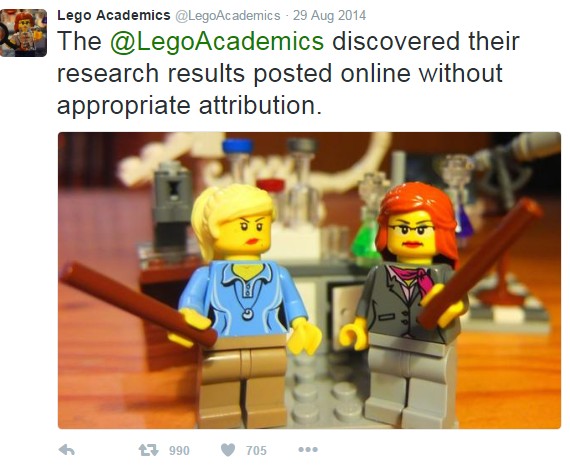
Working on your assignment and unsure how to do references? Wondering what references, citations, endnotes, footnotes, etc., actually are? Don’t know your Harvard style from your Chicago style? We’ve got a few useful online resources that should help demystify the referencing process.
(Lego Academics, 2014)
What is referencing?
Referencing is the process of acknowledging other people’s work when you have used it in your assignment or research. It allows the reader to locate your source material as quickly and easily as possible so that they can read these sources themselves and verify the validity of your arguments. Referencing provides the link between what you write and the evidence on which it is based.
(Cite Them Right Online, no date)
New to the Library: Literary Print Culture
I’m pleased to let you know that the Library now has access to Literary Print Culture: The Stationers’ Company Archive, 1554-2007 from Adam Matthew. Sourced from the archive of The Worshipful Company of Stationers & Newspaper Makers, located at Stationers’ Hall in the City of London, this resource allows access to a vast and unique collection of primary source documents.

You can access Literary Print Culture: The Stationers’ Company Archive via the Databases A-Z list and Primary Source database list. You can also access it through DiscoverEd. Read More
On trial: Women’s Magazine Archive
*The Library has now purchased access to the ‘Women’s Magazine Archive, collection I and II’. See New to the Library: Women’s Magazine Archive.*
Thanks to request from a student in HCA the Library currently has trial access to ProQuest’s Women’s Magazine Archive, collection I and II. This unique database comprises archival runs of leading women’s consumer magazines of the twentieth century.

You can access the database via the E-resources trials page.
Access is available on-campus. For off-campus access you must be connected to the VPN.
Trial access ends 14th November 2018. Read More
Collections
 Love, Loss, and Literature: Cataloguing the Papers of Irene Jessie Young
My name is Nancy Britten, and I’m in my fourth year of studying History at...
Hill and Adamson Collection: an insight into Edinburgh’s past
My name is Phoebe Kirkland, I am an MSc East Asian Studies student, and for...
Love, Loss, and Literature: Cataloguing the Papers of Irene Jessie Young
My name is Nancy Britten, and I’m in my fourth year of studying History at...
Hill and Adamson Collection: an insight into Edinburgh’s past
My name is Phoebe Kirkland, I am an MSc East Asian Studies student, and for...
Projects
Cataloguing the private papers of Archibald Hunter Campbell: A Journey Through Correspondence
My name is Pauline Vincent, I am a student in my last year of a...
Archival Provenance Research Project: Lishan’s Experience
Presentation My name is Lishan Zou, I am a fourth year History and Politics student....