Home University of Edinburgh Library Essentials
June 21, 2026
Protocols.io Update
Our Open Research Coordinator, Kerry Miller, has written the following update to users of the protocols.io platform at the University of Edinburgh. While this relates directly to researchers at the University of Edinburgh, the issues raised neatly highlight the challenges and barriers that open research still faces more broadly.

On the 31st December 2024 our subscription to protocols.io will end and we have taken the difficult decision not to renew it. The reason for this is that in 2023 the company that developed protocols.io sold it to the academic publisher Springer Nature and they have decided to impose an increase in subscription cost of over 700% for 2025. Until now the subscription costs have been met from library budgets, if we continued the subscription we would need to start recouping costs directly from users and these would be somewhere in the region of £250-300 per person for 2025.
We have carefully evaluated how protocols.io is being used by staff and students and we do not feel that we can justify spending so much more for membership of this platform or that the majority of current users would be willing or able to meet the costs from their current grants. We realise that this will be disappointing and inconvenient for researchers and the Research Data Service team is here to help. If you have any questions about how this change will impact you please read the FAQ and if that does not answer all of your questions, or you would like support moving to another platform please email us using data-support@ed.ac.uk.
You can find out more on our protocols.io page https://library.ed.ac.uk/research-support/research-data-service/during/open-research-tools/protocols
Online exhibition now live: Rewriting the Script
We are delighted to announce the launch of “Rewriting the Script”: a new online exhibition and research resource celebrating the life and works of Esther Inglis, curated by Anna-Nadine Pike. This exhibition forms one of the major outputs of the “Esther Inglis 2024” project at Edinburgh University Library. It is the result of several years of research and many months of curation, supported by the invaluable assistance of librarians and digital archivists across the globe who have provided new digital imagery of Inglis’ manuscripts to aid in the telling of her remarkable story. The exhibition displays nearly half of Esther Inglis’ known surviving manuscripts, and contains links to all of the currently-available digital imagery of her work. Structured by nine different sections, this exhibition celebrates the diversity of Esther Inglis’ identity — as scribe, artist, author, mother, and as a truly exceptional Jacobean woman.
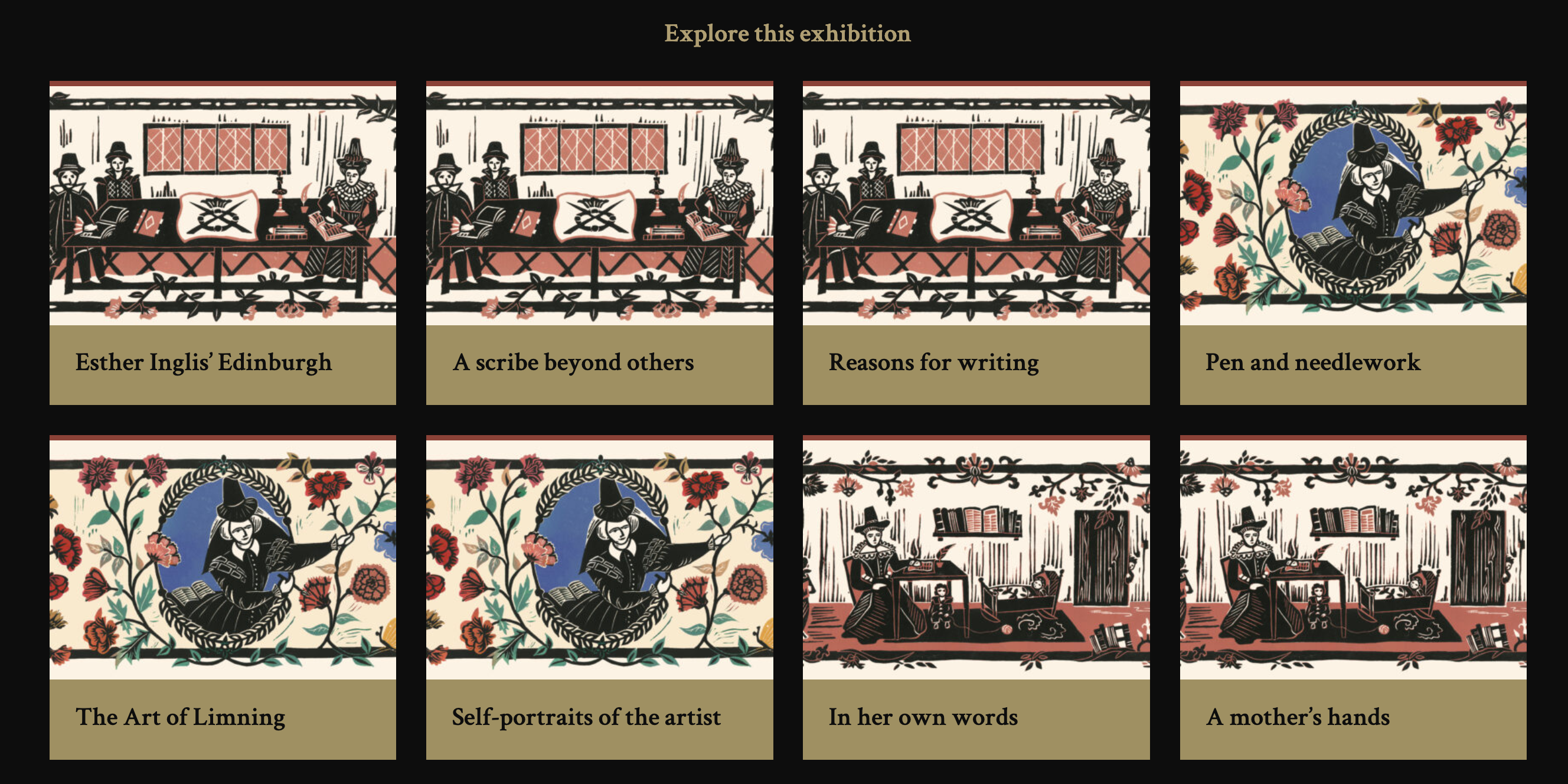
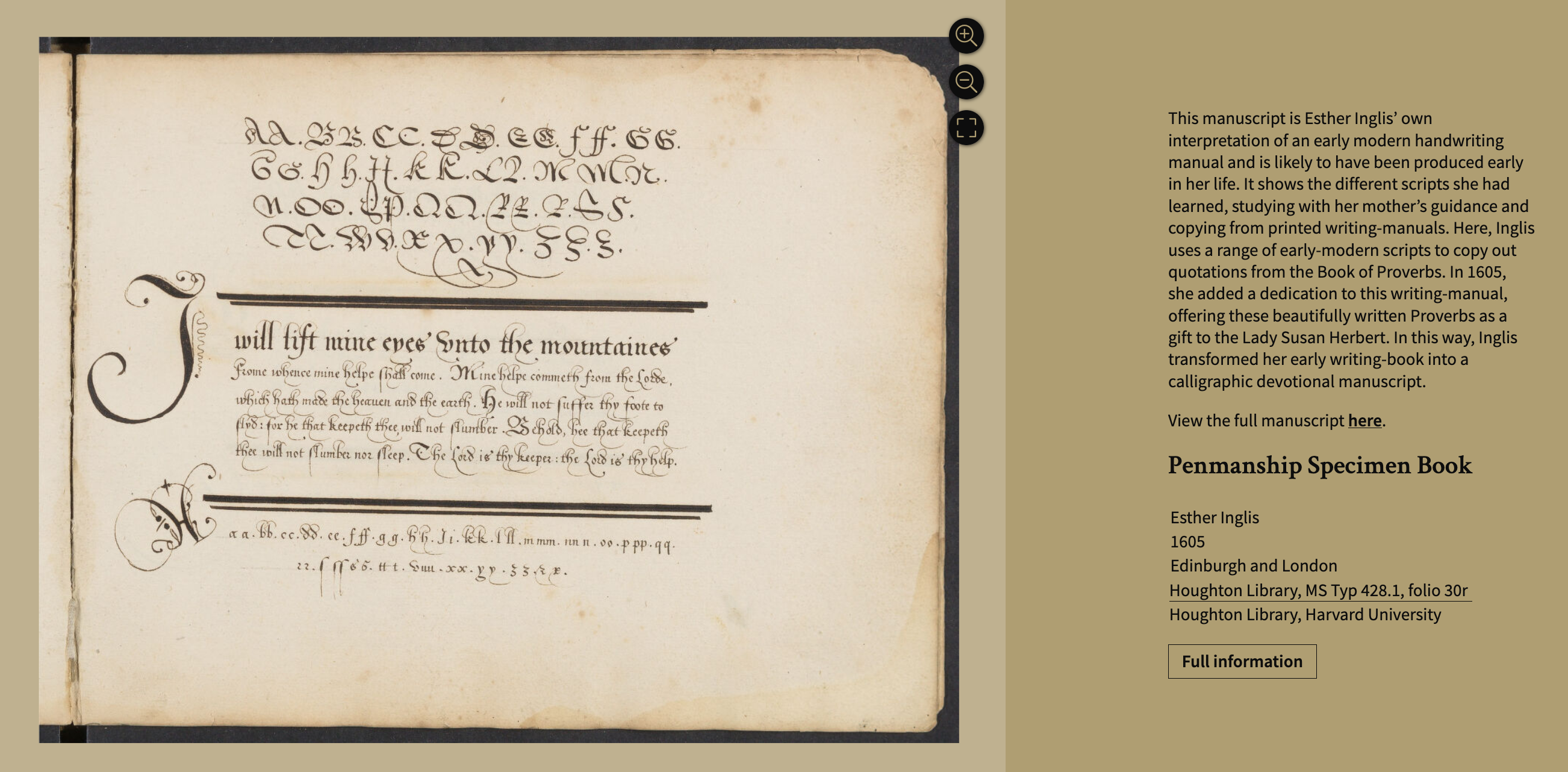
The exhibition has been titled “Rewriting the Script: the works and words of Esther Inglis” — and the different levels to this name are intentional. As a scribe, Esther Inglis’ work was to write and rewrite the many individual scripts which she learned from her mother and from the publications of contemporary writing masters. She worked in more scripts than anyone else from her time, man or woman, professional or pupil. But through her scribal activity, her artistry, the intricacy of her work and her involvement in wider social or literary circles, she also endlessly rewrote the script for an early-modern woman in Scotland or England — known within the Jacobean court and receiving a level of education unparalleled for a non-aristocratic woman.
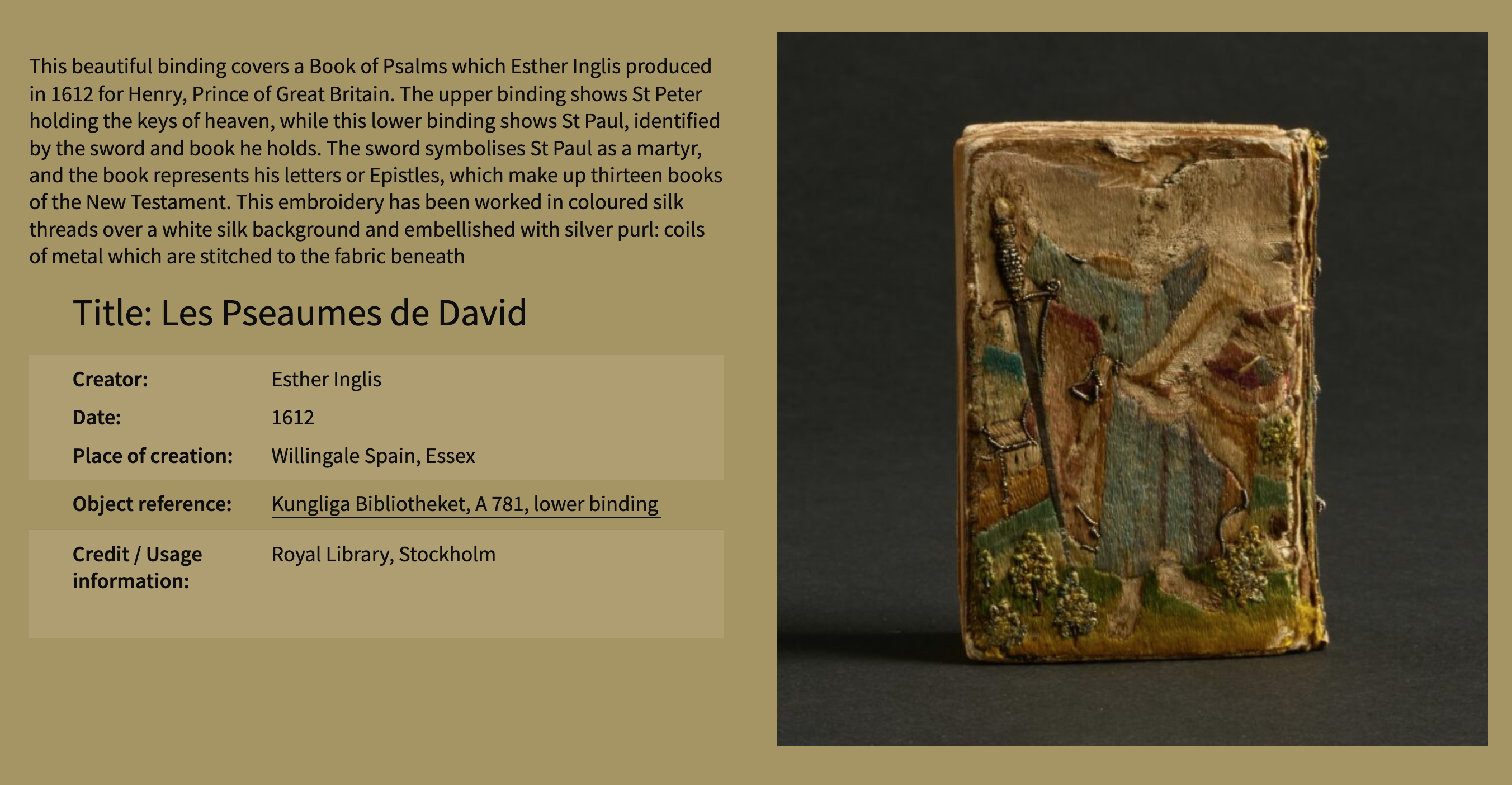
A further layer of “rewriting”, which formed part of the process of curating this exhibition, is the rewriting of how Esther Inglis is known to us today. “Rewriting the Script” emphasises that Esther Inglis was not just a calligrapher — she was a scribe, but she was also an artist with the pen and with the needle, she was an illuminator or limner, she was a portrait miniaturist, a literary author. And, woven into all these facets of her identity, she was a wife, a daughter of refugees, and a mother to eight children.
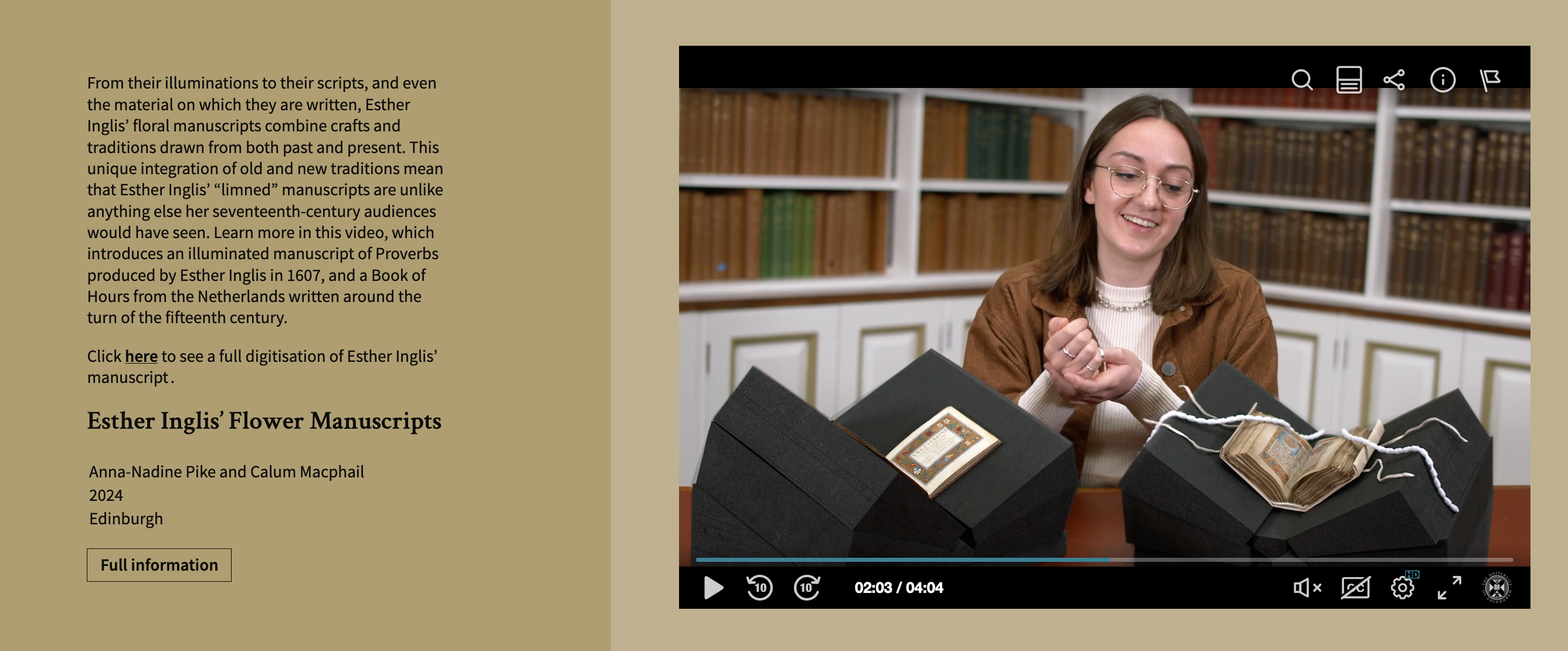
“Rewriting the Script” has been designed as an immersive and interactive online exhibition — alongside the curated images of Inglis’ surviving manuscripts, for example, the exhibition also includes many different audio clips. Listening to the integrated audio, a visitor can hear the ‘voices’ of Esther Inglis and her husband Bartilmo Kello reading from their own manuscripts — as well as longer interview-style pieces with modern scholars, and even the actor Gerda Stevenson reading her own poem, Nine Haiku for Esther Inglis. Adding to its interactivity, the exhibition also incorporates several videos filmed with the National Library of Scotland. These videos facilitate close-up viewing of Inglis’ books while also allowing viewers to deepen their understanding of particular manuscripts. In the example below, the video compares one of Esther Inglis’ manuscripts from 1607 to a Flemish medieval manuscript produced in the early 1500s which then circulated in Scotland, and it explores the connection between their artistic styles.
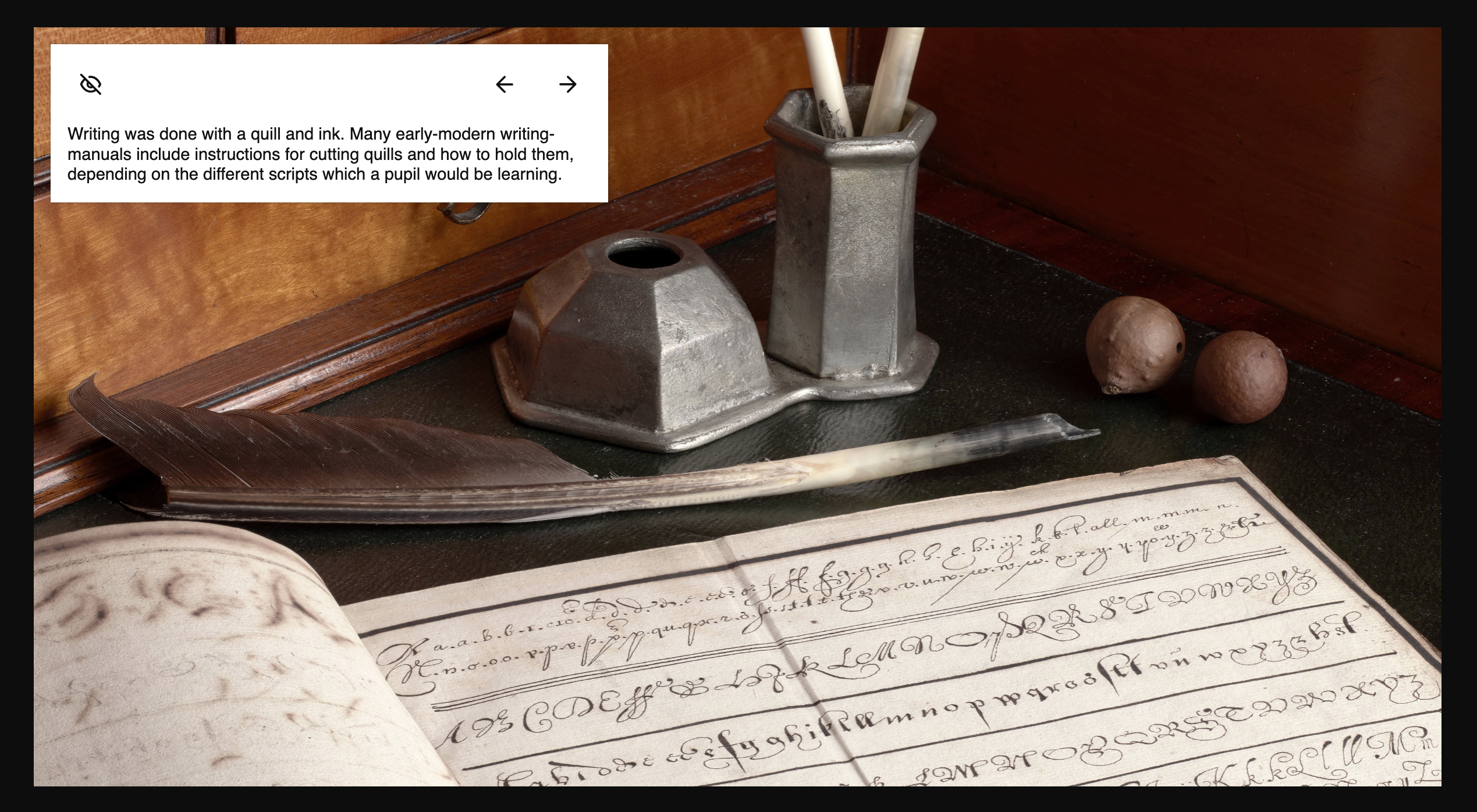
Another possibility offered by an online exhibition is also the potential for close looking – guiding a
viewer through different parts of a particular image. “Rewriting the Script” includes several interactive images which enable close-up encounters with the items displayed — from Esther Inglis’ own self-portraits to an immersive ‘early modern writing desk’. Scrolls through each page, the curation of images also moves between close-ups, magnification, and books held within the palm of the hand, and this is designed to immerse a viewer in the intricacy of Esther Inglis’ work, while still capturing the miniature nature of many of her books.
The final section of this exhibition considers the afterlives of Esther Inglis’ manuscripts — what has happened to these books in the 400 years since their first creation, from journeys to different libraries, to readers’ additions to their pages, to the beginnings of academic conversations around Inglis and her work. It is the hope of the “Esther Inglis 2024” project that this new online exhibition will allow these conversations to continue — while also moving beyond academic spaces, bringing Esther Inglis’ story and her manuscripts to wider audiences. “Rewriting the Script” has been designed as an engaging exhibition which is aimed at the general public, but grounded within the latest scholarly and archival research.
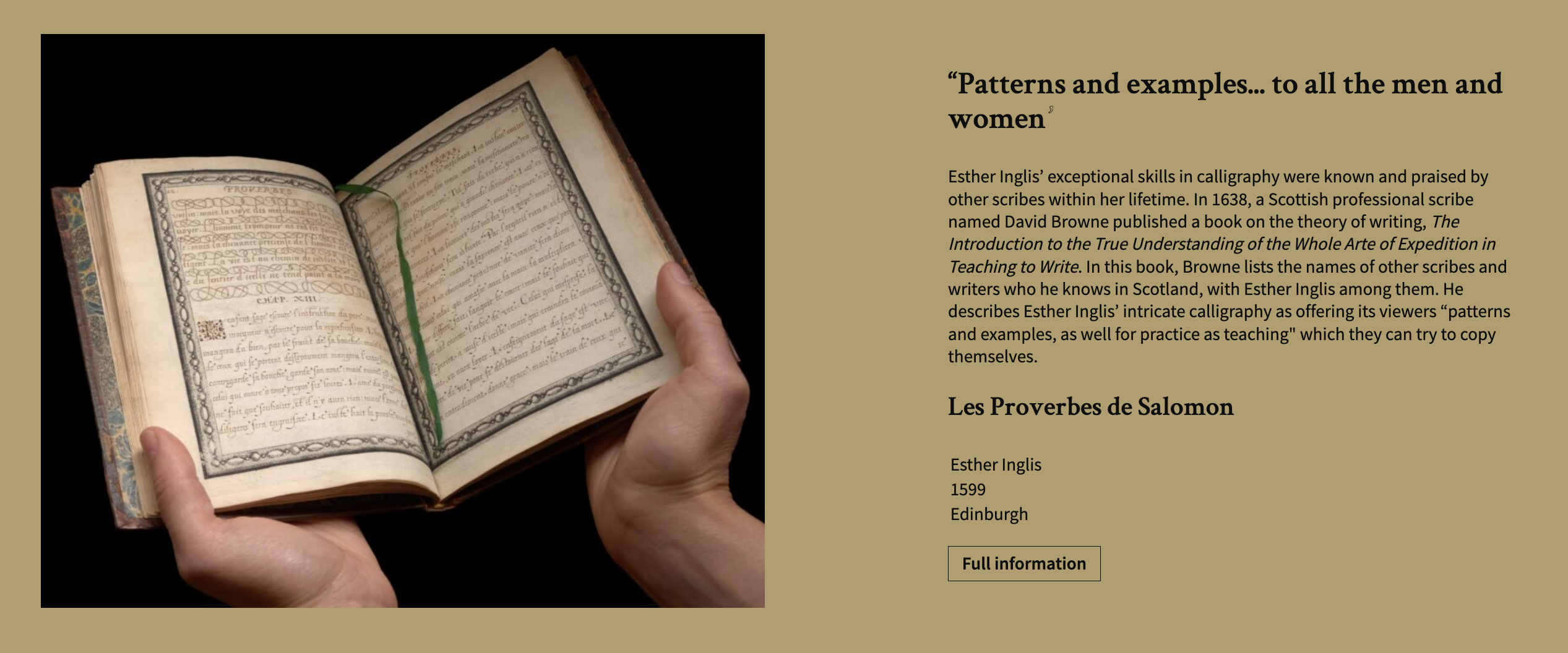
Visit the exhibition here.
We would welcome your feedback on “Rewriting the Script”! Comment your thoughts below, and we would be very glad to hear from you.
Library Research Support Shortlisted for Times Higher Education Award
This is a guest blog post written by Dominic Tate, Associate Director, Head of Library Research Support
We were delighted to learn that the Library Research Support Team, of which the Research Data Service is a part of, has been shortlisted for ‘Outstanding Library Team of the Year’ in the 2024 Times Higher Education (THE) Awards. These prestigious national awards are sometimes dubbed the “Oscars of higher education” and we understand that there were a record number of submissions this year.

This nomination reflects the pioneering work the team has done in the area of rights retention, open research and citizen science.
Members of the Library Research Support Team will be attending a black tie dinner and award ceremony in Birmingham on 28th November; competition is fierce and there are some excellent entries, so please keep your fingers crossed for us.
The Great Fire of Edinburgh, 1824
This year marks the bicentenary of one of the most destructive events in Edinburgh’s history, the ‘Great Fire’ of 15-21 November 1824. In this blog, Ash Mowat, a volunteer in the Civic Engagement Team, will explore a set of engravings that vividly depict the devastation caused by the fire. They are the work of the Edinburgh-based artist William Home Lizars (1788-1859), who published eight images of the ruins to raise funds for those left homeless by the fire. Edinburgh University Library’s copy of this set (shelfmark JZ 449) bears an inscription to ‘Henry McKenzie Esq.’, very probably the Edinburgh novelist Henry Mackenzie (1745-1831), author of The Man of Feeling.
-
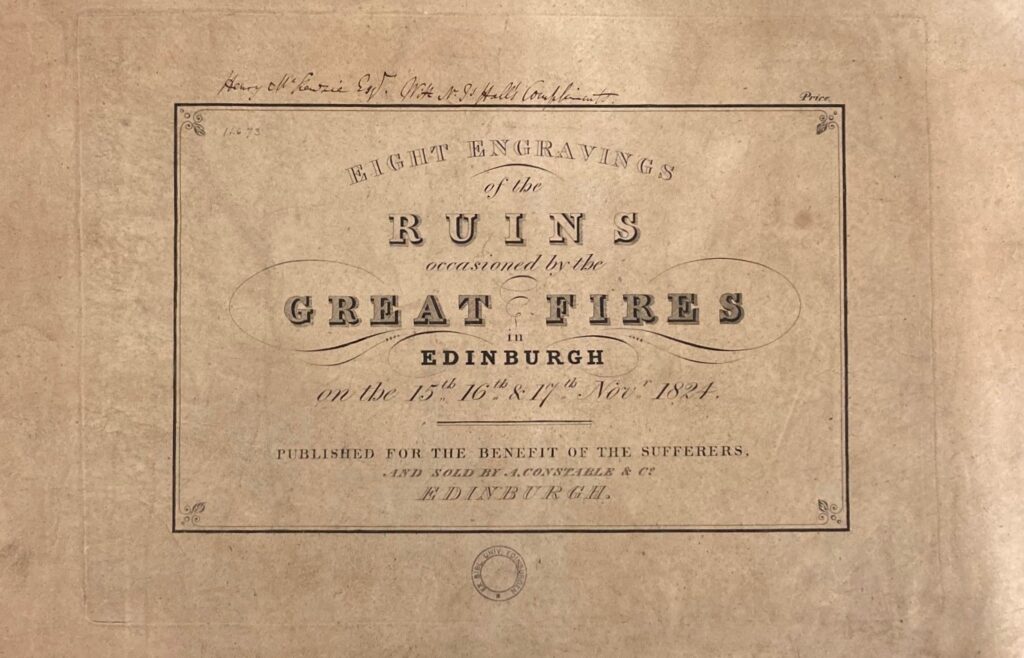
- Front cover of Lizars’ ‘Eight Engravings of the Ruins Occasioned by the Great Fires in Edinburgh’ (JZ 449)
The fire broke out on 15 November 1824 and raged for over five days before it was finally extinguished. It caused considerable damage with the destruction of entire tenement blocks and around 400 homes, together with the loss of printmakers, shops, and other businesses. Tragically, thirteen people lost their lives in the incident, although, given the scale of the fire, this may seem mercifully less than could have been the case. The cause of the fire was never identified, but it is not difficult to imagine how it might have occurred and why it was able to spread over such a large area and endure for so long a span of time. This was a densely populated zone with packed tenement buildings of up to seven storeys in height. All residences utilised open fires as their source of heat and for cooking, and the buildings themselves featured timber floorings and internal frames, enabling flames to flourish and spread.
William Home Lizars was an accomplished and celebrated painter, draughtsman, and engraver, who was involved in the establishment of the Royal Scottish Academy. His engravings consist of eight images taken between Wednesday 17 November and Saturday 20 November.
-
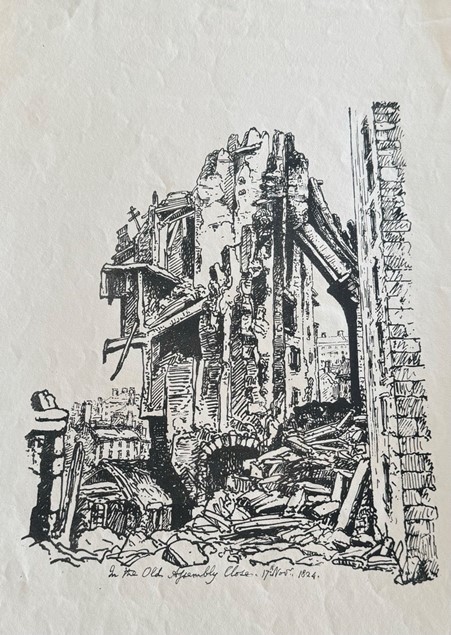
- ‘In the Old Assembly Close, 17th November 1824’ (JZ 449)
The above image shows the abject ruins on Old Assembly Close, where the fire first broke out, destroying four tenements and the Assembly Hall ballroom. It’s a brilliant composition in its concentrated focus on the collapsed debris with no background adornment or surrounding buildings. Instead, we face the exposed interiors and remains of the once impressive buildings, reduced to ruins and rubble. It is very highly detailed and has an almost organic quality to its textures and tones. It is a fine, poignant ode to the devastating impact of the fire that destroyed numerous homes, leaving hundreds of families homeless.
-
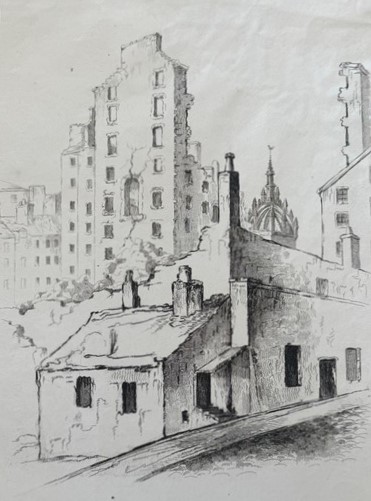
- ‘View from the Old Fish Market Close’ (JZ 449)
In the image above we have the view from Old Fishmarket Close, a narrow passageway running off the High Street, where four six-storey tenement buildings and one business, Neil and Co. printworks, were destroyed in the fire. Like Old Assembly Close, Old Fishmarket Close survives to this day but has been subject to new building developments in the intervening period.
It is a nicely composed piece, which shows the close rising towards the towering tenements of the High Street, with the spire of St Giles Cathedral just off-centre to the right. The engraving captures the aftermath of the fire revealing the scant remains of the frames of the tenements that were damaged beyond repair and would later have to be demolished and rebuilt. There is an interesting contrast between areas of finely rendered detail and the looser depiction of the ruined structures. The chiaroscuro fluctuations in the use of light and dark give the image a three-dimensional feel.
-
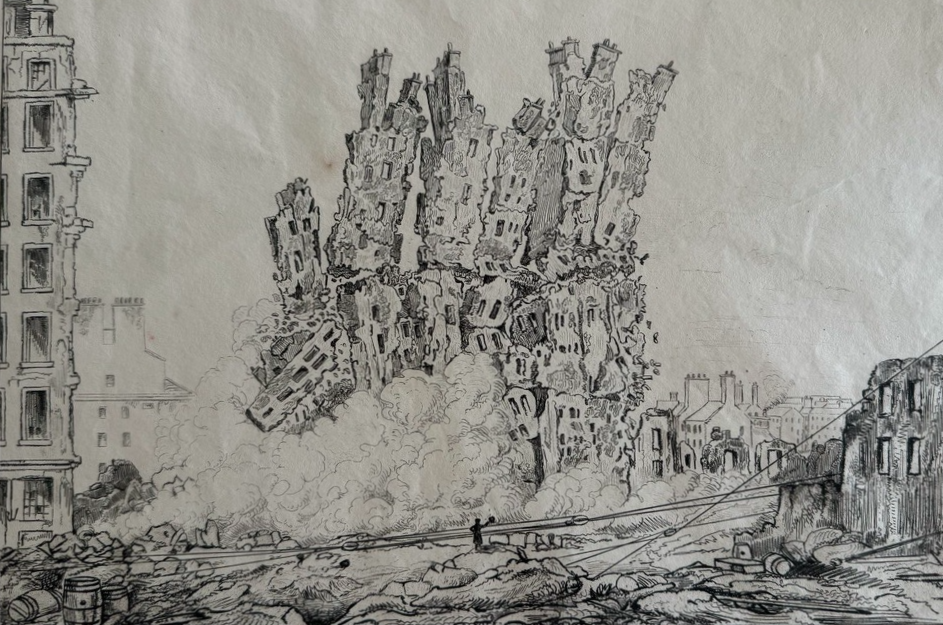
- ‘Appearance of the Ruins on the East Side of the Parliament Square the Instant After the Mines Were Sprung at Noon on Sat[urda]y 20th Nov. 1824’ (JZ 449)
The dramatic image above is taken on 20 November, one day before the fire was fully extinguished, and reveals the impact on the eastern side of Parliament Square when mines were detonated to bring down teetering, fire-ravaged tenements. Our eyes are drawn to the centre of the piece as the remains of the buildings begin to crumble to the ground. To give a highly effective impression of scale, we have a tiny single figure at the foot of the tenements, perhaps orchestrating the operation, as plumes of dust and debris bring both movement and energy to the image.
It would be interesting to know how well tolerated and accommodated an artist would have been amidst the efforts of the firefighters and others to stem the fire and make the area safe. Obviously, we are in a pre-photographic era here so artists would be the only means to capture the events, so presumably someone with the renown and skill of Lizars would have been an authorised and approved presence at the scene.
A curious coincidence with the timing of the fire was that just one month earlier Edinburgh had established the world’s first municipal fire brigade service, led by firefighter and Master of Engines James Braidwood (1800-1861). No blame for the fire damage was laid upon the newly founded service or upon Braidwood’s leadership. Rather, he was praised for his bravery and diligence in fighting and subduing the fire, and in utilising new skills and processes to do so. See the Museum of Scottish Fire Heritage’s Our Origin Story for more on the history of the Fire Service in Scotland.
I’d like to thank my supervisor Laura Beattie (University of Edinburgh Community Engagements Officer) for guidance and support, and to Paul Barnaby (Modern Literary Collections Curator) for suggesting the subject. Further thanks also to all the staff at the Centre for Research Heritage Collections for enabling access to view these items.
History of the Royal (Dick) School of Veterinary Studies
Today we are publishing an article by Ash Mowat, a volunteer in the Civic Engagement team, on the history of the Royal (Dick) School of Veterinary Studies. You can read a previous blog about the fascinating history of vivisection, as relating to material held in our archives, here.
In this blog we shall explore some items pertaining to the history of the Royal (Dick) Veterinary School in Edinburgh and of its founder William Dick,[1] held within the University of Edinburgh’s Heritage Collections.

In the image above we have a copy of an engraving depicting the location of William Dick’s birth as included in items celebrating the 150th anniversary of the foundation of the Edinburgh Veterinary School, and listed below are some key dates outlining the history.[2]
1793: William Dick was born in White House Close Edinburgh, the son of a blacksmith.
1823: William Dick opened his first veterinary School in makeshift accommodation with the financial assistance of the Directors of the Highland and Agricultural Society.
1833: Purpose made buildings were created for William Dick’s Veterinary School and Practice in Clyde Street Edinburgh.
1844: Royal College of Veterinary Surgeons was formed. Dick’s College affiliated to, and the students examined, by this institution.
1866: William Dick died and bequeathed his school to the Town Council of Edinburgh.
1906: The School was renamed as the Royal (Dick) Veterinary College, a change that his sister Mary campaigned to precipitate in recognition of his work in establishing and developing it.
1911: Edinburgh University first created a degree level qualification in Veterinary medicine.
1914: The new building at Summerhall was built with the transfer and relocation of the School from Clyde Steet to its new premises completed by 1916.
1973: Celebration of the 150th anniversary of the school’s foundation.
The next set of items from the collection that I viewed was a bound volume of newspaper clippings dating from 1923 to 1929. [3]

In an article from the Scottish Country Life publication of November 1923, there was a feature to celebrate the then 100th anniversary of the foundation of the school. It cites how its founder William Dick came from a humble background into a family affected by poverty and deprivation, and that therefore the opportunities available to him to pursue an academic career at the time were scant to say the least. Remarkably, however, William Dick managed to overcome such barriers to first study and then devote his life to teaching and practicing Veterinary Medicine, donating considerable sums of his own money to the creation of the Veterinary School, and upon his death bequeathing his entire estate to its continuation and development.
The article tells us that, as part of the anniversary celebrations, a fundraising project was launched in his honour. “The scheme is one that should appeal to all lovers of animals, for the more knowledge is accumulated, the greater will be the possibility of diminishing animal suffering. Nowadays, not only does the science concern itself with the treatment of animal ailments, it also touches very closely the health and well-being of the people.”
In another piece from the North British Agriculturalist of 22nd November 1923, we learn a little more about Dick’s early interest and activities in the field of Veterinary medicine. From 1893 a Professor McCall observed that “Mr William Dick was born in the court end of the Canongate (Edinburgh) in 1793. His father was a blacksmith and farrier and in his early life he followed in his father’s vocation. Happening to attend a couple of popular lectures delivered in connection with the Edinburgh University, his attention was in that way directed to the importance and value of veterinary science, and shortly after that he went to the Royal Veterinary College (London) where he took his diploma in 1818.”
It is remarkable how a seemingly random encounter with the science first sparked an interest in William Dick that was to become his life’s passion, and evidence of the huge importance then and now in universities also opening up some lectures to those not enrolled as students, in widening the access opportunities to people who might otherwise have had their potential overlooked.
In the Glasgow Herald of 30th November 1923, there is an interesting article covering a speech made by Field Marshall Earl Haig[4] made at the Music Hall Edinburgh on the role of animals in veterinary medicine during the first World War. He recounts how the expeditionary forces started with around 53,000 horses rising to and astonishing number of 475,000. He observes that it was as a result of the many advances in the understanding and treatment of animal diseases that this was made possible, and further cites how such scientific endeavours help eradicate foot and mouth disease amongst the military’s horses, and to prevent it from being transferred over to affect livestock back in Britain.

(From the North British Agriculturist 0f 20th October 1925 and image celebrating the opening of the Summerhall location for the Royal (Dick) Veterinary College, and an accompanying article citing to total cost of the building as £75,000 (equivalent to almost six million pounds today).
The Daily Express from 20th October 1929 had a short article addressing the pressure on the Dick Vet to admit women as students and a somewhat reluctant response from the college. “Greater numbers of men and women are entering the profession. The number of students is increasing here as it is in other centres, and extension will probably be needed. Nothing can be done without the sanction of the Royal College of Surgeons who control the (Dick Vet) College and they will probably be asked to consider the question”. Women were first admitted as undergraduates at the University of Edinburgh in 1892 with the first women graduating in 1893 but only in certain subjects.[5] Whilst some other institutions permitted women to study veterinary medicine earlier than others, the first women, known as the “Dick Vet Four”, completed the five-year veterinary course at Dick Vet and qualified in 1948. They were Ann C. Preston, Marjorie E. Millar, Elizabeth A. Copland, and Elizabeth A.Y. Caird.
In the final set of items that I viewed were papers relating to an exhibition of the 150th anniversary of the foundation of the Dick Vet. [6]
In ‘The Life and Works of William Dick’ by J.E. Phillips,[7] this affectionate and informative essay gives further insight into the life and achievements of William Dick. We learn that it was after hearing a lecture by Doctor Barclay that William Dick first encountered the field of science that was to transform his life and become his passion. Dr Barclay was very impressed by William Dick and when he heard other students refer to him disparagingly as a common blacksmith, was reported to have commented “Well, well, all I can say is that whether he be blacksmith or whitesmith, he is the cleverest chap amongst you.”[8]
Dick moved to London in the autumn of 1817 to undertake his study at the Veterinary School there, and astonishingly achieved his diploma in just three months. He then returned to Edinburgh as he was not enamoured of life in London.
On his return he began to provide lectures and teaching to students but initially had just four students, and these were later depleted to just the one. Nevertheless, he did not become dismayed but instead persisted and persevered in his work and by 1823 he had been recognised and enabled to open his first full Veterinary School and practice. Ten years later he personally invested £2500 of his own funds to substantially upgrade the premises at Clyde Street,[9] to include a lecture hall, dissecting room and museum.
Throughout his career he undertook the training of over 800 students who successfully went on to obtain their diplomas, and also taught some 1000 more who attended his lectures but were unable to enrol as students formally or otherwise to complete their diploma. In addition to those academic students, he devoted much time in instructing those working in agriculture with care needs for livestock, in order to teach them how best to look after their animals and to prevent and identify disease.
He was very close to his elder sister Mary who survived him by over twenty years until her death in 1883. She enabled the College to be renamed in her brothers honour as the Royal (Dick) Vet, and was instrumental and a significant leader in the management and running of the Veterinary College since its inception in 1823, and continued to do so throughout her life.
It was truly fascinating and a privilege to view these historical items and I would encourage anyone with an interest to consider exploring these further. I should like to thank my supervisor Laura Beattie (Community Engagement Officer University of Edinburgh) and Fiona Menzies (Project Archivist One Health University of Edinburgh) for their assistance and support. I should also like to thank all the University of Edinburgh staff at the Centre for Research Collections for their kindness, expertise and in enabling me to view these treasures.
[1] https://www.ed.ac.uk/vet/about/history/william-dick
[2] https://archives.collections.ed.ac.uk/repositories/2/archival_objects/217989
[3] https://archives.collections.ed.ac.uk/repositories/2/archival_objects/213444
[4] https://en.wikipedia.org/wiki/Douglas_Haig,_1st_Earl_Haig
[5] https://collections.ed.ac.uk/alumni/women
[6] https://archives.collections.ed.ac.uk/repositories/2/archival_objects/217989
[7] J.E. Phillips, ‘The Life and Work of William Dick,’ British Veterinary Journal, 149.4 (1993), 321 – 330.
[8] Ibid, 323.
DataShare spotlight: History, Classics and Archaeology in DataShare
To celebrate World Digital Preservation Day 2024, this is the first in a series of occasional blog posts which seek to shine a light on some interesting examples of datasets uploaded to DataShare, the University of Edinburgh’s open access data repository.
Research data that is deposited in DataShare comes from across the Colleges and Schools and can relate to cutting-edge scientific research or exploration of under-studied social worlds, however, we also receive valuable historical research data too!
A prime example of this is an item submitted by Professor Charles West, who is based in the School of History, Classics and Archaeology, titled “Autun List of Local Churches, c. 1000”. As neatly described in the title, it contains a list of 144 churches in the diocese of Autun, France, which was made around the year 1000. An example of one of the churches, the Church of Saint Martin in Cordesse, can be seen in the photo below.

According to the item’s description: “The dataset provides the names in the list, the modern place-names, the departement these places are located in, their order in the original list, whether each church is attested in earlier documentation or not, and if so, approximately when.”
The item took on a new life when it was shared on Twitter (now known as X), where a user, William J.B. Mattingly, took the dataset and added latitudinal and longitudinal data to create a mapped visualisation shown in a video. This reuse is documented in the Altmetrics of the item, which details how a DataShare item has been shared or cited. It is also a neat demonstration of how data shared on DataShare can be reused in useful and creative ways!
The DataShare item can be found here: https://doi.org/10.7488/ds/7774
The Tweet with the data visualisation can be found here: https://x.com/wjb_mattingly/status/1813587749905072497
Keith Munro,
Research Data Support Assistant
Exploring Historic Bagpipes: A Six-Month Journey
Zexuan is a PhD candidate at Queen’s University, and recently completed a six-month placement with the musical instrument collection of the University of Edinburgh. In this post, Zexuan shares the highlights of his work, which focused on the study and preservation of historic bagpipes.
New E-resources Trials for November
Thanks to requests from staff and students in HCA, the Library has trial access to 4 digital primary source collections in November. From an Antiguan sugar plantation, politics and war in the 20th century, to a newly released Scottish newspaper archive for the second half of the 20th century.
All 4 databases can be accessed from our E-resources Trials page.
History Commons: Weimar and Nazi Germany

On trial: The Scotsman Archive, 1951-2002
Thanks to a request from staff in History, the Library currently has trial access to the newly launched extension years for The Scotsman Historical Archive from ProQuest Historical Newspapers. While the Library already has access to The Scotsman Archive covering the years 1817-1950, the new extension module increases coverage up to 2002.
You can access ProQuest Historical Newspapers: The Scotsman Archive (1817-2002) on the E-resources Trials page. Access is available until 4 December 2024. Read More
Virtual Geology
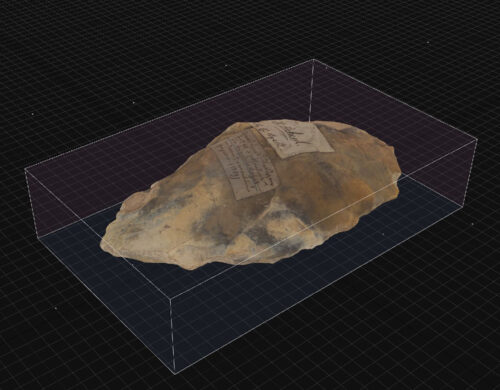
It has been a long–held desire for the CHDS to offer a 3D Digitisation service, and although not 100% there yet, we are several steps closer. Back in 2021, Connor Wimblett did an internship with us looking into the feasibility of offering 3D for the Heritage Collections. You can find out more by reading his blog here.
Collections
 Hill and Adamson Collection: an insight into Edinburgh’s past
My name is Phoebe Kirkland, I am an MSc East Asian Studies student, and for...
Cataloguing the private papers of Archibald Hunter Campbell: A Journey Through Correspondence
My name is Pauline Vincent, I am a student in my last year of a...
Hill and Adamson Collection: an insight into Edinburgh’s past
My name is Phoebe Kirkland, I am an MSc East Asian Studies student, and for...
Cataloguing the private papers of Archibald Hunter Campbell: A Journey Through Correspondence
My name is Pauline Vincent, I am a student in my last year of a...
Projects
Cataloguing the private papers of Archibald Hunter Campbell: A Journey Through Correspondence
My name is Pauline Vincent, I am a student in my last year of a...
Archival Provenance Research Project: Lishan’s Experience
Presentation My name is Lishan Zou, I am a fourth year History and Politics student....