Home University of Edinburgh Library Essentials
June 17, 2026
On trial: State Papers: Eighteenth Century (Part II)
Thanks to a request from a student in HCA and following a previous trial the Library now has trial access to Part II of State Papers Online: Eighteenth Century, 1714-1782 from Gale. Part II covers State Papers Foreign: Low Countries and Germany.
You can access State Papers: Eighteenth Century (Part II) via the E-resources trials page. Access is direct on-campus but if working off-campus you must use VPN.
Trial access ends 30th May 2019. Read More
New! More Springer Protocols added to DiscoverEd

Used primarily in the life sciences, protocols provide individual sets of instructions to allow scientists to recreate experiments in their own laboratories. These documents provide written procedural methods in the design and implementation of experiments that describe the safety, bias, procedures, equipment, statistical methods, reporting, and troubleshooting standards to be used in order to successfully conduct the experiment.
We have now purchased copyright year 2019. These will be added to DiscoverEd for the remainder of the year. A title list is available from https://experiments.springernature.com/download-source-titles-list.
Further info
Springer Protocols can also be accessed at http://www.ezproxy.is.ed.ac.uk/login?url=https://experiments.springernature.com which will allow you to cross-search our other subscriptions from SpringerNature (Nature Protocols, Nature Methods) as well as the open access repository Protocol Exchange.
On trial: Financial Times Historical Archive
Thanks to a request from a student in HCA the Library currently has trial access to the Financial Times Historical Archives, 1888-2016 from Gale. This is the complete run of the London edition of this internationally known daily paper, from its first issue through 2016.

You can access the Financial Times Historical Archive, 1888-2016 via the E-resources trials page.
Access is direct on-campus but if working off-campus you must use VPN.
Trial access ends 3rd June 2019. Read More
New training: Assessing Data Quality and Disclosure Risk in Numeric Data
The Research Data Service, in collaboration with the UK Data Service, are running workshops on the theme ‘Assessing Data Quality and Disclosure Risk in Numeric Data’. These hands-on sessions introduce the key elements of data quality and disclosure risk, and include practical demonstrations of two tools to evaluate the quality (QAMyData) and disclosure risk (sdcMicro) of numeric research data.
Workshops will run across two days, with sessions on different days for researchers interested in social survey data (10th June) and health data (11th June).
Session 1: Assessing Data Quality in Numeric Data
This workshop will introduce the key elements of data quality assessment, including file checks, and undertaking data and metadata checks. Attendees will gain hands-on experience using QAMyData, a purpose-built configurable tool to quickly and automatically detect some of the most common problems in survey and other numeric data (SPSS, STATA, SAS & csv files).
Session 2: Assessing Disclosure Risk in Numeric Data
This workshop will provide an introduction to statistical disclosure control (SDC), covering: types of Identifiers; de-identification and anonymization; types of disclosure; SDC approaches; k-anonymity and l-diversity. The workshop introduces sdcMicro, a practical R package for measuring disclosure risk in numeric data. The session will give attendees hands-on experience using sdcMicro to assess disclosure risk and apply SDC methods to anonymize numeric data, while evaluating the balance between disclosure risk and data loss.
These sessions are available to research staff and students and can be booked using the links below:
Assessing Data Quality in Numeric Data (Social Survey Data) – 10th June 0930-1200, Lister Learning and Teaching Centre, Room 1.16 (Central Area) https://www.events.ed.ac.uk/index.cfm?event=book&scheduleID=34939
Assessing Disclosure Risk in Numeric Data (Social Survey Data) – 10th June 1330-1700, Lister Learning and Teaching Centre, Room 1.16 (Central Area) https://www.events.ed.ac.uk/index.cfm?event=book&scheduleID=34941
Assessing Data Quality in Numeric Data (Health Data) – 11th June 0930-1230, Microlab 1, Chancellor’s Building (Little France) https://www.events.ed.ac.uk/index.cfm?event=book&scheduleID=34940
Assessing Disclosure Risk in Numeric Data (Health Data) – 11th June 1300-1700, Microlab 1, Chancellor’s Building (Little France) https://www.events.ed.ac.uk/index.cfm?event=book&scheduleID=34942
Bob Sanders
Research Data Support
Library & University Collections
China Families – New Genealogy Website by Bristol University
This is an edited re-blog of a newsletter from the Scotland-China Association.
Were your ancestors out in China? If so, track them with China Families:
 China Families is directed by Robert Bickers, Professor of History at the University of Bristol. The database platform allows you to search across 60,000 names of men and women who lived, worked or died in China, between the 1850s and 1940s. The information is drawn from ten different sources, and you can search each one of these individually, but you can also search across all of them. There are many Chinese names here, as well as the names of foreign residents.
In the century before 1950, tens of thousands of foreign nationals lived and worked in China. They could be found in large communities in major coastal cities like Shanghai or Tianjin, as well as in tiny countryside missionary compounds, or isolated Customs stations deep in China’s interior. Often thought to be exotic and obscure, these communities created newspapers, and directories, and their lives and activities were widely recorded. But finding out about ancestors who spent time in China can be difficult, for the records are scattered, and even old cemeteries were destroyed in the 1960s. Therefore, China Families helps uncover a hidden past.
Its companion site Historial Photographs of China makes available over 20,000 photographs of the period, many of them supplied by China families.
On trial: selection of U.S. magazine archives
*The Library has now purchased access to The New Republic Magazine Archive. See New to the Library: The New Republic Archive*
Thanks to a request from staff in HCA the Library currently has trial access to three magazine archives from EBSCO – The Nation, National Review and The New Republic – between them covering the 19th, 20th and 21st century.

You can access the three archives via the E-resources trials page.
Access is available both on and off-campus.
Trial access ends 31st May 2019.
The Nation Archive
The Nation Archive makes it possible for researchers to access 14 decades of America’s best alternative journalism in ways never before possible. The archive contains thousands of historic articles, editorials, letters, reviews, poems, and puzzles dating back to the magazine’s first issue from July 6, 1865. Read More
All Change – Body Language project extended until July 2020
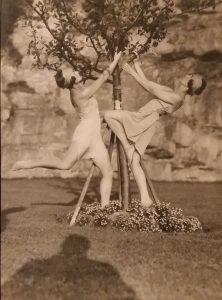
Margaret Morris dancers posing with tree
We are very pleased to announce that a new project archivist, Elaine MacGillivray, has agreed to take on responsibility for our collaborative Wellcome Research Resource-funded archives project ‘Body Language: movement, dance and physical education in Scotland, 1890-1990’. Elaine currently manages another Wellcome Research Resource-funded ‘Evergreen: Patrick Geddes and the Environment in Equilibrium’. With immediate effect, Elaine will split her time 50/50 between the two projects, which means that she will (usually) work Tues-Wed on our Body Language project and Thurs-Fri on the Evergreen Project. This means that the Body Language project will now extend to July 2020.
The extended project period provides a wonderful opportunity to continue the cataloguing work, explore and highlight the collections further and to open up research opportunities using the collections.
Elaine’s predecessor, Clare Button, has successfully completed a significant amount of work on the project. We are very grateful for the huge contribution that Clare made to the project and wish her all the very best in her new post as archivist at the London School of Medicine and Dentistry, at Queen Mary University, London.
“Clare has undertaken a tremendous amount of work on the project to date and I very much hope that I can fulfil her ambitions for the project as I take her work forward. I am also very excited to explore the commonalities between the two projects. Firstly in terms of the ideas relating to movement, health, art and culture, but also in relation to the people found in the collections material. I know Margaret Morris visited Patrick Geddes’ Château d’Assas, near Montpellier, at least once, and that they were both connected with Charles Rennie Mackintosh and Margaret Macdonald Mackintosh.” Elaine MacGillivray, project archivist.
Watch this space for the next update!
Patrick Geddes Archives project extended until March 2020
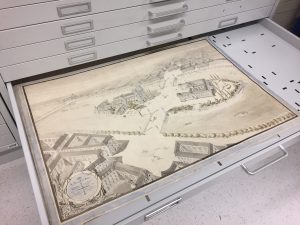
Coll-1167/A/6/8: Paris: bird’s eye view from the north of the Isle de la Cite
With immediate effect our project archivist, Elaine MacGillivray, will be looking after two collaborative Wellcome Research Resource-funded archive projects. Elaine will continue to work on our own ‘Evergreen: Patrick Geddes and the Environment in Equilibrium’ project, and has taken on responsibility for another fascinating archives project ‘Body Language: movement, dance and physical education in Scotland, 1890-1990′. Elaine will be splitting her time 50/50 between the two projects which will see her working (usually) Tues-Wed on the Evergreen project and Thurs-Fri on the Body Language project. This means that our Evergreen project will now extend until March 2020.
The extended time affords an opportunity to create and enhance even more catalogue descriptions, and to engage with more volunteers, interns and student placements. We will also be able to undertake public engagement activity up until March 2020. We are very pleased that this extended window will allow us more time to shine a spotlight on Patrick Geddes and his ideas, and to share with you some of the collection highlights uncovered during the project.
Like the recently re-discovered beautiful pencil and wash drawing shown above. It shows a ‘Bird’s Eye View of Paris from the north of the Isle de la Cite’. The eagle-eyed among you may notice Notre Dame Cathedral minus its steeple. This particular item is undated and we have yet to investigate the possible author. If any of you can shed any light as to the origin and date of this item please do get in touch. We would be delighted to hear from you.
The Westminster Confession
On Wednesday 8th May 2019, The Church of Scotland is hosting a conference, organised by the Theological Forum. The conference, Westminster, Confessions and the Church, will run at New College, Edinburgh. Speakers from Scotland and elsewhere will explore different aspects of the theology and status of the Westminster Confession.

The Humble Advice of the Assembly of Divines… (New College Library, Special Collections MH. 319)
Background
The Westminster Confession of Faith is one part of the Westminster Standards drawn up between 1643-1649 by the Westminster Assembly which consisted of over 100 participants from theological and parliamentary backgrounds, brought together to restructure the Church of England. Several Scots attended the Assembly and the Church of Scotland adopted the Assembly’s recommendations, including the Westminster Confession which, together with the Larger and Shorter Catechisms, became the standards of doctrine for many Presbyterian churches around the world.

An Explication of the Article of the Confession of Faith (New College Library, Special Collections MSS WES 3.2) – temporarily unavailable for consultation due to conservation work.
From its inception, the Westminster Confession has attracted criticism, not least because, by its nature, it has to rely on man’s interpretation of the scripture and that will always be open to question. Nevertheless, its longevity bears witness to the exceptional effort made by, and the effectiveness of, those who gathered in Westminster in the mid-17th century to offer their very human advice regarding ‘a confession of faith: with the quotations and texts of scripture annexed’.

Confession of Faith 1690 with signatures (New College Library, Special Collections MSS WES 3.1)
From 1st-31st May, an exhibition related to this conference will run in New College Library.
If you are interested in seeing specific copies of related Special Collection items which are not included in the displays, please contact staff at the Helpdesk.
Bibliography
https://en.wikipedia.org/wiki/Westminster_Assembly
https://en.wikipedia.org/wiki/Westminster_Confession_of_Faith
https://en.wikipedia.org/wiki/Westminster_Standards
An explication of the Article of the Confession of Faith of the Church of Scotland chapter 2 3 & 4th, namely that infidelity or difference in religion doth not make void the Magistrat’s just and legal authority &c. (New College Library, Special Collections MSS WES 3.2)
The Confession of Faith agreed upon by the Assembly of Divines at Westminster, with the assistance of Commissioners from the Church of Scotland – approved by the General Assembly 1647, and ratified by the Parliament of Scotland 1690. With the formula for the subscription of ruling elders. (New College Library, Special Collections MSS WES 3.1)
The Humble Advice of the Assembly of Divines, now by authority of Parliament Sitting at Westminster, concerning I. A Confession of Faith: II. A larger Chatechism. III. A shorter Chatechism. Presented by them lately to both Houses of Parliament. Westminster Assembly (1643-1652) Edinburgh : Printed at London and reprinted at Edenbrough ; MDCXLVIII [1648. (New College Library, Special Collections MH. 319)
Gina Headden, IS Helpdesk Assistant, New College Library
Trial Access to SAGE Research Methods – Additional Modules

Sage Research Methods – content from SAGE publisher (some unique to SRM) on the steps involved in a research project. Full range of qualitative, quantitative, and mixed methods for the social and behavioural sciences, as well as many methods commonly used in the hard sciences.
Topics: Key concepts in research, Philosophy of research, Research ethics, Planning research, Research design, Data collection, Data quality and data management, Qualitative data analysis, Quantitative data analysis, Writing and disseminating research.
This trial gives access to the following additional modules:
Sage Research Methods Cases Part 2
SAGE Research Methods Datasets 2
Research Methods Video: Data Science, Big Data Analytics, & Digital Methods
Title lists for the new modules can be found at – http://methods.sagepub.com/librarian#TitleLists
The trial lasts until 20th June with the individual content added to DiscoverEd as well as listed on our E-Resources Trials webpage where you can view other e-resources currently on trial as well as complete a trial feedback form.
A user guide for this resource can be found at http://sagepub.libguides.com/research-methods
Collections
 Hill and Adamson Collection: an insight into Edinburgh’s past
My name is Phoebe Kirkland, I am an MSc East Asian Studies student, and for...
Cataloguing the private papers of Archibald Hunter Campbell: A Journey Through Correspondence
My name is Pauline Vincent, I am a student in my last year of a...
Hill and Adamson Collection: an insight into Edinburgh’s past
My name is Phoebe Kirkland, I am an MSc East Asian Studies student, and for...
Cataloguing the private papers of Archibald Hunter Campbell: A Journey Through Correspondence
My name is Pauline Vincent, I am a student in my last year of a...
Projects
Cataloguing the private papers of Archibald Hunter Campbell: A Journey Through Correspondence
My name is Pauline Vincent, I am a student in my last year of a...
Archival Provenance Research Project: Lishan’s Experience
Presentation My name is Lishan Zou, I am a fourth year History and Politics student....