Home University of Edinburgh Library Essentials
September 28, 2026
Scientific Analysis of Heritage Collections using XRF – Employ.ed Internship 2019
This week’s blog post comes from Cameron Perumal who recently began a 10-week Employ.ed internship in the Conservation Studio at the CRC…
Two weeks into my Employ.ed internship, and I have already learned so much about conservation, and X-ray Fluorescence (XRF) spectrometry! I am currently an undergraduate Astrophysics student, and my internship entails me working with Emily Hick, the Special Collections Conservator, to research ways in which XRF can help us understand more about the collections. I’ll also be doing outreach to increase awareness on XRF and how it can be used in conservation to improve the condition and understanding of the collections held by the University of Edinburgh.
By the end of my first week, I had started my radiation training, seen the XRF in action being used by another intern, Despoina, to analyse pigments of a painting on the soundboard of a harpsichord, and been able to see the various (frankly, quite beautiful) collections stored by the University.

Intern Despoina using the new XRF machine to analyse the pigments used on the soundboard paintings of harpsichords made by the Ruckers family
Library & University Collections Journal Club 2019-20
 Thank you to everyone who joined us for our Library & University Collections Journal Club meetings in 2019. We’ve now planned a further programme of dates for the 2019/20 academic year.
Come and join us to talk about a recently published article each month from the field of Library & Information Science. We’re aiming to keep informed about practitioner research, and reflect on how theory relates to our practice. This is a great way for staff to develop their knowledge of the wider professional context for their continuing professional development.
This is an informal session open to staff from across Information Services Group as well as interns, volunteers and students on library & information related courses. We meet on the first Wednesday of each month, 12-1pm, alternately at Argyle House and the Digital Scholarship Centre, Main Library. You can see the articles proposed for discussion on our Journal Club Resource List, and you can suggest articles to discuss each month. Please come ready with your questions, comments and complaints about the article of the month.
| Dates | Location | |
| 04 September 2019 |
|
|
| 02 October 2019 | Digital Scholarship Centre, Main Library | |
| 06 November 2019 | Argyle House Meeting Room 8 | |
| 04 December 2019 | Digital Scholarship Centre, Main Library | |
| 08 January 2020 | Argyle House Meeting Room 8 | |
| 05 February 2020 | Digital Scholarship Centre, Main Library | |
| 04 March 2020 | Argyle House Meeting Room 8 | |
| 01 April 2020 | Digital Scholarship Centre, Main Library | |
| 06 May 2020 | Argyle House Meeting Room 8 | |
| 03 June 2020 | Digital Scholarship Centre, Main Library |
Baltic, Books and Solidarity: Gdańsk University of Technology (GUT) International Staff Week

Gdańsk University of Technology
I was delighted to be able to participate in the 4th International Staff Week at the Biblioteki Politechniki Gdańskiej recently. I work as the Senior Photographer for Edinburgh University’s Library and University Collections, so when I saw that the programme included a visit to the Pomeranian Digital Library it looked like a great opportunity. Additionally, this was the home institution of one of the delegates on our own Knowledge Exchange Week in 2018, allowing further development of previous Erasmus links.
Edinburgh Research Archive Statistics: May 2019

Edinburgh Research Explorer Statistics: May 2019
‘This Single Song of Two’: Centenary of the Marriage of Edwin and Willa Muir
7 June 2019 marks the centenary of the marriage of Edwin and Willa Muir, one of Scottish literature’s great creative partnerships. Acclaimed in their own right as poet and novelist respectively, they worked together as a translating team to bring the novels and stories of Franz Kafka to an English-speaking audience.
Edinburgh University holds a number of remarkable documents, bearing witness to their long and exceptionally close union.
Read More
Normandy landings: through our digital primary sources
On this day, 6 June, 75 years ago the Normandy landings took place. This was part of a major combined naval, air and land assault on German-occupied France by Allied forces, codenamed Operation ‘Overlord’. The D-Day landings saw around 150,000 Allied troops land on French soil but it was just the start of a much longer operation to liberate France. In this week’s blog post I have pulled together just a small selection of our digital library resources that will help you explore the Normandy landings, the events leading up to it and the aftermath. And you can use many of these to find out more about the many other events happening around this time that contributed to the end of the Second World War.
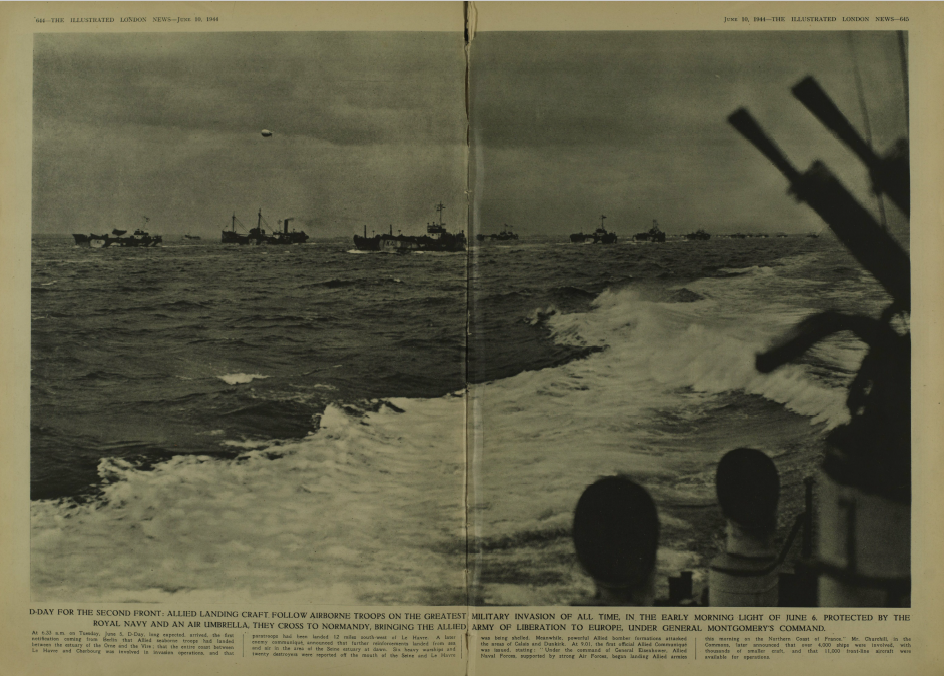
D-Day For the Second Front, ‘Illustrated London News’, Saturday 10 June 1944, pp. 644-645. From Illustrated London News Archive.
What did the papers say?
Operation Overlord was top secret, so it wasn’t until the 6th June that news of the invasion began to filter through. Reports of the Normandy landings does appear in some late editions of newspapers from that day but it is mostly covered in issues published the next day, 7th June, or on next subsequent publication date.
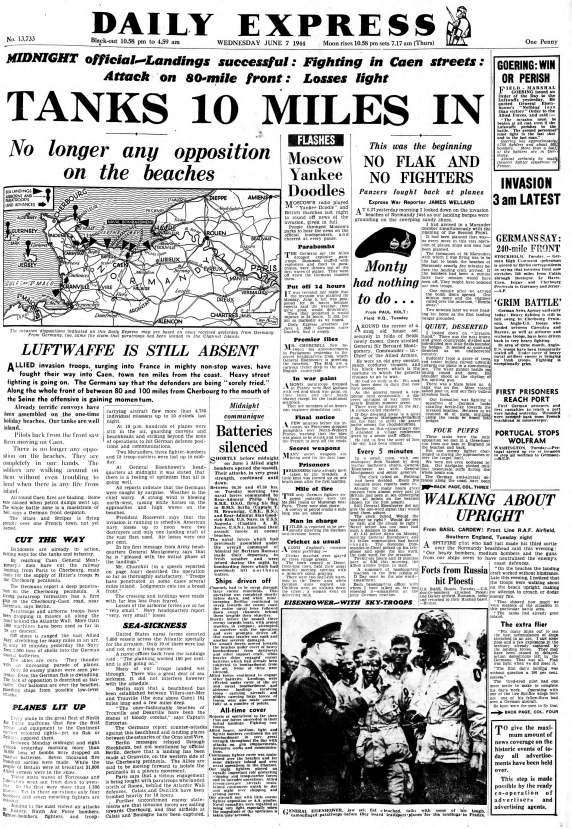
Front page of the ‘Daily Express’, Wednesday 7 June 1944. From UK Press Online.
The Library subscribes to a large number of digitised newspaper archives that will allow you to see what events were being reported on at the time and how they were being reported. Read full text articles, compare how different newspapers were covering the same issues and stories and track coverage of Operation Overlord from the Normandy landings onwards. Read More
On trial: The Sixties: Primary Documents and Personal Narratives 1960 – 1974
*The Library has access to The Sixties: Primary Documents and Personal Narratives 1960-1974 until 31st July 2024 as part of ProQuest Access 350.*
Thanks to a request from a HCA student I’m happy to let you know the Library currently has trial access to The Sixties: Primary Documents and Personal Narratives 1960 – 1974 from Alexander Street Press. The Sixties documents the key events, trends, and movements in 1960s America through digitised archive and primary source material.

You can access The Sixties from the E-resources trials page.
Access is available on and off-campus.
Trial access ends 30th June 2019. Read More
Times Higher Education update

Following a successful first year of a subscription to Times Higher Education Online, we have now renewed it for a further year. Existing subscribers should have received an alert from the publisher that the THE app will be discontinued following the publication of the 6th June issue. For readers who still want to page through the digital version of the weekly THE magazine, the digital editions section of the THE web site allows you to do this, and to download the full weekly magazine for offline reading.
New users, please see our webpage for set up instructions.
An intern’s first impressions
Archive cataloguing project intern, Sorina Mihai, relays her first impressions from her busy first two weeks with our ‘Evergreen: Patrick Geddes and the Environment and Equilibrium’ project. With a jam-packed schedule, and jumping right in at the deep-end of core archive work, Sorina is already making a significant and valuable contribution to our project. Read more about her initial experience and learning in this thoughtful and considered blog post.
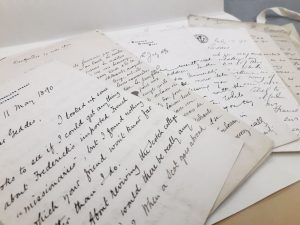
Selection of correspondence from the Patrick Geddes papers (Ref:T-GED12/3)
I was very excited to start my archives cataloguing internship with the ‘Evergreen: Patrick Geddes and the Environment in Equilibrium’ project two weeks ago. I am delighted to be part of a collaborative project between the universities of Edinburgh and Strathclyde which is instrumental in reuniting, preserving and cataloguing the two collections of papers of Scottish polymath Patrick Geddes. My eight-week internship is based predominantly at the Archives and Special Collections at the University of Strathclyde. I will be creating new catalogue descriptions for a discreet series of records within the collection, which pertains to the correspondence related to Patrick Geddes’ educational projects. My contribution will help to enhance the discoverability and usability of the Geddes collection.
I am looking forward to familiarising myself further with professional archive standards and becoming more confident in using them in my daily work. My previous experience as a volunteer with the ‘Evergreen’ project helped me to get acquainted with these standards and professional practices. I feel I am going to benefit considerably through having to use them continuously over a sustained period of time during my internship.
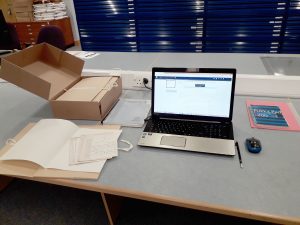
Archive cataloguing project intern work-station at the University of Strathclyde Archives and Special Collections
One of my main objectives is to become aware of and understand the challenges related to archive cataloguing and ways of facilitating access to archive collections. At the beginning of my internship I had the chance to meet with and speak to a range of information and curatorial professionals from both universities. At the University of Edinburgh, I had conversations with Joe Marshall (Head of Special Collections and the Centre for Research Collections), Grant Buttars (Archivist: University Archives and Technical Systems), Louise Williams (Lothian Health Services Archive), Jenny Duffy (Project Archivist), Lorraine McLoughlin (Appraisal Archivist), Fin West (Rare Books), and Emily Hick (Conservation). At the University of Strathclyde I met with Victoria Peters (Head Archivist), Rachael Jones (Assistant Archivist) and Carol Stewart (Special Collections Library Assistant). I also had the opportunity to shadow staff in the archive reading rooms at both institutions. These conversations have allowed me to broaden and deepen my general understanding of the professional field, and I have been able to see how various departments can work together. For example, Lorraine’s new system of appraisal not only helps save precious storage space, but it also greatly facilitates and helps colleagues from other departments keep track of how much stock they have and how much space they still have for new acquisitions. Grant’s efforts for securing funding are paramount for cataloguing, conservation or digitisation projects in order to make valuable collections available to the public both online and on site.
I am particularly interested in developing skills related to collections promotion and advocacy which are areas I have not yet explored. I strongly believe in the value of the Patrick Geddes collections and their importance to national and international cultural heritage. The collections cover most of Geddes’s life, nearly all the places where he lived and worked, and are a testimony of his many fields of activity, such as sociology, education, urban planning, and nature conservation. They also reunite a vast collection of correspondence in various languages from notable scientists, academics, sociologists, artists and writers from across the world. They are an invaluable record of Geddes’ global thinking and many interests, the fervent exchange of ideas across borders and joint efforts for improving education, urban planning and the wellbeing of citizens…just to name a few.
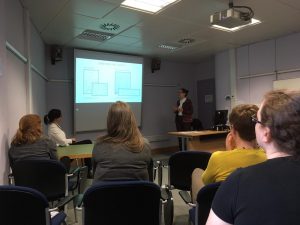
Project intern, Sorina Mihai, helping to promote the Patrick Geddes collections to University of Strathclyde library staff
I realise the ever-increasing importance of promoting collections to patrons and justifying the value of archival services to stakeholders. Archives offer communities the opportunity to learn, explore, interact and can inspire people to become more active in their communities. This is why I would like to develop the ability to engage with different audiences, develop and improve my presentation skills, such as presentation structure and delivery, and body language.
On a personal level, I hope to enhance my decision-making and time management skills, particularly in relation to how to prioritise competing agendas, and successful multi-tasking. I am also looking to gain networking skills which are so valuable in creating and sustaining connections with fellow professionals, enabling innovative and engaging collaborations, projects or initiatives. I would also like to further develop core skills such as work-planning, analysis, interpretation and research.
I feel very fortunate to be working within such an experienced and supportive team. Across the project team and supporting staff I have access to a vast bank of knowledge and professionalism, and their dedication is extremely inspiring and motivating. I very much appreciate the opportunity to learn in such a supportive and knowledgeable environment.
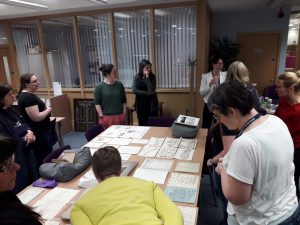
Promoting the Patrick Geddes collections to University of Strathclyde library staff
I have already started on cataloguing, have helped to deliver a training session which was designed to raise awareness of the project, collections and research activity around Patrick Geddes, and learned about reading room procedures at both universities. Helping to deliver the training session, I came to realise that a lot more time and work goes into delivering a presentation than I had anticipated. A lot of thought and work went into designing the content of the presentation for a particular audience and also in selecting the most relevant items to have on display in the reading room. The items had to complement the presentation and be arranged thematically in such a way as to encourage and facilitate curiosity and discovery. This experience also made me realise that the process of physically selecting, retrieving and returning documents for my section of the presentation took a good few hours to complete.
The ‘Evergreen’ internship is a tremendous opportunity for me to start transitioning from libraries to archives, a profession I have developed a great enthusiasm and passion for. I am applying for a postgraduate course in Archives and Records Management this year and this experience will help me to develop a solid practical foundation on which I can build the theoretical knowledge delivered by the postgraduate course. I hope this practical experience, complemented by my academic training in Information and Library Studies and the future study of Archives and Record Management will provide a strong grounding for my future career as an archivist.
Meanwhile, I greatly enjoy discovering the vast network of correspondents that Patrick Geddes was in touch with. I was very pleased to come across correspondence from French Nabis painter Paul Sérusier, Scottish physician and academic Diarmid Nöel Paton, French Prime Minister Georges Benjamin Clemanceau, Belgian lawyer and Nobel Peace Prize winner Henri Marie la Fontaine, English pioneer of women’s higher education Constance Maynard, and French poet and writer Marc-André Raffalovich. Who shall I uncover next?
Collections
 Love, Loss, and Literature: Cataloguing the Papers of Irene Jessie Young
My name is Nancy Britten, and I’m in my fourth year of studying History at...
Hill and Adamson Collection: an insight into Edinburgh’s past
My name is Phoebe Kirkland, I am an MSc East Asian Studies student, and for...
Love, Loss, and Literature: Cataloguing the Papers of Irene Jessie Young
My name is Nancy Britten, and I’m in my fourth year of studying History at...
Hill and Adamson Collection: an insight into Edinburgh’s past
My name is Phoebe Kirkland, I am an MSc East Asian Studies student, and for...
Projects
Cataloguing the private papers of Archibald Hunter Campbell: A Journey Through Correspondence
My name is Pauline Vincent, I am a student in my last year of a...
Archival Provenance Research Project: Lishan’s Experience
Presentation My name is Lishan Zou, I am a fourth year History and Politics student....