Home University of Edinburgh Library Essentials
September 27, 2026
The Shakespeare’s Collection – new resources from Gale
 Several new resources have been added to Archives Unbound, a key primary source database from Gale. Among these is The Shakespeare Collection.
The Collection contextualizes the legacy of this great poet and playwright, containing a selection of over 200 prompt books (annotated working texts of stage managers and company prompters) from the 17th to 20th centuries, the extensive diaries of Shakespeare enthusiast Gordon Crosse documenting 500 UK performances from 1890 to 1953, the First Folio and Quartos, editions and adaptations of Shakespeare’s works from the 17th, 18th and 19th centuries, more than 80 works Shakespeare is thought to have been familiar with, as well as works composed by Shakespeare’s contemporaries.
The Collection contains 225 monographs and 764 manuscripts. Coverage 1571-1975.
There is now a new Shakepeare Resource page, within the Library Subject Guide for English Literature, which brings together major Library resources for the study of William Shakespeare (1564-1616), the greatest dramatist the world has ever seen.
From the Stores #2: Gideon Mantell
This week in the stores, I began to delve into the box lists which describe the new-to-us collection of further papers of Charles Lyell and the family which was received by the University in the summer through the Acceptance in Lieu scheme. These are 18 boxes of papers and correspondence of Lyell, and I have embarked on scanning these box lists which will prepare for more in-depth cataloguing in the short to medium term. Here is what most box lists look like:

Gideon Mantell was a frequent correspondent of Lyell, and their life-long relationship started with a bang in 1821, when Lyell casually called on Mantell while visiting his old school at Midhurst. Having heard tell of the doctor from some workmen in the nearby quarry, Lyell rode the 25 miles over the South Downs and knocked on Mantell’s door nearly at dusk. Presumably they might have known each other’s names from the Geological Society, but one would imagine the visit would still have come as surprise at best. However, common interest prevailed, a well-stocked fossil cabinet provided great amount of conversation, and the two reportedly gossiped until morning. (Bailey, p. 48) Their published letters cover all from scientific theories, discoveries, to the latest gossip and accounts from the GeolSoc and Royal Society, of which they were both members.
In a week which is dominated by a race for a vaccine, we see similar scientific rivalries in the early years of geological science. Today Mantell is known for bringing to light and describing dinosaur reptiles. These letters from 1851 with Lyell may relate to a legendary dispute between Mantell, Lyell, and Sir Richard Owen surrounding a reptile fossil which was found in ancient rock, which previously had only yielded fish. At this time, years before Darwin’s Origins of the Species, views of the evolution of life were split into two camps; progressionists (today, this sect is called orthogenesis) believed that organisms have an innate tendency to evolve to a particular goal, and most followers believed this to mean a trend of increasing biological complexity through time. Any description of a tree of life usually falls within this hypothesis. Lyell and Mantell opposed this belief, identifying as anti-progressionists. A famous dispute occured between Lyell, Mantell, and Owens when Mantell and Owens wrote opposing descriptions of this curious fossil. The legend resolved with Owens in the wrong, and Lyell and Mantell in the right, but research using the archival collections of Owens and Mantell proves the legend wrong, revealing that Lyell urged Mantell, thought infirm and ailing, to write the description long after Owens had already been tapped to view and describe the fossil, and it was Mantell and Lyell who were in the wrong. This is a woefully clipped version of events, but I find the true value of work with archives here: with access and research to correspondence archives such as this one, the true stories of history are told, and legends can be found faulty.

References:
Charles Lyell, Sir Edward Bailey, 1962
For more about this progressionist dispute, see Michael J. Benton’s Progressionism in the 1850s: Lyell, Owen, Mantell and the Elgin fossil reptile Leptopleuron (Telerpeton)
Elise Ramsay
Project Archivist (Sir Charles Lyell Collection)
The Law Library, Old College
Have you visited the Law Library this year?
This is a really unusual year for staff and students at Edinburgh and it can be disconcerting not knowing which facilities are open on campus, or what to expect when you get there. We want to reassure any students who are keen to visit the Law Library at Old College that there will be a warm welcome for you there. Our Helpdesk Team are working hard to make sure the library service is as safe as possible while still providing the excellent support you need to access the resources and study spaces in the building.
We’ve asked our Helpdesk Manager, Fran, to offer a few words of advice for anyone wishing to visit the library:
Library Helpdesk staff would like to welcome you back to the Library! We are here to help with guiding you to the study space that you have booked, card replacements and general enquiries. We do ask that you follow the guidelines for things that have been put in place to ensure the safety of all library users and staff. This means that you must wear a face covering (unless you have an exemption) at all times, even when you are sat in a study space. We have put a lot of cleaning material and hand sanitiser in the library, if anything is missing please let us know. There is a well marked out one way system which is there for you to follow and ensures that we all can maintain social distancing.

Our Helpdesk staff are ready to assist you in the library.
Fran and her team are ready to greet you during the library’s open hours, which are currently as listed below:
| Days | Opening hours |
|---|---|
| Monday – Thursday | 9am – 9.50pm |
| Friday | 9am – 6.50pm |
| Saturday | 9am – 4.50pm |
| Sunday | 12noon – 4.50pm |
These hours may change from the 5th December 2020 in preparation for exams. For more information on this and other changes to the service, check the Law Library pages on the university website:
Law Library Information
Law Library Opening Hours
Booking a study space
We hope that you stay safe and know that the Law Library will be ready to welcome you back whenever it is safe for you to be on campus.
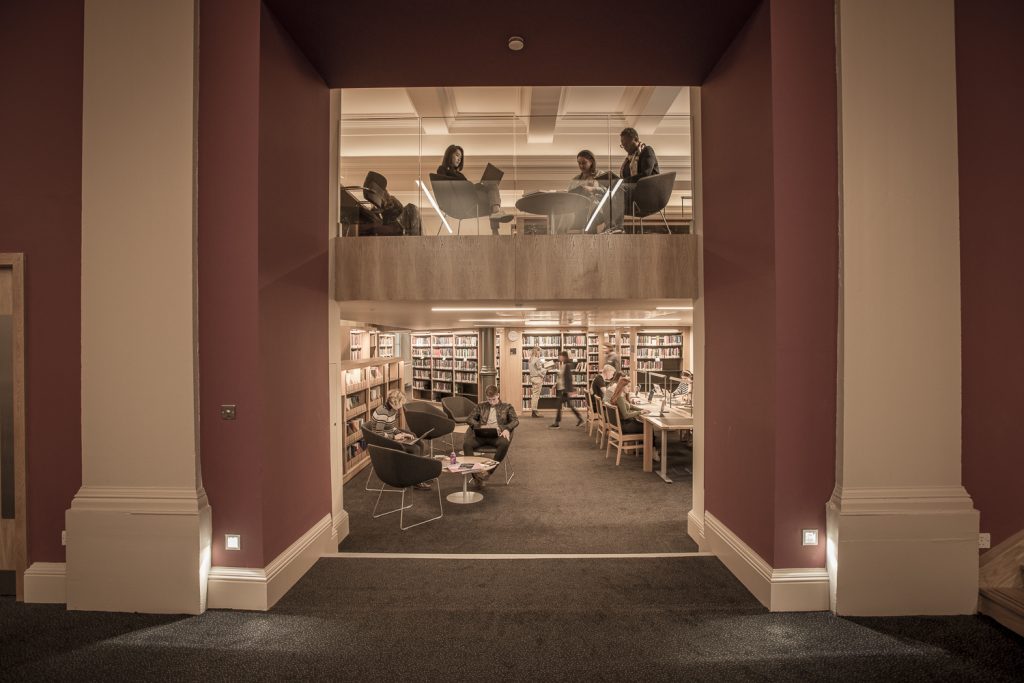
View of the mezzanine from the Senate Room
The Scotichronicon and the Goblin Ha’ – witchcraft and hobgoblins in our manuscripts!
In popular culture, archives sometimes have a cryptic reputation: if some filmmakers were to be believed, in the middle of dust and darkness would rest ancient manuscripts and parchments containing secrets about the occult and the mystic, jealously kept by a lone archivist (or a librarian, since they often appear to be interchangeable)[1]. Even though archives do hold fascinating, touching, thought-provoking materials in a myriad of shapes and forms, any archivist would tell you that such a description is a bit more glamorous than the reality…or, is it? It turned out manuscripts can hold supernatural secrets, as I discovered in a mysterious (and bibliographic) quest started on a rainy autumnal Saturday…
Two years ago, while looking for something to do to entertain my French guests, I had found a web page describing an abandoned castle in the woods near Gifford, a small village 40-minute away from Edinburgh. It seemed like a lovely walk – and even better, a part of the castle was said to have been built in the 13th century by demoniac goblins summoned by a necromancer! Talk about intriguing. The three of us set off. The starting point of our walk was a little path heading into the woods in the middle of the countryside, near a lonely, faded Victorian house. This was a particularly rainy and quiet day; and our directions were not very clear – soon, we were lost. We knew the castle was there somewhere, ancient and hidden, but our position at the bottom of a small valley prevented us from seeing anything other than trees and colourful foliage. Eventually, we met three other walkers who sent us in the right direction. They smiled knowingly when we told them we were looking for Yester Castle, and told us they had left candles inside the vault, “for the atmosphere”… Even more intrigued, we continued our quest, passing a number of old stone bridges hidden by the autumn leaves: perhaps this trail used to be followed by the castle’s inhabitants and visitors?

One of the bridges on the way to Yester Castle.
Finally, after an ultimate bridge curved over the river running at the bottom of the glen, we caught sight of a stone wall at the top of a hill. There it was! We had found our castle! And thanks to the rain, we had it for ourselves. The first edifices we encountered were an impressive tall wall, and the ruins of the stone keep. The castle had been built in the middle of the 13th century by the Laird of Yester Hugo de Giffard (or Hugh Gifford), descendent of a Norman immigrant who had been given land in East Lothian during the reign of David I[2].
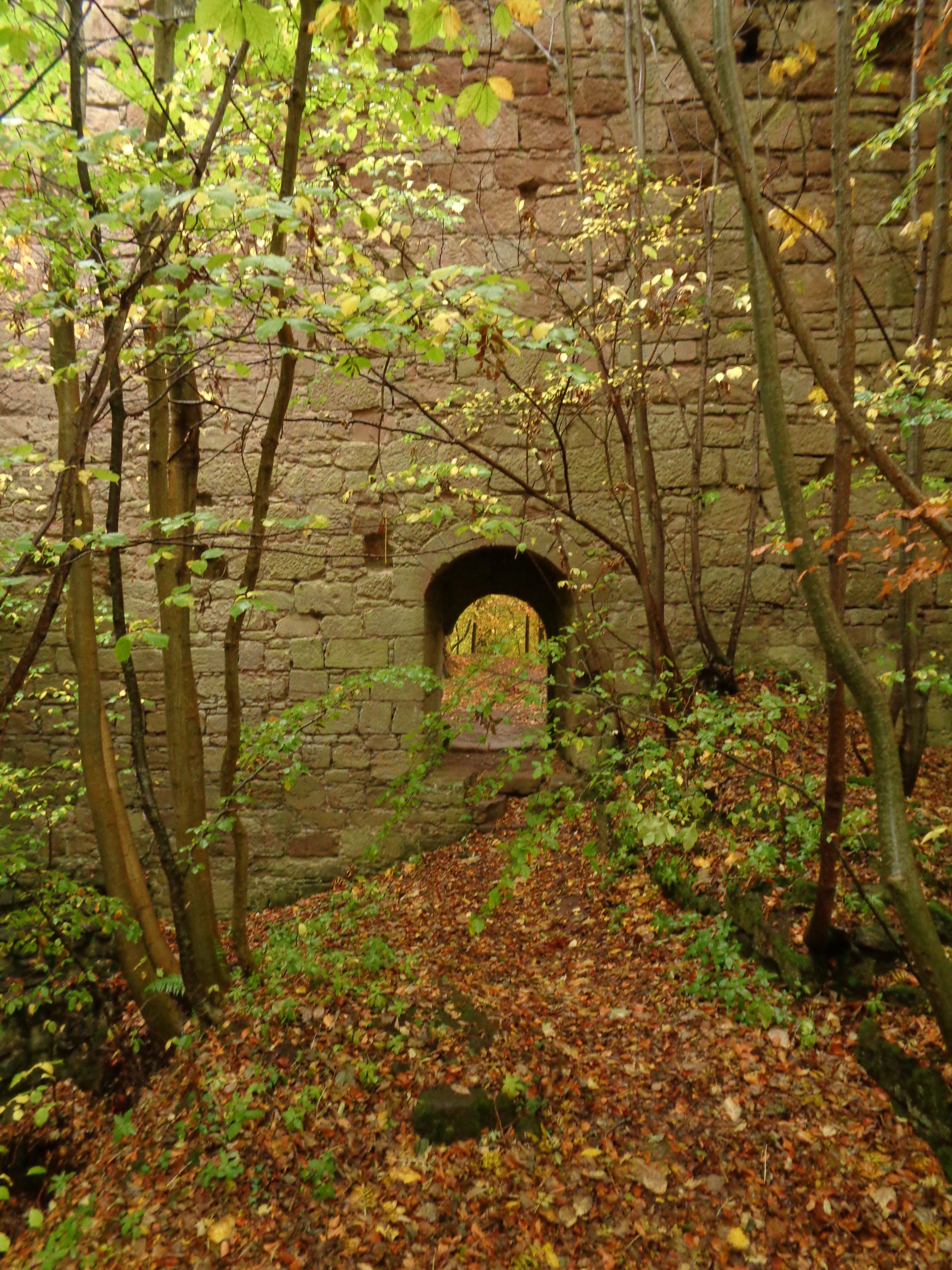
The tall wall leading to Yester Castle.

A remaining tower.
We soon spotted stairs descending into a cold, large, dark chamber. That must be it – the vault supposedly built by the same Hugo de Giffard, a man who left an ambiguous trace in historical records. Officially, we know he was one of the Guardians of the young Alexander III of Scotland; and one of the Regents of the Kingdom appointed by the Treaty of Roxburgh on 20th of September 1255[3]. However, he also had the reputation to be a warlock and a necromancer, and according to the legend he had summoned hobgoblins to build a subterranean vault under his castle, known as Bohall or Goblin Ha’, that he subsequently used for his demoniac activities.

The former entrance (?) of the vault.

The stairs leading down to the vault.
After wandering around the ruins for a while, we discovered a small entrance behind the castle, enabling us to enter the chamber by crouching through a narrow corridor in complete darkness. The size of the vault is still impressive today. The ceiling is high, and reminded me a stony, upside down rib cage. At one corner of the room there were stairs going down even more deeply into the ground. We were not disappointed.
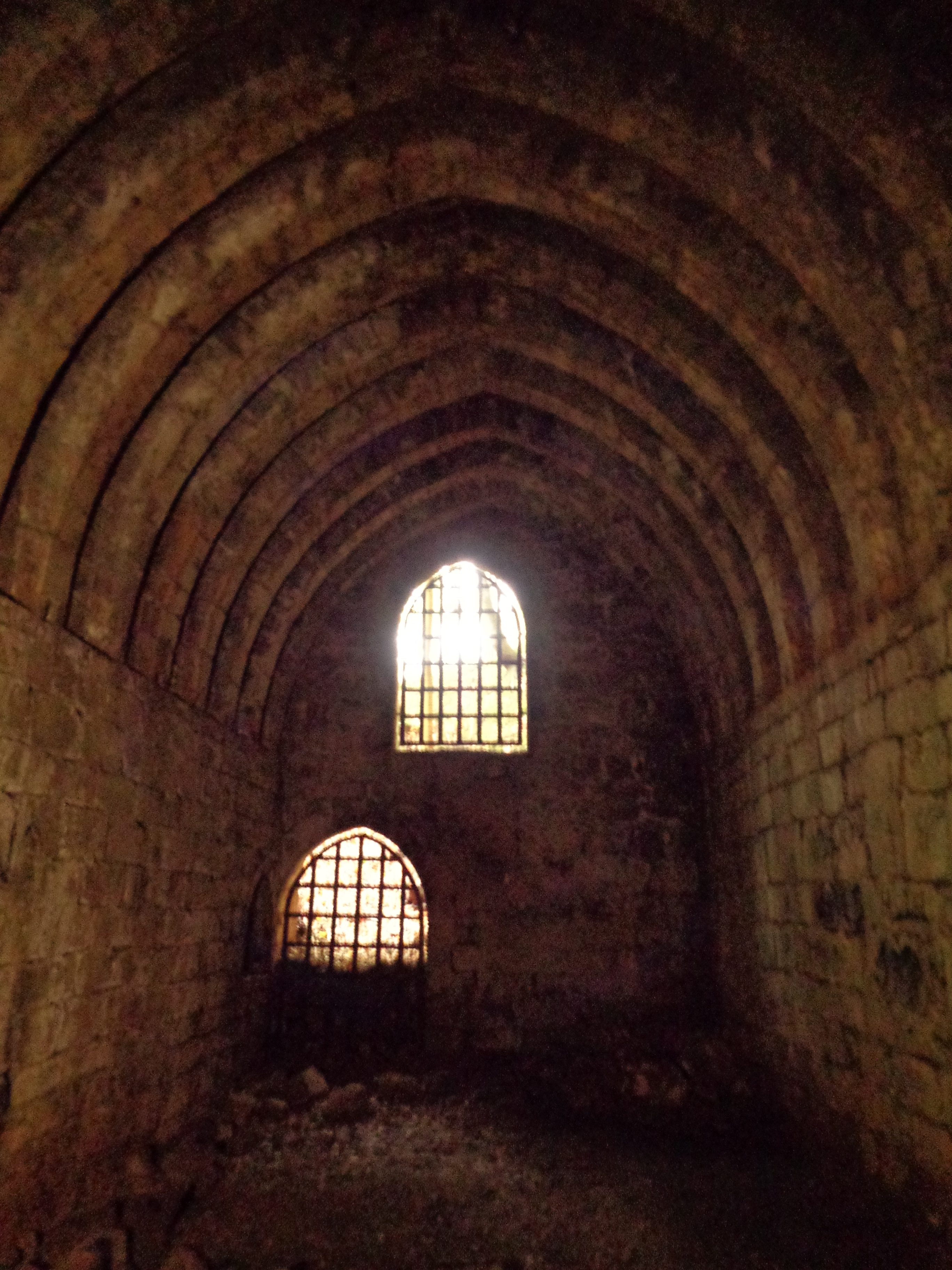
Inside the Goblin Ha’.
Once back to the safety of our home, far from any threat of goblins or medieval wizard, we tried to learn more about this incredible place. Finding a trustworthy source for the occult legend surrounding Hugo de Giffard was not easy. The original citation on which a large part of Hugo’s dark reputation seems to have been built was quoted in his Wikipedia page as follows: “Fordun thus speaks of him in noting his death in 1267: “Hugo Gifford de Yester, moritur cujus castrum vel saltem caveam et dongionem arte demoniacula antiquae relationes fuerunt fabricatas,” (vol.ii, p. 105).” [4]. The quote can be translated as: “Hugo Gifford of Yester died. His castle, at least his cave and his dungeon, was said to have been formed by demoniac artifice”. The Wikipedia page for Yester Castle presented the same idea: “14th century chronicler John of Fordun mentions the large cavern in Yester Castle, thought locally to have been formed by magical artifice.”[5] This was very vague – there was no indication of the work where the quote had been found, and which edition… We decided to get to the bottom of things. After all, we thought, the ruins of a castle built by demoniac forces during the middle ages are only cool if it can be supported by genuine contemporary evidence, not some hearsay on Wikipedia!
The source was said to be Fordun – so we assumed at first that the quotation was from the Chronica Gentis Scotorum (“Chronicles of the Scottish people”) written by the Scottish chronicler John of Fordun in the 14th century[6]. This work was one of the first attempts to relate the history of the Scottish people, from its mythological origins to the death of David I in 1153. Which meant, of course, that it could not have mentioned Hugo de Giffard and his Goblin Ha’, built in the middle of the 13th century… We hit our first hurdle. To make matters more confusing, Sir Walter Scott himself mentions Hugo de Giffard and the infamous Goblin Hall in his book Marmion, published in 1808[7]. We wondered – was the quote just an imaginative addition from a 19th century author to give more credit to a local legend, inspired by Walter Scott’s novel? It seemed all the online mentions of this particular extract stemmed from the same inaccurate Wikipedia citation, copied and pasted in various websites. No recent scholarly publications available online seemed to examine the legend.
However, while reading more about Fordun and his chronicles, we did find a clue: in 1440 Fordun’s Chronica Gentis Scotorum was continued by a Scottish abbot named Walter Bower born around 1385 at Haddington in East Lothian, which is only a few miles away from our mysterious castle[8]. Ah! Could it be that the mention of the Goblin Ha’ was in Bower’s writings, rather than in Fordun’s chronicles? Bower, having grown up in the region, would have known about the local legend. The combined texts from Fordun and Bower are called the Scotichronicon, and are an invaluable source of Scottish history. Fordun was also commonly cited as the main author, especially in older sources, which would explain the mix up in the Wikipedia pages. The only edition available online was the Joannis de Fordun Scotichronicon: cum supplementis et continuatione Walteri Boweri, edited by Walter Goodall and published in 1759. Our Latin quote was in vol. 2, p. 105 – this seemed like the probable source of the Wikipedia entry, which mentioned a “vol. ii, p. 115”. Goodall’s work was for a long time the only complete edition of the Scotichronicon, and is based on Edinburgh University Library’s very own copy dating form 1510 (MS 186)[9]…
This is when I thought – why content yourself with a transcription when you can check the original source directly? I was at the time working with postgraduate students on a project to produce an online catalogue of our Western Medieval Manuscripts, so I took the opportunity to have a look at MS 186. I retrieved the medieval book, which is of an impressive size – it is one of the few manuscripts in our collection which still have its original binding, and I must say, it did look like my idea of an ancient esoteric grimoire full of dark secrets! I then located the Liber X, capitulus XXI as instructed by the 1759 edition, and…. There it was! The very same sentence in Latin, about Hugo de Giffard and his vault built by Hobgoblins.

MS 186, with its original binding. The book measures 41 cm x 25 cm.

Original text in MS 186 – transcription in Latin – translation in English (from Scotichronicon, 8 volumes, ed. by D. E. R. Watt (Aberdeen: Aberdeen University Press, 1987))
I later put our Wikipedia editing training to good use by fixing the entries and clarifying the source and the author of the quote. This marked a satisfying ending to our quest for truth – we could rest easy knowing that our mysterious castle was an authentic ghoulish lair, and that we had done our part in disseminating knowledge through accurate bibliographical sources – could any archivist ask for more?
Aline Brodin, cataloguing archivist at the Centre for Research Collections.
Special thanks to Clément Guézais for his help in finding the Goblin Ha’, and researching its legend.
References:
[1] Oliver, A. Daniel, A., “The Identity Complex: the Portrayal of Archivists in Film.” in Archival Issues 37, no. 1 (2015): pp. 48-70.
[2] Ritchie, Robert L. G., The Normans in Scotland (Edinburgh: Edinburgh University Press, 1954), p. 276.
[3] William Anderson, The Scottish Nation: Or The Surnames, Families, Literature, Honours, and Biographical History of the People of Scotland, vol. 2 (Edinburgh and London: A. Fullarton & co., 1862), p. 298.
[4] “Hugh de Giffard” (last edited in 2019), Wikipedia, Available at: https://en.wikipedia.org/wiki/Hugh_de_Giffard (Accessed: October 2018).
[5] “Yester Castle” (last edited in 2020), Wikipedia, Available at: https://en.wikipedia.org/wiki/Yester_Castle (Accessed: October 2018).
[6] “Fordun, John of”, in Encyclopædia Britannica, vol. 10, ed. By Hugh Chisholm, 11th edn. (Cambridge: Cambridge University Press, 1911). pp. 643-644.
[7] Scott, W., Marmion, 10th edn (Edinburgh: Archibald Contsable, 1821), p. 157.
[8] Watt, D. E. R., “A National Treasure? The Scotichronicon of Walter Bower”, in The Scottish Historical Review, Volume LXXVI, 1: No. 201 (April 1997), pp. 44-53.
[9] Scotichronicon, 8 volumes, ed. by D. E. R. Watt (Aberdeen: Aberdeen University Press, 1987). See in particular, ‘Introduction’ to Volume 1 and Volume 8.
From the Stores #1: Packing List for Fieldwork
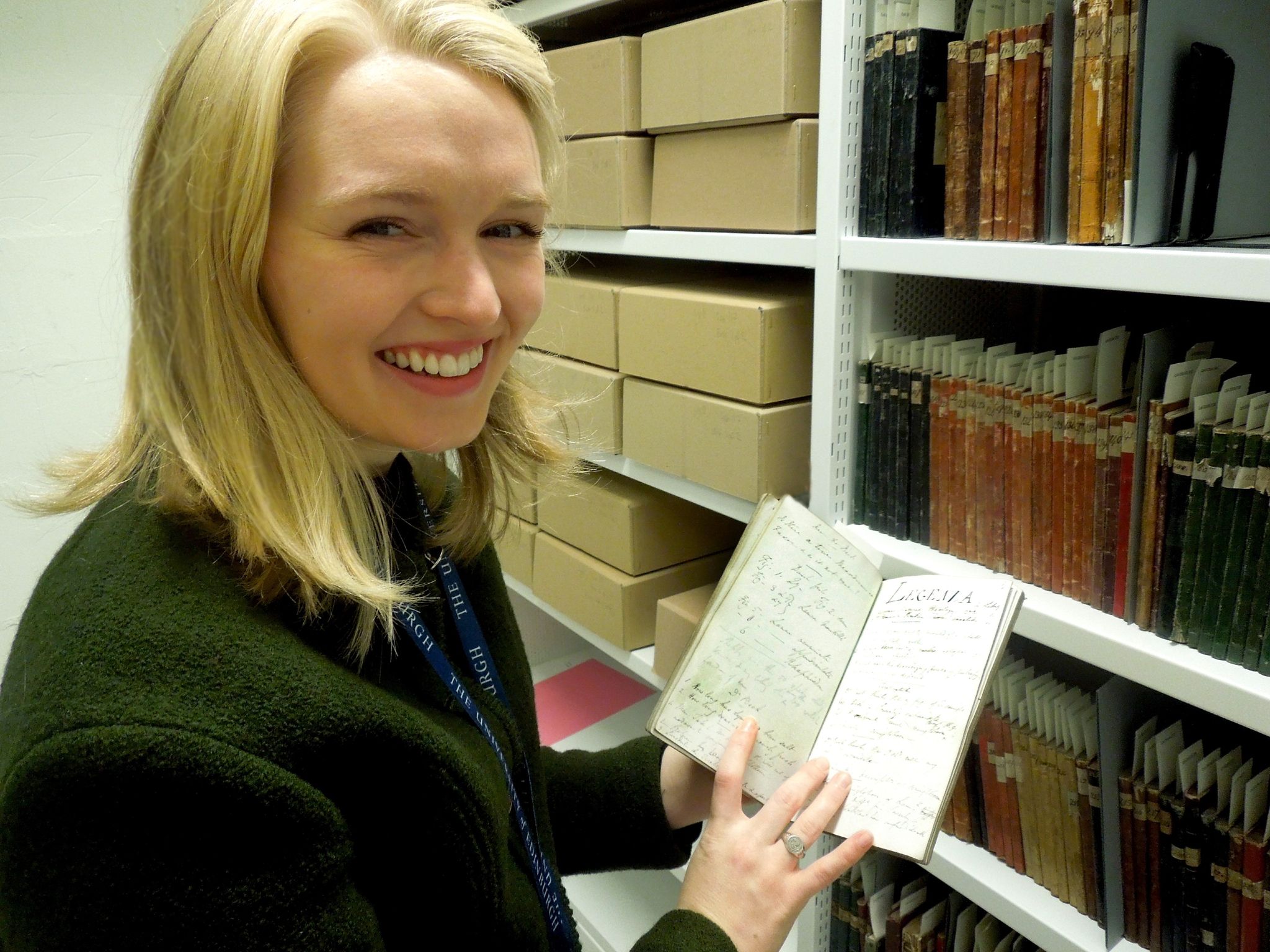
Elise Ramsay at work in the stores
Progress in the Lyell project has taken a giant leap these last two weeks thanks to two developments. Firstly, physical work in the stores where the collection is secured at the University Main Library has been deemed safe, if approached with new procedures, which has meant I have been able to access the collection in person for the first time since March 10th. This has meant the first stage of rapid capture and transcription of Lyell’s indexes has begun. This level of detail will make for rich metadata in the catalogue, and eventually allow researchers to search across the notebooks by subject matter. Thus the need for a new series of blog posts, released each week on Tuesday, where I can highlight all the discoveries I made in working with the collection!
Secondly, I am so excited that Nicky Monroe, a former History of the Book student, has agreed to volunteer on the project remotely. He will be transcribing these indexes and researching Lyell’s life for extra context in the catalogue. We will hear about his progress and discoveries in the collection in the coming weeks!
From my time in the stores last week, I captured this fantastic packing list, inscribed by Lyell in the earliest notebook we have of his, from 1825. During this time he would have been balancing his fondness for geology with his law work, which is reflected in the organisation of this notebook. The first half is brief notes on cases, mainly tenancy law and divorce cases. The second half begins from the back of the notebook, and reverse orientation compared to the first half, where Lyell writes notes from a Geology lecture he attended April 29 1825.
It is during this time, while he struggled with his law practice and his eyesight, that he invested more in geological field trips, often with visiting gentleman scientists. In the early summer of 1824 Lyell and Prevost travel from London to Bristol and Land’s End, ending up at Lyme Regis when Mary Anning made her great discovery of two complete Ichthyosauri. (Bailey, 1962) In the autumn, Lyell focuses on his Scottish roots, living at the Kinnordy estate and hosting William Buckland (his geology tutor from Oxford) to venture to Stonehaven, Aberdeen, Elgin, and Inverness to Brora; then back to Inverness and, after a quick jaunt to Brora, south by Blair Atholl, Glen Tilt, Perth, and Kinnordy to Edinburgh. Throughout these journeys, they were “comfortably interlarded with breakfasts and dinners without end”, stopping to see Sir James Hall near St. Abb’s Head, and twice at the Jameson’s. (Lyell and Lyell, 2019) I would bet that this packing list would have been in preparation for any of these foundational field trips. Stay tuned for Tuesday next week when another installment will be published!
References
Bailey, E., 1962. Charles Lyell. Edinburgh: Thomas Nelson and Sons Ltd.
Lyell, C. and Lyell, K., 2019. Life, Letters And Journals Of Sir Charles Lyell, Bart. Alpha Editions.
Bread Rationing: a surprising and timely subject
Today’s post, highlighting the wide range of newspaper archive databases the Library has and how these can be used to research a particular topic or event, is written by Louise Peterkin, Helpdesk Assistant, University of Edinburgh Libraries. During lockdown Louise also worked part-time with the Library Academic Support team.
I was delighted to be asked to write a blog showcasing the University’s wide range of databases and primary sources. These have been bolstered considerably in the last few months with the exciting addition of 365 new databases through our new ProQuest 350 Access subscription.
Looking for inspiration as to what to write about I searched Google for important events in history that fell between July and August. 22 July 1946 – Bread rationed for the first time in the UK leapt out at me. I always thought bread had been rationed during World War 2? I was keen to find out more.

Screenshot of “Bread Rationing Begins; and Other News Events of the Week.” Illustrated London News, July 27, 1946, 101. The Illustrated London News Historical Archive, 1842-2003.
I researched the topic through the University’s databases, starting with our newspaper archives. We have access to ProQuest Historical Newspapers, which includes access to The Guardian (1821-2003), The Observer (1791-2003) and The Scotsman (1817 -1950) and Gale Primary Sources and Gale News Vault which contain access to many historical newspapers including to the Daily Mail Historical Archive (1896-2004) and Times Digital Archive (1785 to 2011). Read More
Dissertation Festival: 26th October – 6th November
 Are you writing a dissertation this year? Do you want to find out more about the library resources available to support your dissertation?
From the 26th October to the 6th November 2020 we have a fortnight of online events which will highlight what the Library can do for you to help you succeed with your dissertation.
One of the events we’re holding is a Dissertation Fair which showcases library resources and services which support CAHSS students specifically on Thursday 29 October. You can:
- Make your dissertation something special : find out about the fantastic collections
available at the Centre for Research Collections - Discover the full range of digital resources that you can access via the University
- Take the first steps to learn new skills in managing your bibliographic references and your research data
For details of how to book this or any of our other events please visit the Dissertation Festival Subject Guide: https://edinburgh-uk.libguides.com/dissertation
Not available to attend live sessions, or feel that your dissertation is still too far away to plan for? Don’t worry! Most live sessions will be recorded and made available after the Dissertation Festival to be used asynchronously at a time that suits you. The Subject Guide will be updated after the events have taken place with more information.
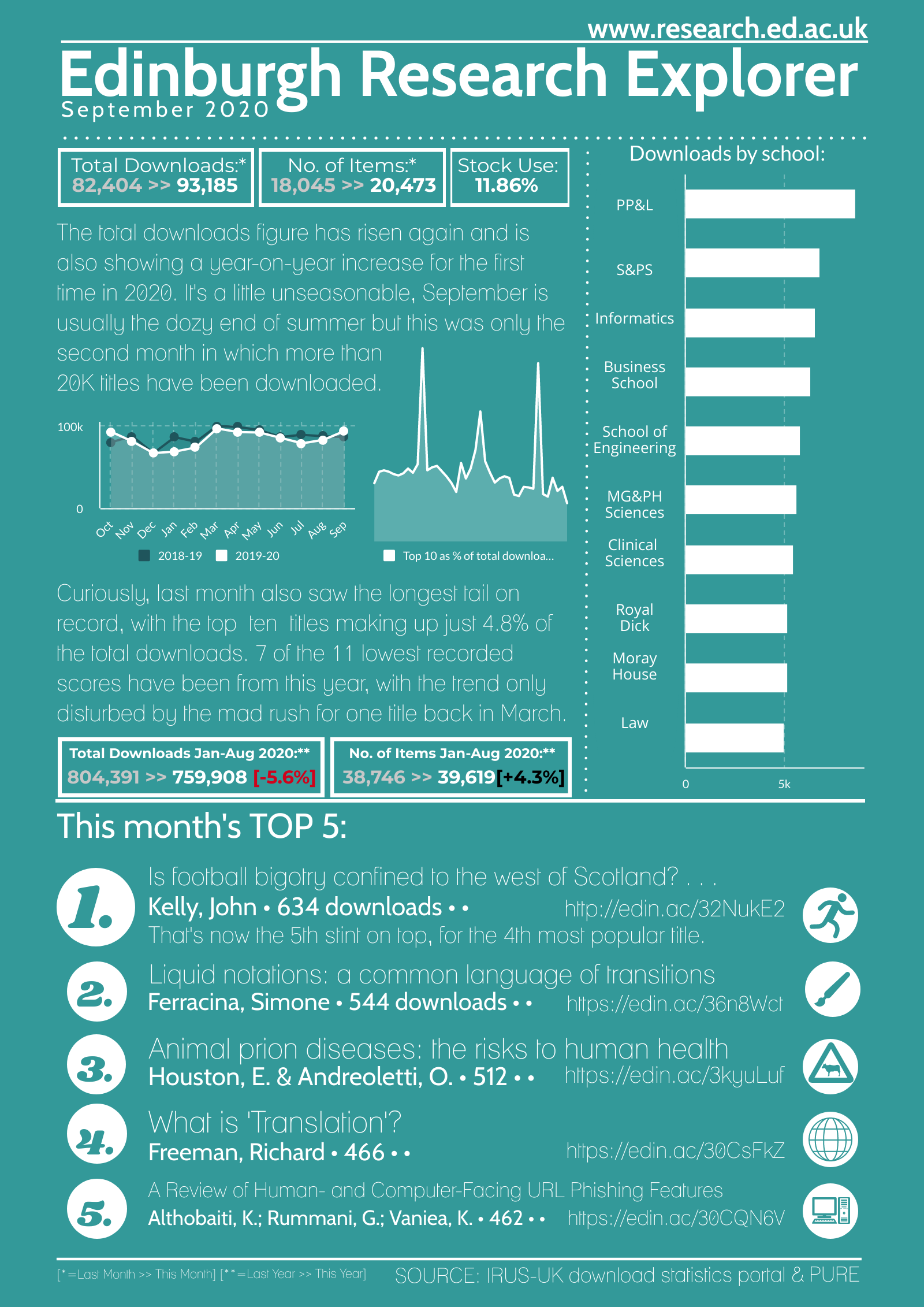
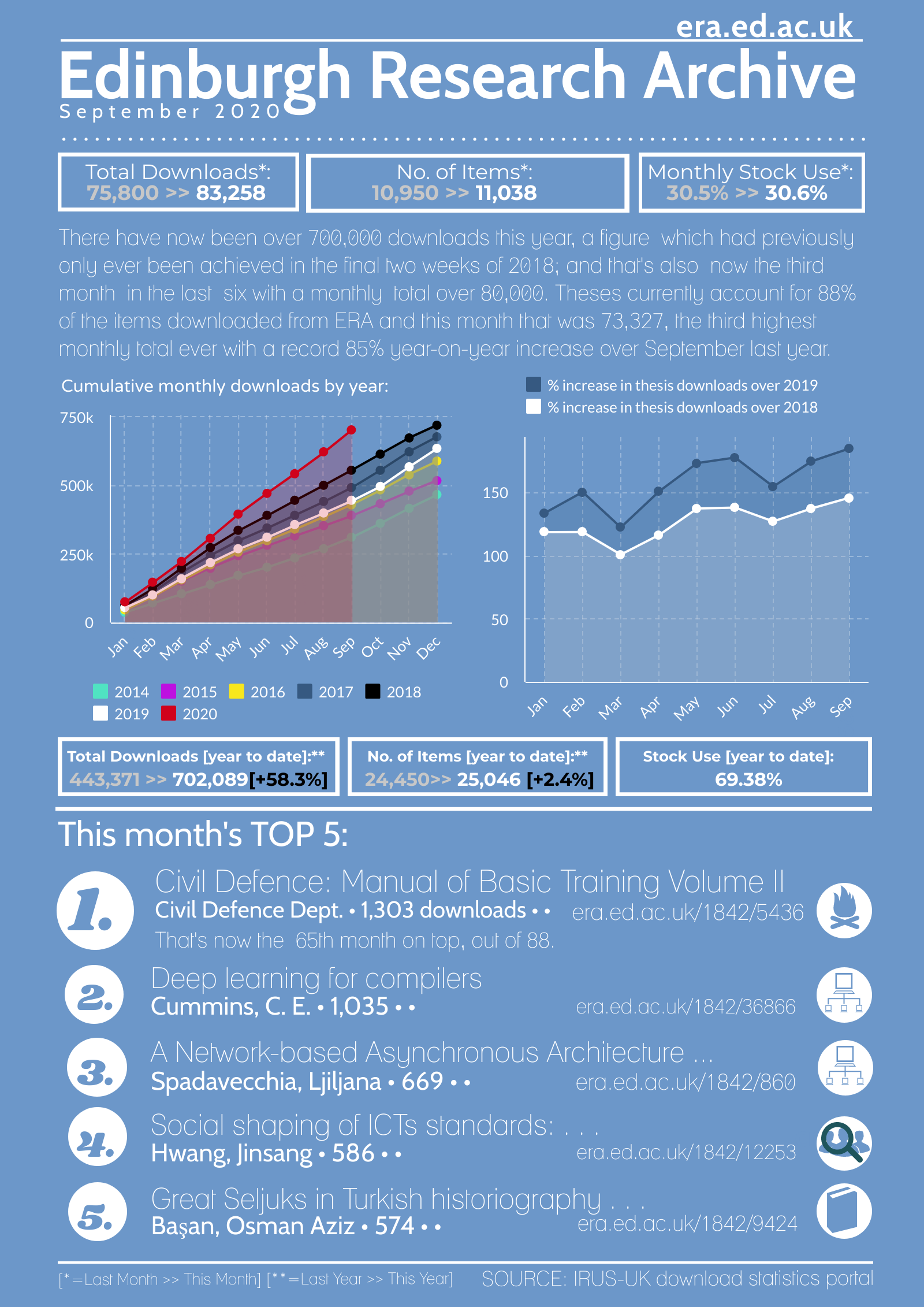
Edinburgh Research Downloads: September 2020
Dissertation Festival 2020
From 26 October – 6 November the Library is running a virtual Dissertation Festival. The online events taking place during this two week period will highlight what the Library can do for you to help you succeed with your dissertation.

In this blog post I am going to focus on the sessions that might be of particular interest to dissertation students (undergraduates or postgraduates) in the School of Social and Political Science (SPS). However, to find all sessions available and to book on take a look at the Dissertation guide. Read More
First online meeting of the Research Outputs Forum (15th October 2020)
After a brief introduction from chair Martin Donnelly, who recapped the rationale for merging the former Open Access and Research Data Management forums into a single channel for communicating progress across Library Research Support to research support colleagues within the Schools and Colleges, Nik Hussin from the Research Information Systems team kicked off with a status report on the future upgrade schedule for the University’s Pure CRIS system, which records research outputs and underpins the University’s all-important REF submission.
Head of Library Research Support Dominic Tate began by talking about the new Research Publications Policy, which is in the process of being scrutinised and approved by various committees and other stakeholders. Dominic explained that the overall goals of the new policy are to make compliance with REF and funders’ Open Access policies easier for all concerned, and to empower researchers to make their own decisions about how and where to publish. Fiona Wright from the Scholarly Communications team then provided updates on publications Block Grants in light of Plan S. These come from Wellcome Trust, British Heart Foundation and Cancer Research UK. Dominic wrapped up with a brief REF update, noting that as much of the submission as possible will be done electronically, although some hard copies will still be required.
Moving on to Research Data Support, we heard from Pauline Ward about new features and improvements to the DataVault, including a larger maximum deposit size of ten terabytes, the refined and more streamlined review process, and the new ‘roles’ feature which enables, for example, a research administrator to access information about all of the deposits from their School.
Robin Rice gave a recap of progress on the Data Safe Haven, including its ISO27001 accreditation and an elucidation of the charges and cost recovery mechanism for using the Safe Haven. Finally, Martin Donnelly talked about the pros and cons of moving our previously face-to-face training online – in short, less interaction with attendees but higher levels of attendance and uptake – and gave a quick overview of the guidance resources produced by Research Data Service, such as the Quick Guides on topics such as data storage options, the FAIR principles for data, and much more.
We received positive feedback from the meeting, and will be organising the next one for early in 2021.
(Update: the Research Data Support slides from this meeting are now available here.)
—
Martin Donnelly
Research Data Support Manager
Library and University Collections
Collections
 Love, Loss, and Literature: Cataloguing the Papers of Irene Jessie Young
My name is Nancy Britten, and I’m in my fourth year of studying History at...
Hill and Adamson Collection: an insight into Edinburgh’s past
My name is Phoebe Kirkland, I am an MSc East Asian Studies student, and for...
Love, Loss, and Literature: Cataloguing the Papers of Irene Jessie Young
My name is Nancy Britten, and I’m in my fourth year of studying History at...
Hill and Adamson Collection: an insight into Edinburgh’s past
My name is Phoebe Kirkland, I am an MSc East Asian Studies student, and for...

Projects
Cataloguing the private papers of Archibald Hunter Campbell: A Journey Through Correspondence
My name is Pauline Vincent, I am a student in my last year of a...
Archival Provenance Research Project: Lishan’s Experience
Presentation My name is Lishan Zou, I am a fourth year History and Politics student....