Home University of Edinburgh Library Essentials
May 23, 2026
Meet your LexisNexis Student Associate!
We’d like to introduce you to Sam Ingleton, one of your fellow students who is a specialist in working with LexisNexis and all their resources – such as the invaluable LexisLibrary database. We asked Sam some questions and hope you’ll enjoy getting to know him just as we did!
Tell us a little bit about yourself! Who are you and what do you study at Edinburgh?
My name is Sam, and I’m taking a Graduate-Entry LLB, following a Philosophy and English Literature (MA) from the University of Edinburgh. I’ve been fortunate to receive a training contract offer from DLA Piper in Edinburgh, which starts in 2022 – a wonderful certainty in a time of global upheaval! Studying for my LLB and working for LexisNexis leaves relatively little time for extra-curricular activities, but I enjoy winemaking, writing, music production, and exploring the city with my dog in my spare hours. I’ll be living in Edinburgh for the foreseeable future, resisting the lure of London for as long as possible; this is a city with a lot to offer young professionals and students (as long as you don’t mind the short days and pervasive drizzle!).
Why did you apply to be the student associate for LexisNexis?
LexisNexis is an extremely useful platform. It has helped me in my own studies, and prepared me for a future of legal research in a professional context. I always had ambitions to teach, but I could never manage full-time academia or classroom teaching. My sister teaches primary school children – a difficult, but extremely admirable profession! Working as a LexisNexis student associate is a fantastic compromise: I find great fulfilment in the practise of academic tuition. As well as the obvious benefits which come with competence in legal research, LexisNexis gave me the opportunity to be of benefit to others, in a community that thrives on a collective, supportive, inclusive ambition.
What do you think is the best feature that LexisLibrary offers for students?
With LexisLibrary, it’s the simple, intuitive functions which bring the most value. My favourite tools are those which barely merit an explanation! The ability to ‘drill-down’ through search results, narrowing by key words, topics, and specific search strings makes finding both familiar and unknown cases incredibly straightforward. This functionality accelerates the process of constructing new legal arguments, as well as enabling those searching for case law to support a specific point in an essay or tutorial question.
If you could name one top tip that everyone should know about your platform, what would it be?
One thing I wish I had known before I began the infamously arduous application process: the ‘alerts’ function. Using this tool, I receive weekly updates on developments at my target firms, which I never would have found using Google, or combing through legal news publications. This way, as soon as cases and judgements reach the press, I can see how my firm has been involved, and read their submissions and the judge’s opinion in full. This would be a much more interesting talking point during an interview than anything I presented during my own assessment period. For aspiring solicitors, I think LexisNexis is an often-neglected opportunity to monitor your specific firms very closely. You’ll never need to have a generic ‘legal implications of the pandemic’ discussion ever again!
When students book a training session with you, what can they expect to get from the meeting?
I’m proud of my ability to move students through the certification quickly, and highlight the tools which I think will be most useful to them, selectively and efficiently. It’s no secret that law students are time-poor, and ‘talking heads’ on video conferences are a very modern nuisance. I try to keep engagement high, explanations concise, and then give the session to the attendees to complete the certification and ask questions. Ideally, the whole process is complete in the time it takes to drink a cup of coffee. I also like to highlight the extreme usefulness of the certification. I spoke to a partner at an international law firm, who expressed to me that the thing they wanted to see from this generation of applicants was a complete literacy in legal database use. I think this could be the key to transforming a good application into an application which secures a training contract.

Sam has provided an introductory poster in case you want to read a bit more about how he can help you with all your LexisNexis needs. You can contact him via LinkedIn, by email (sam.ingleton@googlemail.com), or you can find out more on the LexisNexis Students UK Facebook page.
The Battle of Life: A look at the Dumfriesshire mental health survey
“worried, dull and anxious, not quite up to the battle of life.” Widowed female, 45-54 yrs, Dull and backward

Melancholia, 1830 by William Bartholomew, EU1394, Copyright: Edinburgh University Art Collection
As the second world war was coming to an end a psychiatrist and a psychiatric social worker based at the Crichton Royal Hospital in Dumfries embarked upon the largest survey of a population’s mental health ever undertaken in Scotland. They collated information on over 5000 individuals from 40 rural communities, using hospital and out patient records but also by seeking the opinions of those in positions of authority – ministers, local doctors, teachers, nurses, police constables and public assistance officers – with regards local residents living in their communities, the majority of which had never received treatment. The result is a fascinating, poignant and at times disturbing collection of vignettes of rural life: A mother smoking and reading rather than completing her household chores; an adolescent girl singing too loudly on the bus; a grieving husband drinking before midday; a young boy who mixes up his letters truanting from school; a widow huddling with her cats in a roofless house.
“a helpless creature but has a tongue that “wad cut cloots” Married female, 54-64 yrs, Schizophrenia
On the basis of the collected information, each individual was assigned one of 25 diagnoses. The survey makes no distinction between physical disablities such as deafness or paralysis, learning difficulties, issues such as anxiety and addictions, conditions such as schizophrenia, personality disorders such as psychopathy, or cognitive and neurological disorders such as dementia or epilepsy. In the absence of any interaction between the individuals and a medical professional, these diagnoses were assigned mainly on behaviour, personality and/or looks. Someone may well have been included for being opinionated, humourless, quiet, too thin, overweight, giggly or serious.
“husband a decent fellow, a Communist. She is really in love with someone else – met her first love again recently which upset her” Married female, 25-34 yrs, Manic depressive
Mental health issues were attributed to a number of causes – traumatic births or accidents, home environments, genetics. Illegitimacy is always recorded but it is unclear if this was thought to be a cause of mental disturbances or a symptom. It is certainly implied that this was an indication of moral weakness or that family relations were “inharmonious”, both possibly leading mental health issues.
“Increasing depression and an overwhelming hatred of work in the pits. He has the spectacle of his invalid father always before him and feels a similar fate is awaiting him” Single male, 15-24 yrs, Manic depressive
Work related anxiety appears fairly frequently. One farmer in his 60s was admitted to the Crichton Royal and diagnosed with melancholia following a period of depression and restlessness: “Patient used to out at nights to see his neighbours, but gave this up. The depression gradually got worse until patient became very restless, pacing up and down the floor during the day and not sleeping well at nights. Has a delusion that he has mis-managed the farm, that he is ruined and will be put out ot starve or put in jail. Actually there is no cause for worry, the farm work is all right and no debts”.
Miners in particular suffered because of their working environment, some were claustrophobic, others had had family members who had been injured or killed and for some, the sounds and conditions triggered traumatic memories of serving in the war.
“This boy is good with his hands but backward, “a wee bit dour”. Doesn’t like school. Will probably be quite a good farm hand” Single male, 14 yrs and under, Dull and backward

Imbecility, 1830 by William Bartholomew, EU1384, copyright: Edinburgh University Art Collection
Rural areas at this time were facing an exodus and it would appear that an underlying motivation for the survey was to establish if Dumfriesshire had a viable workforce. The survey entries make repeated references to whether or not individuals are capable of steady work and, if so, what type of employment they are or will be suited to. We therefore get a considerable idea of the common occupations in the area at this time which range from mole catchers, music teachers and mason’s labourers, to railway workers, domestic servants and, of course, farmers. There are also the roles that all towns and villages require – postmasters and mistresses, grocers, tailors, and bakers – and evidence of the major industries and employers in the area: Textiles, forestry, estate work and ICI which arrived in the area at the start of the Second World War.


The language used in the survey is frequently shocking and it would most certainly have been offensive even at the time it was written. It is necessary, however, to distinguish between accepted medical terms which have now fallen out of usage such as “defective”, “idiocy”, “imbecile” and colloquial language entirely inappropriate for inclusion in a formal survey. Scots words appear often: “glaikit”, “dour”, “besom”, “trachle”. The language is a clear indication of the attitudes of authority figures, not just to those with mental health difficulties, but also to women, children and those with disabilities. The vocabulary used is often infantilising, “soft”, “dopey”, or has criminal connotations, “pirate”, “wrong-un”. There is also evidence of the evolution of language, for example “queer”, “bent” and “gay” are used in this instanace to imply otherness and/or irresponsibility. It is interesting that these particular words would later be transferred to the LGBT community, another marginalised and discriminated against group.
“Blousy, drinks, loose habits, went about with Poles, a bad besom” Married female, 35-44 yrs, Psychopathic personality, Alcoholism
Women are judged particlarly harshly by the survey and domestic violence is frequently condoned by the authorities. There is a very narrow window in which women are allowed to be sexually active; if girls are sexually active too young they are a problem and if women are sexually active too old they are also a problem. Women over the age of 40 are repeatedly protrayed as hysterical or man mad. Women can be inlcuded in the survey for having a messy or dirty house but equally can be included if they are thought to be too preoccupied by cleanliness. Some women talk too much, some talk too little, some do not discipline their children enough, while some are deemed too strict.
The survey does, however, include some interesting references to women’s health including menstrual disorders and the menopause:
“This woman is menopausal, just sat and wept and wept, would not go out or talk to anybody”
“This woman is going through the climacteric, has heart symptoms; anxiety”
“Diagnosed as melancholia associated with the climacteric. She wished to go out naked, tore her hair, tortured her children. Ideas of guilt and ruin”
“Confuses g and c. His writing book made most peculiar reading. Quite good verbally” Single male, 14 yrs and under, Maladjusted child
Children too are dismissed very early on if they display difficulties at school. Some of the difficulties and behaviours recorded can easily be recognised today as dyslexia or autism. Although clinically recognized since the late 19th century it was not until the 1980s when dyslexia was recognized as a neurological disorder rather than a consequence of education.
While the survey does undoubtedly include people suffering with very real and frightening mental health difficulties some of the reasons given for inclusion range from the sublime to the ridiculous:


It is difficult to ascertain if those included in the survey would share the attitudes expressed in the survey or if it is a reflection of the establishment’s adherence to a very narrow definition of “normal”. For, in general, the survey paints a picture of ordinary people getting on with their lives, despite the obvious hardships, surviving in a world with no safety net, coping with both physical and environmental handicaps, and accepting of the diversity of their families and communities. It should also not be forgotten that these communities were still recovering from the war and in many instances the scars of the first world war are also evident, with older men presenting with issues stemming from shell shock experienced some 20 years previously. In the main, the individuals in the survey seem to be very much up to the battle of life.
Meet your Westlaw Student Representative!
We often receive requests from students for help with databases, but did you know that there’s a student specialist who can help you with all things Westlaw? Sofia Renshaw is available to answer questions, provide training and has a load of tips and tricks for getting the best from this popular legal database.

I am Sofia and I am currently in my final year studying Law at the University of Edinburgh. I applied for the role of Westlaw Student Representative as I recognise the importance of Westlaw as a resource for law students, particularly as we move to increased online teaching. Westlaw is an invaluable source for students at all stages of their law career and I recommend knowing how to use effectively as early as possible so you can get the most out of it in the coming years! I think that one of the most useful features of Westlaw is the precedent map. This allows you to see where a case has been cited and trace back through authorities to ensure the case you are using represents good law and strengthens any points you are making!
Westlaw training sessions are interactive and aim to prepare you for Westlaw Basic and Advanced certifications which you can put on your CV – remember that 94 of the top 100 UK law firms use Westlaw so this is a really valuable addition to any CV! I can also offer 1:1 sessions if there are specific concerns you wish to have assistance with and I run weekly Drop In Clinics where you can ask any questions!
You can contact Sofia for more information on training sessions or one-to-one appointments by heading to the Future Legal Legends Facebook page, or by emailing her directly: s1725665@sms.ed.ac.uk.
Referencing and Beyond Reading Lists
Last week the Law Librarians held a Referencing training session- focussing on OSCOLA!
If you didn’t get a chance to come along then don’t worry as we will be uploading the recording on to the Law Librarians Media Hopper Channel very soon.
Another date for your diary….
On the 2nd December at 9am there will be a Beyond your Reading List session- looking at where else you may find useful and relevant information.
Details are available on the events booking at https://www.events.ed.ac.uk/index.cfm?event=book&scheduleID=44060

How to DataShare
The latest in our series of Research Data Service ‘how-to’ videos provides guidance and handy hints on making data FAIR (Findable, Accessible, Interoperable and Reusable) by depositing in Edinburgh DataShare, the University’s open access data repository. This video is aimed at researchers seeking a Digital Object Identifier (or DOI, required by many publishers), wanting to share their data online and/or to archive their data somewhere safe for the long-term. The video demonstrates the DataShare submission interface, while the narration covers the kind of advice and guidance we would typically provide to users when working with them in person or via screen-sharing. Our hope is that users will find this video easier to access and quicker than having to request and schedule a meeting. That said, we’re still available and delighted to talk to users who have more complex questions or requirements about archiving and sharing their data.
—
Pauline Ward
Research Data Support Assistant
Library and University Collections
From the Stores #3: Notebook No. 13
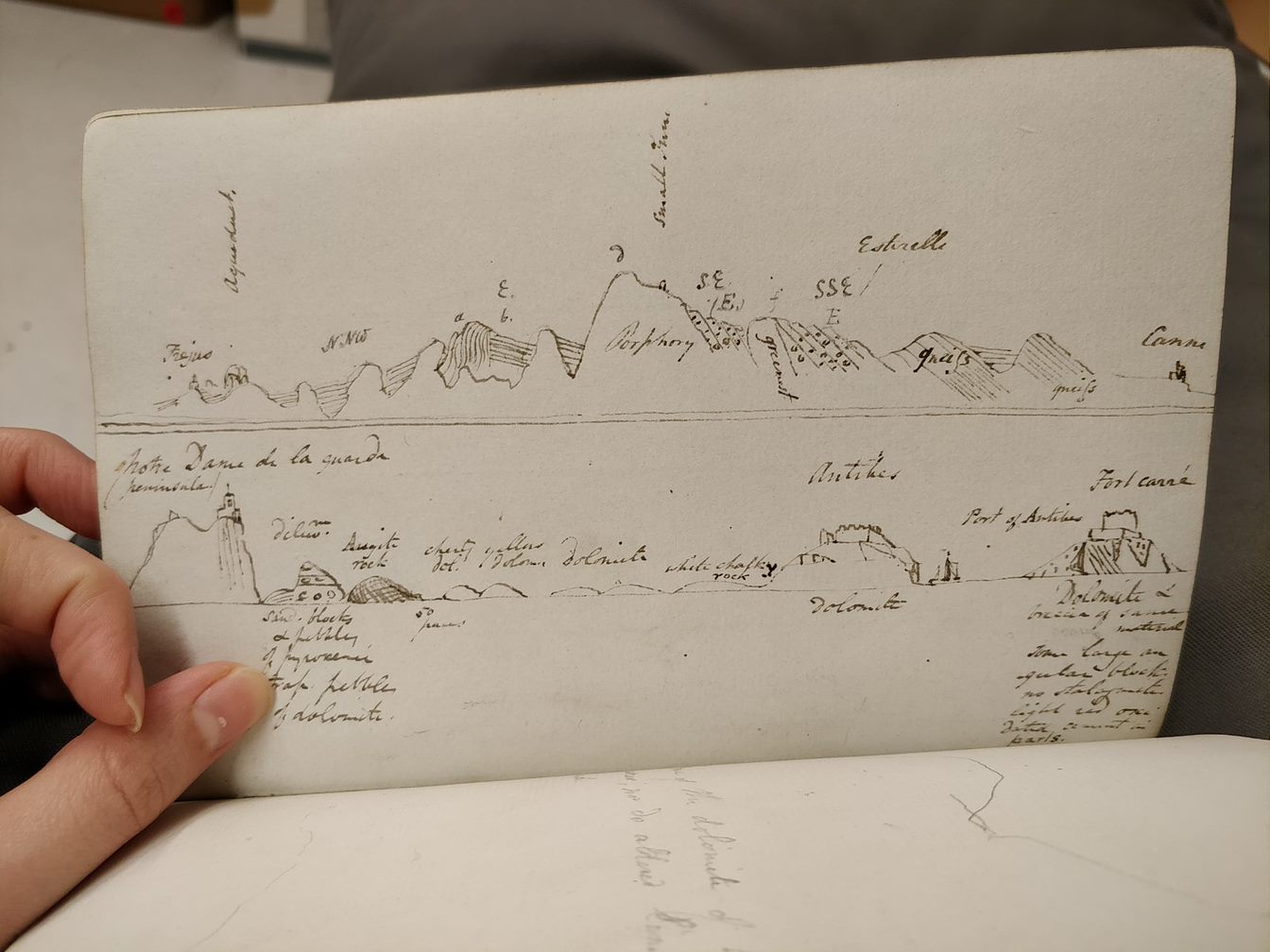
This week I spent some time working with the following notebook, No. 13, which Charles Lyell kept during his tour in southern France in 1828. This tour was originally started with Roderick and Charlotte Impey Murchison, and was foundational in Lyell’s decision to devote his work to geology over law, and also to begin work to write Principles of Geology. It was in comparing the rock formations of Paris to the south of France, Montpellier, Nice, and Italy that he found common fossilised shellfish, and concluded that these areas must at some point have been underwater, and have since been slowly lifted. (Maddox, p. 42) It was here, too, that in writing to Murchison from Naples 15 January 1829, he devoted himself to the study of geology, “I shall never hope to make money by geology, but not to lose, and tax others for my amusement.”
The notebook is filled with journal style writing, daily entries, with full page detailed sketches, as pictured below. Lyell writes in ink and pencil. Subjects include: Valley of Magna, Etangs, Comparison of Montepellier calcium deposits to those in Paris.
References:
Maddox, Brenda. Reading The Rocks. Bloomsbury Publishing, 2017.


Elise Ramsay
Project Archivist (Charles Lyell Collection)
Centre for Research Collections, University of Edinburgh
enewcome@ed.ac.uk
The Shakespeare’s Collection – new resources from Gale
 Several new resources have been added to Archives Unbound, a key primary source database from Gale. Among these is The Shakespeare Collection.
The Collection contextualizes the legacy of this great poet and playwright, containing a selection of over 200 prompt books (annotated working texts of stage managers and company prompters) from the 17th to 20th centuries, the extensive diaries of Shakespeare enthusiast Gordon Crosse documenting 500 UK performances from 1890 to 1953, the First Folio and Quartos, editions and adaptations of Shakespeare’s works from the 17th, 18th and 19th centuries, more than 80 works Shakespeare is thought to have been familiar with, as well as works composed by Shakespeare’s contemporaries.
The Collection contains 225 monographs and 764 manuscripts. Coverage 1571-1975.
There is now a new Shakepeare Resource page, within the Library Subject Guide for English Literature, which brings together major Library resources for the study of William Shakespeare (1564-1616), the greatest dramatist the world has ever seen.
From the Stores #2: Gideon Mantell
This week in the stores, I began to delve into the box lists which describe the new-to-us collection of further papers of Charles Lyell and the family which was received by the University in the summer through the Acceptance in Lieu scheme. These are 18 boxes of papers and correspondence of Lyell, and I have embarked on scanning these box lists which will prepare for more in-depth cataloguing in the short to medium term. Here is what most box lists look like:

Gideon Mantell was a frequent correspondent of Lyell, and their life-long relationship started with a bang in 1821, when Lyell casually called on Mantell while visiting his old school at Midhurst. Having heard tell of the doctor from some workmen in the nearby quarry, Lyell rode the 25 miles over the South Downs and knocked on Mantell’s door nearly at dusk. Presumably they might have known each other’s names from the Geological Society, but one would imagine the visit would still have come as surprise at best. However, common interest prevailed, a well-stocked fossil cabinet provided great amount of conversation, and the two reportedly gossiped until morning. (Bailey, p. 48) Their published letters cover all from scientific theories, discoveries, to the latest gossip and accounts from the GeolSoc and Royal Society, of which they were both members.
In a week which is dominated by a race for a vaccine, we see similar scientific rivalries in the early years of geological science. Today Mantell is known for bringing to light and describing dinosaur reptiles. These letters from 1851 with Lyell may relate to a legendary dispute between Mantell, Lyell, and Sir Richard Owen surrounding a reptile fossil which was found in ancient rock, which previously had only yielded fish. At this time, years before Darwin’s Origins of the Species, views of the evolution of life were split into two camps; progressionists (today, this sect is called orthogenesis) believed that organisms have an innate tendency to evolve to a particular goal, and most followers believed this to mean a trend of increasing biological complexity through time. Any description of a tree of life usually falls within this hypothesis. Lyell and Mantell opposed this belief, identifying as anti-progressionists. A famous dispute occured between Lyell, Mantell, and Owens when Mantell and Owens wrote opposing descriptions of this curious fossil. The legend resolved with Owens in the wrong, and Lyell and Mantell in the right, but research using the archival collections of Owens and Mantell proves the legend wrong, revealing that Lyell urged Mantell, thought infirm and ailing, to write the description long after Owens had already been tapped to view and describe the fossil, and it was Mantell and Lyell who were in the wrong. This is a woefully clipped version of events, but I find the true value of work with archives here: with access and research to correspondence archives such as this one, the true stories of history are told, and legends can be found faulty.

References:
Charles Lyell, Sir Edward Bailey, 1962
For more about this progressionist dispute, see Michael J. Benton’s Progressionism in the 1850s: Lyell, Owen, Mantell and the Elgin fossil reptile Leptopleuron (Telerpeton)
Elise Ramsay
Project Archivist (Sir Charles Lyell Collection)
The Law Library, Old College
Have you visited the Law Library this year?
This is a really unusual year for staff and students at Edinburgh and it can be disconcerting not knowing which facilities are open on campus, or what to expect when you get there. We want to reassure any students who are keen to visit the Law Library at Old College that there will be a warm welcome for you there. Our Helpdesk Team are working hard to make sure the library service is as safe as possible while still providing the excellent support you need to access the resources and study spaces in the building.
We’ve asked our Helpdesk Manager, Fran, to offer a few words of advice for anyone wishing to visit the library:
Library Helpdesk staff would like to welcome you back to the Library! We are here to help with guiding you to the study space that you have booked, card replacements and general enquiries. We do ask that you follow the guidelines for things that have been put in place to ensure the safety of all library users and staff. This means that you must wear a face covering (unless you have an exemption) at all times, even when you are sat in a study space. We have put a lot of cleaning material and hand sanitiser in the library, if anything is missing please let us know. There is a well marked out one way system which is there for you to follow and ensures that we all can maintain social distancing.

Our Helpdesk staff are ready to assist you in the library.
Fran and her team are ready to greet you during the library’s open hours, which are currently as listed below:
| Days | Opening hours |
|---|---|
| Monday – Thursday | 9am – 9.50pm |
| Friday | 9am – 6.50pm |
| Saturday | 9am – 4.50pm |
| Sunday | 12noon – 4.50pm |
These hours may change from the 5th December 2020 in preparation for exams. For more information on this and other changes to the service, check the Law Library pages on the university website:
Law Library Information
Law Library Opening Hours
Booking a study space
We hope that you stay safe and know that the Law Library will be ready to welcome you back whenever it is safe for you to be on campus.
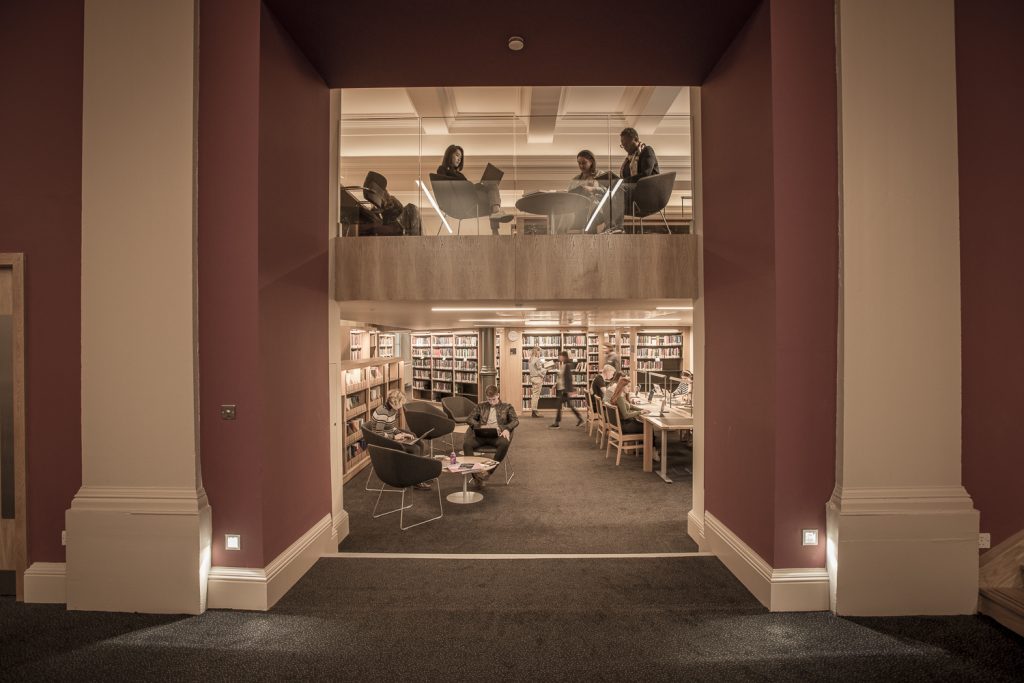
View of the mezzanine from the Senate Room
The Scotichronicon and the Goblin Ha’ – witchcraft and hobgoblins in our manuscripts!
In popular culture, archives sometimes have a cryptic reputation: if some filmmakers were to be believed, in the middle of dust and darkness would rest ancient manuscripts and parchments containing secrets about the occult and the mystic, jealously kept by a lone archivist (or a librarian, since they often appear to be interchangeable)[1]. Even though archives do hold fascinating, touching, thought-provoking materials in a myriad of shapes and forms, any archivist would tell you that such a description is a bit more glamorous than the reality…or, is it? It turned out manuscripts can hold supernatural secrets, as I discovered in a mysterious (and bibliographic) quest started on a rainy autumnal Saturday…
Two years ago, while looking for something to do to entertain my French guests, I had found a web page describing an abandoned castle in the woods near Gifford, a small village 40-minute away from Edinburgh. It seemed like a lovely walk – and even better, a part of the castle was said to have been built in the 13th century by demoniac goblins summoned by a necromancer! Talk about intriguing. The three of us set off. The starting point of our walk was a little path heading into the woods in the middle of the countryside, near a lonely, faded Victorian house. This was a particularly rainy and quiet day; and our directions were not very clear – soon, we were lost. We knew the castle was there somewhere, ancient and hidden, but our position at the bottom of a small valley prevented us from seeing anything other than trees and colourful foliage. Eventually, we met three other walkers who sent us in the right direction. They smiled knowingly when we told them we were looking for Yester Castle, and told us they had left candles inside the vault, “for the atmosphere”… Even more intrigued, we continued our quest, passing a number of old stone bridges hidden by the autumn leaves: perhaps this trail used to be followed by the castle’s inhabitants and visitors?

One of the bridges on the way to Yester Castle.
Finally, after an ultimate bridge curved over the river running at the bottom of the glen, we caught sight of a stone wall at the top of a hill. There it was! We had found our castle! And thanks to the rain, we had it for ourselves. The first edifices we encountered were an impressive tall wall, and the ruins of the stone keep. The castle had been built in the middle of the 13th century by the Laird of Yester Hugo de Giffard (or Hugh Gifford), descendent of a Norman immigrant who had been given land in East Lothian during the reign of David I[2].
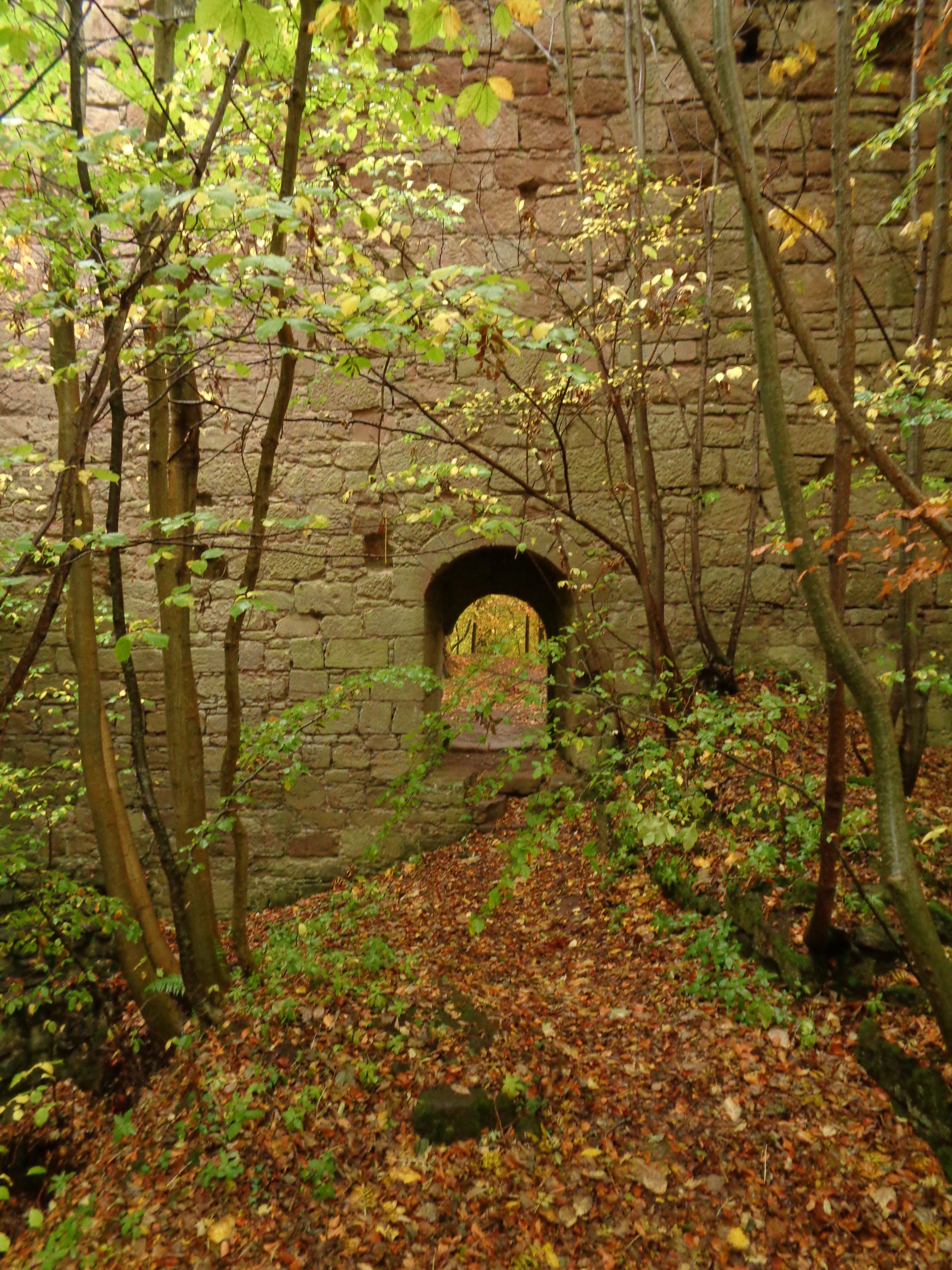
The tall wall leading to Yester Castle.

A remaining tower.
We soon spotted stairs descending into a cold, large, dark chamber. That must be it – the vault supposedly built by the same Hugo de Giffard, a man who left an ambiguous trace in historical records. Officially, we know he was one of the Guardians of the young Alexander III of Scotland; and one of the Regents of the Kingdom appointed by the Treaty of Roxburgh on 20th of September 1255[3]. However, he also had the reputation to be a warlock and a necromancer, and according to the legend he had summoned hobgoblins to build a subterranean vault under his castle, known as Bohall or Goblin Ha’, that he subsequently used for his demoniac activities.

The former entrance (?) of the vault.

The stairs leading down to the vault.
After wandering around the ruins for a while, we discovered a small entrance behind the castle, enabling us to enter the chamber by crouching through a narrow corridor in complete darkness. The size of the vault is still impressive today. The ceiling is high, and reminded me a stony, upside down rib cage. At one corner of the room there were stairs going down even more deeply into the ground. We were not disappointed.
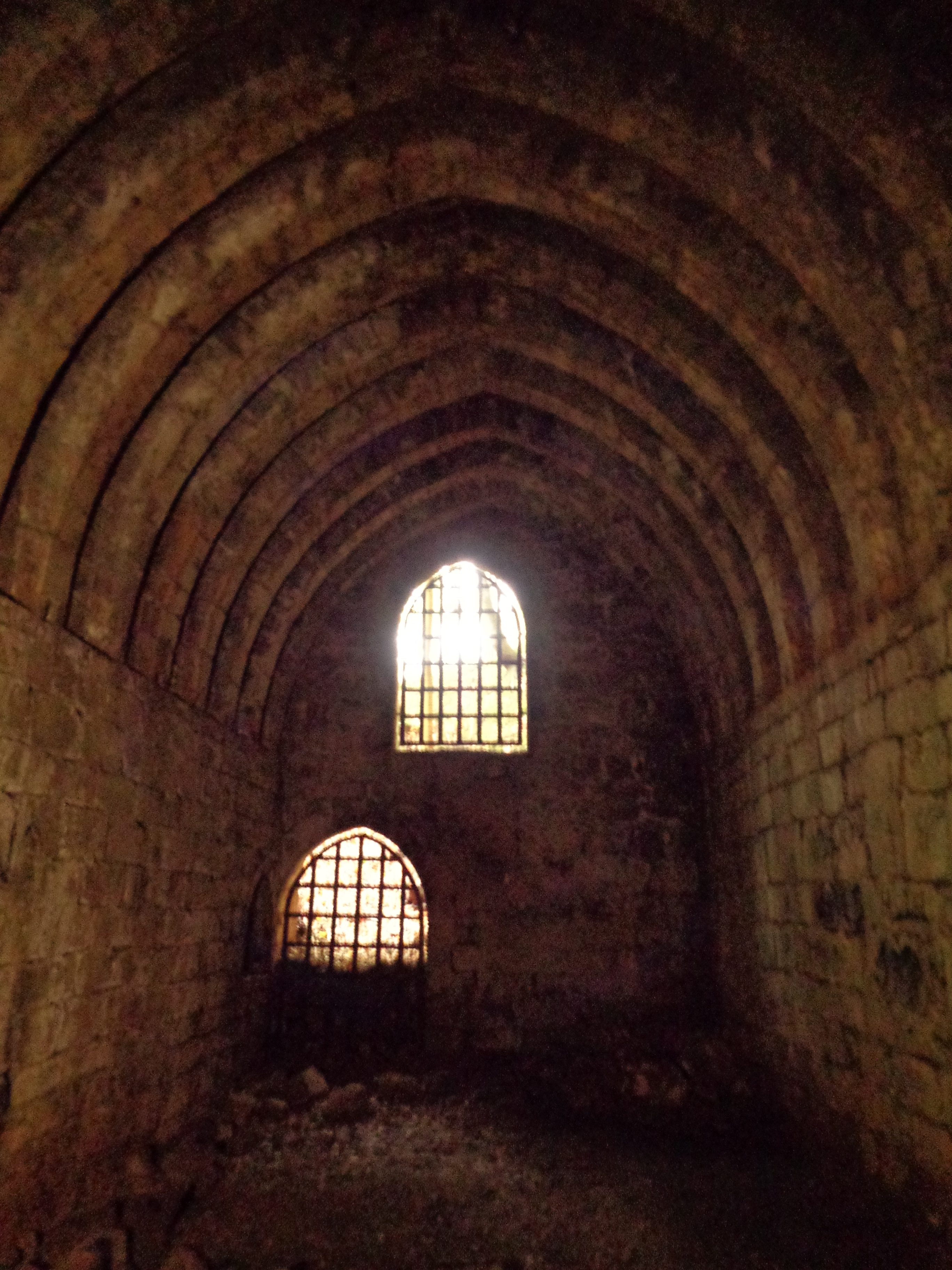
Inside the Goblin Ha’.
Once back to the safety of our home, far from any threat of goblins or medieval wizard, we tried to learn more about this incredible place. Finding a trustworthy source for the occult legend surrounding Hugo de Giffard was not easy. The original citation on which a large part of Hugo’s dark reputation seems to have been built was quoted in his Wikipedia page as follows: “Fordun thus speaks of him in noting his death in 1267: “Hugo Gifford de Yester, moritur cujus castrum vel saltem caveam et dongionem arte demoniacula antiquae relationes fuerunt fabricatas,” (vol.ii, p. 105).” [4]. The quote can be translated as: “Hugo Gifford of Yester died. His castle, at least his cave and his dungeon, was said to have been formed by demoniac artifice”. The Wikipedia page for Yester Castle presented the same idea: “14th century chronicler John of Fordun mentions the large cavern in Yester Castle, thought locally to have been formed by magical artifice.”[5] This was very vague – there was no indication of the work where the quote had been found, and which edition… We decided to get to the bottom of things. After all, we thought, the ruins of a castle built by demoniac forces during the middle ages are only cool if it can be supported by genuine contemporary evidence, not some hearsay on Wikipedia!
The source was said to be Fordun – so we assumed at first that the quotation was from the Chronica Gentis Scotorum (“Chronicles of the Scottish people”) written by the Scottish chronicler John of Fordun in the 14th century[6]. This work was one of the first attempts to relate the history of the Scottish people, from its mythological origins to the death of David I in 1153. Which meant, of course, that it could not have mentioned Hugo de Giffard and his Goblin Ha’, built in the middle of the 13th century… We hit our first hurdle. To make matters more confusing, Sir Walter Scott himself mentions Hugo de Giffard and the infamous Goblin Hall in his book Marmion, published in 1808[7]. We wondered – was the quote just an imaginative addition from a 19th century author to give more credit to a local legend, inspired by Walter Scott’s novel? It seemed all the online mentions of this particular extract stemmed from the same inaccurate Wikipedia citation, copied and pasted in various websites. No recent scholarly publications available online seemed to examine the legend.
However, while reading more about Fordun and his chronicles, we did find a clue: in 1440 Fordun’s Chronica Gentis Scotorum was continued by a Scottish abbot named Walter Bower born around 1385 at Haddington in East Lothian, which is only a few miles away from our mysterious castle[8]. Ah! Could it be that the mention of the Goblin Ha’ was in Bower’s writings, rather than in Fordun’s chronicles? Bower, having grown up in the region, would have known about the local legend. The combined texts from Fordun and Bower are called the Scotichronicon, and are an invaluable source of Scottish history. Fordun was also commonly cited as the main author, especially in older sources, which would explain the mix up in the Wikipedia pages. The only edition available online was the Joannis de Fordun Scotichronicon: cum supplementis et continuatione Walteri Boweri, edited by Walter Goodall and published in 1759. Our Latin quote was in vol. 2, p. 105 – this seemed like the probable source of the Wikipedia entry, which mentioned a “vol. ii, p. 115”. Goodall’s work was for a long time the only complete edition of the Scotichronicon, and is based on Edinburgh University Library’s very own copy dating form 1510 (MS 186)[9]…
This is when I thought – why content yourself with a transcription when you can check the original source directly? I was at the time working with postgraduate students on a project to produce an online catalogue of our Western Medieval Manuscripts, so I took the opportunity to have a look at MS 186. I retrieved the medieval book, which is of an impressive size – it is one of the few manuscripts in our collection which still have its original binding, and I must say, it did look like my idea of an ancient esoteric grimoire full of dark secrets! I then located the Liber X, capitulus XXI as instructed by the 1759 edition, and…. There it was! The very same sentence in Latin, about Hugo de Giffard and his vault built by Hobgoblins.

MS 186, with its original binding. The book measures 41 cm x 25 cm.

Original text in MS 186 – transcription in Latin – translation in English (from Scotichronicon, 8 volumes, ed. by D. E. R. Watt (Aberdeen: Aberdeen University Press, 1987))
I later put our Wikipedia editing training to good use by fixing the entries and clarifying the source and the author of the quote. This marked a satisfying ending to our quest for truth – we could rest easy knowing that our mysterious castle was an authentic ghoulish lair, and that we had done our part in disseminating knowledge through accurate bibliographical sources – could any archivist ask for more?
Aline Brodin, cataloguing archivist at the Centre for Research Collections.
Special thanks to Clément Guézais for his help in finding the Goblin Ha’, and researching its legend.
References:
[1] Oliver, A. Daniel, A., “The Identity Complex: the Portrayal of Archivists in Film.” in Archival Issues 37, no. 1 (2015): pp. 48-70.
[2] Ritchie, Robert L. G., The Normans in Scotland (Edinburgh: Edinburgh University Press, 1954), p. 276.
[3] William Anderson, The Scottish Nation: Or The Surnames, Families, Literature, Honours, and Biographical History of the People of Scotland, vol. 2 (Edinburgh and London: A. Fullarton & co., 1862), p. 298.
[4] “Hugh de Giffard” (last edited in 2019), Wikipedia, Available at: https://en.wikipedia.org/wiki/Hugh_de_Giffard (Accessed: October 2018).
[5] “Yester Castle” (last edited in 2020), Wikipedia, Available at: https://en.wikipedia.org/wiki/Yester_Castle (Accessed: October 2018).
[6] “Fordun, John of”, in Encyclopædia Britannica, vol. 10, ed. By Hugh Chisholm, 11th edn. (Cambridge: Cambridge University Press, 1911). pp. 643-644.
[7] Scott, W., Marmion, 10th edn (Edinburgh: Archibald Contsable, 1821), p. 157.
[8] Watt, D. E. R., “A National Treasure? The Scotichronicon of Walter Bower”, in The Scottish Historical Review, Volume LXXVI, 1: No. 201 (April 1997), pp. 44-53.
[9] Scotichronicon, 8 volumes, ed. by D. E. R. Watt (Aberdeen: Aberdeen University Press, 1987). See in particular, ‘Introduction’ to Volume 1 and Volume 8.
Collections
 Hill and Adamson Collection: an insight into Edinburgh’s past
My name is Phoebe Kirkland, I am an MSc East Asian Studies student, and for...
Cataloguing the private papers of Archibald Hunter Campbell: A Journey Through Correspondence
My name is Pauline Vincent, I am a student in my last year of a...
Hill and Adamson Collection: an insight into Edinburgh’s past
My name is Phoebe Kirkland, I am an MSc East Asian Studies student, and for...
Cataloguing the private papers of Archibald Hunter Campbell: A Journey Through Correspondence
My name is Pauline Vincent, I am a student in my last year of a...

Projects
Cataloguing the private papers of Archibald Hunter Campbell: A Journey Through Correspondence
My name is Pauline Vincent, I am a student in my last year of a...
Archival Provenance Research Project: Lishan’s Experience
Presentation My name is Lishan Zou, I am a fourth year History and Politics student....