Home University of Edinburgh Library Essentials
May 23, 2026
Volunteering Virtually with Conservation
A new year and a new blog from the conservation studio! Our first blog of the month comes from Stephanie Graban, an undergraduate student from the University of Edinburgh currently studying Arabic, who volunteered virtually with the conservation team for eight weeks from October to December 2020….
As my time working as a volunteer for the Centre for Research Collections (CRC) comes to an end, I’d like to reflect on my experiences. The eight-week project, which was both challenging and fascinating, focused on XRF analysis and background research of objects held by the University. These included a rare 15th century German Bible, a striking Persian marbled album, vibrant Indian Ragamala paintings, a collection of commemorative medals, and scraps of a 10th century Qur’anic manuscript. Evidently, the range of objects which I studied was wonderfully varied; each week felt like I was embarking on a new historical journey to a different corner of the world – from the comfort of my bedroom. The internship was carried out remotely due to Covid-19 and, although I wish I had the opportunity to see the XRF spectrometer at work, it was all the detective work that made this project so unique and memorable.

XRF analysis of Ragamala painting (Or.Ms.437) carried out by Special Collections Conservator, Emily Hick, at the CRC
My task was to interpret combinations of periodic elements in a table and deduce what pigments these elements could form. I quickly realised that in practice, this could be quite the challenge as the pigments could be contaminated or mixed with neighbouring colours. In order to make a confident assumption about the pigment’s identity, I consulted various pigment databases on the internet, as well as books exploring colours from various time periods and cultures. It was through this process that I found a new dimension to all the colours I see on a daily basis. Before the project, I never thought twice about why my jeans are blue or how the acrylic colours in my painting set were first named. I quickly realised that each colour that we interact with on a daily basis offers a rich and captivating history, which may even be controversial at times.
Taking the example of the Ragamala paintings which I studied in Week 3, I discovered the surprisingly cruel history of Indian Yellow. The pigment, which began to be utilised on a wide scale in the 16th century, was produced by force-feeding bitter mango leaves to cows until they were near the point of starvation. The leaves would intensify the bile pigment and produce bright-yellow urine. The cow urine was then collected and boiled for hours, resulting in a pigment which proved sensational across Asia and Europe! Without a doubt, everyone has seen this haunting pigment in a world-famous work: Van Gogh’s Starry Night – but few people know about its morbid history.

Ragamala painting (Or.Ms.437)
This was not the only secret the Ragamalas hid in plain sight. Upon analysing the elements making up the colours of the vividly-decorated music sheets, I noticed that titanium was overwhelmingly present in the artwork. This did not seem correct. The only recognised use of titanium in paint is in the manufacture of titanium dioxide white, a paint which was only first synthesised in the early 20th century. The presence of titanium is now commonly used as a marker for detecting forgeries. However, the Ragamalas were dated back to 1842 by the University catalogue, which drew questions about its authenticity. How was it possible for titanium white to be used in the object? Was the dating wrong? After delving into literature on similar Ragamala paintings, I came across a study which raised the exact same questions about the presence of titanium. Here I found an interesting observation: the authors of the article suggested that Indian artists may have been using titanium in their paints since the 17th century, centuries before the West first used it. This is a fascinating idea, but it’s a topic yet to be thoroughly explored. However, discovering further evidence which supported this observation offered a sense of importance to our findings.
That wasn’t the only time throughout the project where XRF analysis proved potentially valuable to academic discourse. A Persian album exhibiting calligraphy and marbled paper was chosen for analysis due to uncertainty in its date of manufacture. The catalogue description claims that the marbled page borders were added to the album at a later date and were not contemporary to the construction of the album. While XRF analysis did not offer any decisive results, I was able to find a recent essay by researcher Jake Benson discussing the very same album. Benson offered strong arguments in favour of the marbling being contemporary to the album’s construction.

Persian album of calligraphy and marbled paper – Qit’at-i Khushkhatt (Or.Ms.373)
After conducting contextual research, I found out that the marbled pages were most likely created by the famous marbling master Muhammad Tahir. In fact, the album likely inspired generations of artists, who used Tahir’s methods to endow Persian literary masterpieces such as Conference of the Birds and Fragrant Orchard with similar marbled borders. I reached out to Jake Benson, who kindly offered his suggestions on specific areas to conduct future technical analysis on in the album that would conclusively date the marbled borders. It felt exciting that the potential data gathered by XRF could be used to change what we know about such an important historical object!
The last object which I studied during the project was one of my personal favourites. It consisted of ancient-looking scraps of vellum displaying angular Qur’anic Arabic calligraphy. The University catalogue did not offer much information on its background or dating, so anything I could find while analysing the XRF data and conducting background research could prove valuable. I ultimately managed to date the manuscript scraps to approximately the 10th century, by using clues relating to the style of calligraphy and the format of the manuscript. I also found out that the manuscripts were discovered in the Al-Amr mosque in Egypt, the same mosque which held the oldest Qur’an ever found (now held at the University of Birmingham).

Scrap of vellum with angular Qur’anic Arabic calligraphy (Or.Ms.175)
Perhaps the most valuable outcome for me personally is that the past two months have taught me so much about various areas of history (including the history of colour) which I have never had the opportunity to study formally. The opportunity to solve a new ‘puzzle’ every week and put all the pieces together into a meaningful and valuable interpretation was more rewarding than any other academic project I’ve worked on! Thank you to Special Collections Conservator, Emily Hick, for all your kind guidance and advice throughout the eight weeks and for making my time as a volunteer (especially Thursday afternoons) very memorable. Lastly, thank you to CRC for offering me an invaluable opportunity to gain experience in the field of XRF analysis.
To find out more about volunteering opportunities at the CRC, please see our website. https://www.ed.ac.uk/information-services/library-museum-gallery/crc/volunteers-interns-honorary-fellows/volunteers-interns
Lyell’s School of Rock
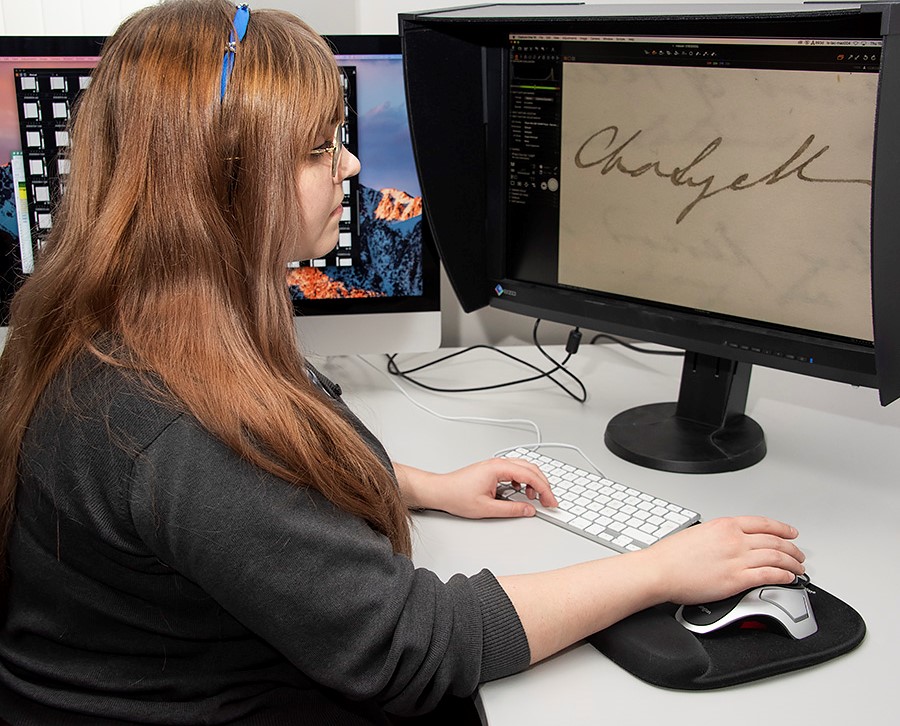
Juliette Lichman working on Lyell digitisation assessment
In November 2019 the Library excitedly welcomed Sir Charles Lyell’s two hundred and ninety-four notebooks into its Special Collections. With support and funding from leading institutions, groups and donations pledged from over 1000 individuals, this tectonic acquisition meant the notebooks were able to stay in the UK and join the Library’s existing collection of Lyell-related materials. As part of the DIU team, I was lucky enough to photograph Lyell’s notebooks, working with the world’s finest quality cameras to digitise a previously private collection into the public sphere and beyond.
Before I dig a little deeper I would like to share a quote from Charles Withers, who we filmed late last year talking about Lyell. He captures the essence of these notebooks perfectly in his description;
“They contain, in a sense, the emergence of thought of one of the world’s leading Earth scientists. But Lyell is much more than that. Lyell was a leading geologist but he was also a geographer, an antiquarian, an archaeologist. He writes with literary references, he writes with a lawyer-like precision, and he’s in touch with very many people whose names, along with Lyell’s, inform our understanding of the emergence of 19th century science.”
Professor Charles W J Withers, Ogilvie Chair of Geography,
University of Edinburgh, Geographer Royal for Scotland

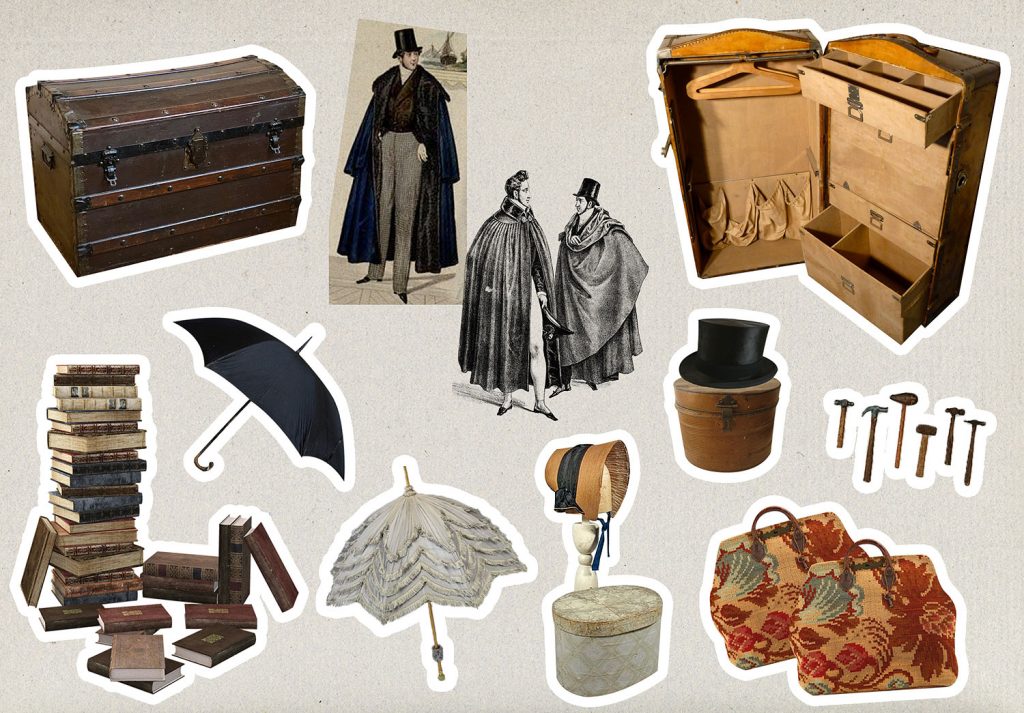
We’re very lucky that Lyell was such a great organiser and essentially catalogued his notebooks for us. With a robust system of pagination and a glossary, he was able to quickly reference information when needed. These small, unassuming notebooks accompanied him everywhere, and in his regular ‘Memoranda for Town’ (a.k.a. to-do lists) there are mentions of particular notebooks which he wanted to pack for later reference, as seen in no.4 below. Very conveniently the locations he visited are neatly labelled on the front of the notebooks. The writing within, however, can be difficult to decipher in some cases, especially where Lyell used his own form of shorthand and references, or if he was in the field resisting against the elements and pressure of the wind.
I find that to-do lists are a simple and yet revealing insight into our every day lives and passing thoughts; little reminders which help us to achieve a larger goal or shape our daily lives. Without having to read a whole passage as you would in a journal, we are able to get a sense of Lyell’s day to day life.

My favourite list is for items to take on an upcoming voyage. There is a glimpse of ‘Lyell the husband’, as he mentions a hat box and a bonnet box, separately, and again, a parasol and an umbrella, alluding to his wife’s presence with him. Indeed, this notebook is from 1837 and the catalogue description indicates:
“This notebook was kept by Lyell during his travels with Mrs. Lyell to Denmark and Norway, where they focused on contact zones between sedimentary rocks and large intrusive bodies of granite and syentie, as well as dykes and sills.”
If you wondered what it was like to travel with Lyell, this is a great example of how he packed light.

I came across an example of ‘Lyell the brother’ in this simple note. His sister, Marianne was a keen lepidopterist, and enjoyed collecting and naming insects. This was especially popular in Scotland, where much of the flora and fauna had no official name. He writes, ‘Curtis – No. 1. Did he not find a spider’. Maybe it was of personal interest, but there is no doubt he would have had illuminating conversations with his sister about entomology and the natural world, perhaps describing foreign insects he encountered in the field, to her delight!

Lyell was well acquainted with the notable entomologist, John Curtis which is evident in this letter he sent to his sister in 1827;
“Dear Marianne, Curtis sends me a note to say that there are good things among the Spring insects, and says the Miss Lyells will do wonders in Scotland. He hopes you will get some general knowledge of botany, as a little knowledge even of Scotch plants, would, he says, double the value of your entomological information. “
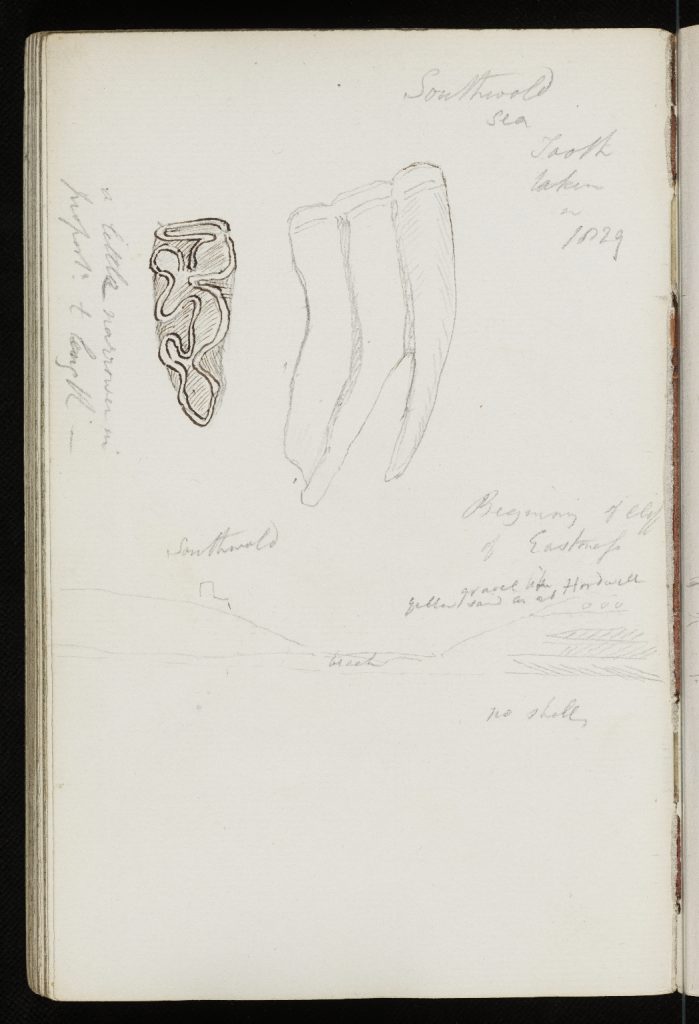
Another favourite find of mine was this illustration of what I assume to be a bovine tooth, with a sketch of Southwold Sea and the beach where he found it. After walking back and forth along the beach, looking intently at the sand for specimens, he stops and notes sadly “no shells”, only teeth!
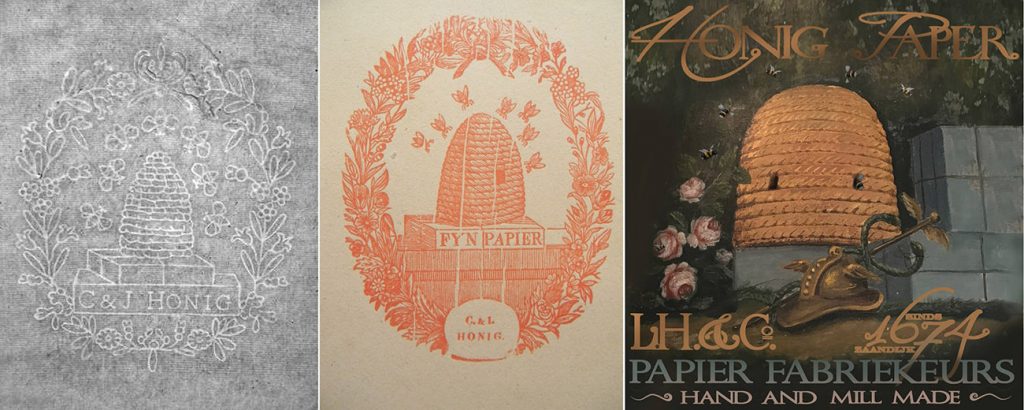
My most recent find in the notebooks was the most exciting by a landslide. We often come across interesting and unique watermarks in our department, but we found one in the notebooks which was very sweet and ornate. This was found in a loosely bound section that Lyell added to the start of a notebook, acting as a preface. The watermarks in the corresponding volume do not bear the same image, so it’s likely that he needed extra paper while travelling and bought some directly from the supplier.

The ‘Beehive’ watermark originated with a family of Dutch papermakers by the name of Honig [honey], who owned mills in Zaandyk (1675–1902). The coat of arms of the Honig family (incorporating the beehive motif) became a watermark extensively copied throughout the Netherlands and abroad in places such as Russia and Scandinavia.1 The ‘Beehive’ watermark became a common motif for Dutch papermakers and those who wished to allude to Dutch papermaking. Eventually it also came to represent a particular paper size.
National Gallery of Australia
https://nga.gov.au/whistler/details/beehive.cfm
Here are a few examples of watermarks and branding from C&J Honig. Note that ours is very similar to the first watermark, with the exception of larger bees.
We’re thrilled that this second batch of notebooks is now digitised and available online for all to enjoy. I photographed Lyell’s notebooks for the majority of the year, and with the added lockdown and social distancing restrictions, for a time it was just myself and the notebooks in the DIU. I will certainly miss seeing Lyell’s familiar scrawling hand and pencilled field sketches – intimate notes that he likely never anticipated sharing with anyone.
It’s been just over a year since our acquisition of these notebooks and it feels as though we have only scratched beneath the surface of the treasures contained within. They are a rare and fascinating glimpse into this famed geologist’s daily life, and like many others I shall be eagerly awaiting the transcriptions and new discoveries from this most beloved rockstar!
Juliette Lichman
Photographer
Useful Links:
- To see the digitised notebooks visit the Geology and Geologists Collection
- Keep up to date with the Lyell blog Through Lyell’s Eyes
- More information about this project on the University of Edinburgh website
Lyell’s School of Rock

In November 2019 the Library excitedly welcomed Sir Charles Lyell’s two hundred and ninety-four notebooks into its Special Collections. With support and funding from leading institutions, groups and donations pledged from over 1000 individuals, this tectonic acquisition meant the notebooks were able to stay in the UK and join the Library’s existing collection of Lyell-related materials. As part of the DIU team, I was lucky enough to photograph Lyell’s notebooks, working with the world’s finest quality cameras to digitise a previously private collection into the public sphere and beyond.
Have a nice break!
As we’re nearing the end of the revision and exam period we wanted to let you know that we’ll be on leave from the 19th of December and will return to work on the 4th of January 2021. If you need to reach us during that time you can email law.librarian@ed.ac.uk and we will reply in the New Year.
The Law Library building will remain open until 5pm on the 21st December, and will then close until the 5th January. If you need to use library facilities during the closed period you will find the Main Library in George Square will be open throughout, except for 24-26 December and 1-2 January. More information on opening hours for all libraries can be found here.
We hope you have a very merry festive break and we look forward to seeing you (either in-person or online) in the New Year!

Festive Law Librarians: SarahLouise (l) and Donna (r)
DataVault ‘at 100’ – stories from our users
The DataVault now contains over one hundred datasets, with a combined size of over one hundred terabytes. These are the stories of a handful of our happy customers, talking about the benefits of using the DataVault…
1. Low-cost long term storage delivers flexibility
Emily Clark (PI) and Mazdak Salavati (Core Scientist)
Emily and Mazdak heard about the DataVault at an event at the Roslin Institute organised by Colin Simpson, local project officer, and expert user of the DataVault. They needed to archive a large amount of genomics data – more than three terabytes. They wanted to save money and liberate their active storage for other data by moving the files from DataStore to DataVault. As DataVault is much cheaper than DataStore (once you’ve used up your initial free DataStore quota). We also held an initial meeting with Colin to answer their questions about how they would be billed (via an eIT), who would be able to deposit and retrieve data and how. Emily wanted flexibility around the billing, and the control to restrict access. We discussed the usefulness of splitting the data into separate deposits, to enable subsets of the data to be exported back to DataStore. As you can see from the public metadata, link below, the information has been worded in such a way as to manage the expectations of the reader appropriately. Mazdak created the vault, gave Emily access, and then deposited the data as a series of separate deposits, over a few days. We then issued the eIT for payment.
Mazdak says:
“Engaging early and reading the documentation was key for the use of DataVault. Having a research data management (RDM) plan from the beginning of your project helps with almost every aspect of dissemination of it i.e. publication, grant reports, collaborators and stakeholders etc. Understanding the types of storage and their cost makes this planning much easier for both the PIs and the data processors involved. Moreover, curating the metadata associated with biological datasets is much easier once the RDM plan is based on a streamlined platform such as DataVault. The clever use of low-cost long term storage solutions can free up lots of flexibility both in consumables and computational resources if considered from the start of every project. The DataVault is maintained and supported by very dedicated folks at the University who would their best to help and accommodate research needs. Talk to them in the earliest point possible to discuss your RDM plan and take advantage of their support.”
You can see the public details of the data by clicking on the DOI:
- Clark, E; Salavati, M “Ruminant Functional Genomics” (2020) Edinburgh DataVault. https://doi.org/10.7488/4b6ccd1f-63f9-4cc6-865e-4616dfe8a256
2. A safe place for personal data
Professor Sue Fletcher-Watson
Sue had a set of video footage gathered as part of her work with children with autism, specifically the Click-East clinical trial. The audio-visual files, a little over a terabyte, were stored on an external hard drive, so she wanted to have them safely backed up, but did not have sufficient spare storage in her DataStore area. Sue had learned about the Edinburgh DataVault when chatting with a member of our team at an IAD event, so she knew DataVault would be an appropriate home for this sensitive data to be stored for the ten year period to which the participants’ parents had consented; the DataVault encrypts the data and stores three copies, and is cheaper than buying additional DataStore storage. Information Services provided Sue with a temporary ‘staging area’ on DataStore free of charge to accommodate the transfer of the data from the external hard drive, first onto the DataStore staging area and then into the vault she created, after first creating a Pure record which we validated. The Research Data Support team now has a similar dedicated staging area on DataStore which we can make available to those users who need the space temporarily for a DataVault deposit or retrieval. Of course, datasets should be split into deposits of an appropriate size so that the retrieval need not occupy too much space on DataStore. Sue successfully deposited the data. And later was able to use the staging area again to retrieve the data.
“The support I got from the DataVault team was exemplary and really helped me with this first deposit. I now have complete confidence that these valuable data are safe and secure. I’ll certainly be using DataVault again”
3. Facilitating restricted sharing and citation of clinical data
An anonymous Edinburgh researcher
One research team contacted us about getting a DOI (Digital Object Identifier) for their pseudonymised clinical data, so they could cite the data in their manuscript, and so they could share the data on a restricted basis with their reviewers. We advised that while the reviewers would not be able to access the DataVault directly, the researchers could use DataSync to share an encrypted copy of the data with them, while protecting the anonymity of the reviewers, by sending the link for DataSync to the journal, for forwarding on to the editors. We helped the researchers describe their data in Pure. The researchers archived the data into DataVault. We minted a DOI on the Pure record, which the researchers then added into their manuscript and is now included in the finished publication. Of course, clicking on the DOI link does not give users direct access to the data – it merely takes them to the metadata, the description, on Pure’s public portal, the Edinburgh Research Explorer, where they can find the information they need to make a request for the data. Thus the research team still has the control, so that they can decline a request, or they can require such external researchers to sign a Data Sharing Agreement, undertaking not to attempt to re-identify any participants nor to share the data further with others.
A note on Data Protection
It is important to keep in mind that Principal Investigators are responsible for understanding and complying with data protection law and their own funders’ and collaborative partners’ requirements. The DataVault should be used as part of good practice in research data management throughout the research data lifecycle. We strongly encourage researchers to make a Data Management Plan for every project; the Research Data Support team is happy to review your Data Management Plan, provide feedback, advise whether the DataVault would be a suitable solution, and help include the associated costs in your research bid.
—
Pauline Ward
Research Data Support Assistant
Library and University Collections
Good Riddance to an ‘Intolerable’ Year: James Hogg Bids Farewell to 1831
To mark the 250th anniversary of the birth of James Hogg (1770-1835), we are featuring a peculiarly timely manuscript from Edinburgh University Library’s collections. Hogg’s poem ‘1831’ will strike a familiar chord with readers in 2020. It bids a hearty good riddance to a year plagued by a rampant epidemic, public unrest, conspiracy theories, and disruption to work and trade.
The poem’s refrain damns 1831 as the accursed year of ‘Burking, Bill, and Cholera’. The first major 19th-century outbreak of cholera reached Northern England in late summer 1831, probably via ships bringing imports from India. By the end of the year, it had entered Scotland, where it spread rapidly through the growing industrial towns, killing over 9,500 people. The disease also caused massive unemployment, particularly among weavers, as the demand for their wares plummeted. Quarantine regulations further prevented hawkers and travelling salesmen from travelling between towns. Economic deprivation led to ‘cholera riots’ in Glasgow, Edinburgh, and Paisley. The target of the rioters’ fury was the medical profession which was suspected of Burking cholera patients. This term alluded to the body-snatching spree of Burke and Hare, crimes fresh in the public memory. It implied that doctors were systematically murdering cholera-sufferers to meet the demand for anatomic specimens.
Some protesters also claimed that the British government was deliberately spreading cholera in order to thin the numbers of the politically troublesome working classes. By ‘Bill’, Hogg means the Reform Bill of 1831, which envisaged a huge expansion of the (male) electorate. The rejection of the Bill by the House of Lords led to a nationwide outbreak of popular violence. Rioters set fire to Nottingham Castle (hence Hogg’s references to ‘flames’ and ‘fumes’) and seized control of Bristol for three days. Suspicion that cholera was being used to suppress the working classes blurred the boundaries between ‘Reform riots’ and ‘Cholera riots’.
Read More
Edinburgh Research Downloads: November 2020
Edinburgh Research Downloads: November 2020 • www.research.ed.ac.uk • www.era.lib.ed.ac.uk
• Looking at how Edinburgh Research Explorer and ERA have performed over the last year relative to other institutions across the UK. Overall they’ve done OK but probably could/should have done better: they’ve just about hung on to the coat-tails of the big guns, but they’ve been outperformed by a few smaller establishments.
• Looking at theses specifically, things look better: UCL have had a good year but ERA’s managed to stay ahead of them, allowing both to make the minutest of inroads into Manchester’s lead; White Rose though, are bigger and growing faster than everyone else.
• The usual snapshot of last month’s performances.
• A snapshot of the year-so-far. Read More
Exams and revision
It’s that time of year where everyone is focused on exams and assignment deadlines. In 2020 of course there’s the added pressure of taking a different kind of test and worrying about getting home safely. It is an extremely stressful time.
If you’re struggling to find your studying groove you may find the links in our Exam and Revision subject guide helpful. You will find information about library services and how to access resources online, but there’s also a wellbeing section with ideas on how to take care of yourself.
The Law subject guide has loads of information including links and instructions on how to use many of the subject specific resources we have available.
And of course we’ve been putting videos up on the Law Librarian Media Hopper channel all semester, so if you’ve forgotten how to use Westlaw or need a refresher on referencing take a look.
Here are our top five tips for revision and successful study:
- Drink plenty of water. It sounds obvious, but the better hydrated you are, the better your brain functions.
- Take breaks. Make sure you get up from your desk and stretch and move around a bit, ideally for a few minutes every hour. Get outside if you can, or open a window. Even when you’re studying on-campus in a library it’s possible to leave your workspace for a short period to take a walk around.
- Organise your notes. It’s a well known fact that librarians love stationery! We’re big fans of colourful highlighters, sticky notes and fancy pens. Even if that doesn’t make organisation fun for you it’s a good idea to keep notes from the same subject together and easily accessible when you’re working on assignments. It’s amazing how much time can be wasted looking for that one scrap of paper that had an important case citation on it.
- Give yourself plenty of time. Inevitably if you’re still working on the day your work is due your references will disappear, you’ll miss the bus, your internet will conk out and the printer will jam. Try to anticipate the issues by planning for the worst-case scenario – sometimes this means tricking yourself into pretending the due date is a day or two before the real deadline.
- Work hard, play hard. When you’re finished studying for the day do something completely different with your free time. Switching off from revision and doing something active, creative or social will help you unwind which will give your brain a rest and will allow you to come back to the task fresh.
We hope some of this information has been useful to you, and wish you the best of luck with your upcoming exams, assignments and submissions. If you have any questions about library resources please do let us know on law.librarian@ed.ac.uk.
Virtual Event: An Introduction to Charles Lyell
 We are excited to offer a new opportunity to experience this collection, a Zoom presentation by the Lyell Project staff on 10 December 2020 at 1pm GMT. This event reveals the ongoing work at the University of Edinburgh with the geological collection of Sir Charles Lyell, a rich corpus of material including his notebooks, family papers, and geological specimens.
Elise Ramsay, Project Archivist, will introduce Lyell and show several key pieces of the collection using the Centre for Research Collection’s new innovative visualizer technology. This collection includes specimens collected by Charles Darwin, letters between Lyell and Darwin, and notebooks in Lyell’s own hand during his fateful tours to France and Italy. Dr. Gillian McCay, from the Cockburn Geological Museum at the Grant Institute, will connect Lyell’s legacy to modern scientific perspectives. Each will discuss adapting working practices over the past year to continue opening up this rich collection of earth science material.
You can find out more about the Sir Charles Lyell Collection here in this blog, and at https://www.ed.ac.uk/information-services/library-museum-gallery/crc/the-sir-charles-lyell-collection
This talk is part of the Carlyle Circle 30th Anniversary online exhibition. The Carlyle Circle was formed in 1990 and in 2020 it celebrates three decades of impact, highlighting the many ways legacy giving has supported opportunities for world-leading teaching and research.
Instructions to join this free talk will go out to all attendees in advance of the online event. We welcome any who are interested, and look forward to seeing you.
Lets get quizzical, quizzical!

You may remember that as part of your introduction to library services the Law Library team presented information on how to find legal resources using our databases. We’ve created a short online quiz for you to test your knowledge and identify areas you may need more practice on.
The questions have been chosen with particular reference to the material used on the Scottish Legal Studies undergraduate course, however we think it’d be a useful resource to practice your skills at all levels.
The quiz can be accessed using the link below and will be live until the 11th December.
Please note the quiz is not compulsory. If you have any questions or comments please let us know by emailing law.librarian@ed.ac.uk.
Collections
 Hill and Adamson Collection: an insight into Edinburgh’s past
My name is Phoebe Kirkland, I am an MSc East Asian Studies student, and for...
Cataloguing the private papers of Archibald Hunter Campbell: A Journey Through Correspondence
My name is Pauline Vincent, I am a student in my last year of a...
Hill and Adamson Collection: an insight into Edinburgh’s past
My name is Phoebe Kirkland, I am an MSc East Asian Studies student, and for...
Cataloguing the private papers of Archibald Hunter Campbell: A Journey Through Correspondence
My name is Pauline Vincent, I am a student in my last year of a...

Projects
Cataloguing the private papers of Archibald Hunter Campbell: A Journey Through Correspondence
My name is Pauline Vincent, I am a student in my last year of a...
Archival Provenance Research Project: Lishan’s Experience
Presentation My name is Lishan Zou, I am a fourth year History and Politics student....