Home University of Edinburgh Library Essentials
April 6, 2026
Welcome to the Academic Support Librarians blog!

Pixabay License. Free for commercial use. No attribution required
Welcome to the Academic Support Librarians blog! You can find out more about the Library Academic Support team here.
We’ll be using this blog to highlight our generic information literacy activity, events and projects. We already have several great ASL blogs for individual Schools, but this will be a blog for every member of the ASL team. Above all we’re aiming to tell the story of the work our team does to support students and staff at the University of Edinburgh.
Literature search clinics: one-to-one sessions
Do you need help with your research? Have you got yourself into a muddle using legal resources online? Do you just need to know what you need to know?
Book a one-to-one meeting with one of the Law Librarians to discuss your research issues or library problems. In previous one-to-ones we’ve helped students with:
- search strategies
- using our subscription databases
- finding international case law
- finding historical Scots material online (specifically the Institutional Writers)
- referencing (specifically using OSCOLA)
- setting up news alerts for cases or legislation
We arrange appointments once a fortnight using the MyEd booking system. Search for “Literature search clinic” and select the Law specific event, or search for “Law” and select provider group “IS Library and University Collections” to find all our Law related training. Future dates include:
- 18th March (currently booked)
- 6th April
- 22nd April
- 3rd May
- 20th May
We release appointments approximately three weeks before the meeting, and all meetings are currently held online via Microsoft Teams with links sent out the week before the appointment. If you cannot see an available meeting slot that suits you please email law.librarian@ed.ac.uk and we will arrange an appointment to suit.

Chris Potter, CC BY 2.0 via Wikimedia Commons
Meet the Team
It is a pleasure to bring the SSSA blog into the world and given that this is our 70th Anniversary it would seem that introductions are long overdue.
Fran Baseby, CRC Services Manager

I am responsible for services that provide access to collections at the School of Scottish Studies Archive & Library, and the Centre for Research Collections. This includes our online enquiries, collections-based teaching, and virtual and physical access to collections. I love that my job enables people to access the collections and experience the immense heritage that they include. Listening to a sound recording or sitting in front of a manuscript creates a unique connection between us as individuals and our collective histories.
Colin Gateley, Audio Visual Resources Technician. Digital Library

I started here in 2006 digitising audio for the Tobar an Dualchais project and now I mostly work on the archive’s photo collection. I like the variety of work – digitising photographs, image processing, video editing, and other AV work. And the collection is such a treasure trove – a sometimes surprising record of former lives and culture.
Elliot Holmes, Archive & Library Assistant

II am one of the Archives and Library Assistants with the SSSA and have been with the team since early 2020. I have particular interest in Welsh and Scottish folklore and I have written about folklore and the field for my undergraduate as well as my MSc in Information Management and Preservation. For the 70th Anniversary, I will be focusing on LGBT+ collections and developing representation and LGBT+ voices in the archive. One of the things I love about our archive and collections is the sheer amount of oral history and invaluable accounts from a wide range of voices, of which I hope to take even further this year.
Cathlin Macaulay, Curator

I have been working at the School of Scottish Studies for the past twenty years or so, mainly in the Sound Archive, though more recently I have had the opportunity to become more familiar with the Photographic Archive. As Curator I help to care for the archives, to enable people to find material, to make connections and to contextualise the collections.The Archives are full of voices, each with a different story to tell, a different song, a different tune. With its rich variety of knowledge and artistry, the SSSA is a place of continual exploration.
Stuart Robinson, Audio-Visual Digitisation Technician
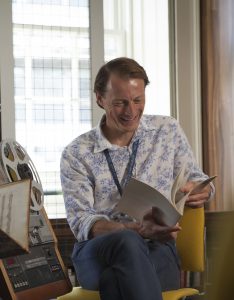
II am an Audio-Visual Digitisation Technician for the School. I have been digitising the collections here for over 10 years, I also manage our digital file storage and contribute to our databases and technical systems. I came from a background working in community radio and commercial recording after studying Electrical Engineering.I enjoy working with and maintaining the fragile legacy audio and video carriers and the various devices that allow us to play them and transfer them to new (and hopefully) future-proof formats to ensure they can be accessed safely for many years to come. As a musician I also particularly enjoy hearing performances of traditional music and songs.
Louise Scollay, Archive & Library Assistant
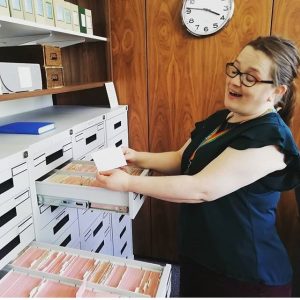
I’ve been Archive & Library Assistant since SSSA opened the public service in 2017, but my history with the School goes back further as I studied there for my Scottish Ethnology degree and graduated in 2011.
It is an absolute joy working at the front-facing services of SSSA; I love seeing people connect and engage with our collections, particularly our sound archive, it’s like watching someone open a treasure chest! It’s hard to choose favourites amongst the collection, but I have a deep connection to our material from Shetland.
Kirsty Stewart, Archivist

I am Kirsty Stewart (Ciorstag ‘sa Ghàidhlig) and I’ve been the archivist for the School of Scottish Studies Archives, one day a week, since we re-opened in 2017. I have a degree in Gaelic Studies from Aberdeen University and did my postgraduate in Archival Studies in University College Dublin, next door to our old friends at the Irish Folklore Archive.
Initially my role was to re-establish the search room service and since then have focussed on managing the needs of our library/special collections and the manuscripts, in particular our administrative records, which tell the story of our 70 year history. One of my favourite things about SSSA is hearing different accents through recordings or their transcripts, these diverse voices that tell the story of our nation.
This year is our 70th Anniversary and we look forward to sharing events and content with you. If you would like to be kept up to date with our posts then please subscribe to get new posts straight to your inbox. You can find the subscribe box at the bottom of the page.
You can also follow us on twitter too https://twitter.com/EU_SSSA
New Resources

Throughout the year the Law Librarians purchase new materials – sometimes following requests, and other times to ensure that new editions of established and key texts are available to staff and students. This part of our work has been especially busy this last year as learning and teaching has gone online!
Requests are received from students, staff and colleagues from across the Law School. Some are related to specific courses, but many are to support the research undertaken by staff and students.
We thought we would take this opportunity to let you know about a few of the new items we have recently ordered and received in:
- Routledge Handbook of Critical Criminology (2018)
- Principle and pragmatism in Roman law (2020)
- Commercial Trusts (D’Angelo, 2014)
- High Crimes and Misdemeanors: A History of Impeachment in the Age of Trump (2019)
- Necessary evil: how to fix finance by saving human rights (2018)
- Shareholder Activism and the Law: The Future of Us Corporate Governance (2020)
- Law Enforcement in the Age of Black Lives Matter : Policing Black and Brown Bodies (2018)
- Copy This Book! : What Data Tells Us about Copyright and the Public Good (2021)
- The Internal Market 2. 0 (2020)
- Llm Dissertation : How to Maximise Marks for Your Practice Focused Dissertation. (2018)
- Records of the Kurds: territory, revolt and nationalism, 1831-1979. (2015)
This last item is a 13 volume set comprising of around 9000 pages, making it an incredibly helpful resource on the topic of the history of the Kurdish people. Having access to this material makes Edinburgh one of a select number of universities who give access to their students and staff to this unique resource.
Staff and students can place requests directly using the online forms available on the Library webpages.
If we cannot purchase the item (may be it is an older edition, out of stock, or not available in the online format you want) then we recommend you use the Interlibrary Loan Request Service which allows us to try to source access from other libraries or academic institutions.
If you would like us to consider a subscription, or you want to discuss your request further you can email us in the usual way using law.librarian@ed.ac.uk.
Happy reading!
Spotlight on Secret Files from World Wars to Cold Wars
Are you interested in British intelligence, foreign policy, international relations, and military history in the 20th century? Then Secret Files from World Wars to Cold Wars: Intelligence, Strategy and Diplomacy may be just what you’re looking for.
Secret Files from World Wars to Cold Wars provides access to British government secret intelligence and foreign policy files from 1873 to 1953, with the majority of files dating from the 1930s and 1940s.

You can access Secret Files from World Wars to Cold Wars via the Databases A-Z list or Digital Primary Source and Archive Collections guide. Read More
Art and The Playfair: Speaking to Absent Volumes, or How to Find Books in the Library, Old Style
During the academic year 2019-20 Rare Books worked with a group of third year students from Edinburgh College of Art. The project was to produce an artist’s book in response to the collections and space of the Playfair Library room in Old College, the home of the University Library from 1827 until it moved to George Square in 1967. The project ended with a photoshoot in the Playfair a few days before the country was put into lockdown in March 2020. The project website, which shows all the student work, was delayed by the pandemic, and went live early in 2021.
The challenge the students were set was to make reference to at least one book which had at some time in its history been on the shelves in the Playfair Library. To achieve this they had to get to grips with the records of the collection when it was there.
This really was a challenge. Read on find out why…
How to Arrange an Old Library
Like many libraries from the Middle Ages until the nineteenth century, the Playfair is a long, narrow rectangle, with windows on both sides, and bookcases projecting into the room at right angles. It is a particularly grand and elaborate example, having an upper, gallery level, which continues the pattern right up to the ceiling.
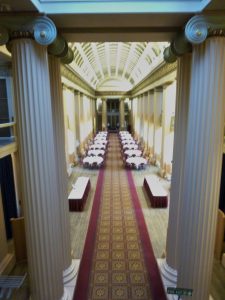
The books were arranged by what is called ‘fixed shelf location’, meaning that each book had a designated place on a particular shelf. Each bay was labelled with a letter of the alphabet; each shelf was numbered; and the books on each shelf were numbered. This set of three characters was written in the books and in the catalogue, as the means of finding them. Modern libraries tend to use a subject classification scheme, which arranges the books in relation to one another in a linear sequence, whereas in the Playfair the arrangement of the books was defined by the architecture of the library. It was three-dimensional rather than linear; there were relationships between books on shelves above, below and opposite, as well as next to one another. Larger books were likely to be on a bottom shelf and smaller ones in the upstairs gallery.
The books were grouped by subject into the different bays of the library. For example:
A: Bibles and the Church Fathers (Religious books were put first)
G – K – Medicine
L – Natural history
O – Maths and physics
P – Geography and topography
S – Poetry and literature, including songs with music
T – Language; grammars etc.
Although all the books left the Playfair Room in 1967, many of them are still arranged according to the Playfair shelfmarks. Divorced from their original location, these have been run together to form a series of sequences in the Centre for Research Collections’ stores. It is possible to imagine these back onto the now empty shelves in the Playfair, and get a spooky sense of what it must have been like when it was in use.
However, quite a lot books which were at some time in the Playfair have since been given new shelfmarks. Some newer books went into the open-access classified sequences in the library in George Square; others have been moved into different sequences within Special Collections. Books were moved around even when the library was in Old College, and not every book the library owned in the nineteenth century has survived to the present.
How to find Anything
So, for our students to be able to find books which were in scope for their project, they had to be able to tell the difference between Playfair shelfmarks and those from elsewhere in the library, use both the catalogues which record where the books are today and those which record the collection when it was in the Playfair, to detect books which have moved. If they wanted to base their work on an entire shelf, or other grouping, which was something we suggested they might do, they also needed the records of how the books were arranged.
The easiest place for them to look for ideas was the main University library search tool, the familiar discovered.ed.ac.uk – which will find records matching any words typed into it, and can limit its search to anything currently in Special Collections (choose “Special Collections – Main Library” and “Special Collections – Centre for Research Collections” for books which used to be in the Playfair)
So far, so familiar. But a lot of the old Playfair books are not catalogued on DiscoverEd at all, and it doesn’t help much for anything which has changed shelfmark.
The next easiest place to look is in the library’s last paper catalogue, the Guardbook which was closed when computers were introduced, in 1985. This is still used to find anything which isn’t online, and has been digitised. It was originally on typed sheets of paper in looseleaf binders. Typed only on one side of the sheet, additions were made on narrower sheets, bound to face the page they were adding to. The whole catalogue is arranged by author, while anonymous works, such as the Bible, go by title.
The experience of using it is very different from searching on a computer. You need to know what you are looking for and you need to be able to look it up in alphabetical order (The trick was to use reference books and bibliographies before trying the catalogue). On the other hand, once you get to the author it is easier than on the computer to browse, to assess at a glance what the library has, to discover the title wasn’t spelt the way you were expecting, or to spot what you wanted in a different version, or as part of a set.
Even the Guardbook records the collection as it was twenty years after it left the Playfair. To reach back to the Playfair’s heyday there are older catalogues. The easiest to use is the one published by the university in three volumes between 1918 and 1923
This is more manageable to use than the Guardbook, even in its online version, and from the point of view of Art and the Playfair, shows the Playfair room in full use, and contains much less material which was out of scope for the project. There are quite a few spare copies of this around, so one was sent back to the studios at ECA, for the students on the project to use.
There was one final, really scary, set of documents for the students to get to grips with…
How Not to Lose Anything in an Old Library
Catalogues, which allow you to find individual books in the library, are only one of the librarian’s tools for managing the collections. The other vital tool is a shelf list; an inventory arranged in the order the books are shelved. This makes it possible to check that nothing is missing, records exactly what is in each volume, if several things are bound together, and helped to keep track of where there was space on the shelves and where new books could most logically be added.
The last set of shelf lists for the Playfair was handwritten in the early twentieth century. These are still in use, though we now work on a digitised copy. They look like this:
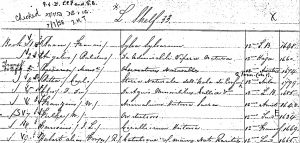
For Art and the Playfair these allowed the students to explore some of the spatial relationships between the books stored in the room, although the handwriting, the crossings-out, and unfamiliar format presented a challenge.
And Then to Make Art
When we set up Art and the Playfair we had no idea how the students would handle this complicated and unfamiliar collection of documents, which as librarians we navigate on a daily basis and take for granted, but were very keen that they should engage with the records and the idea of the library as a space.
As it turned out, they rose to the challenge magnificently. Their biggest initial hurdle was getting over the surprise that they were not only allowed, but being encouraged, to work with very old books. But once they got started they all managed to find something which spoke to their own interests, and then produce something original and true to their own creativity. We were delighted that few of the books they chose were familiar to us, that some of them really got to grips with the difficult shelf lists, and that so many of them picked up unexpected features of their source material and took it to totally new places.
We wish all of the group well as they approach the end of their degree course this year, and make plans for the future.

Five legal news resources in Scotland

Image from kalhh on Pixabay
Always keen to show you that librarians know about more than just books, we like to highlight a range of resources for legal information here on the Law Librarian blog. This week we’re bringing you links to five organisations and that can help you keep abreast of current issues in Scottish legal news.
A website: The Law Society of Scotland: News & Events page
The Law Society of Scotland is not only the professional body for over 12,000 Scottish solicitors, but also a valuable site for keeping up-to-date with recent Society News, Legal News, Blogs and Publications, and much more! If you haven’t already got this page bookmarked we highly recommend it.
An email newsletter: Scottish Legal News
Subscribing to the free daily newsletter from Scottish Legal News brings you highlights and current awareness bulletins directly to your inbox. With everything from training opportunities and digests of notable cases, to job adverts and (our personal favourite) the ‘…and finally’ articles, this service is worth its weight in gold. Follow them on Twitter @ScottishLegal.
A YouTube channel: Edinburgh Law School
Whether you subscribe for the promotional videos from your fellow students talking about their experiences at the Law School, or you want to watch back particularly interesting recordings such as the recent Crime, Justice and Society Seminar on ‘Rap lyrics in criminal trials: What does the case law tell us?’, you can be sure to find something interesting and relevant to your study on the School channel. You can, of course, follow the Law School updates on Twitter @UoELawSchool. CJS are also on Twitter @UoECJS.
A podcast: The Scottish Feminist Judgments Podcast
The Scottish Feminist Judgments Project is part of a global series that aims to imagine how important legal cases might have been decided differently if the judge had adopted a feminist perspective. Coordinated by Sharon Cowan (University of Edinburgh), Chloë Kennedy (University of Edinburgh) and Vanessa Munro (University of Warwick), you can now listen to four excellent episodes of feminist analysis of Scottish judgments via Media Hopper or Apple Podcasts. More information about the project can be found on the website or their Twitter feed, @ScottishFemJP
A student society: Criminal Law and Criminal Justice Society
CrimSoc are a group led by students who are passionate about providing university-wide opportunities to all students interested in exploring all aspects of criminal law and justice. They seek to provide useful information about both legal and non-legal careers as well as regular discussion of current topics of interest with guest speakers. Students can find out more about joining the society using the contact information on the EUSA website, their Facebook group, or by following them on Instagram @uofecrimsoc.
We hope you’ve found something of interest to your studies or your professional development in the above list. If you regularly get your Scottish legal news from another source please leave a comment to tell us where! Alternatively you can contact us by emailing law.librarian@ed.ac.uk.
Using the Library remotely – accessing material you need
With many of you currently not in Edinburgh and access to our Library’s print collections severely restricted, knowing the options for accessing material that isn’t available online or that the Library doesn’t have in its collections has become increasingly important.
While the Covid-19 pandemic has reduced the number of options available to you, there are still possibilities existing that you can take advantage of.
Check DiscoverEd
Request a Book (RaB)
Scan & Deliver
Click & Collect
Inter-Library Loans (ILLs)
National Library of Scotland and other libraries
Open Access (free stuff)
Check DiscoverEd
It’s really important that you check if the Library has the item or material you are looking for in its collections, whether online or in print. Searching Google or Google Scholar will not give you this information (even if you have set up Google Scholar for full text access). DiscoverEd will show you what we (the Library) have. Read More
Dissertation Festival 2021
From 8 – 19 March the Library is running an online Dissertation Festival. The events taking place during this two week period will highlight what the Library can do for you to help you succeed with your dissertation.

In this blog post I am going to focus on the sessions that might be of particular interest to dissertation students (undergraduates or postgraduates) in the School of History, Classics and Archaeology (HCA). However, to find all sessions available and to book on take a look at the Dissertation Festival guide. Read More
Launch of new book on Sir Walter Scott
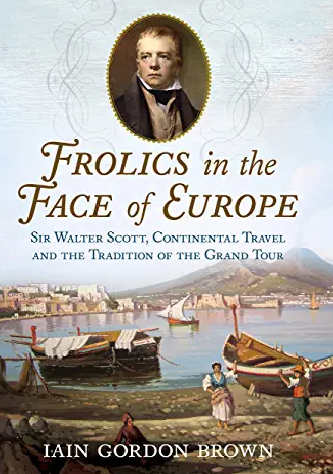 On the occasion of the commemoration of Sir Walter Scott 250th birthday anniversary in 2021, a new book has just been published which will soon be added to the Library collection:
Iain Gordon Brown, Frolics in the Face of Europe : Sir Walter Scott, Continental Travel and the Tradition of the Grand Tour (Fonthill Media, 2020. ISBN: 9781781558096)
The online book launch will take place tomorrow Wednesday evening at 6.00pm, 24th Feb 2021. The event is free and will be in the form of a webinar with Ian Gordon Brown (author) and Professor Joseph Farrell. For more information and to join the event, please visit: https://iiclondra.esteri.it/iic_londra/en/gli_eventi/calendario/2021/02/frolics-in-the-face-of-europe-sir.html
See also:
Collections
 Hill and Adamson Collection: an insight into Edinburgh’s past
My name is Phoebe Kirkland, I am an MSc East Asian Studies student, and for...
Cataloguing the private papers of Archibald Hunter Campbell: A Journey Through Correspondence
My name is Pauline Vincent, I am a student in my last year of a...
Hill and Adamson Collection: an insight into Edinburgh’s past
My name is Phoebe Kirkland, I am an MSc East Asian Studies student, and for...
Cataloguing the private papers of Archibald Hunter Campbell: A Journey Through Correspondence
My name is Pauline Vincent, I am a student in my last year of a...
Projects
Cataloguing the private papers of Archibald Hunter Campbell: A Journey Through Correspondence
My name is Pauline Vincent, I am a student in my last year of a...
Archival Provenance Research Project: Lishan’s Experience
Presentation My name is Lishan Zou, I am a fourth year History and Politics student....