Home University of Edinburgh Library Essentials
April 5, 2026
SSSA In 70 Objects: The Pictish Arts Society
Written by Stuart McHardy
In 1988 the School of Scottish Studies began to host gatherings of the Pictish Arts Society, both its committee meetings and its public lectures. The Society, formed to further interest in, and study of, all aspects of the Picts was originally conceived by myself and the American-born artist Marianna Lines.
Our presence was facilitated by linguist David Clement who was seconded to the School from the Celtic department. I had kept up a tenuous connection with the school since my undergraduate days. The three of us were joined as the inaugural committee by ethnologist Bob Brydon, historian Graeme Cruikshank, lawyer George Fraser and knitwear designer Heather Richard.
In 1992, due to a considerable level of public interest, our initial Newsletter developed into the PAS Journal, which presented a wide range of academically sound articles from a range of contributors, including archaeologists, historians and linguists, as well as professional artists, as the original mission statement of the Society had specifically laid emphasis on the corpus of Pictish Art and its potential to stimulate new work in the modern world.
The open meetings in the Conference Room were always lively and stimulating and within a couple of years the Society began to stage annual conferences, which were initially also held in the School, and which originally included exhibitions of contemporary Pictish inspired artwork. Over time the conferences began to be held in other locations, most of which would generally be considered to be somewhat more appropriate than Edinburgh, even if tradition tells us that Arthur’s sleeping companions inside his Seat in Holyrood Park, are Picts. This highlighted the situation that many members had to travel extensively to come to Edinburgh and in 2000 the PAS officially moved from 27 George Square to the appropriate location of Pictavia near Brechin, with the support of Angus Council through the commitment of my successor as President of the Society, Norman Atkinson.
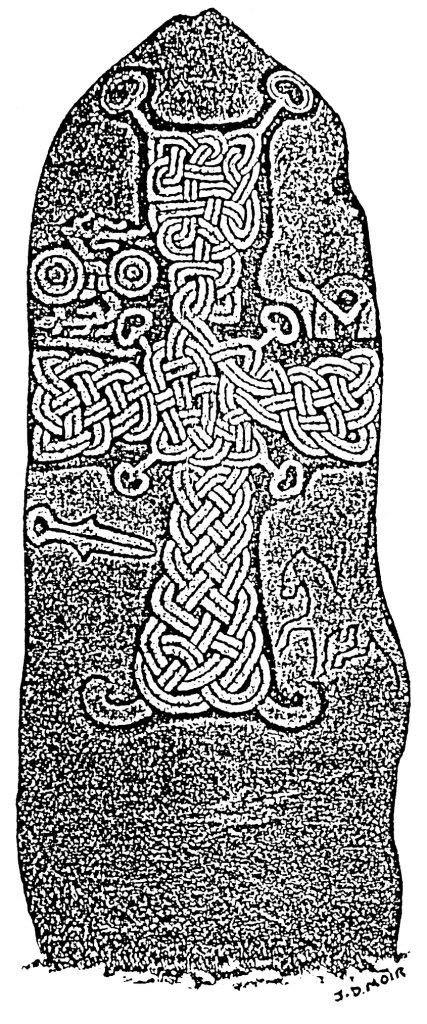
illustration drawn by J D Moir and used with kind permission
Since then, the society has continued to hold regular meetings and conferences, currently on Zoom, and to publish a quarterly newsletter, the Journal having ceased publication after 17 issues. At the time when the PAS formed there were no books on the Picts in print and it is testament to the work of the membership that nowadays there are so many works available, both reprints and new works, and it is likely that the efforts of the early group in George Square has helped ensure that today’s Scottish archaeologists ad historians are much more involved with matters Pictish than was the case when first we met. Sadly, since our early days in the School of the Scottish Studies many of the original enthusiasts have passed on, including in 2018 our co-founder Marianna Lines, whose vibrant and colourful interpretations of Pictish Symbol Stones were so effective in bringing so much of Scotland’s ancient culture to wider public notice.
Stuart McHardy is a Teaching Fellow, Centre for Open Learning, University of Edinburgh
Musselburgh
2021
Information:
The Pictish Arts Society logo is designed by Nick Simpson and the illustration of the stone is by JD Moir. We have used these with permission, please do not reproduce.
http://www.thepictishartssociety.org.uk/
The Pictish Arts Society Newsletter has an open access archive here: http://www.thepictishartssociety.org.uk/newsletters/4593763668
Dissertation Festival Blog: How to use the library remotely for your dissertation

Introduction
It’s time for the second blog! These dissertation festival blogs are an opportunity for me to share my thoughts on the Dissertation Festival Events I have attended. For those who don’t know, the Library’s Dissertation Festival is a collaborative effort from the Library, Digital Skills department and Institute of Academic Development (IAD). They have shared a series of virtual events to provide students with the knowledge and resources to make the most out of their dissertations or theses. To find out more about the festival, click HERE, and you can see my previous blog HERE.
The Session
Hopefully, you should all be aware of the University Library and its associated buildings. Something you may not be conscious of are all the online and offline resources they have on offer. I must admit, even I (a student intern within the Library and University Collections department) am not 100% sure what “RaB” means or that you could easily filter your results on DiscoverEd (see the image below). I learned that and more in the “How to use the Library remotely for your dissertation” event.
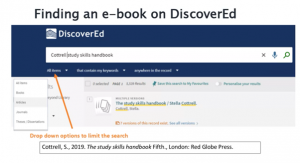
How to limit search options on DiscoverEd
The session began by covering the basics of accessing resources. For online materials, that meant a comprehensive tutorial on how to search on DiscoverEd and a discussion as to why you may need to use the University’s VPN to obtain specific resources. Print was a little bit trickier to communicate (understandably), but directions were given to regularly check the Library Services Update page for the latest information in response to Government Guidelines.
For finding resources about a particular research area, Library Databases are a great place to go. They can give you a window into the literature you are interested in and contain specialist resources produced by experts. If you are unsure what you are looking for, the Library has made searching easier as you can browse databases based on by subject or as a complete A-Z list!
Now, I am sure at this point you are wondering what is “RaB”? During the session, I learned that if the Library doesn’t have the book you require, or it is only available as a print version, you can … Request a Book (RaB). It is such an excellent service that I am sure be beneficial for anyone, not only those completing their dissertation. Another valuable service feature offered by the Library are Inter-Library Loans (ILLs) which enable you to request digital copies of articles and book chapters from other libraries!
Thoughts and Conclusion
If I were to summarise this session in just one saying, it would be “It’s never too late to teach an old dog new tricks”. During the event, I was pleasantly surprised by all the new knowledge I gained, especially about DiscoverEd – a service I have been regularly using over the past 4 years! I was also reminded about other fantastic resources and features supported by the Library, which would help you with your dissertation, thesis, and even general studies!
If you are interested in the session and want to check it out, you can find it HERE!
Thanks for checking out the blog, see you at the next one.
SSSA in 70 Objects: Hò Ro Gur Toigh Leinn Anna
Contributor: Peigi Anndra MacRae, Mairi Anndra MacRae
Fieldworker: Donald Archie MacDonald
Reference: SA1964.062
Link: http://www.tobarandualchais.co.uk/en/fullrecord/104487
Response: Dr Alison Mayne
It’s extremely hard for me to pick one object from the School of Scottish Studies Archives. I first discovered its treasures when Louise Scollay found a lever arch file full of clippings and letters about Cleekwork and she asked me to make a cleek glove based on a pattern found there. This work developed into a Handmaking in the Archives event for the University of Edinburgh Festival of Creative Learning.
Unsurprisingly perhaps, my interest in the SSSA focuses on the world of textiles and wool processing in particular. The archive is packed with images, stories and songs of sheep, shearing, spinning and the transformation into cloth through knit or weave. Louise herself selected a Barra waulking song as her favourite object, celebrating the community preparation of tweed. Coming in a close second for my own favourite is the Tom Anderson 1960 recording of Rosabel Blance singing her own composition of ‘Roo the Bonny Oo’ which magically replicates the sound of a burring spinning wheel.
However, I knew my special SSSA object had to come from Peigi Anndra MacRae. With her sister, Mairi, Peigi opened her home to a young Margaret Fay Shaw in the late 1920s and introduced her to the crofting way of life, traditions, stories and music of South Uist. After her marriage to ethnologist John Lorne Campbell, Shaw remained fast friends with Peigi Anndra as she developed the work which would become Folksongs and Folklore of South Uist.
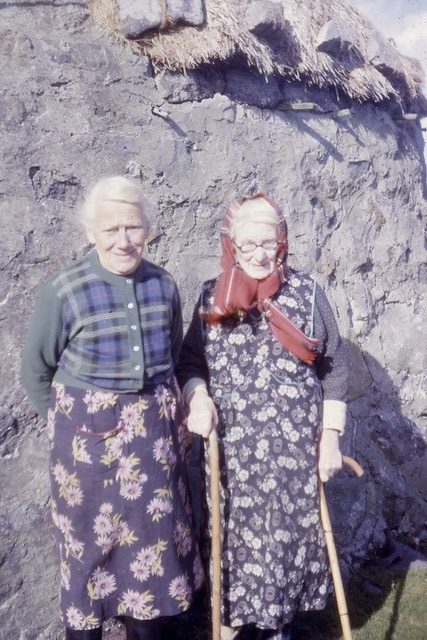
Mary and Peggy MacRae
Image used with kind permission from Alex MacRae.
The relationship between folklorist / ethnologist and contributor is fascinating: There are ethical concerns we are more aware of now which can make the uneven power relations between collector and singer feel uncomfortable; the mantle of expertise may have been borne by the fieldworker, but the incredible depth of knowledge lays with the singer or contributor. In many ways, the interest lies for me in the process of collecting, not necessarily the item itself.
Peigi Anndra’s singing of Hò Ro Gur Toigh Leinn Anna was recorded by Donald Archie MacDonald (who worked at the SSSA between 1962 to 1994) in 1964. It tells of a woman sad that she is unable to take part in waulking the tweed and was composed by Mrs Catriona Campbell of South Lochboisdale.
What I love is the uncertainty of memory, repetition and occasional pauses of Peigi Anndra’s singing, the quiet interjections of MacDonald where she forgets the words, Mairi calling corrections from across the room, the whirr and click of the reel to reel tape. Recordings like this are not only significant in recording traditional song and ways of knowing, but in reminding listeners and researchers down the years of the process of recording. It is a precious reminder that we should not forget the relationships and labour of collecting which have constructed the archive.
Dr Alison Mayne is a researcher in everyday textiles and wellbeing, with additional interests in digital communities and design for older people. She holds awards from Women’s History Scotland, The Pasold Fund and is a University of Glasgow 2020-21 Visiting Library Fellow, supported by the William Lind Foundation.
Image used with kind permission of the MacRae family. Please do not reproduce.
Further resources
There are further recordings from The School of Scottish Studies Collections featuring Peigi and Mairi MacRae. Many of these are available to stream via Tobar an Dualchais.
http://www.tobarandualchais.co.uk/en/searchByTrackId?id=SA1964.062
http://www.tobarandualchais.co.uk/en/searchByTrackId?id=SA1965.118
http://www.tobarandualchais.co.uk/en/searchByTrackId?id=SA1966.081
For more information about Margaret Fay Shaw and her relationship with the MacRaes visit The National Trust: https://www.nts.org.uk/stories/stories-songs-and-starlings
Queering the Archive with Rufus Elliot from OVER/AT and the new EP, “Folk’s Songs”
As part of the Queering the Archive project, we will feature conversations and podcasts with various people undertaking work and projects that feature LGBT+ voices and representation. My first conversation is with musician, Rufus Elliot, about the work with OVER/AT and the new EP, “Folk’s Songs”.
“FOLKS’ SONGS is a new E.P. from the trans music-making world of OVER/AT. It comprises three exclusive, newly commissioned audio pieces by three Scotland-based trans, non-binary, or other gender-minority artists: new songs for/by/with the Folk. It is unlike any trans music-making which has come before it in Scotland.”
Rufus is a composer and musicians and founder and producer of OVER/AT, “a trans nonbinary and gender diverse music making world” that works directly with Scottish and Scotland based trans, nonbinary, and gender diverse musicians. OVER/AT is designed to empower and create imaginative responses from trans voices. It commissioned three artists to make pieces and they each made completely different responses to that idea that made up the EP of “Folk’s Songs”.
The EP is an incredibly visceral record that takes you through the trans, nonbinary, and gender diverse music experience through the voice and its eclectic sounds. The EP explores the idea of speaking out, the voice, and trans voices and spaces and being empowered to explore our voices. The voice is something that can be so personal to each trans experience and the EP is an example of how strong the trans voice and creativity is, as well as showing how trans, nonbinary and gender diverse Folk can use the voice and create spaces in the music scene and beyond. It was a joy to chat everything OVER/AT and the EP with Rufus and delving into the influences of the EP and its own work, as well as trans and queer representation in music and elsewhere.
Listen to the podcast here:
https://edin.ac/3iuhxPH
“Folk’s Songs” was released March 26, 2021.
The work was made possible by Sound and Music’s Composer-Curator programme, and supported by Creative Scotland. Composer-Curator is supported by Arts Council England and PRS Foundation.
Find further information on OVER/AT and purchase “Folk’s Songs” on Bandcamp here: https://over-at.bandcamp.com/ Access the learning resources here: https://www.ambf.co.uk/learning-resources
Find more about Rufus here: https://www.ambf.co.uk/
Written by Elliot Holmes.
Elliot is one of the Archives and Library Assistants at the School of Scottish Studies Archives and uses He/Him pronouns. You can also find him on twitter @elliotlholmes
Follow @EU_SSSA on twitter for updates and sharing our collections.
Please do feel free to get in touch with Elliot to take part in a podcast or for questions on research and resources.
Copyright disclaimer: Copyright belongs to those interviewed and recorded and there is strictly no re-use for publication and broadcast of this recording or blog text. Quotation and para-phrasing from the recording and/or blog post is also prohibited If you wish to use the recording for private study and research and any potential other uses, you must get in touch with scottish.studies.archives@ed.ac.uk for permissions and access.
In Lyell’s Own Words
This month we hear from Lyell Project Archivist Elise Ramsay and Project Volunteer Erin McRae. Elise and Erin each reflect on their recent progress transcribing the Sir Charles Lyell notebooks using ground-breaking AI and machine learning, and their work together to develop this incredible AI tool for further use with the Lyell collections.
Elise Ramsay
Lyell Project Archivist
For me, the written word is the most captivating and characterful element of the Sir Charles Lyell collections. When reading Lyell’s own words on the page in graphite and ink, I can tell when he is writing from a desk, or in the field. In decoding his idiosyncrasies, I have come to understand a bit of the man himself. Understanding Lyell’s handwriting is the key to opening up this internationally significant collection. But it is also the first barrier. Lyell’s handwriting is of his time; often liberally abbreviated, topic specific, and faded. Complete transcription of the collection is paramount to accessibility, and recently, we have made some exciting progress towards this goal.
In early March 2021, the Charles Lyell Project team took part in hosting the EDITOR Transcription virtual workshop. In preparation for the workshop, two digitised notebooks from the Lyell collections (MSVII and Notebook No 4) were selected to be trialled with the Transkribus platform. Over 8 weeks, EDITOR project interns Evie Salter and Nicky Monroe transcribed these notebooks word for word. With this data, an algorithmic model of Lyell’s handwriting was created, effectively teaching Transkribus to recognise Lyell’s words on the page, and to decipher them automatically. This innovative work by the EDITOR Team, has revolutionised our systems and methods of cataloguing. Already we can see this balance of machine learning and human input has introduced new efficiency (and enjoyment!) to the task of transcription.
To build on this momentum, we were delighted to offer a remote volunteer opportunity aimed at trialling the newly created Transkribus model and testing the many features Transkribus offers. In this capacity, Erin McRae joined us in March, contributing to key cataloguing efforts and scoping the features of Transkribus for further use with the collections. Erin is a recent graduate from the MSc in History programme at the University of Edinburgh and holds an MA in Archives and Records Management from University College Dublin in Ireland. In only two months, Erin has produced tremendous material, and we are indebted to her. Here, Erin reflects on her first impressions of the Sir Charles Lyell collections and using Transkribus:

Erin MacRae
Lyell Project Volunteer
When I think of Sir Charles Lyell, I see a man in constant motion and possessing a thirst for knowledge that knew no boundaries. I can picture him observing the volatile Mount Etna, or immersed in the identification of mollusc species, or exploring geologic formations and petrified fossils millions of years old. I imagine him pausing to scribble down his observations in notebooks in his own inimitable style (a combination of English, French, Italian and Latin), so he wouldn’t miss any detail.
The detail of the collection is of untold value to researchers and presents interesting challenges as we describe the collection. In addressing these challenges, the Transkribus platform is an invaluable tool.
Transkribus is “a comprehensive platform for the digitisation, AI-powered text recognition, transcription and searching of historical documents – from any place, any time, and in any language.”1 Using the algorithmic handwriting model developed on the EDITOR project, we were able to upload more raw material from the Lyell collections to the Transkribus platform. In my recent work with Sir Charles Lyell’s notebooks, I found that Transkribus was able to decipher Latin species names with which I was unfamiliar. This saved me a significant amount of time and gave me the ability to transcribe much faster. An example of this occurred when Transkribus identified “Fissurella graeca”.2 A species of mollusc, this name has since been replaced by the accepted name “Diodora graeca”3 . It is remarkable that it was correctly interpreted by the software in the first place.
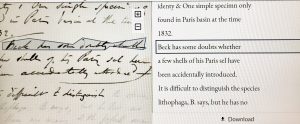
An example of transcription output from the Transkribus platform.
From Sir Charles Lyell Notebook, No. 65
(Ref: Coll-203/A1/65) – (with apologies for the poor quality image).
The transcriptions that Transkribus produces require minor to moderate spellcheck amendments, primarily where vowels are mistaken. There were some instances of errors in phrases, names, and once a whole line of text. In this case I transcribed this line myself which I had done previously with indexes in two other notebooks. These issues are minor and they do not detract from the immense amount of time I saved using Transkribus compared to transcribing without the aid of the algorithmic model. In particular, we were all struck by the accuracy of the model in recognising and deciphering antiquated species names. This was invaluable and changes the role of the transcriber.
The overall benefit of the Transkribus software is that it is helping us to develop a much more comprehensive approach to describing and interpreting the Sir Charles Lyell Collections. To a much greater degree than previously possible, we can document and unlock the life and travels of this principal figure in the evolution of the discipline of geology.
Elise Ramsay, Lyell Project Archivist
Erin McRae, Lyell Project Volunteer
Sources and further information:
1.“Transkribus.” Read Coop. Accessed April 19, 2021.
2. “Fissurella graeca (Linnaeus, 1758).” WORMS: World Register of Marine Species. Accessed April 19, 2021.
3. Ibid.
You can learn more about our revelatory transcription work on the Sir Charles Lyell Collections, part of the EDITOR project, on YouTube:
Editor Transcription Workshop: Day 1/Session 3 – Video 3 of 10 – YouTube
Editor Transcription Workshop: Day 2 /Session 3 – Video 6 of 10 – YouTube
Dissertation Festival Blog: So… what is a systematic review?
Introduction
Welcome to the first of three blogs, where I document my Dissertation Festival Experience. For those who don’t know, the Library’s Dissertation Festival is a collaborative effort from the Library, Digital Skills department and Institute of Academic Development (IAD). They have come together to host a series of virtual sessions spanning over two weeks, providing students with the knowledge and resources to make the most out of their dissertations. Think Tomorrowland, Glastonbury and Coachella but online, free and hosted by the University of Edinburgh. So not quite the same. However, the Dissertation Festival is a fantastic opportunity to learn tips and tricks to help you write, reference and uncover what support is available to you at the University.
The Session
The first Dissertation Festival session I participated in was titled “What is a Systematic Review dissertation like?”. I decided to attend because I was interested in finding out how systematic reviews (SR) differed from other dissertation types. Luckily, this was thoroughly covered within the presentation. After the first 5 minutes of the event, I was able to explain that the goal of a systematic review; to answer a specific question in a topic area using reproducible review principles.
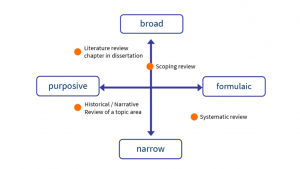
Slide from Dissertation Festival used to help illustrate where different review approaches sit
Other key points of the session include “The supporting principles of a SR” which highlighted the need for a pre-defined and detailed methodology. This was an important topic for me as I am typically more of a ‘go-with-the-flow type person when writing pieces of work. However, now knowing the aims of an SR, I am confident that is not the best strategy. Instead, you should develop a clear plan (in advance), have an inclusion criterion for studies you are considering, find ways to avoid bias and document all your SR activities.
Thoughts and Conclusion
I would recommend this session for those who are just about to carry out a dissertation or thesis and don’t know where to start. The presentation is designed to help you gain a basic level of understanding a SR and what it entails. For all, you indecisive people out there or those who don’t know what research method to use, the pros and cons list shown in the presentation can help you evaluate if this is the right research method for you! Throughout the session, there were lots of valuable pieces of advice and information given. There were also signposts for further knowledge items to help you further your understanding in your own time.
If you are interested in the session and want to check it out, you can find it HERE! Thanks for checking out the blog.
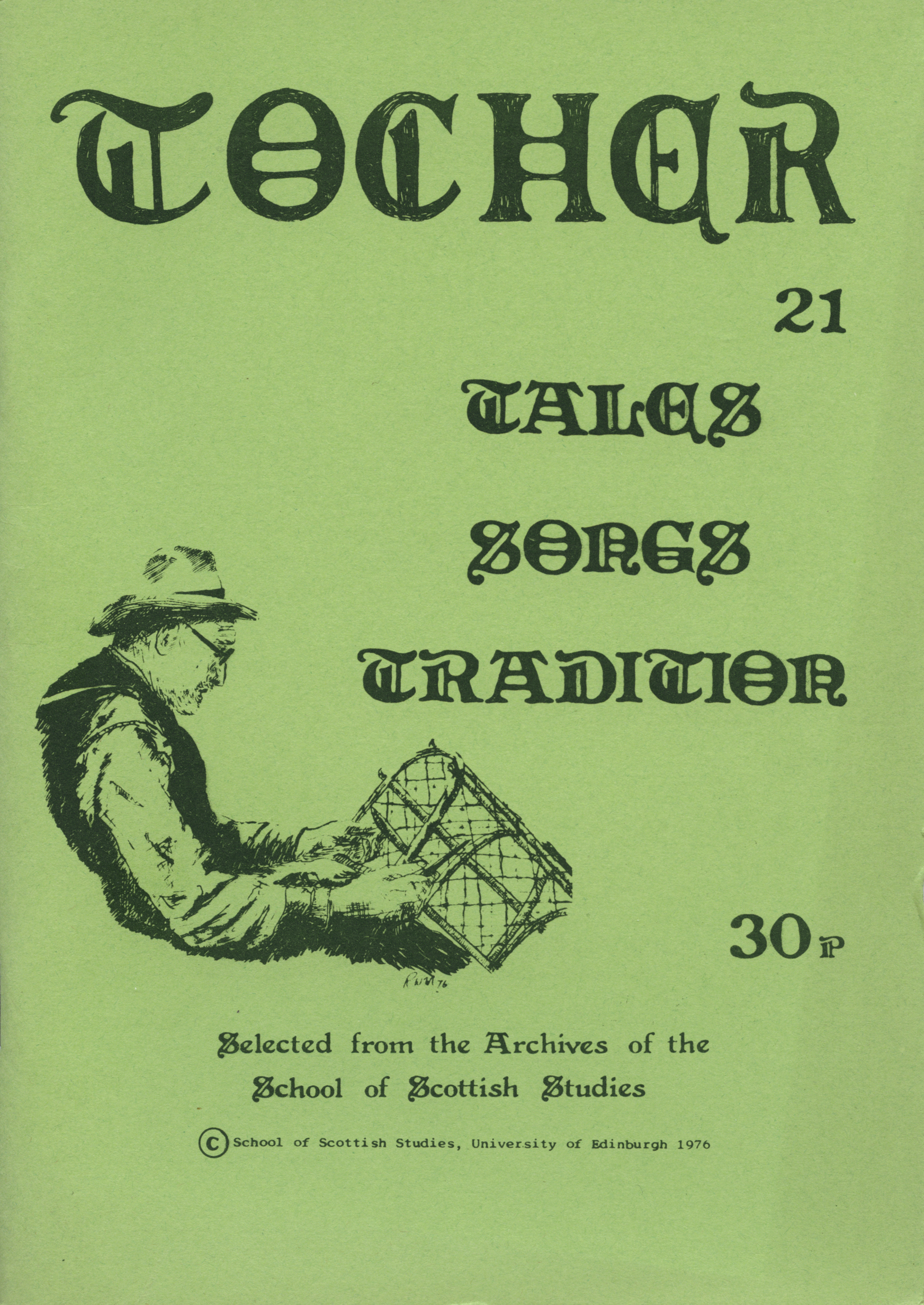
Tocher is 50
In addition to celebrating our 70th anniversary, our publication Tocher turns 50 too!
Named after the Scots word for dowry, Tocher was created in response to share fieldwork by the staff and researchers of The School of Scottish Studies (now the Department of Celtic & Scottish Studies). Material from the archive was transcribed using the interviewee’s own words; Gaelic was translated into English and regional dialects from the Scots language were also included.
We look forward to sharing some of the articles collected on the tales, songs and traditions of the last 50 years of Tocher and the recordings too. We also have some posts lined up with people who worked on the team to create Tocher.
Today we wanted to draw your attention to the blog of the Volunteers in Community Engagement at UoE Collections (VOiCE).
VOiCE are a student group of volunteers, who run a monthly newsletter, podcast and blog about the different collections, people and museums at the University of Edinburgh. We are delighted that today they are highlighting Tocher’s anniversary in their newsletter and we have some exciting plans afoot to collaborate further with VOiCE this year.
Please read and enjoy their post on 50 Years of Tocher, written by VOiCE member, and Celtic and Scottish Studies Masters student, Lily Mellon.

You can sign up to the VOiCE newsletter to be kept up to date with their projects and engagement with UOE collections: https://voiceblog1.wordpress.com/join-us/
VOiCE are on social media and you can find all their links here: https://linktr.ee/voiceed
You can listen to the VOiCE podcast – We’ve Got History Between Us – on Spotify.
Training and dissertation support

Image from Hermann on Pixabay
We know it’s that time of year where dissertation research is many students’ top priority so we have scheduled some events that we hope will help you prepare for the project ahead. These are all happening over the next few months and are released for booking about three weeks ahead of the event date. The first two are now live and the others will be coming onto the system over the next few weeks.
Wednesday 5th May 12.00 to 13.00– Dissertation support: Referencing for Law (bespoke for School, 50 minute session.)
This session is designed to help students learn to reference into larger research projects such as dissertations. We discuss specific referencing systems such as OSCOLA and Edinburgh Law Review, and highlight key issues which students at the School of Law will need to be familiar with. Booking open at
https://www.events.ed.ac.uk/index.cfm?event=book&scheduleID=46811 Now Live!
Wednesday 19th May 12.30 to 13.00 – Using Law Databases (Library Bitesize, 30 minute session open to all)
This session covers selecting the appropriate database for your needs, locating sources of full text information for legislation, case law and commentary and tips and tricks for how to record and revisit searches.
This session will focus on the use of Westlaw, Lexis UK and HeinOnline.
https://edin.ac/2FXpv1q Now Live!
Thursday 3rd June 09.00-09.30– How to Reference and Avoid Plagiarism (Library Bitesize, 30 minute session open to all)
This session covers the basics of referencing and why it is important, tools to help you : Cite it Right, EndNote Online
[Please note : this is a short introductory session. For detailed help on this topic, see Managing Bibliographies with EndNote, Using EndNote Online to Manage your References Sessions]
Link will be at https://edin.ac/2FXpv1q (Not yet live on events booking)
Wednesday 16th June 12.30-13.00 – Choosing a reference manager (Library Bitesize, 30 minute session open to all)
This session covers the differences between reference management products, using with MS Word and how to create references using the software.
Link will be at https://edin.ac/2FXpv1q (Not yet live on events booking)
We also continue to offer individual research support clinic appointments which are available to book via events bookings (http://edin.ac/3bvd78B). Our next available appointment is on the 20th May, and once a fortnight thereafter.
Alternatively if you have questions or would like for us to schedule an appointment for a different day, please get in touch by emailing law.librarian@ed.ac.uk.
Edinburgh Research Archive: March 2021
Edinburgh Research Archive: March 2021 • https://era.ed.ac.uk
March saw a record number of downloads for ERA, with a 10% increase on the previous best of May 2020 and a 27% increase on the then-record of March last year. It also saw a record number of unique items downloaded, albeit just 200 up on the previous best from January.
The total downloads so far this year has seen a 40,000 increase over last year, the number of unique items downloaded this year is 1.0% higher than 2020, and the percentage of the total stock that has been downloaded has passed the 50% mark within 3 months for the first time.
We follow-up to the November 2020 report looking at the three institutional repositories, as monitored by IRUS, with the most thesis downloads in 2020. Previously, we saw that the University of Edinburgh had the third most downloads but that it is likely to be overtaken by Oxford in the not too distant future. This time we’re breaking those downloads down imto percentiles, and seeing that the other two are significantly outperforming Edinburgh all the way through the 10% divides. White Rose sees significantly bigger multiples of its downloaded titles and Manchester fares better when the figures are adjusted for the size of the active collection. ERA works its tail a lot harder: it has both a bigger digital collection and gets a much higher proportion of unique titles downloaded at least once. Overall though, ERA seems to sell the facility to its users but not the contents.
SSSA in 70 Objects : A bird living in one of the houses on St Kilda, 1938
Chosen by Stephen Willis, Library Assistant, Centre for Research Collections.
On 29th August 1930, the island of St Kilda was evacuated due to its remote location and a dwindling population. The School of Scottish Studies Archives contains a photo album of St Kilda containing some bittersweet images of an ornithological visit made in 1938 showing the changes that had occurred.
The trip was made by naturalist and writer, Robert Atkinson, along with some people who had lived on the island, Neil Gillies, Annie Gillies and Finlay MacQueen and would return for the summer months. An image that caught my eye was of a wren, which had made its home in one of the abandoned houses.
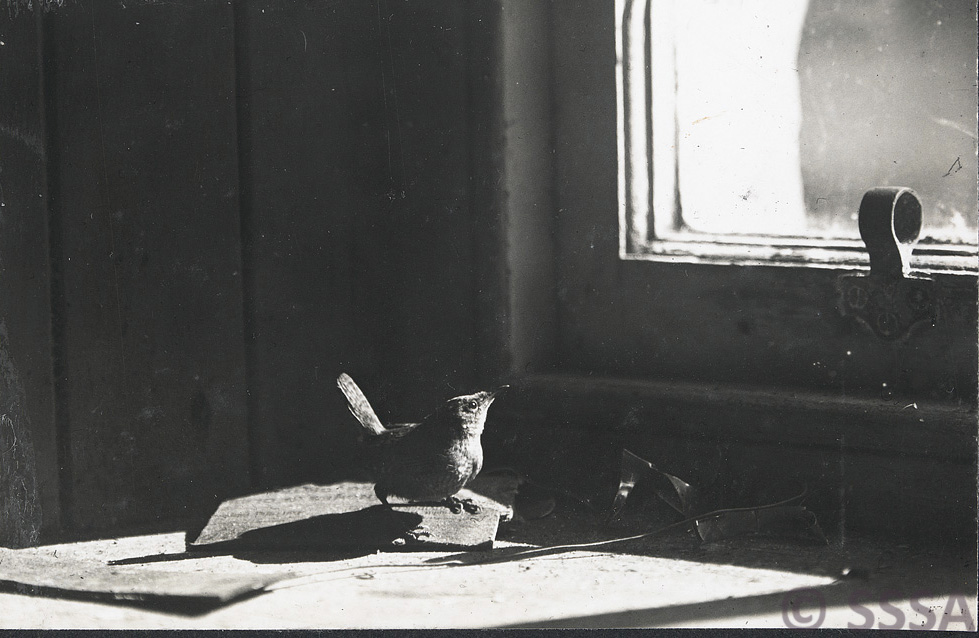
B332 Robert Atkinson Collection – © The School of Scottish Studies Archives
It is amazing to think of such a tiny bird now ruling the roost in a house made for people. It is a beautiful composition, with the sun shining through the window and the bird looking up. It is perched on what looks like debris from the house which has deteriorated without being heated and maintained for 8 years. From another image in the album it looks like one of the birds, possibly the same one was caught and is being examined, before hopefully being allowed to go on its way.
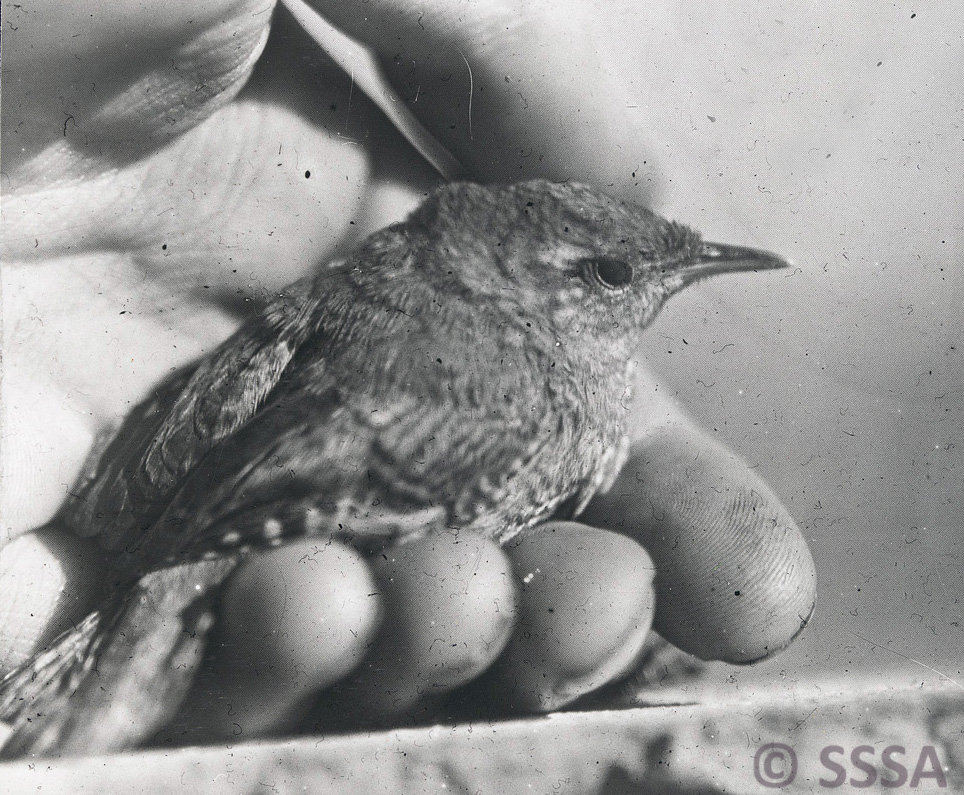
B333 – The Robert Atkinson Collection © The School of Sottish Studies Archives
(Description: St. Kilda: Wren Caught by Neil Gillies in One of the Houses, July 29th 1938)
The bird seems to be sitting fearlessly in one of the visitor’s hands so perhaps this was because it had no experience of people until that day. As Atkinson said in his book Island Going (first published in 1949),
‘St Kilda wrens left the nest for a world without natural enemies. Their only mortality was accidental’.
Like many people, I have been watching birds more during lockdown and I have noticed how quickly they look to reclaim places that they have been chased away from by human activity. I saw a bird that was walking on the road last May and a car drove over where it was standing. Fortunately, it appeared uninjured and flew away, but it had no road sense because there had been so few cars on the road to learn to be afraid.
Perhaps it is most fitting to end with some words from Robert Atkinson’s on the wrens, which complement the images well:
‘They were so near it was like examining a bird in the hand; their St Kildan characteristics of larger size and stronger, greyer markings, robuster bills and legs, were plain. Pleasant to watch the stealthy bright-eyed approach to the nest, the gabbled transfer of caterpillars, the gentle receipt of the white sac; and to hear the invisible whirr of wings amplified within the dark hollow of the cleit.’
Reference: Robert Atkinson, Island Going (Edinburgh, Birlinn, 2008), Chapter 20
You can browse images from the Atkinson Collection on The University of Edinburgh Image Collection website.
Collections
 Hill and Adamson Collection: an insight into Edinburgh’s past
My name is Phoebe Kirkland, I am an MSc East Asian Studies student, and for...
Cataloguing the private papers of Archibald Hunter Campbell: A Journey Through Correspondence
My name is Pauline Vincent, I am a student in my last year of a...
Hill and Adamson Collection: an insight into Edinburgh’s past
My name is Phoebe Kirkland, I am an MSc East Asian Studies student, and for...
Cataloguing the private papers of Archibald Hunter Campbell: A Journey Through Correspondence
My name is Pauline Vincent, I am a student in my last year of a...
Projects
Cataloguing the private papers of Archibald Hunter Campbell: A Journey Through Correspondence
My name is Pauline Vincent, I am a student in my last year of a...
Archival Provenance Research Project: Lishan’s Experience
Presentation My name is Lishan Zou, I am a fourth year History and Politics student....