Home University of Edinburgh Library Essentials
December 16, 2025
Decoloniality and the library (CILIPS Conference 2021)
On 7 June I attended a CILIPS conference session on Decoloniality and the library: the case at Goldsmiths, University of London, by Marilyn Clarke, Director of Library Services at Goldsmiths, University of London.
Marilyn started off with a quote from Desmond Tutu “If you are neutral in situations of injustice, you have chosen the side of the oppressor.” What can we do as librarians to be more than neutral?
At Goldsmiths, a Liberate our library working group was set up to look at this question. They started out by asking : do students see library spaces, books on the shelves, which looks like them? Do students see themselves when they come into the library?
New resources: Elgar 2021 ebooks
You may be interested in some of the exciting new ebook packages we’ve purchased recently for use by students and staff in the School.
Edward Elgar Publishing are a well-respected publisher who produce excellent books, textbooks and journals in many subject areas. We often purchase their annual Law ebook package, and this year is no different. Some highlights include:
- EU copyright law : a commentary edited by Irini Stamatoudi and Paul Torremans.
- Comparative tort law: global perspectives edited by Mauro Bussani and Anthony J. Sebok.
- Poverty and human rights : multidisciplinary perspectives edited by Suzanne Egan and Anna Chadwick.


For more information about the books included in the Law 2021 package, visit the Elgar Online website, or search DiscoverEd for ‘Edward Elgar’.
If you have suggestions for books you’d like us to purchase for the library, students can use the Student Request A Book (RAB) service. Staff members can follow the procedure on the Library Support intranet page.
Critical Approaches to Libraries 2021(CALC) Day 2
It is once again Conference Season, where academic librarians would usually be collecting a variety of colourful lanyards, discussing who had the best snacks with mid-morning coffee and which exhibitors had the best swag. It’s a great time to network with colleagues from other institutions or sectors, and to make new contacts and finally put a face to the name of those twitter accounts. However, as we rounded the bend on a year of online working, we’ve all become quite well versed in the pivot to not only online teaching but also online events. Although we’re used to communicating through a screen – and the related Zoom Fatigue – CALC was an event to get excited about. The speaker list was diverse and exciting. The topics felt relevant to the work we’re doing, or want to be doing. The days looked well thought out and not too overwhelming. The ethics of the conference organisation included an optional additional fee to allow the organisers to provide bursary places free of charge to those from marginalised backgrounds.
Read More
New to the Library: Foreign Office Files for India, Pakistan and Afghanistan, 1947-1980
I’m pleased to let you know that following a request from staff in HCA the Library now has access to Foreign Office Files for India, Pakistan and Afghanistan, 1947-1980. This resource allows you to survey the high politics of Independence and Partition, social and cultural interchange after 1947 and the ramifications that these changes continue to have throughout South Asia today.

You can access Foreign Offfice Files for India, Pakistan and Afghanistan via the Digital Primary Source and Archive Collections guide, the Databases A-Z list or via DiscoverEd. Read More
Library Bitesize Session Review
Introduction
Despite being in my fourth and final year, I am still constantly discovering resources offered to students by the University! Most recently, I attended a Library Bitesize course for “Online Resources for Literary Studies”.
In the past, I have completed Bitesize courses. However, they were in person and not subject-specific. For those interested, it was on referencing and avoiding plagiarism (and I would highly recommend it)! Therefore, this was a bit of a new experience for me and I did ask myself when signing up how learning about literary resources would benefit me. However, by the end of the session, I was extremely glad I went! Reading this blog you will understand why and hopefully be encouraged to attend a session for yourself.
The Session
The session was hosted on blackboard collaborate by Academic Support Librarian (ASL) Shenxiao Tong. It was easy to follow and informative – and fortunately, there were no technology issues during the event!
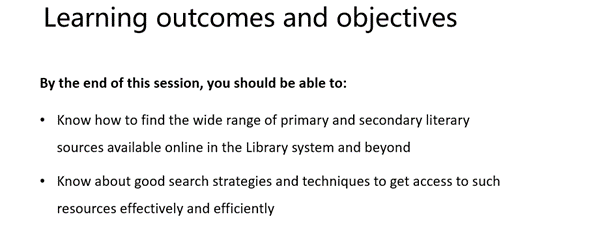
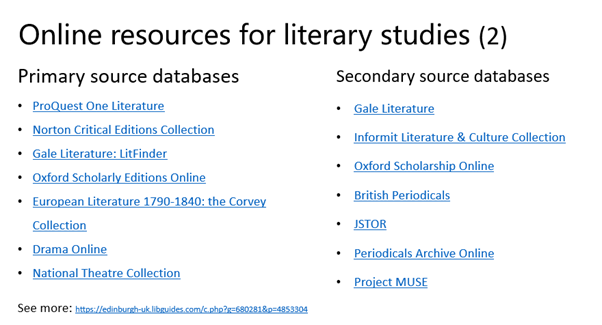
The session began with a helpful introduction to the online library resources made available to university staff and students. It is easy to forget that the Library has such a vast collection of e-books, databases, streaming videos and e-journals. The definitions of primary and secondary resources were also provided! This allowed the rest of the presentation to flow as I was shown which databases to use for primary and secondary resources, with demonstrations given on key resources. Other online resources were also covered including internet resources like google scholar, bibliographies and book reviews. Throughout the session, the usefulness and drawbacks of the different materials were highlighted meaning you would be able to draw your own conclusions to what resource would be most effective for you. This tied in well with the conclusion of the presentation which covered next steps such as how to construct your own research strategy!
Conclusion
You can never go wrong learning new digital skills and resources that can help you with your work! Even if you don’t explicitly need to know about these literary resources for your studies – they may be useful for your extracurricular activities! Plays, poems and novels can all be found using the resources covered in the Bitesize session I attended. If you still aren’t convinced, why not look at what other topics Library Bitesize sessions cover, and I am sure you will find a subject that information needs!
Lyell Inspires!
This month we learn that Erin, one of our Lyell project volunteers, has had her eyes opened to the present-day natural world – thanks to inspiration from our Sir Charles Lyell Collection.
We have all caught the Lyell / Geology bug here at the Sir Charles Lyell Collection Project HQ. Each of us has developed a preoccupation with spotting and identifying pebbles, fossils, gneiss, and schist and so on. Our work and personal libraries groaning with the additional weight of multiple biographies of Lyell, and an almost absurd array of spotters guides to rocks, minerals and fossils. Even our twitter feeds are increasingly populated with evidence of geological time lines (mostly pebbles with veins). No return from a trip to the beach complete without a pocketful of geological specimens; pebbles of grey granite, ovoid pebbles of slate with quartz vein running through it, fragments of whitish chert, and things we used to know, simply, as shells.

A list of shells sent to Bedford Place, dated 5 February 1840, from Sir Charles Lyell’s Notebook, No. 80, 5 February 1840 – 25 June, 1840, (Ref: Coll-203/A1/80)
On my desk, as I type, are an assortment of granite, quartzite, and possibly metamorphic mud – a recent haul from Point beach on the Isle of Lismore. It is one of the great privileges of working so intimately with historical collections: we are repeatedly offered a unique opportunity to develop knowledge and interest in a person, subject, or era that, most likely, would have eluded us had we chosen a different line of work. Earlier this week I read, in the New York Times, Dennis Overbye’s review of the renovated hall of gems and minerals at the American Museum of Natural History. He suggests that ‘Geology Is Our Destiny’.1 For all of us working together to interpret, catalogue and make accessible the Sir Charles Lyell Collection, it would certainly seem so.
Project volunteer, Erin, has developed only a little infatuation with molluscs (to the extent that her new found knowledge required the creation of its very own data-set – Erin is a qualified archivist after all). In working with the Lyell notebooks, Erin has begun to see the world through Lyell’s nineteenth-century geological wisdom. The present-day natural world has opened up to Erin in a way she had never imagined possible. Here, Erin tells us more about her work transcribing Lyell’s notebook indexes and how it has fuelled her growing obsession.
“Transcribing Sir Charles Lyell’s scientific notebook indexes has been a sometimes ruffling but always captivating journey. The one thing I never expected was that like Lyell, I found myself becoming fascinated with molluscs. The Mollusca phylum is:
“one of the most diverse groups of animals on the planet, with at least 50,000 living species (and more likely around 200,000) [and it] includes such familiar organisms as snails, octopuses, squid, clams, scallops, oysters, and chitons”.2
Lyell often took note of the different genera and species he found during his travels. In notebook 80, for instance, I found a list of shells belonging to various molluscs which Lyell had identified and had sent to his home in London.
I felt like both an amateur detective and biologist as I hunted for these bivalves and gastropods on the World Register of Marine Species and MolluscaBase (a global species database, covering all marine, freshwater and terrestrial molluscs, both recent and fossil). As I transcribed, I felt compelled to document them and my new found knowledge about them in an Excel data-set. Some of them proved very elusive and some others are still a mystery. The excitement I felt each time I was able to find a mollusc Lyell had listed was extremely gratifying, particularly when the name he had recorded had fallen out of accepted or general use.
What I have loved most about transcribing Lyell’s notebook indexes is how much I am able to learn from only one index entry; nineteen molluscs in a single page that I had the pleasure of trying to find and learn about! This is what I feel is the most rewarding part of being an archivist. Through this amazing collection we are given the opportunity to explore the life and times of Sir Charles Lyell while presenting his knowledge, research, ideas and wondrous curiosity to a wider audience.
Now, each time I go to Yellowcraigs or North Berwick for a wild swim, I can’t help but stop and examine the rocks, the shells, the crab skeletons, the little pools full of marine life and of course the molluscs. I never would have stopped to explore in this way had I not first discovered so much through the eyes of Sir Charles Lyell.”
We hope you enjoyed reading about how the Sir Charles Lyell Collection has inspired our project volunteer, Erin, to observe and learn about her natural surroundings with new-found enthusiasm. Erin’s story is just one example of the power of historical collections to enable, support and enhance the acquisition of new knowledge, learning and understanding. We would love to know how you might use the collection to aid learning, teaching and research. Please share your thoughts in the comments.
Thanks to Dr. Gillian McCay, assistant curator at the Cockburn Geological Museum, for her help in identifying the Point beach pebbles. Look out for our next blog post, (coming very soon), when we will be taking a bit of a deep-dive into Lyell’s indexes and hearing from another of our project volunteers, Michael. Thanks for reading!
Elaine MacGillivray, Senior Lyell Archivist
Erin McRae, Lyell Project Volunteer
Sources and further information:
1. Dennis Overbye, ‘Why Geology Is Our Destiny’, The New York Times, 22 June 2021 (https://www.nytimes.com/2021/06/22/science/natural-history-museum-gems-minerals.html), [accessed 25 June 2021].
2. Paul Bunje, ‘Lophotrochozoa: The Mollusca: Sea slugs, squid, snails, and scallops,’ Proceedings of the Royal Society B274(1624):2413-2419 (https://ucmp.berkeley.edu/taxa/inverts/mollusca/mollusca.php), [accessed 25 June 2021] .
World Register of Marine Species
MulluscaBase
End of an era – 2017-2020 RDM Roadmap Review (part 1)
Looking back on three years that went into completing our RDM Roadmap in this period of global pandemic and working from home, feels a bit anti-climactic. Nevertheless, the previous three years have been an outstanding period of development for the University’s Research Data Service, and research culture has changed considerably toward openness, with a clearer focus on research integrity. Synergies between ourselves as service providers and researchers seeking RDM support have never been stronger, laying a foundation for potential partnerships in future.
FAIR Roadmap Review Poster
A complete review was written for the service steering group in October last year (available on the RDM wiki to University members). This was followed by a poster and lightning talk prepared for the FAIR Symposium in December where the aspects of the Roadmap that contributed to FAIR principles of research data (findable, accessible, interoperable, reusable) were highlighted.
The Roadmap addressed not only FAIR principles but other high level goals such as interoperability, data protection and information security (both related to GDPR), long-term digital preservation, and research integrity and responsibility. The review examined where we had achieved SMART-style objectives and where we fell short, pointing to gaps either in provision or take-up.
Highlights from the Roadmap Review
The 32 high level objectives, each of which could have more than one deliverable, were categorised into five categories. In terms of Unification of the Service there were a number of early wins, including a professionally produced short video introducing the service to new users; a well-designed brochure serving the same purpose; case study interviews with our researchers also in video format – a product of a local Innovation Grant project; and having our service components well represented in the holistic presentation of the Digital Research Services website.
Gaps include the continuing confusion about service components starting with the name ‘Data’___ [Store, Sync, Share, Vault]; the delay of an overarching service level definition covering all components; and the ten-year old Research Data Policy. (The policy is currently being refreshed for consultation – watch this space.)
A number of Data Management Planning goals were in the Roadmap, from increasing uptake, to building capacity for rapid support, to increasing the number of fully costed plans, and ensuring templates in DMPOnline were well tended. This was a mixed success category. Certainly the number of people seeking feedback on plans increased over time and we were able to satisfy all requests and update the University template in DMPOnline. The message on cost recovery in data management plans was amplified by others such as the Research Office and school-based IT support teams, however many research projects are still not passing on RDM costs to the funders as needed.
Not many schools or centres created DMP templates tailored to their own communities yet, with the Roslin Institute being an impressive exception; the large majority of schools still do not mandate a DMP with PhD research proposals, though GeoSciences and the Business School have taken this very seriously. The DMP training our team developed and gave as part of scheduled sessions (now virtually) were well taken up, more by research students than staff. We managed to get software code management into the overall message, as well as the need for data protection impact assessments (DPIAs) for research involving human subjects, though a hurdle is the perceived burden of having to conduct both a DPIA and a DMP for a single research project. A university-wide ethics working group has helped to make linkages to both through approval mechanisms, whilst streamlining approvals with a new tool.
In the category of Working with Active Data, both routine and extraordinary achievements were made, with fewer gaps on stated goals. Infrastructure refreshment has taken place on DataStore, for which cost recovery models have worked well. In some cases institutes have organised hardware purchases through the central service, providing economies of scale. DataSync (OwnCloud) was upgraded. Gitlab was introduced to eventually replace Subversion for code versioning and other aspects of code management. This fit well with Data and Software Carpentry training offered by colleagues within the University to modernise ways of doing coding and cleaning data.
A number of incremental steps toward uptake of electronic notebooks were taken, with RSpace completing its 2-year trial and enterprise subscriptions useful for research groups (not just Labs) being managed by Software Services. Another enterprise tool, protocols.io, was introduced and extended as a trial. EDINA’s Noteable service for Jupyter Notebooks is also showcased.
By far and away the most momentous achievement in this category was bringing into service the University Data Safe Haven to fulfil the innocuous sounding goal of “Provide secure setting for sensitive data and set up controls that meet ISO 27001 compliance and user needs.” An enormous effort from a very small team brought the trusted secure environment for research data to a soft launch at our annual Dealing with Data event in November 2018, with full ISO 27001 standard certification achieved by December 2019. The facility has been approved by a number of external data providers, including NHS bodies. Flexibility has been seen as a primary advantage, with individual builds for each research project, and the ability for projects to define their own ‘gatekeeping’ procedures, depending on their requirements. Achieving complete sustainability on income from research grants however has not proven possible, given the expense and levels of expertise required to run this type of facility. Whether the University is prepared to continue to invest in this facility will likely depend on other options opening up to local researchers such as the new DataLoch, which got its start from government funding in the Edinburgh and South East Scotland region ‘city deal’.
As for gaps in the Working with Data category, there were some expressions of dissatisfaction with pricing models for services offered under cost recovery although our own investigation found them to be competitively priced. We found that researchers working with external partners, especially in countries with different data protection legislation, continue to find it hard work to find easy ways to collaborate with data. Centralised support for databases was never agreed on by the colleges because some already have good local support. Encryption is something that could benefit from a University key management system but researchers are only offered advice and left to their own mechanisms not to lose the keys to their research treasures; the pilot project that colleagues ran in this area was unfortunately not taken forward.
In part 2 of this blog post we will look at the remaining Roadmap categories of Data Stewardship and Research Data Support.
Robin Rice
Data Librarian and Head of Research Data Support
Library and University Collections
Supplier Help and Training

The university subscribes to hundreds of databases. It can be confusing how to navigate individual databases and resources, and although many can be searched in a similar way they all have unique differences and functionality.
Most resources have help and training pages available to guide you and the Law Library Subject Guide (https://edinburgh-uk.libguides.com/Law) links out to some of the most frequently used including Westlaw, LexisLibrary and HeinOnline. We recently added investorstatelawguide help links – as this platform has recently undergone a refresh.

The help pages on supplier sites are useful as a first port of call – just in case they can answer your query quickly. They also give you access to other materials such as PDF guides, recorded videos, live webinars and online help.
Suppliers encourage users to attend training sessions so if you feel you would benefit then sign up!
SSSA in 70 Objects: The Tiree Clapperboard
On Sunday, August 22 1976, the School of Scottish Studies filmed an open air baptism in Tiree. This was the first baptismal service of its kind in several years and the community and church of Tiree were happy for fieldworkers from the School to capture the event for preservation.
For anyone who has visited us over the past few years, you may have seen this film playing in our foyer.
One of the objects we have in our archive is the clapperboard, which was used by the unit who went to Tiree to make the film.
Clapperboards, or sometimes clapsticks, filmsticks or slate, were used in film productions to assist in synchronizing of picture and sound, and to designate and mark the various scenes and takes as they are filmed and audio-recorded. It was operated by a Clapper loader.
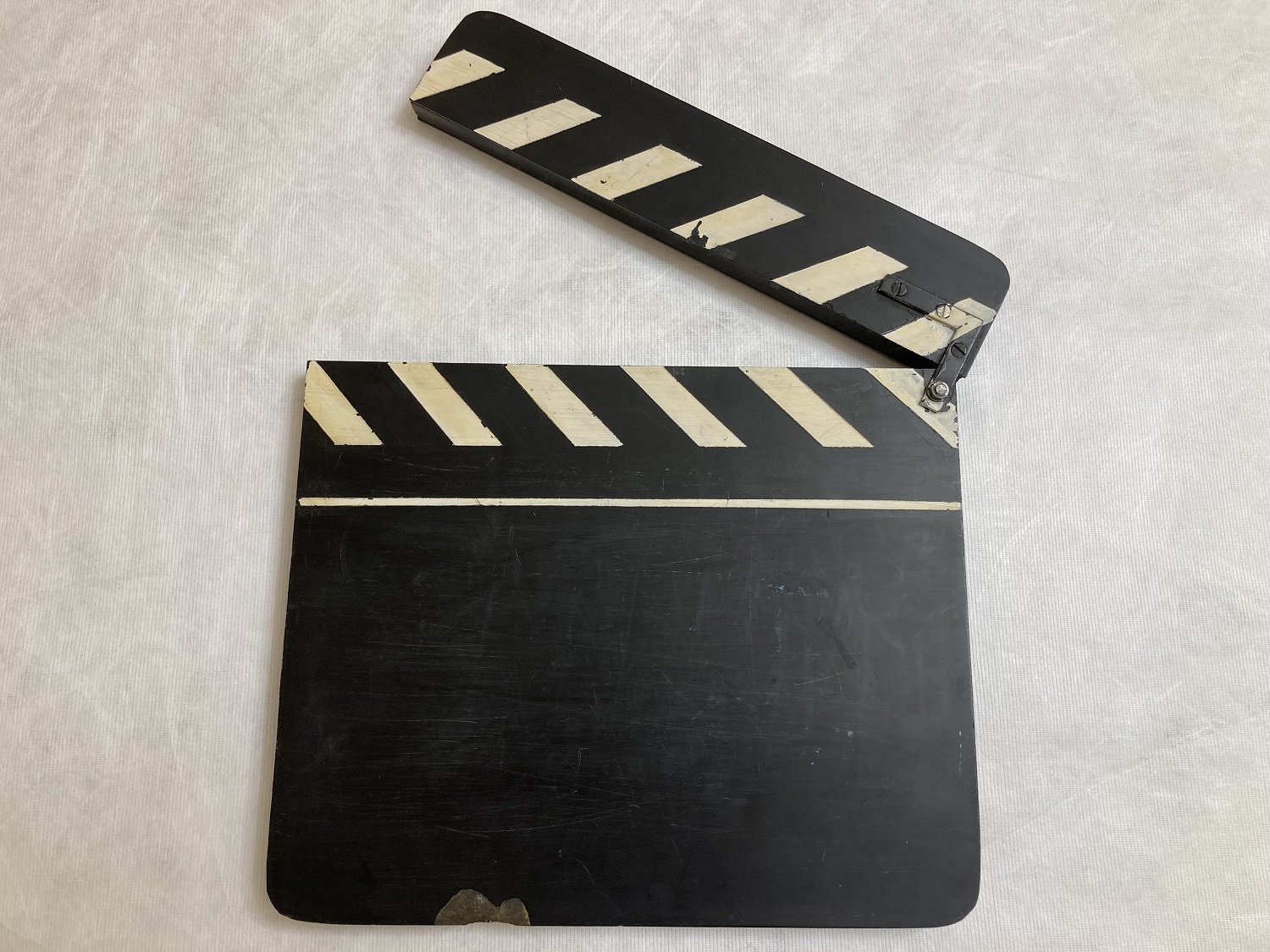
This is a still from the film showing SOSS staff setting up. with Dr Margaret Mackay being the ‘Clapper loader’.
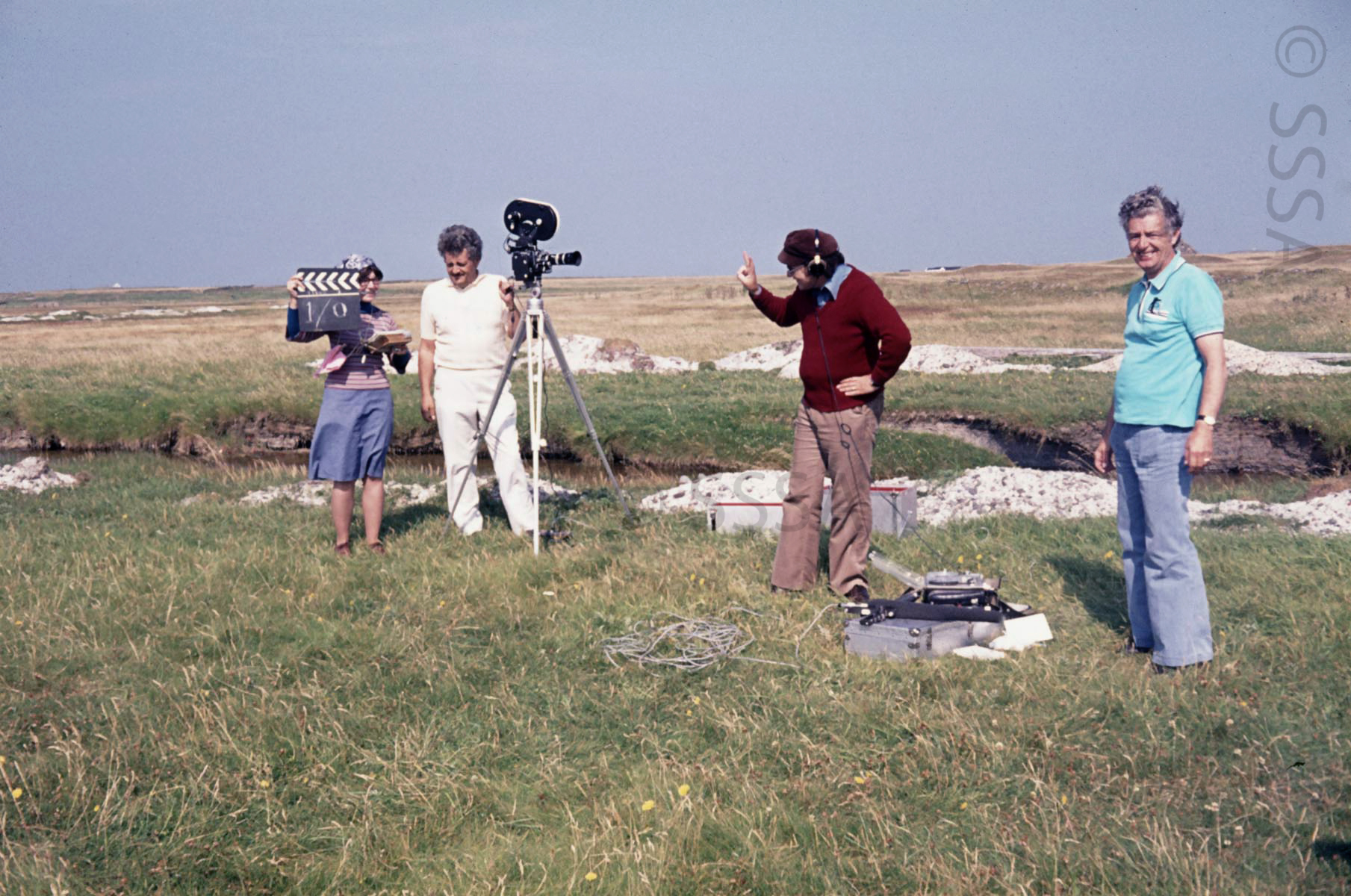
When I took the board out of its box, from the archive store, I was surprised at the weight and heft of it. Presumably it was used for other purposes over the years, as it appears to show the vague etchings of writing and so may have been used in other filming pursuits by the School. I am sad to say though, it also looks like it could have been used as someone’s coaster at one stage too!
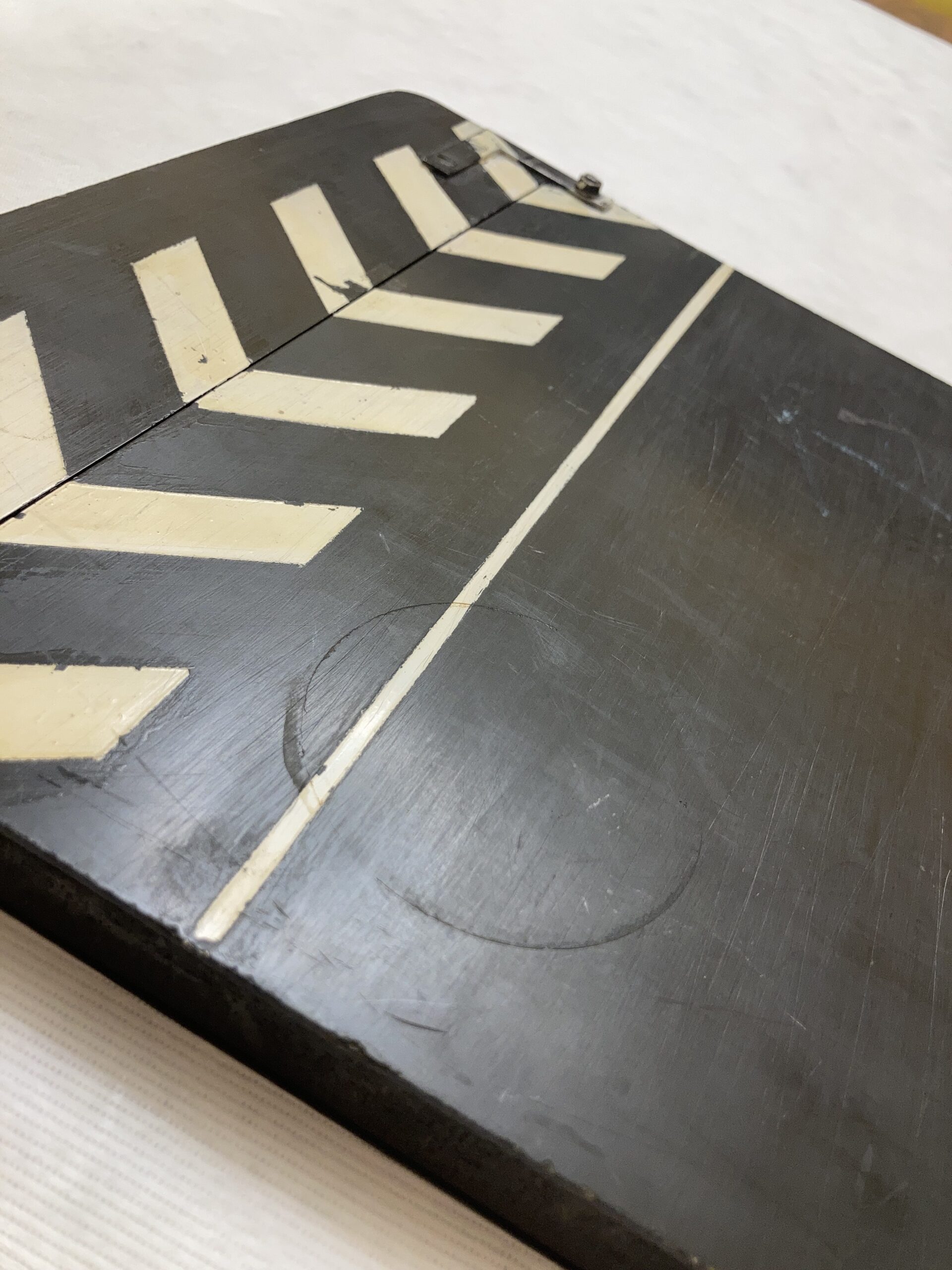
These items are still used in film production today, but the modern equivalent – digislates – have an electronic display, the time code of which is synced with the cameras.
And, if you are wondering, of course I gave it a try and yelled “Action!” (into the set of the empty Scottish Studies Library). Mind you, I did not bring down clappper with any kind of dramatic snap – previous use as a coaster aside – it is an archival object after all!
Event: House of Commons Library and Briefing Paper Research
If you are interested in legal information and the research that goes into official publications, you may find this upcoming event hosted by the Scottish Law Librarians’ Group to be of interest.
The Scottish Law Librarians’ Group Presents, in association with the Advocates’ Library, Edinburgh:
The House of Commons Library and Briefing Paper Research
Thursday 1st July 2021. 7pm-8.30pm
The SLLG Committee and Advocates’ Library are delighted to introduce the inaugural event in our new online lecture series which we hope will be of great interest to law librarians, legal professionals, law students and anyone with an interested in professional legal research.
David Torrance is an experienced researcher at the House of Commons Library and has worked on briefing papers relating to both Scottish Independence and current events in Northern Ireland.
In this talk he will introduce the work of the House of Commons Library, explaining the resources available, how research is conducted, and how briefing papers contribute to the work of the House. We will look at some of the briefing papers David has authored, specifically with reference to issues of relevance for legal professionals in Scotland such as the legality of an independence referendum. The event will also include time for questions after David’s presentation.
This is an online event which will be hosted on Zoom. A link to the event will be sent out to registered attendees two days prior to the talk. The event will be recorded and a link will be circulated to attendees along with additional resources relating to David’s work following the event.
Collections
 Hill and Adamson Collection: an insight into Edinburgh’s past
My name is Phoebe Kirkland, I am an MSc East Asian Studies student, and for...
Cataloguing the private papers of Archibald Hunter Campbell: A Journey Through Correspondence
My name is Pauline Vincent, I am a student in my last year of a...
Hill and Adamson Collection: an insight into Edinburgh’s past
My name is Phoebe Kirkland, I am an MSc East Asian Studies student, and for...
Cataloguing the private papers of Archibald Hunter Campbell: A Journey Through Correspondence
My name is Pauline Vincent, I am a student in my last year of a...
Projects
Cataloguing the private papers of Archibald Hunter Campbell: A Journey Through Correspondence
My name is Pauline Vincent, I am a student in my last year of a...
Archival Provenance Research Project: Lishan’s Experience
Presentation My name is Lishan Zou, I am a fourth year History and Politics student....