Home University of Edinburgh Library Essentials
April 4, 2026
John MacLeod Durward, Queen’s Scholar
Enquiries are very much central to what we do. As well as helping others with their own research, enquiries are often the means by which we learn something new about our own collections. Recently we received one about a (potential) former student, John Macleod Durward, who was recorded in the 1861 as being a Queen’s Scholar.
Newspaper accounts supplied by the enquirer also listed John as having received received various class prizes at the University in 1864 and 1865, including in Moral Philosophy, Rhetoric and English Literature and Mathematics, along with him being from Arbroath. However, we were unable to find him amongst our graduates and the term Queen’s Scholar seemed to have no relation with the University (our initial investigations only uncovered it as something relating to Westminster School).
Nevertheless we persitsed as John had clearly been at the University and we should have some record of him. We discovered that he had in fact matriculated in Arts for the academic years 1863/4 and 1864/5. So, this all tiednicely with the newspaper accounts but what about Queen’s Scholar?
Our colleages at the UK National Archives proved to be a vital part of our deliberations. Their online guide to records of Teacher Training states:
“At 18 pupil-teachers could apply for the Queen’s/King’s Scholarship Examination (later the Preliminary Examination for the Certificate). Successful scholars had the opportunity of attending training colleges for two or three years.”
The University of Edinburgh did not offer teacher training in this period but there were two institutions in Edinburgh which did, the Church of Scotland Training College and the Free Church of Scotland Training College. Both were forerunners to Moray House College/Institute, which is now part of the University but then were independent entities.
While the student records for the latter for this period have not survived, those for the former have. Would we be lucky? As you can see from the image below, we were.

Church of Scotland Training College: Report on Progress of Male Students
This places John at the Church of Scotland Training College in 1861 (the year he appeared on the census as Queen’s Scholar). John then attended the University for two years immediately after undertaking his teacher training.
New home for Edinburgh Research Data Blog!
Tempus fugit. This Data Blog, which has been going since 2013 is now moving to Edinburgh University Libraryblogs. This follows the 2018 organisational merger of the Data Library team at EDINA with Research Data Support in Library & University Collections.
We hope you will actively subscribe to the new blog at https://libraryblogs.is.ed.ac.uk/datablog/ now, by entering your email address in the right navigation panel so you don’t miss any future posts!
Meanwhile we will redirect the old URL and all the older posts to the new site so you won’t have to remember where to go to catch all the news about the Research Data Service and research data management at University of Edinburgh. Any cited posts or bookmarks will continue to resolve.
Otherwise it just remains to thank our former and future hosts – EDINA, and the Digital Library – for providing the platform.
Robin Rice
Data Librarian and Head of Research Data Support
Library and University Collections
SSSA in 70 Objects: Bha Là Eile Ann
Response by Fraser MacBeath
Hello, I’m Fraser MacBeath, a sound artist/electronic music producer from the Isle of Lewis, currently a postgraduate Sound For The Moving Image student at The Glasgow School of Art and a follower of the archive for the past 5 years or so.
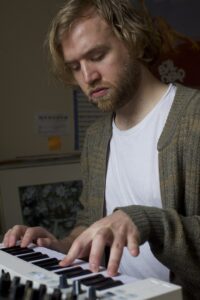
Image: Fraser MacBeath
I became aware of the archive while working at An Lanntair Arts Centre on Lewis. I had been looking for ways in which to integrate aspects of Hebridean life into ambient/electronic music and the archive offered a unique sonic resource to draw inspiration from.
This work was created in response to an open call for soundworks from Radiophrenia Glasgow. I’d always found the folk stories and lore really fascinating. The sense of mysticism alive in the culture with talk surrounding the existence of fairies, mermaids and witches that has been very much stamped out in modern culture is something that seemed worthwhile to try and contemporise. I wanted to further dramatize it however by also building atmospheres and using music to formulate it into a kind of sonic journey. Creating a more immersive listening experience inspired by the kind of emotions and environments that might have surrounded the stories when they were told.
The finished piece is a fully homegrown product of Scotland, although unfortunately I’ve had to rely heavily on the English material due to my very limited understanding of Gaelic at this point, but everything heard is either sourced from the archive or recorded on the Isle of Lewis. The music is made from recordings of small snippets of various traditional instruments and other sounds you might hear floating around the islands. Once recorded there are an infinite number of things that can be done to twist the sound into any kind of music you can think of. The compositions here are made primarily from looping very small segments of audio, after which these can then be time stretched, pitch altered and mapped to the keys of a keyboard, allowing a new instrument to be born out of virtually any sound while still retaining the source texture.
It’s a bit of a crude first attempt production wise, In the future hopefully more of these will materialise with a bit more Gaelic. My hope is that It could develop into an interesting topic for a dreamy podcast series, whilst also providing an educational resource for folklore enthusiasts and Gaelic learners to immerse themselves in the language.
Hope you enjoy it.
You can find more of Fraser’s work on his website: Home | Fraser MacBeath – Music & Sound Design (wixsite.com)
All archive recordings used from SSSA as listed below:
| Contributor | Title | Fieldworker | |||
| SA1973.160 | Betsty Whyte | A changeling baby banished and the real baby restored | Peter Cooke and Linda Williamson | ||
| SA1976.109 | Betsy Whyte | A fisherman saw a mermaid sitting on a rock, | Linda Williamson | ||
| SA1975.107 | Betsy Whyte | A man was changed into a woman and had a family before being… | Linda Williamson | ||
| SA1972.176 | Duncan MacKinnon | An Ataireachd Àrd | Ian Paterson | ||
| SA1957.041 | Essie and Alec Stewart | Essie Stewart gives a description of a fairy she saw. | Hamish Henderson | ||
| SA1955.094 | Brucie Henderson | A woman was rescued from a cliff prison by her lover. | Calum Maclean | ||
| SA1957.043 | Alec Stewart | The contributor discusses his fondness for storytelling. | Hamish Henderson | ||
| SA1989.045 | John James | Santa Cruz | Margaret Bennet and Stephanie Smith | ||
| SA1964.067 | Gordeanna McCulloch | The Shoals o Herrin | Norman Buchan | ||
| SA1971.072 | Dolina Maclennan | Dh’fhàg mi ‘n Seo na Shìneadh e | Peter Cooke | ||
| SA1985.057 | Thomas David Edgar | Unknown/Gypsy Woman | Peter Cooke and Jo Miller |
Future of University of Edinburgh trusted research environments
For the past few years, Information Services (ISG) have been providing a University Data Safe Haven (DSH) service, to host analysis of sensitive research data. Alongside this, Edinburgh Parallel Computing Centre (EPCC) have been delivering national services such as the Scottish National Safe Haven, run on behalf of Public Health Scotland.
 EPCC is a key partner in the Data Driven Innovation programme (DDI), and is funded through the Edinburgh and South East Scotland City Region Deal to deliver the Edinburgh International Data Facility. This will provide similar trusted research environments, such as the DataLoch.
The purpose for which the University DSH service was constructed is now converging with the services which EPCC will be providing as part of the EIDF. ISG and EPCC are now working together to rationalise how these services are provided into the future.
The EIDF and ISG DSH teams will now begin looking at detailed plans for supporting current and future users and the University DSH will stop accepting further projects for on-boarding from 18 June, 2021. Timeframes for research project migrations, where necessary, will be decided on a case by case basis in consultation with principal investigators. We will be contacting all current University DSH project owners to discuss their service provision, and we will similarly contact project owners who were investigating using the University DSH.
For further information contact Robin Rice, Research Data Service Owner (r.rice@ed.ac.uk), Information Services or Rob Baxter, Director of Data Services, EPCC (r.baxter@epcc.ed.ac.uk).
Upcoming Events Celebrating SSSA at 70
As part of our ongoing celebrations for our 70th Anniversary, we are delighted to announce some events which are coming up in August.
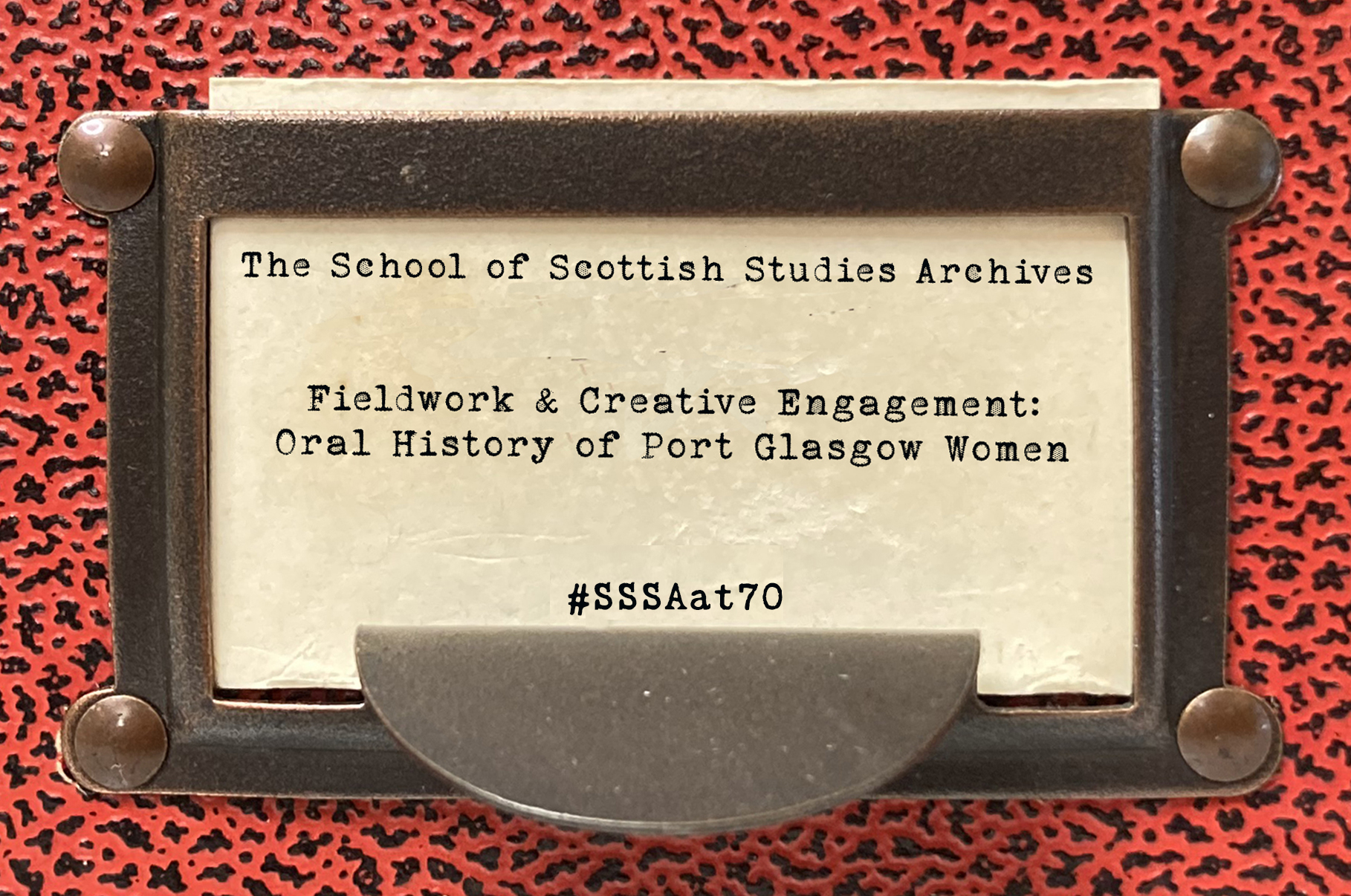
Fieldwork & Creative Engagement: Oral History of Port Glasgow Women
Thursday, 12 August 2021, 14:00-16:30.
Online, via Zoom.
Free, but ticketed via Eventbrite:
https://www.eventbrite.co.uk/e/157935676861
Our two presentations are rooted in the lived experience of women in the shipbuilding communities of Port Glasgow, recordings of which are held in our collection. Through our presenters’ fieldwork – undertaken almost 30 years apart – we see the importance of fieldwork, the collection and preservation of oral history recordings. It is from this perspective we will explore the value in creative reuse of archive recordings.
Speakers:
Dr Hugh Hagan, Head of Public Records Act Implementation at the National Records of Scotland, is passionate about the shipbuilding communities of Port Glasgow and Greenock on the lower reaches of the River Clyde, particularly in the inter-war period. These towns, being removed by some distance from the large and diverse economy of Glasgow, depended entirely on shipbuilding and they developed a very particular sense of community. This was the subject of his PhD research at the School of Scottish Studies in the 1990s and he will draw on that research, specifically the role of women in these communities, in his talk.
Martine Robertson and Hannah Wood, of GaelGal Productiions, were undertaking studies at the Department of Celtic and Scottish Studies, University of Edinburgh, when they attended a lecture by Hugh Hagan, about his Port Glasgow work. They were galvanised to revisit this fieldwork, recording new material with the family of Cassie Graham, one of Hugh’s contributors. They have also been inspired to take these stories to centre stage, lifting the voices and experience of women of the Port Glasgow community and using these recordings in their creative practice. The presentation at this event is but one postcard-sized venture into their ongoing creative piece, What A Voice.
Q&A
After the presentations we shall have a short break, followed by a chaired question-and-answer session with our presenters. Participants are encouraged to submit questions in the chat facility during the papers and the break.
This session is open to anyone who wishes to attend and those with a particular interest in collecting, researching, or creating with oral history recordings. Please register for the event via the link to Eventbrite. Joining instructions will be sent with your ticket.

SSSA at The Edinburgh International Festival
There will also be two special events centring on the work of The School of Scottish Studies (Celtic and Scottish Studies Department) and on music, songs and singers within the collections here at SSSA. These events are hosted by EIF, and you can buy tickets from the website links provided.
A Folk Song Sharing– https://www.eif.co.uk/events/university-of-edinburgh-a-folk-song-sharing
Sunday, 8 August, Old College Quad. 15:00
An intimate intergenerational exchange of songs and their stories: three artists share their favourite songs, how they came to sing them, the story behind each song and how their interpretation evolved. Features performances from Nancy Nicolson (Scots song and story), Josie Duncan (Scots, Gaelic and original song) and Arthur Cormack (Gaelic song).
The Living Archive – https://www.eif.co.uk/events/university-of-edinburgh-the-living-archive
Sunday, 8 August, Old College Quad. 20:00
A range of song, music and dance inspired by material from the School of Scottish Studies Archive. Performances inspired by material from the School of Scottish Studies Archives from Kirsty Law (Scots song), Mary MacMaster (clarsach, electro harp) and Mike Vass (fiddle, tenor guitar) with Sophie Stephenson (dance).
To be kept up to date with the events happening for our 70th anniversary, please follow our blog here or find us on twitter https://twitter.com/EU_SSSA
Decoloniality and the library (CILIPS Conference 2021)
On 7 June I attended a CILIPS conference session on Decoloniality and the library: the case at Goldsmiths, University of London, by Marilyn Clarke, Director of Library Services at Goldsmiths, University of London.
Marilyn started off with a quote from Desmond Tutu “If you are neutral in situations of injustice, you have chosen the side of the oppressor.” What can we do as librarians to be more than neutral?
At Goldsmiths, a Liberate our library working group was set up to look at this question. They started out by asking : do students see library spaces, books on the shelves, which looks like them? Do students see themselves when they come into the library?
New resources: Elgar 2021 ebooks
You may be interested in some of the exciting new ebook packages we’ve purchased recently for use by students and staff in the School.
Edward Elgar Publishing are a well-respected publisher who produce excellent books, textbooks and journals in many subject areas. We often purchase their annual Law ebook package, and this year is no different. Some highlights include:
- EU copyright law : a commentary edited by Irini Stamatoudi and Paul Torremans.
- Comparative tort law: global perspectives edited by Mauro Bussani and Anthony J. Sebok.
- Poverty and human rights : multidisciplinary perspectives edited by Suzanne Egan and Anna Chadwick.


For more information about the books included in the Law 2021 package, visit the Elgar Online website, or search DiscoverEd for ‘Edward Elgar’.
If you have suggestions for books you’d like us to purchase for the library, students can use the Student Request A Book (RAB) service. Staff members can follow the procedure on the Library Support intranet page.
Critical Approaches to Libraries 2021(CALC) Day 2
It is once again Conference Season, where academic librarians would usually be collecting a variety of colourful lanyards, discussing who had the best snacks with mid-morning coffee and which exhibitors had the best swag. It’s a great time to network with colleagues from other institutions or sectors, and to make new contacts and finally put a face to the name of those twitter accounts. However, as we rounded the bend on a year of online working, we’ve all become quite well versed in the pivot to not only online teaching but also online events. Although we’re used to communicating through a screen – and the related Zoom Fatigue – CALC was an event to get excited about. The speaker list was diverse and exciting. The topics felt relevant to the work we’re doing, or want to be doing. The days looked well thought out and not too overwhelming. The ethics of the conference organisation included an optional additional fee to allow the organisers to provide bursary places free of charge to those from marginalised backgrounds.
Read More
New to the Library: Foreign Office Files for India, Pakistan and Afghanistan, 1947-1980
I’m pleased to let you know that following a request from staff in HCA the Library now has access to Foreign Office Files for India, Pakistan and Afghanistan, 1947-1980. This resource allows you to survey the high politics of Independence and Partition, social and cultural interchange after 1947 and the ramifications that these changes continue to have throughout South Asia today.

You can access Foreign Offfice Files for India, Pakistan and Afghanistan via the Digital Primary Source and Archive Collections guide, the Databases A-Z list or via DiscoverEd. Read More
Library Bitesize Session Review
Introduction
Despite being in my fourth and final year, I am still constantly discovering resources offered to students by the University! Most recently, I attended a Library Bitesize course for “Online Resources for Literary Studies”.
In the past, I have completed Bitesize courses. However, they were in person and not subject-specific. For those interested, it was on referencing and avoiding plagiarism (and I would highly recommend it)! Therefore, this was a bit of a new experience for me and I did ask myself when signing up how learning about literary resources would benefit me. However, by the end of the session, I was extremely glad I went! Reading this blog you will understand why and hopefully be encouraged to attend a session for yourself.
The Session
The session was hosted on blackboard collaborate by Academic Support Librarian (ASL) Shenxiao Tong. It was easy to follow and informative – and fortunately, there were no technology issues during the event!
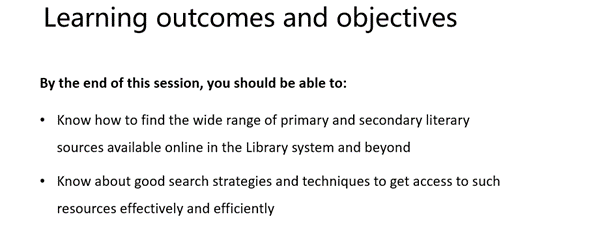
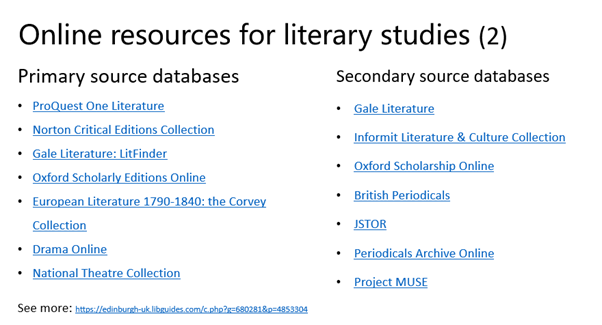
The session began with a helpful introduction to the online library resources made available to university staff and students. It is easy to forget that the Library has such a vast collection of e-books, databases, streaming videos and e-journals. The definitions of primary and secondary resources were also provided! This allowed the rest of the presentation to flow as I was shown which databases to use for primary and secondary resources, with demonstrations given on key resources. Other online resources were also covered including internet resources like google scholar, bibliographies and book reviews. Throughout the session, the usefulness and drawbacks of the different materials were highlighted meaning you would be able to draw your own conclusions to what resource would be most effective for you. This tied in well with the conclusion of the presentation which covered next steps such as how to construct your own research strategy!
Conclusion
You can never go wrong learning new digital skills and resources that can help you with your work! Even if you don’t explicitly need to know about these literary resources for your studies – they may be useful for your extracurricular activities! Plays, poems and novels can all be found using the resources covered in the Bitesize session I attended. If you still aren’t convinced, why not look at what other topics Library Bitesize sessions cover, and I am sure you will find a subject that information needs!
Collections
 Hill and Adamson Collection: an insight into Edinburgh’s past
My name is Phoebe Kirkland, I am an MSc East Asian Studies student, and for...
Cataloguing the private papers of Archibald Hunter Campbell: A Journey Through Correspondence
My name is Pauline Vincent, I am a student in my last year of a...
Hill and Adamson Collection: an insight into Edinburgh’s past
My name is Phoebe Kirkland, I am an MSc East Asian Studies student, and for...
Cataloguing the private papers of Archibald Hunter Campbell: A Journey Through Correspondence
My name is Pauline Vincent, I am a student in my last year of a...
Projects
Cataloguing the private papers of Archibald Hunter Campbell: A Journey Through Correspondence
My name is Pauline Vincent, I am a student in my last year of a...
Archival Provenance Research Project: Lishan’s Experience
Presentation My name is Lishan Zou, I am a fourth year History and Politics student....