Home University of Edinburgh Library Essentials
September 26, 2026
Resources Lists- what are they and where do I find them?

At the start of a new semester it is always a priority to find your course reading material.
Many of the Law School courses use Resource Lists to detail the course readings, and the links to these lists are in your Virtual Learning Environment (VLE) Learn. Look out for the link to Library Resources or Resource List on your course pages.
Not every course uses this type of list for their readings but an increasing number of courses do. Whatever way your course uses to tell you about course readings if you have an issues about accessing library resources then don’t forget you can always get in touch with your Academic Support Librarians (Law.Librarian@ed.ac.uk).
To see the full details of what you can do with Resources Lists and how to get the best from them (using personalisation features) then go over to the Resources Lists pages at:
https://www.ed.ac.uk/information-services/research-teaching-staff/resource-lists
New! Uganda and Malawi under Colonial Rule, in Government Reports
I’m pleased to let you know that the Library now has access to two more digital primary source collections covering colonial rule in African countries in the 20th century. The two databases are Uganda Under Colonial Rule, in Government Reports, 1903-1961 and Malawi Under Colonial Rule, in Government Reports, 1907-1967 from British Online Archives. Between them they contain 92 documents with over 84,000 pages of original primary source material.

You can access both of these databases via the Digital Primary Source and Archive Collections guide, the Databases A-Z list or the African Studies subject guide. Read More
New to the Library: South Asia Archive
I’m happy to let you know that the Library now has access to the South Asia Archive from Taylor & Francis, a specialist digital platform providing global electronic access to culturally and historically significant literary material produced from within, and about, the South Asian region.
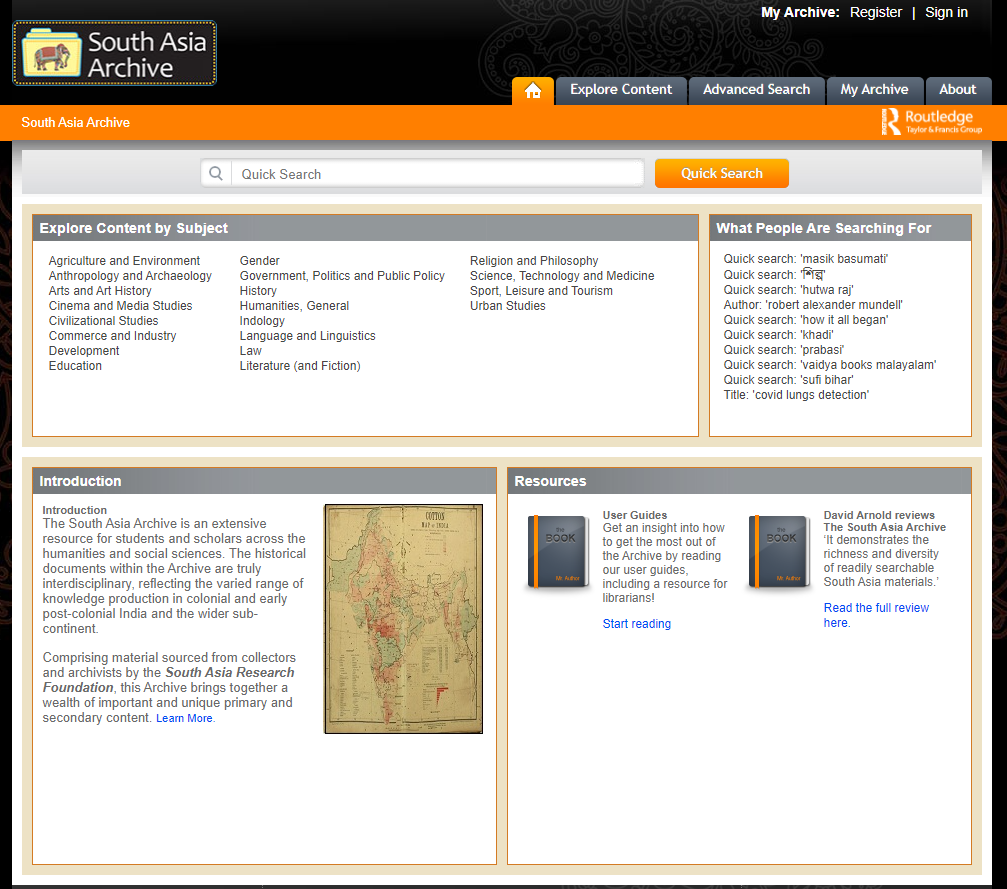
You can access South Asia Archive via the Digital Primary Source and Archive Collections guide or the Databases A-Z list. You will also be able to access it from DiscoverEd within the next few days. Read More
Data Mindfulness training integrated in new resources
The Research Data Service is pleased to announce an update to our ‘Data Mindfulness: Making the Most of Your Dissertation Data’ training materials.
Originally developed to provide face to face research data management (RDM) training for undergraduate students undertaking a dissertation project, the newly revised course is now available as one of ten units within the Library’s new LibSmart II training course.
‘Data Mindfulness: Your Dissertation Data‘ combines videos, reading material, and short interactive exercises to help students think about data management issues as they prepare to undertake a research project, potentially for the first time.
The course is designed to follow the research journey from beginning to end, from developing a research question and conducting a literature search, through to generating and managing project data and files during the life of the project and beyond.
The ‘Data Mindfulness’ unit provides an approachable introduction to the subject of RDM, with up-to-date and relevant information and guidance for undergraduate and masters students. The updated content also includes expanded material on finding and accessing secondary data sources, as well as links to wider training and resources provided by the Library.
You can find more information about the new LibSmart II course, and how to enrol here: https://www.ed.ac.uk/information-services/help-consultancy/rm-and-consultancy/academic-support-librarians/libsmart.
In addition to LibSmart II, we are also pleased to be working in conjunction with the Research Training Centre, based in the School of Social and Political Science, to deliver an updated version of the ‘Data Mindfulness’ course as part of the Micro-Methods Workshop series. You can find details of the Micro-Methods Workshops series here: https://research-training-centre.sps.ed.ac.uk/micro-methods.
Finally, we have made the ‘Data Mindfulness’ training materials available for re-use under an open CC-BY license, and you can find links to the videos and download a PDF of the revised ‘Data Mindfulness’ course handbook from the Research Data Service site (a Word version of the handbook is available on request): https://www.ed.ac.uk/information-services/research-support/research-data-service/training.
We hope these ‘Data Mindfulness’ materials are useful and relevant and appreciate any comments or feedback that you may have at data-support@ed.ac.uk.
Bob Sanders
Research Data Support Assistant
What is LibSmart I?
LibSmart I is designed to give you an introduction to library resources for your study and research! The course enables you to take control of your learning as you self-enrol (click here to find out how) and choose the modules you cover. I personally love the flexibility of the course as you can recall the information provided by LibSmart easily on Learn.

Students studying in the library [Paul Dodds copyright of the University of Edinburgh]
So what does LibSmart I review?
In short, by completing LibSmart I you will develop your information literacy skills and understand what library support is available to you. For a more detailed overview keep reading or better yet check out the course for yourself!
A brief overview of LibSmart I and its learning objectives
Within the LibSmart I course there are five modules that cover key areas:
- Introduction to using the library
- Your information landscape
- Finding and retrieving information
- Managing information
- Referencing and avoiding plagiarism

With each topic, you will gain the confidence and knowledge to effectively research and use resources provided by the Library. My favourite module would be “Finding and retrieval”, I found the tips on research strategy construction and explanation to Boolean operators have been extremely useful when exploring a topic area.
The course has clear goals that you can use to guide your learning and ensure you are finding the support you need. There are also activities and reflective quizzes to help you consolidate your learning to discover the subject matter you need. When you’ve completed the course you’ll also be awarded a Digital Badge, which you can use to show off your newfound expertise.
Ready to get started?
Visit the LibSmart webpage to find out more about how to self-enrol for this course. If you’ve completed LibSmart I, you also read more about how to build on these skills with the next level of research support in LibSmart II!
If you have any questions or concerns about LibSmart you can contact us via the EdHelp portal.
Al-Ahram Digital Archive – on trial
Thanks to a request from a student in Politics & International Relations the Library currently has trial access to the Al-Ahram Digital Archive from EastView. This gives you access to one of the longest-running newspapers in the Middle East.

You can access the Al-Ahram Digital Archive via the E-resources trials page.
Access is available on and off-campus.
Trial access ends 1st October 2021. Read More
Training: Welcome to the Library!

Image from PXfuel, licensed for re-use
It’s almost the start of the new academic year which means it’s one of the busiest times of year for Academic Support Librarians. We offer a range of introductory training sessions for students joining the university, and we have some bespoke sessions arranged for each level of study in the School of Law.
14th September: Postgraduate (online) – Using the University Library
22nd September: Undergraduate: Using the University Library
23rd September: Postgraduate (all) – Using the University Library
29th September: PhD – Sources, Materials & Bibliographies
These training events will all be run online using the Collaborate platform, and are often very popular. To find out more and register please use the MyEd Events Booking system and enter the titles above in the search box. Alternatively watch out for direct booking links being circulated via the UG, PG or PhD offices. We will also record these sessions and upload them to our Media Hopper Channel after the event.
When the semester begins we’ll offer one-to-one appointments which you can use to get additional advice to support your studies. These are also available to book via the MyEd Events Booking system, just search for “Literature search clinic” and select the Law specific event, or search for “Law” and select provider group “IS Library and University Collections” to find all our Law related training.
If you have any questions about these or any other training you’d like, please contact us by email: law.librarian@ed.ac.uk. We look forward to welcoming you (or welcoming you back) soon!
We are digitisation ready to go!
We want to share our exciting news featuring the Sir Charles Lyell notebooks! Curious? Read on….
We are very happy to advise that the fuller project to digitise Lyell’s notebooks will start in September 2021. This means that we will soon be able to add yet more digital images of Lyell’s notebooks to those currently available to view online.
This important work is possible thanks to our generous supporters, who, in responding to our funding appeal, have donated over £40,000. That’s enough to fund two specialist photography staff for 12 months. The work will take place in a newly fitted out digital imaging studio, kitted out with new equipment.
 Thank you to all the individual donors and bodies who have supported us so far. In addition to our anonymous supporters, we would also like to acknowledge the ongoing support of the Murray family, Jim Hunter, the History of Geology Group and the Geologists’ Association Curry Fund. If you are interested in helping us complete the digitisation project’s funding target that would be wonderful. Individual gifts may be made online at: https://donate.ed.ac.uk/portal/public/donate/donate.aspx?destination=LyellAccess
Or please contact David McClay directly to discuss: 07815903725 or david.mcclay@ed.ac.uk
Patrick Geddes Archives – Online Catalogue Live!

Patrick Geddes at the Scots’ College, Montpellier, France (Coll-1869)
We are very pleased to announce that the online catalogue for the Sir Patrick Geddes Archives at the University of Edinburgh is now live.
The collection represents a vital and immensely valuable resource for understanding the life and work of Patrick Geddes, who is internationally revered and acknowledged as one of the most innovative thinkers around the processes of urbanisation and urban planning. Such an understanding may potentially help to inform current debates about wellbeing and how best to cultivate it, and is of great importance to all those working in the fields of sociology, ecology, architecture and urban development.
Sir Patrick Geddes (1854-1932) was a pioneer of the environmental movement. Credited as the father of town-planning, he used biological concepts to develop a holistic view of people and where they live, seeing both as organic and how the balance and imbalance between them affected health and well-being.
Geddes encouraged people to become actively involved in transforming their communities, the best-known example of which was in Edinburgh’s Old Town, injecting green spaces into what was then cramped and overcrowded, allowing the place to breathe, allowing children much-needed play spaces.
The collection was catalogued as part of a collaborative project with the University of Strathclyde Archives, which was generously funded by the Wellcome Research Resource-fund.
You can now search the online catalogue via our Online Archives Collections Catalogue.
Elaine MacGillivray
Strategic Projects Archivist
5 Reasons to check out LibSmart I and II
Introduction
If you haven’t heard about LibSmart I and II yet – then what have you been doing?!
To quickly summarise, LibSmart I and II are fully flexible, self-enrol Learn courses designed to help you get started and advance your library resource knowledge. If the description has got you intrigued and you want to know more, do not worry! In this blog, I will give you five reasons why LibSmart I and II can be beneficial to your studies, general university knowledge and digital skills development.
1. Builds awareness on library offerings
Edinburgh University’s Library and University Collections (L&UC) has a range of awesome resources – I am sure you will be aware of DiscoverEd, Special Collections and physical library locations like the Main Library. Well, the department has two new assets by the names of LibSmart I and II. They will help you discover other library-related services that will help you build your information literacy skills.

The Main Library entrance on George Square. [Taken by Paul Dodds, copyright of the University of Edinburgh]
2. Increases your knowledge: LibSmart helps you be more productive
The information contained in LibSmart will not only boost your awareness of library resources but also guide you, so you can use these resources effectively! Throughout the modules, there are activities and quizzes to help you consolidate your knowledge and test yourself.
3. Supports subject specialism
With LibSmart I you build a foundation of knowledge so you can confidently use library resources when researching for a report or topic. LibSmart II enables you to “advance your library research”, supporting you as you complete your thesis or dissertation. The modules in LibSmart II are subject-specific so you can tailor your learning to your project needs. See the image below of the 10 different modules tackled in LibSmart II.
4. Fully-flexible
As mentioned earlier, LibSmart has been created so that you can work independently and interact with the modules as and when you wish. By working at your own pace, you can make the most out of the courses, ensuring you understand the content available. You can still interact with others who are completing the course and Academic Support Librarians (ASLs) using the discussion board whenever you want, so you gain thoughtful insights into the material you are learning.
5. Earn Digital Badges
The final reason you should enrol onto LibSmart is because you have the opportunity to be rewarded for the work you complete with Digital Badges! After finishing a module and subsequent quiz you will be notified that you have earned a LibSmart eBadge that you can share on various digital platforms such as LinkedIn, Facebook, Twitter, or a website.

LibSmart badges
Collections
 Love, Loss, and Literature: Cataloguing the Papers of Irene Jessie Young
My name is Nancy Britten, and I’m in my fourth year of studying History at...
Hill and Adamson Collection: an insight into Edinburgh’s past
My name is Phoebe Kirkland, I am an MSc East Asian Studies student, and for...
Love, Loss, and Literature: Cataloguing the Papers of Irene Jessie Young
My name is Nancy Britten, and I’m in my fourth year of studying History at...
Hill and Adamson Collection: an insight into Edinburgh’s past
My name is Phoebe Kirkland, I am an MSc East Asian Studies student, and for...

Projects
Cataloguing the private papers of Archibald Hunter Campbell: A Journey Through Correspondence
My name is Pauline Vincent, I am a student in my last year of a...
Archival Provenance Research Project: Lishan’s Experience
Presentation My name is Lishan Zou, I am a fourth year History and Politics student....