Home University of Edinburgh Library Essentials
April 5, 2026
Europresse trial – French newspapers and magazines, and more…
 The Library has arranged a trial of Europresse for a very limited period, for 10 days until 12 Nov 2021. The trial can be accessed from the Library’s E-resources Trials website, or access the following link directly which requires UoE login:
https://nouveau-europresse-com.ezproxy.is.ed.ac.uk/Search/Reading
Europresse provides access to over 6,200 publications including journals, newspapers, blogs, and magazines. Coverage is international with many of the publications included available in their original language and layout. The database includes numerous European national newspapers such as Le Monde, Libération and Le Figaro, along with regional newspapers. English language titles such as The Guardian and The New York Times are also available. Thematically, Europresse titles cover the Humanities and Social Sciences, Politics, Law, Economics, Finance, Science, Environment, IT, Transports, Industry, Energy, Agriculture, Arts and culture (Lire, Le Magazine littéraire, World Literature Today, Télérama, Rock and Folk…), Health, and event Sports (L’Équipe, France Football, Sport 24…). It also includes some TV and radio transcripts, biographies and reports, images, audio and video content.
As an example, it provides the image version of today’s Le Monde newspaper which is a welcome alternative to the text version of Le Monde via Factiva. Le Monde Historical Archive, which we subscribe to, covers only 1944-1999. 
You can see the full list of publications provided by Europresse here:
https://nouveau-europresse-com.ezproxy.is.ed.ac.uk/Pdf
Please send feedback via the E-resources trial feedback form.
SSSA in 70 Objects: Photograph of Sorley Maclean and Ian Paterson
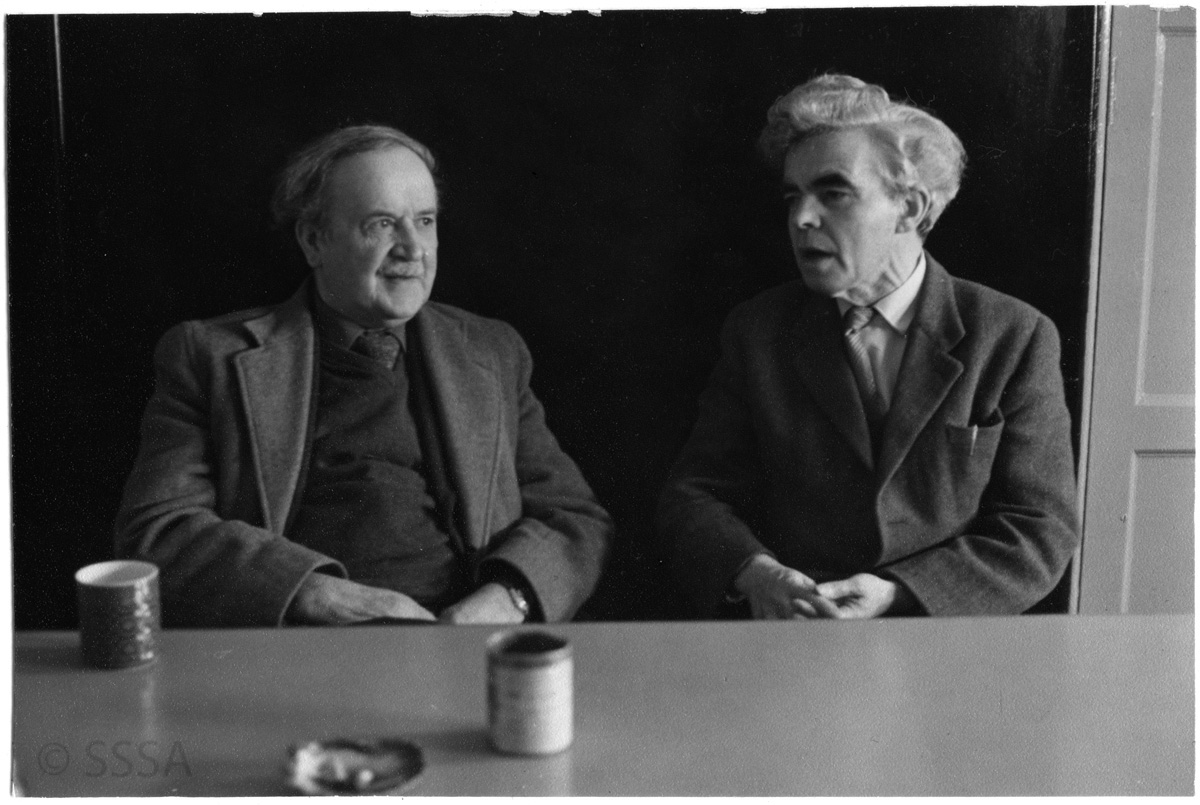
Sorley MacLean and Ian Paterson in the School of Scottish Studies tea room, Summer 1981. © The School of Scottish Studies Archives, Ref: V_2b_8119
This week saw the 110th anniversary of the birth of Raasay poet Sorley MacLean (26 October 1911 – 24 November 1996) and so today’s blog is a great opportunity to share with you a photograph from the collection that I really like, for two reasons.
Here are Sorley and Ian Paterson, sitting at the tea table in the School of Scottish Studies. Ian Paterson was a native of Berneray and worked at The School of Scottish Studies first as a transcriber and then began collecting fieldwork of his own. In July 1974 and November 1978, Ian recorded Sorley reciting his poems at The School. You can hear these recordings via Tobar an Dualchais by following the Reference links below:
It is an incredible gift to be able to listen to one of our greatest contemporary Gaelic poets reciting his own work in fine, resounding voice.
I like the candidness of this image too; such a lack of ceremony. Two people, taking their ease, caught in a conversation while having a cup of tea. And that is the other thing I like about this image. It was taken in the Tea room at 27-29 George Square, in the School of Scottish Studies building and for anyone who worked, studied or had connections in the building, the tea room and the tea table was a special place indeed.
From special occasions to plain old elevenses, there was always a community feel about that room and you were never quite sure who else would be joining you for your tea. When the Celtic and Scottish Studies department and the Archives moved in 2015 the tea table was much mourned as that hub. We often hear stories from people who have memories of being at the tea table and so we thought it would be great to share some of these here on the blog, along with some more photographs from our collections. If you have any memories of occasions in the tea-room, no matter how long or short the tale, please drop us a line at scottish.studies.archives@ed.ac.uk, or leave us a comment below.
Louise Scollay, Archive & Library Assistant
Open Access Week: Meet the (Scholarly Communications) Team
Theo Andrew was one of the first supporters of Open Access at the University of Edinburgh. He started working with the University Library in 2003 on a couple of JISC projects named SHERPA and Theses Alive!, from which produced the Edinburgh Research Archive, which later became our OA repository and one of the most visited DSpace repositories. His comprehensive experience covers OA advocacy and payments, checking publishers and funders’ policies, dealing with copyright enquiries and FOI requests. Now he is the team manager, coordinating a team of five. Outside work, he enjoys running and rolling dice.
Eugen Stoica joined the University Library in 2007 as REF Publications Officer, a role that he resumed for the 2014 submission. Genuinely interested in OA & Copyright and legal matters in general, he is the service manager for the Library Copyright team. Presently he is the Library’s FOI practitioner and in charge of repository administration. A man of few words, he’s an amateur photographer, enjoys travelling and reading history.
Fiona Wright joined the team in 2012 as a Research Publications Assistant to help with the REF2014 submission. Since then, her hard work and professionalism earned everybody’s respect and got her in charge of the OA payments (worth in excess of 1 million pounds) so publishers and researchers alike should stay on the right side of her. She enjoys travelling, going out with her friends and sharing pictures from the top of Arthur’s Seat on early weekend mornings.
Michael Logan was involved in several projects with the University Library, the most recent being the PhD thesis digitisation project (17,000 volumes scanned and deposited in ERA – our OA repository) so in 2019 when he started working with Scholarly Communications Team he fell right into place. Besides managing ERA and producing incredible infographics, he helped with REF2021 submission and with metadata quality. His quirky sense of humour is matched only by his eclectic taste in music.
Rebecca Wojturska joined our team in March 2020 right at the start of the COVID-19 pandemic and for 18 long months she didn’t meet her colleagues in person and never been in the (new) office. Rebecca’s background is in commercial publishing which is a perfect fit for her responsibilities managing and growing our Open Access Journal Hosting service. The latest service development includes a newly created Open Access Book Hosting Service. Her energy and passion for publishing extends outside work as she has her own publishing company focused on Gothic, horror and dark fiction in all formats.
Open Access Week: Download statistics
Introducing Edinburgh Diamond: Library-supported Open Access Books and Journals

Library and University Collections currently offer a journal hosting service, free of charge to staff and students, which you may already be familiar with.
Open Access Week is the perfect time to share that that we have rebranded as Edinburgh Diamond and added a book hosting service to our offering!
The book hosting service will offer much of what the journal hosting service offers: ISBN and DOI allocation, a hosting platform for textbooks, monographs and edited collections, metadata deposits, indexing arrangements, annual reporting, ongoing technical support, guidance on publishing best practice… and more!
Bringing our journal and book services under one umbrella allows us to promote our services as a whole. Edinburgh Diamond does what it says on the tin: promotes diamond open access, transparency, and high-quality research. If you know someone who may benefit from using our service, please put them in touch with Rebecca Wojturska: rebecca.wojturska@ed.ac.uk.
Find out more about Edinburgh Diamond: https://www.ed.ac.uk/information-services/research-support/edinburgh-diamond
Take a look at our new book hosting site:
https://books.ed.ac.uk/
Transformative Agreements: a new way to ‘Read & Publish’

Open access to research publications is one of the key principles of the open science movement. It is often one of the last steps taken, but thankfully, it is also one of the easier steps for researchers to participate in due to investment in infrastructure and support from universities, publishers and research funders. When you publish your research there are three publishing routes you can follow:
Route 1: Publish in a traditional subscription journal and take responsibility for making the Author Accepted Manuscript (AAM) OA in an institutional or subject repository. (Also known as Green OA).
Route 2: Publish in a fully OA journal or platform. (Also known as Gold OA).
Route 3: Publish in a traditional subscription journal through a transformative agreement that is available to you via your organisation. (Also known as ‘Read & Publish’ deals).
The University of Edinburgh’s open access preference is Route 1 using our institutional repository (Pure) to ensure that you are compliant with the REF open access policy. If you have access to funding then you can take Route 2 as the costs should be covered by research funders. Route 3 is a relatively new option that Libraries are exploring to lower barriers to participate in open access publishing, and hopefully restrain and lower the total cost of publishing.
Moving towards a ‘Read & Publish’ model
The idea behind a transformative agreement is that it converts subscription expenditure into a publishing fund that makes all research output OA on publication, whilst maintaining access to any paywalled content. If enough libraries sign up this will shift the publishing business model away from selling subscriptions and paywalls to providing high quality open research.
Recently we have seen an explosion of ‘Read & Publish’ deals being offered by publishers, partly due to the Plan S initiative and also due to the activity of Jisc Collections – the UK organisation who has been taking a leading role in negotiating a transition to open access on behalf of UK libraries. In 2020 the University of Edinburgh had signed up to 3 transformative agreements, but in the space of one year this figure has leaped to 21, with an additional 2 pilot agreements being tested.
How to take advantage of a ‘Read & Publish’ deal
Each of the open access agreements are slightly different due to publishers demands, but generally speaking the process is simple:
- The corresponding author has to be affiliated with the University of Edinburgh, either as a staff member or student. Normally only original research or review articles are covered by the agreement.
- Check if the journal you are publishing in is part of a ‘Read & Publish’ deal. A handy searchable list is available here: https://www.ed.ac.uk/information-services/research-support/publish-research/open-access/read-and-publish-journals
- Upon submission, identify yourself as an eligible author, and then the request should automatically be passed to the Library for approval.
- Select an open licence – we recommend Creative Commons Attribution (CC BY) as this will ensure you are compliant with any relevant research funders open access policies.
You can contact the Scholarly Communications Team (openaccess@ed.ac.uk) for more information about publisher ‘Read & Publish’ deals available at Edinburgh, or you can visit these dedicated webpages: https://www.ed.ac.uk/information-services/research-support/publish-research/open-access/request-apc-payment/publisher-discounts
Unveiling the new Open Access policy at UoE
For Open Access Week 2021 we are pleased to announce a brand new Research Publications & Copyright Policy that will make it even easier for researchers from the University of Edinburgh to make their publications open access.
Earlier this month the University Executive approved the Research Publications & Copyright Policy (2021) which details our approach to the new open access requirements of major research funders from 1 January 2022.
The Research Publications & Copyright Policy (2021) can be read in full on the Information Services web pages, but the key details are outlined below:
- The University of Edinburgh confirms staff members retain the copyright to scholarly works they produce (which is the opposite of UK employment law which states that employers own the copyright to works produced in work time).
- To help comply with funders and other open access requirements, members of staff grant the right for the University of Edinburgh to make manuscripts of their scholarly articles publicly available under the terms of a Creative Commons Attribution (CC BY) licence upon publication.
- This policy will begin on 1st January 2022, and will apply to journal articles and conference proceedings.
This new policy is in line with major organisations including UKRI and the Wellcome Trust and will allow all researchers to make their work open access immediately regardless of their funding situation. Support for implementation of the new policy is available through library research support staff. Any questions or comments regarding the policy can be directed to the Scholarly Communications Team at openaccess@ed.ac.uk.
SSSA in 70 Objects: Filling the Creative Well: A Tribute to Joan W. Clark
Manuscript: The Joan Clark Collection
Response by: Elaine MacGillivray
Out of a thousand possible options, I have chosen to respond to the manuscript collection of Scottish botanist Joan W. Clark (1908-1999) – in particular, her wildflower specimen books
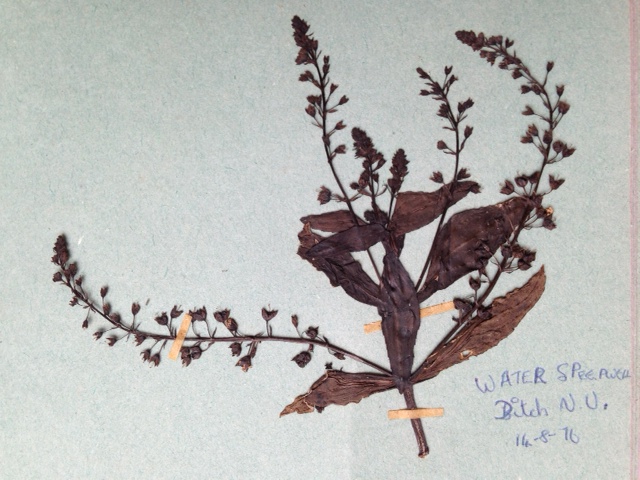
Pressed plant specimen, ‘Water Speedwell’, collected by Joan Clark from a ditch on North Uist, August 1976 (SSSA: Joan Clark Collection)
Joan Wendoline Clark grew up in Kincardineshire and Sussex. Fluent in French and German, skilled in shorthand and a trained typist, she worked for a time at the Foreign Office in London and at the British Embassy in Paris. In the 1930s she returned with her Scottish husband to Scotland and together they settled in Lochaber, where she remained until her death on 6 July 1999. Shortly after her death, her daughter, Anna MacLean kindly gifted Joan’s manuscript collection to the School of Scottish Studies Archives. The collection includes her correspondence and botanical research notes dating from the 1970s right up until 1999, along with three specimen books containing almost 350 pressed wildflowers collected around Onich, Ballachulish, North Uist and Glencoe in around 1976.
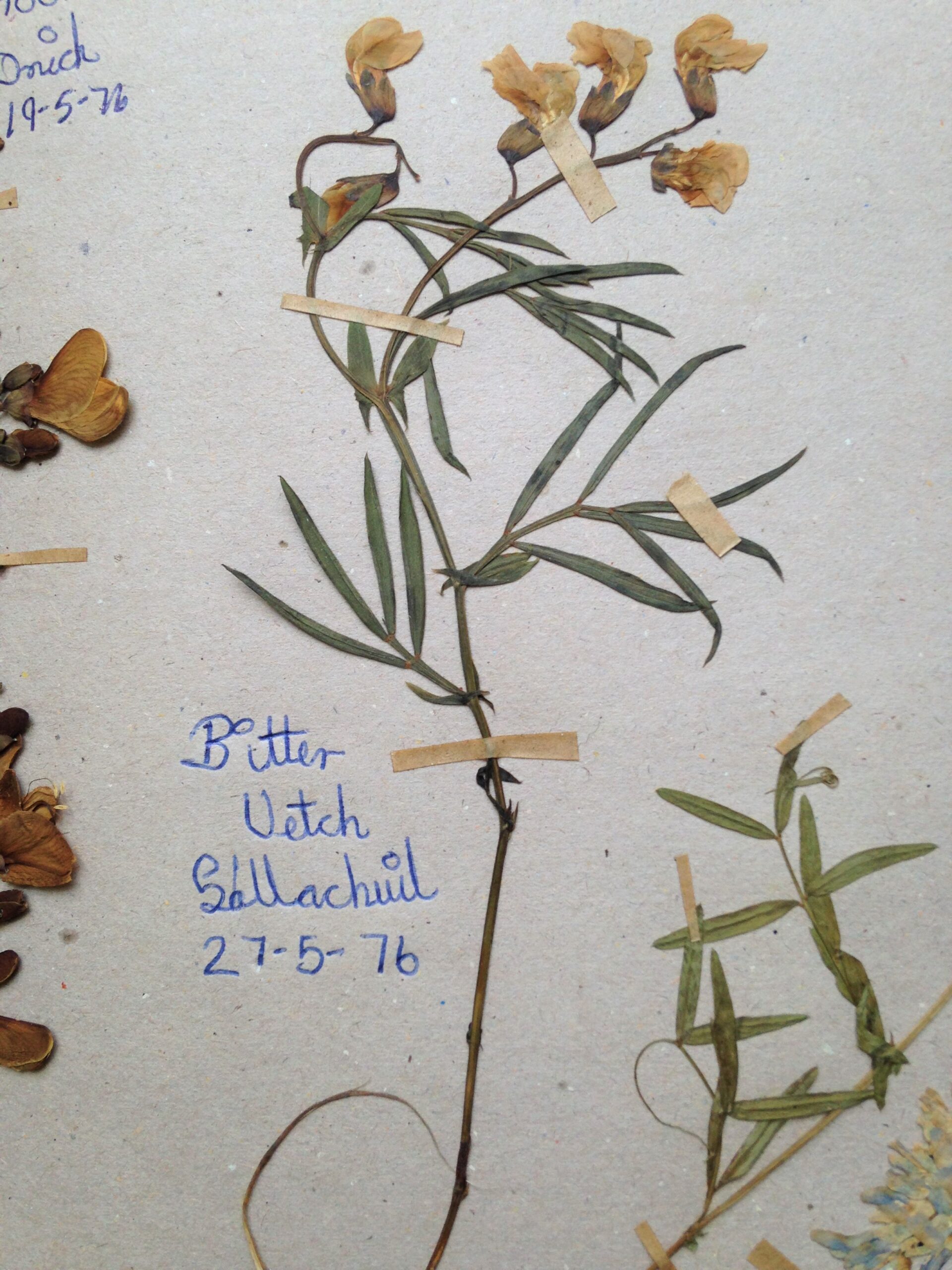
Pressed plant specimen, ‘Bitter Vetch’, collected by Joan Clark at [B]allachuil[ish], May 1976. (SSSA: Joan Clark Collection)
Joan Clark’s wildflower specimen books are made up of three A4 sized sugar paper leaved scrapbooks. Turning the pages, I found each leaf contained between one and three pressed wildflower specimens. Bedstraw, iris, sea pinks, sundew, dog’s mercury and so many more are all represented, carefully laid out and attached with tiny strips of paper glued at either end. Beside each specimen the name of the plant, the location it was found, the date collected and additional notes are recorded in blue or black ink. The addition of this metadata means that the specimen books are not purely aesthetic but also scientifically valuable.
Joan Clark’s manuscript collection is testament to her incredible contribution to botanical science. Her meticulous and painstaking research informed Richard Pankhurst and J. M. Mullin’s Flora of the Outer Hebrides (1991), and she collaborated with Ian MacDonald of the Gaelic Book Council to publish Gaelic Names of Plants / Ainmean Gàidhlig Lusan (1999). Many have paid tribute to her calibre as a botanist, not least the renowned and respected botanist A. C. Jermy of the Natural History Museum (Watsonia, 2000).
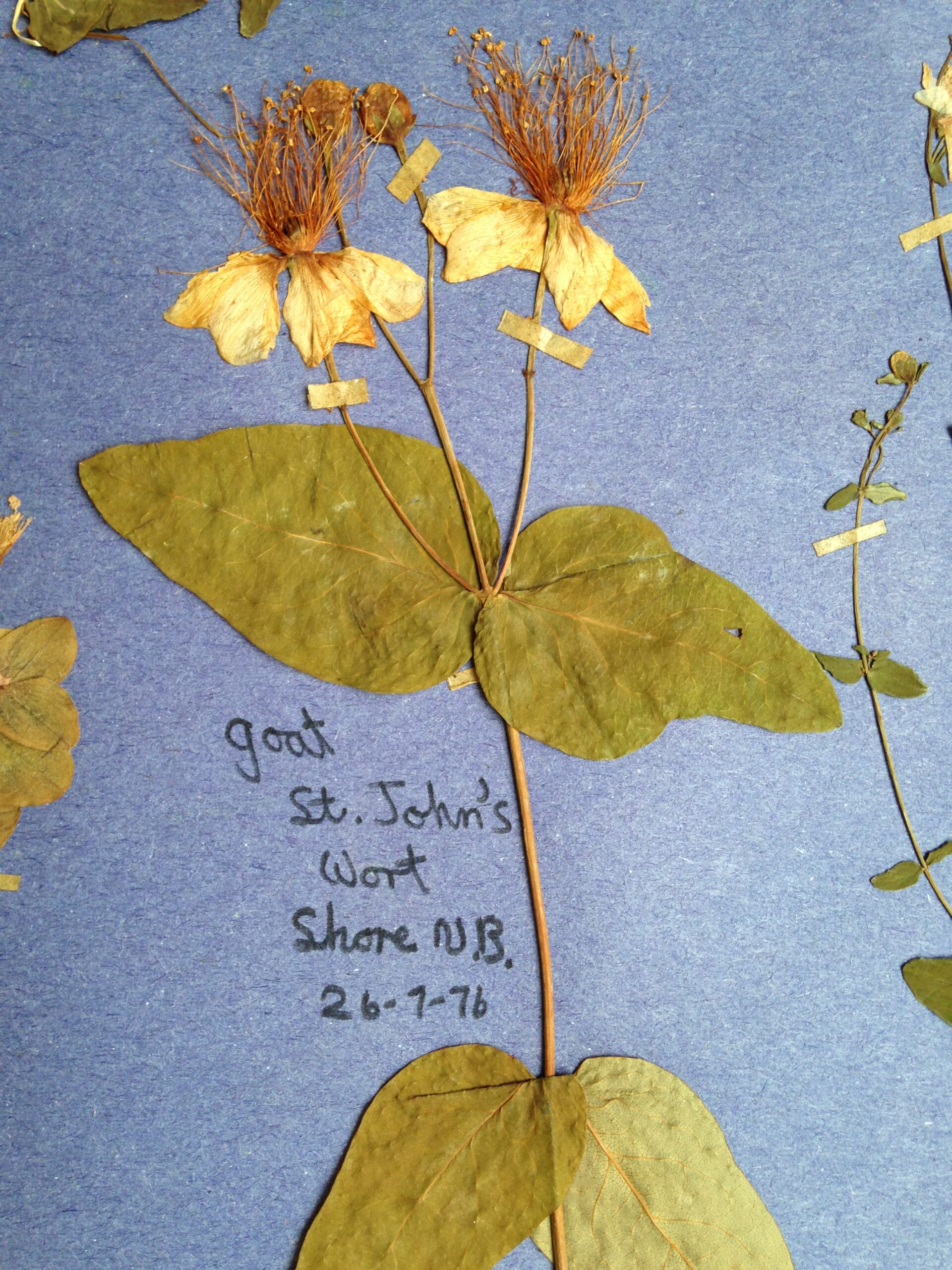
Pressed plant specimen, ‘St John’s Wort’ (also known as Goat Weed), collected by Joan Clark from the shore at North Ballachulish, July 1976. (SSSA: Joan Clark Collection)
Jenny Sturgeon wrote in her response to Alan Bruford’s recording of Tom Tulloch (11 Jun 2021), “local names for flora and fauna root us to where we come from and there is a cultural history and identity associated with them.” Growing up on the west coast of Argyll, I was taught the names of the local wildflowers there by my mother and grandmothers. During my post-graduate studies in Liverpool, my mother once sent me a snapdragon – collected, pressed and placed between two pieces of tissue paper in a card. On the card was a scribbled note: “snapdragons are out and so I thought you would like to see one!” For me, and for many, flora and fauna offer up a very tangible connection to people, place and time.
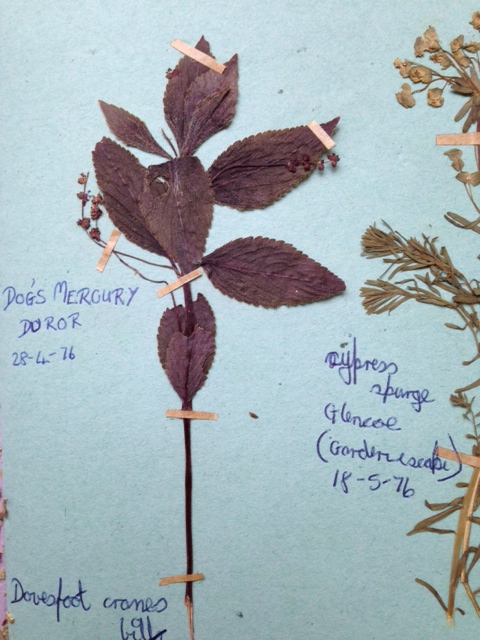
Pressed plant specimen, ‘Dog’s Merury’, collected by Joan Clark at Duror, April 1976 (SSSA: Joan Clark Collection)
With this in mind and inspired by Joan Clark, earlier in 2021 I set out to collect some of my own herbarium specimens. I packed up my rucksack with the Botanical Society of Britain and Ireland’s Guide to Collecting and Pressing Specimens, my phone (for the camera), a pair of scissors, a pack of coffee filters (in place of parchment paper), and Delia Smith’s Complete Illustrated Cookbook (the weightiest book in my library and my makeshift flower press).
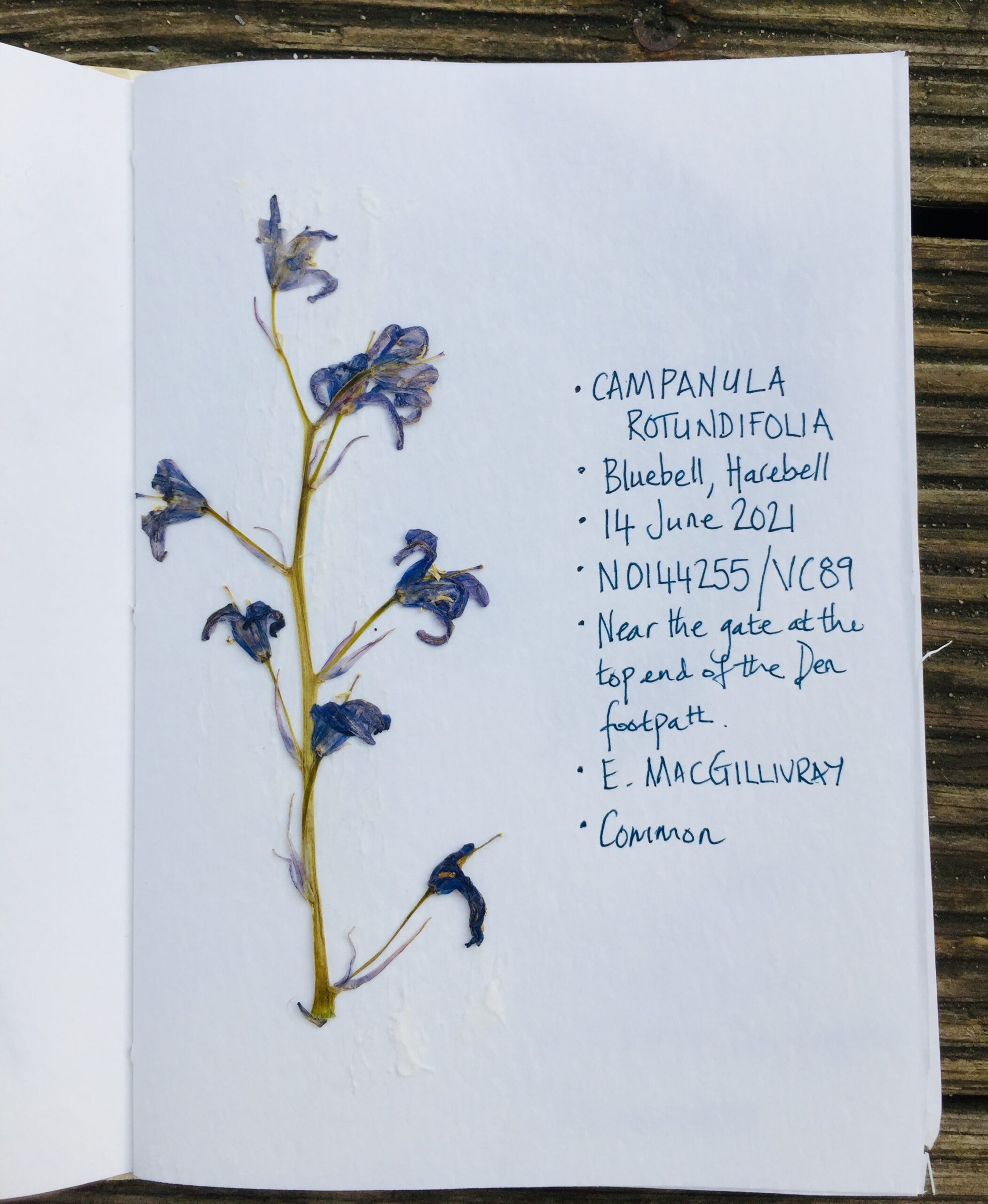
Pressed plant specimen, ‘Bluebell’, collected by Elaine MacGillivray at the Den of Scone, June 2021.
I collected around 10 specimens from a local Perthshire woodland. Some of them I knew well, like the common broom, vetches, campion and bluebell; others left me scratching my head.
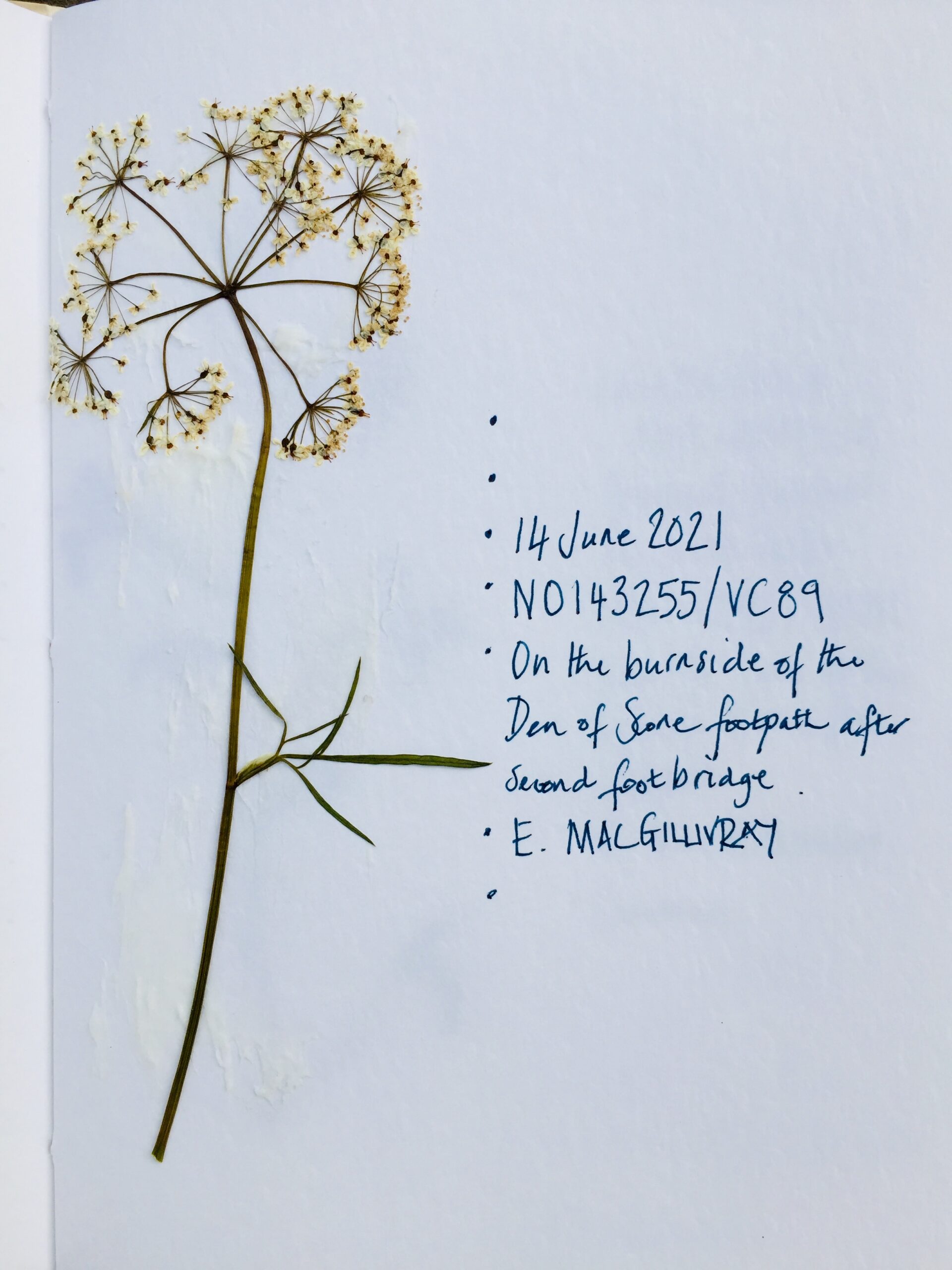
Pressed plant specimen, ‘Unidentified’, collected by Elaine MacGillivray at the Den of Scone, June 2021.
In attempting to identify my specimens, I found myself poring over Francis Buchanan White’s Flora of Perthshire (1898), the Perthshire Society for Natural Science’s Checklist of the Plants of Perthshire (1992), and an old copy of the Readers’ Digest Guide to Wildflowers of Britain (1996). I compared my specimens to photographs that I had of Joan Clark’s specimen books, and to images and descriptions on the webpages of the Scottish Wildlife Trust, Wildflower Finder, and the Botanical Society of Britain and Ireland. The result is that some of my metadata remains lacking until such a time as I can identify and name the plant, or until my newly acquired membership of the botany section of the Perthshire Society for Natural Science pays dividends!
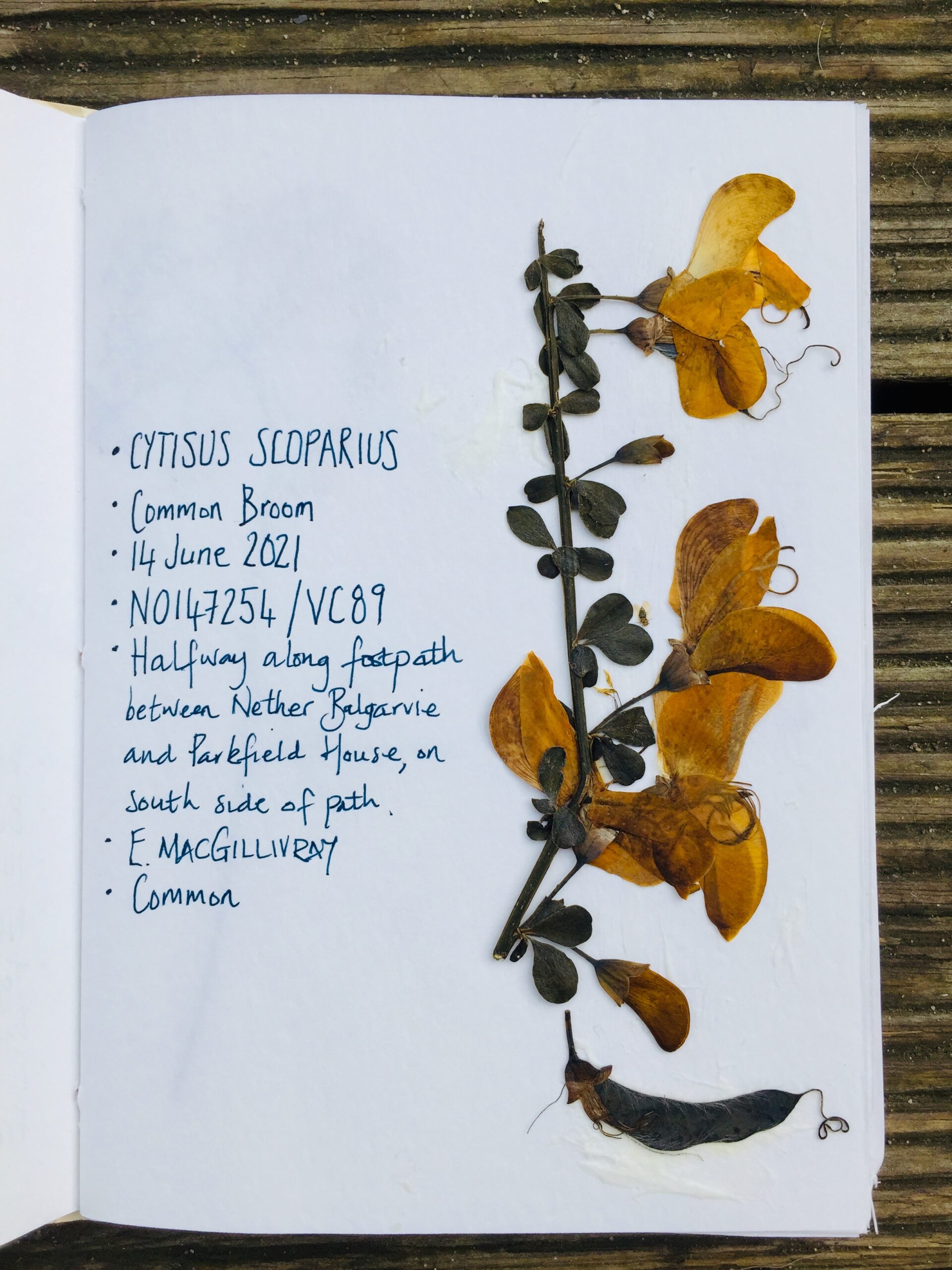
Pressed plant specimen, ‘Common Broom’, collected by Elaine MacGillivray at Nether Balgarvie / Parkfield House, Scone, June 2021.
The creative process of collecting, pressing, identifying and documenting was completely absorbing. Through it I have learned to pay greater attention to my environment, gained a deeper understanding of my locality and the interdependence of people and plants. One of the many privileges of working so intimately with archival collections is that we are repeatedly offered a unique opportunity to develop knowledge and interest in a person, subject or era that otherwise may well have eluded us. In trying to see the world through the botanical wisdom of Joan Clark, the present-day natural world has opened up to me in a way I might never have imagined. I have an even greater respect for the knowledge, work, tenacity, dedication and patience that she and others must have brought to their botanical studies. I wonder what Joan Clark would have made of my amateur attempt to emulate her. I hope that she would be pleased that her legacy has inspired, and is able to continue to inspire, a new found passion to know, understand and protect plants and their environment.
Acknowledgements
Thank you to Louise Scollay, Caroline Milligan and Dr Ella Leith for their encouragement, prods, and proofreading.
Images are copyright, please do not reproduce.
Sources and further information:
Jermy, A.C., Obituary of Joan Wendoline Clark (1908-1999) in Watsonia, No. 23, (2000), pp.359-372 (http://archive.bsbi.org.uk/Wats23p359.pdf)
Murray, C.W., In Memorium – Joan W Clark (Rust) 1908-1999 in BSBI Scottish Newsletter, No. 22, (2000), pp. 12-13 (http://citeseerx.ist.psu.edu/viewdoc/download;jsessionid=2BC0FC507955B7D126E651E0C6CFE287?doi=10.1.1.659.2850&rep=rep1&type=pdf).
Elaine MacGillivray was the School of Scottish Studies Project Archivist, 2014-2016
Is there an ‘object’ related to the School of Scottish Studies that you would like to write about or respond to? It could be a recording, an image, a manuscript or something else!
We’d love to hear from you. Get in touch with us at scottish.studie.archives (at) ed.ac.uk
Open Access Week 2021
 Next week is the annual international Open Access Week where organisations celebrate and showcase open access developments and projects. It is a time for the wider community to coordinate in taking action to make openness the default for research.
This year’s theme of “It Matters How We Open Knowledge: Building Structural Equity” aligns with the recently released UNESCO Recommendation on Open Science, of which Open Access is a crucial component.
We will be publishing a series of blog posts to showcase the best of Open Access at the University of Edinburgh. To give you a sneak peak here is the publishing schedule:
- Monday: Unveiling the new UOE Research Publications & Copyright policy
- Tuesday: Transformative Agreements: a new way to ‘Read & Publish’
- Wednesday: Edinburgh Diamond: a new OA platform for UOE
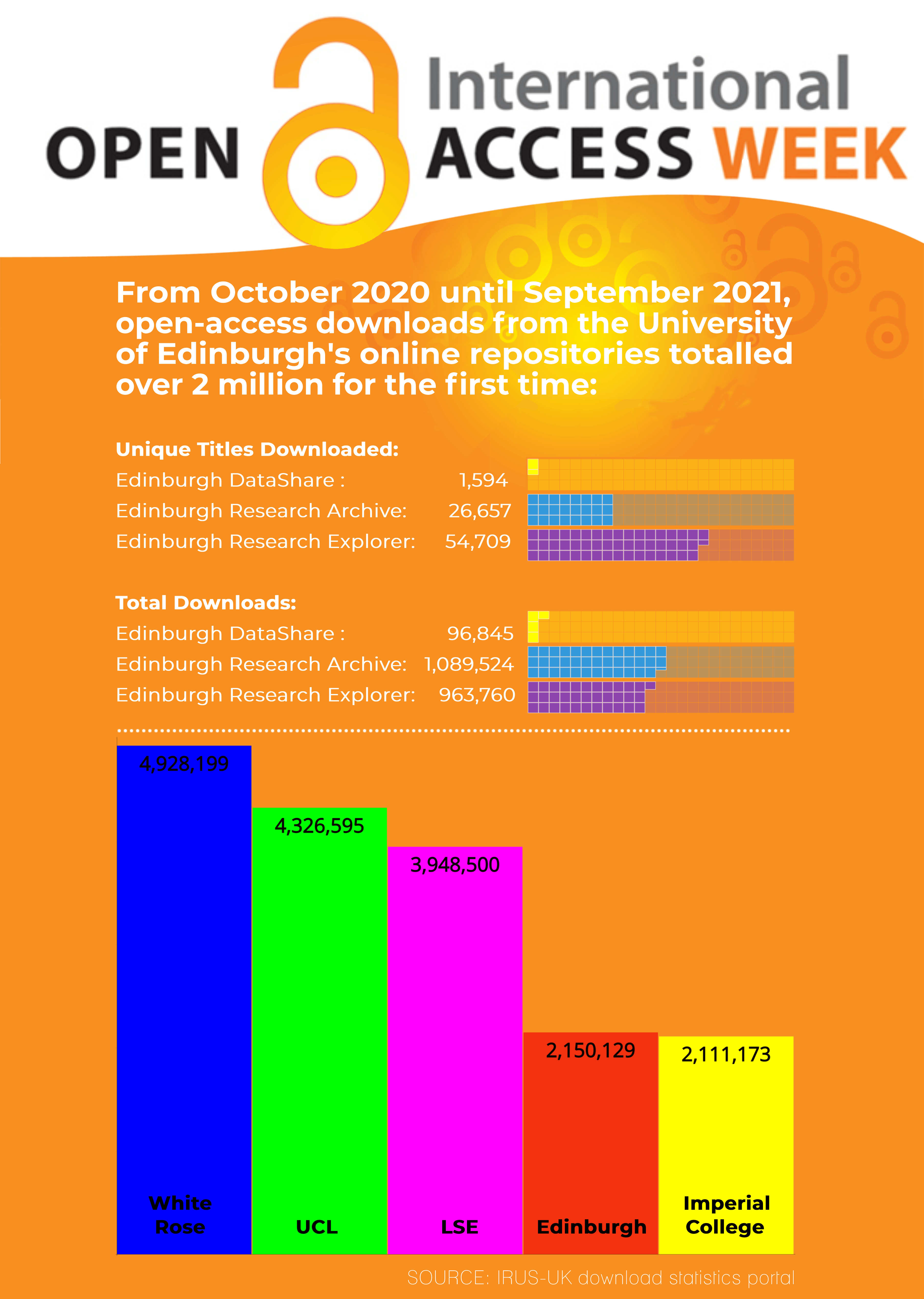
- Thursday: Repository Downloads: a year of Open Access
- Friday: Meet the Team: the experts providing help and support at UOE
Finding Journals and Law Reports
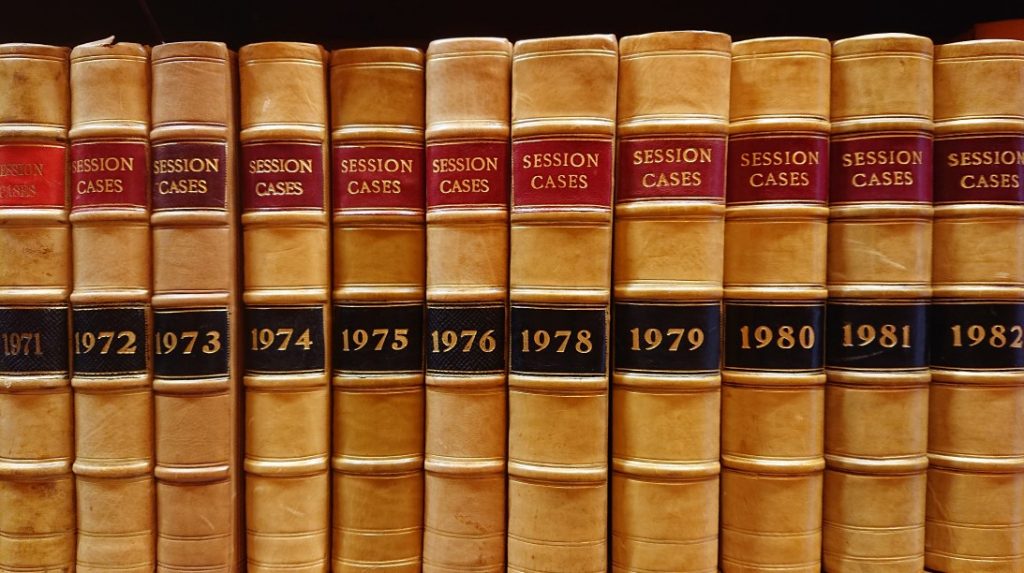
Session Cases, image courtesy of the Supreme Court Library team, SCTS
Law reports and journal articles become increasingly important as students progress through their studies and research, and finding them can be tricky at times.
The library has access to a plethora of reports and journals but not everything is available online. Although we continually look for online access wherever it is available there is material that we can only receive in print.
The main places to get online access to law reports and journals is through our legal databases – mainly Westlaw, LexisLibrary and HeinOnline.
The Law Subject guide includes a section on Law Reports and access to eBooks. There is also information on the hierarchy of law reports to help students decide which reference to use when citing cases.
What to do if we do not have full online access?
Students often contact us asking why they can only get an abstract to the item they want in the online databases. This is because we do not get full text (full online) access to everything within all the databases. Sometimes we only have access to the bibliographic details such as the reference and abstract. So how can you get a copy of the full item?
Staff and students can use the interlibrary loan service to request items. This service involves us requesting material from partner libraries. There is a limit on how much can be requested and full details are on the interlibrary loan pages:
In Edinburgh staff and students also can get access to the National Library of Scotland who have a great range of resources available from their own collection and also through their relationship with the Faculty of Advocates’ Library.

If you’ve tried all the above avenues and are still struggling to get access to what you need, drop us an email on law.librarian@ed.ac.uk for some help.
Collections
 Hill and Adamson Collection: an insight into Edinburgh’s past
My name is Phoebe Kirkland, I am an MSc East Asian Studies student, and for...
Cataloguing the private papers of Archibald Hunter Campbell: A Journey Through Correspondence
My name is Pauline Vincent, I am a student in my last year of a...
Hill and Adamson Collection: an insight into Edinburgh’s past
My name is Phoebe Kirkland, I am an MSc East Asian Studies student, and for...
Cataloguing the private papers of Archibald Hunter Campbell: A Journey Through Correspondence
My name is Pauline Vincent, I am a student in my last year of a...
Projects
Cataloguing the private papers of Archibald Hunter Campbell: A Journey Through Correspondence
My name is Pauline Vincent, I am a student in my last year of a...
Archival Provenance Research Project: Lishan’s Experience
Presentation My name is Lishan Zou, I am a fourth year History and Politics student....