Home University of Edinburgh Library Essentials
April 6, 2026
New to the Library: Medieval and Early Modern Studies
I’m happy to let you know that the Library now has access to Medieval and Early Modern Studies a digital research source from Adam Matthew Digital. This offers you access to a huge range of primary sources covering social, cultural, political, scientific and religious perspectives, from the 15th to early 18th centuries.
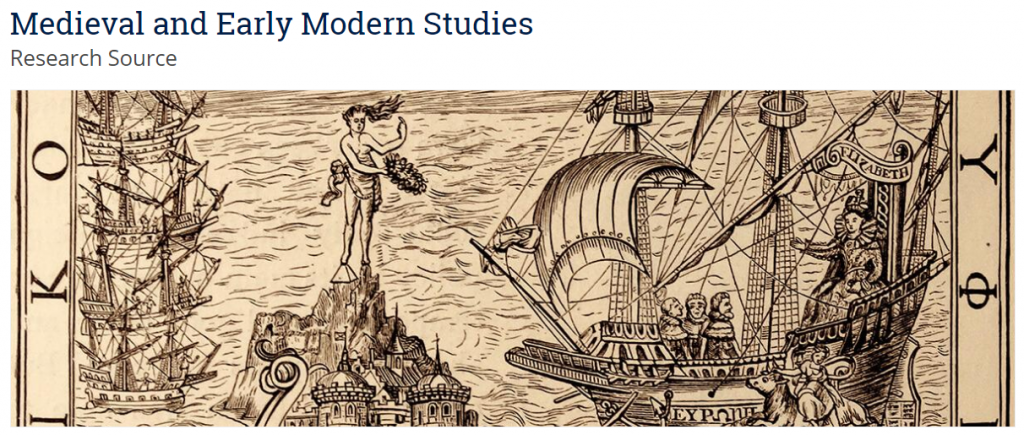
You can access Medieval and Early Modern Studies via the Databases A-Z list, Digital Primary Sources guide and DiscoverEd.
The breadth of resources provided within this collection is extensive, from sources concerning the Black Death to Restoration of the English monarchy and the Glorious Revolution. Read More
Putting the Pieces Together: The Challenges of Working on Architectural Models (Part 2)
This week we have the final part of Project Conservator Mhairi Boyle’s series on the conservation treatment of three Percy Johnson-Marshall architectural models. The first part can be read here.
Putting the Pieces Together: The Challenges of Working on Architectural Models (Part 2)
In my last blog, I introduced the Percy Johnson-Marshall architectural models, and the challenges faced when designing a treatment plan for them. In this week’s blog, I am going to tackle the topic of different adhesives and treatment methods used in this project.
In the field of paper conservation, there are a few gold-standard adhesives. The most ubiquitous adhesive that almost all paper conservators use is wheat starch paste. Though most conservators associate starch-based adhesives with East Asian conservation practices, one of the earliest recorded uses for starch was recorded in Ancient Egypt, where it was used to adhere pieces of papyrus together.
Volunteering at the CRC: Charlotte’s experience
Today we’re introducing Charlotte Holmes, a postgraduate student who is doing some volunteer work under the supervision of archivist Aline Brodin. Her main task is to catalogue and box-list two very different collections from our archives, the Archive of Illustrators Richard and Alison Douglas Tod (Coll-2029) and the Archive of productions of Varsity Vanities and various dramatic groups (Coll-1581). Volunteering with the CRC is a great way to gain some new skills and some practical experience while working with our heritage collections. Charlotte tells us about her background and her work in our reading room:
Hi everyone! My name is Charlotte, and I am a final-year PhD student in History. My thesis is entitled “Domestic Medicine in Early Modern Scotland, c. 1650 – c. 1750”. Before this course, I spent a few years in the “real world” after my undergraduate and masters at Georgetown University in Washington, DC, and the University of Edinburgh respectively. My undergraduate degree was in History and French, concentrating on Western Europe and Africa, while my masters was in Renaissance and Early Modern Studies. I am interested generally in the history of Scotland, medicine, and gender.
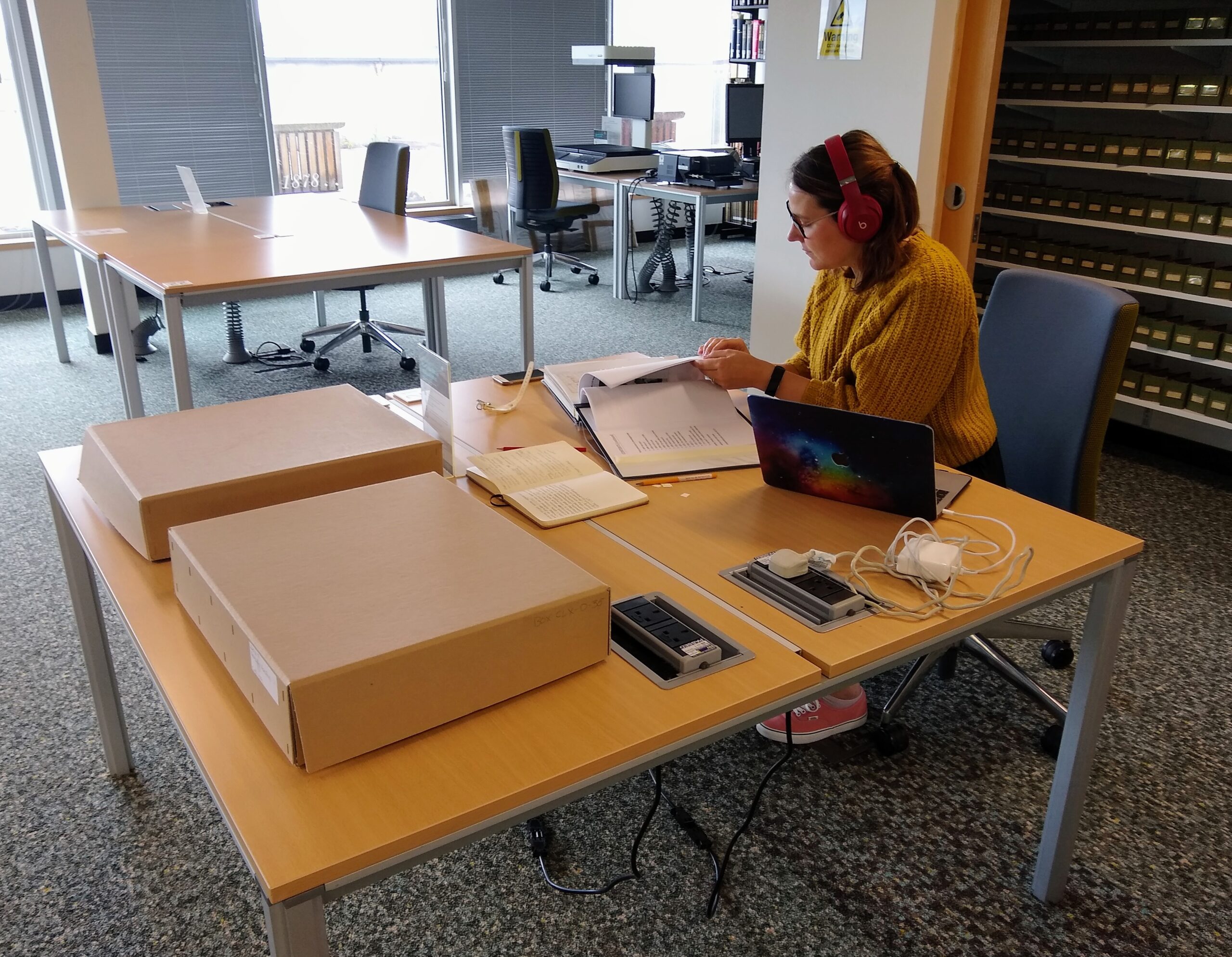
Charlotte working in our reading room.
My position with the Centre for Research Collections is as a Box-Listing Volunteer. As it says on the tin, I have been listing what is in the boxes for two collections: the Richard and Alison Tod fonds and the Varsity Vanities fonds. Richard and Alison Tod were Scottish children’s book illustrators throughout the 20th century and the Varsity Vanities fonds contain photographs and programmes from Edinburgh University student theatre productions from the mid-20th century. Most of my role involves thinking about what researchers need to know about items in the collections: are the photographs or artwork in black and white or colour? Can we determine the year in which the item was created? Then, I enter this data into ArchivesSpace with other archival descriptors such as the call number.
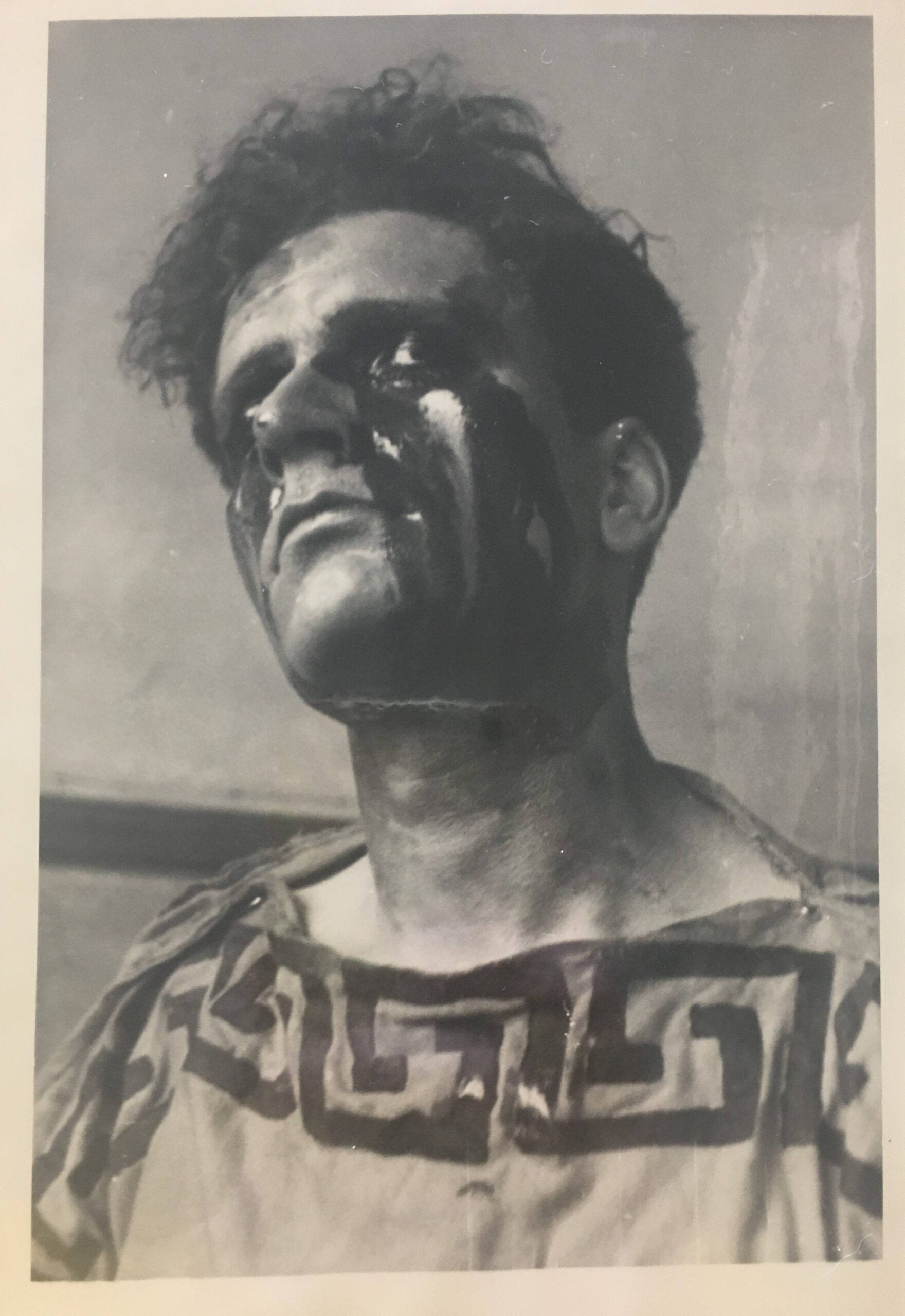
A student acting in a Varsity Vanities play, 1940s (Coll-1581)
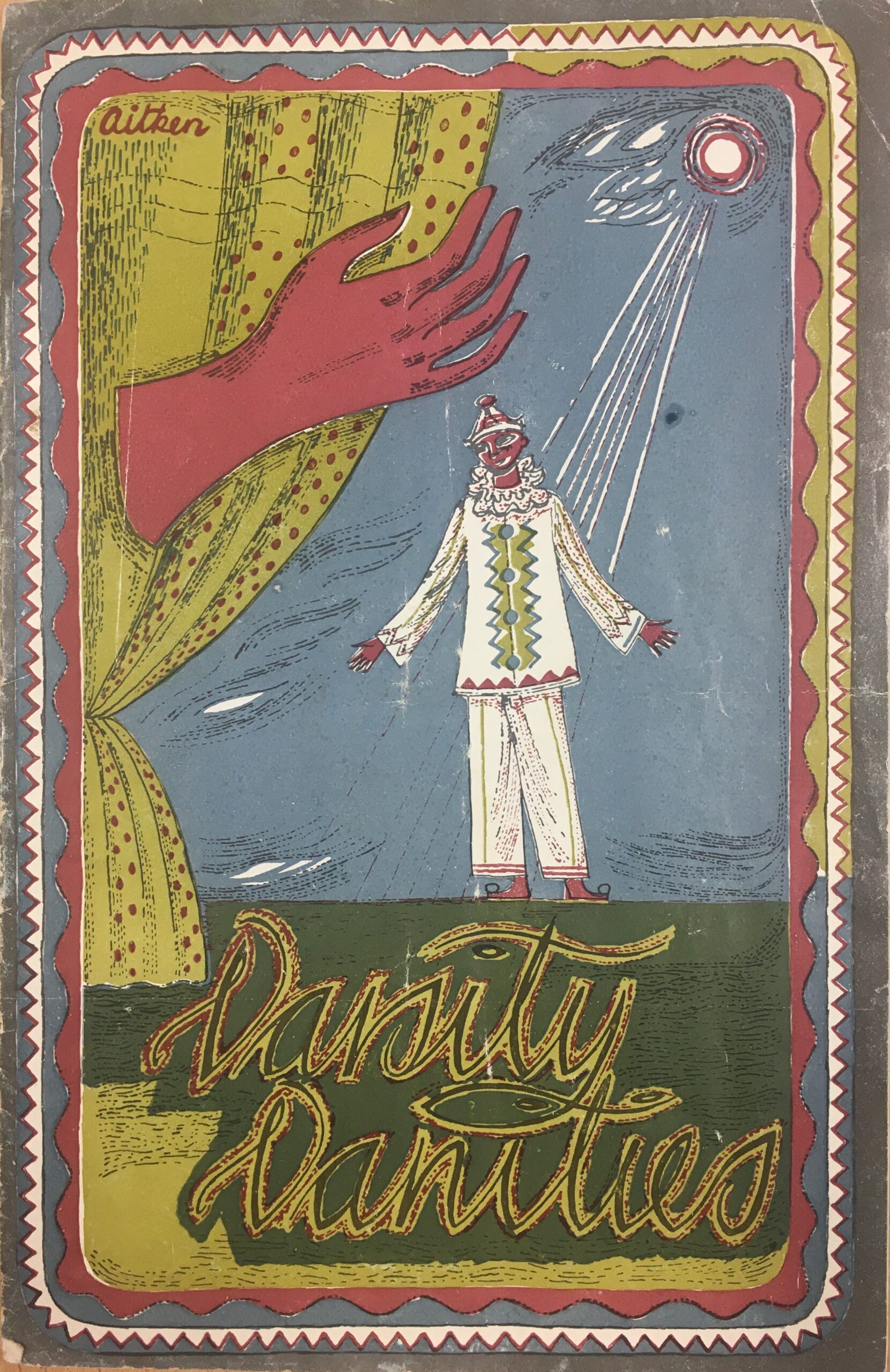
Varsity Vanities programme, 1940s (Coll-1581)
I took this position because I wanted to learn some basic archiving practices. As a researcher, I only look at the published side of the catalogue and I wanted to learn how it worked from the back end. I have certainly learned how much is involved in cataloguing items: it was challenging at first to fight my instincts to analyse them and to remain as objective as possible. But there were pieces in both collections that involved some subjectivity and further research. For example, there were racial depictions that are now commonly understood to be harmful to sections of society. So, I got to stretch my research muscles as well as exercise some subjectivity within the archiving process. It made me remember that there is a very human side to archival objectivity.
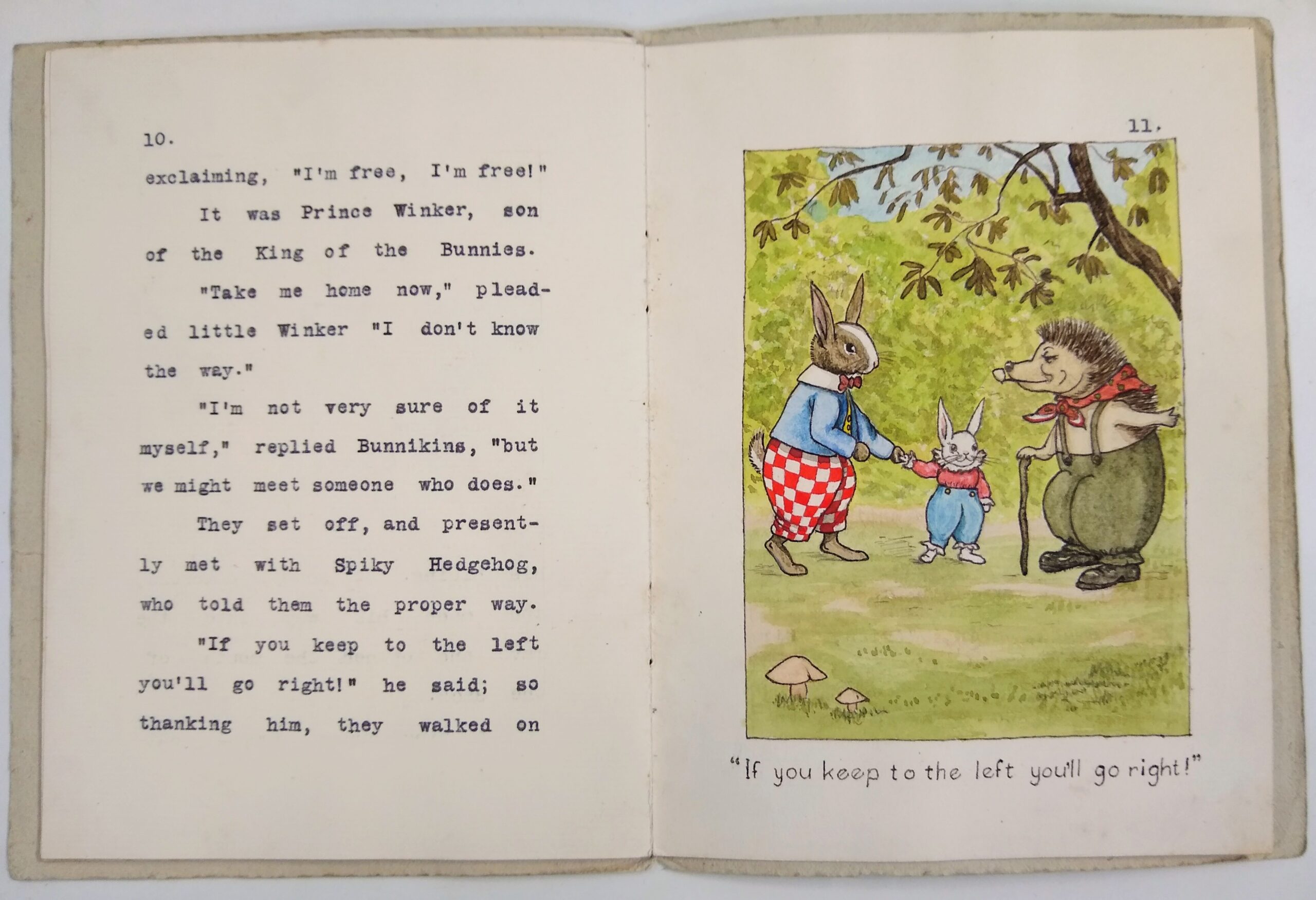
Booklet by Alison Tod entitled “Bunnikin’s Adventures”, with original illustrations, 1935 (Coll-2029/2/3/1)
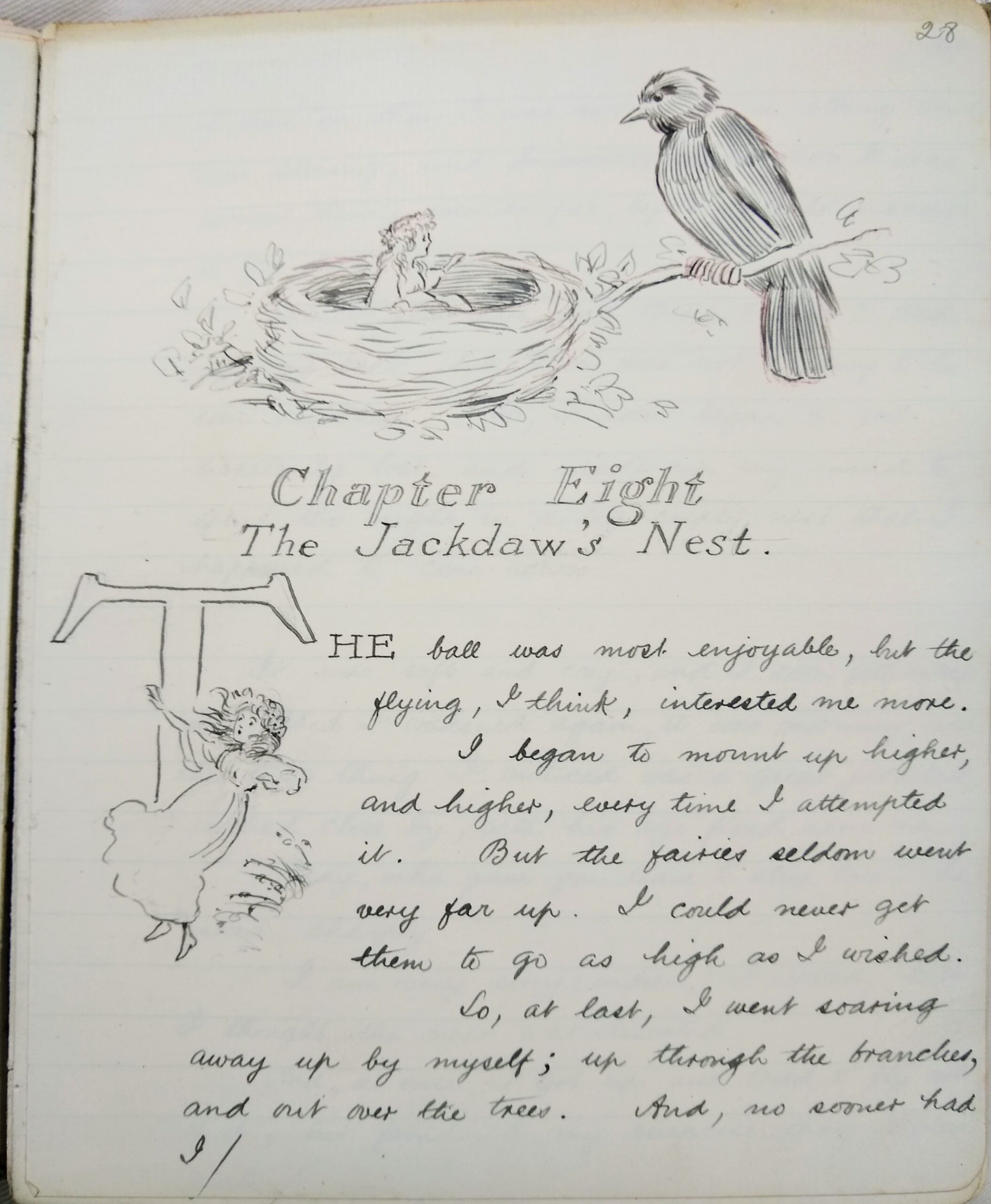
Booklet by Richard or Alison Tod entitled “Fairyland Tales: Googoo’s Gamp”, 1939 (Coll-2029/2/1)
What I am leaving with from my time at the CRC is an incredibly positive learning experience. Everyone that works there, including and perhaps especially the front of house staff, are helpful and supportive. My supervisor, Aline is extremely patient and explains everything well and thoroughly. When I’m in, she makes a point to come say hi. I also have a regular table in the Reading Room, which is infinitely funny to me because of course my regular table wouldn’t be at a coffee shop or pub, but in a nerdy environment! Anyway, if you are interested at all in archives and history, I would highly recommend volunteering for the CRC. It’s worth climbing the six flights of stairs, I promise!
If you are interested in volunteering with us, you can find all the relevant information, including how to be added to our mailing list, on this page: Volunteers and Interns | The University of Edinburgh
Ridicule and research support: Library Twitter strikes back!
Library and research branches of Twitter were outraged recently when two American Law students published a paper in the Harvard Journal of Law & Public Policy relating to abortion rights. The anger centred around the hypothesis that because the students didn’t find any historical literature relating to the term ‘abortion’ in their searches, that abortions simply didn’t exist in American history.
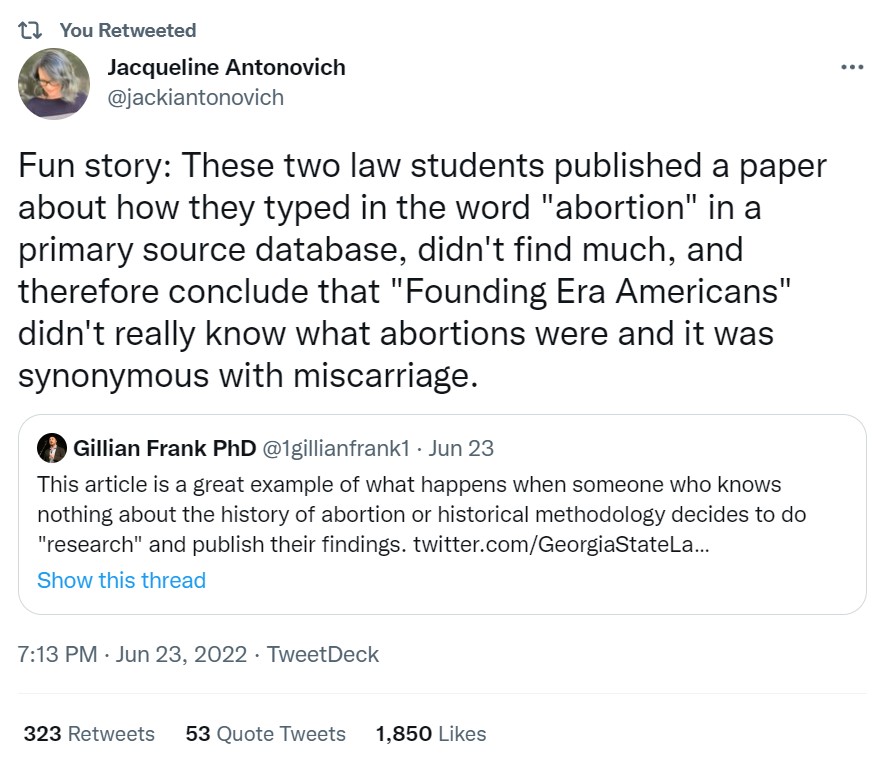
The thread of tweets goes on to explain that the furore surrounding this published paper is not that there was an investigation into historical abortions (which is topical worldwide since the recent overturn of the US Roe V Wade case), but that the flawed methodology was passed through teams of reviewers and editors and allowed to be published. Jacqueline Antonovich goes on to cite an article by Dr Lauren MacIvor Thompson published in the New York Times in 2019 entitled ‘Women have always had abortions’. (This article is behind a paywall but staff and students at the University of Edinburgh can read it in full using some of the news databases that the Library subscribes to.)
Aside from there being an entire school of academic research dedicated to the history of birth control rights, you may be wondering ‘what did those students actually do wrong?’ Dr Gillian Frank (@1gillianfrank1) provides some guidance in his tweets:
Fun fact: Just because you don’t find evidence in one database when you type in the word “abortion,” doesn’t mean a practice didn’t exist. Better historical questions are: Am I using the right keywords? Under what conditions could matters relating to abortion be spoken about?
Ronit Stahl (@ronitstahl) agreed:
And from there, ask questions like *Who* would be talking about this? Who would *write* about this? What *kinds* of documents/sources might include mention of this? *Where* might we find those sources? *How* do we think about/interpret silences?
More information about how to critically assess a search like this can be found by reading through Dr Frank’s twitter thread. Twitter can be an excellent tool for sharing resources and promoting discussion. This example is not only relevant because of the current news cycle but also because awareness of the importance of interrogating research methodologies rigorously is crucial if you are to publish well respected pieces of research.
Consider the bias in all your sources.
- What power structures led to this work being published?
- Who is speaking and why is their viewpoint important?
- Who is missing from the conversation?
- If there is a solitary viewpoint, why is this one in focus?
Librarians talk about bias quite often when discussing critical information skills with students and staff, because we want to be sure that the inferences you make from your source material are sound and fully considered. The Academic Support Librarian team have recently been working with one of our student interns to produce an online resource to help students to expand their searches and diversify their reading, due to be published this summer. We’ve also been crafting a toolbox to help our academic staff colleagues start conversations about including a wider range of resources in their core reading lists. Watch out for more news of both of these going live on the ASL blog.
In the mean time, if you’re struggling with your research and would like some advice on more robust search methodologies, you can contact the Law Librarians by email: law.librarian@ed.ac.uk, or any of our colleagues from the ASL team using the contact information on the ASL by subject area page. Although classes and exams are finished, we are around all summer so please contact us to make an appointment!
Conservator Claire turns to the dark side (but it all ends well).
I am now in my final week of the Lyell Project; time has flown by as myself and our exceptional interns have breezed through the plethora of material in this collection. Once they had finished their internships, my work turned to focus on some of the most challenging conservation work … the printed books!
Held within both the Lyell new accession and the University’s own collections, 22 printed volumes and a handful of special collection volumes were identified as being in need of interventive treatment. Several of the printed volumes had significant structural damage to their boards and spines. It was clear that through use, the tension the volume had undergone – that is the opening and closing – had led to this damage. I had to be careful that whatever method I chose to rectify this would be sympathetic to the remaining structure, and that new materials would need to be carefully introduced to support the volume structurally. All 22 volumes were at different stages of degradation; they all needed some form of structural repair to mitigate this damage. It was a similar picture with the special collection volumes, which were alike in binding style. This blog focuses on the worst of those bunch.
A small handful of the volumes were in the condition that you see Figure 1 below. Spines and boards were detached or even missing altogether. What was left, was falling apart, and the leather had little integrity.
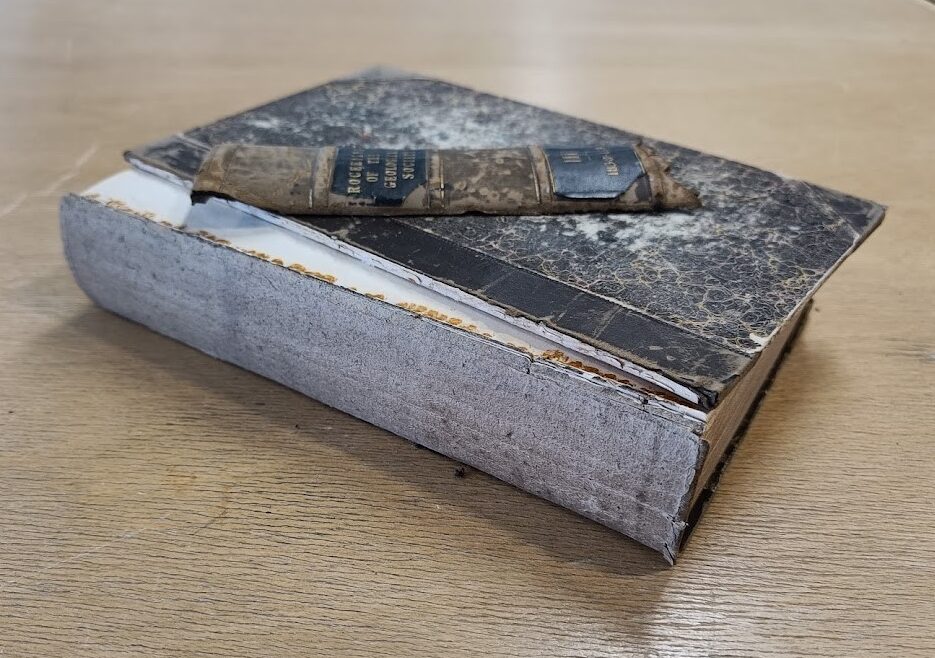
Special Collection Volume before treatment (SC6373)
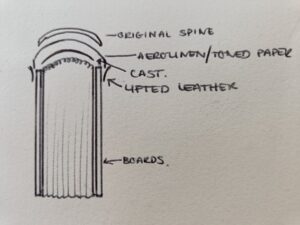
Figure 2- Diagram demonstrating the layers of the Honey Hollow technique
After some thought and research, I decided to use the ‘Honey Hollow’ technique to restore the structure of the volumes, which introduces new materials including a cast of the spine that acts as the new structure. The original spine is then attached to it, but no longer takes on any structural responsibility. This was the most feasible choice, as the condition and strength of the leather that was remaining was too poor. An illustration of the Honey Hollow technique can be seen in figure 2:
All book conservation work started with surface cleaning, consolidation of red rot and any corner repairs. Normally the first step is to lift the original spine piece from the volume. As this had already detached this was not needed. Once they had been safely stored, the casting could begin. The book was placed in a finishing press, and cling film was tightly wrapped around the spine to act as a barrier from any moisture whilst casting the spine. Pieces of 12gsm Japanese tissue were cut and attached layer by layer onto the exposed spine using wheat starch paste. Dependent on the width of the book, between 7-10 layers of tissue were required to make a strong cast.
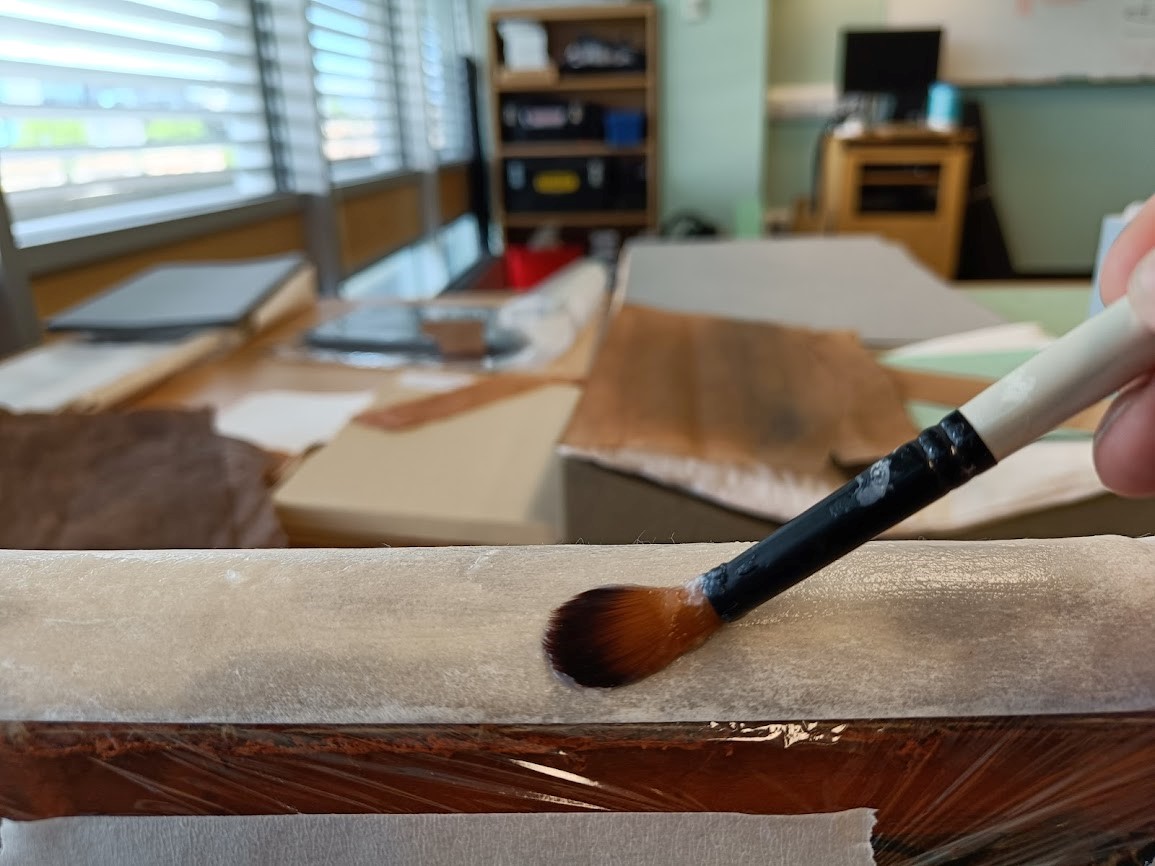
Figure 3 – Casting of the spine using Japanese Tissue and wheat starch paste
Once the cast had dried, it was removed and trimmed. The book remained in the finishing press whilst the leather on the boards was carefully lifted using a leaf spatula. This is where the new Aerolinen fabric would be inserted. This fabric is commonly used in book conservation for both board reattachment and spine repairs. As it needed to wrap around the entire spine, a piece of the linen was pasted to the cast with a 1cm margin either side for insertion into the boards. The attachment to the spine needed to be strong, so EVA was the adhesive used for this part of the process.
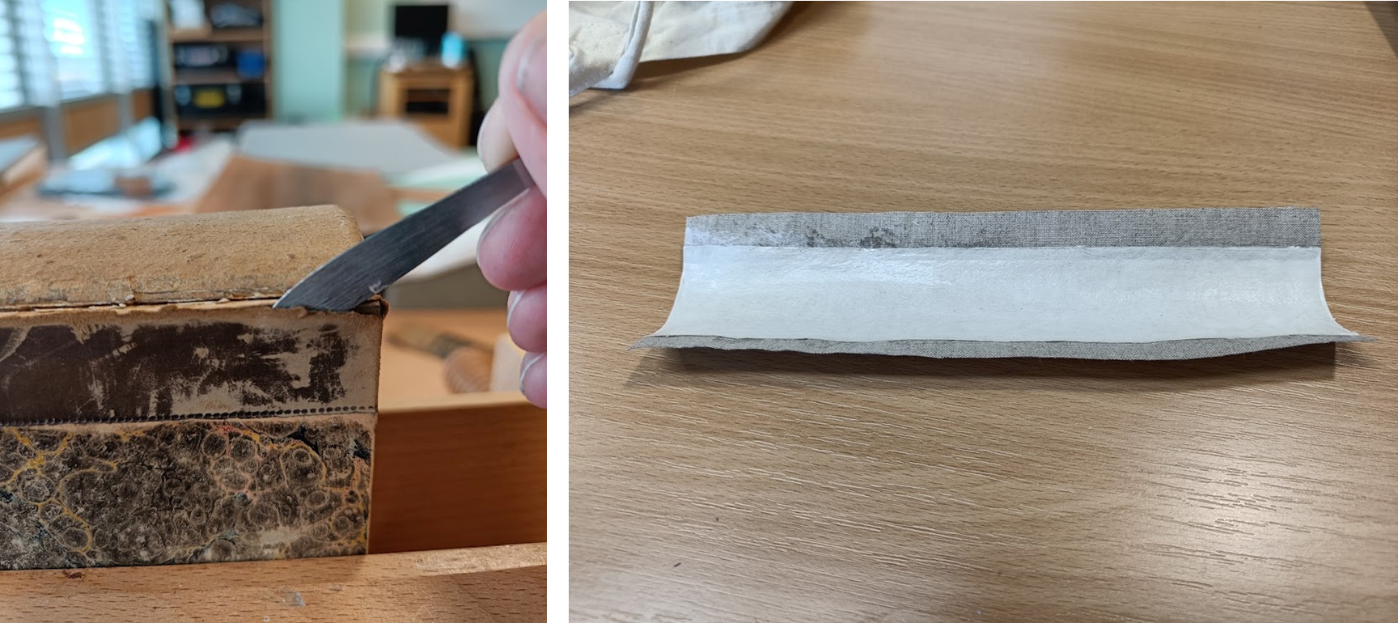
Figure 4 – Left: Lifting of the board leather, Right: New Aerolinen cast
Aerolinen can be toned to make the original spine piece in other applications, however in this case it is best to cover the linen with a toned Japanese tissue of a heavier weight. A medium tone was chosen that could match the darker parts of the leather, rather than the lighter areas where it had degraded. Once attached and trimmed, it was now time to attach the original spine cover to the cast (making sure it was the right way up!).
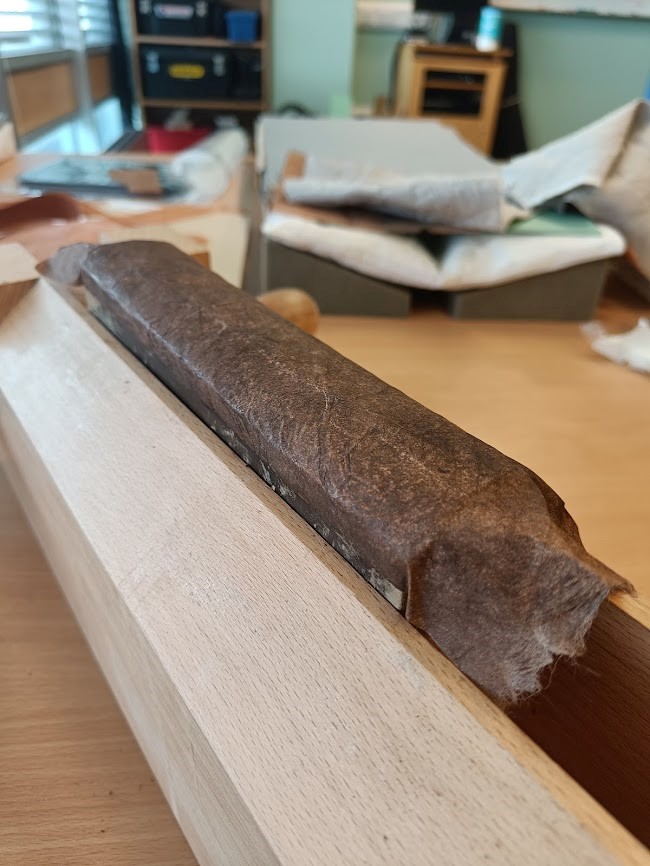
Figure 5 – Toned Japanese Tissue cover of the cast
As often only two thirds of the original spine cover was left, some more acrylic painting had to be done to mask the toned paper. The degradation of the leather was much worse on the spine piece, so the toned Japanese tissue did not match it as well as the sides. After a little bit of painting, the overall look of the new cast was more in keeping with the original spine. All that was left to do was to repair any inner joints inside the book at the start and end of the volume with a light Japanese tissue.
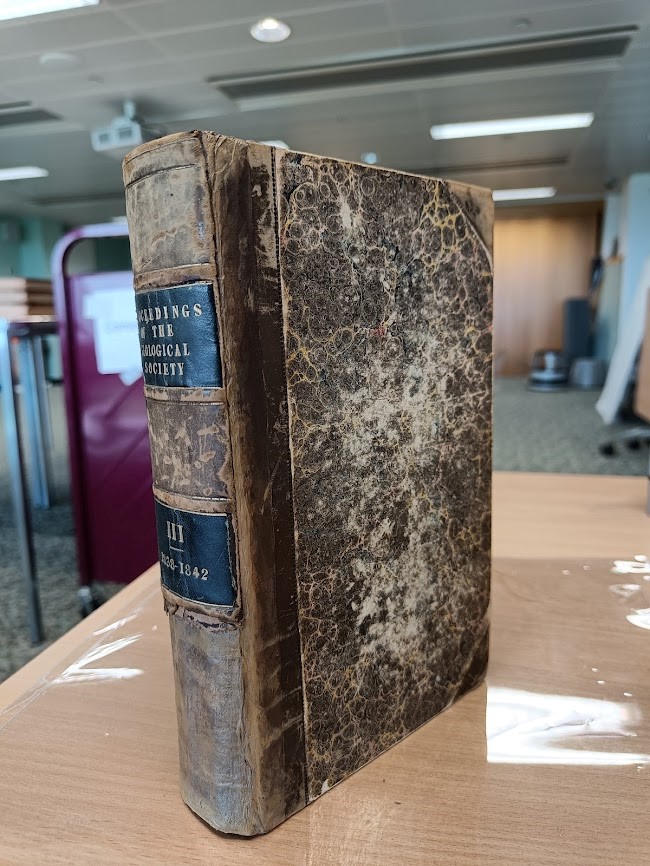
Figure 6 – Special Collection Volume after treatment
The technique overall was a success; this volume and others like it are now safe to handle, and the repairs blend in with the original condition of the rest of the book. It was a really interesting technique to employ and, more importantly, a satisfying one. This was a great experience for me to put both my ethical and technical skills to work to protect the volumes and retain what was left of the binding.
Claire
New blog from the Digitisation Service
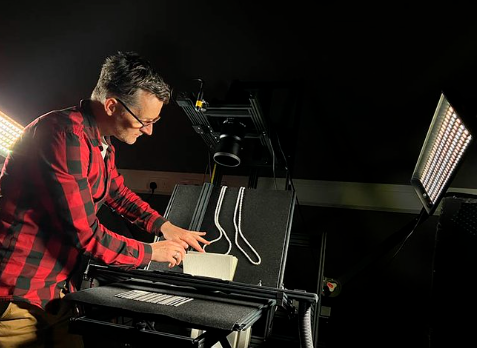
Its taking teams of multi-skilled people to open up the Charles Lyell collection! Read all about the Cultural Heritage Digitisation Service Team’s efforts to digitise the Notebooks on their latest blog here:
From Castles to Cradle: Photographing the Lyell Notebooks | Digital Imaging Unit (ed.ac.uk)
Its a long road ahead, but already 87 of the Notebooks are now completed and online. The images are being added to the University of Edinburgh’s Image website, LUNA, and you can find them here:
Thanks to all the CHDS staff – keep going!
LILAC 2022: Being Better Teachers

Photo by Austin Chan on Unsplash
In our third and final post about the LILAC conference (you can find part one here and part two here) I wanted to touch on the topic of becoming better teachers. Although there was so much to take in from the conference – as you’ll have read from Ruth and Christine’s posts – one of the most impactful things I learned from the sessions was that the work we do is so important and impactful on our students, and it’s in all of our best interests that we consider that we have a powerful role to play in teaching.
The session I attended on the topic of Students, academic reading and information literacy in a time of COVID really reminded me that there can be a marked difference in the information we think our students want, and what they actually want. The panellists explored the results of the Academic Reading Format Information Study (D Mizrachi, 2021) which shows that over 70% of students prefer to use print books for academic study, with only 8.7% preferring ebooks. A later examination of student trends during the pandemic showed that 73% of students who responded in the US would not complete all their prescribed readings for their course due to their availability online. These results surprised and somewhat concerned us, particularly as many institutions operate on an e-first policy for library acquisitions now. If students don’t want ebooks, are we doing them a disservice by putting such emphasis on online access? Do we need to communicate and provide better training in order to help make these resources more accessible? Ultimately these questions could be answered by working more directly with students and not making assumptions about what information needs they have.
There were also inspiring sessions to encourage us to continue to develop as professionals ourselves, because by allowing ourselves time to write and research and read more about developments in our profession, we not only share the student experience with those we teach but we also develop better praxis for ourselves. All three of our academic support librarian delegates attended the Getting Your Writing Groove Back workshop run by the Journal of Information Literacy representatives, and I think all of us found it both fun and instructive. As a result we’ve already restarted the L&UC Journal Club, and look forward to building research and writing further into our current workplace activities in the future.
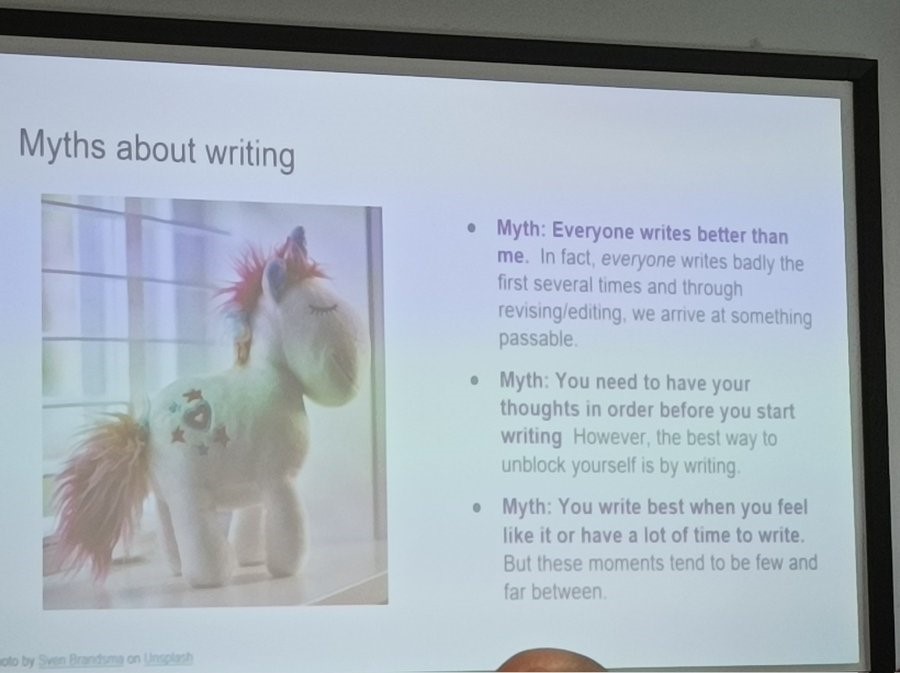
Slide from Getting Your Writing Groove Back presentation, by the team from the Journal of Information Literacy.
My final thought on becoming better teachers as librarians is that we need to seek out recognition of the work we’re already doing. The fact is that many library workers don’t consider themselves teachers, but by attending this conference I was able to hear many people from around the country talk about the impact their work has, and it reminded me that we’re already doing lots of this. Whether it’s creating subject guides or video demonstrations of resources, writing web content or blogs to help highlight useful databases, or directly providing instruction in front of hundreds of students, we are teachers too.
Ruth already spoke about the inspiring words of Marilyn Clarke and Emily Drabinski, but I must return to their keynotes as they both drove home the point for me. Libraries are important and library workers have influence. We must be intentional in the work we do. We have the power to affect great change in the lives of our students and our institutions, whether it’s including a range of examples in our work to help our students feel like they belong in their classes, or challenging them to find a wider variety of voices beyond their prescribed reading. We are supporting their learning and we need to recognise the power we have in order to use it to be the best teachers we can be.
SarahLouise McDonald
Academic Support Librarian
From Castles to Cradle: Photographing the Lyell Notebooks
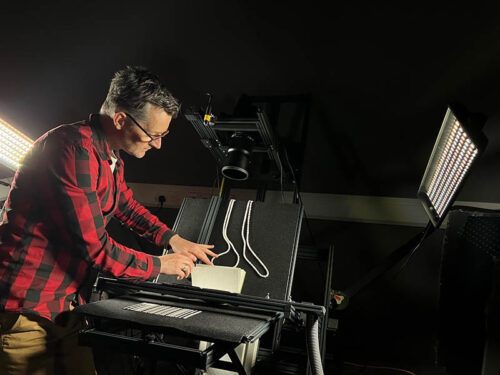
I was delighted to take on the challenge of helping photograph the University’s collection of notebooks of geologist Sir Charles Lyell, and there’s a bit more to photographing 300 notebooks than one might imagine. The Cultural Heritage Digitisation Service is a fantastic team of people, and quickly welcomed me onboard. Prior to this posting, I’ve enjoyed a varied background, including photographing the contents of National Trust for Scotland castles as part of a major digitisation project Reveal, plus Polar and Northern Lights photography aboard expedition cruise ships.
Database trial for Chinese and Japanese ancient books
 Some of us may have already used Diaolong Complete Si Ku Series (in Databases A-Z) that we have subscribed to for the last few years. This resource is part of a larger database which also contains many more pre-1911 Chinese books as well as several thousand volumes of Japanese books. The database is called Diaolong Full-text Database of Chinese & Japanese Ancient Books — 雕龍中日古籍全文資料庫.
The University Library has now set up a trial of this whole database. The trial will be added to the E-resources Trials website: http://edin.ac/e-resources-trials very soon. Meanwhile, you can access the trial directly at the following website on the University network or via VPN while off campus:
The trial will end on 31 August 2022, with a possible subscription depending on feedback and library budget.
Diaolong Full-text Database of Chinese & Japanese Ancient Books contains about 30,000 ancient books which cover a wide range of subjects including history, religion, philosophy, literature, politics, economics, medicine and local gazetteers. The page display can be in scanned images, in transcribed texts, or in both side by side. The huge number of books are sourced from 21 large series titles which can be searched or browsed. These 21 series are:
- Daozang (道藏, 1513 book titles / 5878 vols)
- Daozang jiyao (道藏辑要, 299 / 2553)
- Sibu congkan (四部叢刊, 472 / 13685)
- Xu Sibu congkan (續四部叢刊, 364 / 15328)
- Yongle dadian (永樂大典, 813 / 813)
- Gujin Tushu Jicheng (古今圖書集成, 33 / 10012)
- Dunhuang shiliao(敦煌史料,2952 / 2955)
- Qingdai shiliao (清代史料, 113 / 10832)
- Zhongguo difangzhi (中國地方誌, 2137 / 52022)
- Zhongguo difangzhi xuji (中國地方誌續集,1939 / 37477)
- Zhongguo difangzhi sanji (中國地方誌三集,2090 / 18309)
- Riben gudian shujiku (日本古典書籍庫, 618 / 7400)
- Siku quanshu (四庫全書, 3541 / 92074)
- Xuxiu Siku quanshu (續修四庫全書, 5550 / 104703)
- Siku cunmu (四庫存目,4350 / 65551)
- Siku wei shou shu (四庫未收書,167 / 2479)
- Siku jin hui shu (四庫禁毀書,620 / 13342)
- Liufu wencang (六府文藏, 7717 / 149576)
- Zhongguo minjian wenxue (中國民間文學,203 / 538)
- Qingdai keju zhujuan (清代科舉硃卷, 1071 / 7792)
- Yi jia ku (醫家庫,1033 / 9362)
Feedback would be much appreciated.
Lyell staff update the Murray family donors
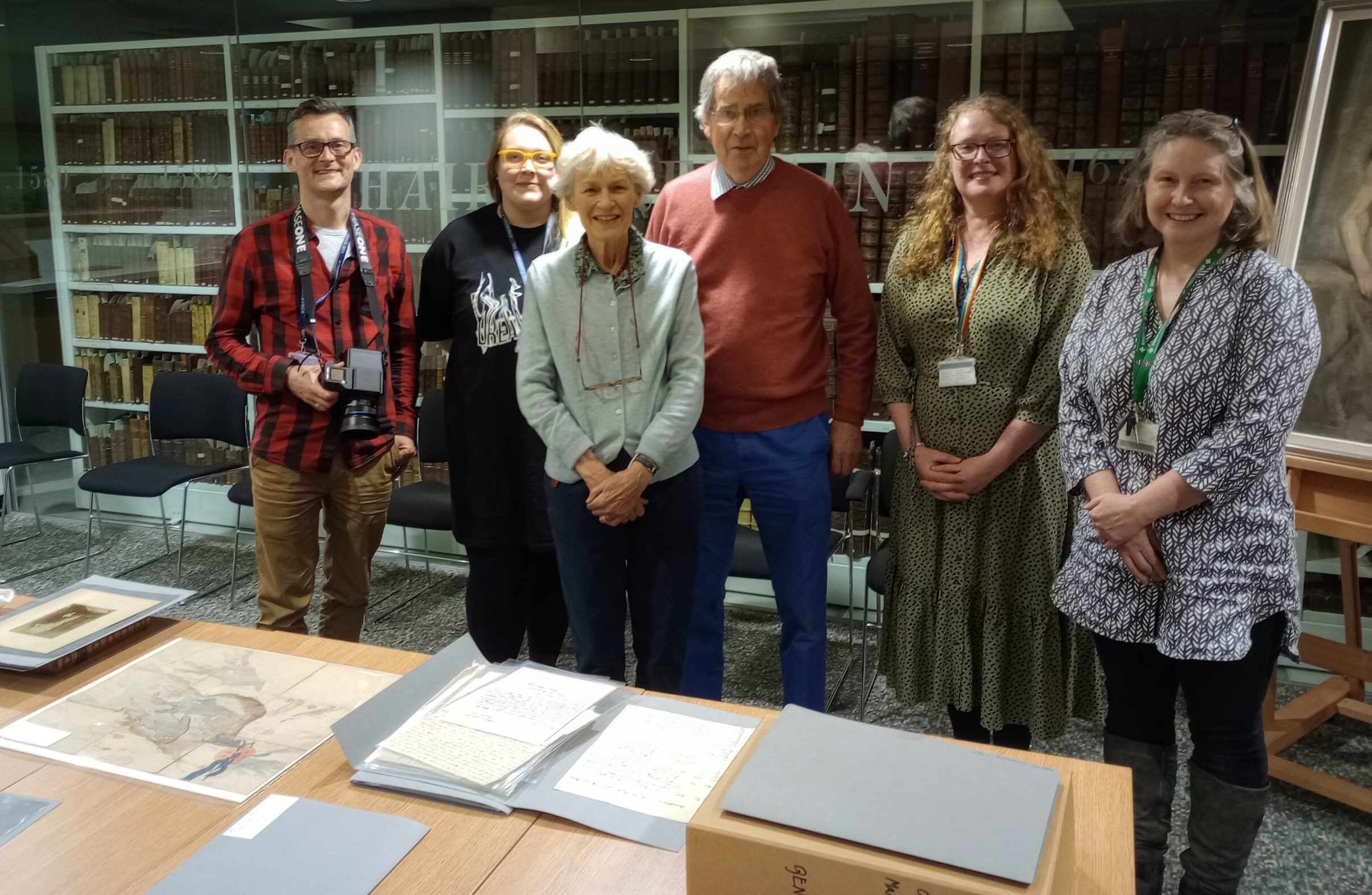
It was a great pleasure for some of the Lyell project staff to welcome the Murray family to the Library, and to show them how their generous support is allowing the archive to be conserved, digitised and curated. The repairs and bespoke rehousing of the notebooks were found to be particularly interesting.
John, Claire, Pamela, Susan, David and colleagues look forward to updating the rest of our supporters as well as welcoming further donors to Edinburgh in the months ahead.
Collections
 Hill and Adamson Collection: an insight into Edinburgh’s past
My name is Phoebe Kirkland, I am an MSc East Asian Studies student, and for...
Cataloguing the private papers of Archibald Hunter Campbell: A Journey Through Correspondence
My name is Pauline Vincent, I am a student in my last year of a...
Hill and Adamson Collection: an insight into Edinburgh’s past
My name is Phoebe Kirkland, I am an MSc East Asian Studies student, and for...
Cataloguing the private papers of Archibald Hunter Campbell: A Journey Through Correspondence
My name is Pauline Vincent, I am a student in my last year of a...
Projects
Cataloguing the private papers of Archibald Hunter Campbell: A Journey Through Correspondence
My name is Pauline Vincent, I am a student in my last year of a...
Archival Provenance Research Project: Lishan’s Experience
Presentation My name is Lishan Zou, I am a fourth year History and Politics student....