Home University of Edinburgh Library Essentials
April 7, 2026
New! Colonial Law in Africa, 1946-1966
I’m pleased to let you know that the Library has recently purchased Colonial Law in Africa, 1946-1966 from British Online Archives. This database provides access to the African Government Gazettes from 1946 to 1966.

You can access Colonial Law in Africa via the Primary Sources guide, the Databases A-Z list or the African Studies guide. And it will be accessible via DiscoverEd in the near future. Read More
Using modules in LexisPSL
This summer we’ve increased the number of modules we have access to in LexisPSL due to student demand! Students and staff can now view all the practitioner advice and notes in each of the following areas:
- Banking & Finance
- Commercial
- Corporate
- Dispute Resolution
- Employment
- Private Client
- Property
- Restructuring & Insolvency
We find that the materials on PSL are particularly helpful for our Diploma students, but all staff and students can view what’s included by following these simple steps:
- Visit the Law Databases page, and scroll down to find the link for LexisPSL.
- If prompted, log in using the link that says ‘use academic sign in’ and then select UK Access Management Federation. Select University of Edinburgh from the list, accept the terms and conditions, and if necessary log in using your UUN.
- You will arrive at the LexisPSL homepage in the Banking & Finance module. Use the dropdown arrows next to the title of the module to select which module you would like to view. This is highlighted in green in the image below. NOTE: we have access to all the modules with a grey tick next to them.
The Lexis platforms for PSL and Lexis Library will be changing as of September; we will provide further instructions and demo videos on how to access these resources in the first weeks of the 2022-2023 academic year. Look out for information on training and induction sessions from the UG and PG offices in September, or contact us if you have questions in the mean time.
Recordings of Lunchtime Seminars: Decolonising and Diversifying the Library
Our recent post on Decolonising and Diversifying the Library introduced the short seminar series the ASL team ran during lunchtimes in July. We’re delighted to be able to follow up that post with the news that recordings of all three sessions have now been added to Media Hopper. Please use the links below to access the videos:
Diversity in First Year Scots Law Reading Lists Supporting Diversity using the ECA Artists Book and Zine Collections
Diversifying your Reading List from a Student Perspective
For more information on these sessions or if you have ideas for what you’d like to see in future lunchtime seminars, please contact us by email or leave us a comment.
American Prison Newspapers, 1800-2020: Voices from the Inside
The library has access to a new collection from JSTOR.
Books stacked on a table on the Law Library mezzanine. Photo by Sam Stills, copyright University of Edinburgh.
American Prison Newspapers, 1800-2020: Voices from the Inside.
The first newspaper published within a prison by an incarcerated person was Forlorn Hope, in 1800. Since then more than 450 newspapers from U.S. prisons have been published. Some are still in publication today such as Angolite and the San Quentin News.
This collection brings together hundreds of these periodicals from across the US into one collection. Representing various institutions there is special attention on women-only institutions.
The collection is open access and can be accessed via the A-Z list of databases.
A Heavenly Rehousing Project!
Today we have the final instalment of a two-part series from Collections Care Assistant, Sarah Partington. In this post, she talks about cleaning and rehousing a collection of works by the Gaelic Baptist preacher and hymn writer, Padruig Grannd. Sarah has just completed a government-funded Kickstart placement and has now started a new role working with our collections at the University Collections Facility.
The Peter Grant Collection comprises volumes of works by the Gaelic Baptist preacher and hymn writer, Padruig Grannd. These were stored together in a box, along with other printed works, manuscript sermon notebooks, and items pertaining to one of his descendants, Daniel Grannd. The material was put together in the 50s and it had unfortunately experienced the effects of unsuitable storage conditions over the years prior to it coming into the care of the Centre for Research Collections. This was obvious from its condition: in addition to the more common issues with older books, such as surface dirt, loose boards, text blocks and spines, most of the items in the box also showed serious signs of mould, residual staining, and warping from damp conditions in past storage. Conservators and archivists alike will get shudders when they hear whispers of attics, basements or garages…the likely former home of this collection.
Bearing Witness: The Pre-Digitisation Conservation Treatment of The Witness, Part 1
This week we have the first instalment of a two-part series by Projects Conservator Mhairi Boyle. Mhairi spent April 2022 working on The Witness, a collection of Edinburgh-based newspapers held by New College Library.
As a child I remember the local tabloid newspaper being delivered every morning, and my dad examining the daily happenings over his morning coffee before heading off to work. At the time I was more interested in the horoscopes and agony aunt sections. Weekends were a more relaxed affair, with a much larger (and more sophisticated) newspaper that barely fit onto the kitchen table. Considered ephemera, the newspaper was read once then discarded, with little thought lent to the matter.
First Edinburgh Open Research Conference: March 27th 2022
On this day in history, Kerry Miller (Library Research Support) and Laura Klinkhamer (Edinburgh Open Research Initiative and ReproducibiliTea) delivered a packed programme of speakers, workshops, and poster presentations.
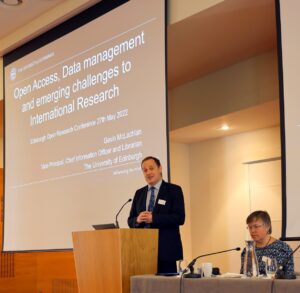 Attendees online and in person were treated to a fine and varied selection of talks. To begin with, topics ranged from Gavin McLachlan’s overview of current national and international political contexts and Dominic Tate’s review of the University’s Open Research Roadmap, to the latest in open access publishing from Rebecca Wojturska and Dominique Walker, FAIR principles from Susanna-Assunta Sansone, and Eugenia Rodrigues on inclusivity and Citizen Science.
Other speakers – Malcolm Macleod, Jane Hillston, Alan Cambell, and Stephen Curry – focused on research culture and integrity. Notably, they reminded us that open practices aren’t just essential for replication and verification, they might also help in dealing with all kinds of bad behaviour: bullying, harassment, perhaps even research misconduct. As one would expect, the need to incentivise and reward openness was also a hot topic. Not a bad idea, especially if the aim is to change people’s behaviour for the better.
The session on training and education was particularly interesting, especially the middle two presentations, both of which focused on openness and pedagogic practice. First, Madeleine Pownall presented a synthesis of evidence relating to impact on student outcomes. Her findings suggest that exposure to open practices can improve scientific literacy, critical thinking, and core competencies, including understanding statistics and research methods.
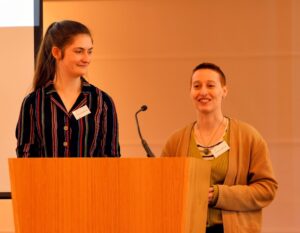 Nicely complementing Madeleine’s study, Emma MacKenzie and Felicity Anderson gave us the benefit of hands-on experience. Speaking from either side of the student-supervisor relation, they described their use of open source tools, materials, and mind-sets in student projects. Here, too, we saw the development of core competencies, this time including the documentation, discussion, and resolution of errors.
The lessons from all three presenters are clear enough: make the resources of scholarly research accessible and students will engage with them enthusiastically, intelligently, and with self-awareness. Just imagine what might be achieved should such attitudes ever escape the classroom and reach the wider world.
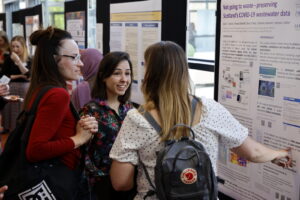 There were also poster sessions, culminating in first prize for Livia Scorza’s ‘Not going to waste – preserving Scotland’s COVID-19 waste water data,’ and there were workshops covering everything from public engagement to Open Research and AI.
The event concluded with a well-deserved show of appreciation for our organisers, Kerry and Laura. Meanwhile, everyone agreed that the day had been a lot of fun and educationally valuable. To see the ties between Open Research, Integrity, and Research Culture being drawn ever closer was both fascinating and encouraging; likewise, the enthusiasm for embedding openness in the student experience.
Best of all, however, it was good to be there in person, especially after the last two years. Speaking to real people and seeing others speak in all three available dimensions was really a very pleasant reminder of what it’s like to be a human being.
Simon Smith
Research Data Support Service
Photographs by Eugen Stoica: ES CC-BY 4.0
New! South Asian Newspapers
Following a number of trials I’m happy to let you know that the Library has purchased access to South Asian Newspapers (1864-1922) from Readex’s World Newspaper Archive. This one-of-a-kind collection provides online access to a select group of South Asian newspapers from the 19th and early 20th centuries.

You can access South Asian Newspapers via the Newspapers, Magazines and other News Sources guide, the Databases A-Z list or DiscoverEd. Read More
Lunchtime seminars: Decolonising and Diversifying the Library
We held our first of three Decolonising and Diversifying the Library lunchtime seminars last week, on the topic of Diversity in First Year Scots Law Reading Lists. The recording (39 minutes) has been uploaded and is now available on our Media Hopper Channel.
We’ve got two more sessions scheduled in this mini series, starting with tomorrow’s look at Supporting diversity through the ECA Library Zine collection and Artists Books collection with Academic Support Librarian Jane Furness. Join Jane at 1pm on Thursday 14th July to hear about the ECA Library artists’ books and zines collections and the ways in which they celebrate the diversity of makers working in these fields today. Book using this link to the MyEd booking system.
The following week we have a special showcase of the work of our Equity, Diversity and Inclusion Digital Engagement intern, Tristan Craig: Diversifying your Reading from a Student Perspective : Digital Engagement (EDI) Internship Showcase
Promoting the use of a diverse range of sources has several pedagogical benefits. It encourages students to become more autonomous learners by going beyond their reading lists and to think critically about the types of sources they’re engaging with. It also prompts them to consider the historical biases inherent in the dissemination of knowledge and look for a variety of voices to conduct more balanced research.
In this presentation Tristan will reflect upon his experiences and discuss how staff can support students to become confident in finding and using diverse sources. To book for this session on Thursday 21st July at 1pm, use this link to the MyEd booking system.
For more information on these sessions or if you have ideas for what you’d like to see in future lunchtime seminars, please contact us by email or leave us a comment.
New to the Library: U.S. Declassified Documents Online
Thanks to a request from HCA staff the Library has recently purchased U.S. Declassified Documents Online from Gale. This database provides immediate access to a broad range of previously classified federal records spanning the twentieth and twenty-first centuries.
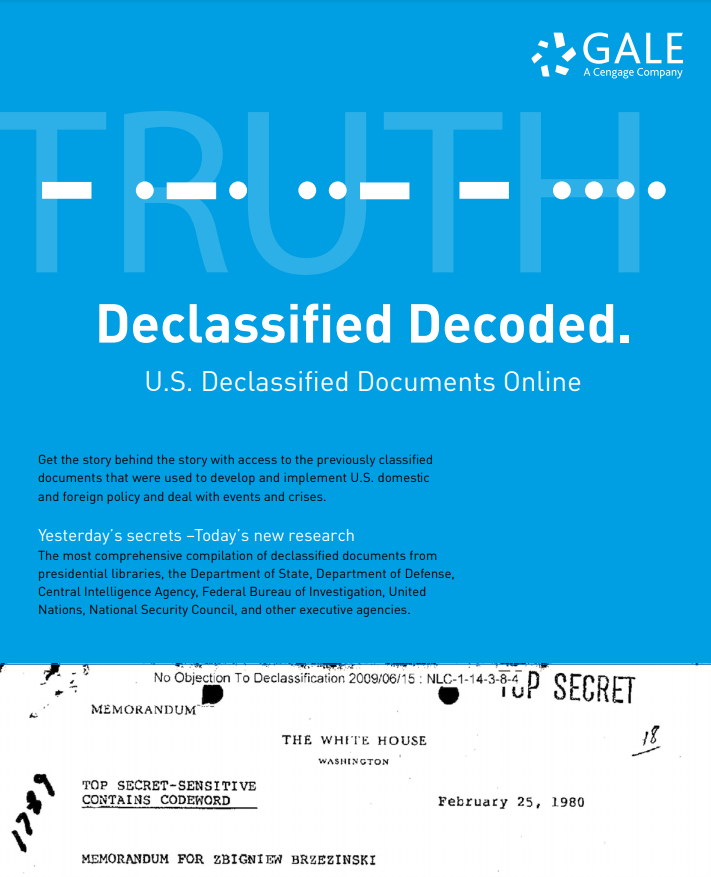
You can access U.S. Declassified Documents Online via the Databases A-Z list, Digital Primary Sources guide and DiscoverEd. Read More
Collections
 Hill and Adamson Collection: an insight into Edinburgh’s past
My name is Phoebe Kirkland, I am an MSc East Asian Studies student, and for...
Cataloguing the private papers of Archibald Hunter Campbell: A Journey Through Correspondence
My name is Pauline Vincent, I am a student in my last year of a...
Hill and Adamson Collection: an insight into Edinburgh’s past
My name is Phoebe Kirkland, I am an MSc East Asian Studies student, and for...
Cataloguing the private papers of Archibald Hunter Campbell: A Journey Through Correspondence
My name is Pauline Vincent, I am a student in my last year of a...
Projects
Cataloguing the private papers of Archibald Hunter Campbell: A Journey Through Correspondence
My name is Pauline Vincent, I am a student in my last year of a...
Archival Provenance Research Project: Lishan’s Experience
Presentation My name is Lishan Zou, I am a fourth year History and Politics student....