Home University of Edinburgh Library Essentials
July 4, 2026

The University of Edinburgh Becomes the First UK University to Appoint a Web Archivist to Preserve 21st Century History
Heritage Collections welcomes a new member of the digital archive team, Alice Austin, the first dedicated Web Archivist at the University of Edinburgh and the first dedicated Web Archivist at a non-legal deposit UK University!
Community of Edinburgh Research Software Engineers (CERSE): Reflections on the 7th meeting
In this blog Dr Eleni Kotoula, Lead Research Facilitator at the University of Edinburgh, writes about the CERSE and their most recent event.
What is CERSE?
CERSE is a community like no other! It offers an excellent opportunity for Research Software Engineers (RSE) to get support and recognition for their work. In addition to Research Software Engineers, the CERSE welcomes those interested in the development, use, support or management of research software. Hence, researchers, research support and research data professionals can get involved, expand their network and broaden their understanding of research software engineering. To find out more, have a look at the CERSE Meeting Handbook.
A summary of CERSE’s 7th meeting
Members of the CERSE community across Edinburgh came together earlier this month in the Bayes Centre for the first post-pandemic meeting. After a long break from activities, the organisers from the University of Edinburgh Digital Research Services, EPCC, Sofware Sustainability Institute and the Centre of Data, Culture and Society were keen to resurrect meetings.
Mario Antonioletti opened the meeting, briefly referring to the RSE movement and its previous meetings in Edinburgh. Mike Wallis, Research Services Lead at the University of Edinburgh, gave an overview of the Edinburgh Compute and Data Facility, highlighting data storage, cloud and high performance computing services. Andrew Horne provided an update on EDINA’s ongoing project for the development of Automatic Systematic Reviews. Then, Mario Antonioletti presented EPCC and services such as Archer2 and Cirrus, as well as the important work of the Software Sustainability Institute. After the short talks, Felicity Anderson, PhD candidate in Informatics and Software Sustainability Institute Fellow, led an ice-breaking activity, followed by a networking session. All presentations are available here.
Next steps
The CERSE community has the potential to grow and flourish in a region so rich in research-intensive institutions and academic excellence. We aim to continue by alternating face-to-face and virtual meetings monthly. To do so, we need active participation from those interested in the RSE community. There are different ways to get involved; attending meetings, talking about your relevant work or volunteering to help organize one of the following meetings. For us in Digital Research Facilitation, CERSE offers the opportunity to meet and connect with researchers, RSEs, IT and research support staff. Moreover, we share the same passion for best practices in data-intensive and computational research. That’s why we have been heavily involved in supporting this community in practice and strongly encourage those interested to join us. We are looking forward to meeting you in one of the following CERSE meetings, either in person or online.
How to get involved?
Join the Joint Information Systems Committee (JISC) mailing list: http://www.jiscmail.ac.uk/ed-rse-community
Follow the CERSE on Twitter: https://twitter.com/cerse7
Join the RSE: https://society-rse.org/join-us/
Dr Eleni Kotoula
Digital Research Facilitation
Back to the Wall: A Year of Experimenting with the Main Library’s Digital Wall
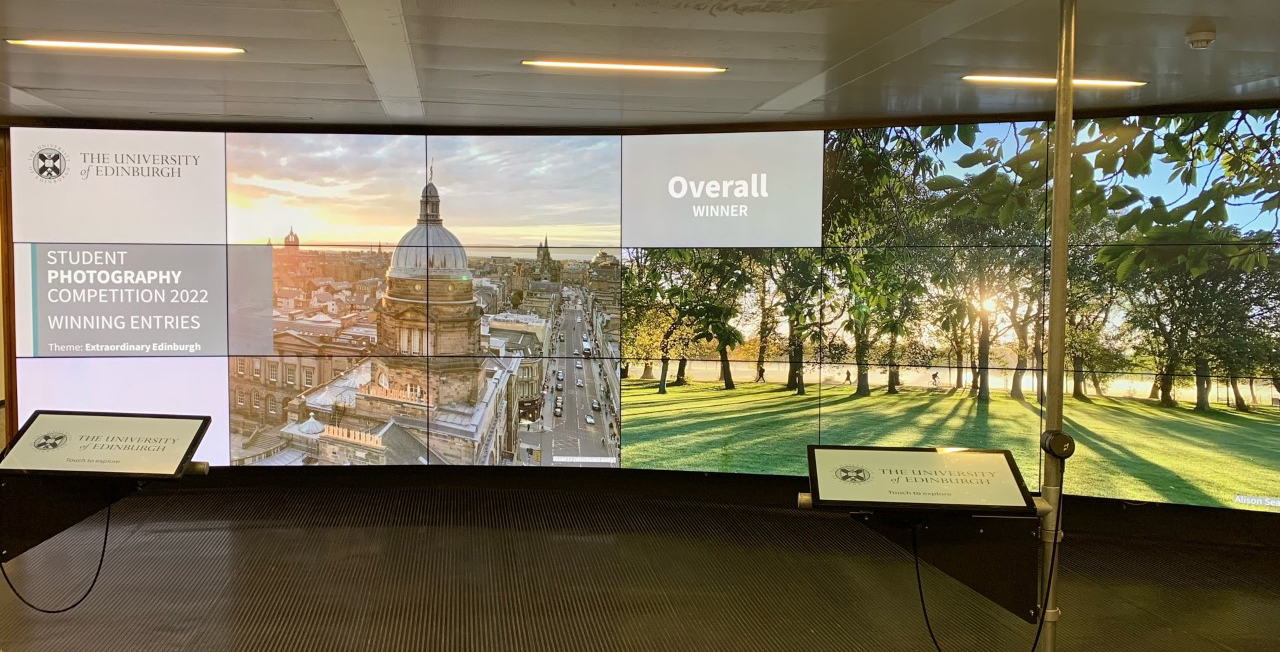
The Cultural Heritage Digitisation Service (CHDS) has managed the Main Library’s Digital Wall since it was installed in late 2019.1 The Wall is made up of two sets of nine 4k screens which are operated by touch screens: users can navigate high resolution images of the library’s cultural heritage collections as well as watch videos that feature specific collection items, projects and pieces of work undertaken by library staff. When the Wall is not in use, it displays massive “Attractor” videos which run across all 18 screens, designed to draw users in. Read More
ERASMUS work placement visitor from Germany
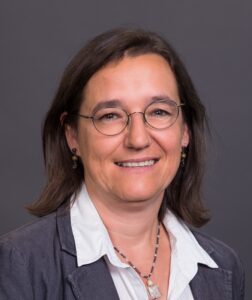 My name is Judith Dähne (Daehne). I am the Research Data Support Officer of RheinMain University of Applied Sciences.
When I started to think about research data management (RDM) around 2015, MANTRA provided my first opportunity learn about RDM and how to handle data correctly. I also discovered DMPonline, delivered by the Digital Curation Centre, and it therefore seemed to me that Edinburgh was somehow the cradle of RDM.
When I heard of the final opportunity to visit the UK with the EU’s ERASMUS programme (it will stop in May 2023) I was keen to apply for a visit with the Research Data Support team of the University of Edinburgh… I am really happy that I landed this wonderful opportunity of a short job shadowing visit.
I attended several meetings and training sessions of the Research Data Service team. I am impressed how much support and aid is provided for the researchers. The infrastructure of storage and exchange like DataStore, DataSync, DataShare, DataVault forms the technical basis of the support.
Even more important, in my opinion, is the personal backing and advice of the data management team.You might just ask your questions by pressing one of the “Contact us” buttons and there you find email and phone numbers of the research data team at your finger tips.
And the team really takes care over every single dataset that is loaded in DataShare: how to enhance the metadata and how to make it more visible for the scientific community. Not many institutional repositories are curated in such a detailed way – I will take home some precious tips and workflows!
One sticking point, however, is the same as with us: How do we make the services known? How do we reach as many researchers as possible? And how can the transformation to more open science then succeed? Perhaps to just carry on with talking and teaching seems the only way…
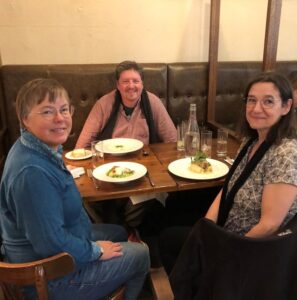
Robin, Simon and Judith enjoy a working lunch at Howie’s
Research data are a social good and data management supports the verification and replication in science. Ultimately transparency, openness and good data management strengthen the credibility of science and help to counter climate change deniers and conspiracy theorists. To emphasise this argument, like here in Edinburgh, is also a very important take home message for me.
I would like to thank Robin & her team for sharing their knowledge and their hospitality! I hope we stay in touch.
Guest blog post by Judith Dähne
RheinMain University of Applied Sciences
Bloomsbury Professional Ebooks: formerly on LexisLibrary
We want to alert students to a change we’re dealing with regarding Bloomsbury Professional ebooks which were formerly offered on the LexisLibrary platform.. Unfortunately going forward these will no longer be available on this database, and we’re working on access to them via Bloomsbury’s own platform instead.
The courses affected are mainly Property, Evidence, Criminal, Employment, and Contract Law, and the book titles are as follows:
- Walker & Walker: The Law of Evidence in Scotland
- A fingertip guide to Scots Criminal law
- Commercial Leases
- McDonald’s Conveyancing Manual
- Conveyancing Practice in Scotland
- Property Trusts and Succession
- Mental Health, Incapacity and the Law in Scotland
- Scottish Law of Leases
- Scots Criminal Law
- Employment Law in Scotland
- Contract Law in Scotland
- Missives
- Scottish Planning Law
- Scottish Older Client Law Service
- Drafting Wills in Scotland
- International Sucession Laws
- Thomson’s Delictual Liability
- Tolley’s Estate Planning
- Tolley’s Inheritance Tax
- Tolley’s Company Law Handbook
- Style Writs in the Sheriff Court
While negotiations are ongoing with Bloomsbury (and until the end of May 2023) we’ll be able to access all of these titles using a trial they’ve given us to their own platform, providing students from 2022/23 access through the end of Semester Two exams. The procedure for finding these books is as follows:
- Visit the EResources Trials page
- Click on ‘Bloomsbury Professional Scots Law Titles’
- You will be prompted to log in with your usual username and password.
- You’ll arrive at a page that will give you the username and password to use on the Bloomsbury site
- Click the link to Bloomsbury (it helps to do this in a new tab or window so you can copy the log in details), then enter the username and password to log in.
- Use the navigation on the left hand side to access the title of the book you need.
This information has been added to the DiscoverEd records for these books, and I will also be circulating it via newsletters, blogs and other communication channels. Please do share this information with your classmates to assist them with their study or research if they require access to these books.
If you have any issues accessing these items please email us on law.librarian@ed.ac.uk.
New to the Library: BFI Player
*The Library now has full 1 year access (until 30 Sept 2024) to BFI Player via a deal with JISC. You can access it from our Databases A-Z list, Film Studies databases list, Video Resources A-Z and DiscoverEd. Note if you already had a BFI Player account linked to our pilot subscription before 1 Oct 2023, you will need to relink your account following instructions given at the above access points.*
We are happy to let you know that the Library has a pilot subscription to the fabulous BFI Player, a video on demand service from the British Film Institute (BFI). Access is available to us until the end of August 2023.
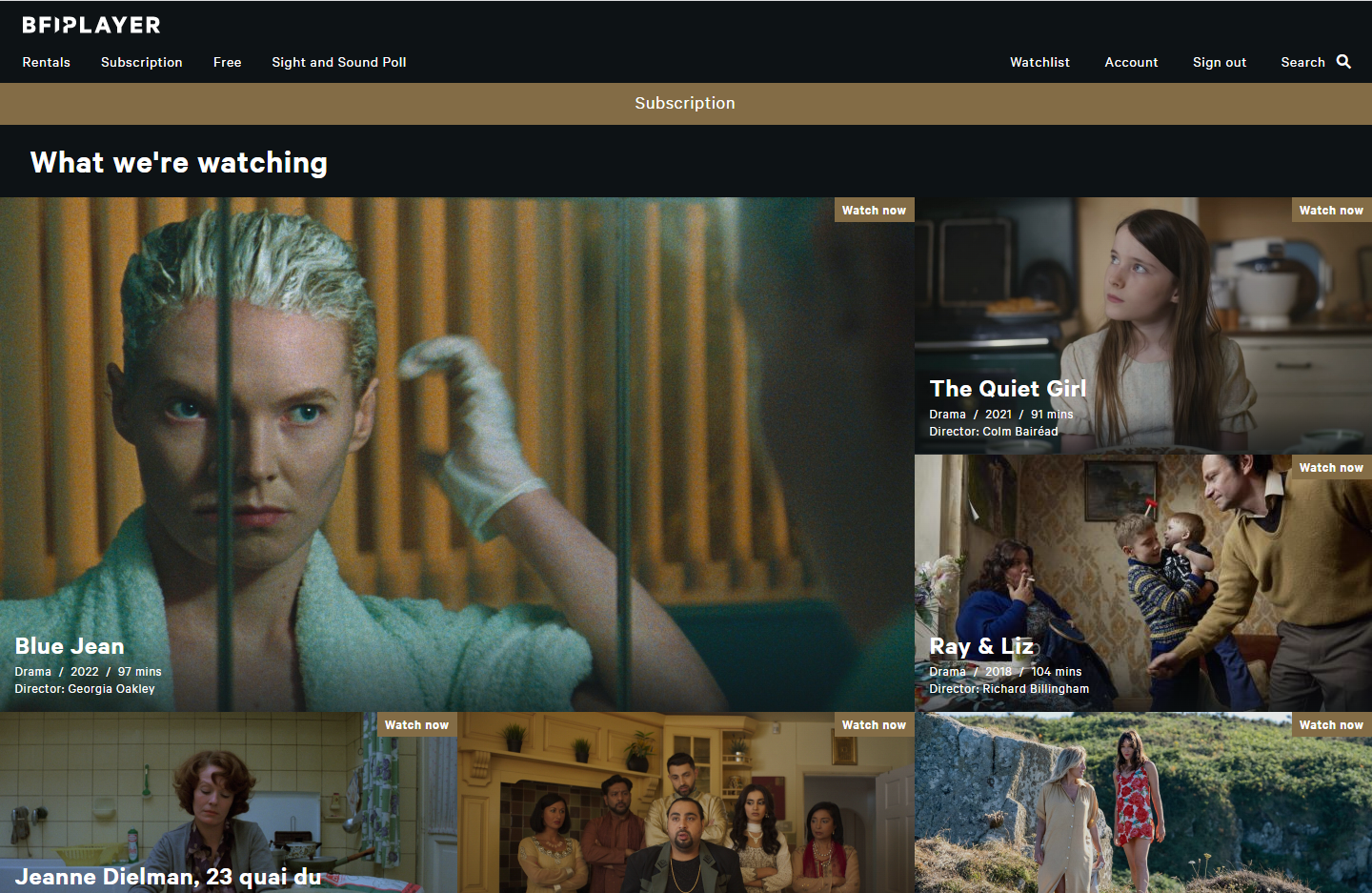
BFI Player streams acclaimed, landmark and archived films. Reflecting the BFI’s wider cultural mission the focus is on British and European independent films but it does also include international releases. And it allows you to access classic and cult films from across the decades. Read More
On trial: Latin American Newspapers, Series 1
Thanks to a request from HCA staff the Library currently has trial access to Latin American Newspaers: Series 1 from Readex, which allows you to explore Latin American history and culture during the 19th and 20th centuries.

You can access the Latin American Newspapers: Series 1 via the E-resources trials page.
Trial access ends 9th December 2023. Read More
On trial: Colonial Caribbean
Thanks to a request from HCA staff the library currently has trial access to Colonial Caribbean from AM Digital, which provides access to British Colonial Office files from The National Archives, UK.
You can access the Colonial Caribbean via the E-resources trials page.
Trial access ends 28th April 2023. Read More
On trial: Two databases on sexuality and LGBTQI+ history
*The Library has purchased access to both Gender: Identity and Social Change and Sex & Sexuality. These can be accessed via Digital Primary Source and Archive Collections or the Databases A-Z.*
Thanks to a request from staff in HCA the Library currently has trial access to two databases from AM Digital that look at sexuality and LGBTQI+ history, Gender: Identity and Social Change and Sex & Sexuality.

You can access the Gender: Identity and Social Change and Sex & Sexuality via the E-resources trials page.
Trial access ends 27th April 2023. Read More
The Case of the ‘L’Homme de la Denise’
We are grateful to present another guest blog! This time from Timothé Lhoste who is currently completing his master’s degree studying History of Science at the School for Advanced Studies in the Social Sciences in Paris. Timothé was in touch with the Centre for Research Collections requiring access to Charles Lyell’s Notebooks, and a very interesting story emerged, which sheds light on how Lyell worked. Read on to find out more about Timothé (and Lyell’s!) research …
I am working on a scientific controversy concerning a “human fossil” known as ‘L’Homme de la Denise’, and named to acknowledge its discovery in 1844 on the slopes of the Denise Mountain, near the city of Le Puy-en-Velay in the French Massif Central. The find was crucial, as from the outset, doubts hovered over the authenticity and the exact age of the discoveries. In fact, these bones and the gangue (the material that surrounds them) continued to fuel a lively discussion for more than a century.
Drawing on the method of the biography of scientific objects, such as Marianne Sommer’s Bones and Ochre: The Curious Afterlife of the Red Lady of Paviland, my study seeks to trace the impact of this object on the social world and vice versa. I am also interested in the evolution of different scientific interpretations of these objects.

Lyell’s sketch showing the south face of Denise Mountain, Notebook 240, page 11
Charles Lyell’s Notebooks 239 and 240 document his trip to France during the summer of 1859, when he stayed in the vicinity of Le Puy-en-Velay from August 6th to 16th. He already knew this region, since he had visited it in 1828, as evidenced earlier in the run of his Scientific Notebooks in Notebook 12, dated 30 June – 21 July 1828. This area of the French Massif Central called Velay was of particular interest to Lyell. Volcanic formations had allowed the genesis and preservation of many fossil sites – and so of course would be of interest to Lyell the ‘volcano hunter’! – but in 1859, Lyell was now looking in particular for solid geological evidence of the antiquity of man.
For this reason, in the wake of Edmond Hébert and Edouard Lartet, he carried out investigations on the Denise site. He described the geology of the surroundings of Le Puy and carefully examined the human bones, which had been found in the region fifteen years before. During his stay, he met with local scholars such as Auguste Aymard, Bertrand de Doue, Pichot-Dumazel and Félix Robert. He even met Georges Poulett Scrope who came to complete his observations of the volcanoes of this region.
Lyell’s Notebooks testify to the richness of his observations. He visited other geological and paleontological sites (including Polignac, Cussac, Espaly, Saint Privat d’Allier, Doue, and La Roche Rouge), drew multiple sketches and talked with many local people. The most compelling piece of ‘evidence’ is a photograph of the “museum block” (bought in 1844 by Auguste Aymard and Bertrand de Doue for the local museum) which is glued into Lyell’s Notebook 240; this illustrates the particular interest that Lyell had in these bones.
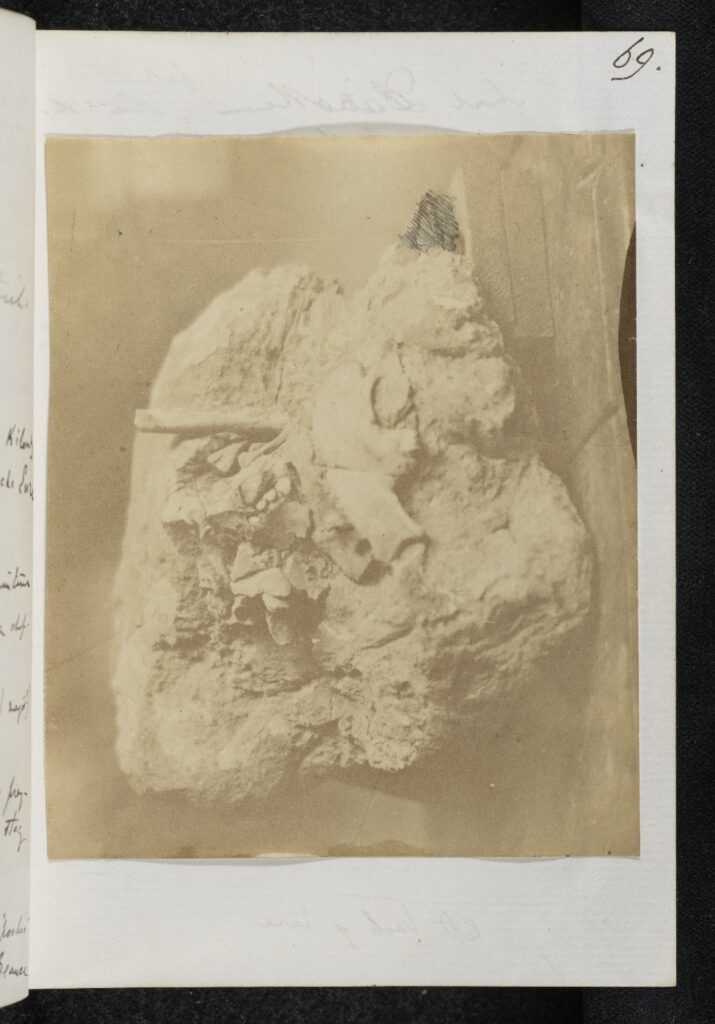
Photograph acquired by Lyell showing the Denise block containing human bones which is glued into Notebook 240 page 69
Moreover, he also took Notebook 240 with him to Aberdeen for the 29th meeting of the British Association for the Advancement of Science, along with the famous photograph commissioned by Prestwich and Evans, and featuring the local workmen, showing the position of a stone axe into the sedimentary series of Abbeville (and for more information on that, please see Clive Gamble’s article featured in the Geological Society of London’s Blog Photographs of the Drift ).
In his speech at Aberdeen (and later in his book Geological Evidences of the Antiquity of Man published 1863), Lyell referred to the Denise findings, acknowledging their authenticity and he praised and acknowledged the scientific validity of the discoveries Jacques Boucher de Perthes had made in Abbeville.
However, Lyell could not commit to the idea of ‘L’Homme de la Denise’ as a proof of the contemporaneity of the man, and the latest eruptions of the Massif Central, refusing to give them any value of antiquity.
Thank you Timothé for sharing your research – we wish you all the best for the completion of your Masters degree. Thanks also to Caroline Lam, Archivist & Records Manager at The Geological Society. This enquiry initially drew our attention to the fact that there was an original photograph in the collection – in fact – one of only two glued into the Notebooks. We can now appreciate how important photography must have been to Lyell – and indeed to others working at that time. It has enabled us to ‘unearth’ many more related archives – we will revisit this topic!
Further Reading:
Lyell Charles, 1859, “On the occurrences of works of human art in post-pliocene deposits”, Twenty-Ninth meeting of the British association for the advancement of science, London, Murray.
Lyell Charles, 1863, Geological Evidences of the Antiquity of Man, London, Murray.
Collections
 Hill and Adamson Collection: an insight into Edinburgh’s past
My name is Phoebe Kirkland, I am an MSc East Asian Studies student, and for...
Cataloguing the private papers of Archibald Hunter Campbell: A Journey Through Correspondence
My name is Pauline Vincent, I am a student in my last year of a...
Hill and Adamson Collection: an insight into Edinburgh’s past
My name is Phoebe Kirkland, I am an MSc East Asian Studies student, and for...
Cataloguing the private papers of Archibald Hunter Campbell: A Journey Through Correspondence
My name is Pauline Vincent, I am a student in my last year of a...

Projects
Cataloguing the private papers of Archibald Hunter Campbell: A Journey Through Correspondence
My name is Pauline Vincent, I am a student in my last year of a...
Archival Provenance Research Project: Lishan’s Experience
Presentation My name is Lishan Zou, I am a fourth year History and Politics student....