Home University of Edinburgh Library Essentials
October 9, 2026
Christmas in the David Laing manuscripts
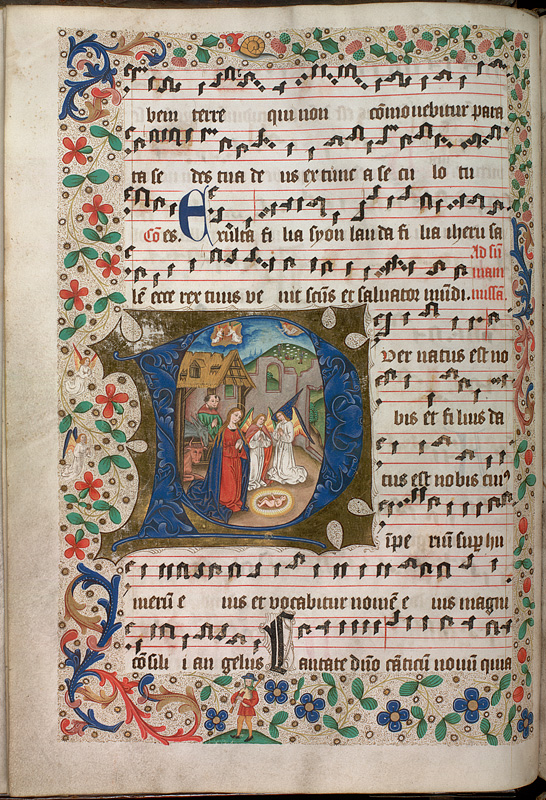
This is a leaf from MS.33, a 15th century Gradual received by the Library as part of the David Laing bequest in 1878. We have recently been awarded a substantial grant from the National Manuscripts Conservation Trust to preserve the Laing manuscript books, which are among our greatest treasures. Happy Christmas to all our blog readers and we look forward to sharing more tales from the collections in 2014.
Christmas is nearly here!
In celebration of the next week’s big event, we thought we’d bring you a sample of some of the festive bits and pieces in our archive collections.
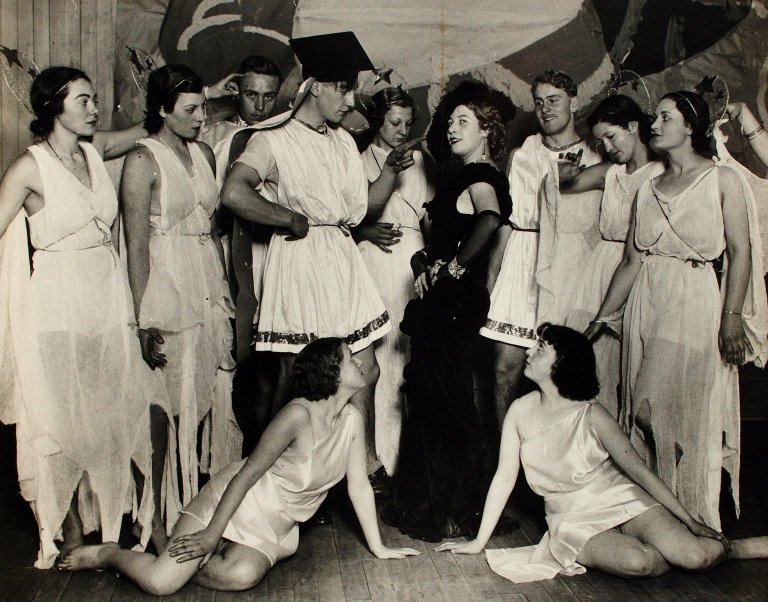
As always, the ECA Christmas Revel provides some wonderful outfit inspiration for all your office parties – above we have a scene from the 1934 skit Picard Goes West, with Miss Nessie Sutherland playing Mae West. Below is a group of dancers in miscellaneous costumes, obviously all blinded by the camera’s flash!

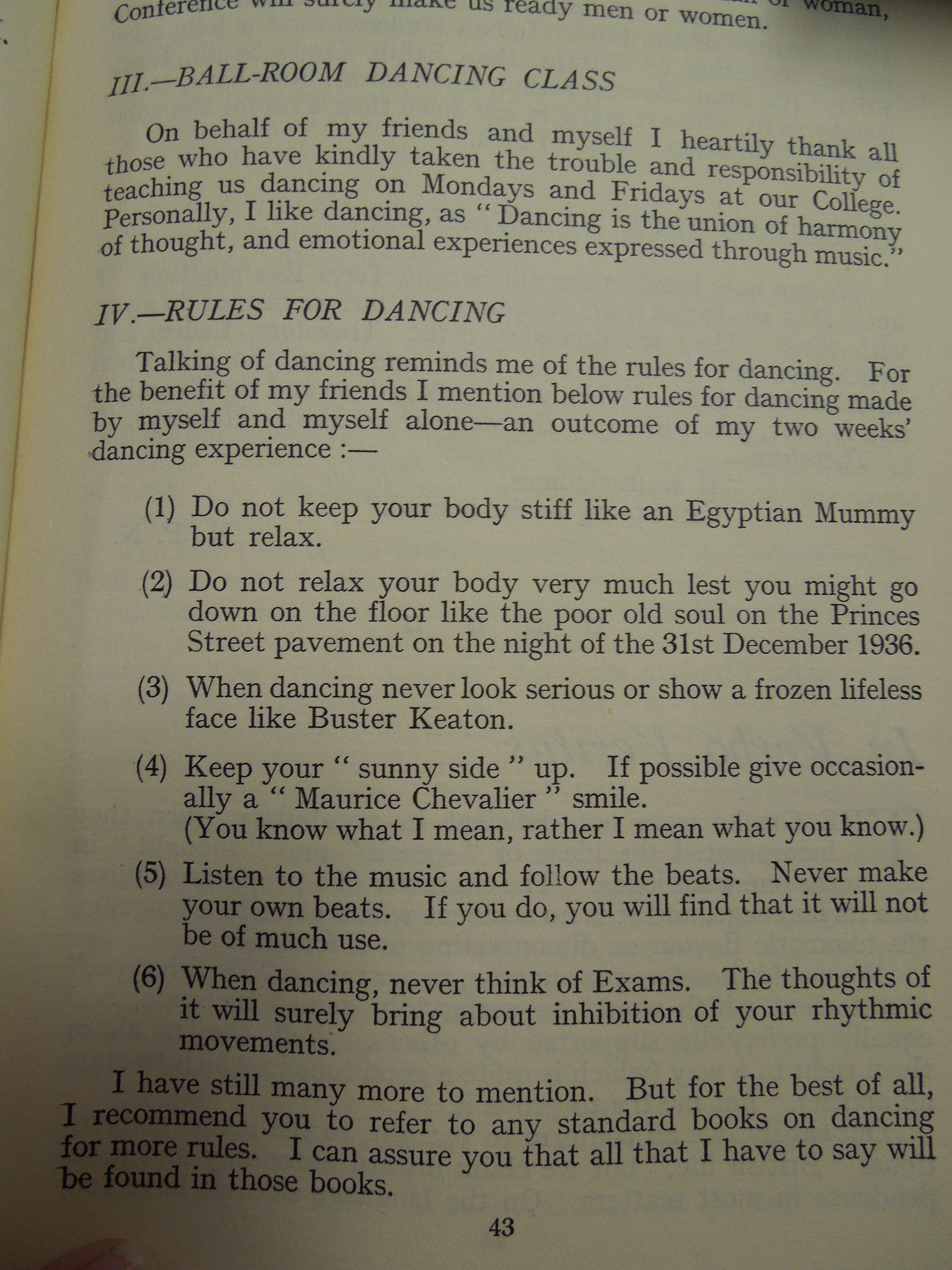 Now, this is what I’ve always needed for Christmas – rules to help me look good on the dancefloor. The Moray House magazine for 1937 offers precisely that, although I think a room full of people all practising their Maurice Chevalier smiles would be quite terrifying…
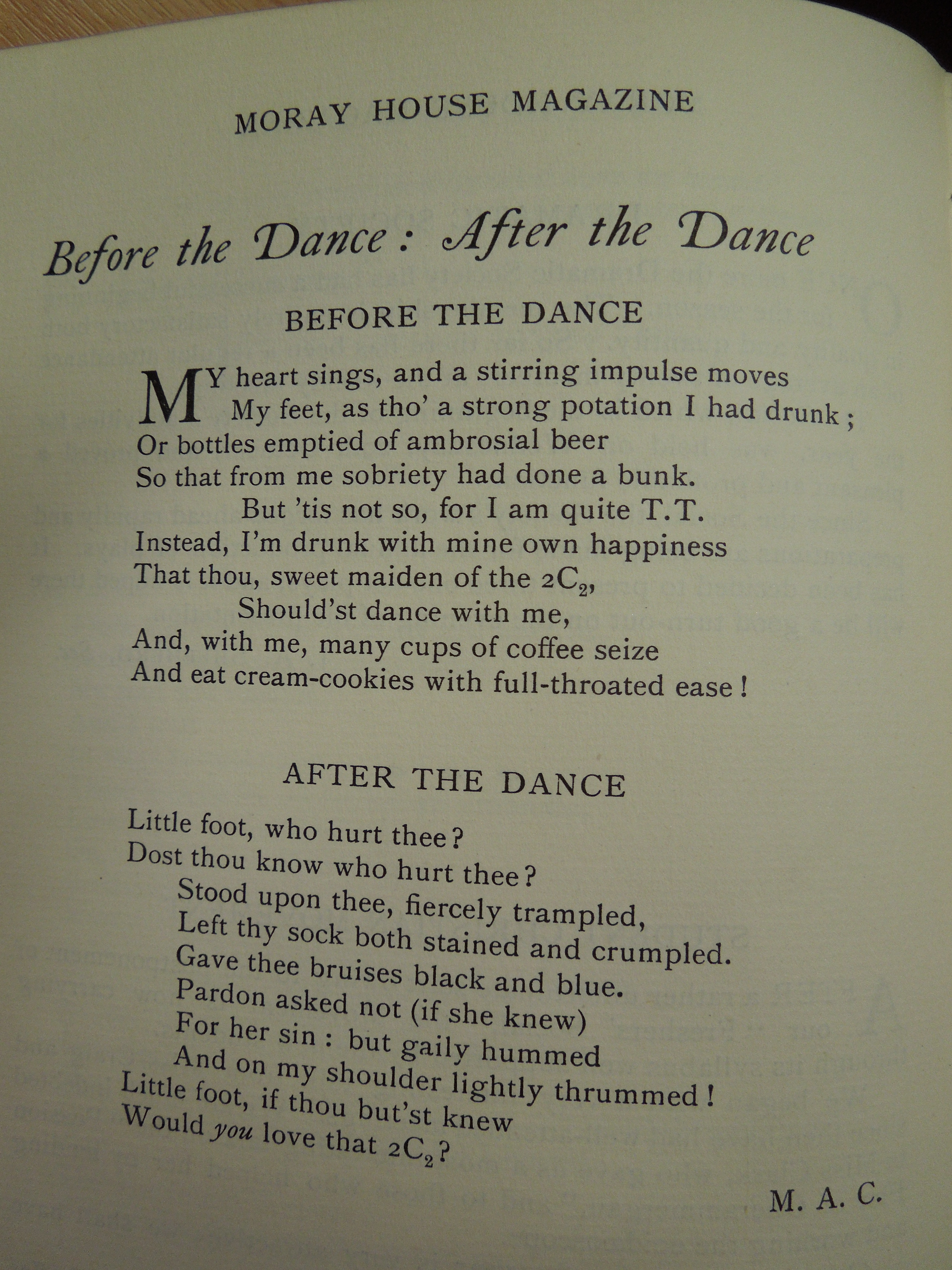
The 1930’s edition of the magazine describes the dangers of dancing with the ‘sweet maiden’ you’ve had your eye on all night.
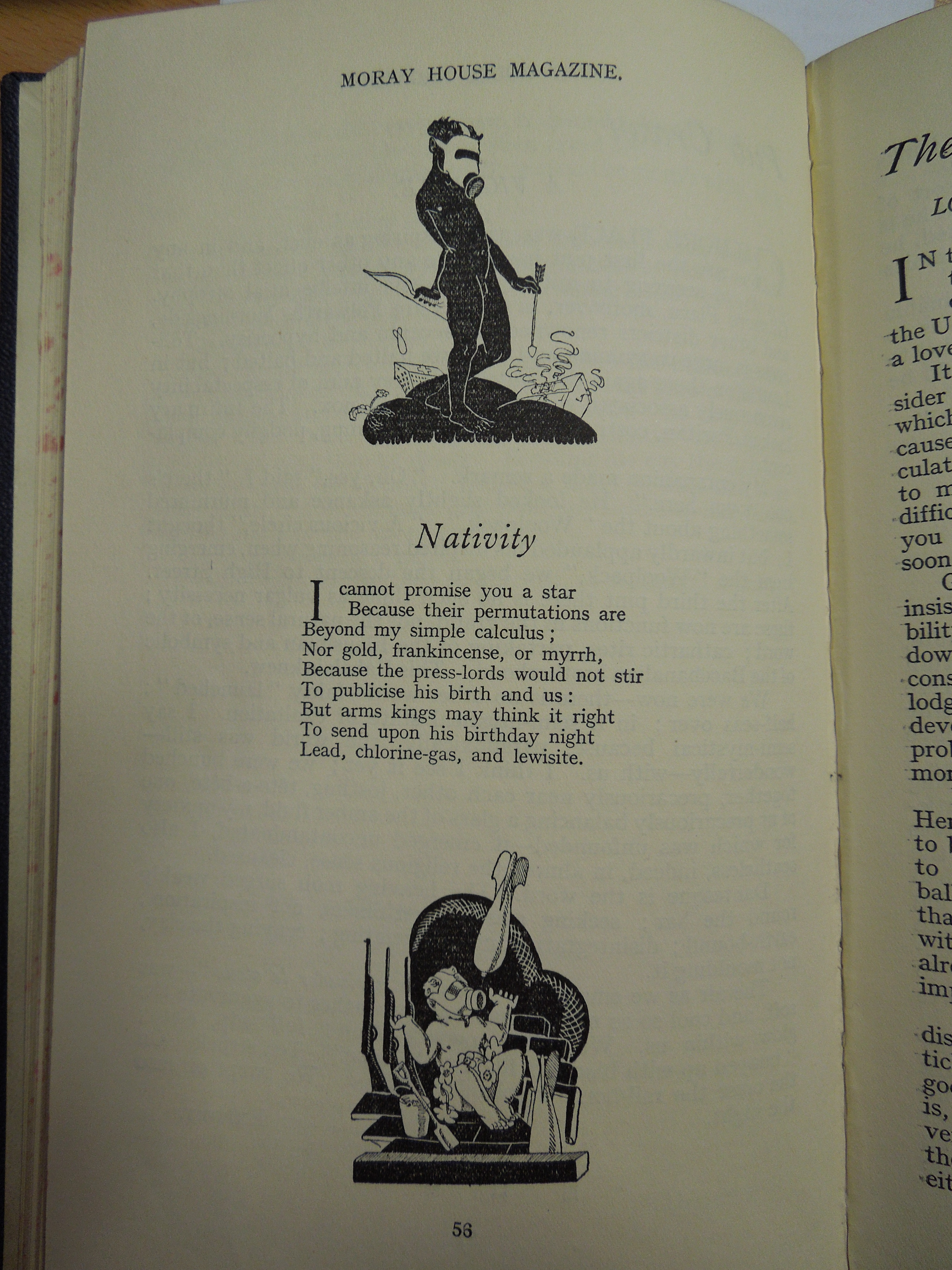
And we end on an even darker note – a horrifying poem entitled Nativity from 1938.
Merry Christmas!
Thinking about a Data Vault
[Reposted from https://libraryblogs.is.ed.ac.uk/blog/2013/12/20/thinking-about-a-data-vault/]
In a recent blog post, we looked at the four quadrants of research data curation systems. This categorised systems that manage or describe research data assets by whether their primary role is to store metadata or data, and whether the information is for private or public use. Four systems were then put into these quadrants. We then started to investigate further the requirements of a Data Asset Register in another blog post.
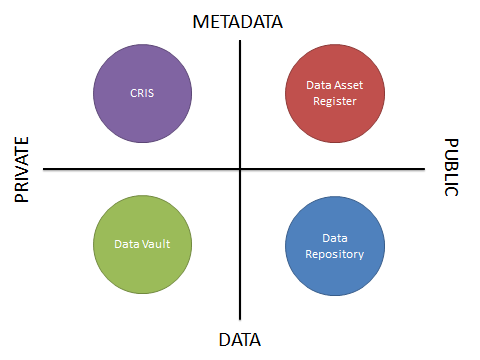
This blog post will look at the requirements and characteristics of a Data Vault, and how this component fits into the data curation system landscape.
What?
The first aspect to consider is what exactly is a Data Vault? For the purposes of this blog post, we’ll simply consider it is a safe, private, store of data that is only accessible by the data creator or their representative. For simplicity, it could be considered very similar to a safety deposit box within a bank vault. However other than the concept, this analogy starts to break down quite quickly, as we’ll discuss later.
Why?
There are different use cases where a Data Vault would be useful. A few are described here:
- A paper has been published, and according to the research funder’s rules, the data underlying the paper must be made available upon request. It is therefore important to store a date-stamped golden-copy of the data associated with the paper. Even if the author’s own copy of the data is subsequently modified, the data at the point of publication is still available.
- Data containing personal information, perhaps medical records, needs to be stored securely, however the data is ‘complete’ and unlikely to change, yet hasn’t reached the point where it should be deleted.
- Data analysis of a data set has been completed, and the research finished. The data may need to be accessed again, but is unlikely to change, so needn’t be stored in the researcher’s active data store. An example might be a set of completed crystallography analyses, which whilst still useful, will not need to be re-analysed.
- Data is subject to retention rules and must be kept securely for a given period of time.
How?
Clearly the storage characteristics for a Data Vault are different to an open data repository or active data filestore for working data. The following is a list of some of the characteristics a Data Vault will need, or could use:
- Write-once file system: The file system should only allow each file to be written once. Deleting a file should require extra effort so that it is hard to remove files.
- Versioning: If the same file needs to be stored again, then rather than overwriting the existing file, it should be stored alongside the file as a new version. This should be an automatic function.
- File security: Only the data owner or their delegate can access the data.
- Storage security: The Data Vault should only be accessible through the local university network, not the wider Internet. This reduces the vectors of attack, which is important given the potential sensitivity of the data contained within the Data Vault.
- Additional security: Encrypt the data, either via key management by the depositors, or within the storage system itself?
- Upload and access: Options include via a web interface (issues with very large files), special shared folders, dedicated upload facilities (e.g. GridFTP), or an API for integration with automated workflows.
- Integration: How would the Data Vault integrate with the Data Asset Register? Could the register be the main user interface for accessing the Data Vault?
- Description: What level of description, or metadata, is required for data sets stored in the Data Vault, to ensure that they can be found and understood in the future?
- Assurance: Facilities to ensure that the file uploaded by the researcher is intact and correct when it reaches the vault, and periodic checks to ensure that the file has not become corrupted. What about more active preservation functions, including file format migration to keep files up to date (e.g. convert Word 95 documents to Word 2013 format)?
- Speed: Can the file system be much slower, perhaps a Hierarchical Storage Management (HSM) system that stores frequently accessed data on disk, but relegates older or less frequently accessed data to slower storage mechanisms such as tape? Access might then be slow (it takes a few minutes for the data to be automatically retrieved from the tape) but the cost of the service is much lower.
- Allocation: How much allocation should each person be given, or should it be unrestricted so as to encourage use? What about costing for additional space? Costings may be hard, because if the data is to be kept for perpetuity, then whole-life costing will be needed. If allocation is free, how to stop it being used for routine backups of data rather than golden-copy data?
- Who: Who is allowed access to the Data Vault to store data?
- Review periods: How to remind data owners what data they have in the Data Vault so that they can review their holdings, and remove unneeded data?
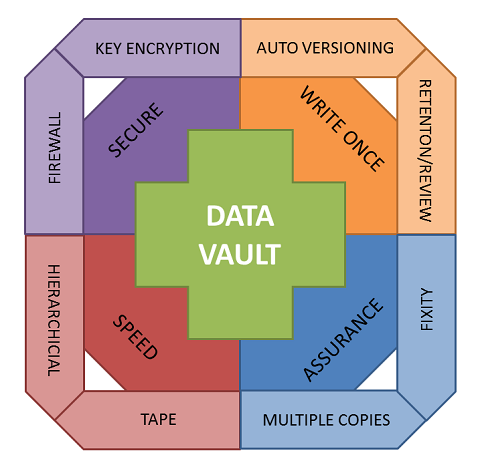
Feedback on these issues and discussion points are very welcome! We will keep this blog updated with further updates as these services develop.
Image available from http://dx.doi.org/10.6084/m9.figshare.873617
Tony Weir, Head of Unix Section, IT Infrastructure
Stuart Lewis, Head of Research and Learning Services, Library & University Collections.
Thinking about a Data Vault
In a recent blog post, we looked at the four quadrants of research data curation systems. This categorised systems that manage or describe research data assets by whether their primary role is store metadata or data, and whether the information is for private or public use. Four systems were then put into these quadrants. We then started to investigate further the requirements of a Data Asset Register in another blog post.
This blog post will look at the requirements and characteristics of a Data Vault, and how this component fits into the data curation system landscape.
What?
The first aspect to consider is what exactly is a Data Vault? For the purposes of this blog post, we’ll simply consider it is a safe, private, store of data that is only accessible by the data creator or their representative. For simplicity, it could be considered very similar to a safety deposit box within a bank vault. However other than the concept, this analogy starts to break down quite quickly, as we’ll discuss later.
Why?
There are different use cases where a Data Vault would be useful. A few are described here:
- A paper has been published, and according to the research funder’s rules, the data underlying the paper must be made available upon request. It is therefore important to store a date-stamped golden-copy of the data associated with the paper. Even if the author’s own copy of the data is subsequently modified, the data at the point of publication is still available.
- Data containing personal information, perhaps medical records, needs to be stored securely, however the data is ‘complete’ and unlikely to change, yet hasn’t reached the point where it should be deleted.
- Data analysis of a data set has been completed, and the research finished. The data may need to be accessed again, but is unlikely to change, so needn’t be stored in the researcher’s active data store. An example might be a set of completed crystallography analyses, which whilst still useful, will not need to be re-analysed.
- Data is subject to retention rules and must be kept securely for a given period of time.
How?
Clearly the storage characteristics for a Data Vault are different to an open data repository or active data filestore for working data. The following is a list of some of the characteristics a Data Vault will need, or could use:
- Write-once file system: The file system should only allow each file to be written once. Deleting a file should require extra effort so that it is hard to remove files.
- Versioning: If the same file needs to be stored again, then rather than overwriting the existing file, it should be stored alongside the file as a new version. This should be an automatic function.
- File security: Only the data owner or their delegate can access the data.
- Storage security: The Data Vault should only be accessible through the local university network, not the wider Internet. This reduces the vectors of attack, which is important given the potential sensitivity of the data contained within the Data Vault.
- Additional security: Do we encrypt the data, either via key management by the depositors, or within the storage system itself.
- Upload and access: Options include via a web interface (issues with very large files), special shared folders, dedicated upload facilities (e.g. GridFTP), or an API for integration with automated workflows.
- Integration: How would the Data Vault integrate with the Data Asset Register? Could the register be the main user interface for accessing the Data Vault?
- Description: What level of description, or metadata, is required for data sets stored in the Data Vault, to ensure that they can be found and understood in the future?
- Assurance: Facilities to ensure that the file uploaded by the researcher is intact and correct when it reaches the vault, and periodic checks to ensure that the file has not become corrupted. What about more active preservation functions, including file format migration to keep files up to date (e.g. convert Word 95 documents to Word 2013 format)
- Speed: Can the file system be much slower, perhaps a Hierarchical Storage Management (HSM) system that stores frequently access data on disk, but relegates older or less frequently access data to slower storage mechanisms such as tape. Access might then be slow (it takes a few minutes for the data to be automatically retrieved from the tape) but the cost of the service is much lower.
- Allocation: How much allocation should each person be given, or should it be unrestricted so as to encourage use? What about costing for additional space? Costings may be hard, because if the data is to be kept for perpetuity, then whole-life costing will be needed. If allocation is free, how to stop it being used for routine backups of data rather than golden-copy data?
- Who: Who is allowed access to the Data Vault to store data?
- Review periods: How to remind data owners what data they have in the Data Vault so that they can review their holdings, and remove unneeded data.
Feedback on these issues and discussion points are very welcome! We will keep this blog updated with further updates as these services develop.
Image available from http://dx.doi.org/10.6084/m9.figshare.873617
Tony Weir, Head of Unix Section, IT Infrastructure
Stuart Lewis, Head of Research and Learning Services, Library & University Collections.
A few of my favourite [festive!] things
At the start of the festive period, I had the best of intentions to post a festive blog post for every day of advent. Alas, there isn’t much mention of Christmas in Thomson’s papers – even his family photo albums are a decidedly festive free zone! However, having three working days left until we break up for the festive period, I thought I would share (you’ve guessed it!) three festive items from the collection…
1) Christmas card to Thomson from his students…


Quite possibly the best Christmas card I’ve ever come across – spelling ‘Christmas’ in mathematical terms. Genius! And if that wasn’t zany enough, there is a wonderfully nebulous poem on the inside!
In all seriousness, this is one of my favourite items in the collection – it is signed by 13 of Thomson’s students, who were obviously very fond of him, and I bet the master of Factorial Analysis loved it!
2) Christmas card from Andromache


Andromache was the wife of Thomson’s son, Hector. Hector was a classicist, so the mythical love story of Hector and Andromache would have been one familiar to him. She is a frequent character in the collection, and is mentioned throughout Thomson’s correspondence by friends and family – Thomson and Lady Thomson appear to have been particularly fond of her. The card depicts her native Cyprus.
3) A Christmas gift from Lady Thomson:


The gift is a thoughtful one – Thomson was brought up near Newcastle, and the sights in this book would have been familiar to him. The book has clearly been well loved and frequently referred to, and has some beautiful images of Newcastle.


With that, I’d like to wish you all a lovely Christmas and a productive New Year!
If anyone recognises their signature or that of anyone else’s on the card, do please get in touch (Emma.Anthony@ed.ac.uk)
REF 2014 Physical Submission
The Research Excellence Framework (REF) is a system for assessing the quality of research in UK HEIs. It replaced the Research Assessment Exercise (RAE) and is undertaken by the four UK higher education funding bodies, to:
– inform the selective allocation of research funding to HEIs
– provide benchmarking information and establish reputational yardsticks
– provide accountability for public investment in research and demonstrate its benefits
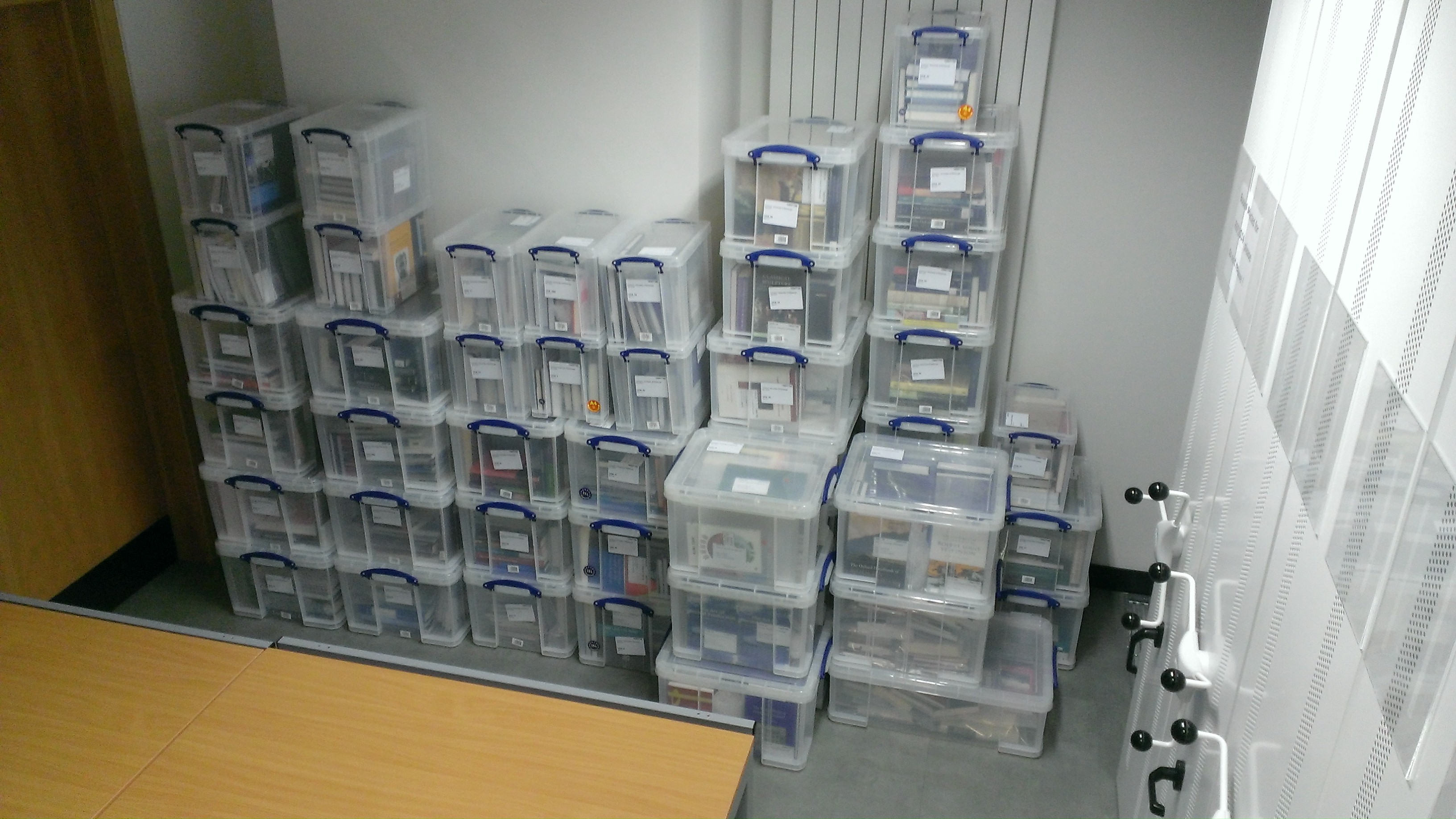
The library’s role in the REF submission was to provide overall leadership for the submission of REF2 data and physical outputs; this involved metadata verification of over 7000 records, checking Scopus citation information and the submission of physical research outputs which amounted to almost 700 items including books, portfolios, journals and compositions.
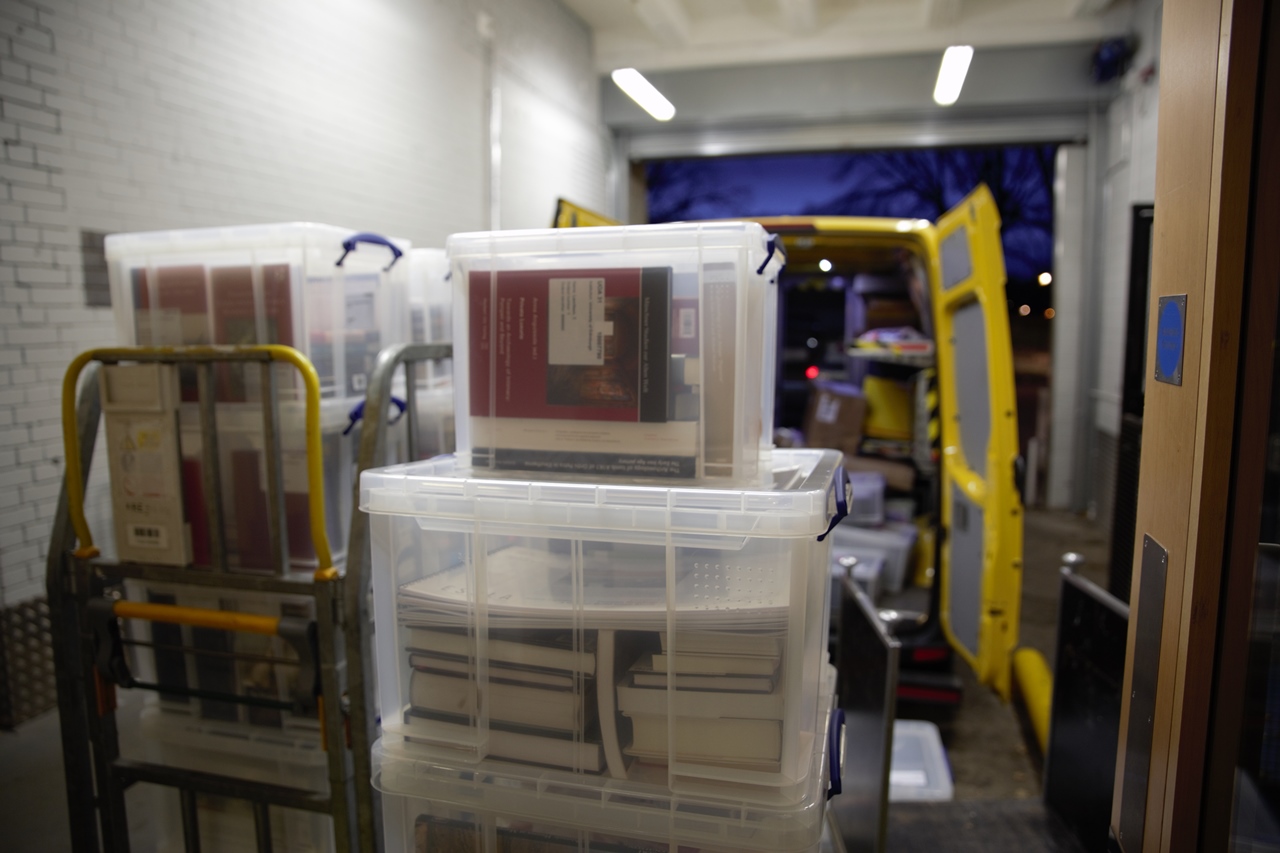
The electronic submission deadline was 29 November 2013 so for most people involved in REF2014 their part was done, however here in the library there were almost 700 physical items still to be submitted and each one of these had to be checked, labelled and boxed up before being sent to HEFCE.
On 12 December the physical outputs left the library on their way to HEFCE, the past few months have been extremely busy here within Scholarly Communications and we are grateful for all the help we’ve received from our acquisitions and cataloguing colleagues in helping us meet this deadline, finally we can breathe a sigh of relief!
Merry Fishmas to you all!
As it’s only a week to go until Christmas, enjoy a festive edition of The Wee Red Herring from the ECA archive, complete with zombies and everything.
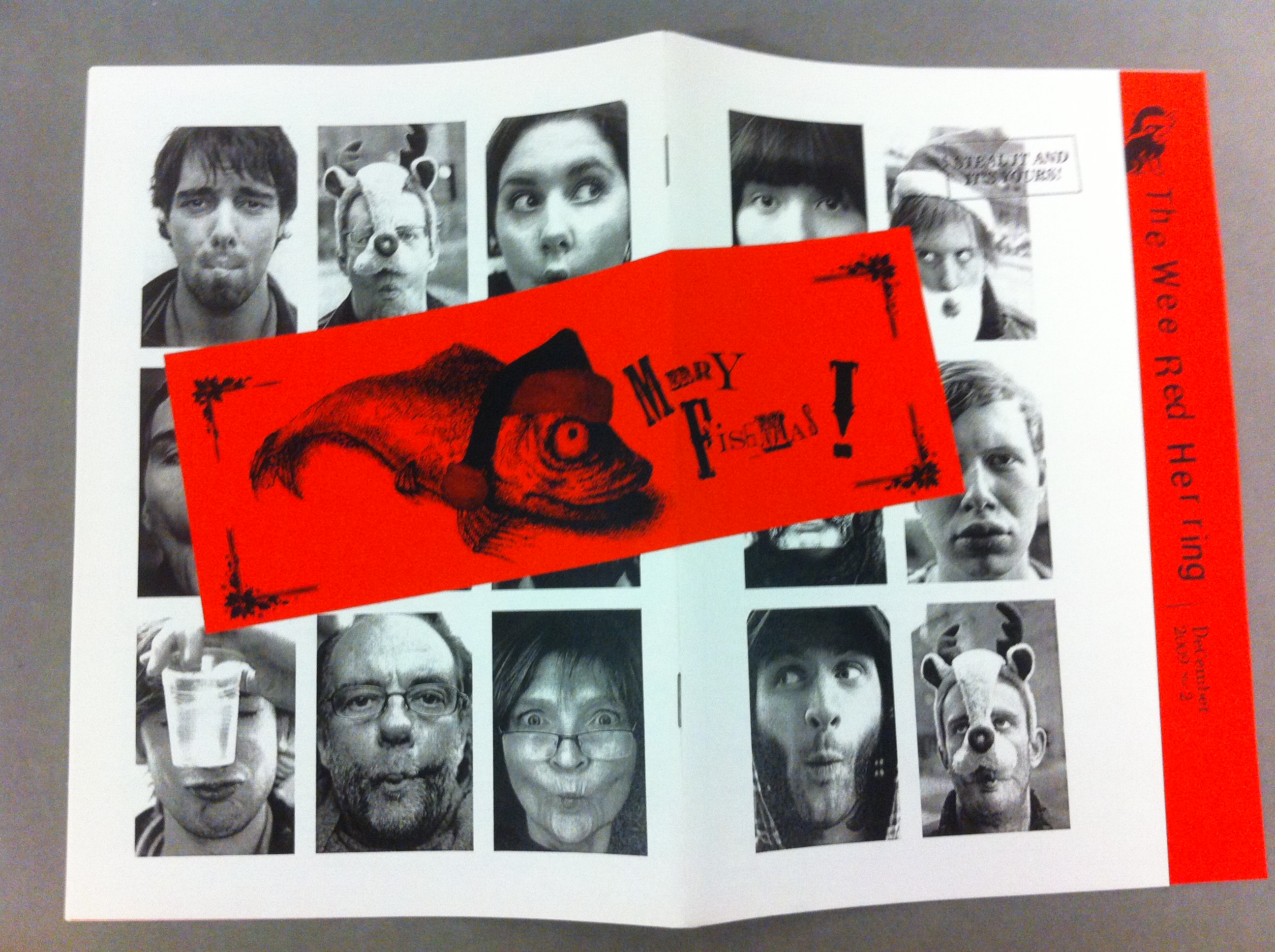
December 2009 issue
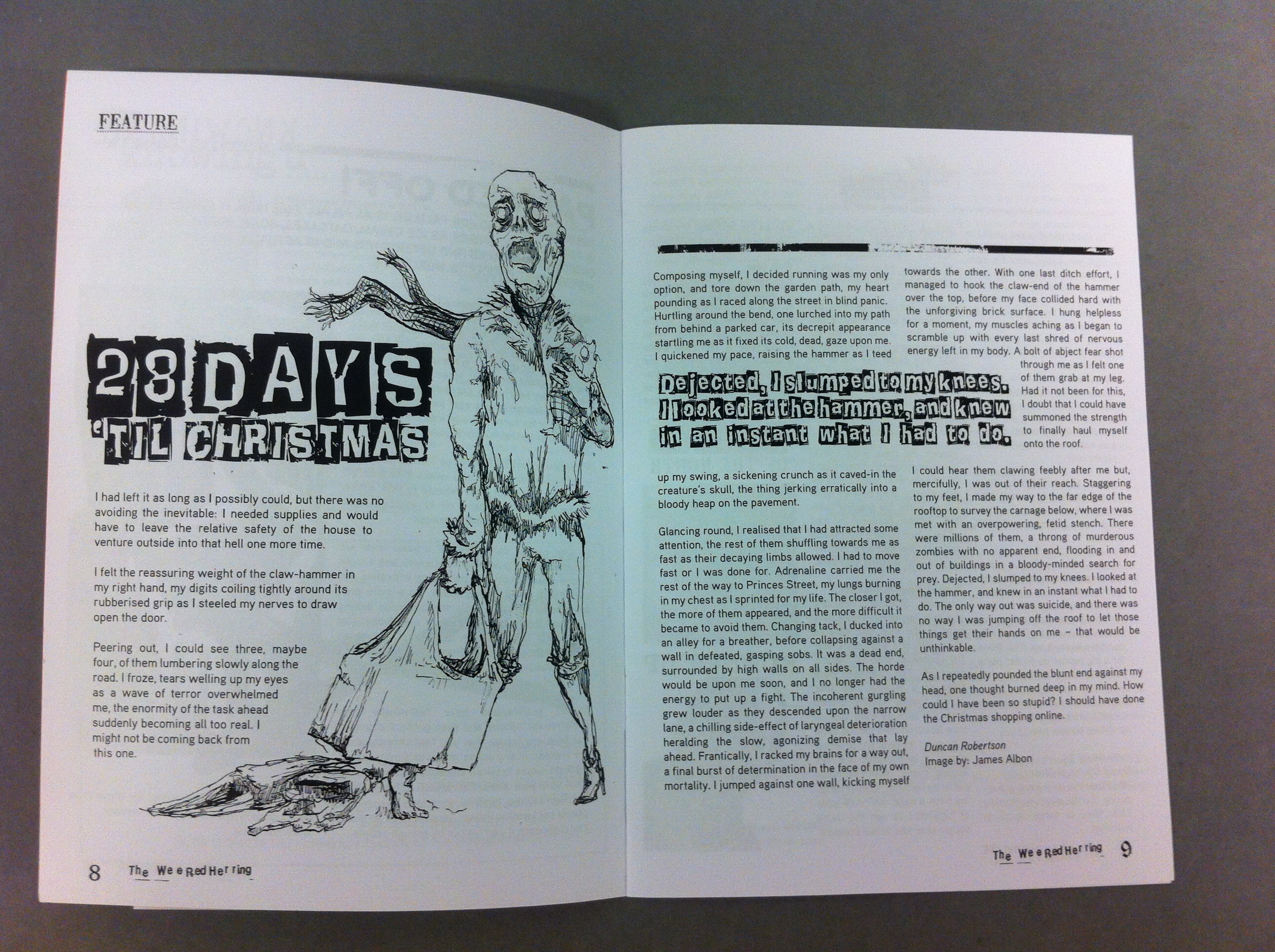
A festive tale, with zombies.
Photographing The Apocalypse Circa 1483
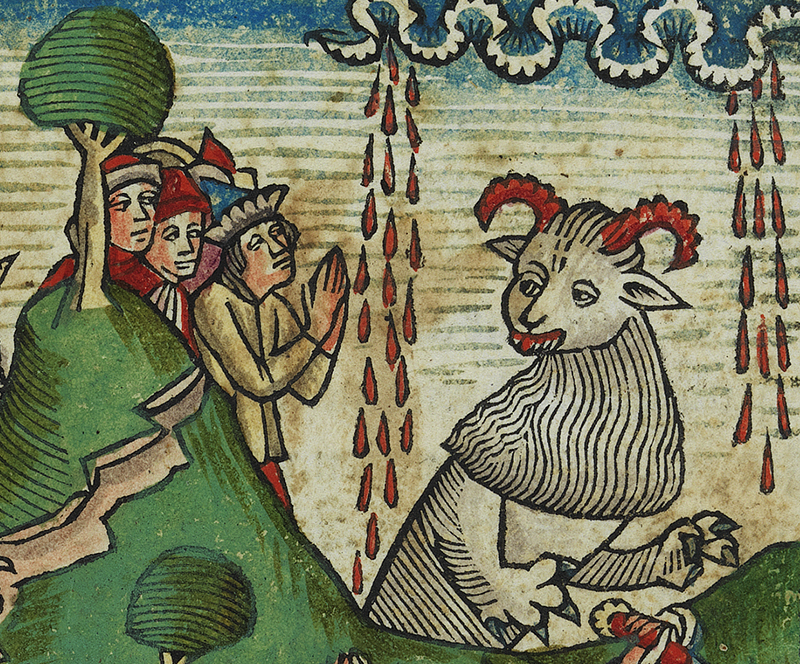
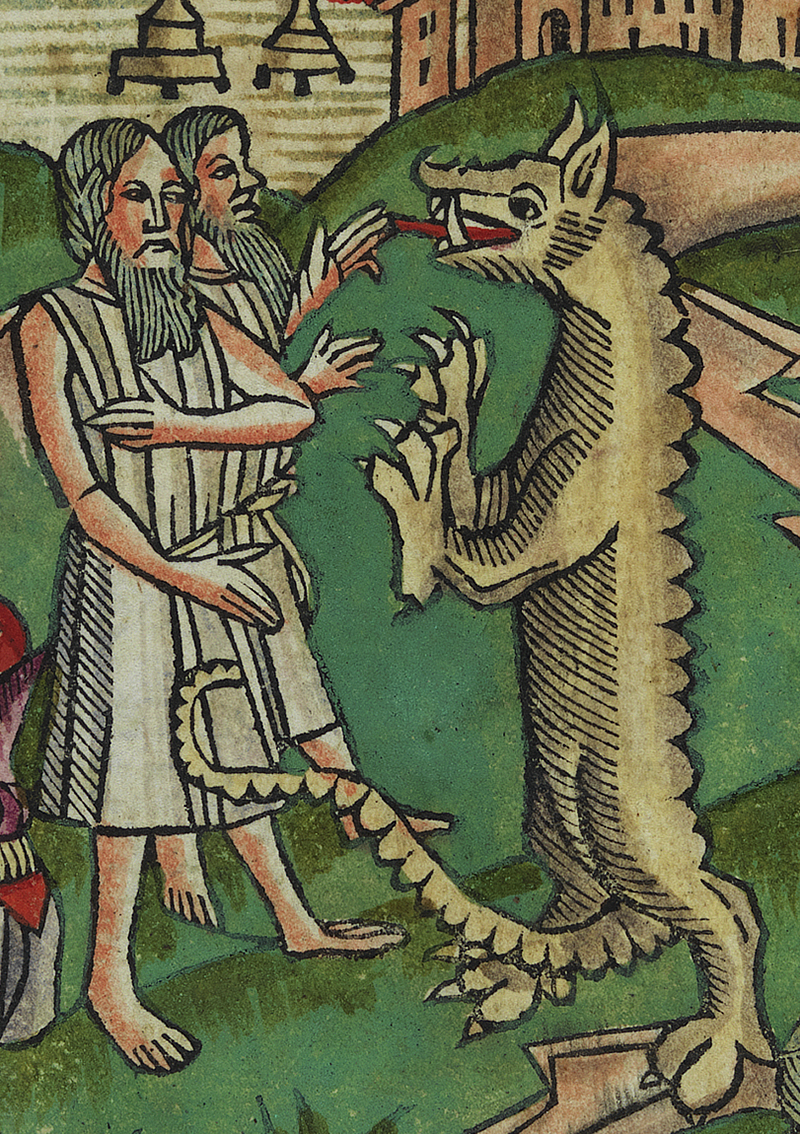
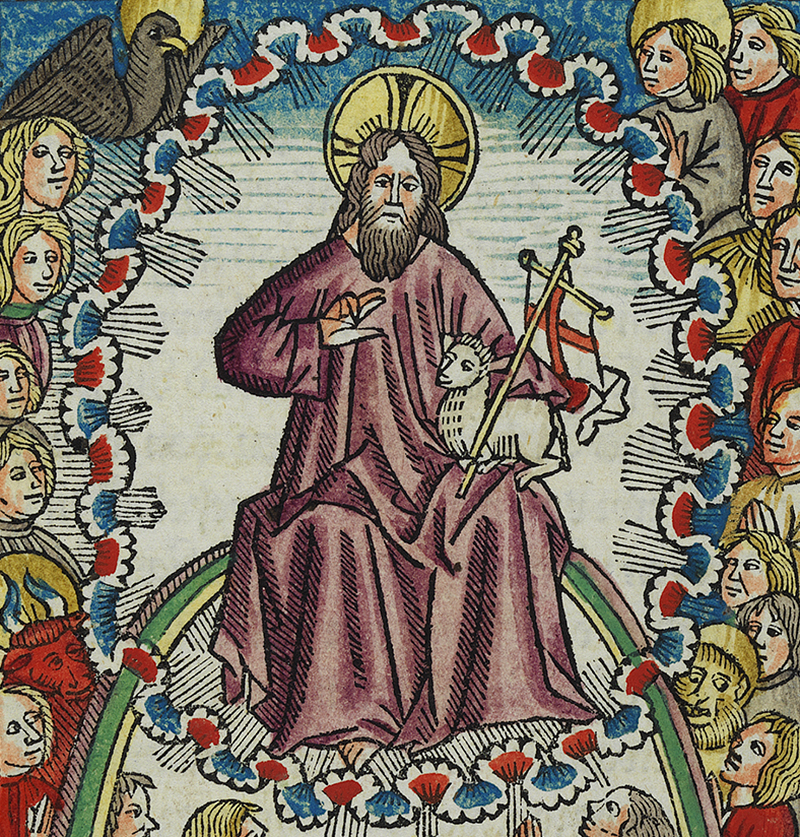
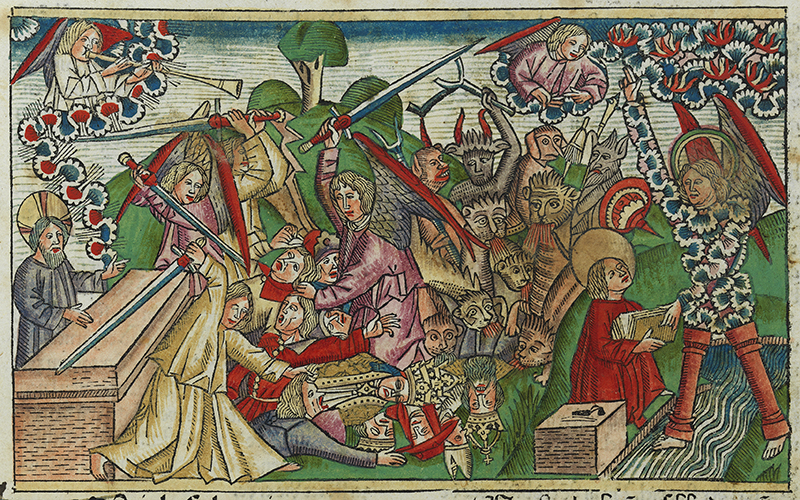
Recently the Digital Imaging Unit were asked to photograph all 8 illustrations from the book of the Apocalypse in Anton Koberger’s German Bible of 1483. Shelf-mark Inc.45.2. I have selected a few details from the illustrations here to demonstrate the quality of the line and its powerful descriptive impact. ” Koberger was the godfather of Albrecht Dürer, whose family lived on the same street. In the year before Dürer’s birth in 1471.” Giulia Bartrum, Albrecht Dürer and his Legacy, British Museum Press, 2002, pp 94-96, ISBN 0-7141-2633-0
Malcolm Brown
Art Collections at the Edinburgh College of Art Sculpture Party
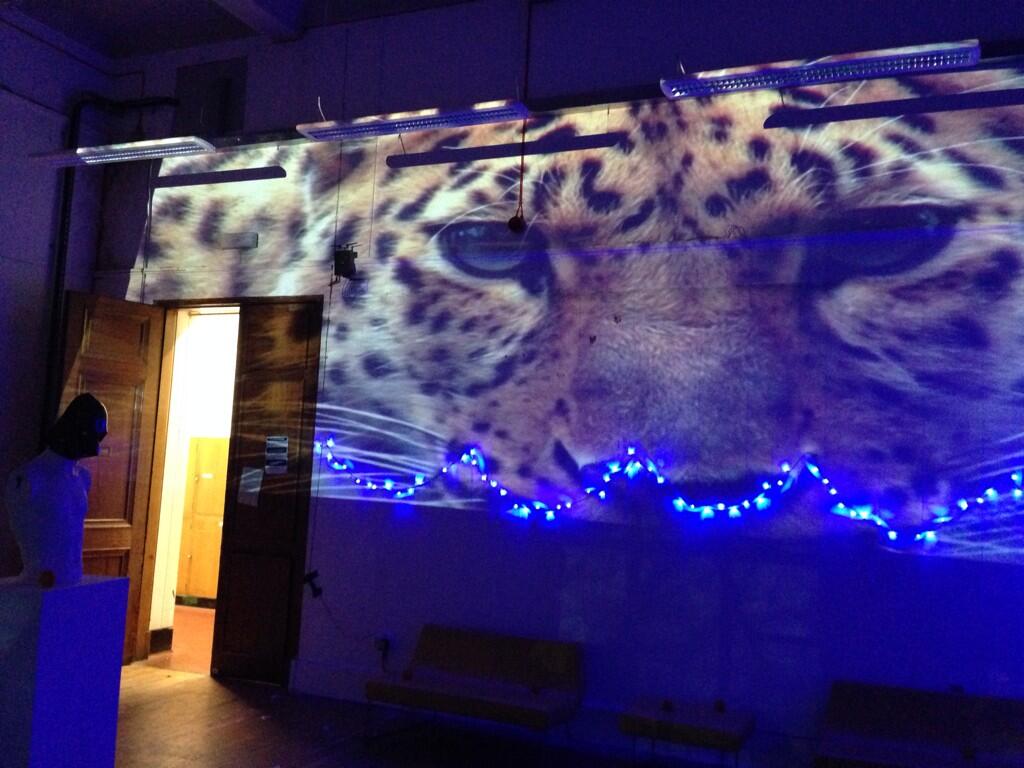 Zane by Isobel Turley
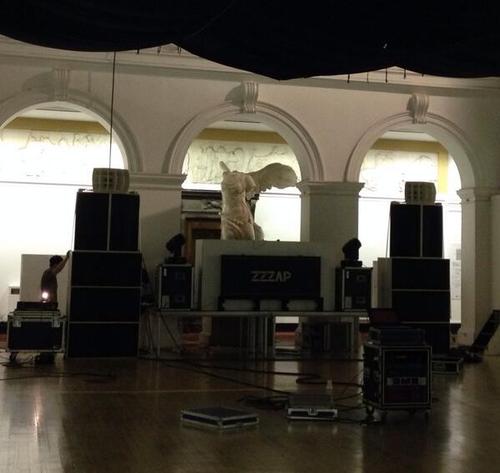
The annual Sculpture Party is part of ECA legend. Organised by the Sculpture department, it raises money for the School of Art Degree shows and takes over most of the area surrounding the Sculpture Court. Above is Zane by Isobel Turley, which was one of our acquisitions from the 2013 ECA Degree Show, and was projected in one of the studio spaces used in the party. Below is Winged Victory, looking like she is getting set up for a DJ set. Of course, us in Collections are far too well behaved to attend a riotous party like this, so thanks to Emma Smith for the pictures.
South Asianist celebrates a century of Indian Cinema
The fifth issue of The South Asianist celebrates a century of India cinema with an impressive range of articles, interviews and film reviews.
Senior Indian film-music critic, writer and commentator, Rajiv Vijayakar provides a valuable overview to ‘the role of a song in a Hindi film’ alongside a who’s who of eight decades of Hindi film music.
Founder editor of Stardust and pioneer of film journalism in India, Nari Hira, shares the inside drama behind some of the biggest Bollywood scoops of all time.
While Rajani Krishnakumar, investigates how the nature of the clothing of a heroine and its attributes contribute to the marriage-worthiness of a Tamil woman, using examples from a century of Tamil cinema.
There is also a candid interview with Sai Paranjpye, ‘Queen of humour’ and Ram Mohan, the forgotten ‘father of Indian animation’.
http://www.southasianist.ed.ac.uk

The South Asianist is supported by the University’s Journal Hosting Service: http://journals.ed.ac.uk
Collections
 Love, Loss, and Literature: Cataloguing the Papers of Irene Jessie Young
My name is Nancy Britten, and I’m in my fourth year of studying History at...
Hill and Adamson Collection: an insight into Edinburgh’s past
My name is Phoebe Kirkland, I am an MSc East Asian Studies student, and for...
Love, Loss, and Literature: Cataloguing the Papers of Irene Jessie Young
My name is Nancy Britten, and I’m in my fourth year of studying History at...
Hill and Adamson Collection: an insight into Edinburgh’s past
My name is Phoebe Kirkland, I am an MSc East Asian Studies student, and for...

Projects
Cataloguing the private papers of Archibald Hunter Campbell: A Journey Through Correspondence
My name is Pauline Vincent, I am a student in my last year of a...
Archival Provenance Research Project: Lishan’s Experience
Presentation My name is Lishan Zou, I am a fourth year History and Politics student....