Home University of Edinburgh Library Essentials
June 20, 2026
Lyell’s Islands
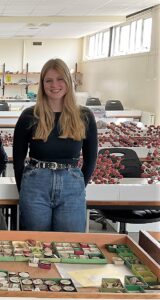
Lyell Summer Intern Harriet Mack on a visit to the Cockburn Museum to see their Lyell Madeira shells
We’ve been lucky to have had Harriet Mack, who is heading into her 3rd Year of a joint honours degree in Archaeology and Classics working with us as our Lyell Summer Intern! In this blog, Harriet shares her experience – which has included a lot of island hopping!
I first learnt about the Charles Lyell collection through a deep dive into Heritage Collections website, and I really liked the bright colours of the notebooks and the interesting handwriting. I then found the opportunity to volunteer with the Lyell project, cataloguing some of Lyell’s letters. I was captivated with the life and work of Lyell and his 19th century contemporaries, and started to gain an understanding of what transcription and palaeography were about.
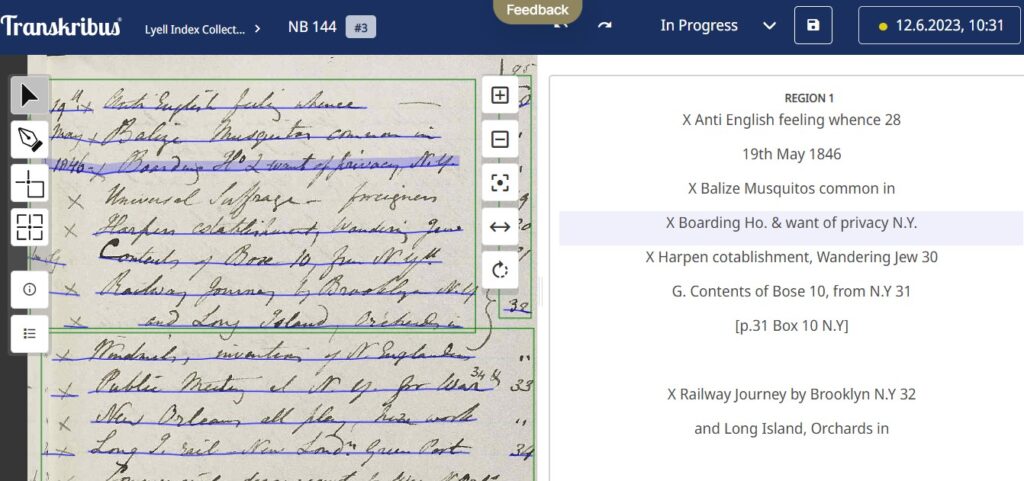
Starting as Lyell Transcription Intern, I had to upgrade my palaeography skills, and Transkribus helped. Switching to their Lite version enabled me to view the information differently and really helped emphasize the difficult words.
Screenshot from Transkribus, Scientific Notebook 144 page 95
I was also able to join the other remote volunteers, Drew and Beverly, online, where we could work together, bringing multiple perspectives to Lyell’s work. Later, when I encountered more difficult issues like the Portuguese place names from the Madeira notebooks, we reached out to expert Carlos A. Góis-Marques who helped to bring context to some of the notebooks. Planning was crucial and I developed a plan that could grow with me, as my skills developed and improved. I could also follow the communal spreadsheet which enabled me to track my progress. I realised my notes also developed over time, even looking a bit like Lyell’s…
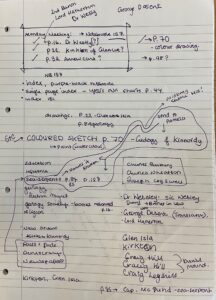
Extracts from Harriet’s own project notebook
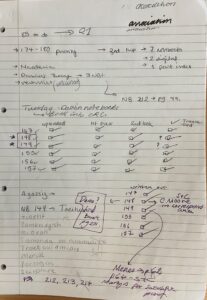
Once I had developed my skills – it was time to set off island hopping! First stop east coast of Georgia, then the Isle of Wight, Madeira and the Canary Islands.
Notebooks 129 and 130 both cover Georgia, USA, focusing on some of the islands off the east coast like St Simons Island, and Pelican Bank. On these islands, I was introduced to Lyell’s geological observations particular to islands, the environmental impacts, fauna and flora, and historical contexts. In America especially, Lyell’s observations of the workings of the islands mix into his observations on slavery, race, and indigenous people.
I then moved on to Notebooks 212, 213, and 214, with some of the contents being based on the Isle of Wight – which is where I’m from, adding a layer of expertise. I know the places he stayed along the West coast, at the Needles, Freshwater Bay, and Hamstead. Lyell noted the difference in geological specimens and rocks either side of the chalk ridge of the island, allowing him to suggest that south of the ridge – with marine specimens – was part of the Paris basin and had been exposed to the sea. North of the chalk ridge he found land specimens suggesting that it was originally connected to the mainland of the United Kingdom.
I wanted to know more about Lyell’s interest in the Isle of Wight, and took time to search more. I found that as early as Notebook 3 page 108-109, he notes reading about the Isle of Wight in Camden’s Brittania, leading me to find an online copy of the book and an early map. This really excited me as it gave an insight into what map Lyell could have used. I also established that Lyell visited the British Museum and consulted a Charter dated 949 AD. This charter told of King Eadred giving 1 hide (mansa) on the Isle of Wight to his gold and silversmith Ælfsige. This charter is one of the earliest primary sources I had seen, referring to the Isle of Wight as Vecta Insula, a Latin name given by the Romans.
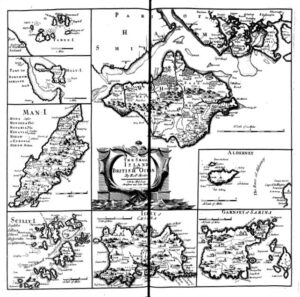
Camden’s Britannia, : Newly Translated into English: With Large Additions and Improvements· Publish’d by Edmund Gibson, of Queens-College in Oxford. ProQuest, UMI, 1695. Print. Page 1048-1049
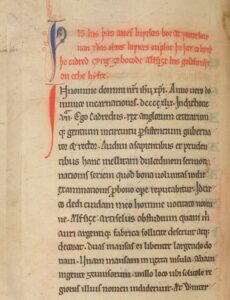
Isle of Wight Charter, MS Harley 436 f. 76v
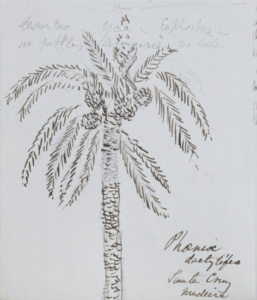
Lyell’s drawing of a Phoenix dactylifera, Madeira January 1854, Scientific Notebook 189 page 60
After looking into Lyell’s travels to the Isle of Wight, I hopped on to Madeira and the Canary Islands. Lyell’s study of these islands runs to 12 Notebooks dating January – August 1854, and contain his work alongside Georg Hartung (German geologist). I found they were more complicated, however, once I gained more context, I found they were the most enjoyable to work on. Lyell arrives in Funchal and the Notebooks relate his developing thoughts on formation and volcanic theory in response to his contemporaries such as Élie de Beaumont. The Notebooks include both geological and nature notes, with a large focus on shells and volcanic formations. One of my favourite drawings from this book is the Phoenix dactylifera (Date Palm). Lyell lists the shells he is collecting at Porto Santo and Madeira, such as Buccinidae. It was then really special for me to visit the University’s Cockburn Museum, and see some of their Madeira shells.
There are a team of people working together to write an upcoming exhibition on Lyell, and via my deep dive in Madeira, I was able to draw their attention to Notebook 191 page 3 and detailed sketches of Cape Girão on the south coast. This page stands out as having colour in-depth notes, and impressive detail. Its good to know this Notebook page will now be included in the exhibition.
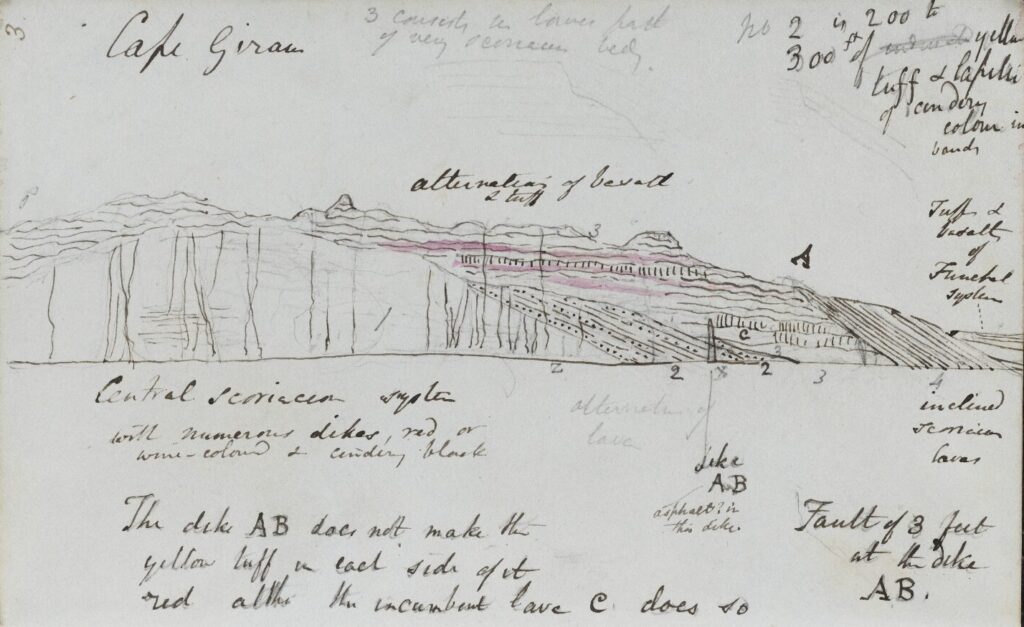
Lyell’s drawing of Cape Girão, Scientific Notebook 191 page 3
I found that my place recognition was drastically improving. Google Earth was extremely helpful, revealing the terrain and magnitude of Madeira and the Canary Islands in 3D. This not only improved my modelling skills, but also unlocked an environment that was virtually unchanged from that which Lyell was observing. Using Cape Girão as a starting point, I could match drawings to Google Earth and established that Lyell’s sketch in Notebook 191 page 3 was most likely drawn at sea to give Lyell the fullest image of the cliff face.
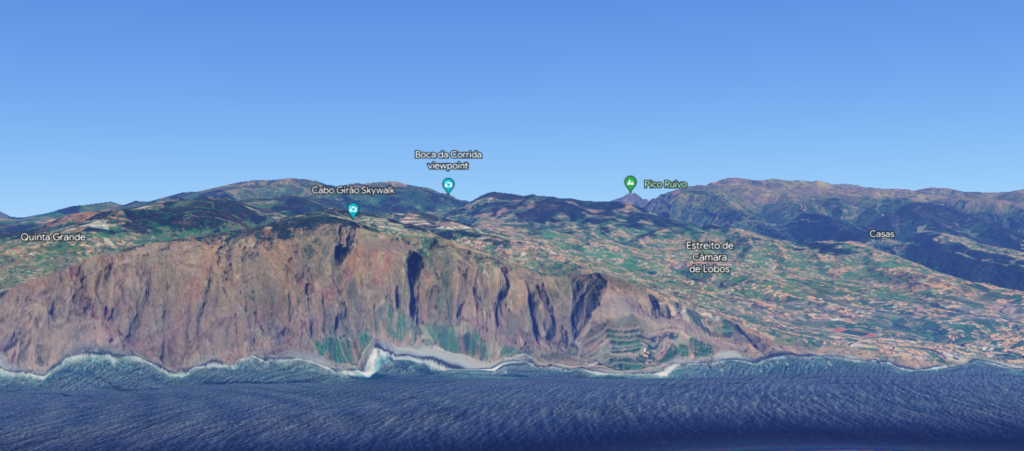
Google Earth (Version 9.191.0.0), Cabo Girão, Madeira: Latitude: 32.6322222 Longitude: -17.00583333333333
Whilst looking at the Madeira notebooks, there was a name that was repeated throughout that was initially unknown and difficult to decipher. That was until Notebook 191 p.110 where Lyell finally wrote the full name down as Johan F. Eckersberg, a Norwegian painter, who was in Madeira at the same time as Lyell, and as the Notebooks evidence, interacted and may have even advised Lyell’s sketches.
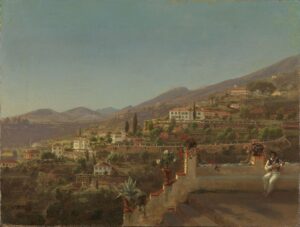
View of Funchal, Madeira. Johan Fredrik Eckersberg, 1854, Nasjonalmuseet for kunst, arkitektur og design, The Fine Art Collections, NG.M.03396
Eckersberg completed many paintings of Madeira, recording what the Island looked like whilst Lyell and Hartung were there. By connecting Eckersberg’s artistic realism to these geological travels, the landscape and environment can be better understood.
Notebooks 194– 195 cover La Palma and have some of the most recognisable landscape drawings. One that stood out to me was Lyell’s drawing of La Palma’s Caldera from Tazacorte. This one was much easier to locate on Google Earth as it had specific peaks, so I was able to be more accurate in terms of angles and direction.
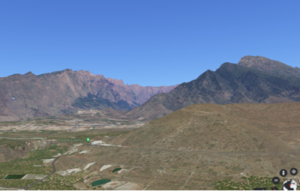
Google Earth (Version 9.191.0.0), Tazacorte, La Palma: Latitude: 28.6475 Longitude: -17.92277777777777
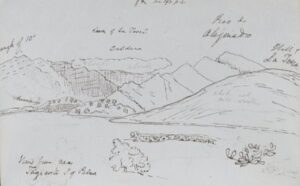
Notebook 195 page 40, Lyell’s view of La Palma Caldera
Over 10 weeks, I have visited 7 islands with Lyell, and completed the transcription and summaries of 25 notebooks. This internship has really opened up my understanding of 19th century geology and Lyell’s contribution to this emerging science, as well as just how connected society was.
Thank you Harriet for all of your hard work during the Summer! By utilising both old fashioned tools – lists, note taking, reaching out to experts and finding contemporary sources and art – alongside 21st century ones such as AI and Google Earth, you’ve really been able to explore Lyell’s islands and make them much more accessible for the future!
Pseudoscience and the supernatural: from phrenology and eugenics to ghosts, deceptions and mistakes, UFOs and conspiracy theories (Part 2)
Ash Mowat is one of our volunteers in the Civic Engagement Team. Ash has been looking into the relationship between pseudoscience and unexplained phenomena. In Part 1 of this blog post, Ash explores the science of pseudoscience and the papers of the Eugenics Society held in the University of Edinburgh Archives. In Part Two (of three), he looks at a letter in the University Archives from Arthur Conan Doyle, describing ‘psychic disturbances’.
Part Two: Sir Arthur Conan Doyle: A letter describing “psychic disturbances”
I paid a visit to the University of Edinburgh archives to view a letter from the creator of Sherlock Holmes Arthur Conan Doyle. [1]
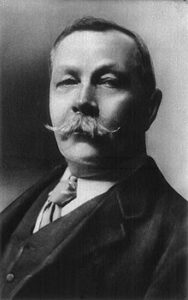
Arthur Conan Doyle studied medicine at the University of Edinburgh in 1876 to 1881. He had an interest in paranormal events and by 1887 had made public that he was a spiritualist. [2]
The letter is in response to an unnamed individual and is undated, and discusses reports of “psychic incidents”. He acknowledges that the events described to him by the letter’s recipient as being “consistent with those that break out so often in what are called poltergeist hauntings”.
He refers to “most famous case” in what is now known as the Epworth phenomenon of 1716, incidents of knockings and other disturbances lasting several months, with implied validity given the family status (Reverend Samuel Wesley, and son John Wesley, the founder of the Methodist Church). [3]
He then makes reference to the “most important still” events at Hydesville New York state in 1948, the episodes affecting the Fox sisters from 1848. [4] Once again, the chief reports were of mysterious knocking and others sounds, allegedly being generated by a spirit that could answer yes and no questions with a tapping sound.
It would be very interesting to know the date of this letter of Doyle’s, as by 1888 the Fox sisters had admitted that they had faked the entire events.
In the letter Doyle remarks, without further explanation, “it is when the female child is approaching the age of puberty that this phase of psychic phenomenon is most violent, although occasionally a lad is at the centre of this strange source. “This is a puzzling statement to say the least and not exactly scientific.
Intriguingly he mentions an incident when he was personally able to intervene to stop such a psychic disturbance. “Last month where a home was almost uninhabitable, I was able to offer some advice and the nuisance was brought to an end. “ It would be interesting had he been able to give details on what his solution entailed.
He concedes that there are some reports in the field that are either faked or otherwise invalid, such as when the child “is either through the force of suggestion or out of pure mischief begins to stimulate the phenomena….an unprejudiced judgement is needed in such circumstances. “
It is notable that he says that an unprejudiced judgement, rather than scientific proof, is required. Looking at the history now, it seems strange that such an educated man as Doyle would have embraced spiritualism. Indeed, even at the time there was scepticism and reported faked incidences. However, whatever our academic achievements, we are all open to adopt beliefs that may not live up to scientific rigour. His famous creation Sherlock Holmes famously said “If you eliminate the impossible, then whatever remains, however implausible, must be the truth”. In the absence of any firm evidence to support such psychic events, it appears in this case that not enough elimination was carried out.
An interesting insight into Victorian spiritualism, specifically that of celebrated medium Daniel Douglas Home, is explored in University of Edinburgh report by Peter Lamont of 2004. [5]
In this fascinating history, the author refers to a “crisis of evidence” whereby those who were sceptical that séances were genuine events were yet confounded when such “phenomena was ostensibly validated by scientists.” Such phenomena in his appearances included apparent levitation of people.
Home appears as anomaly, as unlike most mediums he is reported never to have charged for his services. Further we hear, “ in 25 years of conducting services, he was never caught cheating, despite many attempts to catch him, he was tested more thoroughly than any medium in this period, and he convinced many non-spiritualists in the existence of a natural (which became known as psychic) force”.
Home attracted formidable followers and patrons, and took a formal stance of exposing and denouncing fake spiritualists. Examples like this can indicate why a qualified Physician like Arthur Conan Doyle might yet be persuaded by spiritualists, although his declared belief in them came later in 1887 than with Home’s practices, as he’d retired by 1876.
The interesting conjecture of this post is a switch on the role of evidence. In that if no-one, despite extensive contemporaneous and subsequent testing, has been able to confirm that Home’s displays of psychic events were simply tricks and been able to explain how they were achieved, does this mean his séances have any weight as actual evidence that they were genuine?
[1] https://archives.collections.ed.ac.uk/repositories/2/resources/83640(accessed 5.1.2023)
[2] https://en.m.wikipedia.org/wiki/Arthur_Conan_Doyle(accessed 6.1.2023)
[3] https://en.m.wikipedia.org/wiki/Old_Rectory,_Epworth(accessed 7.1.2023)
[4] https://en.m.wikipedia.org/wiki/Fox_sisters(accessed 6.1.2023)
[5] https://www.research.ed.ac.uk/files/11872202/Spiritualism_and_a_mid_Victorian_crisis_of_evidence.pdf(accessed 6.1.2023)
New resource: Decolonisation and Legal Knowledge
In January the School of Law was fortunate to host the book launch event for Professor Folúkẹ́ Adébísí’s Decolonisation and Legal Knowledge: Reflections on Power and Possibility.
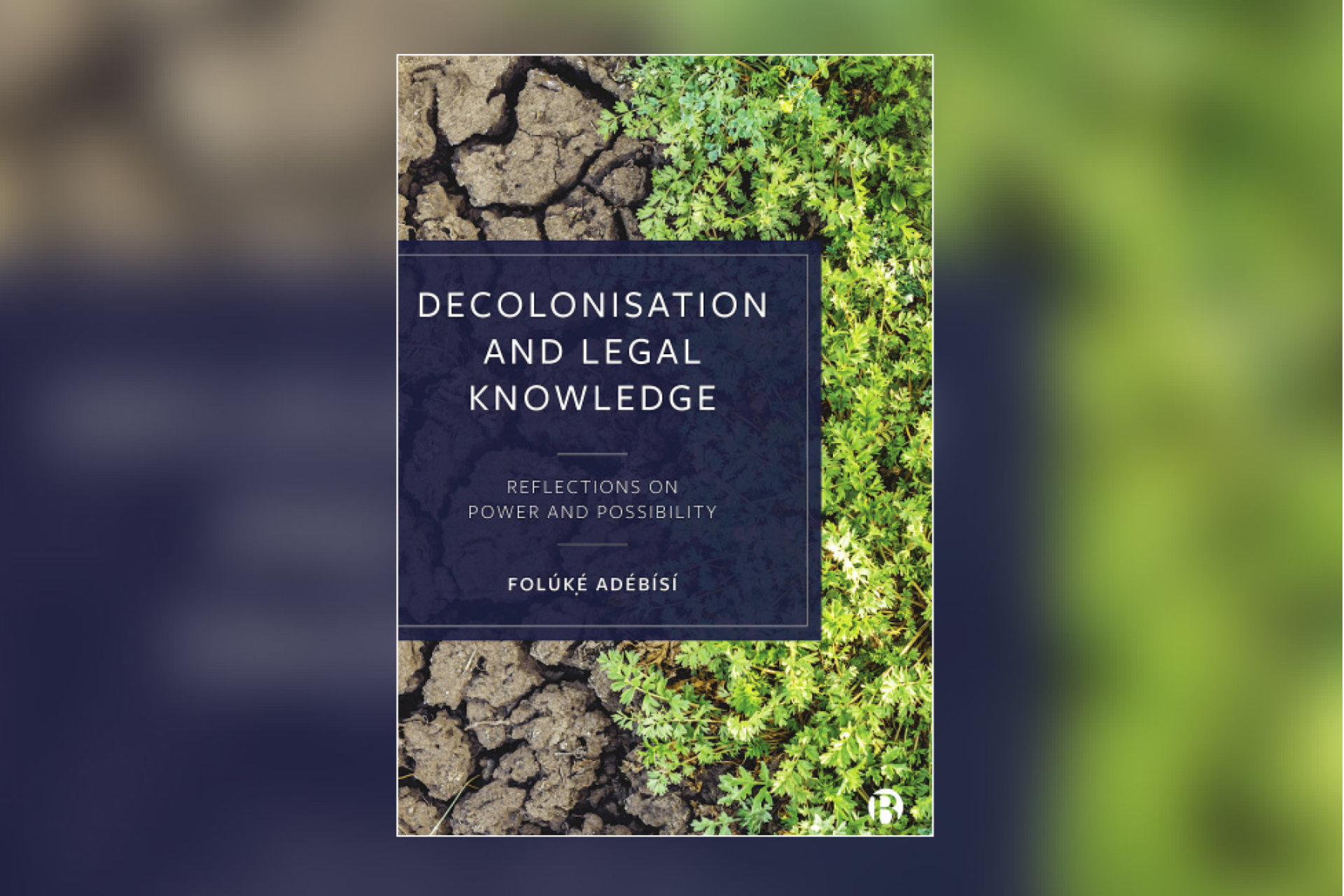
From the publisher:
The law is heavily implicated in creating, maintaining, and reproducing racialised hierarchies which bring about and preserve acute global disparities and injustices. This essential book provides an examination of the meanings of decolonisation and explores how this examination can inform teaching, researching, and practising of law.
It explores the ways in which the foundations of law are entangled in colonial thought and in its [re]production of ideas of commodification of bodies and space-time. Thus, it is an exploration of the ways in which we can use theories and praxes of decolonisation to produce legal knowledge for flourishing futures.
This text is now available via DiscoverEd: Decolonisation and Legal Knowledge: Reflections on Power and Possibility.
If you’re interested in requesting material like this that you think would be a valuable addition to the Law Library, you can complete the Request A Book (RAB) form. Alternatively if you’re interested in the library securing access to subscriptions or expensive items that you think would benefit teaching or research, contact us by email (law.librarian@ed.ac.uk) to discuss your idea!
CHDS DAMS Internship Experience
Over the past 6 months, I have had the pleasure of working with the Cultural Heritage Digitisation Service team as a DAMS (Digital Asset Management System: software used to manage digital heritage collections) Assistant, working to build the foundations for the migration of these collections from the current DAMS (LUNA) to the new Digital Collections Platform (Archipelago). Read More
Stories To Tell: South Asian Heritage Month
From 18 July to 17 August it is South Asian Heritage Month, a chance to celebrate and raise the profile of British South Asian history, arts, culture and heritage. This year’s theme is #StoriesToTell, celebrating the stories that make up the diverse and vibrant South Asian community.
Sometimes, to understand your own story or those of others, you have to look back and in this blog post we are highlighting just a small number of digital archives you can access through the Library that allow you to learn more about South Asian history and the stories that have shaped our present and future.
South Asia Commons (formerly South Asia Archive)

CRC: A Space Odyssey – Day in the Life of a Collections Management Technician
My name is Jasmine, and I’ve been working here at the University for five and a bit months as the Collections Management Technician. I’m the other half to Robyn Rogers’ role as Collections Care Technician, whose fantastic blog post about her recent work you can read here, and I work directly with the Appraisal Archivist and Archives Collection Manager, Abigail Hartley, whose equally wonderful blog post was featured last month.
Abigail did a great job of defining appraisal and the challenges to the archivist when it comes to choosing what material to preserve. The archivist is often put in the position of assessing the ‘value’ of the record, a thorny process which comes with a number of ethical challenges. Thinking through these problems, it might seem easier to suggest that we simply keep everything we receive. If we get to keep everything, we don’t have to think through complicated questions, like what is the purpose of the record? And what is the purpose of the archivist? After all, if something has found its way into the archive, isn’t that an implicit statement of its value? Why appraise at all?
New! Mass Observation Project, 1981-2009
I am happy to let you know that following a successful trial, that ended last month, the Library has now purchased Mass Observation Project, 1981-2009 from AM Digital, which allows you to explore the history of Britain through three turbulent decades, written by those living through it.
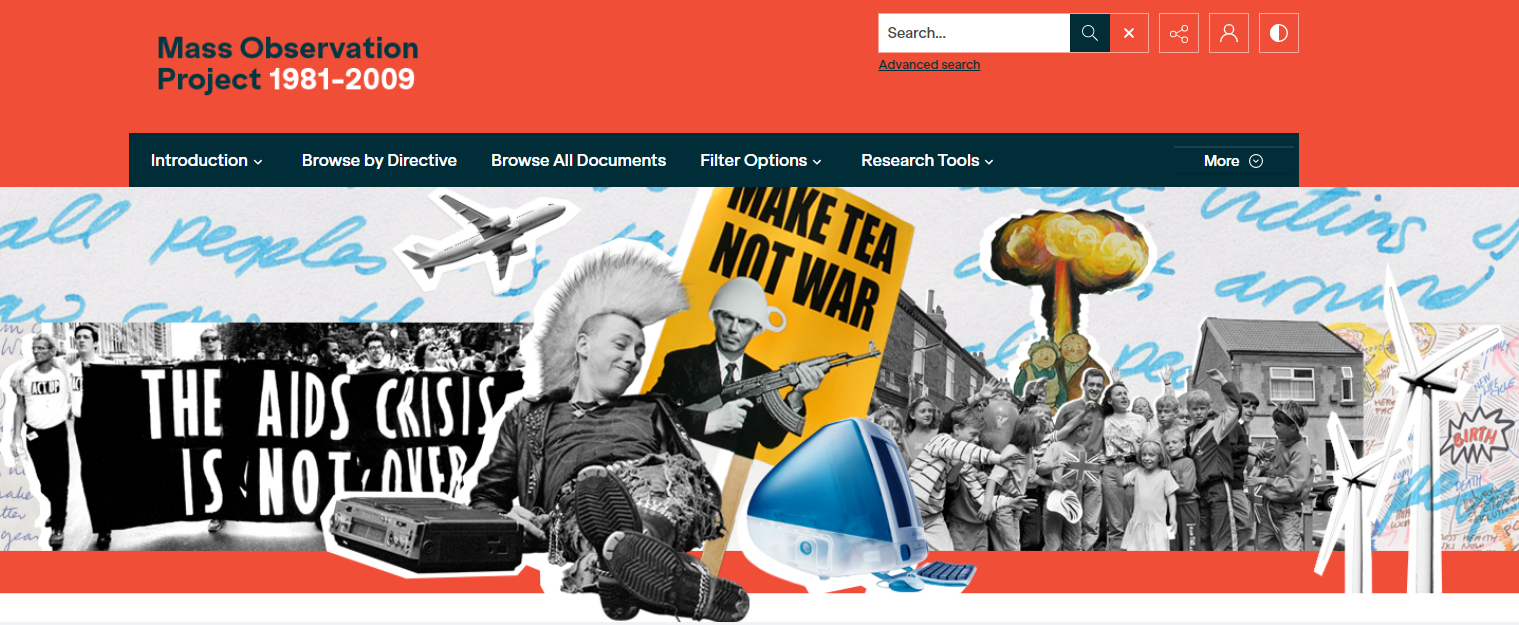
You can access Mass Observation Project via the Digital Primary Source and Archive Collection guide or the Databases A-Z list. You will also soon be able to access it via DiscoverEd.
Mass Observation Project, 1981-2009 provides digital access to a unique life-writing archive, capturing the everyday experiences, thoughts and opinions of people living through the turbulent final decades of the 20th century and the advent of the 21st century. Read More
New Data Visualisation Intern
It’s often said that the best way to achieve your goals is to visualise success. But what if visualisation is your goal? Then get someone clever to do it for you. That’s what we did: hired a new Data Visualisation Intern.
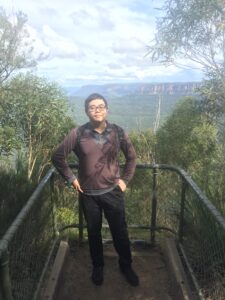
Henry Sun has joined Research Data Support for the summer to work on our Data Dashboard project. Henry is about to start his 4th year as an undergraduate, studying electronics and computer science. That’s right, he’s doing 2 degrees: our very own Henry Beauclerc. Henry also came to us with previous experience of laboratory research. Impressed? Us too, very.
Just how Henry manages to find time for anything else is a little baffling. But find it he does and with it, among other things, he watches superhero movies – Marvel for preference, obviously. And he cooks: Henry tells us that he already has special skills in Asian, especially Chinese cuisine, and now he’s learning how to bake. You can imagine how popular he’s going to be when his colleagues find out.
This internship is Henry’s first time in a professional services role and that role is to develop a dashboard that will enable us to monitor and to understand all the Open Research activity that goes on at the University of Edinburgh. Primarily, that means tracking down a range of internal and external data sources and figuring out a way to tie them all together and visualise them. And if that’s not enough, we’re hoping that Henry will be able to predict the future, or at least come up with some ideas for ongoing development of the dashboard. Exciting stuff, right? Right.
And what do we plan to do with this shiny new box of numbers? Management teams will want have a look, of course. We in Research Data Support are expecting to get a clearer and more detailed picture of the data management situation across the University: good practice, bad practice, and no practice at all. Knowing all that, especially the last two, will enable us to focus on the areas where we’re needed most. It will also be useful for our three Colleges – Arts, Humanities & Social Sciences, Science & Engineering, and Medicine & Veterinary Medicine – to see what kind of Open Research their researchers are producing. And speaking of Open Research, we’re aiming to make at least some of this data – headline numbers, etc. – available to the public via our website. It will be nice to show off all the hard work that’s going on in Open Research at Edinburgh as well as all the hard work Henry is doing for us.
Simon Smith
Research Data Support Officer
Library & University Collections
New College Library Library is moving August / September 2023

Inside New College Library, Mound Place
In January 2020 the majority of New College Library General Collections were relocated to 40 George Square to provide a Library service for the duration of a major Estates project. This Estates Project has now come to an end. New College Library at 40 George Square will close at 4.50pm on 9th August 2023.
Between 10 August and 10 September access to the New College Library General Collections will be unavailable as they move location. While access to collections is paused the Library will support Library users to identify alternative ways to access required Library resources.
New College Library plans to re-open at Mound Place with full access to General Collections, study spaces and Library services on 11th September 2023.
Further information about the Library is provided on the New College Library website New College Library | The University of Edinburgh
On trial: Brepolis online databases
*The Library now subscribes to both Monumenta Germaniae Historica and Archive of Celtic-Latin Literature. Find out more at New to the Library: Archive of Celtic-Latin Literature and Monumenta Germaniae Historica.”
Thanks to a request from staff in History the Library is currently trialing access to 3 Brepolis databases: Monumenta Germaniae Historica, Archive of Celtic-Latin Literature and Aristoteles Latinus. As well as trialling access to their Cross Database Searchtool which allows you to cross search all 3 of these databases, in addition to their Library of Latin Texts, which the Library already has a subscription to.

You can access all 3 databases plus the cross search database tool via the E-resources trials page.
Trial access ends 5th August 2023.
Monumenta Germaniae Historica (eMGH)
The Monumenta Germaniae Historica was founded in 1819 by the Gesellschaft für Deutschlands ältere Geschichtskunde. It is one of the most prestigious editorial undertakings for the critical publication of medieval historical texts. In more than 300 volumes, covering the widest possible range of historical documents, divided into five major Series (Scriptores, Leges, Diplomata, Epistolae and Antiquitates) and into 33 Subseries, the Monumenta not only continues its editorial programme but it has established for all Western scholarship a standard for critical editions. Read More
Collections
 Hill and Adamson Collection: an insight into Edinburgh’s past
My name is Phoebe Kirkland, I am an MSc East Asian Studies student, and for...
Cataloguing the private papers of Archibald Hunter Campbell: A Journey Through Correspondence
My name is Pauline Vincent, I am a student in my last year of a...
Hill and Adamson Collection: an insight into Edinburgh’s past
My name is Phoebe Kirkland, I am an MSc East Asian Studies student, and for...
Cataloguing the private papers of Archibald Hunter Campbell: A Journey Through Correspondence
My name is Pauline Vincent, I am a student in my last year of a...
Projects
Cataloguing the private papers of Archibald Hunter Campbell: A Journey Through Correspondence
My name is Pauline Vincent, I am a student in my last year of a...
Archival Provenance Research Project: Lishan’s Experience
Presentation My name is Lishan Zou, I am a fourth year History and Politics student....