Home University of Edinburgh Library Essentials
June 18, 2026
Dame Anne McLaren (1927-2007)
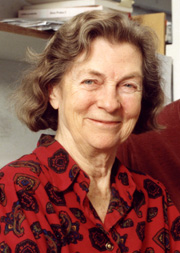
Anne McLaren (picture sourced from http://en.wikipedia.org
It’s always great to receive comments and feedback from our blog readers, especially those which suggest subjects or people which we haven’t yet featured. We have a growing list of posts to respond to our readers’ suggestions, and we are delighted that our first of these focuses on Dame Anne McLaren.
Anne McLaren was a hugely important figure in the fields of mammalian reproductive and developmental biology and genetics, and she is possibly best known for her work as director of the Medical Research Council Mammalian Development Unit at University College London. Her long and rich career in the techniques and ethics of fertility is covered in ample detail in John Biggers’ excellent obituary: http://www.theguardian.com/science/2007/jul/10/uk.obituaries
In this blog, I want to focus specifically on McLaren’s time in Edinburgh, and her appearances in our archive collections. After gaining her degree at Oxford and completing postdoctoral work in London, McLaren moved to Edinburgh in 1959 with her then-husband Donald Michie. She joined the Agricultural Research Council’s Unit of Animal Genetics (based within the Institute of Animal Genetics), working initially on the reproductive physiology of the mouse with Alan Beatty and others. During her time at the Institute, McLaren’s research spanned mammalian fertility, embryo transfer techniques and immunocontraception. She was particularly interested in egg transfer, the hormonal control of ovulation, superovulation and its effects on pregnancy, placental and foetal growth, and the effects of the uterine environment on skeletal character. She and John Biggers were the first to demonstrate that a mammalian embryo grown in vitro for several days would subsequently develop into a normal adult. McLaren also worked with chimeras (organisms consisting of two or more genetically different kinds of tissue), and her later book on the subject, published in 1976, became a classic text.
McLaren was well liked and respected in Edinburgh. The correspondence of Institute of Animal Genetics director C.H. Waddington reveals that he proposed McLaren for Fellowship of the Royal Society in 1968 (he was disappointed that she was not elected until 1974, after she had left the Institute), with F.W. Rogers Brambell as seconder. Waddington’s statement of support commends McLaren’s work on the reproductive biology of the mouse, and in particular the rigour of her statistical and quantitative approach. Waddington also praises her personal attributes: ‘She has in a high degree an ability found only in some scientists of being both highly critical and extremely helpful. Very many workers, at all levels from the young to quite mature ones, like to talk over with her some subject they are tackling, confident that she will spot any weaknesses in their arguments, or, more positively, coax them into thinking straighter than they had done before.’ (Coll-41/9/4/4)
Alan Beatty’s papers contain the most information relating to McLaren, as they worked closely together until McLaren departed for London in 1974. They secured a series of grants from the Ford Foundation for a sustained programme of work on reproductive physiology, and together with colleagues, they lobbied for a Centre for Reproductive Biology to be established in Edinburgh (which occurred in 1980). Beatty’s archive reveals an active and busy schedule of planning meetings and funding applications underpinning he and McLaren’s research. Letters from McLaren after her departure to London show that she continued to take an interest in matters in Edinburgh, and stayed in touch with old colleagues and friends.
In London, McLaren’s research took her on to study the development of mammalian primordial germ cells, and she published an acclaimed book on the subject in 1980. After her retirement from the MGU, she became principal research associate at the Welcome Trust/Cancer Research UK Gurdon Institute in Cambridge. Anne McLaren died aged 80, along with her former husband Donald Michie, in a car accident en route from Cambridge to London on 7 July 2007.
Importantly, McLaren’s scientific work formed the basis of her wider engagement with ethical and societal issues surrounding fertility and reproduction, and, later, stem cell research and cloning technologies. She sat on the Warnock Committee, which contributed to the passing of the 1987 Family Law Reform Act and the 1990 Human Fertilisation and Embryology Act. A copy of one of her articles, titled ‘The Future of the Family’, was retained by Waddington in his papers, and demonstrates that, for McLaren, science has the potential to direct humans towards a better society. The article, written in 1972, concludes:
People in the future will be faced with more leisure: I hope that they will use it for a greater degree of democratic participation in the running of our society; for self-education, aided by computers whose tutorial intelligences will soon be at our disposal; and above all for the benefit of their smaller families of children. It is in the early years of life that personalities are moulded and the foundations of ethical systems laid: we must find out how not to cripple children’s minds as most, perhaps all, are crippled today, and how to instil an ethic of loyalty and protectiveness which begins with other members of the family and does not stop at national boundaries, but extends for the first time over the entire human race.
Clare Button
Project Archivist
If you have a topic relating to animal genetics in Edinburgh which you’d like to see covered, get in touch!
Win a University of Edinburgh Hoodie!
At the Library pop up session this afternoon Leisa and Serena will be there to talk to you about how to get involved with library work and projects.
Leisa will be there from the Development and Alumni department and will be talking about what they do to fundraise for the Library and how students can help with this work. Leisa will also be joined by one of her colleagues from Alumni engagement.
Serena co-ordinates the volunteers and interns who work with the Library and all of the collections – if you’ve ever thought about a career in libraries, museums or archives, this is your opportunity to find out more!
![20140908_140608[1]](https://libraryblogs.is.ed.ac.uk/popuplibrary/files/2014/10/20140908_1406081.jpg)
Jamie – one of our lovely interns!
Dancing with Data
I went to an interesting talk yesterday by Prof Chris Speed called “Dancing with Data”, on how our interactions and relationships with each other, with the objects in our lives and with companies and charities are changing as a result of the data that is now being generated by those objects (particularly smartphones, but increasingly by other objects too). New phenomena such as 3D printing, airbnb, foursquare and iZettle are giving us choices we never had before, but also leading to things being done with our data which we might not have expected or known about. The relationships between individuals and our data are being re-defined as we speak. Prof Speed challenged us to think about the position of designers in this new world where push-to-pull markets are being replaced by new models. He also told us about his research collaborations with Oxfam, looking at how technology might enhance the value of the second-hand objects they sell by allowing customers to hear their stories from their previous owners. 
All very thought-provoking, but what about the implications for academic research, aside from those working in the fields of Design, Economics or Sociology who must now develop new models to reflect this changing landscape? Well, the question arises, if all this data is being generated and collected by companies, are the academics (and indeed the charity sector) falling behind the curve? Here at the University of Edinburgh, my colleagues in Informatics are doing Data Science research, looking into the infrastructure and the algorithms used to analyse the kind of commercial Big Data flowing out of the smartphones in our pockets, while Prof Speed and his colleagues are looking at how design itself is being affected. But perhaps academics in all disciplines need to be tuning their antennae to this wavelength and thinking seriously about how their research can adapt to and be enhanced by the new ways we are all dancing with data.
For more about the University of Edinburgh’s Design Informatics research and forthcoming seminars see www.designinformatics.org. Prof Chris Speed tweets @ChrisSpeed.
Pauline Ward is a Data Library Assistant working at the University of Edinburgh and EDINA.
Your friend BoB (Box of Broadcasts)
 Want to find out how to:
- View & record over 1 million TV & Radio programmes
- Create clips & clip compilations
- Compile favourite shows into playlists and share them with others
- Record missed programmes
You can do all this & more with help from BoB (Box of Broadcasts). You can find out how simple it is to use this fantastic resource by coming along to our pop-up library session on Thursday 16th October from 10 till 12 on the 1st floor of the main library.
You’ll wonder how you ever managed before life with BoB!!!!
See more about BoB here.
Margaret Redpath
Main Library Helpdesk
Be in charge of the Library for the day
And win some free print credit!
 Tell us what you would change to make the Library better or tell us what you love about the Library and you could win free print credit.
This is a great chance for you to meet Library managers and tell us what improvements you think could be made to services, collections, spaces, etc., to enhance the student experience.
We are also interested to hear what you do like about the Library and what your favourite thing about the Library is.
The best comment or suggestion will win £10 free print credit.
On the day you will be able to speak to Richard Battersby and Irene McGowan from Library Academic Support and Barry Croucher from Help Services. So please pop up for a chat about your Library on Wednesday 15th October, 2-4pm, on the 1st floor, Main Library.
This session will be repeated on Wednesday 22nd October, 2-4pm, with another chance to win £10 free print credit.
We look forward to meeting you.
User Services Division (USD) Managers
New books for Social and Political Science
Thanks to recommendations from members of staff and requests via RAB from students the Library is continually adding new books to its collections both online and in print. Here are just a small number of the books that have been purchased by the Library for Social and Political Science subject areas since the start of semester.
 The symbolic representation of gender: a discursive approach by Emanuela Lombardo and Petra Meier (shelfmark: HQ1075 Lom. Also available as e-book)
The fire below : how the Caucasus shaped Russia edited by Robert Bruce Ware (shelfmark: DK511.C2 Fir. Also available as e-book)
Illicit by Moisés Naím (shelfmark: HV6252 Nai.) Read More
Meet the Collections Managers
Hannah and I can’t wait to meet some of our users tomorrow, when we do our Pop Up Library session on the 1st floor of the Main Library.
We will tell anyone who will listen about the new Library Resources Plus initiative, aimed at helping all our students get access to the resources they need (including those outside our collections).
www.ed.ac.uk/is/library-resources-plus

Library Resources Plus
We want to hear about your experiences in getting access to materials for your courses (good and bad!).
And will answer any questions you have about how we develop the Library’s collections, and what we do to maintain them in an accessible manner.
Please do stop by!
Laura M. Shanahan (nee Macpherson), Head of Collections Development and Access
Hannah Mateer, Collections Lifecycle Manager
E-Journals – at risk period
Our e-journal links are at risk during the period Sunday 12th October 3am – 11am due to some maintenance and a server re-boot. Going directly to the journal’s website while on campus or using the VPN is a workaround if you encounter any issues.
Trial – BBC Monitoring Library
 We have trial access to the BBC Monitoring Library until 17th November. Please see the SPS librarian blog post for full info.
Freshers, Festival, Football: The Student, 11 Oct 1984

Hot off the press (and a day early!), the 11 October 1984 edition of The Student is now available to read online https://libraryblogs.is.ed.ac.uk/thestudent/.
Featuring the surprising success of Big Country, a review of Freshers’ Week 1984 and a shock win for Hearts, this week’s paper comes with the intriguing headline “Fur coat and no knickers”.
Read more at https://libraryblogs.is.ed.ac.uk/thestudent/ .
Collections
 Hill and Adamson Collection: an insight into Edinburgh’s past
My name is Phoebe Kirkland, I am an MSc East Asian Studies student, and for...
Cataloguing the private papers of Archibald Hunter Campbell: A Journey Through Correspondence
My name is Pauline Vincent, I am a student in my last year of a...
Hill and Adamson Collection: an insight into Edinburgh’s past
My name is Phoebe Kirkland, I am an MSc East Asian Studies student, and for...
Cataloguing the private papers of Archibald Hunter Campbell: A Journey Through Correspondence
My name is Pauline Vincent, I am a student in my last year of a...
Projects
Cataloguing the private papers of Archibald Hunter Campbell: A Journey Through Correspondence
My name is Pauline Vincent, I am a student in my last year of a...
Archival Provenance Research Project: Lishan’s Experience
Presentation My name is Lishan Zou, I am a fourth year History and Politics student....