Home University of Edinburgh Library Essentials
October 5, 2026
Trial access to IBIS World

We have trial access to IBISWorld until 4th December. Update : Subscription started January 2016.
IBISWorld is an online industry intelligence solution. Covering 432 UK industries at SIC L5, each of its industry reports provides the most detailed performance data and analysis on the market; supply chain information; forecasts; risk scores; operating strengths and weaknesses; analysis of external drivers; major player market strategies; and industry profit and costs benchmarks. Reports are updated three times per year on average ensuring the most up to date research possible.
In addition to coursework/assignments, these reports would be of use to students researching industries for placements, future careers (including start up research) and interview preparation.

Feedback and further info
We are interested to know what you think of this e-resource as your comments influence purchase decisions so please do fill out our feedback form.
A list of all trials currently available to University of Edinburgh staff and students can be found on our trials webpage.
10,000th open access item added to the Edinburgh Research Archive

Thanks to a major digitisation project being undertaken by Library & University Collections we are proud to announce our 10,000th open access item has recently been deposited in the Edinburgh Research Archive (ERA).
ERA is a digital repository of original research produced at The University of Edinburgh. The archive contains documents written by academic authors, based or affiliated with Edinburgh that have sufficient quality to be collected and preserved by the Library, but which are not controlled by any other organisations (for example commercial publishers). Holdings include full-text digital doctoral theses [6150], masters dissertations [950], project reports, briefing papers and out-of-print materials. Current research produced by the University is available from the research portal, which has 101,860 records, of which 28,220 have open access documents attached.
Since 2005 the majority of PhD theses issued by the University have been submitted in a digital format, and around 20 recently completed PhD theses are added each week. Our digitisation activities seek to make accessible older unique content which is only available onsite in the Special Collections reading rooms. The oldest University of Edinburgh thesis archived in ERA was originally published in 1819.
Theatre in Video
In 2013 we acquired Theatre in Video which contains more than 250 definitive performances of the world’s leading plays, together with more than 100 film documentaries, online in streaming video – more than 500 hours in all, representing hundreds of leading playwrights, actors and directors. This video resource can be accessed from the Database A-Z list or Databases by subject for English Literature.
Now, we have been offered a free trial of Volume II of Theatre in Video which includes new, international, and contemporary performances; ground-breaking documentaries; and critical instructional series. The trial will last until 30th Nov 2015. To access the trial, please go to the Library’s e-resources trial site. Feedback welcome. 
The publisher Alexander Street Press has given the following information about the content of Theatre in Video: Volume II:
PERFORMANCES: This release of Theatre in Video: Volume II includes almost forty hours of either live performance or cinematic productions of plays from classical playwrights such as William Shakespeare, Molière, Voltaire, and Anton Chekhov but also incorporates new, contemporary writers such as Philip Kan Gotanda, Alexander Buzo, and William Yang. Examples include:
- Sadness from the National Film and Sound Archive of Australia (1999): Award-winning photographer William Yang explores issues of grief, family and identity in this adaptation of his acclaimed stage performance. Through this poetic montage of storytelling, photography and stylized reenactment, Yang brings to life the stories of his family and friends.
- Sweeney Todd from Image Entertainment (2001): The San Francisco Symphony Orchestra’s 2001 concert production of Stephen Sondheim’s musical is superb and (even without scenery) theatrically effective. The performers are in costume and use a few essential props such as Todd’s razor, but more than these details the quality of their singing and acting makes this production stand out. Features Tony Award-winners Patti LuPone and Neil Patrick Harris.
- Candide from Image Entertainment (2004): Leonard Bernstein’s comic operetta comes to new life under the guidance of director Lonny Price (A Class Act). Based on the classic Voltaire tale of an innocent young man’s journey through a life filled with colorful characters and unexpected life lessons, this production features Tony Award-winners Patti LuPone and Kristin Chenoweth.
- Modern Moliere: Tartuffe from TMW Media Group (2007): This contemporary version of Moliere’s classical comedy, Tartuffe, is the timeless story of a religious impostor who tries to steal his wealthy benefactor’s wife, daughter and fortune. Set in modern-day Los Angeles and told all in rhyme, Tartuffe comes brilliantly alive on screen.
- Shakespeare: Twelfth Night (Globe)** from Opus Arte (2013): One of Shakespeare’s best-loved comedies, Twelfth Night was ‘blissfully reborn’ (Telegraph) for the 2012/13 season at London’s Globe Theatre, under the direction of Tim Carroll. The tale of misdirection and deception is performed here by an all-male cast, among whom we find Mark Rylance as Olivia and Roger Lloyd-Pack as Sir Anthony Aguecheek. The production also marks Stephen Fry‘s return to the stage as the pompous Malvolio, ridiculous in his yellow stockings.
- Sado Tempest from John Williams (2012): Arashi mixes Japanese rock, Noh Masks, and the weird volcanic landscapes of Sado Island in a radical reworking of Shakespeare’s The Tempest. In this Tempest the storm has gone badly wrong and ruined the island, Caliban is now in charge, Miranda has gone crazy, and Prospero is missing – presumed dead.
DOCUMENTARIES: With almost six hours of key documentary in this release, Theatre in Video: Volume II explores independent theatre scenes, the internationality of theatre, and the lives of acting giants. Examples include:
- Black Theater: The Making of a Movement from California Newsreel (1978): Black Theatre: The Making of a Movement documents the birth of a new theatre out of the Civil Rights activism of the 1950s, ’60s and ’70s.
- Amazing Scenes from the National Film and Sound Archive of Australia (1980): Spike Milligan takes a look at the Australian fringe theatre scene and finds a colourful, somewhat offbeat array of talent, including David Argue, Cappriccios, Circus Oz, Clowneroonies (featuring Geoffrey Rush), and many more.
- Pram Factory from the National Film and Sound Archive of Australia (1994): In the early 1970s Melbourne was home to the Australian Performing Group, a theatre collective that quickly became a focal point for the intellectual, artistic and political life of those turbulent times.
- Shakespeare, India and Me** from electric sky (2012): In Shakespeare, India & Me, Felicity Kendal, one of Britain’s best loved actors, tells the story of India’s long love affair with Shakespeare, from the first days of Empire to Bollywood and beyond.
- Elaine Stritch: Shoot Me** from Smart Broad Films (2013): In her final years, Broadway legend Elaine Stritch remained as ferociously funny as ever, moving from project to project with unparalleled zest and zeal. This bold, hilarious, and poignant documentary reveals the uncompromising Tony and Emmy Award-winner both on and off the stage.
INSTRUCTIONAL MATERIAL: Instructional material is key in any drama department. This release of Theatre in Video: Volume II brings customers 65 hours of content across a wide range of topics: from how to run the front of house to the difference between acting for the stage versus acting for a TV series. Examples include:
- Audition Series with Michael Shurtleff from First Light Video Publishing: Michael Shurtleff teaches an approach to acting that helps students learn to locate their own inner strengths and bring these strengths to bear with maximum energy and force in each role and each moment on the stage.
- Actor’s Notes** from Sound Venture: Following in the footsteps of our very successful series on ballet and classical music, this series examines the art of acting from the actor’s point-of-view. Hosted by veteran actor, Jennifer Dale, the series features interviews and performances by some of Canada’s greatest stars, working in a particular genre of acting: Feature Films, TV Series, Shakespeare, Musical Theatre, from Stage to Screen, and Comedy.
- Producing for the Theatre Series from TMW Media: This actually includes three sub-series, separated into different categories, covering all aspects of the business of theatre. The following playlists are available for each of these sub-series:
- Dreamers and the Builders: This sub-series examines the jobs of the creative people behind theater productions and considers their processes. It explores the various aspects of the work of actors, directors, playwrights, designers, and technicians and discusses the ways in which they work individually and collaborate.
- Forces Who Run the Theatre: This sub-series examines the roles and responsibilities of the people who control the venues, content, and talent in theatre and provide a wide panorama of what theatre is and who ‘makes it happen.’
- Business of the Theatre: This sub-series describes the business aspect of producing the play, how you raise the money to capitalize a play or musical, structuring budgets to account for pre-production and ‘running’ costs, and developing a marketing/publicity and advertising plan.
William Henry Playfair, architect
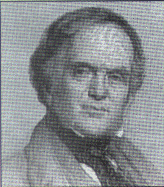
William Henry Playfair
On 2 Nov 2015, the CRC hosted a seminar which looked at the figure of William Henry Playfair (1790-1857), discussing his life and work and looking in some detail at a range of architectural drawings which had been selected from our collection.
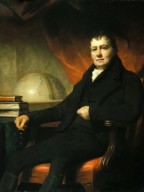
John Playfair
Playfair was born was born in Russell Square, London, July 1789. On the death of his father, architect James Playfair, he was sent to reside with his uncle in Edinburgh. Professor John Playfair, mathematician and geologist and a leading figure in the Edinburgh Enlightenment, took control of his nephew’s education. Following his father’s profession, the young Playfair studied under William Starke of Glasgow. Following Starke’s death in 1813, Playfair moved to London where he worked in the offices of James Wyatt and Robert Smirke, returning to Edinburgh in 1816.
He established himself professionally by winning the commission in 1817 to complete the unfinished University buildings (leaving the front as designed by Robert and James Adam). He also designed the city’s Royal Terrace and Regent Terrace on the Calton
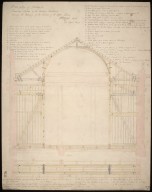
College of Edinburgh Transverse Section of the Southern Buildings
Hill estate; the unfinished National Monument on Calton Hill; and, the Royal Scottish Academy and the National Gallery on the Mound. While Playfair’s most important works in Edinburgh have been executed in the Greek revivalist or classical style – earning for Edinburgh the title of ‘Athens of the North’ – he was competent in other styles too. He designed New College for the ten newly established Free Church of Scotland, a jagged-lined rendering of the Gothic style. He also built country houses and mansions in the Italianate and Tudor styles.
The discussion in the seminar was not structured in any major way but flowed directly from looking at the drawings we had selected to view. Alongside the physical drawings, we also looked at digitised ones, using the complement of both to do things which one or other could not do alone.
With over 5000 to choose from, electing the drawings was never going to be an easy task. However we settled on one or more drawings relating to the following of Playfair’s projects:
- College of Edinburgh
- Royal Observatory
- Dollar Academy
- Blenheim Place
- Elm Row
- Royal Institution
- Royal Institution Additions
- National Monument
- Royal College of Surgeons
- Stewart Monument
- Donaldson’s Hospital
- New College Edinburgh
Links:
- All of the digitised drawings can be viewed in a dedicated online gallery
- View Playfair in the Archives Catalogue
LibQUAL+ Survey 2015

If you have been selected to complete the survey, please do before the 15th November. You could win one of four £50 prizes. Prizes include either a Blackwell’s vouchers or high street vouchers!
Thank you very much if you have already completed the survey. Your feedback shows us to where to make improvements, to give you the best possible library experience.
Sound as a Snake: conservation techniques for unusual materials
One of the MIMEd instruments that went under conservation treatment this month by

Sanxian prior to conservation
conservator Jonathan Santa Maria Bouquet is a Chinese sanxian (MIMEd 437). The instrument, played both as a solo or orchestral instrument in Chinese classical music, is a plucked instrument with three strings. This sanxian was made in the mid-nineteenth century and was collected by John Donaldson, the founder of the Music Classroom Museum of Edinburgh University, and has been part of the University’s collection since before 1872.
An interesting element of sanxian construction is that the front and back of the body are made of snake skin – often that of a python. Although visually stunning, this material is susceptible to damage. Unfortunately changes in relative humidity over the years has caused the skin of the back and front of our sanxian to stretch resulting in tears.

Tear in front of instrument body

Torn back section
To treat this instrument Jonathan used a technique he recently learned from a workshop given by Caroline Scharfenberg, a rare book conservator, which took place at the conservation studio of the Main Library. The technique is known as Japanese paper toning and it involves the use of Japanese paper to reinforce torn materials. The paper is then coloured using natural pigments to match the original material resulting in an inconspicuous repair. In the case of the sanxian Jonathan reinforced the tears in the snake skin, applying Japanese paper to the inside of the instrument. He then toned and texturized the paper to match that of the snake skin.

Front with Japanese paper before toning

Front with toned paper

Back with Japanese paper before toning

Back with toned paper

Instrument ready for display
Although the tears are still visible, this treatment has made the damage less noticeable and more stable. Now the instrument is ready for display in the redeveloped St Cecilia’s Hall.
Billy Graham and Tell Scotland
Saturday 7 November marks the 97th birthday of the famous evangelist Rev Billy Graham. He is probably best known for his crusades during the 1940s, 50s and 60s. He visited Scotland in 1954-1955 in what became known as the “Tell Scotland” movement. This movement was led by Rev Tom Allan, whose papers are kept here in the archives at New College Library.
Music was a very large part of the crusades and the Tell Scotland evangelistic events, with choirs of sometimes of thousands of singers being involved. This is evident in the archives, which contains a copy of a specially printed hymn book for the Tell Scotland Gorbals Mission (ref. AA6.3.5)
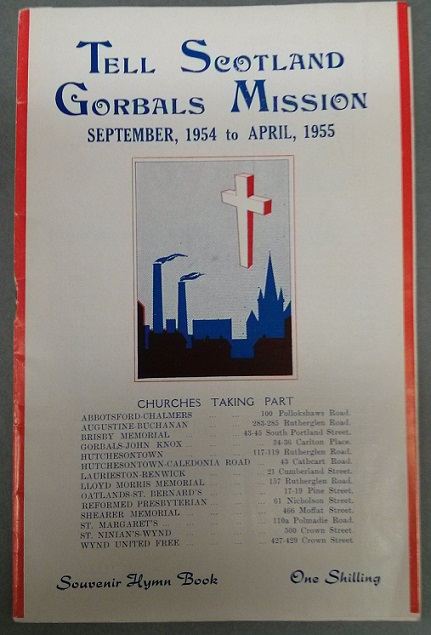
and a hymn entitled “Tell Scotland” (ref. AA6.3.6) written by Ian B Doyle and dedicated to Tom Allan.
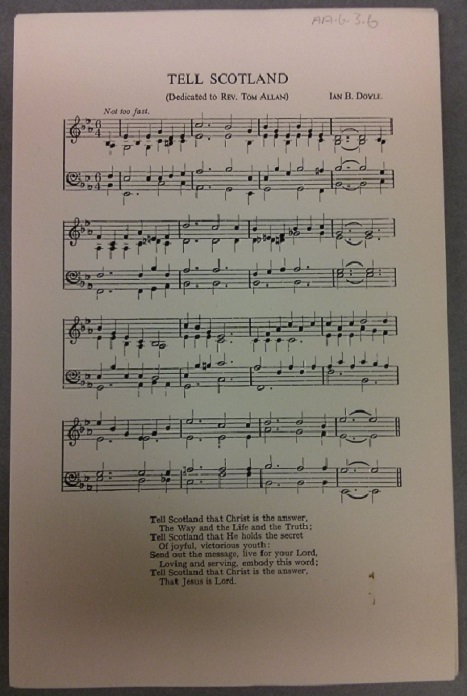
In addition, there is a photograph of the organisers of the Tell Scotland rallies with Billy Graham (front row, 4th from left) and his musical director Cliff Barrows (back row, 7th from left). Rev Tom Allan is front and centre next to Dr Graham.

Although now 60 years ago, the Tell Scotland rallies are well-remembered in Scotland for the significant impact they made. Hopefully, Billy Graham remembers them fondly too.
Happy Birthday, Dr Graham!
Kirsty M Stewart, New College Collections Curator
All of the above items can be seen at New College Library: http://www.ed.ac.uk/information-services/library-museum-gallery/using-library/lib-locate/newcoll-lib
New exhibition showcases unique items from the University’s Anatomical Museum
The Visual Dissection – The Art of Anatomy exhibition in the Main Library will give visitors an extremely rare opportunity to see a range of collections from the University’s Anatomical Museum, some of which have never been on display to the public before. The exhibition will tell the story of how anatomical representation of the body has changed over the years, taking you on a journey from the woodcuts and engravings of the 17th and 18th centuries, to the wax and papier mâché models of the 19th and 20th centuries, and then on to the digital technologies of today.
The late 18th and early 19th century was a golden age for the production of anatomical models and the Anatomical Museum collections are particularly rich with examples from across Europe. Exotic sounding manufacturers like ‘Maison Tramond’ and ‘Ziegler’ are well represented in the exhibition and visitors will be able to see for themselves the exquisite craftsmanship required to produce a resin cast of a lung or the corrosion cast of a foot. These objects have been used to help teach generations of medical students in the Anatomy Department at the University of Edinburgh. Many of the models on display are so accurate and detailed in their anatomical representation that they are still used for teaching today.
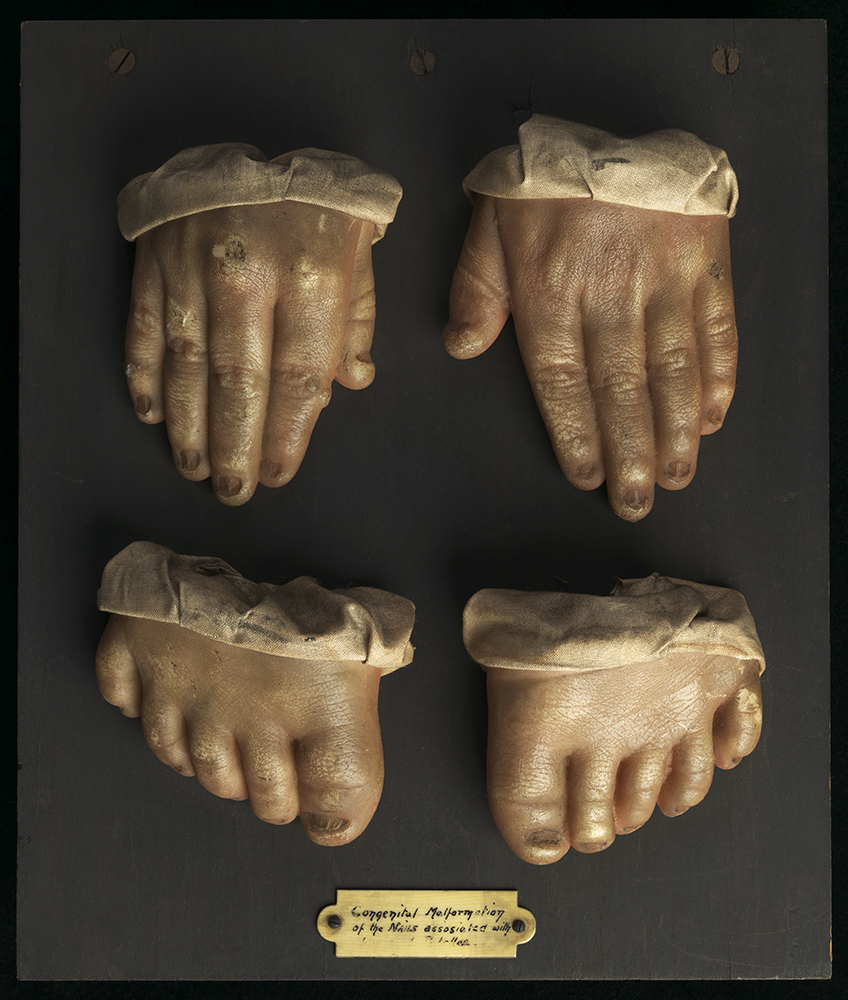
Wax moulage of hands and feet, early 20th century. This moulage shows a congenital malformation of the nails.
Part of the richness of this exhibition comes from the fact that these treasures of the Anatomical Collection are complemented by works from the University’s Fine Art and Special Collections. A particular notable example is the inclusion of Giambologna’s écorché figure of a horse (dating from 1585) from the Torrie Collection, which will be displayed for the first time alongside another of the University’s iconic items, Carlo Ruini’s Anatomia dell cavallo, infermita, et suoi rimedii (from 1618). As well as these rare illustrated books and the unique anatomical casts and models, the exhibition will also include a life sized hologram of the human body, believed to be the largest anatomical hologram ever made.
Visual Dissection presents the anatomical models on display as being a product of innovative collaborations between the worlds of art and science and perhaps just as importantly as works of art in their own right. Highlighting these collaborations in the displays is entirely appropriate as the exhibition itself is the result of a partnership between Doug Stevens, a 5th year student at Edinburgh College of Art, and the Anatomical Museum. Doug put the Visual Dissection exhibition proposal together as part of his Employ.ed internship. Doug’s initial exhibition vision was made into a reality thanks to the input of Anatomical Museum staff and additional funding from the Biomedical Teaching Organisation, Edinburgh College of Art, the School of Medicine and the Anatomical Society.
Doug, who is studying for an MA (Hons) Fine Art degree said ‘I first heard about the Internship through a fellow Fine Art student who had done it the previous year and thought that it would be a great way to combine the theoretical and research-based aspects of my course with the practical elements of exhibition design. Although I had no real experience of studying Anatomy, I feel I was able to apply approaches learnt through my studies to the Anatomical Collection and open up interesting ways of viewing and interpreting its constituent items.’
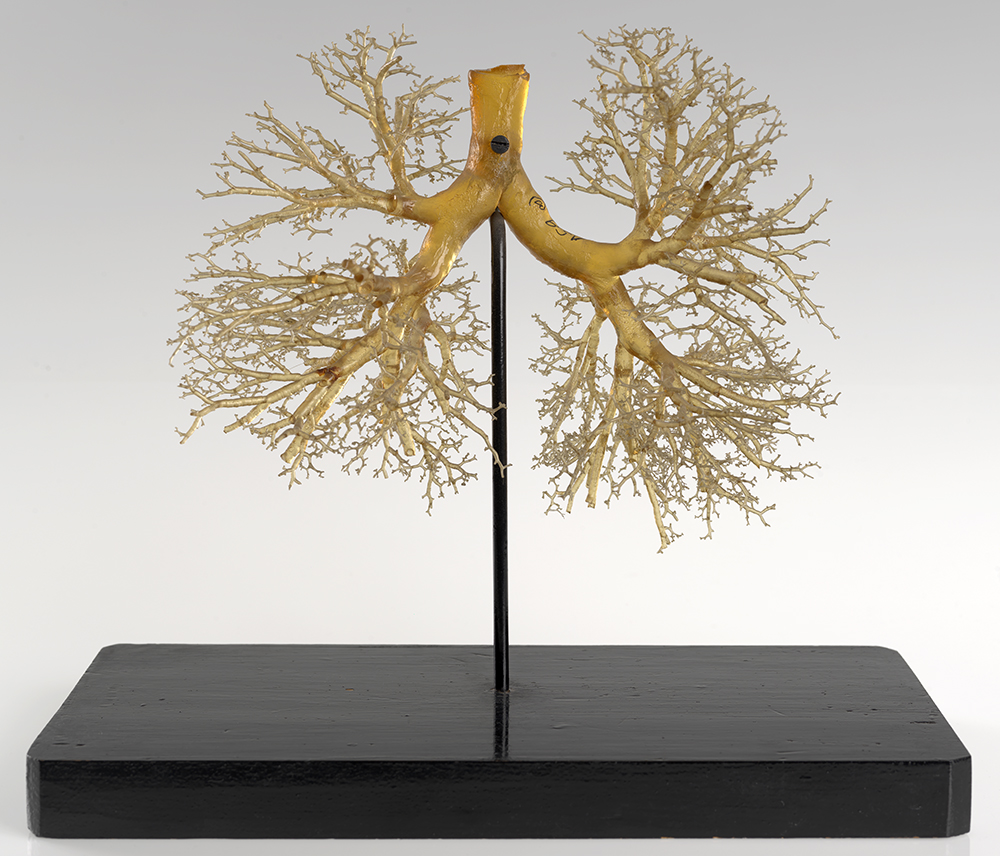
Mounted resin cast of lungs
Visual Dissection – The Art of Anatomy opens in the University of Edinburgh Main library gallery on the ground floor on 4th December and runs until 5th March 2016, it is open Monday – Saturday from 10am to 5pm and admission is free.
Trial access to Voxgov
Studying American politics? Finding it hard to search for and locate the swathes of information being published by the US Federal Government? Voxgov may be for you.
The Library has set up trial access to Voxgov, a distinctive resource that pulls together the vast amount of US Federal Government information, communications and publications and allows you to easily search, discover, compare and get full text access to this material.
You can access Voxgov from the E-resources trials page on the Library website (or direct at https://www.voxgov.com). On-campus access is direct. For off-campus access you will need to use the VPN.

1,000 Science and Engineering PhD theses added to ERA
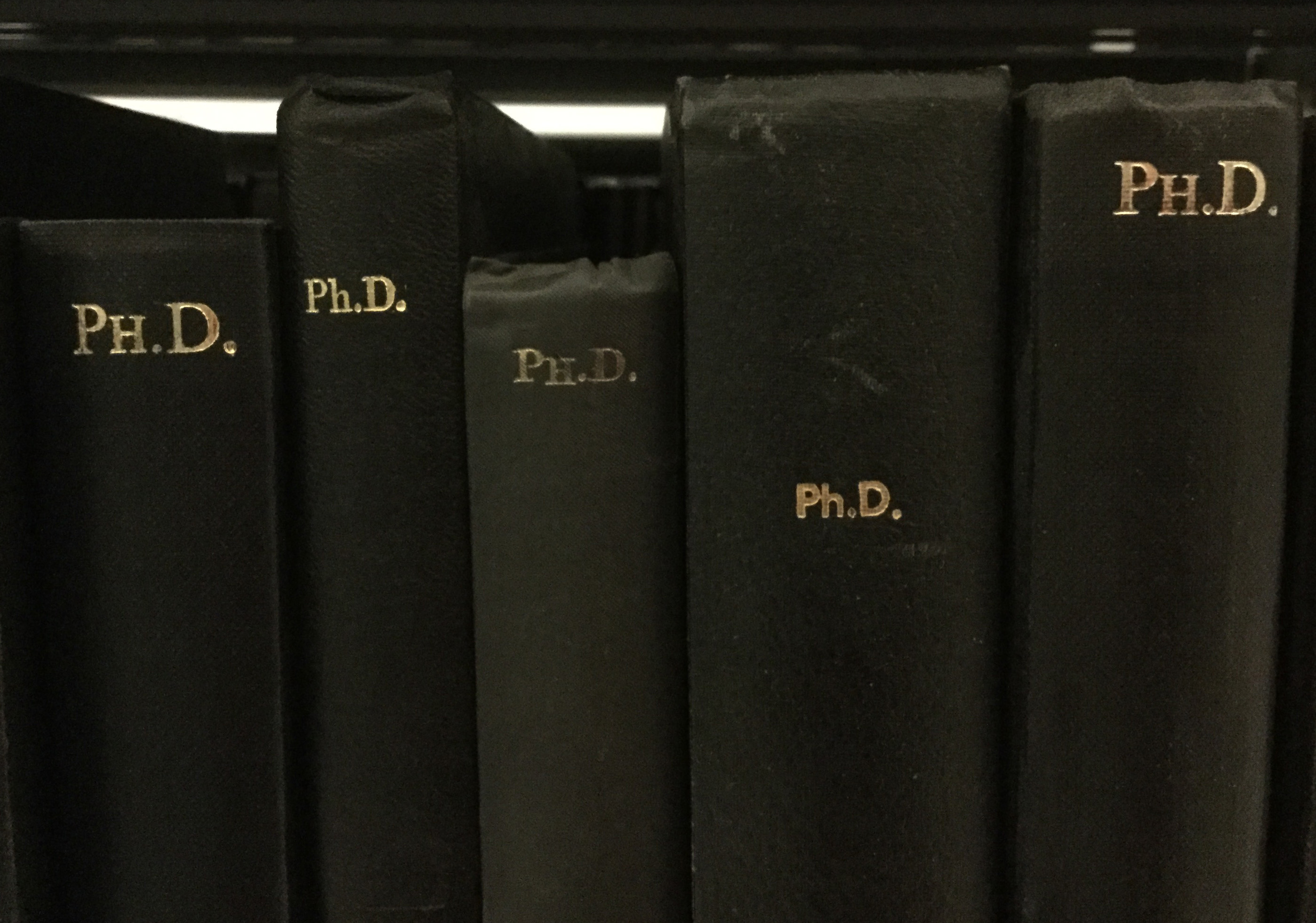
In the Library’s largest ever one-off digitisation project, L&UC have been working with RedRock, a scanning company and member of the supported business framework, to digitise and make available on-line over 5,000 University of Edinburgh Science and Engineering PhD theses.
We are delighted to announce that the first 1,000 theses are now available on ERA, the Library’s digital repository, at:
This incredibly diverse collection, dating from the early 1900s to the present day, contains unique works on almost every subject in the science and engineering field: some highlights include early work on DNA, analysis of E-coli and Salmonella and a study of the impact of electrification in the developing world.
The project, which involves the scanning of over 1 million pages, will double the number of fully-searchable Edinburgh theses available on-line and open up a vast collection of material which had previously only been accessible from the King’s Buildings’ library store. Over the coming weeks we will continue to upload more theses and intend to have the full collection of 5,000 available by the end of 2015.
Please contact Gavin Willshaw (gavin.willshaw@ed.ac.uk), Digital Curator, Library and University Collections, if you would like more information.
Collections
 Love, Loss, and Literature: Cataloguing the Papers of Irene Jessie Young
My name is Nancy Britten, and I’m in my fourth year of studying History at...
Hill and Adamson Collection: an insight into Edinburgh’s past
My name is Phoebe Kirkland, I am an MSc East Asian Studies student, and for...
Love, Loss, and Literature: Cataloguing the Papers of Irene Jessie Young
My name is Nancy Britten, and I’m in my fourth year of studying History at...
Hill and Adamson Collection: an insight into Edinburgh’s past
My name is Phoebe Kirkland, I am an MSc East Asian Studies student, and for...

Projects
Cataloguing the private papers of Archibald Hunter Campbell: A Journey Through Correspondence
My name is Pauline Vincent, I am a student in my last year of a...
Archival Provenance Research Project: Lishan’s Experience
Presentation My name is Lishan Zou, I am a fourth year History and Politics student....