Home University of Edinburgh Library Essentials
October 5, 2026
E-Resource Trials – last chance to try out
The following e-resource trials end on Monday. These can all be accessed from the e-resources trial page where links to trial feedback forms can also be found.
 Voxgov – a distinctive resource that pulls together the vast amount of US Federal Government information, communications and publications and allows you to easily search, discover, compare and get full text access to this material. Content includes official releases, congressional documents, legislation, federal register and social media. Coverage is from 2005 onwards although older material is being added as it is digitised by the US Federal Government.
 Theatre in Video: Volume II brings together classic and contemporary plays and documentaries. With a greater focus on contemporary and international productions, Theater in Video: Volume II offers a simple way for libraries to acquire highly valued and often difficult-to-find performances. Users can view the works of widely studied playwrights and theatre artists from around the globe, including many new performances from Shakespeare’s Globe Theatre collection (Opus Arte), Theatre Arts Films, the BBC, and TMW Media Group
 The Cecil Papers – a collection of documents, principally from the reigns of Elizabethan I and James I/VI, privately held by the Gascoyne-Cecil family at Hatfield House in Hertfordshire. The Cecil Papers contain nearly 30,000 documents gathered by William Cecil (1521-98), Lord Burghley and his son Robert Cecil (1563-1612), First Earl of Salisbury. Occupying some of the highest offices of state in the land (both men were Secretary of State to Elizabeth I and Robert Cecil also served her successor, James), these two men were at the heart of events during one of the most dynamic periods in Western history.
 Colonial State Papers – This growing collection offers insight into the colonial history of North America and the West Indies. It includes the National Archives collection CO 1– papers that were presented to the Privy Council and the Board of Trade during 1574-1757. More than 7,000 hand-written documents and more than 45,000 bibliographic records give fascinating insight into British trade, history and overseas expansion between the 16th and 18th centuries.
 Nineteenth Century Collections Online (NCCO) – A ground-breaking resource for 19th century studies, NCCO is a multi-year global digitization and publishing program focused on primary source collections of the long nineteenth century. Collections for this program are sourced through partnerships with major world libraries as well as specialist libraries, and content includes monographs, newspapers, pamphlets, manuscripts, ephemera, maps, statistics, and more.
Cambridge Companions Online
 We have access to all Cambridge Companions Online as they are published. A further 20 new titles in the subject areas of literature and history of ideas have been added to DiscoverED. See the list of new titles here.
June Baker Trust – Emerging Conservator Grant
In this week’s blog post, we hear from Project Conservator, Emily Hick, who recently carried out a self-led continuing professional development project at the CRC, which was funded by the June Baker Trust Grants for Emerging Conservators….
The June Baker Trust was set up in 1990 to promote and encourage the development and study of the conservation of either historical or artistic artefacts in Scotland. Since that time the scheme has awarded more than £25,000 in grants to Scottish conservators for continuous professional development.
The success of these awards led the trustees to develop a new strand of funding for emerging conservators, which has been made possible this year thanks to the generosity of the Gordon Fraser Charitable Trust.
In May 2015, three newly qualified conservators based in Scotland, received awards of up to £1000 each from the June Baker Trust to carry out a project of their own design, and I was lucky enough to be one of them.
My project focused on developing my skills of carrying out surveys for conservation work. I chose to focus on this area after analysing my CV and finding that this was an area of weakness. It is difficult to gain these types of skills as an emerging conservator as often a project has been scoped out before a position starts. If mistakes are made while surveying a collection, and incorrect time and material estimates are given, it can result in going over budget and over time. So these are vital skills to develop.
The project lasted four weeks in total, and I began by spending a day at Royal Commission of Historic and Ancient Monuments in Scotland (RCHAMS). During this time they were carrying out a survey of their whole collection prior to a merger with Historic Scotland. Due to the limited time available, they had developed a very basic survey to gain condition and current housing data. I helped carry out this survey and was also shown a previous, more detailed survey of the whole collection that had been carried out 5 years beforehand, as well as several other types of surveys they had done in the past.
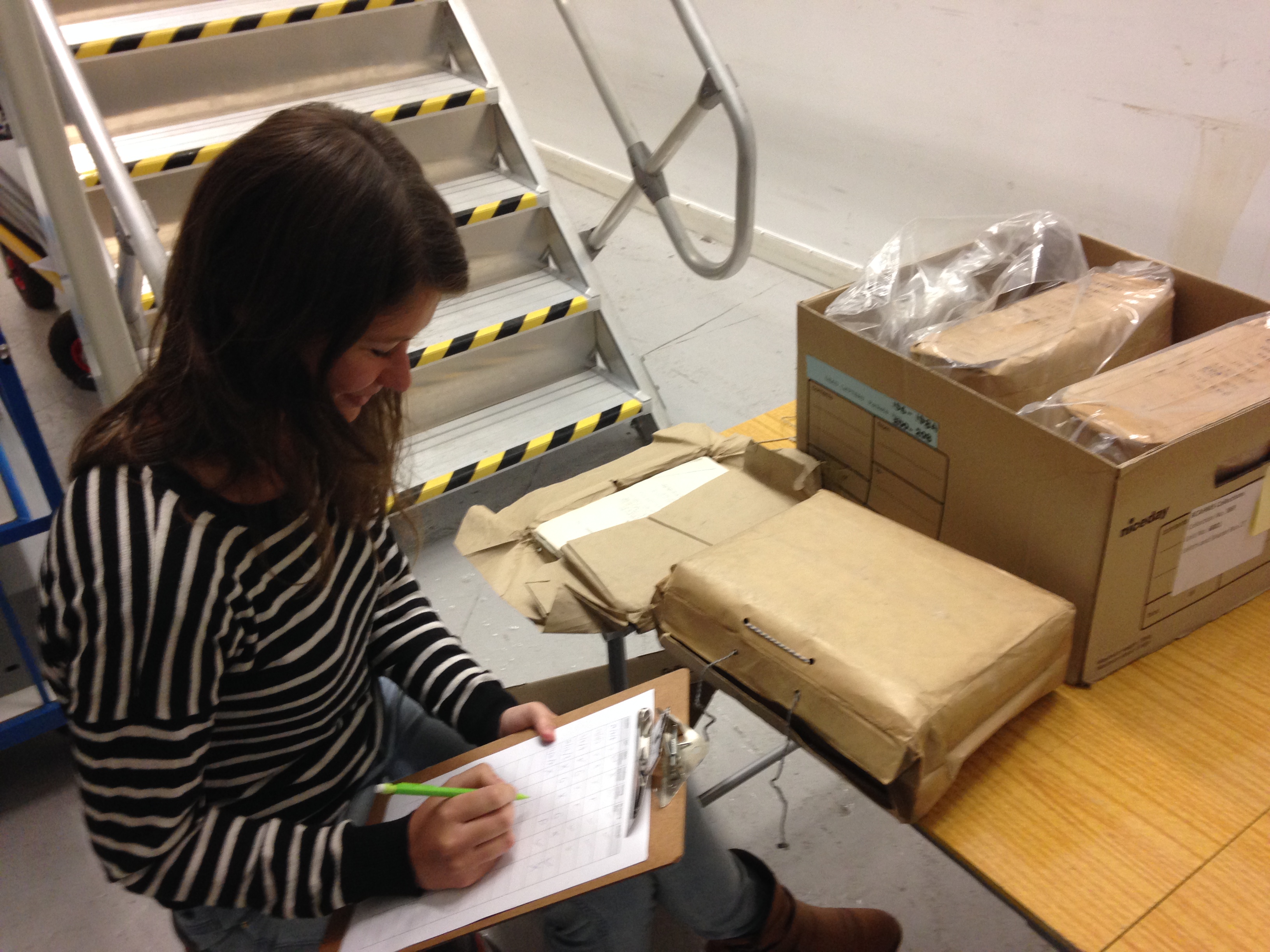
Surveying the Collections at RCAHMS
I also spent two days at the National Library of Scotland (NLS). Here I was shown several surveys in a range of styles; A Preservation Assessment Survey (PAS) of the whole collection using a random sampling method, an item by item survey of the photographic collection, and a basic survey of bound volumes prior to digitisation. The conservators talked about how they change the criteria of the survey depending on how the results would be used, rather than having a ‘one size fits all’ approach, and gave useful tips about what types of questions to include. I also helped to carry out a survey of a collection of printed ballads. I was also shown how to create a Microsoft Access Database to make my own survey form.
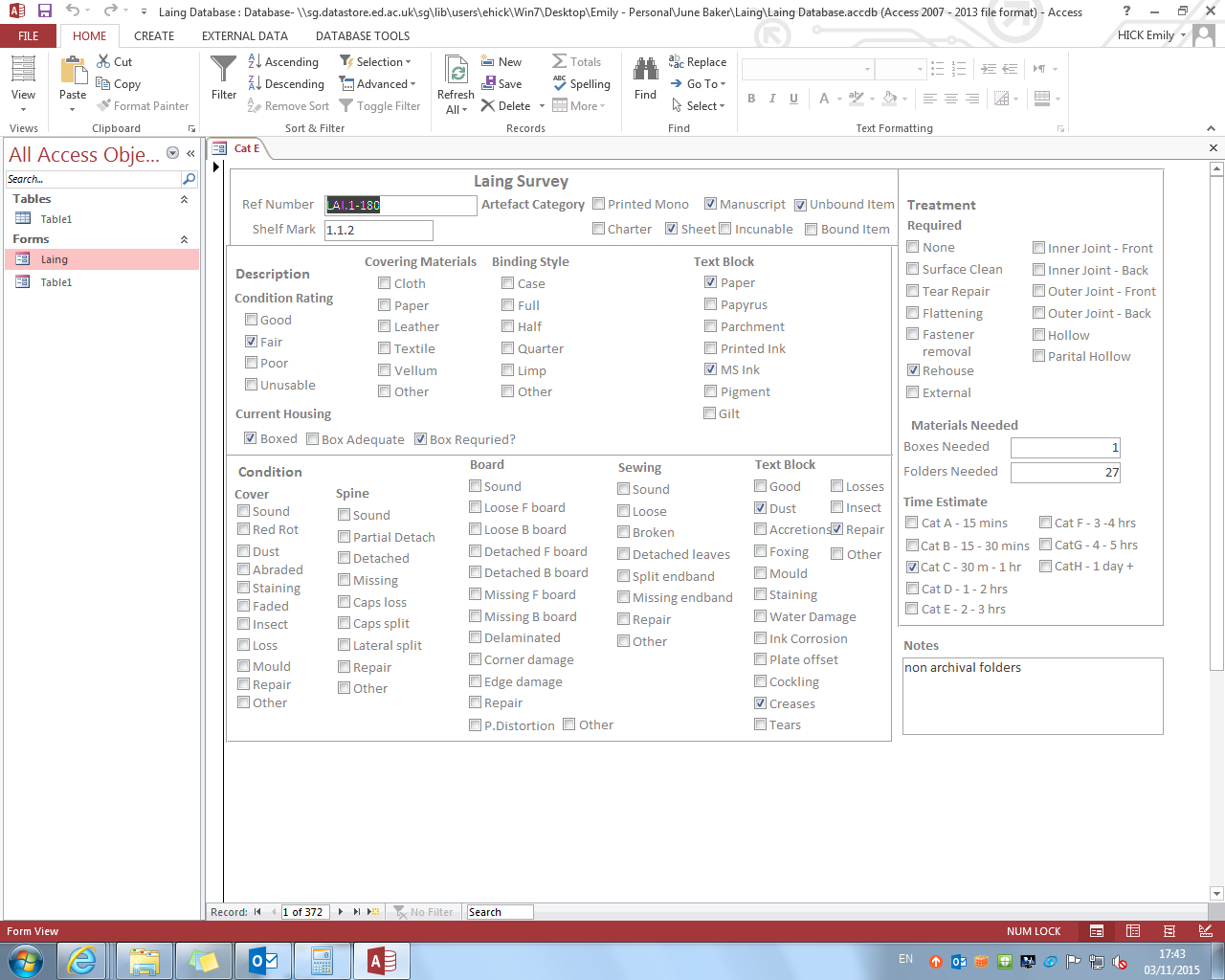
Screenshot of Microsoft Access Database
Following this, I then spent two days carrying out research on survey methods, spending time at Edinburgh University Library and at the National Library Scotland. I also took a day to create two surveys databases on Microsoft Access Database for use in carrying out two collection reviews at the CRC.
At the CRC, I carried out three surveys in total; an item by item survey of the Oriental Manuscripts collection (5 days), and a random sample survey of the Laing collection (5 days). Following this, I spent two days writing up reports which included information on the condition of the collections, recommendations for future work, materials needed and time estimates. I also spent two days carrying out a brief survey on the use of space in the store rooms, suggesting how items could be repackaged to make more efficient use of the shelving.
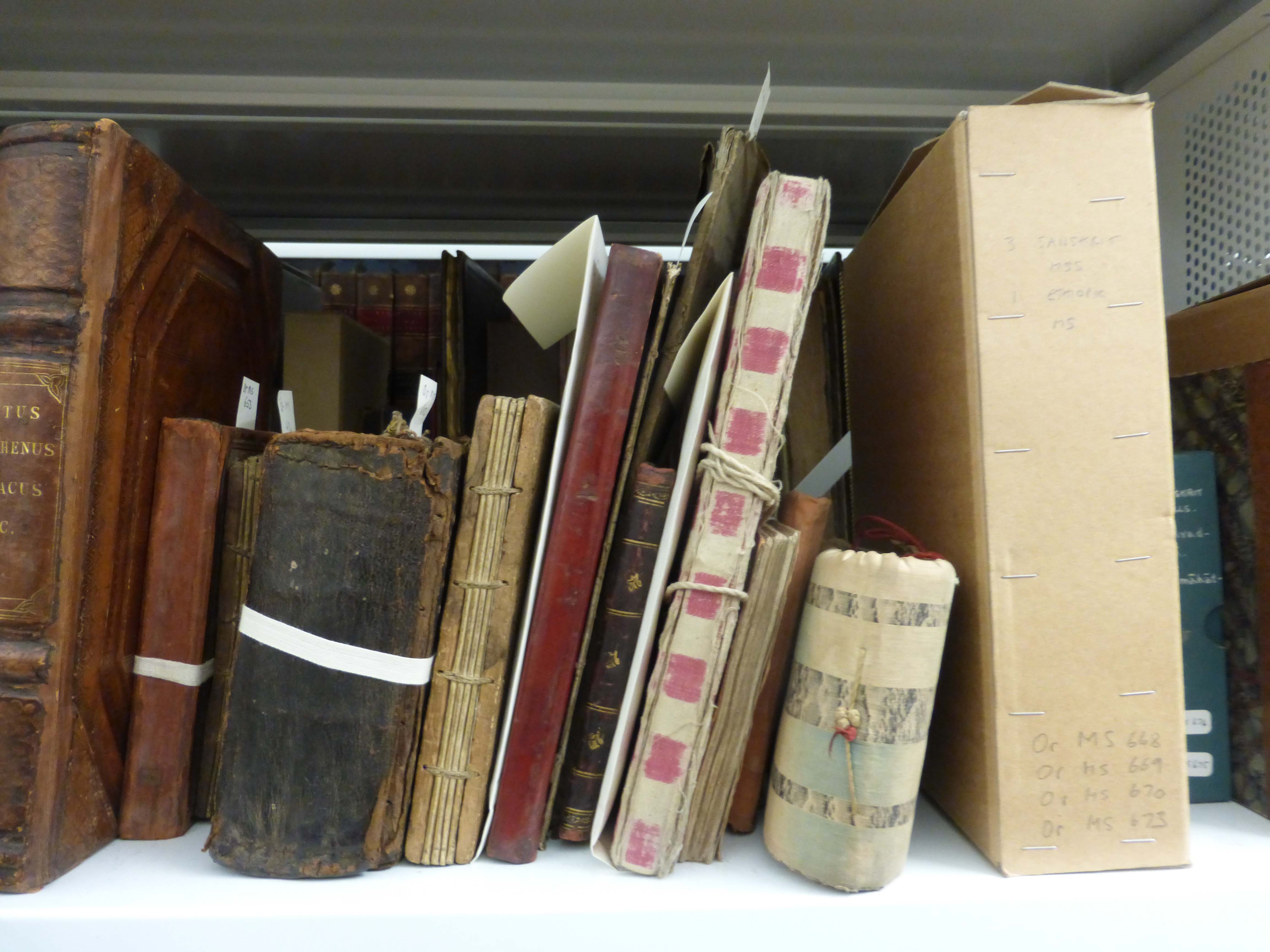
Oriental Manuscript Collection on the Shelves at the CRC
This project has been hugely beneficial to me and helped me gain surveying skills which are frequently asked for in more senior conservation job descriptions. I hope that the reports will also be useful to the CRC and inform future funding bids.
Emily Hick, Project Conservator
Institutionally Authored Books
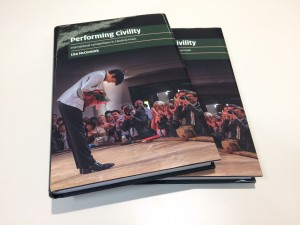 The Scholarly Communications Team estimates that staff at the University of Edinburgh write, edit or contribute to over 500 books annually and the Library aspires to hold two copies of each of these books (one for general loan, one for preservation). In light of this aspiration, Edinburgh University Library has developed a policy relating to the acquisition of institutionally authored books, which encourages staff to donate two copies to the library, wherever this is possible.
Today we received our first donations under this policy, Performing Civility by Dr Lisa McCormick. Lisa generously sent two copies to the Scholarly Communications Team, which has checked that there is a record of the research output on PURE. The print copies have now been sent for cataloguing and should be available very shortly.
Congratulations to Lisa, firstly on her publication and secondly for being the first to donate copies of books under this new policy!
Dominic Tate, Scholarly Communications Manager.
Foreign Office Files for China 1919-1948 & China: Culture and Society
The Library has arranged further database trials for Chinese Studies.To access these trials, please go to the Library’s e-resources trials page and scroll down to find these entries.
Foreign Office Files for China 1919-1948
 Foreign Office Files for China provides access to the digitised archive of British Foreign Office files dealing with China, Hong Kong and Taiwan between 1919 and 1980. The complete files consist of six parts. We have purchased full content for the three parts covering 1949-1956. Files between 1919 and 1948 are now under trial which cover the following parts: 1919-1929: Kuomintang, CCP and the Third International; 1930-1937: The Long March, civil war in China and the Manchurian Crisis; and 1938-1948: Open Door, Japanese war and the seeds of communist victory. The formerly restricted British government documents include diplomatic dispatches, letters, newspaper cuttings, maps, reports of court cases, biographies of leading personalities, summaries of events and other diverse materials.
Trial ends 16/12/2015
China: Culture and Society
 Spanning three centuries (c. 1750-1929), this resource makes available for the first time extremely rare pamphlets from Cornell University Library’s Charles W. Wason Collection on East Asia, one of the oldest and most distinctive collections of its kind and a very rich source for research on China for teachers and students from undergraduate-level to research-level and beyond. Digitised in its entirety and in full colour, the Wason collection of c. 1,200 pamphlets encompasses speeches, guides, reports, essays, catalogues, magazine articles and other material addressing Chinese history, culture, and everyday life. The resource is full-text searchable, allowing for the collection to be comprehensively explored and studied. The wide variety of research interests and themes covered by the pamphlets include education, emigration, the foreign presence, missionaries, wars, rebellion, reform, opium, healthcare and language. *Please note that PDF download options are not available during trials.
Trial ends 17/12/2015
It’s all Greek to me!
Hello, my name is Katharine – I’m the new Intern with the Conservation department at the Centre for Research Collections. Having spent the last four years working in collections care in historic houses, I was keen to branch out and experience a different working environment in conservation. I’m thrilled to have been given this opportunity to work with the research collections at Edinburgh University. It has been interesting to learn about the challenges of managing a working research collection and the conservation issues that come with it.
I’m working with Project Conservator, Emily Hick, for 10 weeks, to conserve and rehouse a collection of Greek books owned by John Stuart Blackie, Professor of Greek at Edinburgh University from 1852 to 1882. The collection was largely in poor condition; most of the books were very dusty and had suffered some degree physical damage from years of use and exposure. In this state, many of the books were unable to be used by researchers without suffering further damage. The aim of this project is to stabilise and protect the collection and thus making it accessible to researchers.
The first step of the project was to surface clean the collection. To save time only the edges of the text block and end papers of the books were cleaned, as these are typically the areas where most dust accumulates on books. I started by removing loose surface dirt using a vacuum cleaner with on low suction setting and a soft brush attachment. I then removed the ingrained surface dirt using smoke sponge.
 An example of a dusty book before surface cleaning
As I finished cleaning each shelf of books Emily started the interventive conservation treatments, which has included consolidation of red rot, and re-attaching loose boards and spines.
Once the books have received their treatment rehousing can begin. Each book is to be given its own made-to-measure enclosure made of acid-free box board. The book enclosures are a relatively simple design. The box board is cut to fit the book’s shape as closely as possible, folded together and fastened with cotton archival tape. By using this design we avoid using adhesives which release potentially harmful gases that may damage the books.
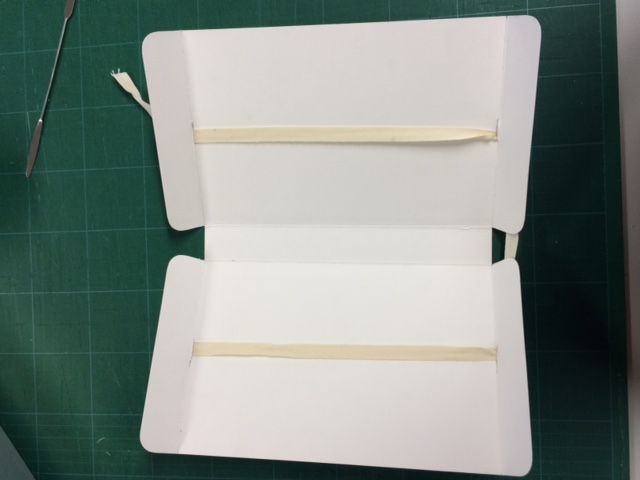
 Finished book enclosure
The enclosures will protect the books from physical damage caused be handling, and in addition will act as a barrier against dust and the environment while the books are in storage.
 Books looking happy in their new enclosures
Keep an eye out for future posts about this project over the next couple of months!
Look, there’s a libretto in the library!
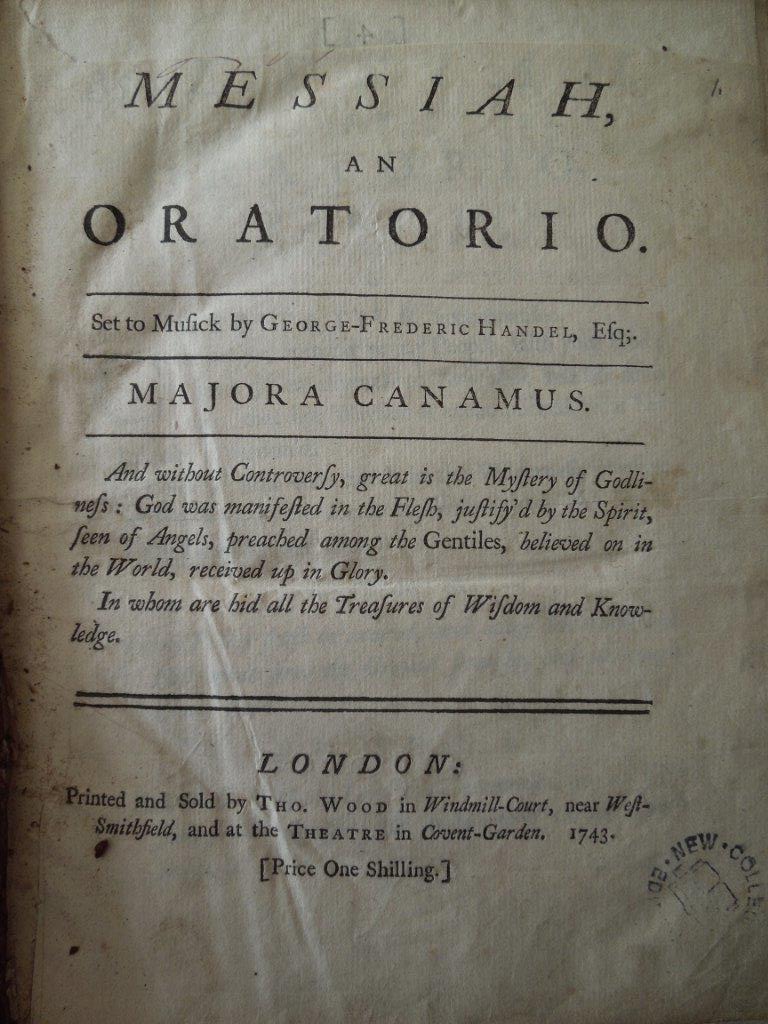
Handel, George. Messiah : an Oratorio.
New College Library O.b.2/1
It’s not every day that you find a rare edition of Handel’s Messiah in your library but I’m delighted to say that we have one at New College Library! This recently catalogued pamphlet from our Special Collections appears to be the first printing in England, and second edition overall of the libretto of Handel’s Messiah (The first edition was in Dublin.) It is also the first edition printed in England by six years. According to Elizabeth Lawrence, EUL Assistant Rare Books Librarian, “The oratorio was first performed in Dublin in 1742, and then again in London in March 1743. The publication we have, the libretto, known as the ‘word book’, was published to sell at the theatre, so the audience had half an idea what was going on. There are no copies of this edition currently on ESTC.”
Cambridge University Press E-Book Additions – November

A further 306 e-books published by Cambridge University Press have been added to DiscoverEd. Subject areas cover most disciplines. See the list here – tab 1 contains the monographs and tab 2 contains the course books.
Further info
Further information about our e-books is available from http://www.ed.ac.uk/information-services/library-museum-gallery/finding-resources/ebooks
If a book you require is not held by the library, please visit our Library Resources Plus webpage.
E-Resources Access Alert – EZProxy issues
There are currently intermittent access problems to e-resources via EZProxy links which are being investigated by our IT team.
Eg http://www.ezproxy.is.ed.ac.uk/login?url=http://www.oxfordscholarship.com/oso/public/ may not work but if you drop the “http://www.ezproxy.is.ed.ac.uk/login?url=” portion e.g. http://www.oxfordscholarship.com/oso/public the link will work.
Please see http://edin.ac/1bjVuCC for details of how to access E-Resources during this time, especially if off campus.
Further updates may also appear on the IS Alerts page http://reports.is.ed.ac.uk/alerts/.
We apologise for any inconvenience during this time.
Opening Doors with Bluetooth Beacons
Location-based intelligence is a growing area of importance in the academic library environment (as identified in the most recent NMC Horizon Report) and we’ve been exploring how Bluetooth beacons can be used to deliver information and content to users based on their location in the library space.
Earlier this year we used the technology with Google Glass to create an immersive visitor experience as part of the Something Blue exhibition: beacons were placed next to several exhibits in the gallery space and when users came within proximity, a video was activated on the Glass headset.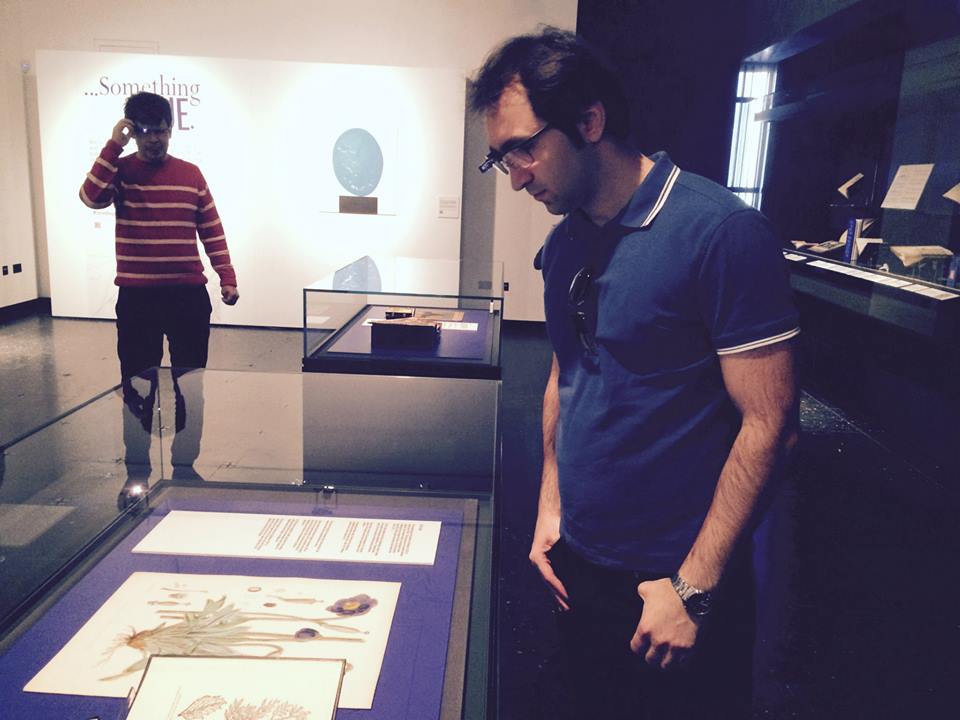
More recently, we’ve started to explore ways in which beacons can be used to provide tours of the library building itself. There are several potential use cases for this, such as a tour for new undergraduates showing them where key services are located, or a tour of the paintings on display in the main library for art enthusiasts, but we decided to create a tour of the building for the general public in order to tie in with Doors Open Day 2015. Our library was designed by the British architect Sir Basil Spence and A-listed in 2006: its history is of real interest to our visitors.
Working with colleagues from across Information Services, we developed a tour app (available from the Apple App Store and Google Play) which uses beacons to tell the story of the library building and service. Beacons were set up at seven locations and users who had installed the app on their phone were sent a notification whenever they came into proximity of one – tapping the notification provided the user with a short, 1-2 minute long, video about the area they were in, such as this general introduction to the building:
We had originally hoped to use beacons to create a form of ‘internal GPS’ to show the user their location in the library space (much like the blue ‘you are here’ dot on Google Maps) but we found that their inaccuracy over three metres made it impossible to trilaterate location accurately enough.
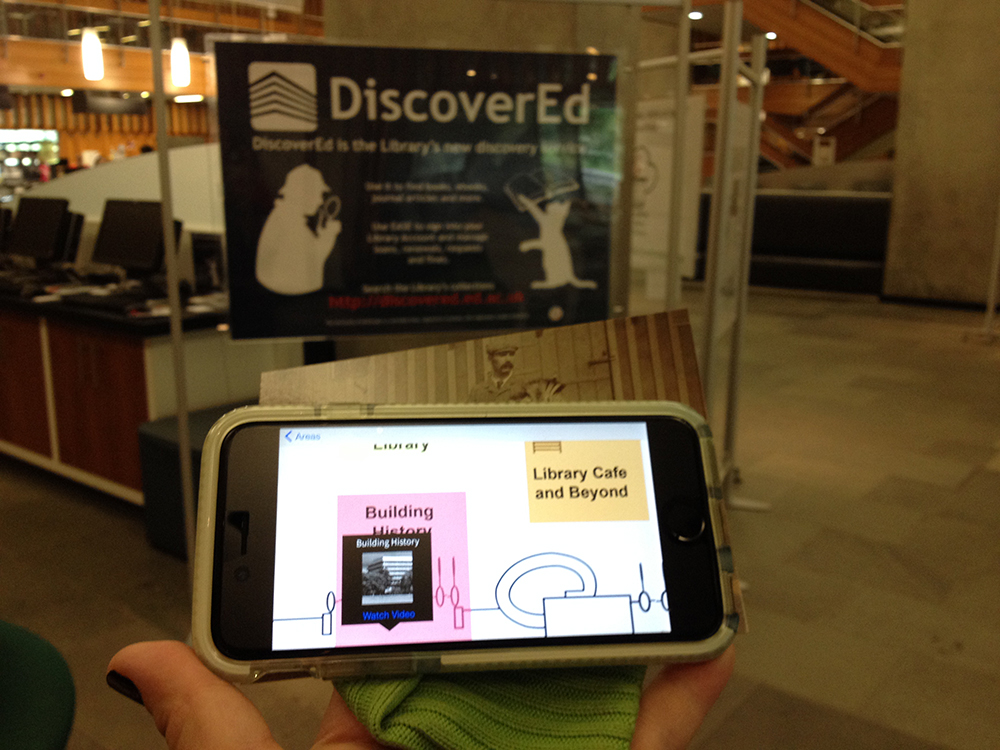
Around 45 people downloaded the tour over the weekend and the feedback was extremely positive. We learned some important lessons from this application, which will inform future uses of technology in this way.
- Have a backup content delivery mechanism: make sure the content can be accessed manually through the app if the beacons don’t work. This also allows visitors to access the videos once they have left the building.
- Have staff on hand to help people download the app: many visitors needed assistance to access the Wi-Fi network and download the app from the relevant online store.
- Make sure Wi-Fi is available: provide Wi-Fi so that visitors don’t need to use their data connection to download the app, particularly as apps can be quite large (our app was 50MB). We set up a Wi-Fi hotspot for people who didn’t have access to the network.
- Provide some basic signage in the physical space: let people know when they are in a beacon zone and provide QR codes linking to the app stores in order to assist with the download.
- Bluetooth: make sure users switch it on!
- The content is more important than the medium: we got good feedback for our experiment but, ultimately, a beacon is just a delivery mechanism and it was crucial that we provided high quality content. It took in the region of 50 staff hours to create seven two-minute videos.
- Having to download an app is a huge barrier: the need to download an app prevented many visitors from engaging with the tour.
We’re continuing to explore the use of beacons in the library space and recently secured funding to see how Google’s new Eddystone beacon can be used to provide information and updates to library users throughout the building. We are especially keen on exploring the potential for Eddystone to bypass the need to download an app and will blog more as the project progresses!
Gavin Willshaw (Library & University Collections) , Ben Butchart (Edina), Sandy Buchanan (Edina), Claire Knowles (Library & University Collections)
Collections
 Love, Loss, and Literature: Cataloguing the Papers of Irene Jessie Young
My name is Nancy Britten, and I’m in my fourth year of studying History at...
Hill and Adamson Collection: an insight into Edinburgh’s past
My name is Phoebe Kirkland, I am an MSc East Asian Studies student, and for...
Love, Loss, and Literature: Cataloguing the Papers of Irene Jessie Young
My name is Nancy Britten, and I’m in my fourth year of studying History at...
Hill and Adamson Collection: an insight into Edinburgh’s past
My name is Phoebe Kirkland, I am an MSc East Asian Studies student, and for...
Projects
Cataloguing the private papers of Archibald Hunter Campbell: A Journey Through Correspondence
My name is Pauline Vincent, I am a student in my last year of a...
Archival Provenance Research Project: Lishan’s Experience
Presentation My name is Lishan Zou, I am a fourth year History and Politics student....