Home University of Edinburgh Library Essentials
May 8, 2026
Stuck with your dissertation literature search? Try this.
 Are you stuck with the literature search for your dissertation? Not finding as much on your topic as you hoped? Here are five suggestions to help you move forward. Read More
Africa Wide Information – database trial
 The Library has set up trial access to Africa Wide Information (Ebsco) until 30th June.
Africa-Wide Information comprises an aggregation of 50 databases sourced from Africa, Europe and North America. Africa-Wide provides comprehensive, multidisciplinary information which documents research and publications by Africans and about Africa.
Africa-Wide covers close to 4 million news articles, scholarly publications articles, books, reports, theses, citations, and grey literature. Records include article abstracts and some full text with keyword indexing to enhance relevant retrieval. The coverage is comprehensive from the 18th century to current and dates back to the 16th century. Africa-Wide Information is an essential resource for those with an interest in African research and publications and for those doing research in an African context, no matter the subject field.
See the full list of databases included in this trial along with their descriptions at http://www.nisc.co.za/products/22/databases/africa-wide-information
This trial is listed in DiscoverEd and the E-Resources Trial Webpage where links to trial feedback forms can be found.
On trial: ImageQuest
The Library has trial access – until the end of June – to ImageQuest, a unique collection of over 3,000,000 rights-cleared images from 59 of the world’s image houses.
New resource : Migration to New Worlds

The University of Edinburgh now has access to the online primary source collection, Migration to New Worlds, due to negotiations with JISC to provide free access to all UK higher and further education institutions.
Migration to New Worlds provides an in-depth look at the emigration of peoples from Great Britain, mainland Europe and Asia to the New World and Australasia in the nineteenth and twentieth centuries. It includes Colonial Office files on emigration, diaries and travel journals, ship logs and plans, printed literature, objects, watercolours, and oral histories. A migration mapping feature allows you to explore immigration and emigration of the United States, Australia, Canada and New Zealand over time.
Access via Discovered.
Christine Love-Rodgers – Academic Support Librarian, SPS
Main Library Study Spaces project blog goes live
During summer 2016 358 additional study spaces will be created in the Main Library.
This blog will be updated weekly with information about what is happening in the building. We will let you know which areas of the Main Library will be unavailable or potentially noisy.
Check out the overview page to find out what will be happening and when.
If you have a specific question about the changes in the Main Library go to the FAQs page or contact us.
Trials ending soon
Last chance to try out the following e-resources and make purchase recommendations. All can be accessed from the E-Resources Trial webpage:
 Journal of Medical Insight (JoMI) – on trial until 27th May
JoMI is surgical video journal providing cutting edge techniques and education for medical professionals via high quality video and animations. JoMI films orthopedic surgery, trauma surgery, general surgery, and other surgeries at Massachusetts General Hospital, Brigham and Women’s Hospital, Tufts Medical Center, Boston Medical Center, among other top hospitals.
 Building Types Online – on trial until 31st May
Large international collection of contemporary buildings, from housing and offices to museums, schools and other building types. Focus on floor plans and sectional drawings in unrivalled quality. A large part of the drawings are vector-based. The case studies combine an in-depth analytical description with high-quality drawings. In addition to that, there are thematic articles that provide coherent background information on the key design issues for each building type. Elaborate Search and Browse functions allow for all kinds of user-specific research, based on a systematically structured approach to building typology that was developed by the editor of this database, Professor Oliver Heckmann of Singapore University of Technology and Design, an expert on housing. The database will be updated yearly with new examples and additional building types.
 ClinicalKey – on trial until 31st May
ClinicalKey is a clinical search engine that helps health professionals make better decisions anywhere, anytime, in any patient scenario. ClinicalKey’s Smart Search saves time by preventing unnecessary extra searches. ClinicalKey allows you to access the latest (indexed daily), most evidence-based answers in every medical and surgical speciality and contains the fulltext of Elsevier e-journals, e-books as well as videos, images and guidelines. More info at the following blog post.
 The Literary Encyclopedia – on trial until 31st May
The Literary Encyclopedia publishes biographies of major and minor writers; scholarly descriptions of all interesting texts written by these authors, including those often neglected; and a variety of descriptive and critical essays on literary, cultural and historical matters, which provide a finer understanding of the social contexts in which this writing was produced. Includes coverage of English, American, German, Russian, Italian, French and Classical literatures, as well as substantial and increasing coverage of Hispanic, Japanese, Canadian, East European and various postcolonial literatures. (Other major literatures to be added as resources permit.) Currently has about 7557 completed articles, with a total of about 15.77 million words with around 20-40 articles added to the Encyclopedia every month. More info at the following blog post.
Further info
If you would like to recommend a resource for trial/purchase, please fill out a trial request form – http://www.ed.ac.uk/information-services/library-museum-gallery/finding-resources/library-databases/e-resources-trials/e-resource-trial-request
A Lengthy Challenge: Photographing the Mahabharata

Recently I was asked to scope the digitisation of a beautiful scroll we have in our collection, Or.Ms 510, or better known as the Mahabharata. Gemma Scott, our former Digital Library intern, says that:
‘the Mahabharata tells the tale of a dynastic struggle between two sets of cousins for control of the Bharata kingdom in central India. One of the longest poems ever written, eclipsed only by the Gesar Epic of Tibet, it is said to have been composed between 900 and 400BCE by the sage Vyasa, although, in reality, it is likely to have been created by a number of individuals. To Hindus, it is important in terms of both dharma (moral law) and history (itihasa), as its themes are often didactic.’
Our scroll dates to 1795 and came to Edinburgh University in 1821 when it was donated by Colonel Walker of Bowland. It is 13.5cm wide and a staggering 72m long, housed in a wooden case, wound around rollers and turned by a key in the side. It has 78 miniatures of varying sizes and is elaborately decorated in gold, with floral patterning in the late Mughul or Kangra style. The text itself is dense, tiny, and underpinned with yet more gold leaf decorations.
Staff Scholarship Scheme funds Digital Preservation course
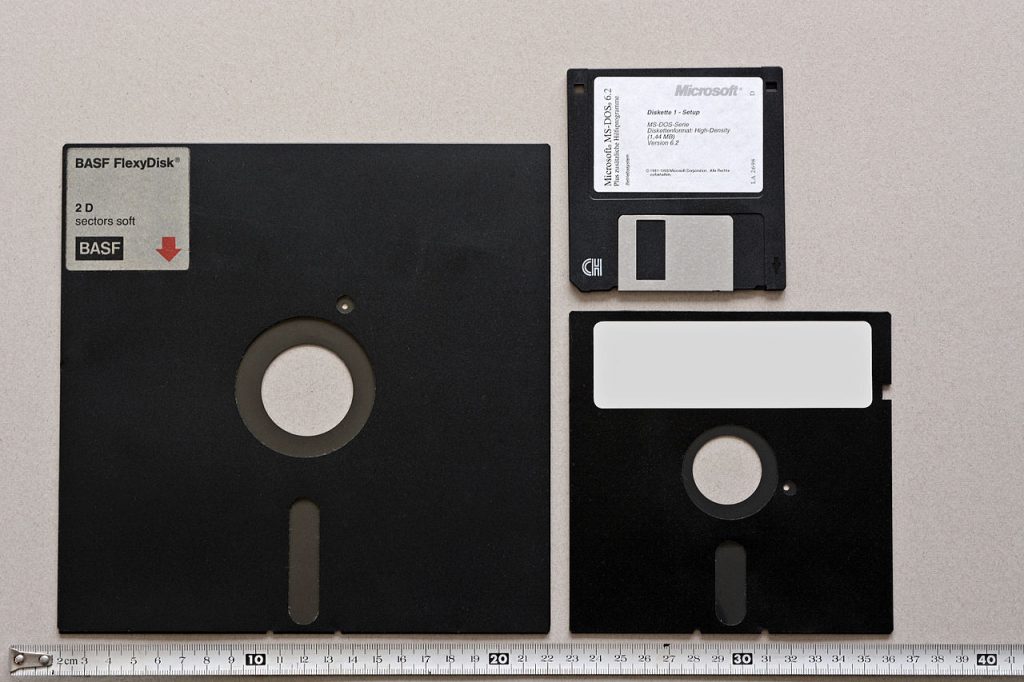
Three generations of floppy disk. By Hubert Berberich (HubiB) – Own work, Public Domain, https://commons.wikimedia.org/w/index.php?curid=27217977
Last year I completed the Centre for Archive and Information Studies (CAIS) course on the Management and Preservation of Digital Records. The module, which is one of several Masters-level CPD courses available, was fully funded by the University of Edinburgh’s staff scholarship scheme and offers a detailed overview of the diverse and challenging area of Digital Preservation.
As the Digital Curator at the University Library, it’s important that I have a broad and in-depth understanding of the issues surrounding the long-term preservation of digital material: if we are to digitise and make available our unique heritage collections, it is vital that they are stored securely. The Centre for Research Collections’ project to develop a Digital Strong Room, which adheres to international standards and uses open source solutions, will provide the University with a platform for the long-term preservation of its important digital cultural collections.
I had already completed the three-day Digital Preservation Training Programme run by the University of London Computer Centre (as-well as their one-day Web Archiving 101 workshop), but I felt it was important to undertake a formal qualification in this area in order to study it in more depth. The staff scholarship scheme usually only funds course offered by the University of Edinburgh but, because Edinburgh doesn’t currently offer a postgraduate module in Digital Preservation, I was able to apply to CAIS.
The course was a four-month distance-learning module, which I took alongside a cohort of students who were completing a full Master’s level course at the Centre. Each week we were provided with reading in a different area of Digital Preservation and we were assessed through four short tasks during the course and two longer written pieces at the end. I found this style of assessment really useful, particularly as Digital Preservation is very much a ‘building block’ field which requires mastery of one area before it is possible to move onto the next. I also found the types of task varied and interesting, and they each tested different skills and areas of knowledge. While one task required writing a short discussion piece about the authenticity of digital records compared to physical, another required using the PREMIS Data Dictionary to fill out a preservation metadata record for a digital object of our choosing (I chose this, from the Album Amicorum: http://images.is.ed.ac.uk/luna/servlet/s/24vvp6). One of the longer pieces required students to write a report analysing the training needs of an institution to enable them to deal with the challenges of Digital Preservation; this task really got me thinking about the wide range of skills required for an organisation to manage its digital collections effectively.
Overall, the course was comprehensive and went into a good level of detail about the different areas of Digital Preservation. It started with a brief introduction to key computer science concepts and terms, compared digital and analogue archiving techniques and then reviewed the current state of Digital Preservation theory and practice. We then looked at metadata standards, including PREMIS for preservation metadata, studied how organisations can validate their Digital Preservation activity, and concluded with a look at the preservation of more complex digital materials, such as databases, emails and social media.
It was a well-designed course and covered a large amount of material in a short time. I found it very useful to build on my existing Digital Preservation knowledge and, because the field is quite jargon and acronym heavy, I would strongly recommend anyone taking a course such as this to do some serious background reading in advance, perhaps starting with Marilyn Deegan and Simon Tanner’s introductory work Digital Preservation.
Thank you to the staff scholarship for funding this qualification – see their website for more information about how to apply: http://www.ed.ac.uk/student-funding/staff
Gavin Willshaw, Digital Curator, Library & University Collections
New resource from Past Masters: The Collected Works of John Dewey, 1882-1953
The Library has purchased a further electronic resource from the Past Masters series in the shape of the collected works of the American philosopher, psychologist and educational reformer, John Dewey. Read More
Past Masters – Collected Works of Dewey 1882-1953 (2nd Release) now purchased

We have purchased The Collected Works of John Dewey, 1882-1953 within the Past Masters series.
It includes:
Dewey, John. The Early Works of John Dewey, 1882-1898. 5 vols. Carbondale and Edwardsville: Southern Illinois University Press, 1972.
The Middle Works of John Dewey, 1899-1924. 15 vols. Carbondale and Edwardsville: Southern Illinois University Press, 1978.
The Later Works of John Dewey, 1925-1953. 17 vols. Carbondale and Edwardsville: Southern Illinois University Press, 1985.
The Collected Works of John Dewey, 1882-1953. Supplementary Volume 1: 1884-1951. Carbondale and Edwardsville: Southern Illinois University Press, 2008
Access Past Masters via the Databases AZ list or DiscoverEd.
Further info
Past Masters trial content – we are also trialling the Stirling/South Carolina Research Edition of the Collected Works of James Hogg until 3rd June 2016. See the E-Resources trial page for access and other e-resources currently on trial.
Collections
 Hill and Adamson Collection: an insight into Edinburgh’s past
My name is Phoebe Kirkland, I am an MSc East Asian Studies student, and for...
Cataloguing the private papers of Archibald Hunter Campbell: A Journey Through Correspondence
My name is Pauline Vincent, I am a student in my last year of a...
Hill and Adamson Collection: an insight into Edinburgh’s past
My name is Phoebe Kirkland, I am an MSc East Asian Studies student, and for...
Cataloguing the private papers of Archibald Hunter Campbell: A Journey Through Correspondence
My name is Pauline Vincent, I am a student in my last year of a...
Projects
Cataloguing the private papers of Archibald Hunter Campbell: A Journey Through Correspondence
My name is Pauline Vincent, I am a student in my last year of a...
Archival Provenance Research Project: Lishan’s Experience
Presentation My name is Lishan Zou, I am a fourth year History and Politics student....