Home University of Edinburgh Library Essentials
March 25, 2026
New Conservation Internship at the CRC
This week’s blog is written by our new conservation Intern, Holly, who is working on a collections rationalisation project within the rare books department…
I am now beginning my third week as an Intern here at the conservation studio, and thought I would take the time to briefly introduce myself and the project.
I am a current student at the University, studying for an MSc in Book History and Material Culture. The opportunities provided through this degree since it’s commencement in September have allowed me to realise fully a long-held belief in the irreplaceable importance of cultural heritage, and I soon wanted to get involved and gain experience in the field of conservation. As such, I have been a volunteer in the conservation studio since January, and when the advert for this internship was brought to my attention, I jumped at the chance.

Holly working in the studio
New Look and Feel for DiscoverEd!
On Tuesday 4th July 2017 the Library rolled out a new look and feel for DiscoverEd, our online discovery service. This means there’s a new improved mobile responsive interface, so you can use DiscoverEd easily on a range of devices including tablets and phones. It is also now easier to navigate.
The core functionality of DiscoverEd has not changed. Users are still be able to search the same extensive range of resources, view online resources, access their account details, renew loans, place requests, pay fines and access the same range of functions offered by the previous version of DiscoverEd.
Search results are displayed as before, with options for refining them. However, the screen has greater readability across a range of devices, and easier access to useful functions:

What’s new?
Options for saving and exporting are now easily accessible from the list of search results:

The full details and links for each item on your results list are now conveniently displayed on a single page:

The My Account area has been enhanced and now provides a useful overview page, which allows you to review your account information at a glance:

e-Shelf has been replaced with My Favourites. When you are signed in to DiscoverEd you can easily add items to your saved records list in My Favourites by clicking the Pin icon.

You can organise your list of saved records in My Favourites by adding descriptive labels:

The Queries section in the old DiscoverEd, which allowed you to save queries and set up alerts, has been replaced by the SAVED SEARCHES section in My Favourites.
IMPORTANT: Please note that any saved queries you have in the old DiscoverEd ARE NOT be available in the new interface. Instead you will need to run these searches again in the new interface and then save each of them as a saved search in My Favourites.

2 and 3D Photography: Practice, Prophecies, and Beyond- Conference at the Rijksmuseum

Team DIU (well, half of it!) have been visiting the Rijksmuseum again for the biennial conference on 2 and 3D photography. 2 full days of speakers followed by another workshop day left us with lots to think about. This year’s conference built on the last, Robert Erdmann released the open source code for his amazing curtain viewer which can be tried out in the Bosh Project here http://boschproject.org/#/ . Malcolm is going to delve deeper in to Erdmann’s latest developments below. Otherwise 3D technology seems to be taking root, with debate over the level of quality and detail needed, and advances such as ‘videogrammetry’ and ‘unstructured light field renderings’ (see below) entering the fray.
Free access to optional contents of JapanKnowledge
The following contents will temporarily be accessible on the JapanKnowledge platform between 1 June and 30 June 2017:
1. Encyclopedia of Japanese Historical Place Names http://japanknowledge.com/en/contents/rekishi/index.html

2. Fuzoku Gaho http://japanknowledge.com/en/contents/fuzokugaho/index.html

3. Oriental Economist http://japanknowledge.com/en/contents/orientaleconomist/index.html

Please contact shenxiao.tong@ed.ac.uk if you have any feedback.
When size matters : big books
A really good question was asked by one of our student interns recently about the rare books collections they were working with : “Why are the big books so big?”. This set me thinking about the size of the books in our Special Collections, big and small, and why size matters.

[Bible. Authorized version]. The Holy Bible : containing the Old and New Testaments … Glasgow ; Edinburgh ; London : Printed and published by William Mackenzie ; 1862-1863. New College Library B.r.302a-b
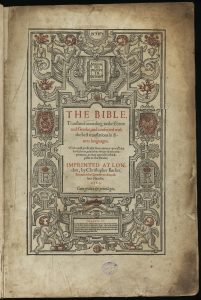
The Bible: translated according to the Ebrew and Greeke, and conferred with the best translations in diuers languages. London: Christopher Barker, 1583. B.r.33/1
Alongside this book, in our early Bibles collection we have several examples of pulpit Bibles such as this Geneva Bible used as the pulpit Bible in Crail, Fife. Traditionally Presbyterian churches in Scotland had a centrally located pulpit, reflecting the importance of the Bible as the foundation of faith. The large size of the book is part of its role as an object used in public worship.
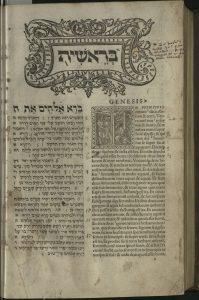
Mikdash yeyai, ʻesrim ve-ʾarbʻa sefare ha-mikhtav ha-ḳadosh = En tibi lector Hebraica Biblia. Basel, 1534. LP4/2.10
In fact many of the largest books in our rare book collections are Bibles, and this is no surprise considering that the Bible is a very large amount of text, which requires a large book to fit it all in. This is even more the case for polyglot Bibles, which offer parallel versions of the text in different languages such as Latin, Hebrew and Greek, or for Bible versions that include commentary parallel with the text. In the recently catalogued LP section, this folio edition of the complete Hebrew Bible, with Latin translation, and Latin commentary drawn from Rabbinic sources, is one of the greatest Christian Hebraists of the sixteenth century, Sebastian Münster. This Bible was highly valued by 16th century Christian students of the Hebrew language and the Hebrew Scriptures, and is likely to have been among the resources used by Luther in preparing his Genesis lectures (1535-1545), his last major work.
Christine Love-Rodgers, Academic Support Librarian
With thanks to Janice Gailani, Rare Books Cataloguer.
New! Past Masters Commons

We now have access to Past Masters Commons, a growing series of important texts and translations that present the history of philosophy and thought. Read More
Psalm singing and the Reformation
New College Library welcomes delegates to The Cultures of the Reformation: A Colloquium in Honour of Professor Jane Dawson on Thursday 1 June 2017. We have updated our current display of early psalm books and Scottish liturgy to include two new items.
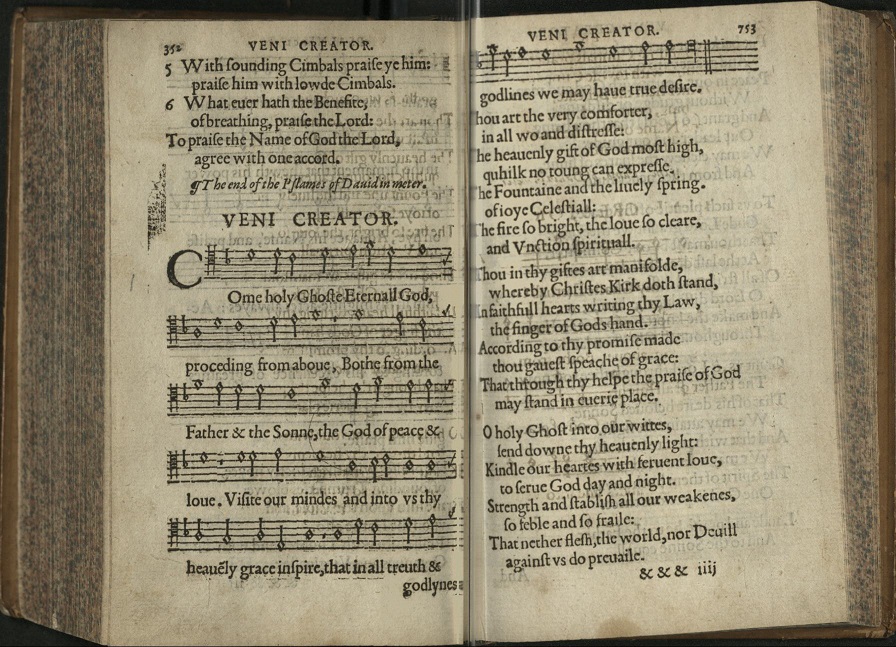
The CL. Psalmes of David in meter : for the vse of the Kirk of Scotland : the contents of this buke follovve in the next page after the kalender. Imprinted at London : By Thomas Vautrollier dwelling in the Black-Friers, 1587. tUR 77 1587
Journal of Professions and Organization – new subscription

We have a new e-journal subscription – Journal of Professions and Organization
Journal of Professions and Organization aims to be the premier outlet for research on professional organizations, including their work, management and their broader social and economic role. It will focus on the organizational level but will still maintain a broad interest in professionals, the professions, professionalization, professional practice and relevant work-place issues. The journal is receptive to interdisciplinary perspectives and contributions, with strong interests in all professional organizations, professional service firms (PSFs), and public sector professionals (PSPs). While recognizing the importance of traditional professions, they welcome work on new professions, occupations claiming some professional status, and on knowledge workers more generally.
Research Data Service highlights to report: August to December 2016
Research Data Service
New Research Data Service Website
The Research Data Service’s redesigned website was released in December. The new website is more accessible and includes new and updated content in support of RDM. The new website can be visited at http://www.ed.ac.uk/information-services/research-support/research-data-service
RDM Forum Meetings
There were two RDM forum meeting held during the autumn term (7 September and 23 November). This is part of a collaborative effort that Çuna Ekmekcioglu (L&UC) and Jacqueline McMahon and Ewa Lipinska (College of Arts, Humanities and Social Sciences) organised to invite staff from CAHSS and other Colleges and Schools to meet and have discussions about RDM activities, and how these can be supported. There were almost 25 people in attendance for each meeting with another one scheduled for 28 March 2017.
A RDM forum SharePoint site has also been created to accommodate RDM resources including papers, presentation slides, work flow diagrams, guides and a collection of sample data management plans.
Visits
The Research Data Service welcomed visitors from seven universities during the autumn term with two visits from Kyoto University.
The purpose of their visits was to learn more about the services and resources we provide in support of research data management at the University of Edinburgh. The Digital Curation Centre (DCC) and senior IS staff also participated during some of the visits, which included meetings, presentations and tours.
- Nanyang Technological University: 3 – 4 August
- University of Auckland: 14 September
- Kyoto University (National Institute of Informatics): 26 September
- Malmö University: 10 – 11 October
- University College Cork: 21 September
- John Hopkins University: 21 September
- Kyoto University (Kyoto University Library): 26 October
- University of Malaya: 22 November
Data Management Planning
DMPonline had 57 new registered users and was used to create 115 data management plans (DMPs); in total, 256 DMPs were created in 2016.
There were 25 data management plan consultations from August to December.
Data Management Support
MOOC and MANTRA
A total of 1,817 learners enrolled for the 5-week RDMS MOOC rolling course from August to December, with a total of 5,466 learners enrolled for the year (2016); the MOOC started in March 2016.
2016 concluded with 22,544 MANTRA sessions recorded for the year, slightly lower than in 2015, when MANTRA had 22,950 sessions.
Active Data Infrastructure
DataStore
Active users remained consistent throughout the 2016 year with data stored on a steady rise. There was a natural decline over the summer break, which has been observed in previous years.
In 2016, the College of Arts, Humanities and Social Sciences (CAHSS) activity was distinct from other Colleges with a spike in usage.
DataSync
DataSync usage includes the following stats that were reported at the end of 2016:
- Number of active users: 1,740
- Number of distinct clients (IPs 2017): 5,423
- Total DataSync storage: 3TB
- Number of mappings to DataStore areas: 294
Data Stewardship
Pure
In 2016, 326 Pure records for datasets were created, which surpass the number of records created in 2014 (31) and 2015 (32).
DataShare
202 datasets were deposited into DataShare.
DataVault
DataVault closed the year with 21 deposits for 2016. There was a soft release of DataVault in February 2016 and plans are to commit resources to DataVault so that there can be a release in mid 2017.
3D Printing and Additive Manufacturing – new subscription

We have a new e-journal subscription – 3D Printing and Additive Manufacturing.
3D Printing and Additive Manufacturing is a peer-reviewed journal that provides a forum for world-class research in additive manufacturing and related technologies. The Journal explores emerging challenges and opportunities ranging from new developments of processes and materials, to new simulation and design tools, and informative applications and case studies. Novel applications in new areas, such as medicine, education, bio-printing, food printing, art and architecture, are also encouraged.
The Journal addresses the important questions surrounding this powerful and growing field, including issues in policy and law, intellectual property, data standards, safety and liability, environmental impact, social, economic, and humanitarian implications, and emerging business models at the industrial and consumer scales.
Collections
 Hill and Adamson Collection: an insight into Edinburgh’s past
My name is Phoebe Kirkland, I am an MSc East Asian Studies student, and for...
Cataloguing the private papers of Archibald Hunter Campbell: A Journey Through Correspondence
My name is Pauline Vincent, I am a student in my last year of a...
Hill and Adamson Collection: an insight into Edinburgh’s past
My name is Phoebe Kirkland, I am an MSc East Asian Studies student, and for...
Cataloguing the private papers of Archibald Hunter Campbell: A Journey Through Correspondence
My name is Pauline Vincent, I am a student in my last year of a...

Projects
Cataloguing the private papers of Archibald Hunter Campbell: A Journey Through Correspondence
My name is Pauline Vincent, I am a student in my last year of a...
Archival Provenance Research Project: Lishan’s Experience
Presentation My name is Lishan Zou, I am a fourth year History and Politics student....