Home University of Edinburgh Library Essentials
April 9, 2026
‘The price of blood’ : Frederick Douglass speaks to Scotland
A guest post for Black History Month by Eleanor Rideout, IS Helpdesk Assistant
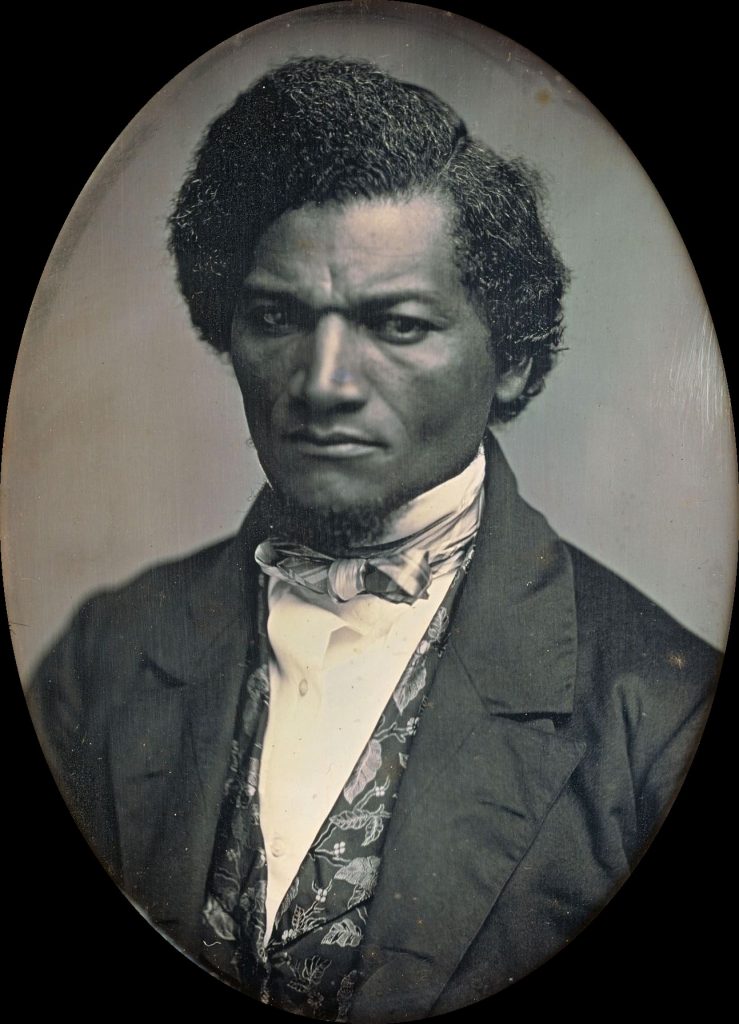
Frederick Douglass by Samuel J Miller, 1847-52. Wikimedia Commons
Noted African-American anti-slavery campaigner Frederick Douglass had embarked on a tour of Ireland and Great Britain, reaching Scotland in 1846. He was speaking against the evils of slavery generally, but a decision made by the Free Church of Scotland became the focus of his work here.
The separation of the Free Church from the Church of Scotland meant that funding needed to be found. One source was fellow Presbyterian Churches, including those in the American South. Money was accepted from slaveholders, which did not go unnoticed by abolitionists.
Douglass’s reputation as a powerful speaker is confirmed by two anonymous letters from a woman living in Dundee, addressed to Free Church leader Thomas Chalmers, which are held at New College Library, Edinburgh.
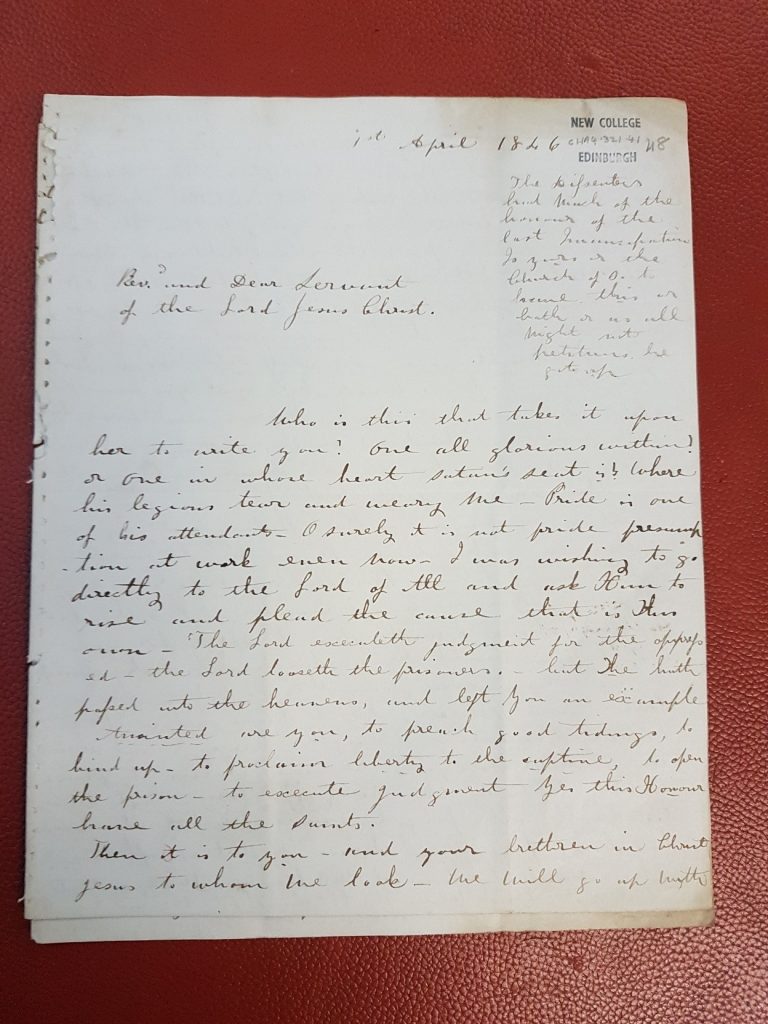
Anonymous to Thomas Chalmers, 1 April 1846. MS CHA 4.321.41-42.
The writer’s style is impassioned, swerving between criticism of slaveholders, concern for her own soul, and description of events recently witnessed:
“They would not give the churches and few comparatively speaking gave their ears. Because it was said that the strangers witnessed too hard things against your Church. If the Men tell the Truth you should not be angry.”
“Dear Dr C. What are you going to do in the matter of taking money from the slaveholders in the America about which I heard a great deal last week & meetings – two of which I attended – as I used to be very much interested in the Slave question…”
“Part of my ordinary as Rev. T Boston would say, or rather my extraordinary for in thought word and deed I am of late a Backslidder [Backslider], ah for Grace to grow in grace. You see how I wander –It is the Poor Captive slave I wish now to speak for. I would you would be a tongue to such dumb ones. Then soon soon the Lord will look down and deliver. For to them belongeth Power, Dominion, Strength, Mercy. And then will their tongues become glories to praise, to bless to laud the King of Glory – and they too shall not forget you –as we all have too long forgotten them. Neglect is infliction.
O how much I know of my Masters will yet do it not I wish whiles the Lord would set me and take me.”
She also uses rhetorical flourish herself to try and persuade Chalmers:
“It was sins of ignorance I was reading today 4 Lev. I see there the Lord will not let such pass. It was for such the blessed Jesus prayed when on the cross Father forgive them. Now I believe firmly you did not see at the time that taking money from slaveholders was the price of blood – verily your Church hath been guilty. Do not think I am glad to set aught against you because you have far outstript us in the way of voluntary giving. No I was glad and I myself made crape [crêpe] the year of the disruption that I might give what I had for ribbon, to your Free Church, Free Church what have you to do with the House of Bondage. Hath the Truth made you Free – then Freely give.”
It is interesting to be able to read her words along with the published transcripts of the speeches made by Frederick Douglass, also held at New College Library :
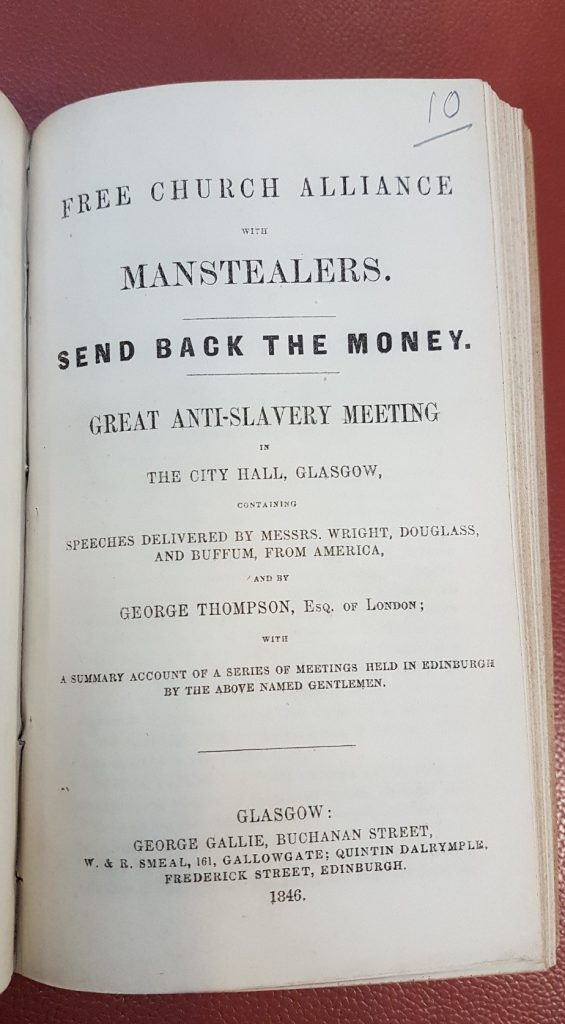
Free Church Alliance with manstealers: send back the money, great anti-slavery meeting in the City Hall, Glasgow. Glasgow: George Gallie, 1846. M.d.9/10.
“All was going on gloriously – triumphantly; the moral and religious sentiment of the country was becoming concentrated against slavery, slaveholders, and the abetters of slaveholders, when, at this period, the Free Church of Scotland sent a deputation to the United States with a doctrine diametrically opposed to the abolitionists, taking up the ground that, instead of no fellowship, they should fellowship the slaveholders. According to them the slaveholding system is a sin, but not the slaveholder a sinner.”
“The deputation had an excellent opportunity of aiming an effectual blow at slavery, but they turned a deaf ear and refused to listen to the friends of freedom. They turned a deaf ear to the groans of the oppressed slave – they neglected the entreaties of his friends- and they went into the slave states, not for the purpose of imparting knowledge to the slave, but to go and strike hands with the slaveholders, in order to get money to build Free Churches and pay Free Church ministers in Scotland. [Cries of “shame” and applause.]”
“I verily believe, that, had I been at the South, and had I been a slave, as I have been a slave – and I am a slave still by the laws of the United States- had I been there, and that deputation had come into my neighbourhood, and my master had sold me on the auction block, and given the produce of my body and soul to them, they would have pocketed it and brought it to Scotland to build their churches and pay their ministers.”
While the Free Church money was not returned the strong impression made on listeners by Frederick Douglass’s words can be seen clearly in these letters. With the 200th anniversary of his birth in 2018 his great contribution to the abolitionist cause is likely to be celebrated more and more.
Eleanor Rideout
With thanks to Alasdair Pettinger whose article ‘The Bloody Gold’ drew attention to this letter: http://www.bulldozia.com/projects/index.php?id=616
Updates from the fourth meeting of the RDM Forum
Guest blog post by Ewa Lipinska
On 28th August members of the RDM Forum gathered in the stunning Old Library at the Department of Geography in the Old Infirmary building, to hear the latest updates from the Research Data Service team and discuss all things data. It’d been a good few months since the last time we met, so the event presented us with the perfect opportunity to catch up on new developments, network with colleagues working on RDM in different parts of the University, and prepare ourselves for the new academic year which will see the University take up a pivotal role in making Edinburgh the Data Capital of Europe.
We started off with an RDM update from Cuna Ekmekcioglu, who gave us an overview of developments to University research data services: the launch of interim DataVault long-term retention service, continuing development of Data Save Haven aimed at research projects dealing with sensitive data, and a new release of DataShare which will allow larger datasets. We also learned about RDM training courses planned for the new academic year, most of which can be booked via MyEd.
Next, Pauline Ward gave a presentation which went into a bit more detail about the DataVault service allowing researchers to comply with their funders’ requirements to preserve data for the long term in cases where the datasets cannot be made public. The current interim service requires a mediated deposit which can be done by contacting data-support[at]ed.ac.uk. Comprehensive guidance on how to prepare your data before storing it in DataVault can be found on the service website.
This was followed by a demonstration of the new Research Data Service promotional video which outlines the range of tools and support offered by the team, and which can be a very good resource for new members of staff who would like to find out about the types of services available. Diarmuid McDonnell who presented the video also gave us a quick overview of a recent project called Scoping Statistical Analysis Support, which looked at the demand for statistical analysis training for current postgraduate students. The final project report is full of current information about statistical training around the University.
We then went on to discuss the potential impact of data sharing, which tied in nicely with a recent panel discussion at Repository Fringe 2017 that focused on how repositories and associated services can feature in supporting researchers to achieve and evidence impact in preparation for the next Research Excellence Framework exercise (live notes from the day are available). Pauline Ward presented examples of popular public datasets by Edinburgh University researchers, described ways to access information about their usage, and talked about how datasets can be shared more widely to engage external audiences, which may lead to potential impact. Even though on their own research data usage statistics are not enough to demonstrate significant impact beyond academia, they are a good (though perhaps still slightly overlooked) starting point for tracking how and by whom datasets are used, and how that benefits individuals and communities.
The meeting concluded with a presentation by Robin Rice, who shared with us the draft Research Data Service Roadmap. As the goals set out in the previous roadmap have now largely been achieved, the time has come to look to the future and identify new objectives for the next few years. It was interesting to hear about the team’s long-term plans which include unification of the service (aiming to ensure the best user experience and interoperability between systems), advocacy of data management planning, support around active data, enhanced data stewardship, improved communications and more training opportunities.
Overall, it was a very useful and informative meeting, and I’d very much encourage anyone interested in research data management and sharing to join us next time. In the meantime Cuna’s slides, together with lots of other useful resources and points for discussion, are available on the RDM Sharepoint (access on request).
Ewa Lipinska
Research Outcomes Co-Ordinator
College of Arts, Humanities and Social Sciences
Trial of a huge range of Chinese resources from Superstar

The Library has arranged a free trial, until 31st October 2017, of several important full-text Chinese resources from the Superstar company (超星公司) which is provider of our currently subscribed databases Duxiu and Chinamass, both of which are in the Databases A-Z list. These resources range from Chinese classics, pre-1949 periodicals and books, to local gazetteers and academic journals since 1949. They are accessible on three different platforms:
- Special collections (专题图书馆 and 超星专题库). These two large sets of resources can be accessed on the Chinamaxx platform. . It contains a vast amount of Chinese classics and books on special subjects. Superstar historical documents (超星文史资料) is under a separate section and may be of special interest for regional studies. The following resources are available:
四库全书 (We have this database)全宋文 (We have a print collection of 360 volumes in the East Asian Collection, Main Library)
古今图书集成 (We have this database)
- Superstar journals (超星期刊) which can be accessed on the Duxiu database platform. This resource contains over 6,500 full text post-1949 Chinese journals. Please also remember that we are subscribing to two Chinese journals already: China Academic Journals, and China Online Journals, both of which are in the Database list.
- Dacheng gu zhi dui (大成故纸堆). This is a huge database containing several series: 老旧刊(pre-1949, 7491 periodicals),民国图书(39,950 books published before 1949),《申报》(1872-1942),古方志集(3566) ,党史(208 Communist Party publications before 1949), 《顺天时报》(1907-1930),《大美晚报》(1943-1946).This database is to be accessed from: www.dachengdata.com on the University network.
Feedback about these trials are welcome.
Ruth Fulton Benedict Papers
I’m pleased to let you know that a large portion of American anthropologist Ruth Benedict’s professional and personal papers are now freely available online. These have been made available by Alexander Street Press via one of their open access initiatives Anthropology Commons.

You can access the Ruth Fulton Benedict Papers via the Databases A-Z list or via the Anthropology database list. Read More
On trial: Illustrated London News 1842-2003
*The Library has now purchased access to this resource. See New to the Library: Illustrated London News Historical Archive*
Thanks to a request from a member of staff in HCA the Library currently has trial access to the Illustrated London News Historical Archive, 1842-2003. Illustrated London News was the world’s first pictorial weekly newspaper and this archive gives access to the full run of this iconic illustrated newspaper.

You can access this online archive via the E-resources trials page. Access is available both on and off-campus.
Trial access ends 31st October 2017.
The first issue of Illustrated London News was published on Saturday 14 May 1842 and as the world’s first fully illustrated weekly newspaper, it marked a revolution in journalism and news reporting. Read More
Freedom to read, freedom to believe #BannedBooksWeek
 A guest post by Eleanor Rideout, IS Helpdesk Assistant
Banned Books Week, held the week of September 24th in 2017, is an annual celebration of the freedom to read. New College Library holds many texts that have been banned at different points in history, and by different nations and cultures. This week you can see some of these banned books on display in New College Library. Read More
Scoping Statistical Analysis Support
The following is a post by our former PhD Intern, Cindy Nelson-Viljoen, where she outlines her experience of working on a significant Data Library project supported by the Innovation Fund.
Scoping Statistical Analysis Support, supported by the Information Services Innovation Fund and managed by Diarmuid McDonnell, was a six-month project that aimed to identify gaps in statistical analysis training provision at the University of Edinburgh, and the potential role of the Data Library in addressing these gaps. The focus was on understanding how statistical analysis support and training is conducted across University of Edinburgh schools; scoping existing support mechanisms and models for students, researchers and teachers; and identifying services and support that would satisfy existing or future demand.
The activities of the project included designing an online questionnaire of research students, and to engage with and interview faculty (researchers and teachers) with knowledge of and responsibility for quantitative methods/statistical analysis support in their respective school. As part of the project, the Data Library employed a PhD intern (Cindy Nelson-Viljoen) via the Employ.ed scheme, and offered an excellent opportunity for Cindy to develop her knowledge of social science methods, statistical analysis and support, and research data management in a collaborative cross-disciplinary setting.
The project’s findings will inform future planning of statistical analysis support and training within the Data Library, ISG and the University. The report describing the project, methodology, findings and recommendations is available at http://edin.ac/2hnJYPb.
New library subject guides for SPS
We’ve been revamping the library subject guides for School of Social and Political Science. So if you’re just starting at the University or you are a returning student why not take a look?
The subject guides include information about and links to library resources, facilities and services both specifically for your subject area and for general library use.

You can find new subject guides for the following subject areas:
- African Studies
- Canadian Studies
- Global Public Health
- International Development
- Politics & International Relations
- Science, Technology and Innovation Studies
- Social Anthropology
- Social Policy
- Social Work
- Sociology
- South Asian Studies
These subject guide pages have been completely overhauled and we hope these will prove useful to you.
Caroline Stirling – Academic Support Librarian for School of Social and Political Science
British War Medal – a medal of the First World War
CAMPAIGN MEDAL AWARDED TO WILLIAM HUNTER (1861-1937) – GREAT WAR
 The British War Medal was awarded to those who served in the campaigns of the Great War or World War between 5 August 1914 (the day following the British declaration of war against the German Empire) and the armistice of 11 November 1918… both dates inclusive. As war approached again in the mid-1930s, this Great War or World War became known as World War One.
The British War Medal – a medal of the First World War – was established on 26 July 1919. In its Silver version, 6,390,000 were awarded. Some 110,000 Bronze versions of the medal were awarded to labour battalions. The British War Medal was designed by the Aberdeen-born sculptor William McMillan (1887-1977).

British War Medal – awarded to William Hunter (Centre for Research Collections, Coll-1146)
The medal is a circular silver design – or in bronze- and 36 mm in diameter. The ribbon is 32 mm wide with a broad orange watered stripe down the centre bordered with white, black and blue stripes. The medal obverse (the principal side) shows a bareheaded King George V effigy, facing left, with ‘GEORGIVS V BRITT: OMN: REX ET IND: IMP:’ (George 5th, King of all the Britain’s, and, Emperor of India).

British War Medal – awarded to William Hunter (Centre for Research Collections, Coll-1146)
The reverse of the medal shows St. George, naked, on horseback armed with a short sword (an allegory of the physical and mental strength which achieves victory over Prussianism). The horse tramples on the Prussian shield and the skull and cross-bones. Just off-centre, near the right upper rim, is the sun of Victory. The dates 1914 and 1918 appear in the left and right fields respectively.
The British War Medal shown here was the one awarded to Edinburgh University alumnus William Hunter who served in Serbia during the Great War (see the May 2015 post of these Untold Stories, ‘William Hunter & the Order of St. Sava’). Hunter was President of the Advisory Committee, Prevention of Disease, in the Eastern Mediterranean and Mesopotamia (Gallipoli, Egypt, Salonika, Malta and Palestine), and he also served with the Eastern Command, 1917-1919.
It is contained within the collection of Medals, awards and decorations of William Hunter (1861-1937) curated by the Centre for Research Collections (CRC), Edinburgh University Library, Coll-1146.
Dr. Graeme D. Eddie, Assistant Librarian Archives & Manuscripts, CRC
Sources: (1) Online resources. (2) British battles and medals. Lawrence L. Gordon. London: Spink, 1979. Ref. .7372(42) Gor. (Closed stack)
Resources for Christian ministry and worship at New College Library
Today New College welcomes ministers and worship leaders to a CPD day focusing on Biblical resources. Topics include current scholarship on the Gospel of John and Advent themes in the Hebrew Bible.
 At New College Library, we welcome people working in the church to use our outstanding theological collections for research and continuing professional development. Read More
Collections
 Hill and Adamson Collection: an insight into Edinburgh’s past
My name is Phoebe Kirkland, I am an MSc East Asian Studies student, and for...
Cataloguing the private papers of Archibald Hunter Campbell: A Journey Through Correspondence
My name is Pauline Vincent, I am a student in my last year of a...
Hill and Adamson Collection: an insight into Edinburgh’s past
My name is Phoebe Kirkland, I am an MSc East Asian Studies student, and for...
Cataloguing the private papers of Archibald Hunter Campbell: A Journey Through Correspondence
My name is Pauline Vincent, I am a student in my last year of a...

Projects
Cataloguing the private papers of Archibald Hunter Campbell: A Journey Through Correspondence
My name is Pauline Vincent, I am a student in my last year of a...
Archival Provenance Research Project: Lishan’s Experience
Presentation My name is Lishan Zou, I am a fourth year History and Politics student....