Home University of Edinburgh Library Essentials
April 9, 2026

Conservation Volunteers in the Collections Rationalisation Project
This week our Project Conservator, Helen, talks about the great work volunteers have done as a part of the Collections Rationalisation project…
Some of the main aims of the Collections Rationalisation project at Edinburgh University is to ensure that the library space is being used as efficiently as possible and that collections housed at the University Collections Facility (UCF) are stable and safe to be handled. For this project, priority collections which require conservation have been identified and highlighted. So far the main focus of the project has been on the special collections, in particular the rare books.
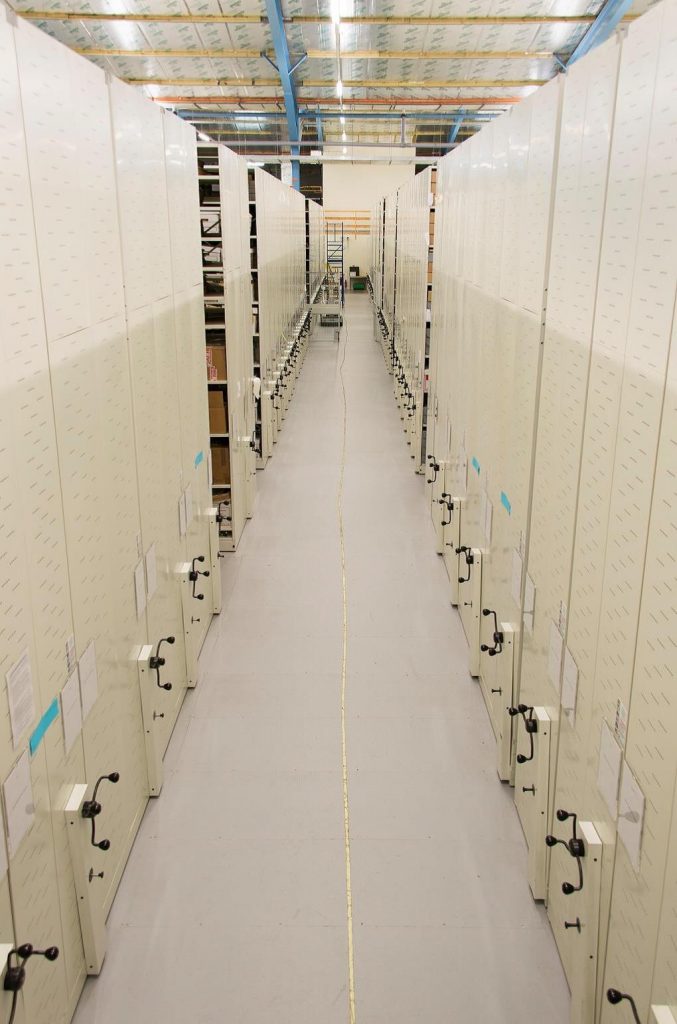
Roller racks at the UCF
Dawsonera e-book download changes

From the 1st November, e-books (both PDF’s and ePub’s) downloaded from the Dawsonera website will require installation of Adobe Digital Editions or the Bluefire app for mobile devices. As many of our e-books are already set up this way, most users will be unaffected. If you do need to install Adobe Digital Editions, some useful links are below:
- Installation page for Adobe Digital Editions – http://www.adobe.com/uk/solutions/ebook/digital-editions/download.html
- Dawsonera userguide on installing ADE – http://libraryservices.bertrams.com/DawsonBooks/InstallingAdobeDigitalEditions.pdf
- Dawsonera guide on creating an Adobe ID- https://youtu.be/BYw95y4jXQs
Further info
Further info about the main e-book platforms we use can be viewed at our e-book AZ lists.
Green open access and REF compliance
Yesterday’s blog post suggested that our reliance on Hybrid Gold Open Access to meet research funder’s open access requirements was too expensive and libraries should be supporting alternative pathways. In terms of pure numbers the main way the University of Edinburgh is making access to it’s research open is via Green Open Access (OA) – where the Author’s Accepted Manuscript (AAM) version of the research output is deposited in a repository and made available as soon as publishers copyright policies allow.
Since we started compiling monthly reports in 1st April 2016 we have made 6266 journal articles and conference proceedings open access which equates to around 92% of the University’s total output.
The University of Edinburgh has always had a preference for Green OA because there are no upfront costs for authors so everyone can participate without requiring access to large research budgets. But since the REF2021 open access requirements were published, Green OA has become even more important. The HEFCE policy states that, to be eligible for submission to the next REF, authors’ final peer-reviewed manuscripts must be deposited in a repository. The University of Edinburgh has adopted this policy and provided the infrastructure and support for all it’s researchers to make their research Green OA. The programme which was adopted to facilitate open access in the University of Edinburgh’s College of Medicine and Veterinary Medicine is described in more detail in the following paper:
The results of the open access implementation plan have been extremely successful and we can report a 92% adoption rate for Green OA. The Scholarly Communications Team prepares monthly reports using data from our repository to identify the current level of compliance with the REF open access policy. These monthly reports indicate the numbers of in-scope research outputs (journal articles and conference proceedings with ISSNs) and whether they meet the requirements for the next REF, as per our repository’s compliance-checker functionality.
The figure and table below show the growth in the percentage of research outputs made open access since April 2016 and also a more detailed breakdown by subject area. The reporting period is a rolling window three months behind the current date.

| 1 April 2016 – 31 May 2017 | Number of papers | Indicative compliance |
| Arts, Humanities & Social Sciences | ||
| Business School | 123 out of 126 | 97.62% |
| Divinity, School of | 22 out of 22 | 100% |
| Economics, School of | 21 out of 21 | 100% |
| Edinburgh College of Art | 111 out of 118 | 94.07% |
| Health in Social Science, School of | 118 out of 125 | 94.40% |
| History, Classics and Archaeology, School of | 86 out of 88 | 97.73% |
| Law, School | 102 out of 104 | 98.08% |
| Literatures, Languages and Cultures, School of | 59 out of 61 | 96.72% |
| Moray House School of Education | 155 out of 160 | 96.88% |
| Philosophy, Psychology and Language Science, School of | 402 out of 405 | 99.26% |
| Social and Political Science, School of | 181 out of 191 | 94.76% |
| Medicine & Veterinary Medicine | ||
| Clinical Sciences, Deanery of | 1183 out of 1387 | 85.29% |
| Biomedical Sciences, Deanery of | 214 out of 239 | 89.54% |
| Molecular, Genetic and Population Health Sciences, Deanery of | 794 out of 910 | 87.25% |
| Veterinary Studies, Royal (Dick) School of | 550 out of 573 | 95.99% |
| Edinburgh Medical School | 672 out of 732 | 91.80% |
| Centre for Medical Education | 7 out of 8 | 87.50% |
| Science & Engineering | ||
| Biological Sciences, School of | 407 out of 455 | 89.45% |
| Chemistry, School of | 203 out of 231 | 87.88% |
| Engineering, School of | 373 out of 385 | 96.88% |
| GeoSciences, School of | 354 out of 373 | 94.91% |
| Informatics, School of | 366 out of 376 | 97.34% |
| Mathematics, School of | 135 out of 135 | 100% |
| Physics and Astronomy, School of | 340 out of 380 | 89.47% |
| Edinburgh Parallel Computing Centre | 6 out of 7 | 85.71% |
Problems
Despite a hugely successful Green OA implementation programme at the University of Edinburgh there are a number of significant outstanding problems. To my mind the main issues are that Green OA is:
Not immediate. Most publishers (but not all) require an embargo period of between 12-36 months before the AAM can be made open access. Not only are long embargo periods are hugely detrimental for scholarly communication, but I believe they are unnecessary. Many academic publishers insist on long embargo periods to protect journal subscription revenue from cancellations. However, a number of academic publishers (including the Royal Society, Cambridge University Press, Emerald and SAGE) have zero month embargoes for selected titles are they are not unduly affected by cancellations.
Not compliant with all research funders policies. Unfortunately, these long embargo periods are not compliant with all research funders policies (e.g. RCUK) which means that many researchers are forced to pay Hybrid OA fees for their publications. As we discussed yesterday Hybrid OA accounts for 70% of our open access expenditure. In the UK researchers are faced by a myriad of different funders policies (e.g. HEFCE, RCUK, Horizon 2020) which currently require different routes to open access.
Not cost-free. If you factor in hidden costs – such a repository platform fees and staff costs for mediated deposits/copyright checking – Green OA is more expensive than you would initially imagine. Whilst gathering data for a recent HEFCE open access questionnaire we estimated that we have around eleven full time equivalent staff distributed across the entire University working on open access implementation. If you aggregate all these costs then the cost per paper to deliver Green OA is somewhere in the region of £45 which I think is too expensive (but put in context this is still pretty good value for money as our average Gold OA costs are £1,676 per paper).
In summary, Green OA is a step in the right direction but still does not answer all of the problems that we currently face. What we can do to alleviate the issues of long embargo periods, harmonising research funders policies and simplifying processes and thereby lowering costs is the topic of tomorrows blog post – the UK Scholarly Communications Licence.
On trial: Socialism on Film
I’m pleased to let you know that the Library has been given the opportunity to trial for a second time the fascinating Socialism on Film: The Cold War and International Propaganda from Adam Matthew Digital and the BFI National Archive.

This impressive collection of documentaries, newsreels and features reveals the world as seen by Soviet, Chinese, Vietnamese, East European, British and Latin American film makers. Documenting the communist world from the Russian Revolution until the 1980s and covering all aspects of socialist life. And what makes this resource unique is the collection of films were produced almost exclusively in the communist world and then versioned into English for distribution in the West.
You can access the database via the E-resources trials page. Access is available both on and off-campus.
Trial access ends 20th November 2017. Read More
University of Edinburgh 2016/17 Gold open access spend analysis

The University of Edinburgh receives two main block grants from Research Councils UK (RCUK) and Charity Open Access Fund (COAF) to support researchers funded by them to comply with their open access policies. The Library’s Scholarly Communications Team manages these block grants on behalf of the institution. In 2016/17 we spent £1,167,966 to make 697 articles open access via the Gold open access route. In addition, £28,951 was spent on other publication costs, for example page and colour charges.
A summary of the open access charges made to the top 15 publishers is shown in the table and figures below:
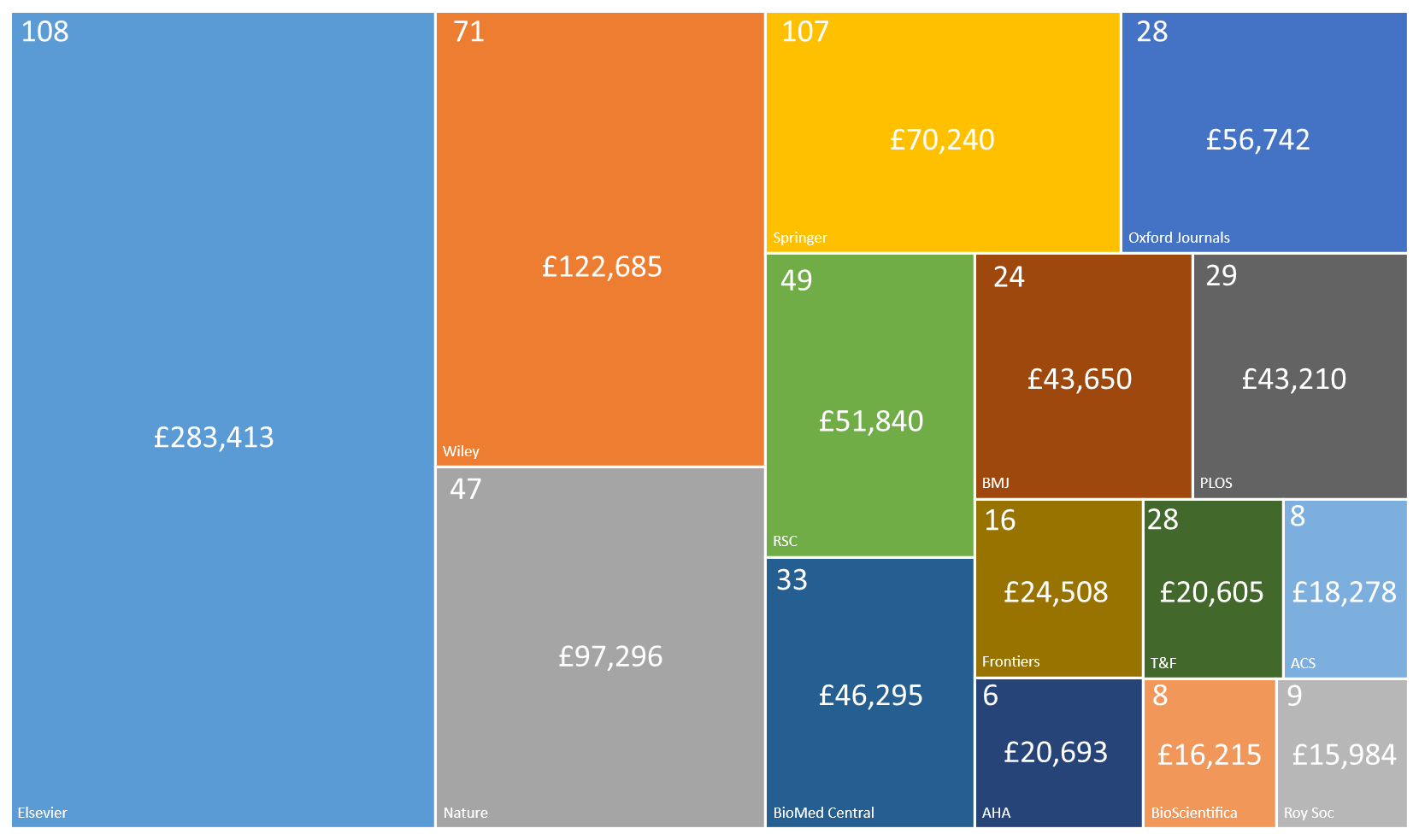
| Row Labels | Count of APC paid | Sum of APC paid (£) | Ave APC (£) |
| Elsevier | 108 | £283,413 | £2,624 |
| Wiley | 71 | £122,685 | £1,728 |
| Nature | 47 | £97,296 | £2,070 |
| Springer | 107 | £70,240 | £656 |
| Oxford Journals | 28 | £56,742 | £2,026 |
| Royal Society of Chemistry | 49 | £51,840 | £1,058 |
| BioMed Central | 33 | £46,295 | £1,403 |
| BMJ Publishing Group Ltd | 24 | £43,650 | £1,819 |
| Public Library of Science | 29 | £43,210 | £1,490 |
| Frontiers | 16 | £24,508 | £1,532 |
| American Heart Association | 6 | £20,693 | £3,449 |
| Taylor & Francis | 28 | £20,605 | £736 |
| American Chemical Society | 8 | £18,278 | £2,285 |
| BioScientifica | 8 | £16,215 | £2,027 |
| Royal Society Publishing | 9 | £15,984 | £1,776 |
Points and trends to note:
- Our overall spend on open access in 2016/17 was £1,167,966 which bought 697 papers, with an average Article Processing Charge (APC) of £1,676.
- The open access expenditure is dominated by three large publishers: Elsevier, SpringerNature and Wiley. These 3 publishers account for 53% of our total spend. Note that we have shown SpringerNature as three individual publishers in the table and figure as they have distinct publishing identities – Springer, Nature and BioMedCentral.
- The top individual publisher (Elsevier) alone accounted for 24% of the total spend, with their APCs 56% more expensive than the average.
- Generally speaking, we found the highest individual APCs were from US society publishers, like the American Heart Association or American Chemical Society.
- Best value APCs were from publishers where we have offsetting or national agreements with – for example Taylor & Francis, Springer and Royal Society of Chemistry.
- 70% of our expenditure is on Hybrid Gold OA – where journals charge a subscription and APCs – rather than pure Gold OA (30%) where APCs are the only charge.
- Looking at the whole dataset Hybrid Gold OA is more expensive (£2,075) than pure Gold OA APCs. (£1,581).
Discussion
The University of Edinburgh publishes 6 -7,000 journal articles and conference proceedings per year. In the current market conditions if we were to fully transition to Gold OA then we estimate it would cost in the region of £10M per year. To put this in context Edinburgh University Library spends approximately £4M per year on e-journal subscriptions so this represents a significant uplift on the total cost of publication. I suspect this figure is similar for other research-intensive universities.
At its current scale and intensity, open access as purely delivered by Hybrid Gold OA and Gold OA alone is not likely to happen. Any increase to the total cost of publication is not acceptable.
If we wish to transition to full open access then significant cost mitigation for paid open access needs to occur, and alternative low cost or no cost options need to be investigated and adopted. Some options are described below.
Reducing cost recommendations
- Push for offsetting deals : Libraries should be a) requesting offsetting deals, b) pushing for significant discounts, and c) helping publishers adopt transformative business models.
Examples of publishers offering good offsetting schemes are IOP – where an actual rebate is given depending on Gold OA spend – and SAGE Publishing who globally discount the subscription rate of journals where more than 5% of articles are published as Gold OA. SAGE also offer steep open access discounts of 80% for some members of consortia subscriptions. Taylor & Francis are another publisher which significantly reduce APC cost (by 75%) to consortia members. These steep discounts are welcome, but have a fundamental problem in that they rely on privilege. Discounts are not available to all authors as they rely on institutions having a subscription.
Transformative business models such as the UK Springer Compact national agreement, or the Royal Society of Chemistry Read and Publish agreement, are also welcome as they lower transactional barriers for authors to participate in Gold OA. This leads to a greater coverage of open access articles in journal titles, rather than the patchy open access that Hybrid Gold OA delivers. The overall costs are also appreciably lower than the cumulative costs seen with Hybrid Gold OA – look at the difference in our expenditure between Elsevier and Springer for a similar amount of Gold OA articles published.
- Support ‘low cost and no cost’ Gold OA : Academic and National Libraries should support open access initiatives that are inclusive and open to scholars who do not have budgets for publishing.
Gold OA does not necessarily equate to paid open access. Many academic or library-led publishing initiatives do not charge Article Processing Charges as the costs are covered through alternative mechanisms. Some examples of innovative academic or library-led publishing activities are described below.
Edinburgh University Library provides an Open Journal Service which is available free of charge to University of Edinburgh students and academics. It provides a hosting platform for academic and student-led groups to create and publish their own Open Access journal. Currently the service has a portfolio of 16 journals and is looking to grow and develop in the coming year.
The Open Library of Humanities (OLH) is a charitable organisation dedicated to publishing open access scholarship with no author-facing article processing charges. The OLH publishing platform supports academic journals from across the humanities disciplines, as well as hosting its own multidisciplinary journal. The University of Edinburgh has opted to support the Open Library of Humanities at a higher rate than required. This additional support will enable the OLH to continue its growth mission to convert subscription journals to a solid, ongoing, open-access model, with no author-facing charges.
- Reduce reliance on Hybrid Gold OA : Hybrid Gold OA – where journals charge both subscriptions and Article Processing Charges – is too expensive.
Unfortunately, Hybrid Gold OA which accounts for 70% of our expenditure are significantly more expensive than pure Gold OA costs. It is not uncommon to receive invoices of $5,000 for individual APCs. Our open access block grants are supported either directly by taxpayers money (RCUK), or from charitable organisations (COAF), so it is imperative that anyone managing these funds should be seeking best value for money. I would find it very difficult to explain to someone who has raised money for Cancer Research UK the hard way by running the London Marathon that their sponsorship money has only paid for half an APC. Where research funders policies allow we should be seeking to reduce our reliance on Hybrid Gold OA by utilising alternative mechanisms like Green OA, which we will visit in more detail in tomorrow’s blog post.
On trial: Women’s Magazine Archive I and II
*The Library has now purchased access to the ‘Women’s Magazine Archive, collection I and II’. See New to the Library: Women’s Magazine Archive.*
Following a request from a student in HCA the Library now has trial access to ProQuest’s Women’s Magazine Archive, collection I and II. This unique database comprises archival runs of leading women’s consumer magazines of the twentieth century.

You can access the database via the E-resources trials page.
Access is available both on and off-campus.
Trial access ends 16th November 2017. Read More
Open Access week: 23-29th October
For Open Access week we have a series of blog posts lined up to be published every day. We’ll start by describing the current state of play of open access here at Edinburgh, before moving on to highlight some of the innovative projects and initiatives we are involved in to develop and promote scholarly communication. We will round off the week by sharing our long-term strategy to support our academics to make their research open. Our blog-posting schedule will look something like this:
Monday : University of Edinburgh 2016/17 Gold open access spend analysis.
Tuesday : University of Edinburgh Green open access and REF compliance.
Wednesday : Implementing the UK-Scholarly Communications Licence (UK-SCL)
Thursday : Academic-led publishing supported by the Library and other actors.
Friday : The University of Edinburgh’s longer-term strategy for open access.
DataShare 3.0: The ‘Download Release’ means deposits up to 100 GB
With the DataShare 3.0 release, completed on 6 October, 2017, the data repository can manage data items of 100 GB. This means a single dataset of up to 100 GB can be cited with a single DOI, viewed at a single URL, and downloaded through the browser with a single click of our big red “Download all files” button. We’re not saying the system cannot handle datasets larger than this, but 100 GB is what we’ve tested for, and can offer with confidence. This release joins up the DSpace asset store to our managed filestore space (DataStore) making this milestone release possible.
How to deposit up to 100 GB
In practice, what this means for users is:
– You can still upload up to 20 GB of data files as part of a single deposit via our web submission form.
– For sets of files over 20 GB, depositors may contact the Research Data Service team on data-support@ed.ac.uk to arrange a batch import. The key improvement in this step is that all the files can be in a single deposit, displayed together on one page with their descriptive metadata, rather than split up into five separate deposits.
Users of DataShare can now also benefit from MD5 integrity checking
The MD5 checksum of every file in DataShare is displayed (on the Full Item view), including historic deposits. This allows users downloading files to check their integrity.
For example, suppose I download Professor Richard Ribchester’s fluorescence microscopy of the neuromuscular junction from http://datashare.is.ed.ac.uk/handle/10283/2749. N.B. the “Download all files” button in this release works differently than before. And one of the differences which users will see is that the zip file it downloads is now named with the two numbers from the deposit’s handle identifier, separated by an underscore instead of a forward slash. So I’ve downloaded the file “DS_10283_2749.zip”.
I want to ensure there was no glitch in the download – I want to know the file I’ve downloaded is identical to the one in the repository. So, I do the following:
- Click on “Show full item record”.
- Scroll down to the red button labelled “Download all files”, where I see “zip file MD5 Checksum: a77048c58a46347499827ce6fe855127” (see screenshot). I copy the checksum (highlighted in yellow).
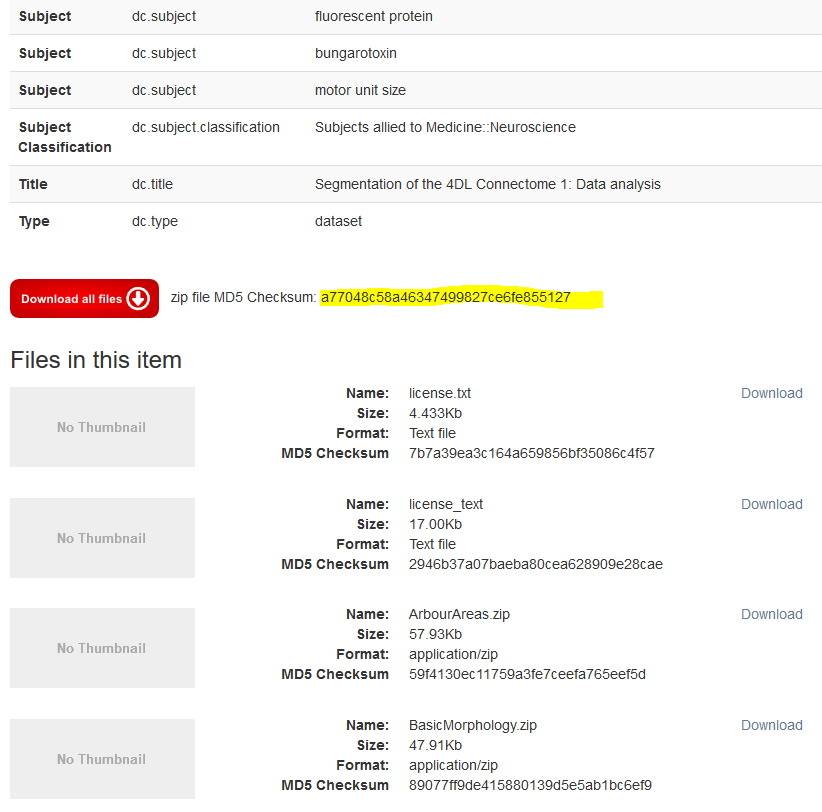
DataShare displays MD5 checksum hash
- On my PC, I generate the MD5 checksum hash of the downloaded copy, and then I check that the hash on DataShare matches. There are a number of free tools available for this task: I could use the Windows command line, or I could use an MD5 utility such as the free “MD5 and SHA Checksum Utility”. In the case of the Checksum Utility, I do this as follows:
- I paste the hash I copied from DataShare into the desktop utility (ignoring the fact the program confusingly displays the checksum hashes all in upper case).
- I click the “Verify” button.
In this case they are identical – I have a match. I’ve confirmed the integrity of the file I downloaded.
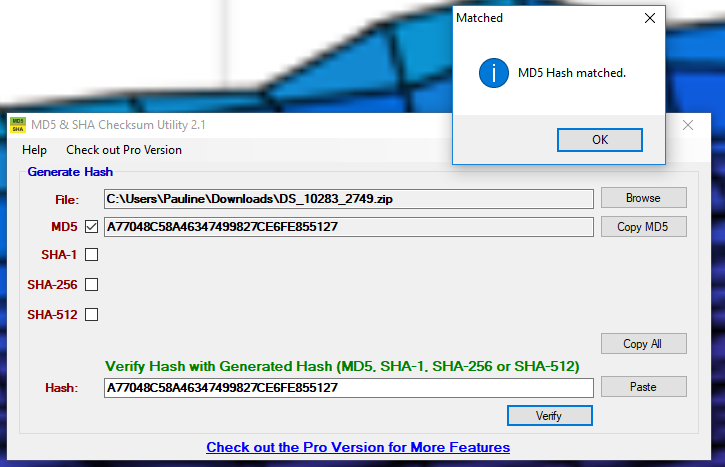
The MD5 checksum hashes match each other.
More confidence in request-a-copy for embargoed files
Another improvement we’ve made is to give depositors confidence in the request-a-copy feature. If the files in your deposit are under temporary embargo, they will not be available for users to download directly. However, users can send you a request for the files through DataShare, which you’ll receive via email. If you then agree to the request using the form and the “Send” button in DataShare, the system will attempt to email the files to the user. However, as we all know, some files are too large for email servers.
If the email server refuses to send the email message because the attachment is too large, DataShare 3.0 will immediately display an error message for you in the browser saying “File too large”. Thus allowing you to make alternative arrangements to get those files to the user. Otherwise, the system moves on to offer you a chance to change the permissions on the file to open access. So, if you see no error after clicking “Send”, you’ll have peace of mind the files have been sent successfully.
Pauline Ward, Research Data Service Assistant
EDINA and Data Library
New! International encyclopedia of public health
Thanks to a request from staff in the School of Social and Political Science the Library now has online access to all 7 volumes of the International encyclopedia of public health (2nd ed.) The Encyclopedia is an authoritative and comprehensive guide to the major issues, challenges, methods, and approaches of global public health.
You can access the International encyclopedia of public health via DiscoverEd. Access is available both on and off-campus.

University of Edinburgh Further Supports Open Library of Humanities
 The University of Edinburgh has opted to support the Open Library of Humanities at a higher rate than required. This additional support will enable the OLH to continue its growth mission to convert subscription journals to a solid, ongoing, open-access model, with no author-facing charges.
Theo Andrew, Scholarly Communications Manager at the University of Edinburgh, said: “The OLH is such good value for money. Library budgets are always tight, but we feel that we should be doing more to support academic-led publishing. OLH puts a lot back into the academic community and we are pleased to help with its ongoing sustainability.”
Professor Martin Paul Eve, a CEO of the Open Library of Humanities, added: “We are greatly indebted to the University of Edinburgh for its support and flattered by its praise. It is intensely gratifying to see libraries who can, in the face of budgetary difficulty, still find ways to support their core mission: the dissemination of knowledge to all. We understand that not every institution can do this, but when it does happen, it genuinely makes a difference to us in what we can provide.”
Collections
 Hill and Adamson Collection: an insight into Edinburgh’s past
My name is Phoebe Kirkland, I am an MSc East Asian Studies student, and for...
Cataloguing the private papers of Archibald Hunter Campbell: A Journey Through Correspondence
My name is Pauline Vincent, I am a student in my last year of a...
Hill and Adamson Collection: an insight into Edinburgh’s past
My name is Phoebe Kirkland, I am an MSc East Asian Studies student, and for...
Cataloguing the private papers of Archibald Hunter Campbell: A Journey Through Correspondence
My name is Pauline Vincent, I am a student in my last year of a...

Projects
Cataloguing the private papers of Archibald Hunter Campbell: A Journey Through Correspondence
My name is Pauline Vincent, I am a student in my last year of a...
Archival Provenance Research Project: Lishan’s Experience
Presentation My name is Lishan Zou, I am a fourth year History and Politics student....