Home University of Edinburgh Library Essentials
April 8, 2026
Scotland’s languages: Gaelic, Scots and English
This is the second post on Scotland’s languages. This time we look more closely at the languages spoken throughout the parishes. As can be gleaned in the last blog post, at one point the majority of Scots spoke Gaelic, or Erse as this was called in some of the parish reports. According to the authors of the Statistical Accounts, Gaelic was more widely spoken in many parishes. But there were also areas of Scotch or Scots speakers, with English beginning to make strong inroads.
Predominantly Gaelic-speaking parishes
There were many parishes where most inhabitants spoke Gaelic, including:
- Barvas, County of Ross and Cromarty (NSA, Vol. XIV, 1845, p. 147);
- Moy and Dalarossie, County of Inverness (OSA, Vol. VIII, 1793, p. 499);
- Applecross, County of Ross and Cromarty (NSA, Vol. XIV, 1845, p. 102)
- Gairloch, County of Ross and Cromarty – “The Gaelic is the prevailing language in this, as well as in several other corners on the West coast” (OSA, Vol. III, 1792, p. 93);
- Inverary, County of Argyle – “The language generally spoken is the Gaelic. Among the agricultural labourers, it is almost exclusively used; and as many of them, for various reasons, remove from the country into the burgh, they naturally continue to speak their mother tongue, and to teach it to their children.” (NSA, Vol. VII, 1845, p. 27).

Brown, William Beattie; Coire-na-Faireamh, in Applecross Deer Forest, Ross-shire; 1883-84. Royal Scottish Academy of Art & Architecture; http://www.artuk.org/artworks/coire-na-faireamh-in-applecross-deer-forest-ross-shire-186783
However, this situation was beginning to change. If you look at the parish reports for Gigha and Cara, County of Argyle, you can see the differences in language use even between the Old and New Statistical Accounts of Scotland.
“The language of the common people is Gaelic, but not reckoned the purest, on account of their vicinity, to Ireland, and intercourse with the low country, by which many corruptions have been introduced into their phraseology. They understand English, and several speak it well enough to transact business; but very few of them can understand a connected discourse in that language.” (OSA, Vol. VIII, 1793, p. 65)
“English, however, is much better understood by young and old than it was forty years ago, but there are not above ten persons in the parish who do not understand and speak Gaelic.” (NSA, Vol. VII, 1845, p. 401)
By the time of the New Statistical Accounts, in practically all of the parishes English was increasingly understood and spoken. It is always interesting when figures, even approximations, are provided. In Southend, County of Argyle, “the language generally spoken by two thirds of the people is Gaelic; but, from the establishment of schools and the intercourse with Campbelton, and the Lowland districts of Scotland, the English language is beginning to be universally understood. Families who understand Gaelic best, 210; English best, 145.” (NSA, Vol. VII, 1845, p. 431)
We will be looking at the rise of the English language in the next post.
Predominantly Scotch/Scots-speaking parishes
Scots is a Germanic language variety spoken in Lowland Scotland and some areas of Ulster. It is itself “a dialect of the Dano-Saxon, which was brought from the other side of the German Ocean, by the Danish invaders of the ninth and eleventh centuries”. (OSA, Vol. IX, 1793, p. 226) Here are some examples of parishes which were predominantly Scots-speaking. Again, we can see that in many cases other languages have also left their mark.
- New Spynie, County of Elgin (OSA, Vol. X, 1794, p. 637)
- Cromarty, County of Ross and Cromarty – “The language of all born and bred in this parish, approaches to the broad Scotch, differing, however, from the dialects spoken in Aberdeen and Murrayshire; this being one of the three parishes in the counties of Ross and Cromarty, in which, till of late years, the Gaelic language, which is the universal language in the adjacent parishes, was scarce ever spoken. There has been a considerable change, of late years, in this respect, among the inhabitants here; the Gaelic having become rather more prevalent than usual.” (OSA, Vol. XII, 1794, p. 254) This was attributed to Gaelic-speaking people coming to work in the parish.
- Kirkmichael, County of Ayrshire – “The language is a mixture of Scotch and English, without any particular accent. In this district, as in every other, there are certain provincial words and phrases peculiar to itself.” (OSA, Vol. VI, 1793, p. 111)
- Drainie, County of Elgin – “The only language here is Scotch; but the pronunciation is gradually approaching nearer to the English. Gaelic is not spoken nearer than 20 miles; and very few
of the names of places here seem derived from it.” (OSA, Vol. IV, 1792, p. 87) - Boharm, County of Banff – “The Scotch is the only language spoken in the parish; but, with a few exceptions, the names of the places belong to the Erse tongue.” (OSA, Vol. XVII, 1796, p. 362)
- Tannadice, County of Forfar – “The broad Scotch is the only language spoken here. Some of the names of places are Gaelic, and others of Gothic origin; although the former seems to abound most.” (OSA, Vol. XIX, 1797, p. 380)
- Kinfauns, County of Perth – “The language of this parish and corner is Saxon, intermixed with Scottish words and expressions; attended, however, by little or no provincial accent or dialect. Though this part of the country is not at a great distance from the Highlands, yet neither Gaelic words nor accent are known amongst the natives below Perth. Very few names of places are Erse; but great number are Scotch or Saxon.” (OSA, Vol. XIV, 1795, p. 223)
- Canisbay, County of Caithness – “The Scotch, with an intermixture of some Norwegian vocables, is the only language spoken in the parish… There is scarcely a place in the whole parish, whose name is not of Norwegian derivation.” (OSA, Vol. VIII, 1793, p. 162)
- New Machar, County of Aberdeen – “The common people speak the Scotch language, and in what is commonly called, and well known by the name of, the Aberdonian Dialect.” (OSA, Vol. VI, 1793, p. 470)

Nasmyth, Alexander; Robert Burns; 1821-22. National Portrait Gallery, London; http://www.artuk.org/artworks/robert-burns-157341
In some parish reports, particular Scots pronunciation was remarked upon. In Gamrie, County of Banff, “the language spoken in this parish is the Scottish, with an accent peculiar to the north country. There is no Erse.” (OSA, Vol. I, 1791, p. 477) In Dron, County of Perth, “the language spoken here is Scotch, with a provincial accent or tone; the pronunciation rather slow and drawling, and apt to strike the ear of a stranger as disagreeable.” (OSA, Vol. IX, 1793, p. 478) Scots spoken in the county of Fife also had its own pronunciation. In Carnock, County of Fife, “the language now generally spoken in this district, is the broad Scotch dialect, with the Fifeshire accent, which gives some words so peculiar a turn, as to render the speaker almost unintelligible to the natives of a different county.” (OSA, Vol. XI, 1794, p. 496) In St Andrews and St Leonards, County of Fife, “the language of this parish is the common dialect of the Scotch Lowlands. The Fifans are said, by strangers, to use a drawling pronunciation, but they have very few provincial words.”(OSA, Vol. XIII, 1794, p. 215) Specific examples of pronunciation will be given in the next post on Scotland’s languages.
Predominantly English-speaking parishes
What is particularly interesting to note about the predominantly English-speaking parishes is that, for the most part, they do not actually border England! (Read the next post to look at possible reasons why.) Again, there are influences from other languages, such as Gaelic and Scots, and Norse in the Shetland Isles.
- Cushnie, County of Aberdeen – “English is the only language now known in the parish, the Gaelic having ceased to be understood.” (OSA, Vol. IV, 1792, p. 177)
- Ardersier, County of Inverness – “The language generally spoken in the village, which contains three-fourths of the population of the parish, is English. In the interior, Gaelic prevails. But, from recent changes in the lessees of farms, and from the new occupants possessing little of the Celtic character, it may be fairly stated, that the Gaelic has lost, and is losing ground.” (NSA, Vol. XIV, 1845, p. 472)
- Newbattle, County of Edinburgh (NSA, Vol. I, 1845, p. 70)
- Broughton, County of Peebles – “The language spoken here is English, with the Scotch accent.” (OSA, Vol. VII, 1793, p. 158)
- Kirkconnell, County of Dumfries – “only the English language is now spoken here, as in the rest of Nithsdale, with considerable purity, excepting chiefly a few old Scotch, or rather obsolete Saxon words, that now and then occur; and in a plain, easy, manly style of pronunciation, without any of those grating peculiarities of provincial accent, that mark the dialect of some of the adjoining counties. With the small exception, of one from England, and another from Ireland, the inhabitants are all natives of Scotland.” (OSA, Vol. X, 1794, p. 447)
- Portpatrick, County of Wigton – “English is spoken in this parish, with less of provincial accent and less mixture of Scotch than in the more central and populous districts of Scotland.” (NSA, Vol. IV, 1845, p. 145)
- Section on the county of Shetland from volume 15 in account 2 – “The language is English, with the Norse accent, and many of its idioms and words.” (NSA, Vol. XV, 1845, p. 156)
Here, we should mention that there seems to be some confusion between the English language and the Scots dialect. In some quarters, Scots is seen as a dialect of English, or even “English or Saxon, with a peculiar provincial accent” (OSA, Vol. VIII, 1793, p. 193), instead of it being a language in its own right. This makes it a little difficult to identify those parishes speaking English and those speaking Scots. Examples include:
- Bellie, County of Elgin – “The Gaelic tongue, however, has long disappeared in this part of the country; the language, in general, being that dialect of English common to the North of Scotland; though, among all persons who pretend to anything like education, the English language is daily gaining ground.” (OSA, Vol. XIV, 1795, p. 264)
- Luss, County of Dumbarton -“The language now universally spoken by the natives of the parish is the English language, or rather the provincial Scotch dialect.” (NSA, Vol. VIII, 1845, p. 162)
- Speymouth, County of Elgin – “The language here spoken is the English, if the broad Scotch that is spoken throughout the greatest part of Murray, Banff, and Aberdeenshires, be thought entitled to that name. Erse is not the common language within 20 miles of us.” (OSA, Vol. XIV, 1795, p. 406)
- Keith, County of Banff – “In this parish, and in all the neighbourhood, the language spoken is the Scotch dialect of the English language.” (OSA, Vol. V, 1793, p. 423)
Language differences within parishes
As well as language differences between parishes, there are differences within parishes. In the parish of Luss, County of Dumbarton, “south from Luss, English, and north from it the Gaelic, is the prevailing language.” (OSA, Vol. XVII, 1796, p. 266) Here are some other inter-parish variations:
- Keith, County of Banff – “All the old names of places are evidently derived from the Gaelic, which language is generally spoken in a detached corner of the parish, by a colony from various districts of the Highlands; who being indigent, and supported by begging, or their own alertness, are allured there by the abundance of moss, and the vicinity of a very populous and plentiful country.” (OSA, Vol. V, 1793, p. 423)
- Little Dunkeld, County of Perth – “In that part of the parish which is below lnvar, the people speak the Scottish dialect of the English, and are not distinguished by any perceptible shade of character from the inhabitants of the low country parishes around them. The rest of the inhabitants (more than three fourths) are Highlanders, who speak a dialect, not perhaps the purest, of the Gaelic. They have all a strong attachment to their native tongue; many speak English with tolerable case, and the youth, by means of the charity schools, can write it with rather more propriety, and copiousness than those of the low country part of this parish, who are very all situated with respect to schools.” (OSA, Vol. VI, 1793, p. 369)
- Dowally, County of Perth – “It is curious fact, that the hills of King’s Seat and Craigy Barns, which form the lower boundary of Dowally, have been for centuries the separating barrier of these languages. In the first house below them, the English is, and has been spoken; and the Gaelic in the first house, (not above a mile distant), above them.” (OSA, Vol. XX, 1798, p. 490)
- Edenkillie, County of Elgin – “In the lower part of the parish, the Scotch dialect of the English language is only spoken; but, in the upper part, the Gaelic is still much in use. About 50 years ago, the minister preached the one half of the day in English, and the other half in Gaelic.” (OSA, Vol. VIII, 1793, p. 566)
- Strathdon, County of Aberdeen – “The language spoken is English, or rather broad Scotch, excepting in Curgarff. The people there, especially in the upper part of that district, speak also a kind of Gaelic; but that language among them is much on the decline.” (OSA, Vol. XIII, 1794, p. 183)
- Monzie, County of Perth – “This parish being situated on the borders of the Highlands, and having much intercourse and connection with the natives, we need not be surprised to find that the Gaelic is spoken in the back part of it, and the old Scotch dialect in the fore part, pronounced with the Gaelic tone and accent. There are, however very few persons in the whole parish, who do not either speak or understand Gaelic.” (OSA, Vol. XV, 1795, p. 251)
- Dunkeld, County of Perth – “The English language is spoken in Dunkeld. In Dowally, with the exception of 110 persons, English is spoken with fluency, but they prefer Gaelic. Gaelic is still preached, and it is taught, along with English, at school.” (NSA, Vol. X, 1845, p. 989)
- Crieff, County of Perth – “The people speak the English language in the best Scotch dialect: although the Gaelic be commonly spoken at the distance of three miles north, of four west from Criess, yet no adult natives of the lowland part of the parish can either speak or understand it. They have not even contracted the peculiar tone of that language, by their intercourse with the numerous Highland families now residing in the town. Many indeed of these understand no other language but the Gaelic, and their children born in Crieff speak that alone for a few years as their mother-tongue.” (OSA, Vol. IX, 1793, p. 601)
Conclusion
It has been very interesting to discover the language similarities and differences between parishes and even within parishes. It is clear that, even though parishes were predominantly Gaelic, Scots or English speaking, other languages were influencing what was being spoken. In the next post, we will look at the concept of language purity and, conversely, corruption, as well as specific examples of pronunciation found in the Statistical Accounts of Scotland.
Fitba’ crazy, fitba’ mad? A football inspired reading list (yet again!)
The 2018 World Cup kicks off today in Russia and to mark this occasion we decided to resurrect and update our football inspired reading list that we originally published just over 2 years ago when Euro 2016 began (and 2 years before that when the 2014 World Cup started – don’t say we don’t have any new ideas!) These are just a small number of the e-books currently available to staff and students of the University in the Library’s collections that look at different aspects of the beautiful (or not so beautiful) game from a social sciences perspective.

Football and supporter activism in Europe: whose game is it? edited by
Marketing and football: an international perspective edited by Michel Desbordes and Simon Chadwick examines in two parts the study of football marketing in Europe and the development of a marketing dedicated to football, with the question of the European example being used worldwide.
Football hooliganism, fan behaviour and crime: contemporary issues edited by Matthew Hopkins and James Treadwell focuses on a number of contemporary research themes placing them within the context of palpable changes that have occurred within football in recent years. The collection brings together essays about football, crime and fan behaviour from leading experts in the fields of criminology, law, sociology, psychology and cultural studies. Read More
Correcting Shakespeare
 Since November last year, I have been volunteering on the Luna Project in the Digital Imaging Unit. Throughout the project I have been working with the University of Edinburgh’s Shakespeare Collection. As a fan of Shakespeare’s work, I was delighted to have the opportunity to work closely with this collection which contains a variety of different classic Shakespeare plays such as; Romeo and Juliet, Henry VI, Midsommer Night’s Dreame and my personal favourite, the Taming of The Shrew. Read More
Plaque Unveiled to Edinburgh University’s First Nobel Prize Winner
Today, at the Hermitage of Braid, Principal Peter Mathieson will unveil a plaque commemorating Edinburgh University’s first Nobel Prize winner, physicist Charles Glover Barkla (1877–1944). Barkla is one of a dozen figures being honoured in this year’s round of Historic Environment Scotland’s Commemorative Plaque Scheme. The plaque will be mounted at Barkla’s former home of Braidwood, which is currently the Visitors Centre for the Hermitage of Braid Nature Reserve.

Born in Widnes, Lancashire, Barkla studied at University College Liverpool, and occupied a number of academic posts in Cambridge, London, and Liverpool, before being appointed to Edinburgh University’s Chair of Natural Philosophy (Physics) in 1913. He held the chair until his death in 1944, playing a prominent role in instituting honours degrees in pure science and developing the honours school of physics.
Barkla was awarded the 1917 Nobel Prize for Physics for his ground-breaking work with X-rays. Barkla conducted experiments that demonstrated that X-rays could be partially polarized, thereby proving that they were a form of transverse electromagnetic radiation with properties similar to light. With the First World War still raging, the announcement of the 1917 Nobel Prize was delayed until 12 November 1918. Barkla’s Nobel Banquet was held on 1 June 1920, and he gave his Nobel Lecture on 3 June 1920.
Edinburgh University Archives hold Barkla’s Nobel Prize citation (E96.23; see images below), together with a collection of congratulatory letters and telegrams from fellow scientists (E96.10). Our Barkla Papers (Coll-296) also contain lectures and lecture notes (E91.105).
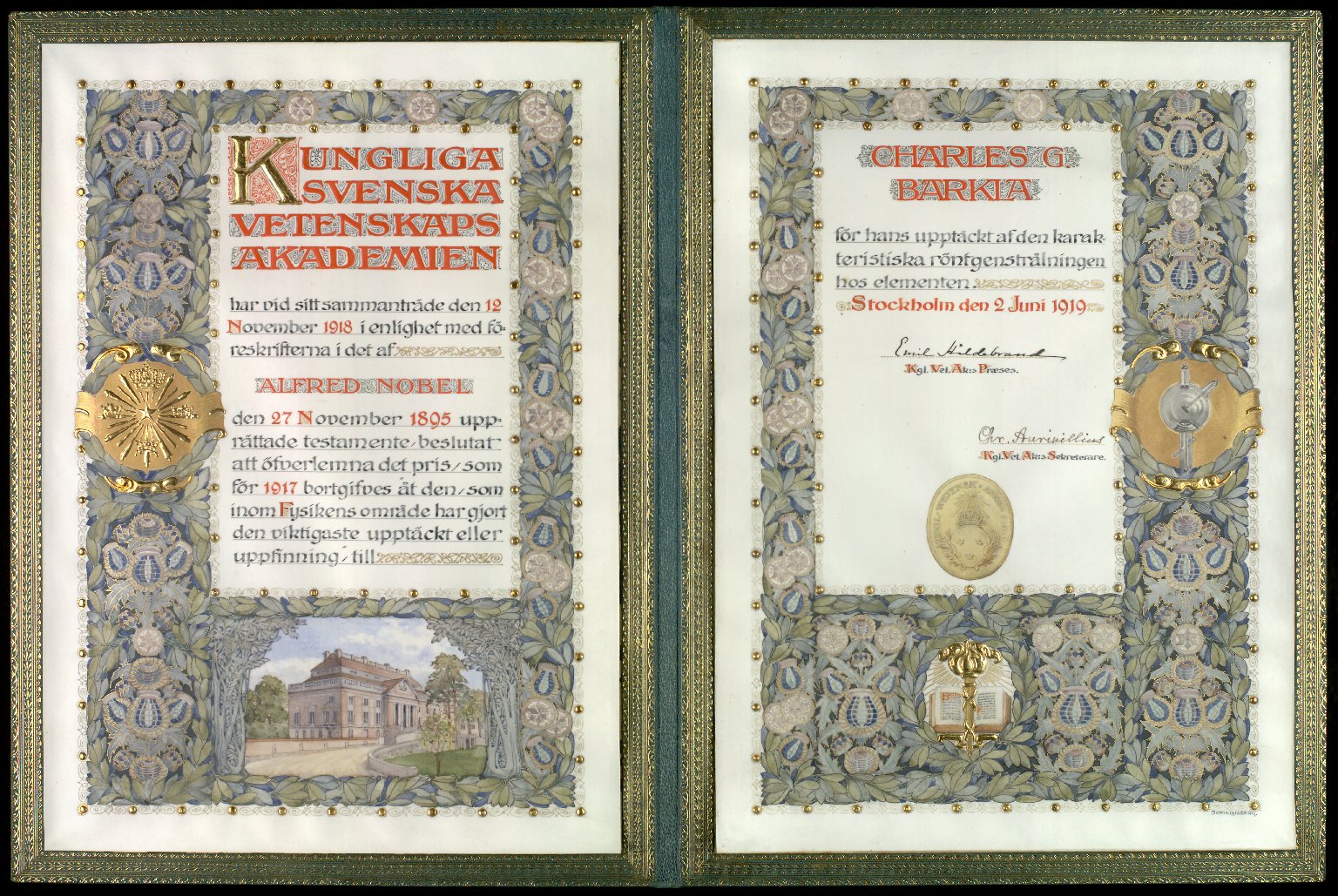
Barkla’s Nobel citation
Barkla is also commemorated by a plaque on the University of Edinburgh’s Institute of Geography building (formerly occupied by Natural Philosophy). See here for more information:
D-Day anniversary: Norman memories in the archives
A more personal take on our archives…
As any archivist knows, you can sometimes stumble upon archives with an unexpected and personal connection: this was the case for me when I found out that in the Special Collections of the Library was an album containing 175 photographs and postcards showing my home city, Caen, before and during the Second World War (Coll-164)… It immediately reminded me of my own grandparents, who had lived through the occupation, the bombing and finally the liberation of this medium-sized Norman city. They would always tell me stories about life during the war, and describe the way Caen looked before it: indeed, about 80 percent of the city was destroyed, in particular during the controversial bombing raid that preceded the ‘Operation Charnwood’ in July 1944.
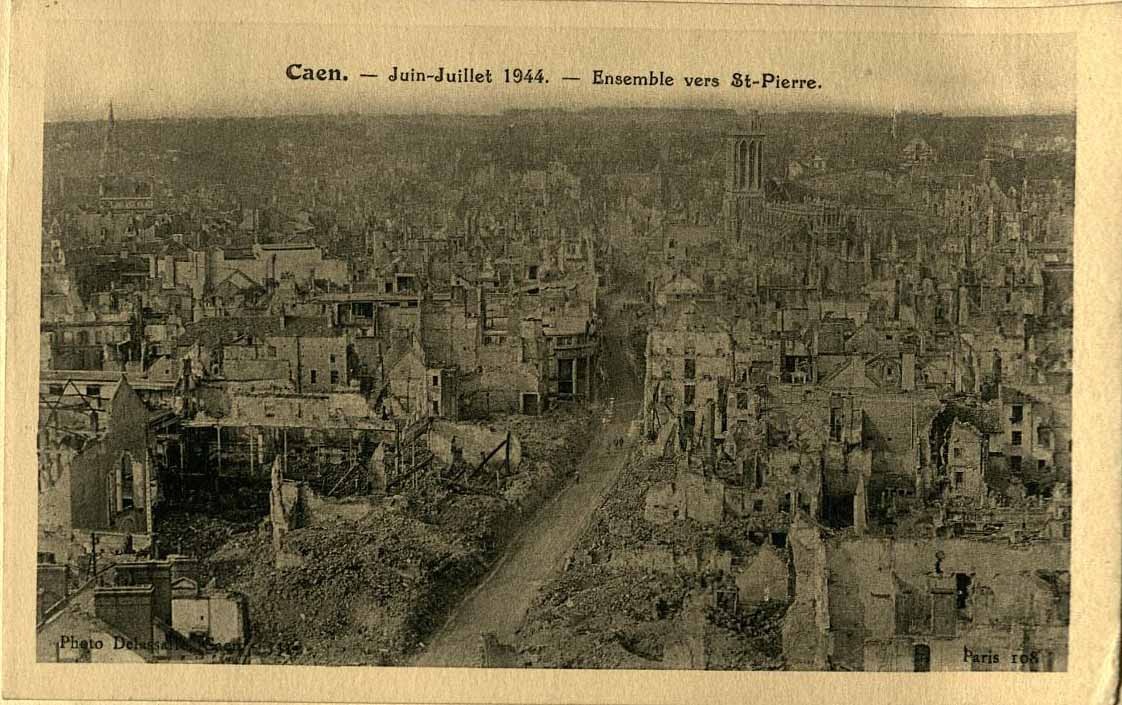
Aerial view of Caen after the bombings in July 1944 (Coll-164/4)
As you can see in the picture, the city was ravaged. The central area around the castle, St Pierre Church, and the neighbourhood called îlot St Jean were particularly affected. Post-war Caen looks like a field of ruins, and I was moved when I browsed the album for the first time and saw the full extent of the devastation. When it happened my grandmother, who was around 15 at the time, had taken shelter in a town a few kilometres away; but my grandfather was there and took part in the rescue effort to help searching the rubbles for survivors. He was only 18.
Looking through the album, I was able to recognise a few familiar buildings amid the destruction: churches, streets, houses, the castle… I knew exactly where these were and what they looked like now. I found the comparison really interesting, and this is why I decided to do a little before/after photo shoot when I went home for the Christmas holidays.
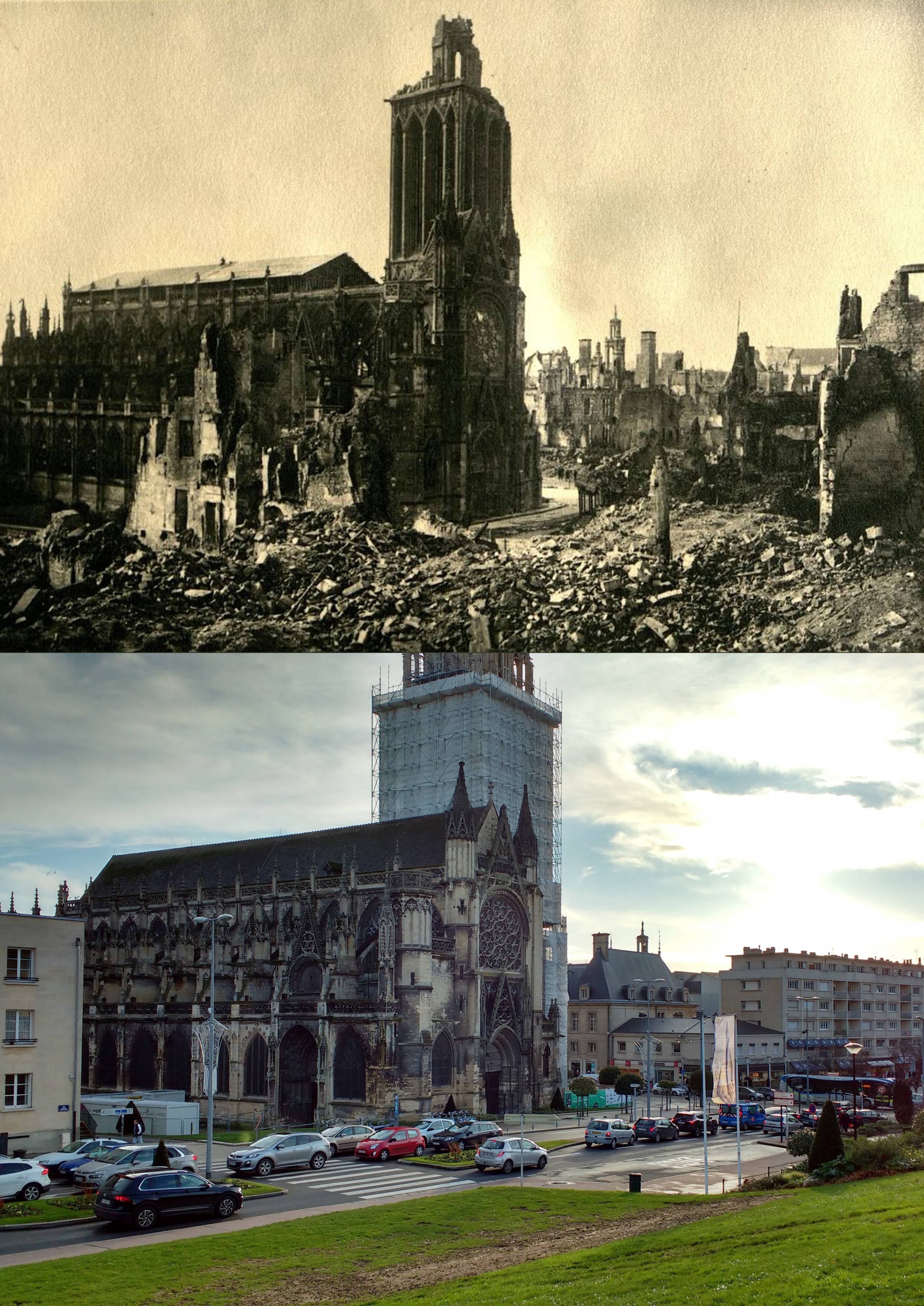
St Pierre Church and surrounding area (Coll-164/58)
I started my little project on a sunny winter afternoon. Walking past my old university, I remembered that one of the nearby avenues was called ‘Avenue d’Edimbourg‘; and I finally understood why! Edinburgh was one of the cities that sent help and supplies to Caen after the bombing raid. The album is testimony to this connection: it was donated by John Orr, Professor of French at the University of Edinburgh and founder of the Caen-Edinburgh Fellowship. The latter was set up after the war to help the inhabitants of Caen by sending food, clothes, and supplies to the devastated city. John Orr himself organised for books to be sent to the library of the University, which was completely destroyed and had to be rebuilt from scratch, and for this he’s also had a street named after him.
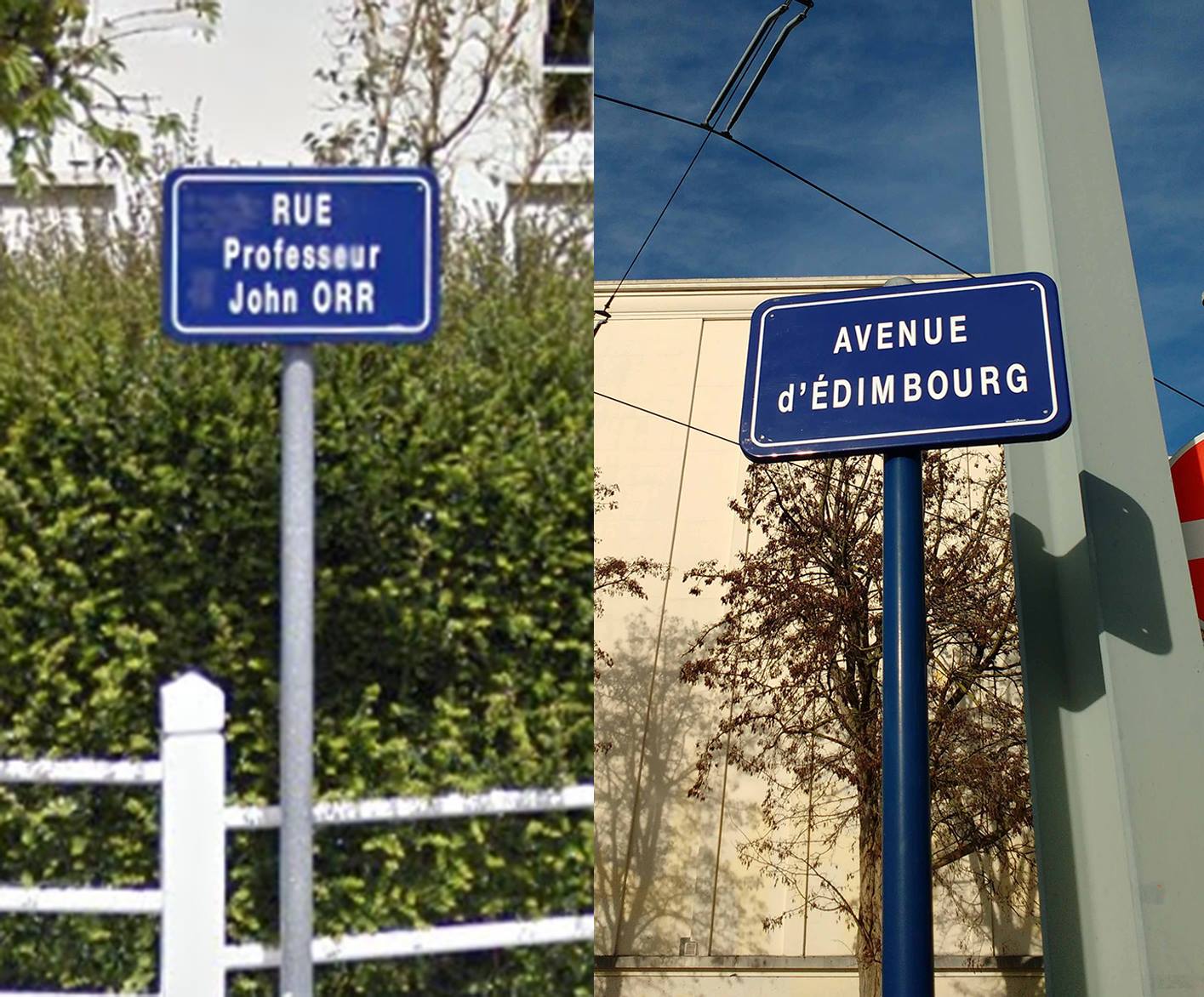
Street signs named after John Orr.
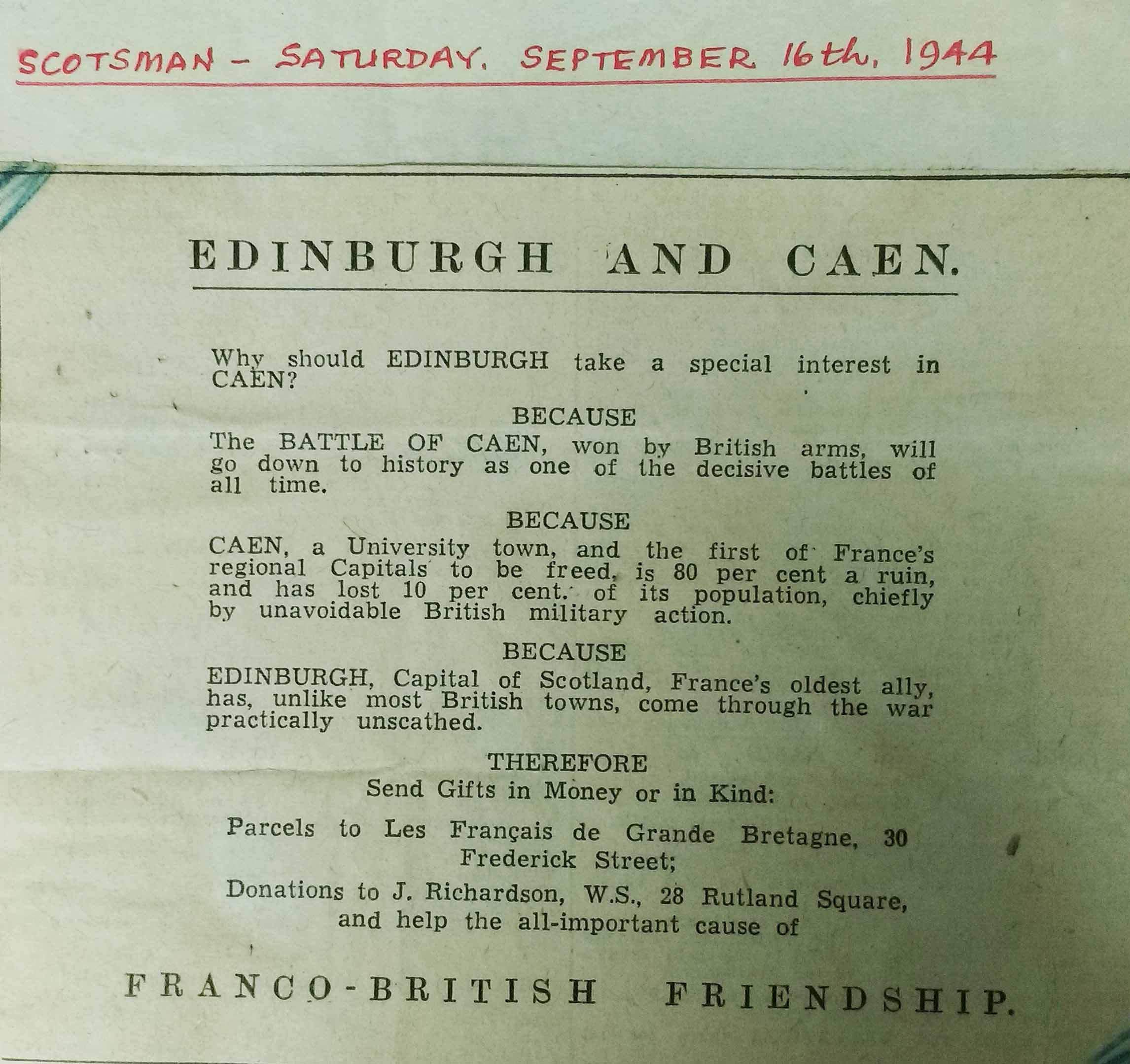
Call for donations to Caen from the papers of Professor John Orr held in the Special Collections (Coll-77).
I soon arrived in the city centre. The most noticeable building in Caen is its massive castle, founded in 1060 by William the Conqueror. It was used as barracks between 1789 and 1945, and occupied by German troops during the War, which explains why it was targeted by bombings. Some buildings and parts of walls were damaged, but most of it survived in decent condition. The same cannot be said for the houses build alongside its walls…And so, after the clearing of the ruins, the castle reappeared, and it was decided to restore and showcase this millennium-old building that overlooks the city. The words of my grandmother came back to me: ‘We didn’t even know we had a castle because there were so many houses around it! After the war it came a bit as a surprise…’
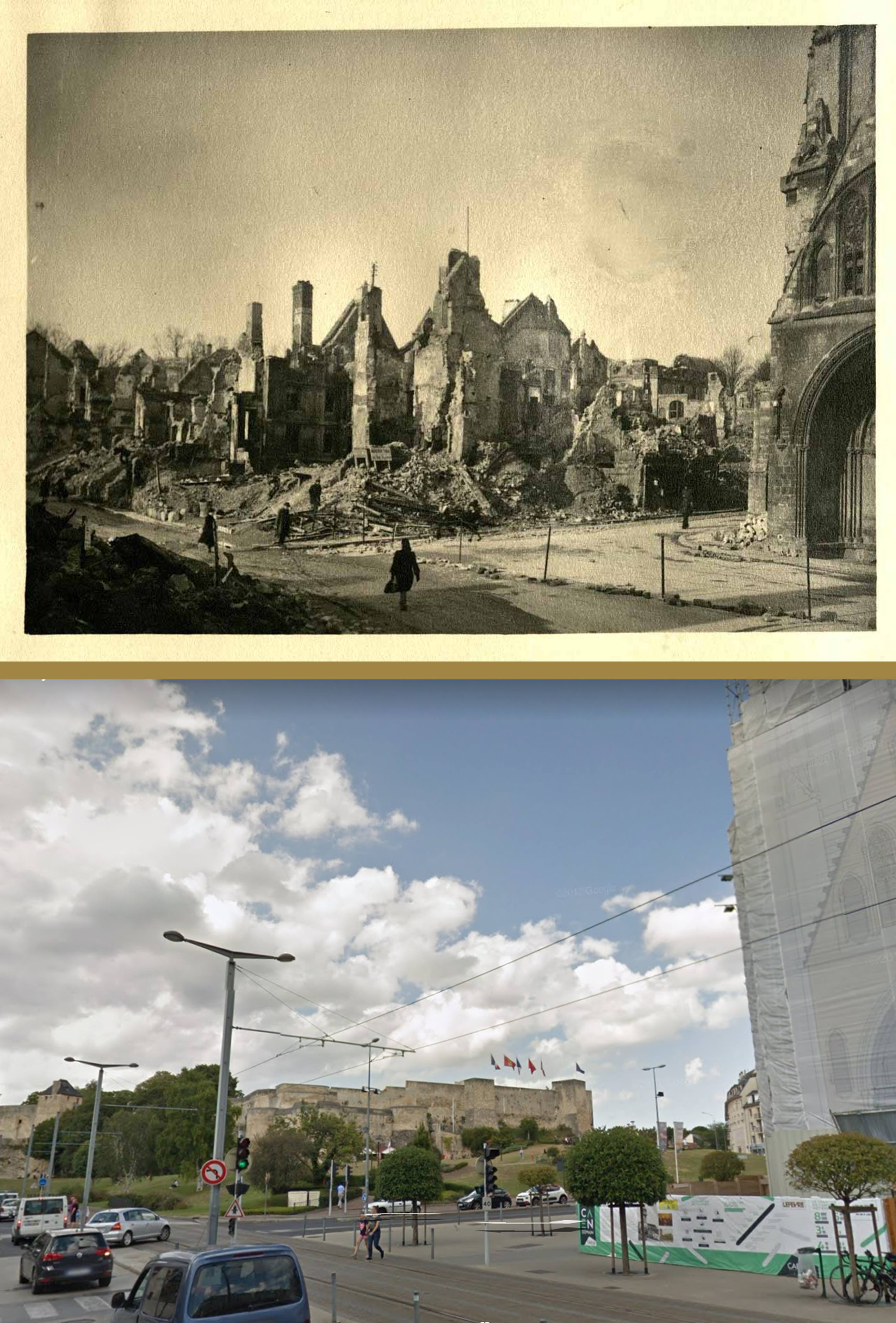
Castle of Caen seen from St Pierre Church. The surrounding buildings which were hiding it for centuries were not rebuilt after the war. (Coll-164/61)
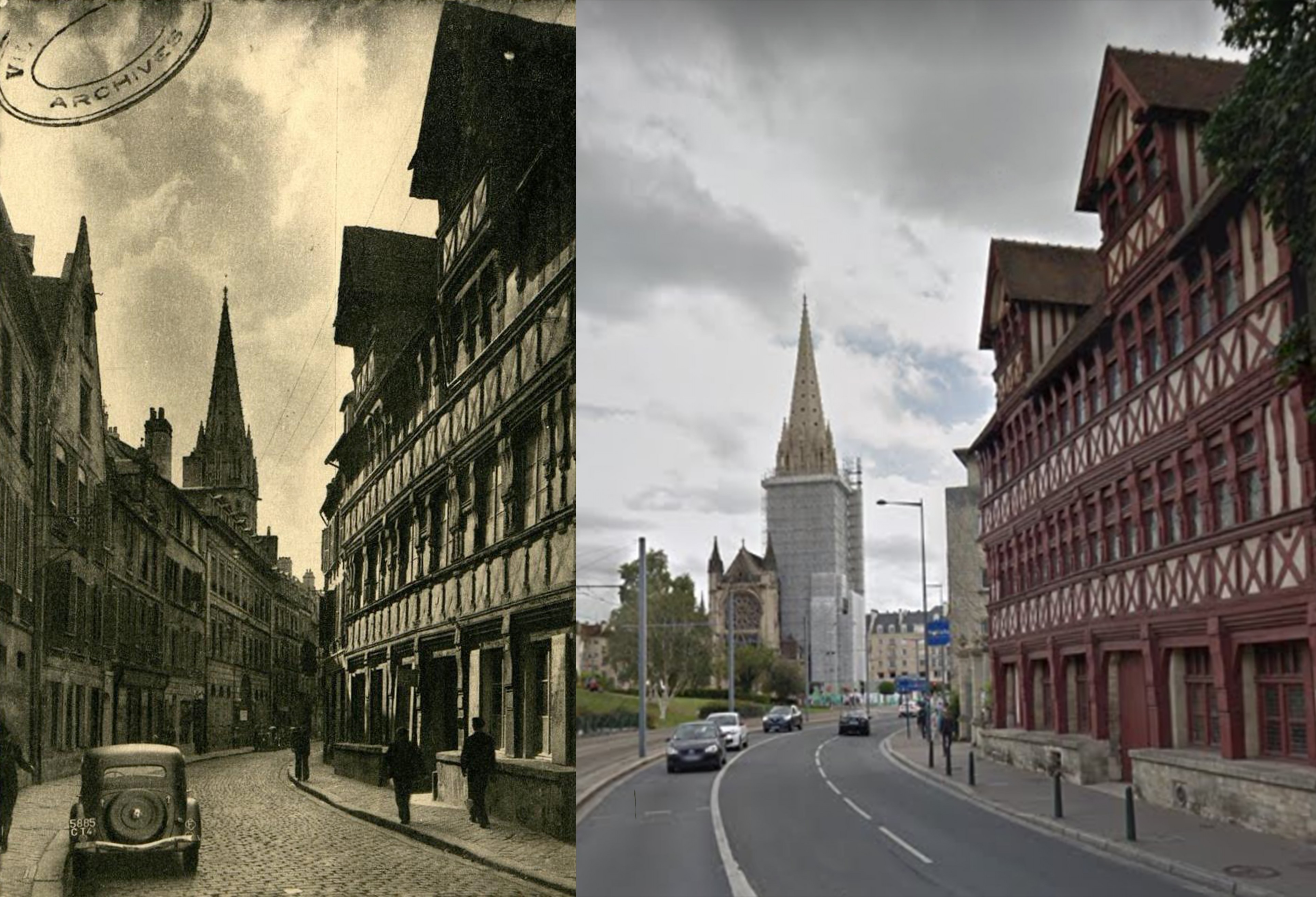
Maison des Quatrans. The buildings which were in-between the house and the castle have been destroyed. (Coll-164/71)
But not everything was completely destroyed in Caen! Our old town centre, the Quartier St-Pierre (‘St Pierre neighbourhood’), still has many original features. The Church, for starter – the tower was destroyed and then rebuilt, and is now being cleaned to restore its original white-yellowish colour, darkened by pollution. The buildings around it, however, went up in smoke. La Rue Montoire Poissonerie (Montoire Poissonerie Street), for example, has vanished.
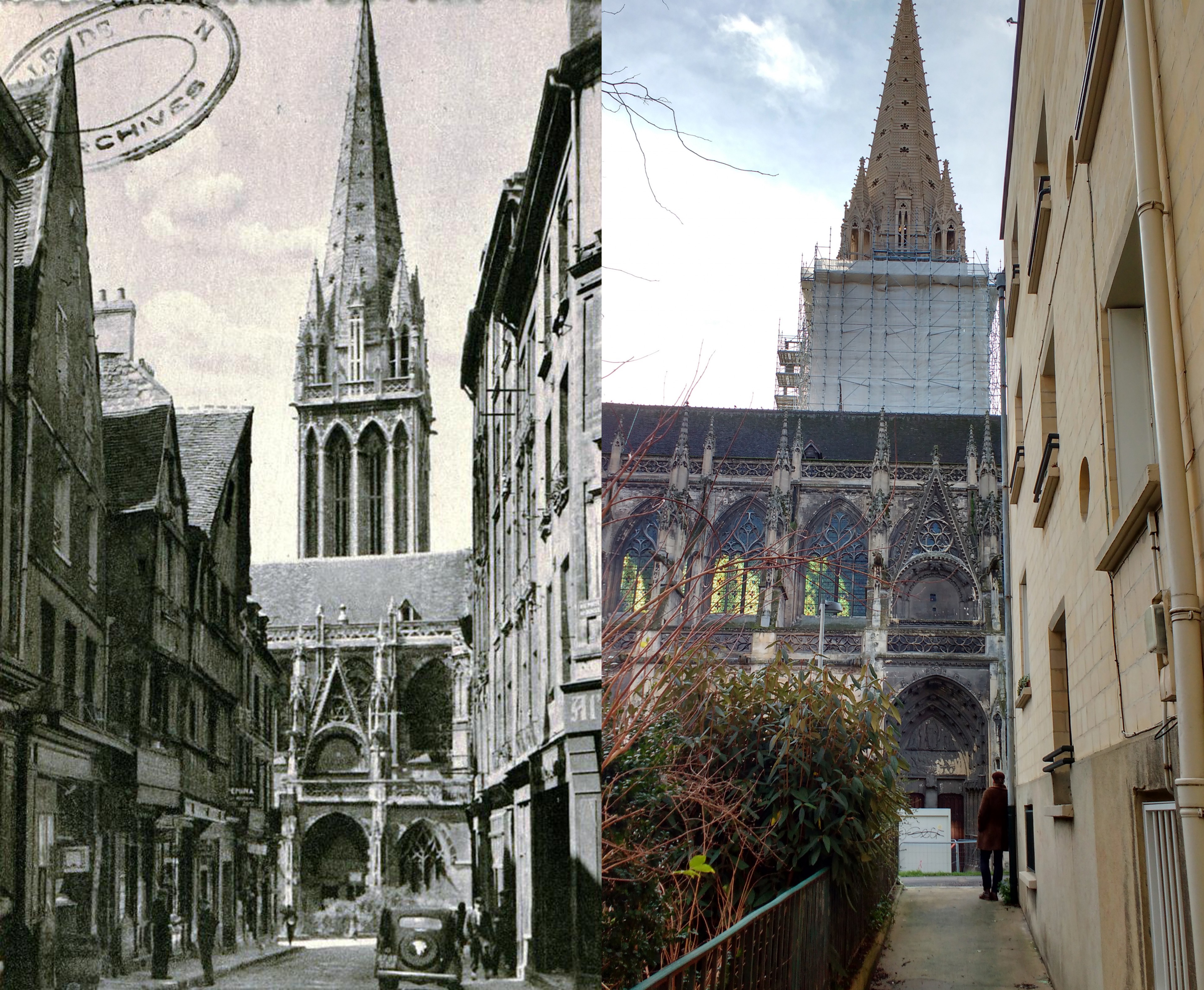
St Pierre Church from Rue Montoire Poissonerie (now an apartment building). (Coll-164/11)
On the other hand, the main street of the neighbourhood, la rue St Pierre, has been more or less spared, and the old stands alongside the new. In the picture below you can see the busy Place St Pierre, full of shoppers and tourists, with the church Notre-Dame-de-Froide-Rue in the background and a beautiful half-timbered house from the 15th century. They miraculously survived, and are now being restored to get their lively colours back!
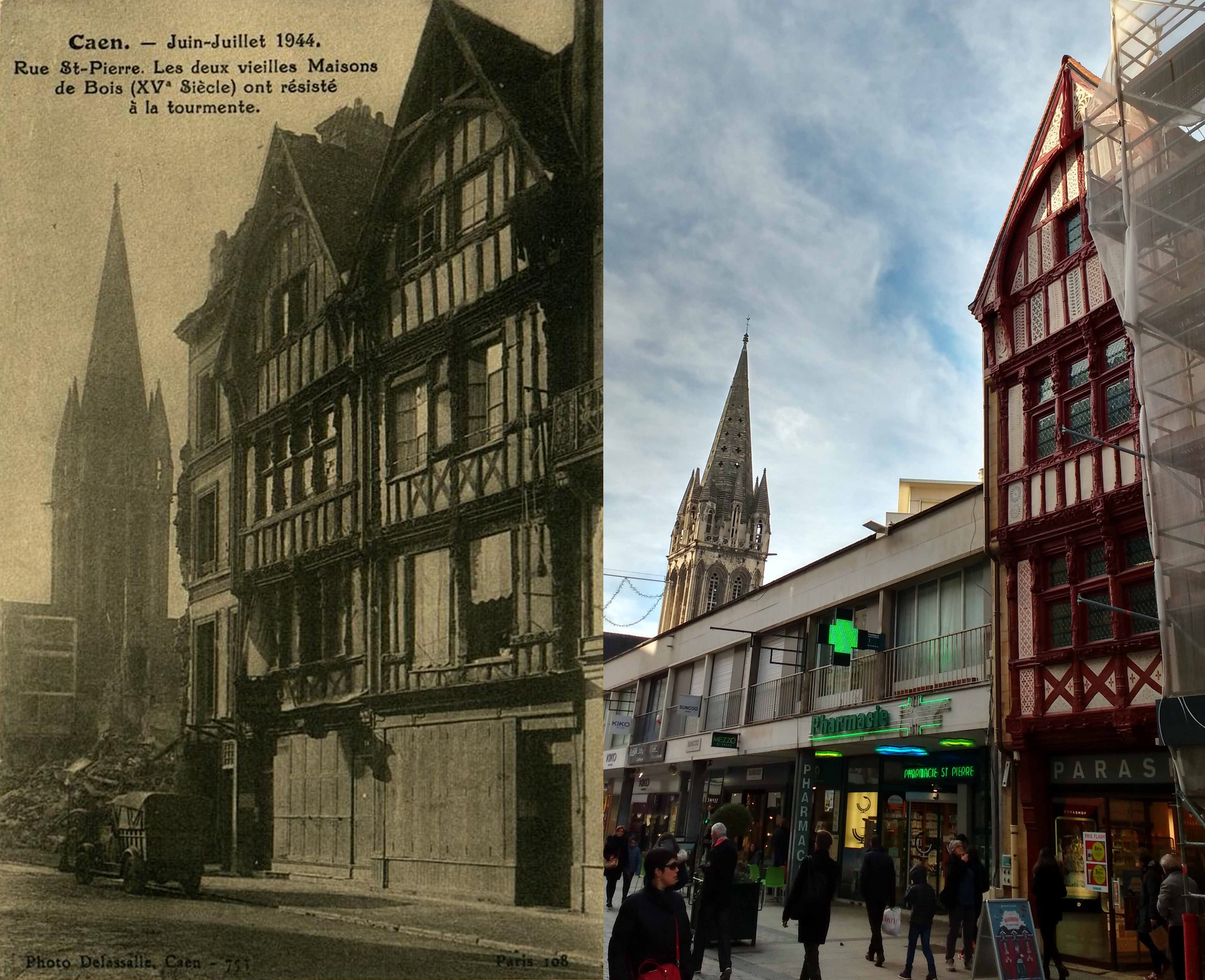
Place St Pierre and its 15th century half-timbered houses. (Coll-164/18)
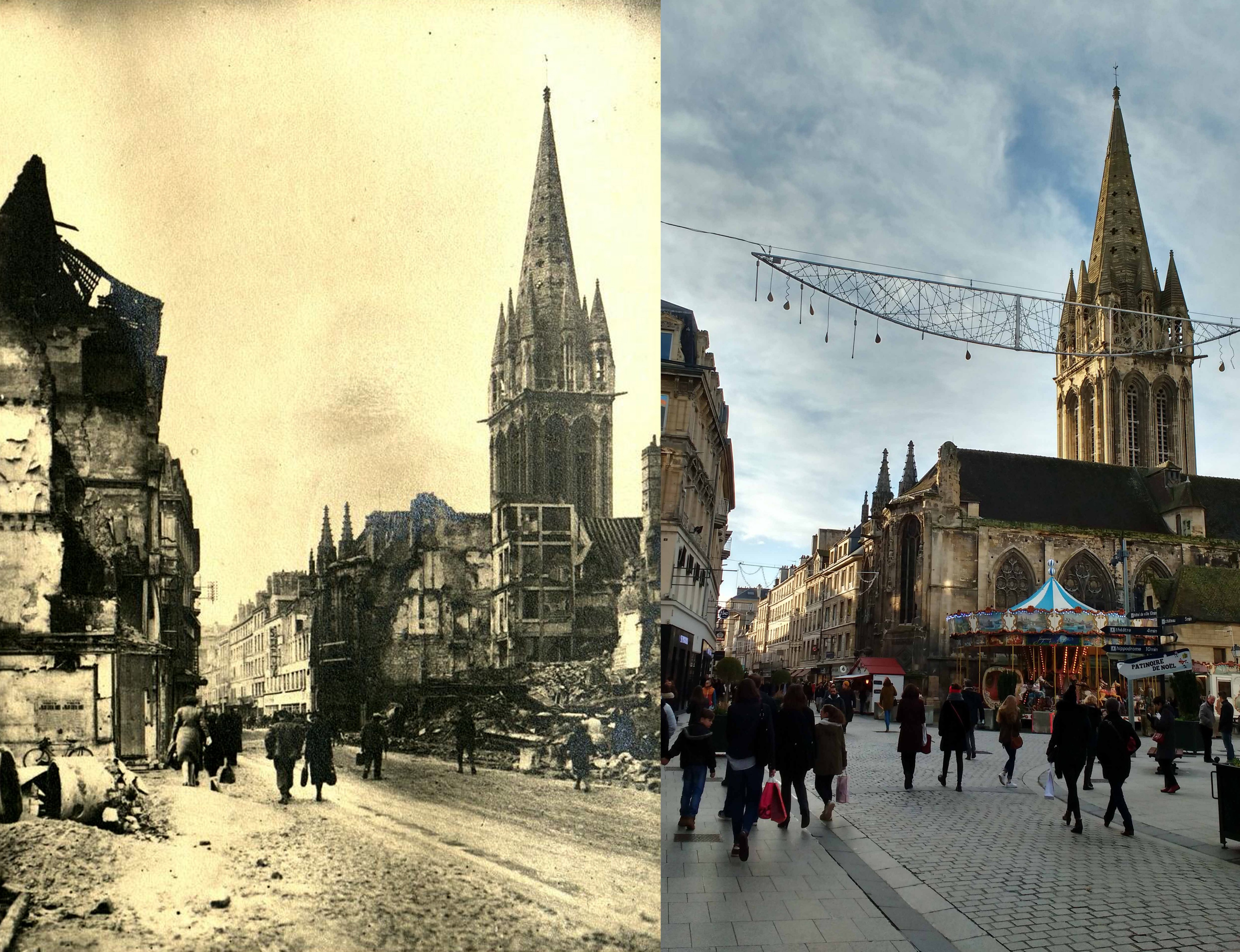
Place St Pierre and Notre-Dame-de-Froide-Rue Church. (Coll-164/38)
As a medievalist, I still regret the loss of the Rue St Jean, a once beautiful street full of hôtels particuliers and ancient half-timbered houses just like the one in the picture above. One of the only original buildings still standing is the very curious Eglise Saint-Jean – which has the particularity of being completely wonky! Our very own modest Pisa Tower, which is leaning because Caen was built on unstable grounds. Everybody thought this fragile building would never last – little did they know it would be the only monument to survive the raid of St-Jean street.
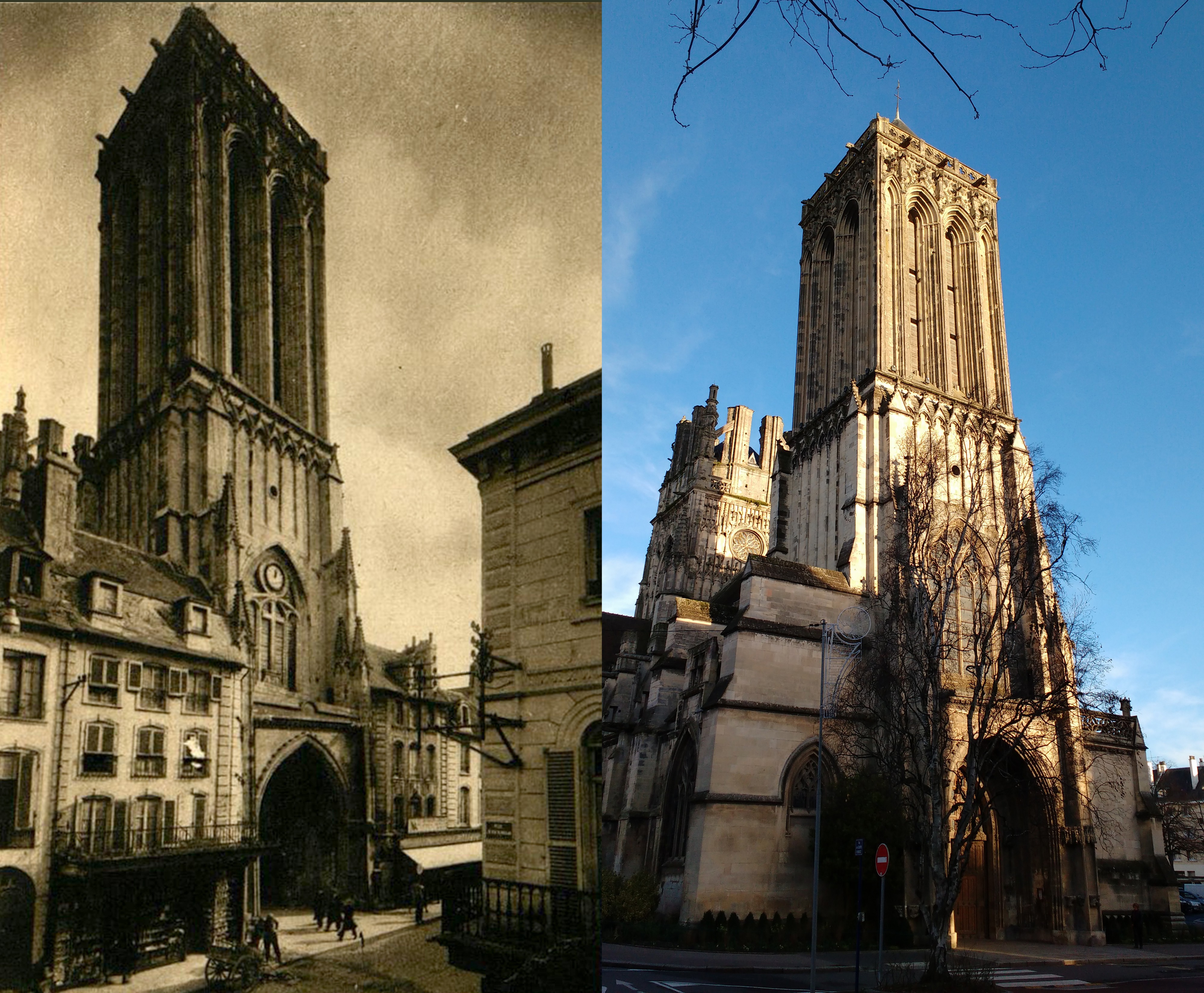
Eglise Saint-Jean, which is much sturdier than it looks…(Coll-164/72)
Sometimes, there was nothing to save but a section of wall, a half-collapsed doorway, the base of a pillar…left as a memory, a reminder of what the city had gone through:
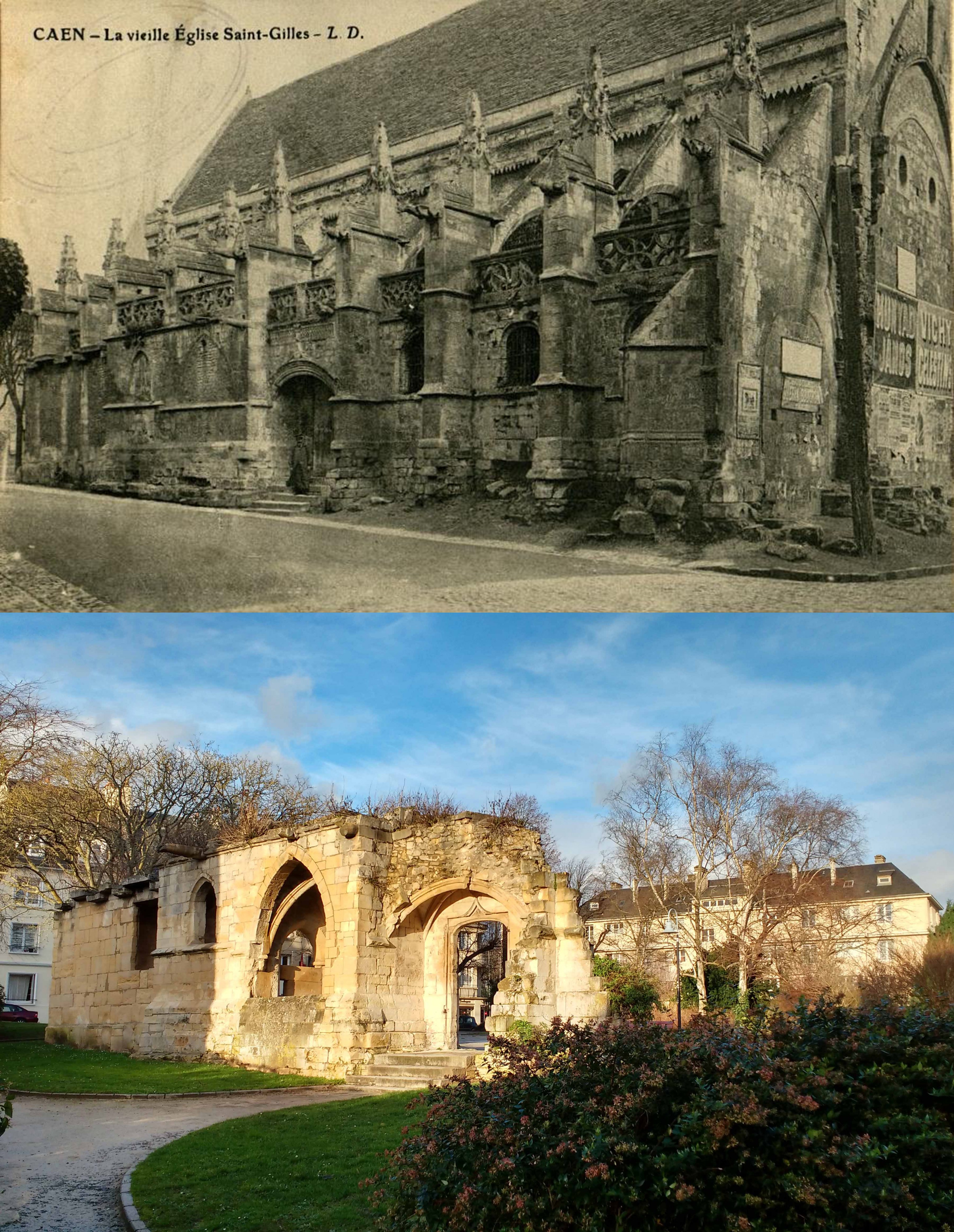
Saint-Gilles Church, now a small park. The only recognisable feature is an archway. (Coll-164/36)
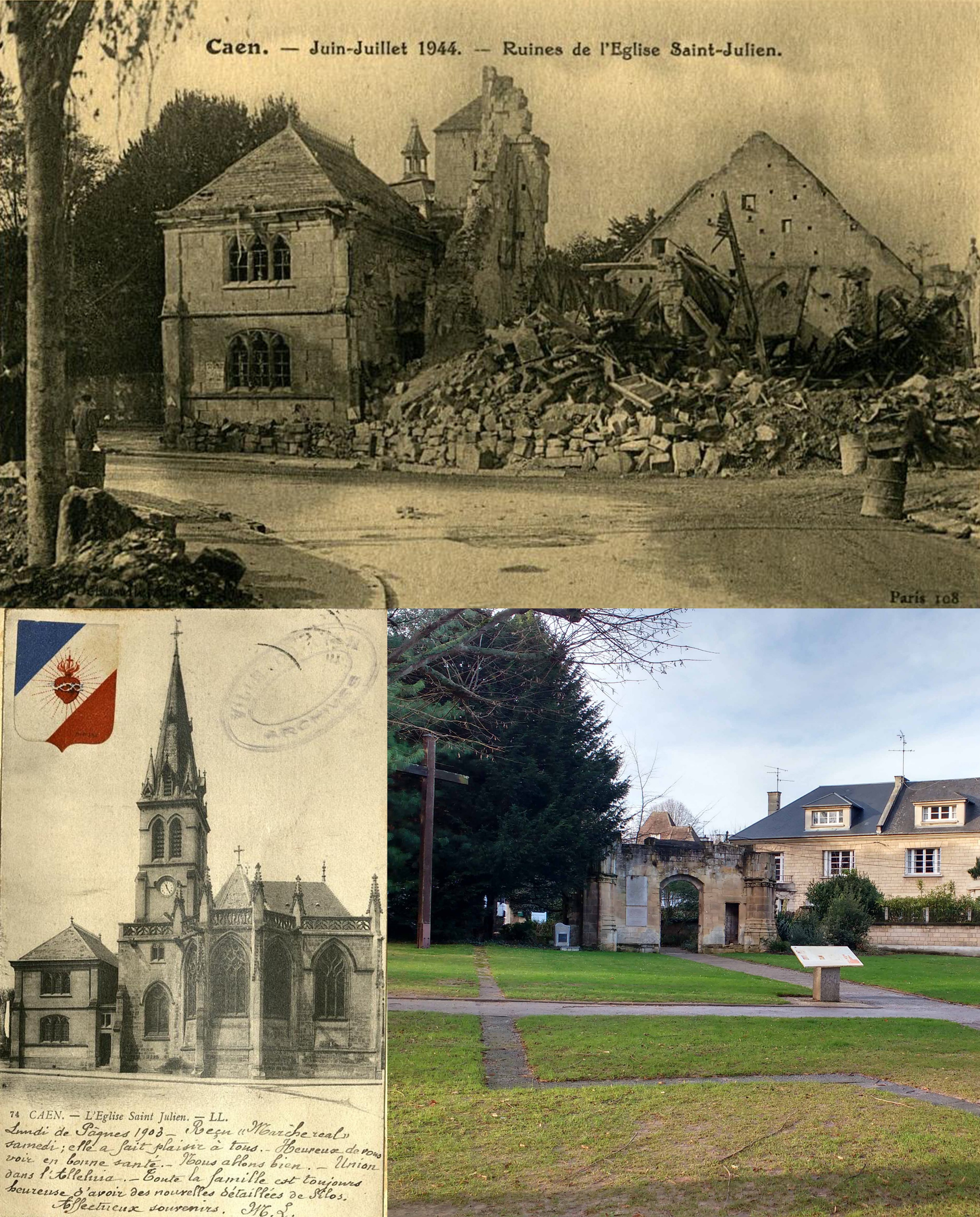
Saint-Julien Church before, during and after the bombings. (Coll-164/45 and Coll-164/48)
Like many French towns and cities, old Caen was full of narrow, dark medieval streets that would add a lot of charm to a city nowadays. I remember lamenting about the destruction of these quaint quarters – some of the largest boulevards in Caen have actually been shaped by American bulldozers –, and my grandfather replying: ‘it was dark and dirty before, very cold and inconvenient. It’s nicer now. They did a good job rebuilding everything’. The inhabitants rebuilt their home with the very typical Caen stone, which has a light and warm yellow colour, and the new blends in with the old. The city may not be as beautiful as other French towns spared by the war, but it is a nice place to live, where history has left its mark.
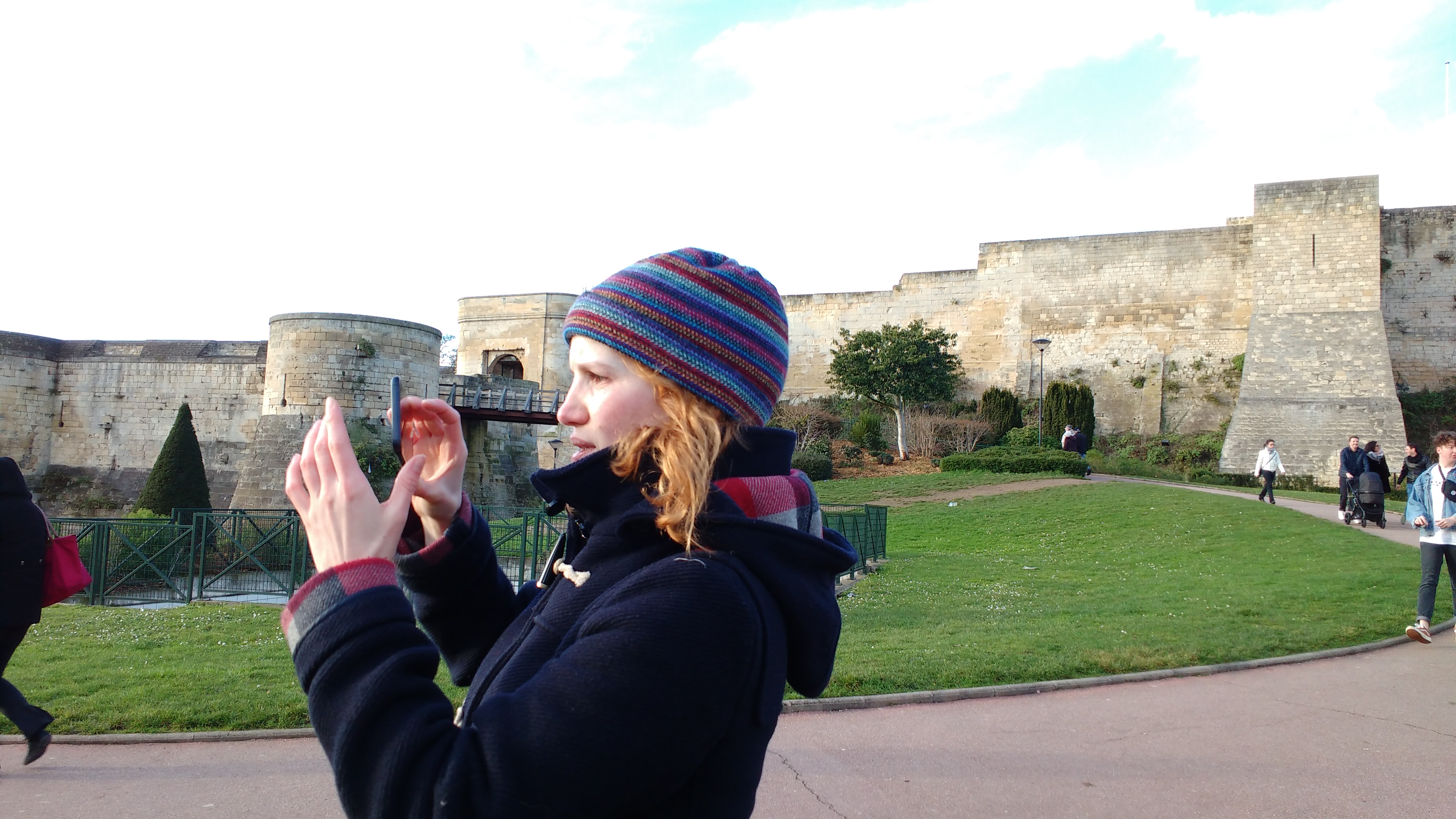
Our archivist doing some fieldwork…
Description of the album on ArchivesSpace: https://archives.collections.ed.ac.uk/repositories/2/resources/312
Aline Brodin, cataloguing archivist, 6 June 2018.
Special thanks to Clément Guézais and Inès Prat for their help in taking and editing the photographs.
Defence, Duress, and Detectives: Alexander McCall Smith’s PhD
Most know the name of Alexander McCall Smith in connection with his award-winning children’s literature, but he is also a giant in the legal field, both in the UK and in southern Africa where he was born. He was co-founder of the law school at the University of Botswana, and today he holds the title of Emeritus Professor of Medical Law at the University of Edinburgh. But bearing in mind that he is also the author of novels which have been read by millions, it’s easy to see the twinkle of a novelist behind his engaging style of legalese, and vice versa:
“Hugh spoke triumphantly. ‘Then your position is even stronger! … It’s a promise extracted under duress. He’s ground you down — taken advantage of you; pushed you into making the offer.’”
This passage from A Conspiracy of Friends (2011, first serialized in The Scotsman) was written nearly 30 years after McCall Smith submitted his PhD thesis, The Defence of Duress, to the faculty of law at the University of Edinburgh, which marked the beginning of an influential legal career. This thesis, which came under our scanners in April, provides a unique glimpse at the background of a writer who enjoyed success in two very different careers.
His PhD thesis attempts to give some scope to the depth of complexities beneath simple questions: “How is coercion to be distinguished from influence or persuasion? Is coercion inevitably a moral concept? Is an agent who performs an act under coercion always to be relieved of responsibility for his action?” McCall Smith takes nothing for granted as he picks apart the fibres of legal principles so old and venerable they were no longer questioned.
 He begins the argument by harkening back to Aristotle’s explorations on the subject.

McCall Smith approves of the ‘lenient’ attitude of modern law toward crimes committed under duress, while supporting the view that “the moral gravity of the act performed under compulsion is relevant in assessing responsibility for compelled action, as is the degree of compelling force used.”
Philosophical abstractions are accompanied by illustrative examples, such as:

In the end, he finds, there are two logical approaches toward the question of culpability in these scenarios, and each in some measure absolves the victim-cum-perpetrator:

McCall Smith’s fictional works have been praised for depicting complex truths within the simple actions required to live, and it’s easy to see how a legal background could add colour to this way of seeing the world. His books, mainly written for young adults, far from being sugar-coated or dumbed down, are complex discussions of ethical problems. Similarly we see in his legal ruminations an articulate relevance to everyday moral dilemmas. Reading this thesis, which he wrote at the age of 31, we can see a storyteller beneath the barrister’s wig — in fact he published his first book, The White Hippo, less than a year after receiving his diploma from Edinburgh.
In an interview in 2004, McCall Smith stated:
“In my books I’m increasingly going to look at that question: how people resolve ordinary dilemmas and moral issues in their day-to-day life.” (Interview in The New York Times, 6 October 2004)
I enjoyed reading this thesis, but I’ve also taken the opportunity to re-acquaint myself with the powerful and charming novels which came after it.
McCall Smith’s PhD thesis, The Defence of Duress, was digitized in April by the Centre for Research Collection’s ongoing digitization project and can be downloaded from the Edinburgh Research Archive: https://www.era.lib.ed.ac.uk/handle/1842/30464
Gavin Willow, Project Digitisation Assistant, PhD Digitisation Project
Database trial – Ogonek Digital Archive 1923 – 2017
The Library has arranged a free trial of Ogonek Digital Arch ive 1923 – 2017 until 29 June 2018. The trial can be access on the University network via the web link: http://dlib.eastview.com/browse/udb/3030
Ogonek is one of the oldest weekly magazines in Russia, having been in continuous publication since 1923. The importance of Ogonek as a primary source for research into the Soviet Union and bolshevization of its cultural and social landscapes cannot be overestimated. The digital archive provides access to fully searchable full-text and full-colour digital copies of issues of Ogonek from 1923 through 2017.
On trial: Scottish nationalist leaflets, 1844-1973
*The Library has now purchased access to ‘Scottish nationalist leaflets, 1844-1973’. See New to the Library: Scottish nationalist leaflets, 1844-1973.*
I’m pleased to let you know that thanks to a request from a student in HCA the Library now has trial access to Scottish nationalist leaflets, 1844-1973 from British Online Archives. This primary source collects together pamphlets relating to Scottish nationalism printed by the Scottish National Party (SNP) and their predecessors.

You can access this online resource via the E-resources trials page.
Access is available both on and off-campus.
Trial access ends 4th July 2018.
Read More
New to the Library: Irish Newspaper Archive
I’m very happy to let you know that following a successful trial earlier this year and further to requests from students and staff in HCA the Library has a 1-year subscription to the Irish Newspaper Archive. This is the largest online database of Irish newspapers in the world covering nearly 300 years worth of history.

You can access the Irish Newspaper Archive via the Databases A-Z list or Newspapers and Magazines database list. You will soon also be able to access it via DiscoverEd. Access on-campus is direct but if you are working off-campus you will need to use VPN to get access. Read More
Times Higher Education – now available
 University of Edinburgh current staff and students now have access to the Times Higher Education via a library subscription.
With our institutional subscription, you will be able to read online articles and digital editions using the THE website, and you will also be able to download the THE app to your device.
This service provides access to the latest weekly edition, and you can also access full text dating back to January 2013. An archive of earlier articles can be searched, and you have the option to set up a weekly email alerting you when the new edition is available.
Access is enabled via a personal account which is associated with the University using your official University e-mail address (ending .ed.ac.uk)
Registering as a first time user
You can register for an account to access our institutional subscription from 1st June onwards.
If you are registering to access the Times Higher Education for the first time please follow these instructions so that your personal THE account is associated with the University’s institutional subscription:
- From the Times Higher Education website click on the user account icon (i.e. the red person icon towards the top right)
- Register using your University of Edinburgh email address ending @ed.ac.uk
- Choose a username and password (please note that your username will appear in public facing parts of the site – for example if you choose to leave comments on articles)
- Click on Join us at the bottom and you will be logged in
- You will receive a confirmation email
Once you have successfully registered your personal account, just click on Login the next time you use the service.
Access digital editions
- To access digital editions of Times Higher Education, go to the magazine’s homepage at https://www.timeshighereducation.com.
- Click the “Professional” tab, then click “Digital Editions”.
- Then simply select the issue you want to view.
Download the app
- The Times Higher Education app is available on iOS, Android and Kindle Fire. Visit your app store provider to download it to your device.
- Select the edition you would like to view (e.g. UK or Global).
- Log in by clicking on the icon in the top right corner.
- Select Account, then click “Existing THE account”.
- Enter your username and password.
Still need help?
If you require further information about setting up your access for the library subscription to Times Higher Education then please:
Contact us via the IS Helpline
Collections
 Hill and Adamson Collection: an insight into Edinburgh’s past
My name is Phoebe Kirkland, I am an MSc East Asian Studies student, and for...
Cataloguing the private papers of Archibald Hunter Campbell: A Journey Through Correspondence
My name is Pauline Vincent, I am a student in my last year of a...
Hill and Adamson Collection: an insight into Edinburgh’s past
My name is Phoebe Kirkland, I am an MSc East Asian Studies student, and for...
Cataloguing the private papers of Archibald Hunter Campbell: A Journey Through Correspondence
My name is Pauline Vincent, I am a student in my last year of a...
Projects
Cataloguing the private papers of Archibald Hunter Campbell: A Journey Through Correspondence
My name is Pauline Vincent, I am a student in my last year of a...
Archival Provenance Research Project: Lishan’s Experience
Presentation My name is Lishan Zou, I am a fourth year History and Politics student....