Home University of Edinburgh Library Essentials
April 8, 2026
A Prized Collection
We were recently rather excited to receive a significant accrual to an existing donation of records from Scottish Gymnastics. This includes over 100 books (some of them rare and inscribed), papers and photographs and an extensive collection of shields, trophies, medals, and other artefacts. A donation of objects like these in such a quantity is quite unusual for us and they make up by far the largest part of the Scottish Gymnastics archive. However the proportion of objects to paper records makes complete sense in the context of the organisation’s chief focus on local, national and international competitions.
The collection comprises a real mix of objects, including medals, shields, trophies and plaques, dating from the 1890s (when the organisation was new) right up to 2017. As well as objects which were given as awards, the collection also includes commemorative objects, particularly glassware, which were given to Scottish Gymnastics to mark their participation in particular events over the years.
Probably the most historically notable item in the collection is the Scottish Shield, an impressively decorated three-foot wide object bearing the Scottish Gymnastics logo and the names of the previous winners (picture below):

The shield was awarded as part of an annual competition between Scottish gymnastics clubs. The first winners, in 1890, were the Aberdeen Gymnastic and Rowing Club (the oldest of the Scottish gymnastics clubs). Jim Prestidge’s invaluable book The History of British Gymnastics also features this photograph of the shield in 1902, when it was won by the Dundee Gymnastic and Athletic Club (shield is on the far left).

At the time Prestidge was writing (1988), the Scottish Shield was still being awarded, and Prestidge states that it “is the longest serving Team Shield still in service”. It must certainly be one of the oldest gymnastics awards in Scotland, predating the famous Adams Shield (also featured in the above photograph, on the right) by nine years. We would like to find out more about the history of the Scottish Shield, so please do let us know if you have any information to share!
Artefacts like these form an important part of sporting heritage collections, but because of their unwieldy nature, they are often at risk of being discarded or forgotten, with institutions sometimes being reluctant to take them in. So it’s fantastic to now have this very tangible – and often downright beautiful – part of gymnastics history here at the Centre for Research Collections. The items are a valuable resource for understanding the material culture of gymnastics as well as giving precise information about individual, team and club achievements over time. It would be great to now see researchers begin to use this collection to its full potential.
The Scottish Gymnastics archives catalogue is currently being updated to include these new items. Once this is complete, the catalogue will be viewable here:
http://archives.collections.ed.ac.uk/repositories/2/resources/86677
Clare Button
Project Archivist
Sources
Prestidge, Jim, The History of British Gymnastics (British Amateur Gymnastics Association, 1988)
New to the Library: New York Amsterdam News
I’m delighted to let you know that following a successful trial in 2017/18 the Library has now purchased access to the New York Amsterdam News (1922-1993) from ProQuest Historical Newspapers. Founded in 1909 this is one of the leading Black newspapers of the 20th century and the oldest and largest Black newspaper in New York City.

You can access New York Amsterdam News (1922-1993) via the Databases A-Z list and Newspapers & Magazines database list. You can also access the title through DiscoverEd*
The Amsterdam News was founded over 100 years ago by James H. Anderson and was named after the street where he lived and where the first issues were produced and sold. It was one of only 50 Black newspapers in the United States at that time. Read More
New! News, Policy & Politics Magazine Archive
I’m happy to let you know that following some successful trials in the last couple of years the Library has purchased the News, Policy & Politics Magazine Archive from ProQuest. This resource offers digital access to the archival runs of 15 major 20th and 21st century consumer magazines covering such fields as the history of politics, current events, public policy and international relations. Central to this collection is the archive of Newsweek, one of the 20th century’s most prominent and highest circulating general interest magazine.

You can access News, Policy & Politics Magazine Archive from the Databases A-Z list and appropriate databases by subject lists. You’ll soon be able to access it from DiscoverEd as well. Read More
New to the Library: Daily Mail Historical Archive
I’m really pleased to let you know that the Library has purchased access to the Daily Mail Historical Archive (1896-2004) from Gale Cengage. Regardless of your personal feelings about the Daily Mail this is a fascinating archive that provides access to over 100 years of the newspaper, while also providing an important alternative perspective to newspapers such at The Times, The Guardian, etc.

You can access Daily Mail Historical Archive (1896-2004) via the Databases A-Z list, Newspapers & Magazines database list and relevant subject guides. Access via DiscoverEd will also become available soon.
The Daily Mail Historical Archive includes nearly 1.2 million pages of content from the paper, including all of the major news stories, features, advertisements and images. And as well as the regular edition of the newspaper, uniquely the archive also includes the Daily Mail Atlantic Edition, which was published on board the transatlantic liners that sailed between New York and Southampton between 1923 and 1931. Issues of the Daily Mail Atlantic Edition are very rare and not available digitally from any other source. Read More
Channel Islands occupation: through the Library’s online primary sources
On this day, 30 June, in 1940 the Germans invaded the Channel Islands which was the beginning of nearly 5 years occupation. In this week’s blog I’m using some of the Library’s online resources to find primary source material to discover more about this facet of the Second World War.
I recently had the opportunity to visit the Jersey War Tunnels, one of Jersey’s many tunnel complexes built by mostly forced and slave labour under German command during the occupation.I have to admit that before that visit I really knew very little about this period in the Channel Islands history but I was inspired by the incredibly moving and fascinating exhibition to try and find out what primary source material was available to us through the University Library’s fantastic online primary source collections about the occupation.
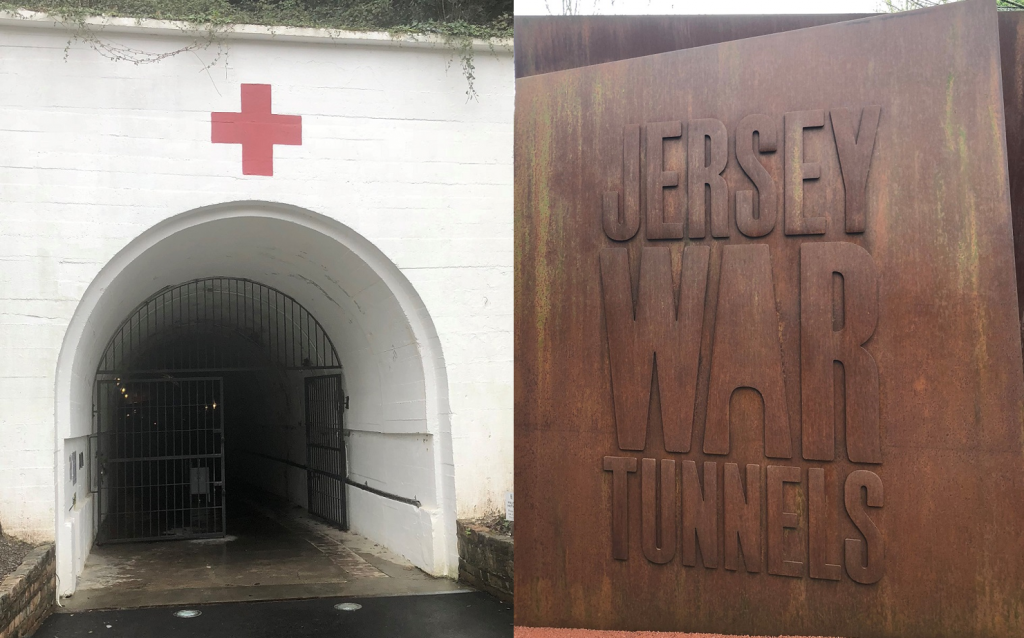
© Mark Cairney
There are many stories that could be told about the Channel Islands occupation and I encourage you to seek them out but due to the nature of our online primary source collections and time limits I’m focusing on what the outside world, mainly Britain, knew (or didn’t) about what was happening on the Channel Islands during the occupation.
The blitzkrieg nears Britain
The first half of 1940 was a dark time for the Allies in the Second World War. In fairly quick succession Denmark, Norway, Belgium, the Netherlands and France were invaded by Germany. With the evacuation at Dunkirk (Operation Dynamo) and France, faced with no real other choice, signing an armistice with Germany in June of that year, Britain was now on its own and under threat.
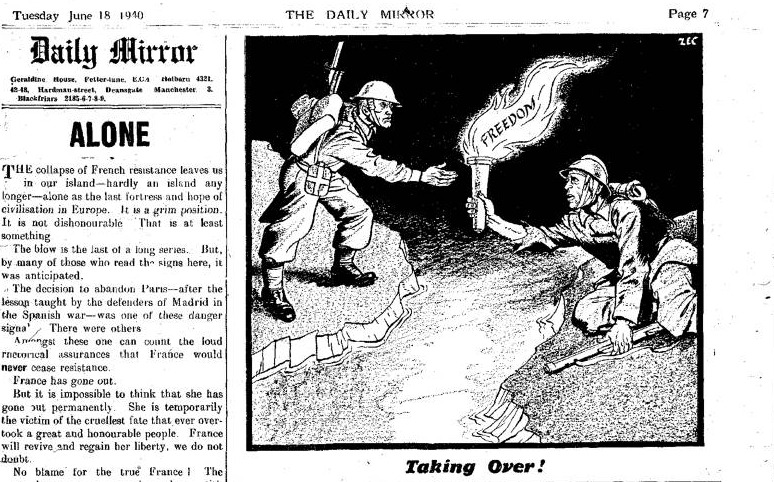
The Daily Mirror, Tuesday, 18 June 1940, p. 7. UK Press Online. Accessed 25th May 2018.
Marking up collections sites with Schema.org
This blog was written by Holly Coulson, who is working with Nandini Tyagi on this project.
For the last three months, I have been undergoing a Library Metadata internship with the Digital Development team over in Argyle House. Having the opportunity to see behind the scenes into the more technical side of the library, I gained far more programming experience I ever imagined I would, and worked hands on with the collections websites themselves.
Most people’s access to University of Edinburgh’s holdings is primarily through DiscoverEd. But the Collections websites exist as a complete archive of all of the materials that Edinburgh University have, from historical alumni to part of the St Cecilia’s Hall musical instrument collection. These sites are currently going through an upgrade, with new interfaces and front pages.
My role in all of this, along with my fellow intern Nandini, was to analyse and improve how the behind-the-scenes metadata works in the grander scheme of things. As the technological world continually moves towards linked data and the interconnectivity of the Internet, developers are consciously having to update their websites to include more structured data and mark-up. That was our job.
Our primary aim was to implement Schema.org into the collections.ed.ac.uk spaces. Schema, an open access structured data vocabulary, allows for major search engines, such as Google and Yahoo to pull data and understand what it represents. For collections, you can label the title as a ‘schema:name’ and even individual ID numbers as ‘schema:Identifier’. This allows for far more reliable searching, and allows websites to work in conjunction with a standardised system that can be parsed by search engines. This is ultimately with the aim to optimise searches, both in the ed.ac.uk domain, and the larger search engines.
Our first major task was the research. As two interns, both doing our Masters, we had never heard of Schema.org, let alone seen it implemented. We analysed various collections sites around the world, and saw their use of Schema was minimal. Even large sites, such as the Louvre, or the National Gallery, didn’t include any schema within their record pages.
With minimal examples to go off, we decided to just start mapping our metadata inputs to the schema vocabulary, to get a handle on how Schema.org worked in relation to collections. There were some ideas that were very basic, such as title, author, and date. The basics of meta-data was relatively easy to map, and this allowed us to quickly work through the 11 sites that we were focusing on. There were, however, more challenging aspects to the mapping process, which took far longer to figure out. Schema is rather limited for its specific collection framework. While bib.schema exists, an extension that specifically exists for bibliographic information, there is little scope for more specific collection parameters. There were many debates on whether ‘bib.Collection’ or ‘isPartOf’ worked better for describing a collection, and if it was viable to have 4 separate ‘description’ fields, for different variations of abstracts, item descriptions, and other general information.

The initial mappings for /art, showing relatively logical and simple fields

More complicated mappings in /stcecilias, with a lot of repetition and similar fields, and ones that were simply not possible, or weren’t required.
There were other, more specific, fields we had to deal with, that threw up particular problems. The ‘dimensions’ field is always a combined height and width. Schema.org, with regards to specific dimensions, only deals with individual values: a separate height and a separate width value. It wasn’t until we’d mapped everything that we realised this, and had to rethink our mapping. There was also many considerations for if Schema.org was actually required for every piece of metadata. Would linking specific cataloguing and preservation descriptions actually be useful? How often would users actually search for these items? Would using schema.org actually help these fields? We continually had to consider how users actually searched and explored the websites, and whether adding the schema would aid search results. By using a sample of Google Analytics data, we were able to narrow down what should actually be included in the mapping. We ended up with 11 tables, for 11 websites (see above), offering a precise mapping that we could implement straight away.
The next stage was figuring out how to build the schema into the record pages themselves. Much of the Collections website is run on PHP, which takes the information directly from the metadata files and places them in a table when you click on an individual item. Schema.org, in its simplest form, is in HTML, but it would be impossible to go through every single record manually and mark it up. Instead, we had to work with the record configuration files to allow for variables to be tested for schema. If they were a field with a schema definition, the schema.org tag is printed around it, as an automated process. This was further complicated by filters that are used, meaning several sets of code were often required to formulate all the information on the page. As someone who had never worked with PHP before, it was definitely a learning curve. Aided by various courses on search engine optimisation and Google Analytics, we were becoming increasingly confident in our work.
Our first successes were uploading both the /art and /mimed collections schema onto the test servers, only receiving two minimal errors. This proved that our code worked, and that we were returning positive results. By using a handy plugin in Chrome, we were able to see if the code was actually offering readable Schema.org that linked all of our data together.
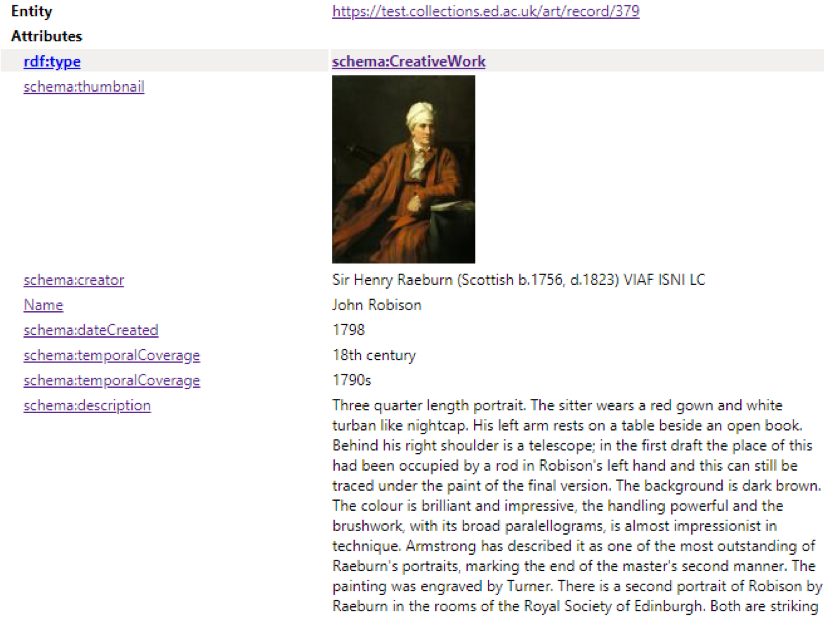
The plugin, OpenLink Structured Data Sniffer, showing the schema and details attributed to the individual record. In this case, Sir Henry Raeburn’s painting of John Robison.
As we come to the final few weeks of our internship, we’ve learnt far more about linked data and search engine optimisation than we imagined. Being able to directly work with the collections websites gave us a greater understanding of how the library works overall. I am personally in the MSc Book History and Material Culture programme, a very hands-on, physical programme, and exploring the technical and digital side of collections has been an amazingly rewarding experience that has aided my studies. Some of our schema.org coding will be rolled out to go live before we finish, and we have realised the possibilities that structured data can bring to library services. We hope we have allowed one more person to find the artwork or musical instrument they were looking for. While time will tell how effective schema.org is in the search results pages, we are confident that we have helped the collections become even more accessible and searchable.
Holly Coulson (Library Digital Development)
Database trials – China Core Newspapers & The Eastern Miscellany
China Core Newspapers provides the full-text articles from 633 current newspapers in China from 2000 onwards. The database is updated daily. The trial can be accessed by going to the China Core Newspapers entry in the Library’s Databases A-Z list, or simply click here. The trial will end on 31 July 2018.

The Eastern Miscellany (《東方雜誌》) was an iconic periodical of the Commercial Press from 1904 to 1948. It is highly regarded as a very important resource for the study of the modern history of China. The database includes the full 44 volumes (819 issues), with over 30,000 articles, 12,000 pictures, and over 14,000 advertisements. Articles cannot be downloaded directly, but the full texts of the articles can be copied and pasted. To access the trial, please click here on the University network. The trial will also be advertised on the Library’s E-resources Trials website. The trial will end on 21 July 2018.
Feedback would be appreciated.
Session Paper Project Internship
My name is Claire and I am the first intern to work with Nicole on the Session Papers Project. I am due to graduate with a master’s degree in paper conservation this year, but I am starting this internship to broaden my knowledge of book conservation. Methods and skills within conservation tend to overlap, and this is especially true with books and paper. My role within this pilot project is to assist in the conservation of 300 books. Conservation treatments include structural repairs, consolidation, and board reattachment. The volumes need to be in a good enough condition to withstand digitisation and further handling following the project.
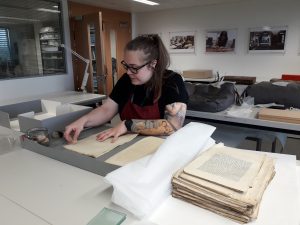
Claire working in the conservation studio
Scotland’s languages: Pronunciation and purity
In the last post we looked at predominantly Gaelic, Scots and English speaking parishes. But, it is important to note that the other minority languages have impacted on whatever the majority language was, including its pronunciation and intonation. The linguistic landscape of Scotland’s parishes was far from black and white. For some of those writing the parish reports, the jumble of languages used was an unwelcome development, as they saw it as an erosion of the “superior” pure form of language.
Pronunciation
It has been fascinating to find out how people pronounced words. Several parish reports give us a idea of the kinds of sounds produced, in the various Scots dialects in particular. Again, it is other languages which greatly influenced pronunciation.
In Wick, County of Caithness, “the language spoken over all the parish is, with exception of that of some Gaelic incomers, a dialect of the lowland Scottish. It is distinguished, however, by several peculiarities. Wherever the classical Scottish has wh, the dialect of the parish of Wick has f; as fat for what, fan for whan; and wherever the Scottish has u, this dialect has ee ; as seen for sune, meen for mune, feel for fule. Ch at the beginning of words is softened into s, or sh; as, surch for church; shapel for chapel. Th at the beginning of words is often omitted. She, her, and hers are almost invariably used for it and its. This seems a Gaelic idiom; and the tendency to pronounce s and ch, as sh, seems a relic of Gaelic pronunciation.” (NSA, Vol. XV, 1845, p. 144)
Jedburgh, County of Roxburgh – “The common people in the neighbourhood of Jedburgh pronounce many words, particularly such as end in a guttural sound, with a remarkable broad, and even harsh accent. They still make use of the old Scotch dialect. Many of the names of places, however, are evidently derived from the Erse, and expressive of their local situation in that language. For instance, –Dunian, John’s Hill; –Minto, Kids Hill; –Hawick, Village on a River; –Ancrum, anciently called Alnicromb a Creek in the River; etc. etc.” (OSA, Vol. I, 1791, p. 15)

Unknown artist; Jedburgh Abbey, 19th Century. Glasgow Museums.
Wilton, County of Roxburgh – “The language generally spoken by the lower orders, throughout this district, contains many provincialisms, but these are becoming gradually obsolete. Two diphthongal sounds, however, seem still to maintain their ground, namely, those resembling the Greek eǐ, and the ow, as in the English words, cow, sow, how, now,–e.g. the common people generally pronounce, tree, treǐ; tea, teǐ; knee, kneǐ; me, meǐ; and, instead of the diphthongal sound of oo in the pronoun you, the pronunciation is almost invariably yow, as in now.” (NSA, Vol. III, 1845, p. 78)
Dalgety, County of Fife – “The language commonly spoken in the parish is the Old Scotch dialect, and there seem to be no peculiar words or phrases which are not in general use throughout most parts of the kingdom. The words are pronounced with a broad accent; and I have often heard in this part of the country a sound given to the diphthong oi, which is not, I believe, so usual in other places: it is frequently pronounced as if it consisted of the letters ou, as for boul boil, pount for point, vauce for voice, etc.” (OSA, Vol. XV, 1795, p. 265)
Caputh, County of Perth – “The Stormont dialect, of course, prevails, in which the chief peculiarity that strikes a stranger is the pronunciation of the Scotch oo as ee, poor being pronounced peer, moon meen, aboon abeen, &c.” (NSA, Vol. X, 1845, p. 677)
Dunlop, County of Ayrshire – “The language which they speak is a mixture of Scotch and English, and has no other singularity, but the slow drawling manner in which it is spoken, and that they uniformly pronounce fow, fai-w, and mow, mai-w.” (OSA, Vol. IX, 1793, p. 541)
Alves, County of Elgin – “The language generally spoken is the Scotch. A stranger is struck with the peculiar vowel sounds, given in a great many words, as wheit for wheat, feel for fool, pure for poor, and wery for very, &c.” (NSA, Vol. XIII, 1845, p. 107)
Montrose, County of Forfar, “One great peculiarity which strikes a stranger from the south, in the language of the common people in this county, and in the neighbouring counties on the north, is the use of f for wh, as fan, far, &c. for when, where, &c. Except by the better classes, the lowland Scotch is universally spoken with a strong provincial accent.” (NSA, Vol. XI, 1845, p. 279)
The Buchan dialect is mentioned in several parish reports from the County of Aberdeen. It is also known as the Doric dialect, and is a sub-dialect of Northern Scots, found in a small area between Banff and Ellon. In Peterhead, County of Aberdeen, “the language spoken in this parish is the broad Buchan dialect of the English, with many Scotticisms, and stands much in need of reformation, which it is to be hoped will soon happen, from the frequent resort of polite people to the town in summer.” (OSA, Vol. XVI, 1795, p. 592) People in the parish of Aberdour, County of Aberdeen, also spoke “the broad Buchan, or real Aberdeenshire, and this dialect is much the same as it was forty years ago.” (NSA, Vol. XII, 1845, p. 266) For more information on the Buchan dialect take a look at the parish report for Longside, County of Aberdeen. (OSA, Vol. XV, 1795, p. 294)
Intonation is also described in some of the parish reports. In Dunfermline, County of Fife, “the language is a mixture of Scotch and English. The voice is raised, and the emphasis frequently laid on the last word of the sentence.”(OSA, Vol. XIII, 1794, p. 479) A similar observation was also made in the report for Lesmahago, County of Lanark. “The language spoken is the broad Scotch dialect, with this peculiarity, very observable to strangers, that the voice is raised, and the sound lengthened upon the last syllable of the sentence.” (OSA, Vol. VII, 1793, p. 433)
Purity
Some writers of the parish reports had a very clear perception of language purity and, conversely, corruption. Inhabitants in many parishes were considered to be speaking a language that was not in its pure and correct form.
- Lochgoil-Head and Kilmorich, County of Argyle – “The Gaelic that is spoken in this place, owing to the frequent communication with the Low Country, is corrupted with a mixture of English words and phrases, and is not so pure, nor so correct, as that which is spoken in the more remote parts of the Highlands.” (OSA, Vol. III, 1792, p. 190)
- Logierait, County of Perth – “The language spoken here, is a corrupted dialect of the Gaelic. The Saxon dialect of the lowlands is, however, pretty generally understood here.” (OSA, Vol. V, 1793, p. 82)
- Comrie, County of Perth – “All the young people can speak English; but, in order to acquire it, they must go to service in the Low Country. The Gaelic is not spoken in its purity, neither here nor in any of the bordering parishes.” (OSA, Vol. XI, 1794, p. 186)
,_Comrie,_Scotland)_LOC_3450353536.jpg)
View on the Earn, Comrie, Scotland. Taken between ca. 1890 and ca. 1900. By The Library of Congress [No restrictions], via Wikimedia Commons.
- Fortingal, County of Perth – “The Gaelic is the language of the natives. It is, however, losing ground, and losing its purity, very much of late. Forty years ago, in some parts of the parish, especially in the district of Rannoch, it was spoken in as great purity as in any district of the Highlands. That race of genuine natives having disappeared, many of their phrases and idioms have become almost unintelligible to the rising generation. It is, however, gratifying to the antiquary and to the lover of Celtic literature, that so much has been done to rescue the language and insure its permanency and stability; still all that is practicable has not yet been achieved. Hundreds of vocables might be collected which have escaped the notice of the several learned compilers of our Gaelic dictionaries.” (NSA, Vol. X, 1845, p. 553)
- Halkirk, County of Caithness – “[Erse] is much corrupted, but yet spoken with great fluency and emphasis, and not without harmony of sound. [English] has also many words, which are neither English nor Scotch, yet, according to its idiom, it is spoken with great propriety, and the sentiments are expressed by it, either in narration or description, as intelligibly and significantly, as in any county in Great Britain, nay, I dare say, more so than in most of them. These languages are spoken in various degrees.” (OSA, Vol. XIX, 1797, p. 62)
- Eddlestone, County of Peebles – “The language generally spoken is a corrupt Scotch, with a barbarous admixture of English. A few only of the oldest of the people speak the Scottish dialect in its purity. These, however, are rapidly disappearing, and in a few years more in all probability there will not be one person alive who could have held converse with his grandfather without the aid of a dictionary.” (NSA, Vol. III, 1845, p. 149)
- Evie and Rendall, County of Orkney – “In the language of the people, there is an intermixture of Norse words with Scotch and English; but, on the whole, they speak more correctly than the peasantry do in other parts of Scotland. The accent is peculiar though far from being unpleasant.” (NSA, Vol. XV, 1845, p. 202)
In the parish report for Kilmalie, County of Inverness, it was noted that “it is remarkable, yet not the less true, that the illiterate Highlander, who is a stranger to every other language but the Gaelic, speaks it more fluently, more elegantly, and more purely, than the scholar.” (OSA, Vol. VIII, 1793, p. 430)
In some cases, inhabitants were strongly criticised for speaking impure languages, especially those of Kilmadock, County of Perth!
- Kirkmichael, County of Perth – “The prevailing language in the parish is the Gaelic. A dialect of the ancient Scotch, also, is understood, and currently spoken. These two, by a barbarous intermixture, mutually corrupt each other.” (OSA, Vol. XV, 1795, p. 516)
- Kilmadock, County of Perth – “The language of the common people in this parish, like many of the parishes in the neighbourhood, is a mixture of Scotch and English. This jargon is very unpleasant to the ear, and a great impediment to fluent conversation. No language is more expressive than the Scotch, when spoken in perfection; and, though the ancient be short and unmusical, yet it is by no means disagreeable to hear two plain country men conversing in the true Scotch tongue; but, in this parish, you seldom meet with such instances... In the quarter towards Callander, the generality of the inhabitants speak Gaelic; and this is perhaps still more corrupt than even the Scotch, in the other quarters of the parish. It is impossible to conceive any thing so truly offensive to the ear, as the conversation of these people. The true Gaelic is a noble language, worthy of the fire of Ossian, and wonderfully adapted to the genius of a warlike nation; but the contemptible language of the people about Callander, and to the east, is quite incapable of communicating a noble idea… It ought, therefore, to be earnestly recommended to the people of this parish, and, indeed, to other parishes in that quarter, to study a more perfect style; either to practice the true Gaelic, the true Scotch, or the true English tongue. But all kinds of civilization in society go hand in hand; and when arts and sciences begin to flourish here, the language will gradually polish and refine.” (OSA, Vol. XX, 1798, p. 53)
Language trends
A couple of parishes reported a particularly interesting development, that of younger Gaelic speakers interspersing their language with English or Scots words. In North Uist, County of Inverness. “The language spoken is the Gaelic, which the people speak with uncommon fluency and elegance. One fifth of the whole population above the age of twelve years understand and speak English. Such of them as are in the habit of going to the south of Scotland for trading or for working, are fond of interlarding some English or Scotch phrases with their own beautiful and expressive language. This bad taste is confined to so limited a number, that it has but slightly affected the general character of their native tongue. There are only five individuals in the parish who do not understand the Gaelic, and some of these have made considerable progress in its attainment.” (NSA, Vol. XIV, 1845, p. 172) In Gairloch, County of Ross and Cromarty, “some young men, indeed, who have received a smattering of education, consider they are doing great service to the Gaelic, by interspersing their conversation with English words, and giving them a Gaelic termination and accent. These corrupters of both languages, with more pride than good taste, now and then, introduce words of bad English or of bad Scotch, which they have learned from the Newhaven or Buckie fishermen, whom they meet with on the coast of Caithness during the fishing season. The Gaelic, however, is still spoken in as great purity by the inhabitants in general, as it was forty years ago.” (NSA, Vol. XIV, 1845, p. 95)
In some cases, however, the impure form of language at least made it easier for certain groups of people to understand. In Rogart, County of Sutherland, “a considerable proportion of the inhabitants, however, can converse in the English language; and, in a few years it is likely that none may be found who cannot do so. Their English, being acquired from books, and occasional conversation with educated persons, is marked by no peculiarity, except a degree of mountain accent and Celtic idiom; so that it is more easily intelligible to an Englishman than the dialect spoken by the Lowland Scotch.” (NSA, Vol. XV, 1845, p. 51)
Conclusion
Languages are very fluid, with changes occurring over time in vocabulary, pronunciation and intonation. In some parish reports there are some strong comments bemoaning the lack of language purity, but the pure form of a language is an ideal, not a reality. This is certainly the case in Scotland where the Gaelic, Scots, English and Scandinavian languages influenced each other.
Changes were even felt between the first and second Statistical Accounts of Scotland, most notably the increased comprehension and use of English. In the final post on Scotland’s languages we look look more closely at the reasons for linguistic change.
A Stitch in Time: Mahābhārata Delivered Online

I don’t know if I have ever been more excited about a digitisation project going live: the Edinburgh University’s 1795 copy of the Mahābhārata is now available online. This beautiful scroll is one of the longest poems ever written, containing a staggering 200,000 verses spread along 72 meters of richly decorated silk backed paper. As one of the Iconic items in our Collection it was marked as a digitisation priority, so when a customer requested the 78 miniatures back in April 2017 it seemed like a good opportunity to digitise it in its entirety. There was just one problem: it was set to go on display in the ‘Highlands to Hindustan’ exhibition, which opened at the Library in July. This left us with only a narrow window of opportunity for the first stages of the project: conservation and photography. Read More
Collections
 Hill and Adamson Collection: an insight into Edinburgh’s past
My name is Phoebe Kirkland, I am an MSc East Asian Studies student, and for...
Cataloguing the private papers of Archibald Hunter Campbell: A Journey Through Correspondence
My name is Pauline Vincent, I am a student in my last year of a...
Hill and Adamson Collection: an insight into Edinburgh’s past
My name is Phoebe Kirkland, I am an MSc East Asian Studies student, and for...
Cataloguing the private papers of Archibald Hunter Campbell: A Journey Through Correspondence
My name is Pauline Vincent, I am a student in my last year of a...
Projects
Cataloguing the private papers of Archibald Hunter Campbell: A Journey Through Correspondence
My name is Pauline Vincent, I am a student in my last year of a...
Archival Provenance Research Project: Lishan’s Experience
Presentation My name is Lishan Zou, I am a fourth year History and Politics student....