Home University of Edinburgh Library Essentials
September 30, 2026
That would be an ecumenical matter … Celebrating 70 years of the World Council of Churches
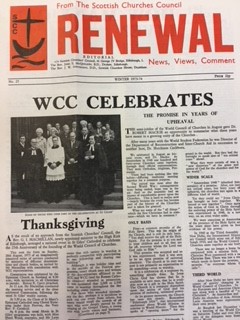
In our New College Library Hall display for September 2018, we’re celebrating the 70th anniversary of the foundation of the World Council of Churches. Inaugurated in 1948, the World Council of Churches (WCC) is one of the leaders of the modern ecumenical movement, working towards the goal of Christian unity. The WCC brings together churches, denominations and church fellowships in more than 110 countries and territories throughout the world, representing over 500 million Christians. New College Library contains nearly a thousand WCC publications, including many unique or rare pamphlets. In the New College Library Archives, we hold the papers of several individuals and organisations who worked with the WCC, including Rev J.H. Oldham, Rev Robert Mackie and Rev. Tom Allaallenn. Read More
DHC2018 part 2: highlight talks
There were a number of talks which stood out for me, both in terms of general interest and also in their relation to work in libraries. I’ve summarised just a few of these below.
DHC2018 part 1: some key themes
I was fortunate to receive funding this year from UCISA to attend DHC2018 (Digital Humanities Congress – not to be mistaken with the 16th International Symposium on District Heating and Cooling, which tops the Google results). DHC is a biennial conference organised by The Digital Humanities Institute at the University of Sheffield, exploring digital humanities research, as well as its implications for the cultural heritage sector and IT support services.
In this first blog post, I’m going to list the key themes raised at the conference – and in my next post, I’ll summarise some of the papers that I found particularly interesting.
Scottish Court of Session Papers: Phase 2 Pilot
“The most valuable unstudied source for Scottish history….in existence.” Historiographer Royal, Professor T.C. Smout
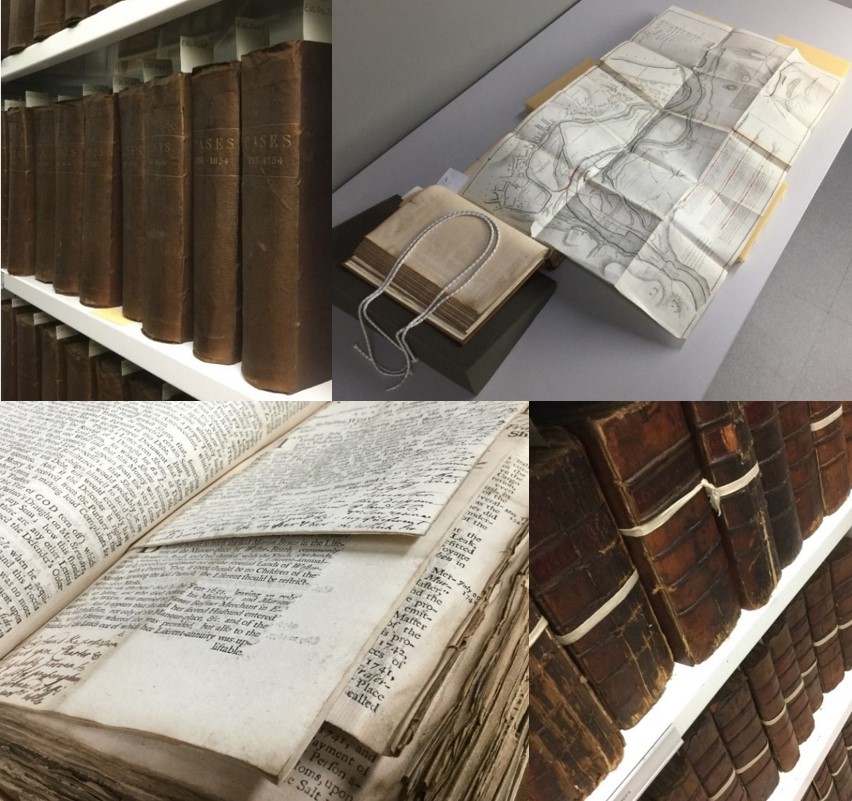
It has been a while since we provided an update on our Scottish Court of Session Papers Digitisation Project after the initial pilot in early 2017 (see previous blog post here). To recap, this project consists of an expansive collection of court records from Scotland’s highest civil court. The collection is held over three institutions here in Edinburgh; The Faculty of Advocates, The Signet Library and the Edinburgh University Library (EUL), with EUL leading the project. There are over 5000 volumes made up of written pleadings of contested cases, answers, replies, and case summaries, many of which have contemporary annotations. It is almost certainly the world’s largest single body of uncatalogued English language printed material before 1900. Many of the volumes are in very poor condition, requiring conservation care, and the volumes often contain large foldouts which present many digitisation challenges.
Welcome to New College Library 2018 #edwelcome

Welcome to all new and returning staff and students from New College Library at the beginning of the academic year.
We’re looking forward to meeting you. To help you get started with Library & IT services at the University, check out this Get Connected to the University page. Don’t forget to collect your University card from the Main Library in George Square.
You can find out more about New College Library at http://www.ed.ac.uk/is/new-college-library and about library resources for Divinity at : http://www.ed.ac.uk/is/subject-guides-divinity.
I’ll be running library tours that are open to all UG and PG students on Wednesday 19 September at 1.15pm and on Wednesday 26 September at 1.15pm. If you’d like a library tour or introductory meeting and these dates don’t suit you, please do get in touch with me to make other arrangements.
Have a look at the Divinity Library Newsletter 2018 which includes
- Successful pilot leads to extended Library opening hours
- New digital collections for Divinity
- New journals for Divinity
Christine Love-Rodgers, Academic Support Librarian, Divinity
Thomas Chalmers and The West Port Experiment
Those with an interest in Scottish church history are likely to be very familiar with Thomas Chalmers and the role he played in the Disruption of 1843 but how many know much of his West Port experiment? Read More
New to Library: Greek Tragedy and Latin Poetry
I’m happy to let you know that the Library now has access to two further modules from Oxford Scholarly Editions Online (OSEO). This gives us online access to a further 101 texts covering Greek Tragedy and Latin Poetry, including works by Euripides, Aeschylus, Sophocles, Ovid, Virgil and Horace.

You can access the individual texts by searching DiscoverEd. Or you can access OSEO via the Databases A-Z list, Classics databases list or Classics subject guide. Read More
New! More Springer Protocols added to DiscoverEd

Used primarily in the life sciences, protocols provide individual sets of instructions to allow scientists to recreate experiments in their own laboratories. These documents provide written procedural methods in the design and implementation of experiments that describe the safety, bias, procedures, equipment, statistical methods, reporting, and troubleshooting standards to be used in order to successfully conduct the experiment.
We have purchased over 800 new Springer Protocols – covering copyright years 2014, 2015, 2016, 2017 and 2018. These have been loaded to DiscoverEd in time for the new semester and for the remainder of 2018, we will continue to add newly published protocols. A title list is available from https://experiments.springernature.com/download-source-titles-list.
Further info
Springer Protocols can also be accessed at http://www.ezproxy.is.ed.ac.uk/login?url=https://experiments.springernature.com which will allow you to cross-search our other subscriptions from SpringerNature (Nature Protocols, Nature Methods) as well as the open access repository Protocol Exchange.
New! Sage Research Methods Videos and E-Books
Just in time for the new academic year, we now have access to new Sage e-resources…

Sage Research Methods Video: Practical Research and Academic Skills – This newest collection of streaming video on the SAGE Research Methods platform offers support on the practical skills that researchers need to successfully complete their research. Key areas such as writing a research proposal, planning and designing a research project and securing ethical approval are explicitly covered. Practical skills such as project management, writing for publication, presenting work, and building networks are also presented through helpful explanatory videos. This video collection will give researchers the confidence to successfully navigate their research work, take responsibility for their professional development and identify the transferable skills they need to progress their careers.
Further info
A title list can be found here and there is a user-guide at http://sagepub.libguides.com/c.php?g=453083&p=5996497

We have expanded our coverage of Sage Knowledge content and now have access to over 4000 e-books in Business & Management, Counselling, Criminology, Education, Geography, Health & Social Care, Media & Communication, Politics & International Relations, Psychology and Sociology. Additional titles will be added to DiscoverEd as records become available.
An internship in the Research Data Service: Towards tailored Research Data Support
For four weeks in July and August 2018, I did an internship in the Research Data Support (RDS) of the University of Edinburgh’s Information Services (IS). Otherwise, I am working as a librarian trainee in Bern University Library in Switzerland. There, as well as in other parts of Europe, research data is an issue which constantly gains momentum, and libraries are, among others, at the forefront of the changing scene. IS has a very good reputation for their work in this field, and so, as a librarian to be, the internship in the RDS was an outstanding opportunity for me to get first hand insights and experiences.
The project I was working on was about tailoring guidance for researchers writing their Data Management Plans (DMP) with the tool dmponline. As a basis for this, I had to gather information about the practices and needs of academic and support staff around research data management (RDM) and DMP. I was to work with staff from all three colleges. (In fact, I found that my project had quite some similarities to Clarissa’s who was just finishing her project when I joined the team.)
My first step was to get in touch with the school support staff, which was essential to get an overall impression of how RDM worked in each school, and to arrange my contacts with researchers. From this, along with information gathered from each schools’ websites, I created an interview questionnaire as well as an online survey. These served to capture researchers’ and support staff’s experience with RDM. For me, conducting interviews was a new and valuable experience. I gained confidence, and I was inspired by the staff’s willingness to share their experience with RDM. I think that interviewing is a very useful skill to develop, because finding out what school staff think and what they need is important in almost every sector of library work.
From the interviews and surveys, I also learnt a lot about researchers’ different practices and challenges in the context of research data management. I analysed the responses and documented my findings in reports for IS and school support staff. Unfortunately, my internship was too short for me to complete the tailored guidance part of the project, but I hope that my work will serve as a basis for the teams’ endeavours to further adapt their DMP support.
Summing everything up, my internship was an inspiring experience which was at times intense but also hugely enriching. This was due in large part to the fantastic team who were welcoming and supported me most effectively whenever needed (this is true, too, for my contact persons in the schools). I would have loved to learn even more about their various experiences, but, after all, I am really grateful for the opportunity I have been given to participate in their work and to learn so much about RDM.
Gero Schreier
Research Data Service Project Assistant
Librarian in training, University Library, University of Bern (Switzerland)
Collections
 Love, Loss, and Literature: Cataloguing the Papers of Irene Jessie Young
My name is Nancy Britten, and I’m in my fourth year of studying History at...
Hill and Adamson Collection: an insight into Edinburgh’s past
My name is Phoebe Kirkland, I am an MSc East Asian Studies student, and for...
Love, Loss, and Literature: Cataloguing the Papers of Irene Jessie Young
My name is Nancy Britten, and I’m in my fourth year of studying History at...
Hill and Adamson Collection: an insight into Edinburgh’s past
My name is Phoebe Kirkland, I am an MSc East Asian Studies student, and for...

Projects
Cataloguing the private papers of Archibald Hunter Campbell: A Journey Through Correspondence
My name is Pauline Vincent, I am a student in my last year of a...
Archival Provenance Research Project: Lishan’s Experience
Presentation My name is Lishan Zou, I am a fourth year History and Politics student....