Home University of Edinburgh Library Essentials
June 30, 2026
New e-journal – Journal of the American Society of Nephrology

We now have access to the current content of the Journal of the American Society of Nephrology.
JASN publishes highly competitive original manuscripts, brief reviews, and special articles in areas of basic and clinical science relevant to the broad discipline of nephrology. Topics include but are not limited to cell biology; developmental biology; genetics; cell and transport physiology; hemodynamics and vascular regulation; immunology and pathology; pathophysiology of renal disease and progression; mineral metabolism and bone disease; clinical nephrology, epidemiology and outcomes; dialysis; and transplantation. ASN publishes JASN monthly with an additional Renal Week abstract issue in October. It has an ISI impact factor of 8.98.
This journal is now listed on our E-Journals AZ as well as DiscoverEd.
Edinburgh Research Explorer Statistics: August 2019

XRF Internship at the Centre for Research Collections
Find out what our Employ.ed Intern, Cameron Perumal, got up to in the final weeks of her project at the CRC in this week’s blog…
As I near the end of my internship, I have started reflecting on all the skills I have gained in just 8 short weeks.
As part of the University’s Employ.ed Internship Programme this summer, I was the Scientific Analysis of Heritage Collections Intern – or, trying to better understand the use of XRF (X-Ray Fluorescence) in conservation, so that we can engage more with the University’s special collections, in terms of its materiality. XRF is a non-destructive, surface analysis technique used to understand the elemental composition of artefacts, and to gain more historical context of their function.
Short-term projects that I have worked on have included: a framed collection of old British medals (to determine whether they were electrotype copies and to understand their composition); a large Giambologna bronze horse from the Torrie Collection (to gain more information that can be mapped onto a 3D image of the horse for an enhanced user experience); ancient Egyptian ushabtis (to attempt to classify and date them); Indian miniature paintings from the Tasawir collection (to understand pigment composition); and a page of text that claims to be written in West Port serial killer William Burke’s blood from a Burke and Hare scrapbook (to confirm whether Burke’s blood was really used).

Cameron with the XRF
RDM Training for Undergraduate Students
RDM Training for Undergraduate Students
The Research Data Service at the University of Edinburgh provides research data support and training for staff and postgraduate students. Yet, over the last year through an Innovation Grant – we have decided to branch out and produce training materials to support our undergraduate students as well.
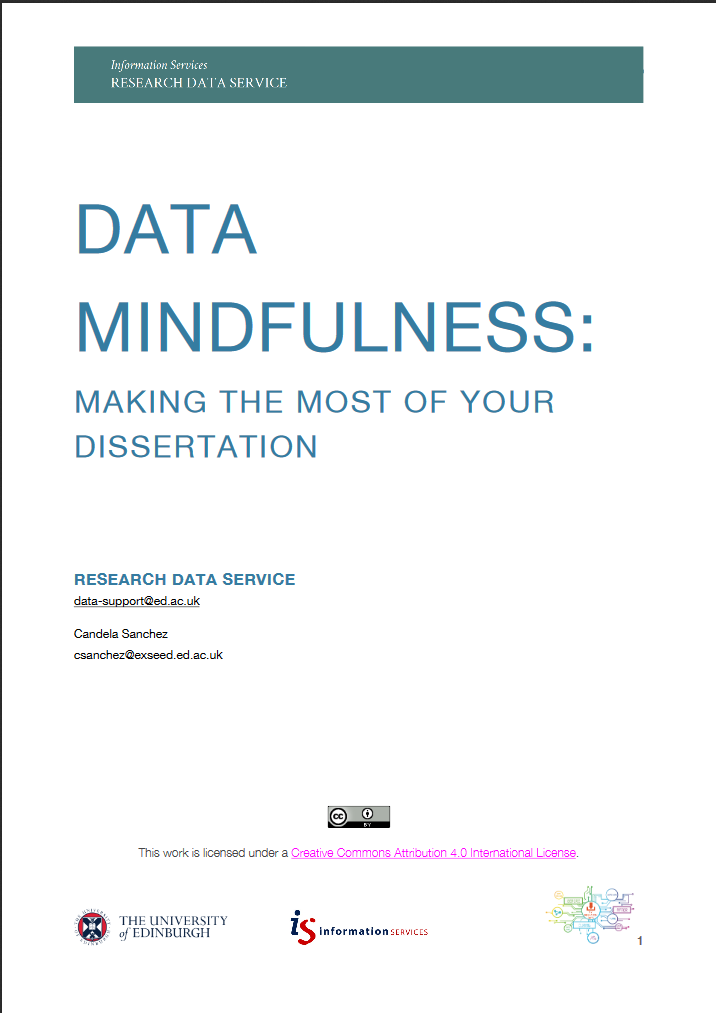
The result is a new handbook called ‘Data Mindfulness: Making the most of your dissertation’, along with a set of face-to-face workshops that we have delivered during the spring semester and will be delivering again this autumn. The idea behind this handbook and the workshops is to take UG students through all the stages of their dissertation journey: from choosing their question to dealing with literature and data to preserving their data after submission.
Unlike existing material for postgraduates and researchers, this handbook has been written by one of our PhD interns from the perspective of a student; and it places data management tips within the broader experience of conducting a UG dissertation. We believe this student perspective is what makes this handbook unique and particularly innovative.
Download Data Mindfulness-Making the Most of your Dissertation handbook for your own use or to customise for your own UG students.
Candela Sanchez-Rodilla Espeso
UG Research Data Management Skills Co-ordinator
Edinburgh Research Archive | ER-data: Jan. – June 2019

Edinburgh Research Archive • www.era.lib.ed.ac.uk • ERdata: Jan. – June 2019
The first half of 2019 saw the fifth highest total of downloads from ERA over a six-month period, unfortunately this is the lowest total of its ‘mature’ phase (since Jan-Jun 2017 download numbers have been consistently higher than 300,000 per 6-month block).

More disappointingly, this is the first time in ERAs history that we’ve witnessed a fall-off in numbers in two consecutive blocks: December 2018 saw a 15% decline and June 2109 has brought a further decline of 6.5%.
The remainder of this report aims to offer an overview of the last six-months of download activity on the Edinburgh Research Archive. Using data generated through the IRUS-UK download statistics portal to investigate that activity under the following headings:
New E-Resource – Jutastat

Following a successful trial earlier this year, we now subscribe to Justastat. Content in Jutastat includes:
- Namibia Law Reports, Statutes of Namibia,
- South African Law Reports from 1947 to date and South African case law from 1838, South African Statutes,
- Tanzania Law Reports, Statutes of Tanzania,
- Zambia Law Reports, Statutes of Zambia,
- Zimbabwe Law Reports, Statutes of Zimbabwe,
Juta’s online journal content:
- Acta Juridica
- Annual Survey of SA Law
- South African Law Journal
- South African Journal of Criminal Justice
- South African Mercantile Law Journal
- Stellenbosch Law Review
- Tydskrif vir die Suid Afrikaanse Reg / Journal of South African Law
Subject coverage includes administrative, civil procedure, commercial, constitutional, criminal, intellectual property, international, labour, mining, revenue and shipping law.
Edinburgh Research Archive Statistics: July 2019

Ban Dainagon Ekotob : a premium replica of the late 12th-century Japanese emakimono (picture scroll)
 The Library has just purchased a beautiful reproduction of a late 12th-century Japanese emakimono (絵巻) – a set of 3 illustrated narrative picture scrolls called Ban Dainagon Ekotob (伴大納言絵詞 The Tale of Great Minister Ban). The full-colour painting depicts the events of the Ōtemmon Conspiracy, an event of Japan’s early Heian period. The painting, attributed to Tokiwa Mitsunaga, is over 20 m (66 ft) long and about 31.5 cm (12.4 in) tall. The original art work is considered to be Kokuhō (國寶, or a Japanese national treasure) among six such rare and invaluable picture scrolls. Information about their replica can be found here.
The reproduction was published by Chikuma shobo (筑摩書房) in 1971-1974 in a limited edition of 1000 copies. Our Library copy has the set number ’84’. The 3 hand-scrolls are placed individually in 3 wooden cases, each accompanied with a booklet. The set has been catalogued for the Centre for Research Collections. See the bibliographic record in DiscoverEd here.
The material has been purchased in response to needs for a Japanese Studies course called “Supernatural Japan: doing Japanology through Yokai”. As the course takes a ‘learning by doing’ approach, allowing students to experience Yokai in art, literature to discover the historical and cultural value of Yokai in Japanese society, this set of 3 hand-scrolls will give a rare opportunity of authentic reading experience for students of Japanese Studies or anyone interested in Japanese art, history and culture.
The Edinburgh School of Social Study and Training
Foundations:
Social work training at the University of Edinburgh has gone through several guises since it was first taught in 1918. Initially it was established as the Edinburgh School of Social Study and Training, under the auspices of the University of Edinburgh. The School was established to meet the increasing need for trained social workers, in the broad sense of the term, which had been highlighted during the First World War. A number of civic minded citizens, including several University of Edinburgh lecturers, came together to form an Association for the Promotion of Social Study and Training in 1917. The School began teaching students in 1918. The School operated as a separate body until it amalgamated with the University in 1928 to become the Department of Social Studies and Training. Archival material gives us rich insights into these early years, and the work that was done to keep the School running and demonstrate that training for social work was both feasible and worthy of association with the University.

Theoretical and Practical training:
The first lecture of the Edinburgh School of Social Study  and Training was given by Miss M. T. Rankin on the subject of ‘Social Economics’ on 8th January 1918 at 4.15pm in the Mathematical Institute, 16 Chambers Street (shown opposite).
The lecture series for the term also included ‘Social Ethics’ and ‘Personal and Public Hygiene’. Students could enrol for the full 2-year Diploma Course or attend individual classes, with public lectures also being given on topics such as ‘The Nature and Duties of Citizenship’ and ‘The Co-operative Movement in Edinburgh’. By 1927 the curriculum had expanded to include, among others, courses in Elementary Anatomy and Physiology, Social Psychology, Office Work and Moral Philosophy. As well as attending theoretical courses students undertook practical training for 3 days each week working in a variety of settings for example day nurseries, juvenile and adult courts, the Craiglockhart Poorhouse, and the Welfare Department of the North British Rubber Works. Additional visits were organised to factories, hospitals and public health departments.
Student and their career prospects:
Initially numbers enrolling in the School were small, but they gradually grew from 11 full time students in 1918 to 34 in 1927. The School was training its students for social work, but at this time the field encompassed much broader roles that it does today, including jobs such as Factory Inspectors, Welfare Workers, Labour Organisers and House Management Workers. Archival material notes that former students went on to have careers in a variety of roles such as the Maternity and Child Welfare Visitor, Stockton-On-Tees; the Industrial Secretary of the YMCA, China; the Police Court Missionary and Probation Officer at Marlborough Street Police Court, London; and the Assistant Welfare Worker in Fry’s Chocolate and Cocoa Works. As well as providing training for social workers the School offered a Health Visitor’s Probation Certificate, which was awarded to 132 students. Archival material also shows that the School was also approached to offer various forms of training and lectures to other groups including disabled officers following the First World War, Women Police Officers and the Edinburgh Women Citizens’ Association.
Amalgamation with the University:
The Director of the School, Miss Nora Milnes, and the wider Executive Committee of the School were keen that the School and its students be afforded academic recognition on a par with the other social studies courses being run at Universities around the UK. The School quickly began setting out its case for its relationship with the University to become more integrated. This was achieved in 1928 when the University Court agreed to the proposed amalgamation and the School became the Department of Social Studies and Training. Announcing the amalgamation in the 1928 Annual Report Nora Milnes notes that:
“the change which is now to take place is the best proof of the success of the School. Social Study has won for itself a recognised position not only in the University, but also in the City of Edinburgh.”
Edinburgh Research Explorer Statistics: July 2019

Collections
 Hill and Adamson Collection: an insight into Edinburgh’s past
My name is Phoebe Kirkland, I am an MSc East Asian Studies student, and for...
Cataloguing the private papers of Archibald Hunter Campbell: A Journey Through Correspondence
My name is Pauline Vincent, I am a student in my last year of a...
Hill and Adamson Collection: an insight into Edinburgh’s past
My name is Phoebe Kirkland, I am an MSc East Asian Studies student, and for...
Cataloguing the private papers of Archibald Hunter Campbell: A Journey Through Correspondence
My name is Pauline Vincent, I am a student in my last year of a...

Projects
Cataloguing the private papers of Archibald Hunter Campbell: A Journey Through Correspondence
My name is Pauline Vincent, I am a student in my last year of a...
Archival Provenance Research Project: Lishan’s Experience
Presentation My name is Lishan Zou, I am a fourth year History and Politics student....