Home University of Edinburgh Library Essentials
April 7, 2026

On trial: South Asia Archive
*The Library now has permanent access to the South Asia Archive. See New to the Library: South Asia Archive *
Thanks to a request from a HCA staff member the Library has been given extended trial access to South Asia Archive from Taylor & Francis, providing online access to documents ranging from the mid-18th to the mid-20th Century.

You can access South Asia Archive from the E-resources trials page.
Access is available on and off-campus.
Trial access ends 1st June 2020. Read More
This Is (Almost) The End
A brief update on the final stages of our Wellcome Research-Resource funded project, read on to find out what to expect next….
Our Wellcome Research-Resource funded project ‘Evergreen: Patrick Geddes and the Environment in Equilibrium’ is very near to its conclusion. While officially, the funding came to an end in the middle of March 2020, there are one or two loose ends that we continue to tidy up.

Patrick Geddes at the Scots’ College, Montpellier, France (Ref: Coll-1869)
The collections at the University of Edinburgh have now been fully catalogued and we are just running some final checks before the new online catalogue goes live. You can look forward to browsing over 2000 catalogue descriptions and we will look to link digital objects to the catalogue descriptions wherever we can so that you can view some of the collections material online.
The new online portal to both the Universities of Edinburgh and Strathclyde’s Patrick Geddes collections is undergoing final tests. We are working hard to make this live as soon as we can but you can expect it online in early May, 2020. This means that you can look forward to searching for material across both collections in one place and lots of useful information to help you contextualise and navigate the collections.
A final report highlighting all of the achievements and successes of the project will be available via the project blog and the new online portal once it goes live. Thank you to all of our stakeholders, researchers, project staff and followers for your continued support and patience. Watch this space!

Patrick Geddes’s Intellectual Origins, front cover
In the mean-time, we recommend exploring Murdo MacDonald’s latest publication, Patrick Geddes’s Intellectual Origins, which came hot off the Edinburgh University Press last month (March 2020). Murdo Macdonald is Emeritus Professor of History of Scottish Art at the University of Dundee. He was editor of Edinburgh Review from 1990-1994 and the author of Scottish Art in Thames and Hudson’s World of Art series. He has written extensively about Patrick Geddes over many years and we were very fortunate to have him as our academic adviser throughout the duration of our project. You can also read an interview with the author on the Edinburgh University Press Blog.
British Online Archives – full access until 30th June 2020
*Access has been extended until 30th June 2020*
I’m happy to let you know that British Online Archives (BOA) are providing 30 days free access (starting from 23rd March) to its entire collection of digital primary sources in light of the Covid-19 outbreak.

BOA provide students and researchers with access to unique collections of primary source documents. Their website hosts over 3 million records drawn from both private and public archives. These records are organised thematically, covering 1,000 years of world history, from politics and warfare to slavery and medicine. Read More
JSTOR – expanded set of content freely available now
 *JSTOR have extended their expanded access to e-journals and digital primary source databases until 31st December 2020 and their expanded access to e-books until 31st August 2020.*
I’m delighted to let you know that JSTOR, and their participating publishers, are making an expanded set of content freely available to participating institutions where students have been displaced due to COVID-19.
What this means at the University of Edinburgh is that we are getting access to journals and primary source collections that we do not already have a licence for and a collection of ebooks freely available through June 30, 2020.
To see the journals and primary source collections included see JSTOR’s Expanded access to journals and primary sources page. To see the participating publishers for the e-books (not all of their partner publishers are participating) see JSTOR’s Expanded access to ebooks page.
While at the University we already have access to 2 of JSTOR’s primary source collections, 19th Century British Pamphlets and Struggles for Freedom: Southern Africa, this expanded offer from JSTOR gives us access for a limited period to World Heritage Sites: Africa and Global Plants. Read More
Bloomsbury Digital Resources – full access until June 2020.
I’m pleased to let you know that Bloomsbury Digital Resources are providing us with full access to their online resources until 30th June 2020 in light of the Covid-19 outbreak.

Bloomsbury Digital Resources products cover a range of disciplines in the Humanities, Social Sciences, Visual Arts, and Performing Arts. Their collections include primary documents, critical texts, historical archives and the latest in video and audio resources.
While at the Library we already have access to some of these collections, this current offer from Bloomsbury Digital Resources gives us access to a wide range of further resources including Bloomsbury Medieval Studies, Bloomsbury Cultural History and Arcadian Library Online. Read More
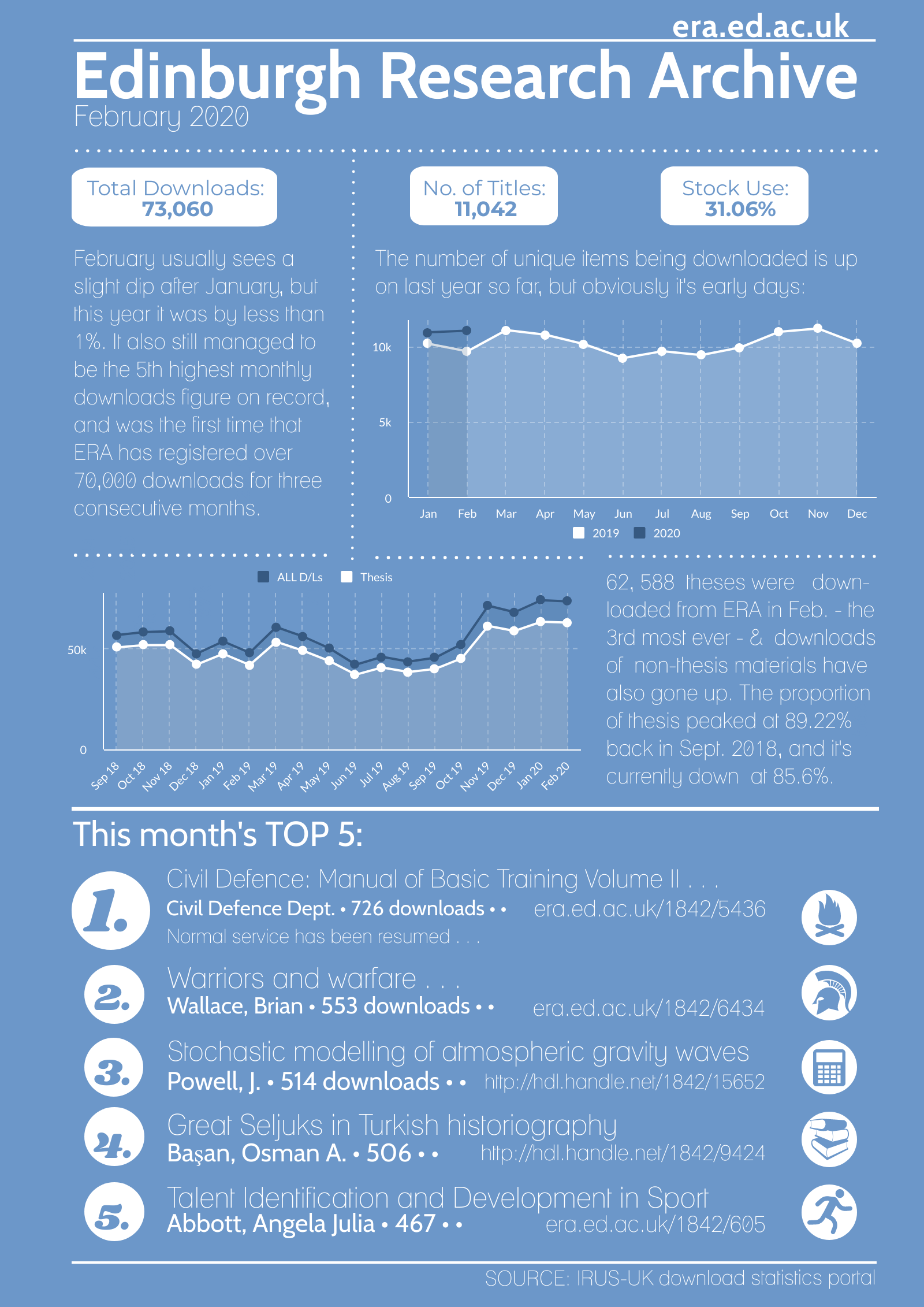
Edinburgh Research Archive Statistics: February 2020
New Post: Project Archivist (Climate Change)

courtesy of Jasmine Keuter
My name is Elise Ramsay, and I am delighted to introduce myself as the University of Edinburgh’s new Project Archivist on Climate Change. My remit includes cataloguing the Lyell notebooks, and scoping other collections the University holds related to Charles Lyell, climate change, and Earth Science. Even in my short time working with the collection, it is apparent that there is an incredible wealth of research opportunity in these notebooks, not only concerning the environment and climate change, but also women’s contribution to science, 19th century social dynamics, international relations between scientists, and 19th century methods of travel, to name but a few.
about me:
I am an Archivist, trained at the University of Glasgow’s Information Management and Preservation course, and with experience in a variety of academic institutions, recently St. George’s School for Girls, and as a volunteer cataloguing on other projects at the Centre for Research and Collections (CRC). In my undergraduate studies, I read French and History, but was very interested by environmental and earth sciences, so in working on this collection, I can employ my understanding of French (Lyell often drafts letters to French colleagues in his notebooks), and continue to learn about Earth Science so as to create detailed metadata.
why climate change?
The University of Edinburgh has committed to become zero carbon by 2040. In line with this, the CRC is committed to improve access to Earth Science collections, and create opportunities for ground-breaking research about the climate, species biodiversity, and more. The Lyell collection particularly captures many of these initiatives.
progress so far…
For a collection of this size, a set methodology is key to completing the project, and ensuring that all items are catalogued equally. Therefore, I dedicated the first few weeks to reading biographies of Lyell, highlighting important people, organisations, and places (known archivally as authorities), and created a process for cataloguing. To ensure that each notebook isn’t damaged in the process of cataloguing, I limited the time each notebook is open to 15 minutes. In those 15 minutes, I take note of the following information:
- How many pages? How many folios? (Imagine you’re taking a picture of each page with text; how many pictures?This number tells us how full the notebook is, and allows us to estimate the effort needed to digitise)
- Authorities
- Subjects (the goal of this is to be as detailed as possible; specimen terms are especially important to make note of so researchers can access material based on their specialisation; for example, volcanoes and volcanic activity; strata; lithification; silicification; opal; coal)
- Illustrations, and page numbers
- Index, page numbers
All of these elements are then created in Archive Space, and included in the catalogue entry.
character of the collection
In reading the notebooks, I have relied on the support of Dr. Gillian McCay to provide specialised knowledge and identify key areas which will be important to researchers. This means learning about geological theories and concepts, and often opposing ideas from scientists of the time. It is clear that the network Lyell operated in featured intense, driven personalities, all motivated to prove their theories about the Earth’s origins and activity. This therefore informs the way I will catalogue this collection to prioritise authorities and give context to Lyell’s contemporaries.
more to come…
Watch this space for details about the collection, discoveries, photos, and updates on the project!
On trial: Telegraph and Financial Times Archives
*The Library now has permanent access to The Telegraph Historical Archive, 1855-2016. See New to the Library: The Telegraph Historical Archive.*
Thanks to a request from a HCA student the Library currently has trial access to two extensive newspaper databases from Gale, The Telegraph Historical Archive, 1855-2016 and Financial Times Historical Archive 1888-2016.
You can access these databases from the E-resources trials page.
Access is available on and off-campus.
*Trial access has now been extended until 30th June 2020.*
Read More
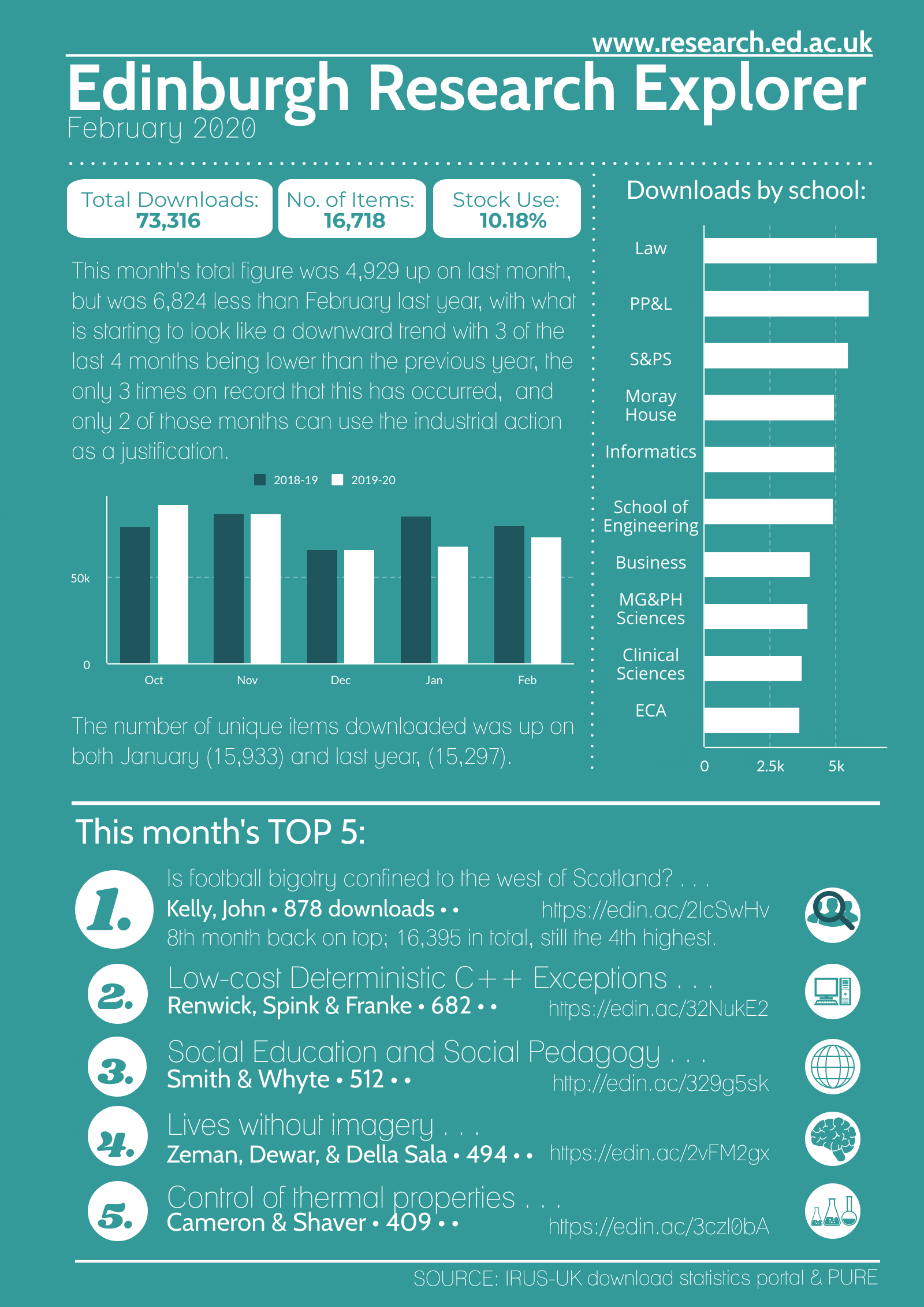
Edinburgh Research Explorer Statistics: February 2020
CNKI Open Access Platform for Chinese literature on COVID-19
CNKI, provider of our Library subscribed databases “China Academic Journals” and “China Doctoral & Masters Dissertations Full-text Databases”, has just launched an Open Access Platform for all Chinese literature published regarding the current new coronavirus known as COVID-19 – http://cajn.cnki.net/gzbd/brief/Default.aspx (Chinese version). The platform will have an English version very soon. All the articles are in Chinese. New articles are being added every day.

Collections
 Hill and Adamson Collection: an insight into Edinburgh’s past
My name is Phoebe Kirkland, I am an MSc East Asian Studies student, and for...
Cataloguing the private papers of Archibald Hunter Campbell: A Journey Through Correspondence
My name is Pauline Vincent, I am a student in my last year of a...
Hill and Adamson Collection: an insight into Edinburgh’s past
My name is Phoebe Kirkland, I am an MSc East Asian Studies student, and for...
Cataloguing the private papers of Archibald Hunter Campbell: A Journey Through Correspondence
My name is Pauline Vincent, I am a student in my last year of a...

Projects
Cataloguing the private papers of Archibald Hunter Campbell: A Journey Through Correspondence
My name is Pauline Vincent, I am a student in my last year of a...
Archival Provenance Research Project: Lishan’s Experience
Presentation My name is Lishan Zou, I am a fourth year History and Politics student....