Home University of Edinburgh Library Essentials
April 6, 2026
From the Stores #1: Packing List for Fieldwork
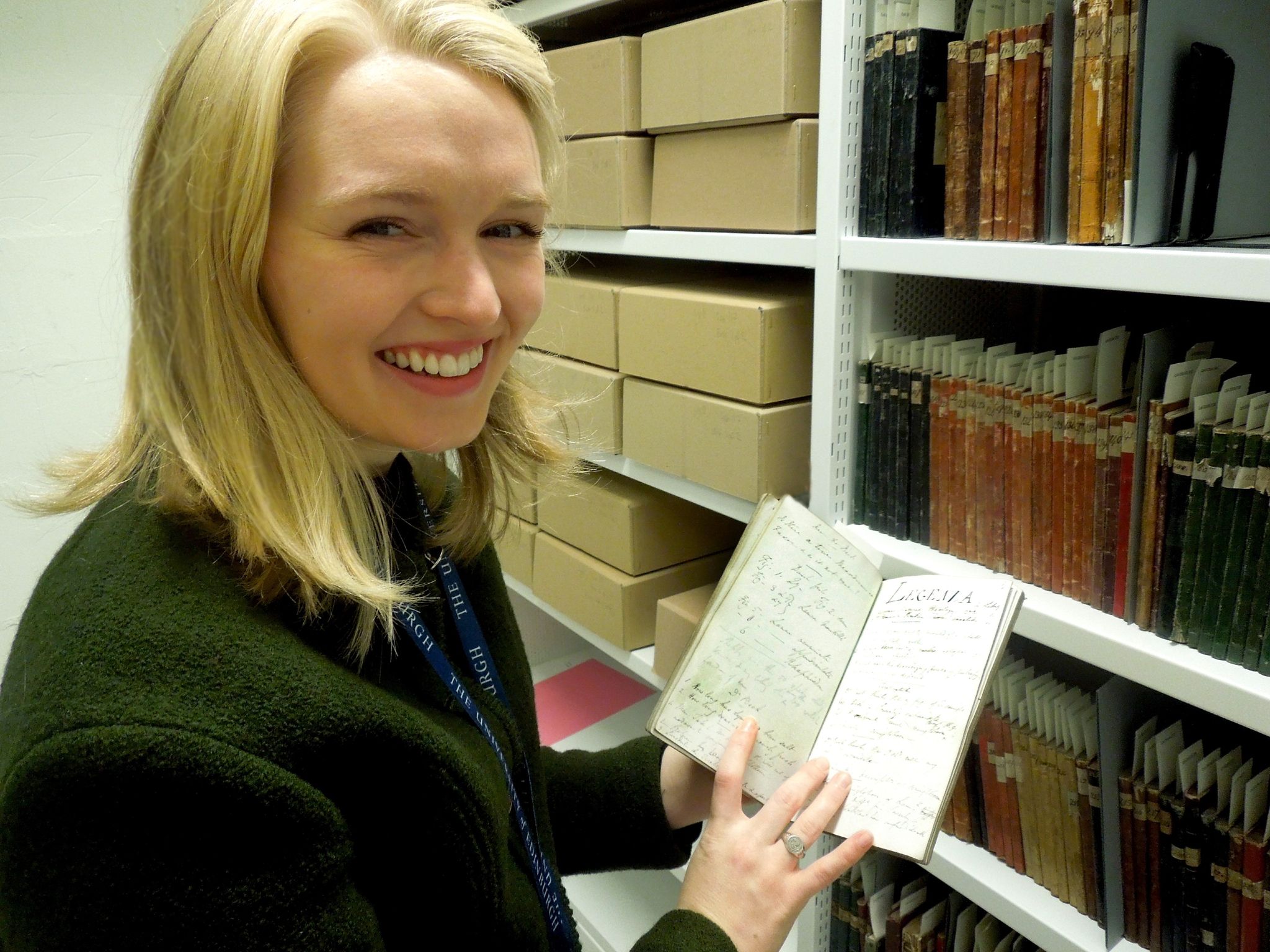
Elise Ramsay at work in the stores
Progress in the Lyell project has taken a giant leap these last two weeks thanks to two developments. Firstly, physical work in the stores where the collection is secured at the University Main Library has been deemed safe, if approached with new procedures, which has meant I have been able to access the collection in person for the first time since March 10th. This has meant the first stage of rapid capture and transcription of Lyell’s indexes has begun. This level of detail will make for rich metadata in the catalogue, and eventually allow researchers to search across the notebooks by subject matter. Thus the need for a new series of blog posts, released each week on Tuesday, where I can highlight all the discoveries I made in working with the collection!
Secondly, I am so excited that Nicky Monroe, a former History of the Book student, has agreed to volunteer on the project remotely. He will be transcribing these indexes and researching Lyell’s life for extra context in the catalogue. We will hear about his progress and discoveries in the collection in the coming weeks!
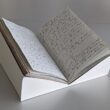
From my time in the stores last week, I captured this fantastic packing list, inscribed by Lyell in the earliest notebook we have of his, from 1825. During this time he would have been balancing his fondness for geology with his law work, which is reflected in the organisation of this notebook. The first half is brief notes on cases, mainly tenancy law and divorce cases. The second half begins from the back of the notebook, and reverse orientation compared to the first half, where Lyell writes notes from a Geology lecture he attended April 29 1825.
It is during this time, while he struggled with his law practice and his eyesight, that he invested more in geological field trips, often with visiting gentleman scientists. In the early summer of 1824 Lyell and Prevost travel from London to Bristol and Land’s End, ending up at Lyme Regis when Mary Anning made her great discovery of two complete Ichthyosauri. (Bailey, 1962) In the autumn, Lyell focuses on his Scottish roots, living at the Kinnordy estate and hosting William Buckland (his geology tutor from Oxford) to venture to Stonehaven, Aberdeen, Elgin, and Inverness to Brora; then back to Inverness and, after a quick jaunt to Brora, south by Blair Atholl, Glen Tilt, Perth, and Kinnordy to Edinburgh. Throughout these journeys, they were “comfortably interlarded with breakfasts and dinners without end”, stopping to see Sir James Hall near St. Abb’s Head, and twice at the Jameson’s. (Lyell and Lyell, 2019) I would bet that this packing list would have been in preparation for any of these foundational field trips. Stay tuned for Tuesday next week when another installment will be published!
References
Bailey, E., 1962. Charles Lyell. Edinburgh: Thomas Nelson and Sons Ltd.
Lyell, C. and Lyell, K., 2019. Life, Letters And Journals Of Sir Charles Lyell, Bart. Alpha Editions.
Bread Rationing: a surprising and timely subject
Today’s post, highlighting the wide range of newspaper archive databases the Library has and how these can be used to research a particular topic or event, is written by Louise Peterkin, Helpdesk Assistant, University of Edinburgh Libraries. During lockdown Louise also worked part-time with the Library Academic Support team.
I was delighted to be asked to write a blog showcasing the University’s wide range of databases and primary sources. These have been bolstered considerably in the last few months with the exciting addition of 365 new databases through our new ProQuest 350 Access subscription.
Looking for inspiration as to what to write about I searched Google for important events in history that fell between July and August. 22 July 1946 – Bread rationed for the first time in the UK leapt out at me. I always thought bread had been rationed during World War 2? I was keen to find out more.

Screenshot of “Bread Rationing Begins; and Other News Events of the Week.” Illustrated London News, July 27, 1946, 101. The Illustrated London News Historical Archive, 1842-2003.
I researched the topic through the University’s databases, starting with our newspaper archives. We have access to ProQuest Historical Newspapers, which includes access to The Guardian (1821-2003), The Observer (1791-2003) and The Scotsman (1817 -1950) and Gale Primary Sources and Gale News Vault which contain access to many historical newspapers including to the Daily Mail Historical Archive (1896-2004) and Times Digital Archive (1785 to 2011). Read More
Dissertation Festival: 26th October – 6th November
 Are you writing a dissertation this year? Do you want to find out more about the library resources available to support your dissertation?
From the 26th October to the 6th November 2020 we have a fortnight of online events which will highlight what the Library can do for you to help you succeed with your dissertation.
One of the events we’re holding is a Dissertation Fair which showcases library resources and services which support CAHSS students specifically on Thursday 29 October. You can:
- Make your dissertation something special : find out about the fantastic collections
available at the Centre for Research Collections - Discover the full range of digital resources that you can access via the University
- Take the first steps to learn new skills in managing your bibliographic references and your research data
For details of how to book this or any of our other events please visit the Dissertation Festival Subject Guide: https://edinburgh-uk.libguides.com/dissertation
Not available to attend live sessions, or feel that your dissertation is still too far away to plan for? Don’t worry! Most live sessions will be recorded and made available after the Dissertation Festival to be used asynchronously at a time that suits you. The Subject Guide will be updated after the events have taken place with more information.
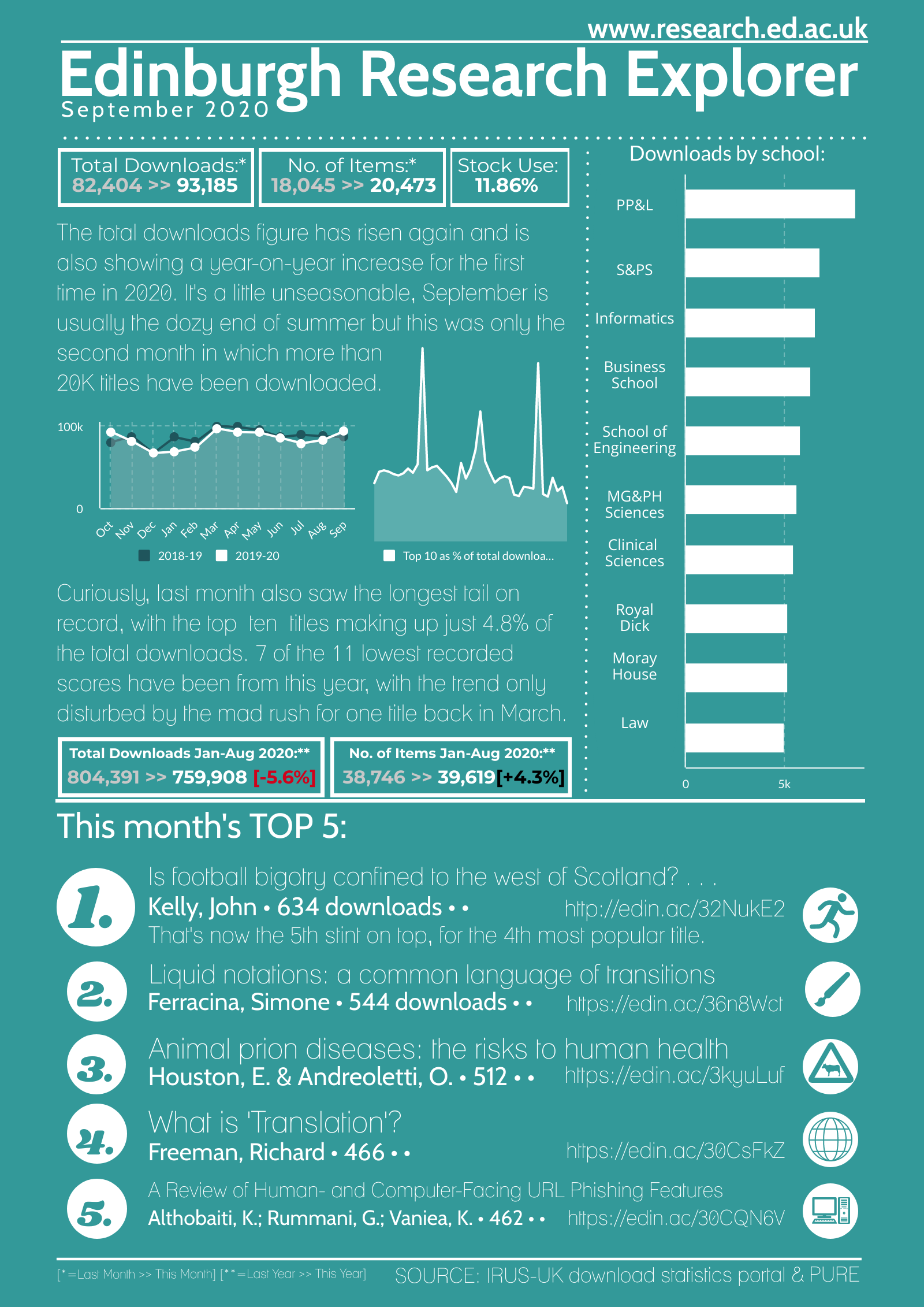
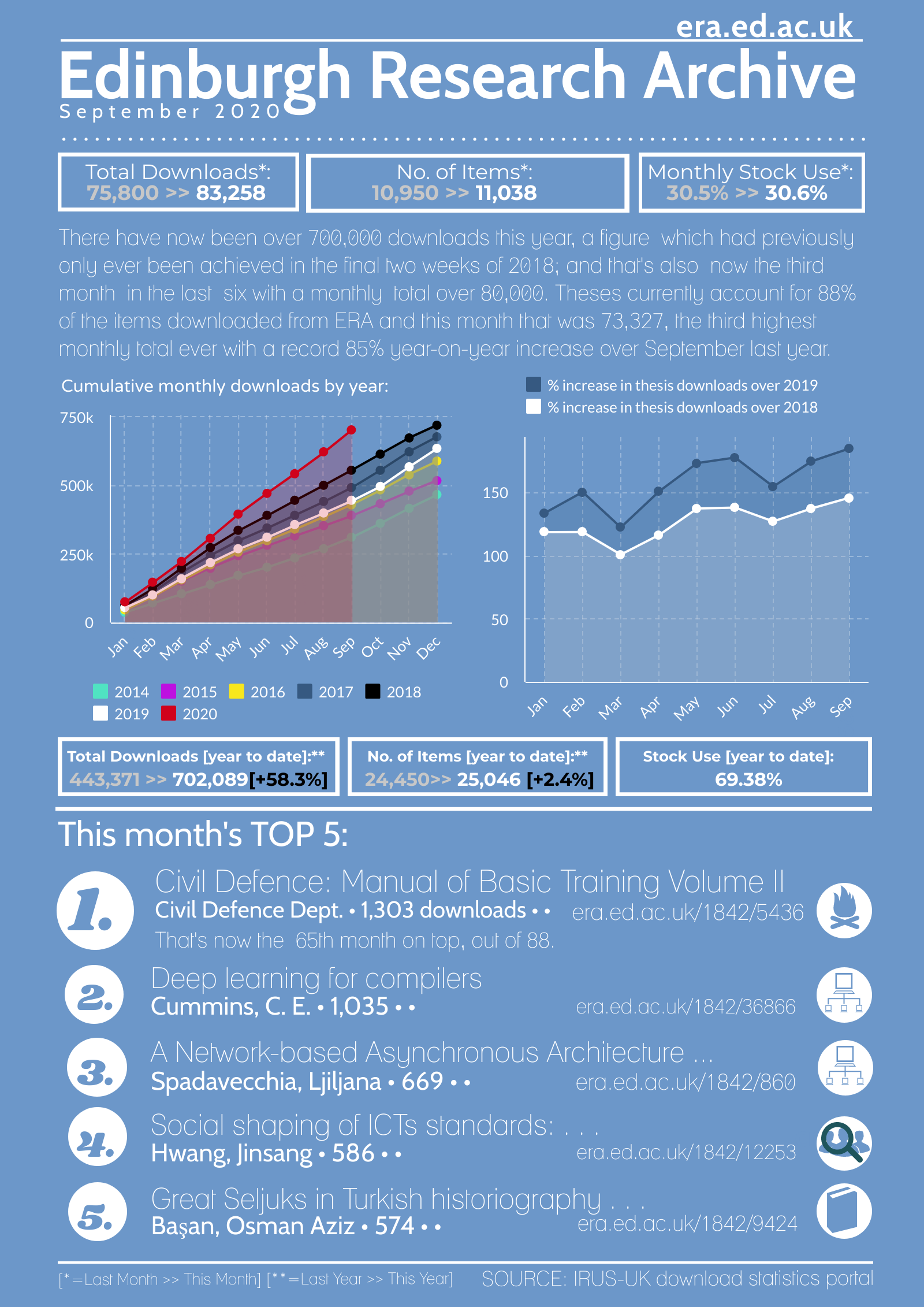
Edinburgh Research Downloads: September 2020
Dissertation Festival 2020
From 26 October – 6 November the Library is running a virtual Dissertation Festival. The online events taking place during this two week period will highlight what the Library can do for you to help you succeed with your dissertation.

In this blog post I am going to focus on the sessions that might be of particular interest to dissertation students (undergraduates or postgraduates) in the School of Social and Political Science (SPS). However, to find all sessions available and to book on take a look at the Dissertation guide. Read More
First online meeting of the Research Outputs Forum (15th October 2020)
After a brief introduction from chair Martin Donnelly, who recapped the rationale for merging the former Open Access and Research Data Management forums into a single channel for communicating progress across Library Research Support to research support colleagues within the Schools and Colleges, Nik Hussin from the Research Information Systems team kicked off with a status report on the future upgrade schedule for the University’s Pure CRIS system, which records research outputs and underpins the University’s all-important REF submission.
Head of Library Research Support Dominic Tate began by talking about the new Research Publications Policy, which is in the process of being scrutinised and approved by various committees and other stakeholders. Dominic explained that the overall goals of the new policy are to make compliance with REF and funders’ Open Access policies easier for all concerned, and to empower researchers to make their own decisions about how and where to publish. Fiona Wright from the Scholarly Communications team then provided updates on publications Block Grants in light of Plan S. These come from Wellcome Trust, British Heart Foundation and Cancer Research UK. Dominic wrapped up with a brief REF update, noting that as much of the submission as possible will be done electronically, although some hard copies will still be required.
Moving on to Research Data Support, we heard from Pauline Ward about new features and improvements to the DataVault, including a larger maximum deposit size of ten terabytes, the refined and more streamlined review process, and the new ‘roles’ feature which enables, for example, a research administrator to access information about all of the deposits from their School.
Robin Rice gave a recap of progress on the Data Safe Haven, including its ISO27001 accreditation and an elucidation of the charges and cost recovery mechanism for using the Safe Haven. Finally, Martin Donnelly talked about the pros and cons of moving our previously face-to-face training online – in short, less interaction with attendees but higher levels of attendance and uptake – and gave a quick overview of the guidance resources produced by Research Data Service, such as the Quick Guides on topics such as data storage options, the FAIR principles for data, and much more.
We received positive feedback from the meeting, and will be organising the next one for early in 2021.
(Update: the Research Data Support slides from this meeting are now available here.)
—
Martin Donnelly
Research Data Support Manager
Library and University Collections
Training Sessions- Diary Dates
Learn something new or simply refresh your memory!

There are a couple of online training sessions coming up soon that you may find useful:
Using Law Databases (Library Bitesize)- Wednesday 21st Oct 2020, 12:30- 13:00. Bookable through MyEd Events and Training: https://edin.ac/2FXpv1q
Referencing for Law- Wednesday 11th Nov 2020, 09:00- 10:30. Bookable through MyEd Event and Training: https://edin.ac/312Roiq
Thank you Friends
Friends of the National Libraries
Friends of Edinburgh University Library
The University of Edinburgh’s Lyell archives continue to grow, thanks to the support of our generous friends. The Friends of the National Libraries and the Friends of Edinburgh University Library united to help us acquire a fascinating Lyell family album of 118 letters and 57 portraits.
The album’s correspondents are quirkily described as “Divines, metaphysicians and philologists.” They date from 1805 to 1899 and include letters from Charles Kingsley, Samuel Wilberforce, Ralph Waldo Emerson, John Stuart Mill, Herbert Spencer and Wilhelm and Jacob Grimm.
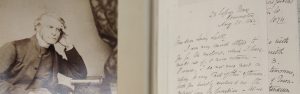
Lyell album of letters and portraits
The correspondence appears to be mainly unpublished and will be an important resource for researchers seeking to understand the vital social, scientific and intellectual network of Sir Charles Lyell and his extended family.
The album cost $22,000 from an American dealer and was supported by a £10,000 from the Friends of the National Libraries and £500 from the Friends of Edinburgh University. The album’s contents will join his notebooks and other archives as part of our ambitious Creating Charles Lyell’s World Online project. The ongoing support of our many Friends deserves our heartfelt and warm thanks.
David McClay, Philanthropy Manager, Library & University Collections
‘Using the Library’ sessions, and catching up
We’re now in week three of semester one, and by this point we’ve been able to conduct introductory ‘Using the Library’ presentations for undergraduate, postgraduate and PhD level students. If you weren’t able to attend the sessions at the time you will be able to catch up by watching the videos which we’ve uploaded to our Media Hopper Channel, here:
Law Librarian Resources Media Hopper Channel
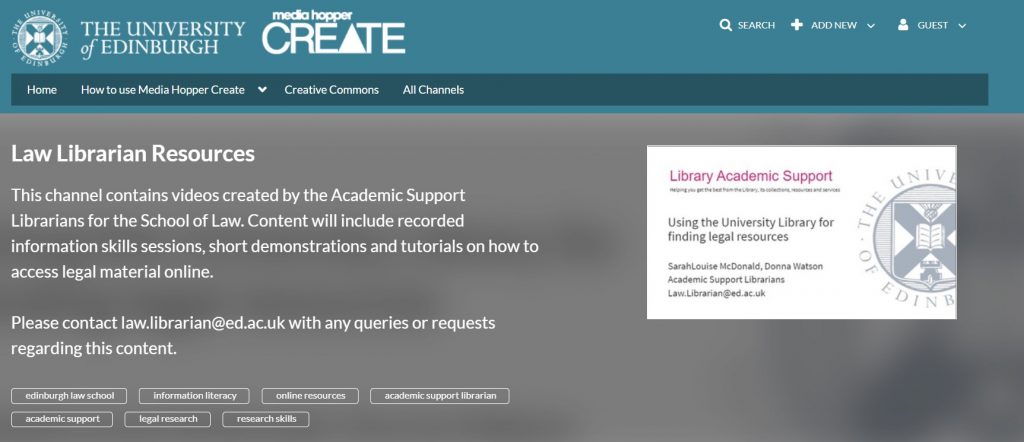
Screen grab of the Law Librarian Media Hopper front page.
If you click in to the video that interests you you will also find the slides used for our presentation by clicking on the ‘attachments’ tab.
We intend to continue to upload useful videos on our channel throughout the year, including training and walkthroughs of using our databases, DiscoverEd, Referencing for Law, using reference managers, and any other relevant pieces of training or help we can offer. If you’ve got anything you’d like to see us include please let us know by leaving a comment or emailing law.librarian@ed.ac.uk.
Attending LIBER and REDUX 2020 Conferences Online
In our continuous shift towards digital culture, and of course during the pandemic, conferences have been adapting their programmes to online formats. This is no mean feat, particularly as even the best laid plans can have technical issues. But at least online you can fix yourself a cup of tea or stretch your legs while the hosts sort issues out, rather than sitting awkwardly in the audience.
I attended two big conferences online that I usually would have attended in person: LIBER (Europe’s largest association of research libraries) 2020 and the 2020 University Press Redux Conference. The former took place over one week while the latter had five webinars spread out over four months. Both conferences had plenty of sessions that revolved around open access and, as open access is very much my area (I run the open access journals hosting service), I was excited to dive in and attend as many as I could. I’ve popped a few of my highlights below and hope you find them useful!
LIBER
With an excellent keynote on marketing (by Christine Koontz) two panels, ten sessions, six workshops, and paper presentations, LIBER 2020 was a packed week.
Open Access Insights
Denis Bourguet (UMR CBGP, INRAE, Montpellier) made the case for preprints and argued they are important as a tool of accessibility, as they are free for authors and readers and offer immediate access for researchers. However, as there is no peer review all types of research will be hosted, including the “not so good stuff”. Denis works on the Peer Community In (PCI) project (Winner of the LIBER Award for Library Innovation!) which aims to add peer review into the mix. Meanwhile, in Finland, Malin Sofia Fredriksson (The Donner Institute for Research in Religion and Culture) reported that one of the major funders in Finland requires open access publishing now and that humanities have the smallest proportion of peer-reviewed journals but has the largest share of monographs and edited works. Their biggest hurdle is challenging the idea that open access means lower quality and less visibility. Leo Waaijers (QOAM, The Netherlands) introduced Quality Open Access Market (QUAM) which is an online instrument that helps authors share their publishing experience with colleagues by completing a four-question scorecard about the peer review, editorial board, the value and ‘recommendability’ of the journal they were publishing in. The journal is then given a Quality of Service indicator, alongside information about publication fees. Sounds handy!
Libraries as Open Innovators and Leaders
The next session, and one I was really looking forward to given my role. Dr. Markku Roinila, Kimmo Koskinen and Kati Syvälahti (Helsinki University Library, Finland) spoke about their use of the Open Journals System (OJS) to host academic–led journals, at no cost to the editors and with maintenance and technical support provided by the library (exactly like us at Edinburgh!). Helsinki University Library empowered the journal managers to become “teachers”, so they could teach the use of OJS and of academic workflows to students. They gathered great feedback about the pilot, realised the importance of technical support from the library and are now looking into launching some student-led journals. Next, Shane Collins and Siobhán Dunne (Trinity College Dublin, Ireland) spoke of open scholarship (instead of open science, so that they are inclusive of AHSS) and how they created a taskforce of staff who look at Plan S and Trinity’s strategic open access targets. They ran events and podcasts with inclusivity at the forefront and found high levels of collaboration between departments. They also said that “bringing the melting pot of people together for culture change requires this type of grass-roots approach”. Finally, Dr. Coen Wilders and Martine Pronk (Utrecht University Library, The Netherlands) see the library as experts on making scientific information fair in a world that is increasingly more open and digital. They spoke of how libraries support the entire research process and said they choose to focus on metadata and repositories (instead of catalogues) as this is in line with their internal target audience.
Tools for Transparency and Open Access
First up, Sarah Ames (National Library of Scotland, Scotland) spoke about NLS’s Digital Scholarship Service, which encourages, enables and supports use of computational research methods with their collections, among other aspects. They focused on internal and external engagement and worked hard to communicate transparency, including utilising social media, which was highly engaged with. Next, Maurits van der Graaf (Pleiade Management & Consultancy, The Netherlands) looked at a library toolkit for open access and pointed out that institutional repositories are a vital form of green open access. There are currently 5,367 repositories and 82% of publishers allow self-archiving. Maurits concluded by stating the importance of green and gold routes in the move to open access and highlighted the need for more Read and Publish deals as well as more library support for APC-free publishing. Finally, Nicole Krüger and Dr. Tamara Pianos (ZBW – Leibniz Information Centre for Economics, Germany) spoke of the importance of considering open educational resources (OER) before designing learning materials. They used H5P as it was mobile-friendly and allowed for interactive content. Although content hosted via this route isn’t indexed by search engines, it can be downloaded and adapted for other sites, such as WordPress. Overall, they found H5P very user-friendly.
REDUX
Monographs, open access and public policy: UKRI OA consultation 2020
Helen Snaith (the Senior Policy Adviser at Research England) said that monographs should not try to replicate journal open access models and that they need to ensure that policy doesn’t create accessibility issues. Richard Fisher (Vice Chair of Yale University Press) said that removing the financial barrier is only one aspect of open access, and that money needs to be spent on marketing in order to make the book successful. Overall, it was agreed that publishing open access shouldn’t affect the quality of the content.
Open Access: Sales – Open Access business models for books and journals
Martin Paul Eve (Professor of Literature, Technology and Publishing, Birkbeck, University of London) pointed out that books are much more expensive to produce than journals, and this can be an issue for the humanities and social sciences in particular as there is generally less funding. He said that it isn’t as simple as a library switching the book purchasing budget to the book processing charge (BPC) budget, as the former wouldn’t sufficiently cover the latter, and that COVID19 has shown the inaccessibility of books online compared to journals. Similarly to Richard Fisher, Martin said that gold open access may not be the way to go for books. Emily Farrell (Library Sales Executive, The MIT Press) said they rely on a hybrid approach to funding their open access activities, including article processing charges (APCs) and crowdfunding approaches for books, such as Knowledge Unlatched. She acknowledged that they see a lot more usage when books are open and they aim to roll out a library–centred collective model by 2021. Lastly, Vivian Berghahn (Manging Director, Berghahn Books) spoke about the subscribe-to-open (S2O) model, where subscribers get discounted access to the content and, if enough subscribers participate, the content is made open access. Vivian said they have 305 participants to date and the model is working particularly well for their anthropology journal.
Conclusion
Having the conferences online, in my opinion, worked well. More people could attend due to the lack of a financial barrier (no travel, no accommodation, no delegate fee). And the less air travel the better, of course. Without these barriers, knowledge can be shared more widely too. The main downside is the lack of organised networking and ability to have in-depth discussions with your colleagues and peers. Perhaps a solution is on the horizon for conference organisers.
It was brilliant to see so much conversation about open access, including accessibility, be given through open and accessible platforms with no financial restrictions. Open access policy is still developing, and it’s important that conferences continue to highlight and discuss the impact of this.
A final positive of hosting an online conference is the ability to record and share online for those who can’t make it or to have the information to hand. Speaking of which, you can access all the LIBER sessions here and the REDUX ones here. I thoroughly recommend checking out both. Happy watching!
Collections
 Hill and Adamson Collection: an insight into Edinburgh’s past
My name is Phoebe Kirkland, I am an MSc East Asian Studies student, and for...
Cataloguing the private papers of Archibald Hunter Campbell: A Journey Through Correspondence
My name is Pauline Vincent, I am a student in my last year of a...
Hill and Adamson Collection: an insight into Edinburgh’s past
My name is Phoebe Kirkland, I am an MSc East Asian Studies student, and for...
Cataloguing the private papers of Archibald Hunter Campbell: A Journey Through Correspondence
My name is Pauline Vincent, I am a student in my last year of a...
Projects
Cataloguing the private papers of Archibald Hunter Campbell: A Journey Through Correspondence
My name is Pauline Vincent, I am a student in my last year of a...
Archival Provenance Research Project: Lishan’s Experience
Presentation My name is Lishan Zou, I am a fourth year History and Politics student....