Home University of Edinburgh Library Essentials
April 5, 2026
Critical Approaches to Libraries 2021(CALC) Day 1
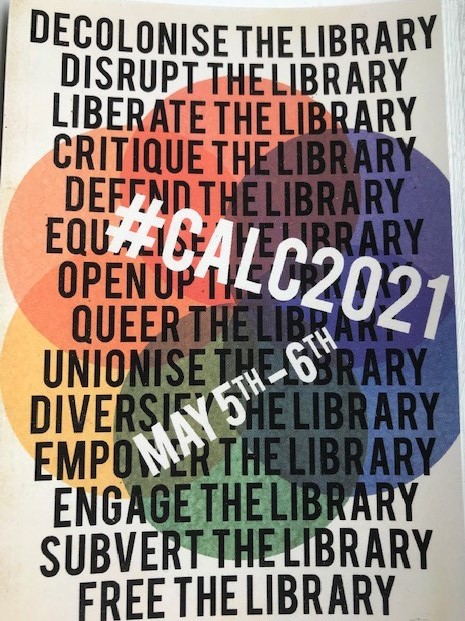
On Monday 5 May I attended the Critical Approaches to Libraries 2021 conference, a really interesting and dynamic gathering exploring all aspects of critical practice in libraries. My first session was A novel data solution to analyse the diversity of reading lists – The case of Imperial College London Masters in Public Health by Robyn Price (Bibliometrics Manager) and Mark Skopec (Research Assistant – Primary Care and Public Health) at Imperial. This was a research project piloted on a masters course at Imperial, which aimed to create a decolonisation reading list checklist/toolkit, addressing diversity and geographic representation in reading lists. Read More
Tocher at 50: Morag Macleod and Tocher
We are incredibly grateful to Morag Macleod, who has written this week’s post about her recollections of Tocher and her wider work in the School of Scottish Studies, working with Gaelic material.
I was very fortunate during a break in my undergraduate career to be asked to fill the recently vacated post of Texts Transcriber in the School of Scottish Studies. That was in 1962, and my work was to write Gaelic stories and interviews and the words of Gaelic songs. The material was mainly on 5” and 7” tapes, and some of those were in a bad way. With storing conditions that were not ideal, the tapes tended to dry, and this made them brittle. After a time I would sometimes make an attempt to collect the bits of tape that scattered around, and mend them, but it was mainly the work of the technicians to make the best of that. A story went around of a comment by Calum Maclean when bits of tape landed on the floor, “Catch that tape, it might be a grace-note”.
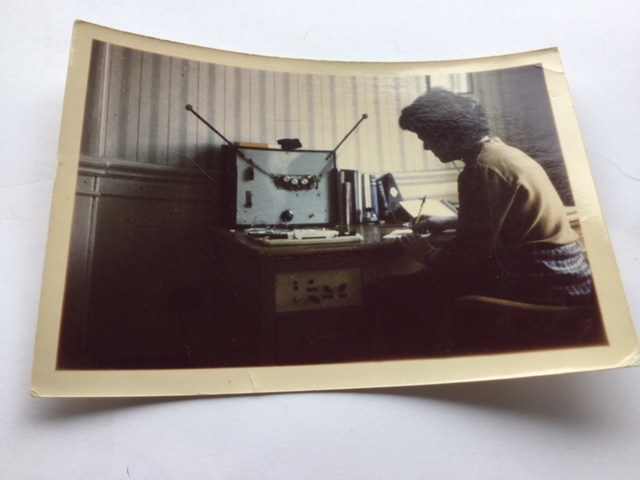
A device, a repeater, invented by Fred Kent, the chief technician, was indispensable for me. A short piece of spoken or sung text was recorded on to a short loop which could be played over and over to facilitate making a correct interpretation of the item on the original tape. As texts transcriber, I was given recordings from Harris , the easiest for me to understand. That material was then added to files in the library, ready for typing when required.
In my time, Mary Macdonald did most of the typing, and that familiarised her with the richness of the material, and encouraged in her the strong wish that it should be seen. Mary’s roots were in Islay although she had lived for some time in Barra. She loved the material held in the School and she it was who thought of publishing it, with eager support from Dr Alan Bruford. Dr Bruford was then the editor, with Mary his assistant. Between them they came up with an A5-sized booklet, Tocher, TALES, SONGS, TRADITION, SELECTED FROM THE ARCHIVES OF THE SCHOOL OF SCOTTISH STUDIES.
The basic English translation of the Gaelic word Tochar is dowry, but it can convey collection or treasure, and had the advantage for us of having a similar sound in English or Scots.
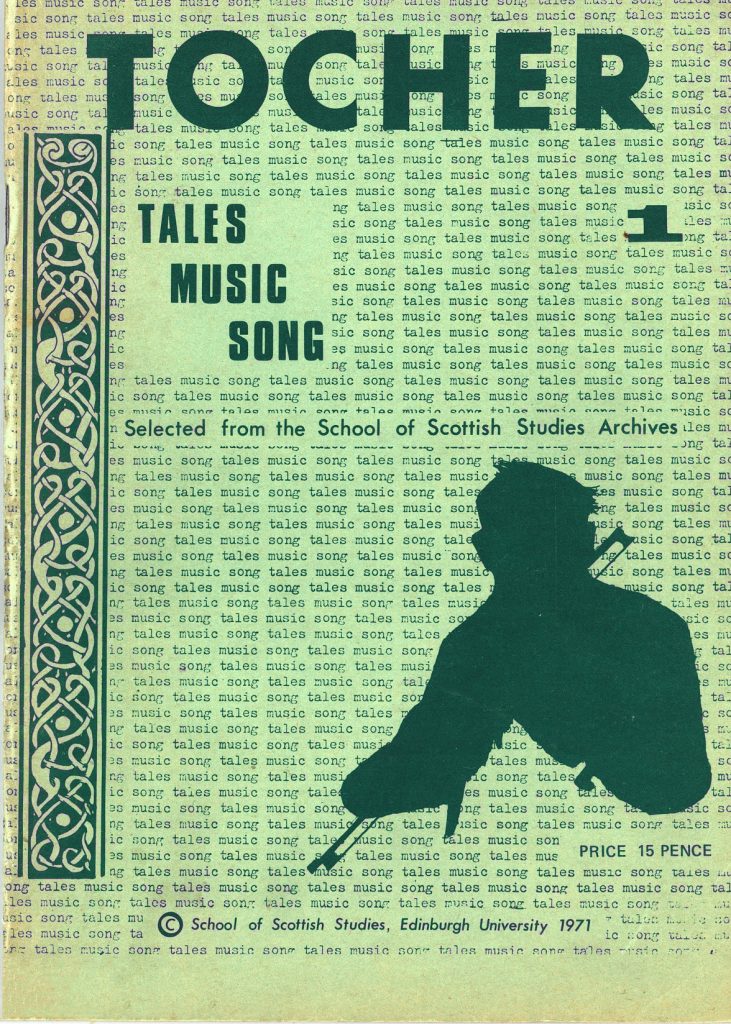
All members of staff were required to contribute to the booklet, leaving the choices and editing to Alan and Mary, and Donald Archie Macdonald, Cathie Scott and Joan Mackenzie were amongst those who were involved in its production over time, as well as Tony Dilworth. Ralph Morton contributed fine illustrations by hand and edited photographs.
Personally, I was advised to write the Gaelic material in a way that let the reader know how the informant pronounced the words. Of course I couldn’t be given the luxury of confining myself to my native Scalpay, Harris, Gaelic, and I remember well some difficulty I had with a waulking song from Lewis. Waulking songs accompanied the rhythmic beating of tweed on to a board in order to wash it and shrink it. The form was solo and chorus, and a lot of the texts were spontaneous. The performer (and author) had to be familiar with the concept of assonance, at the ends of lines or between a word at the end of a line and one in the middle. O mo leannan, é mo leannan (Oh, my sweetheart, ay, my sweetheart) is the refrain to a very popular waulking song. There is a verse that goes:
‘S e mo leannan am fear donn
A chì mi ? a’s an taigh-chiùil.
My sweetheart is the brown-haired
one whom I can see ? in the ceilidh-house.
That ? word had to rhyme with donn, which is pronounced like English down. My colleague John Macinnes had to tell me that it was bhuam (along / across from me, pron. voo-um in my dialect) which would be pronounced like fomm = fowm in Lewis.
A greater leap was when John MacInnes asked me to transcribe stories and songs from the traveller Alex Stewart . His Sutherland Gaelic was very different from mine, and that created a steep learning curve for me. I was given me a lifelong awareness of the ties of spelling with pronunciations, especially in Gaelic.
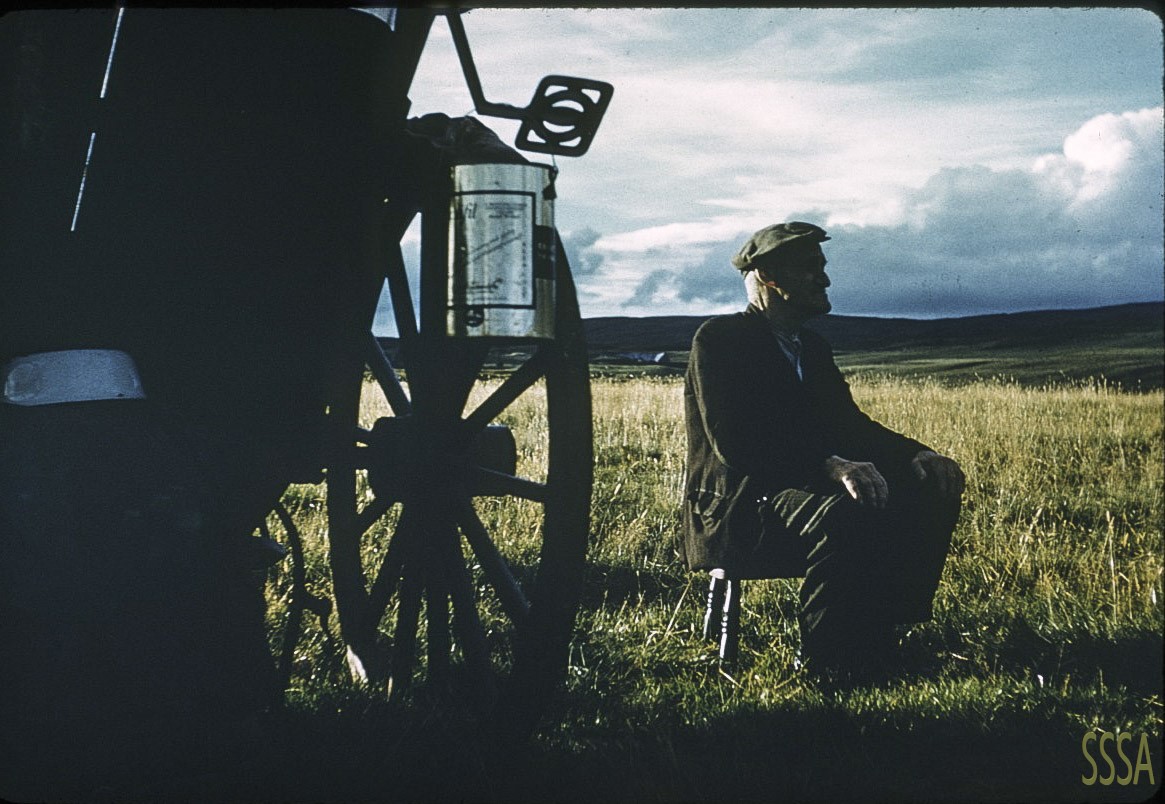
Alexander Stewart, photograph by Sandy Paton
SSSA-HH14
An incident that stays in my mind connected with my contributions to Tocher is when I chose a song from the archive that I had known from childhood, to fit in with a fishing, sailing theme. I actually made no claim for its provenance, – thank Goodness, although I had thought it might possibly be from my native island – but that the singer was from Scalpay. In the next issue of Tocher , No 20, there was a notice from Dr John Lorne Campbell of Canna to say that the song was a version of one by John Campbell of Lochboisdale, South Uist, and was published in Orain Ghàidhlig le Seonaidh Caimbeul by J. MacInnes and J.L Campbell in 1936. The notice in Tocher was probably much more polite than Dr Campbell’s private comment. Incidents such as those two made me aware of the tremendous knowledge there was around about the simplest things that I had taken for granted over the years, and of how ignorant I was.
After a year another vacancy occurred when Gillian Johnston resigned as music transcriber. I had done Higher music in school, but I did not see myself as competent to produce written versions of melodies. When approached by the current musicologist, Thorkild Knudsen, a Dane, I tried to explain my limitations to him, and he boosted my morale so much by saying “You’re not the best, Morag, you’re the only one.” It is hard to believe now that at that time that was true. Anyone who had qualifications in music did not see this work as at all prestigious, and their being literate in Gaelic was immaterial. It was to the credit of Prof Sidney Newman, head of the Music Faculty in the University, that he was an enthusiastic member of the academic board of the School of Scottish Studies at its beginnings, but such a combination was unusual.
Transcribers in Tocher, apart from me, produced a tremendously accurate reproduction of the singer’s performance. One example of a song learned from the magazine showed me that an indication of speed was advisable. I hear the song on radio and the vocal reproduction is, to me, so slow as to be unrecognisable. Dr Emily Lyle at one time tried hard to persuade us to put together a collection of the material in Tocher, and I confess that I resisted that idea, which I now see is a pity – Sorry, Emily! It would, especially with, perhaps, some further editions have been an asset to folklorists.
But, how things have changed. Even by the 1960s, more attention was being given to Gaelic music in education, and the interest of the Royal College of Music in Glasgow giving classes in Gaelic singing and piping, quickly brought about a greater prestige to the subject. Some of the first students from there – later the Conservatoire – are really well-known now. Tobar an Dualchais, was established officially in December 2010. It consists of archive material, mainly from the School of Scottish Studies, Canna and the BBC. It has made an incredible difference to the general knowledge of traditional Gaelic music.
Now there is a change in attitude to the rights of the informants. There were different kinds of implication in collecting traditional material. Sometimes we would be asked, “So when will we hear it?” as employees of the BBC were the most familiar carriers of microphones and recorders. Others would almost require an oath that it would not be heard by anyone outwith the department. I remember one occasion when someone who had given us a large number of songs said something like. “Why should I give you songs when you just give them away to any Tom Dick or Harry?” (I won’t try to think of a Gaelic form of that). A well-known singer had sung a song on radio which could only have come from one of our recordings and was completely recognisable as that. Of course, if a song or story was selected for use on radio, forms were produced for permissions. Mary Macdonald saw the publication of a portion of the material as a way of passing on the treasures that she loved whilst keeping to the desire for confidentiality to a reasonable extent, and Tocher fitted her wish perfectly.
With Tobar an Dualchais there is little need to produce something like Tocher, and the last issue, no. 59, came out in 2009. I was responsible for one issue and was really surprised at the amount needed to provide a reasonable volume. It is still, I think, useful for items relating to particular themes, and particular informants.
Morag has was involved with several roles and projects in The School of Scottish Studies from music transcriber, fieldworker, Senior lecturer in Gaelic song, and working to create Tocher and the Scottish Traditions Series. Morag is now retired, but she remains a valuable touchstone of knowledge for us at the Archive. Thanks to her once again for writing about her memories of The School and Tocher.
If you would like to listen to some of Morag’s fieldwork recordings for The School of Scottish Studies Archives, you can listen to over 1000 tracks on Tobar an Dualchais.
Please do not reproduce images without prior permission.
Library of Congress Law Library

Whilst searching for material you sometimes find a resource that you want to tell other people about! On this occasion it is the Library of Congress Law Library.
It is based on a print book collection, which is not accessible to us. However as with most libraries today they are digitising their collection. Access may be limited but it still offers alot of interesting material for students of this topic.
One of the sections of most interest was the Indigenous Law Portal, which allowed PDF downloads of some of the materials. This included maps, Constitutions and by-laws, Corporate charters of native villages and Laws.
All in all a treasure trove of material.
If you find any resources you’d like us to share on the blog, please let us know by emailing law.librarian@ed.ac.uk.
On trial: U.S. Declassified Documents Online
*The Library has now purchased this resource. See New to the Library: U.S. Declassified Documents Online.*
Thanks to a request from staff in HCA the Library currently has trial access to U.S. Declassified Documents Online from Gale. This database provides immediate access to a broad range of previously classified federal records spanning the twentieth and twenty-first centuries.
You can access U.S. Declassified Documents Online via the E-resources trials page.
Access is available on and off-campus.
Trial access ends 1st July 2021. Read More
SSSA in 70 Objects: “No Winder You Canna Catch Fish”
Response by: Holly Graham
Recording: Up Helly Aa peats replaced by tar barrels
Contributor: Katie Laurenson
Fieldworker: Elizabeth Neilson
Reference: SA1961.89.B74
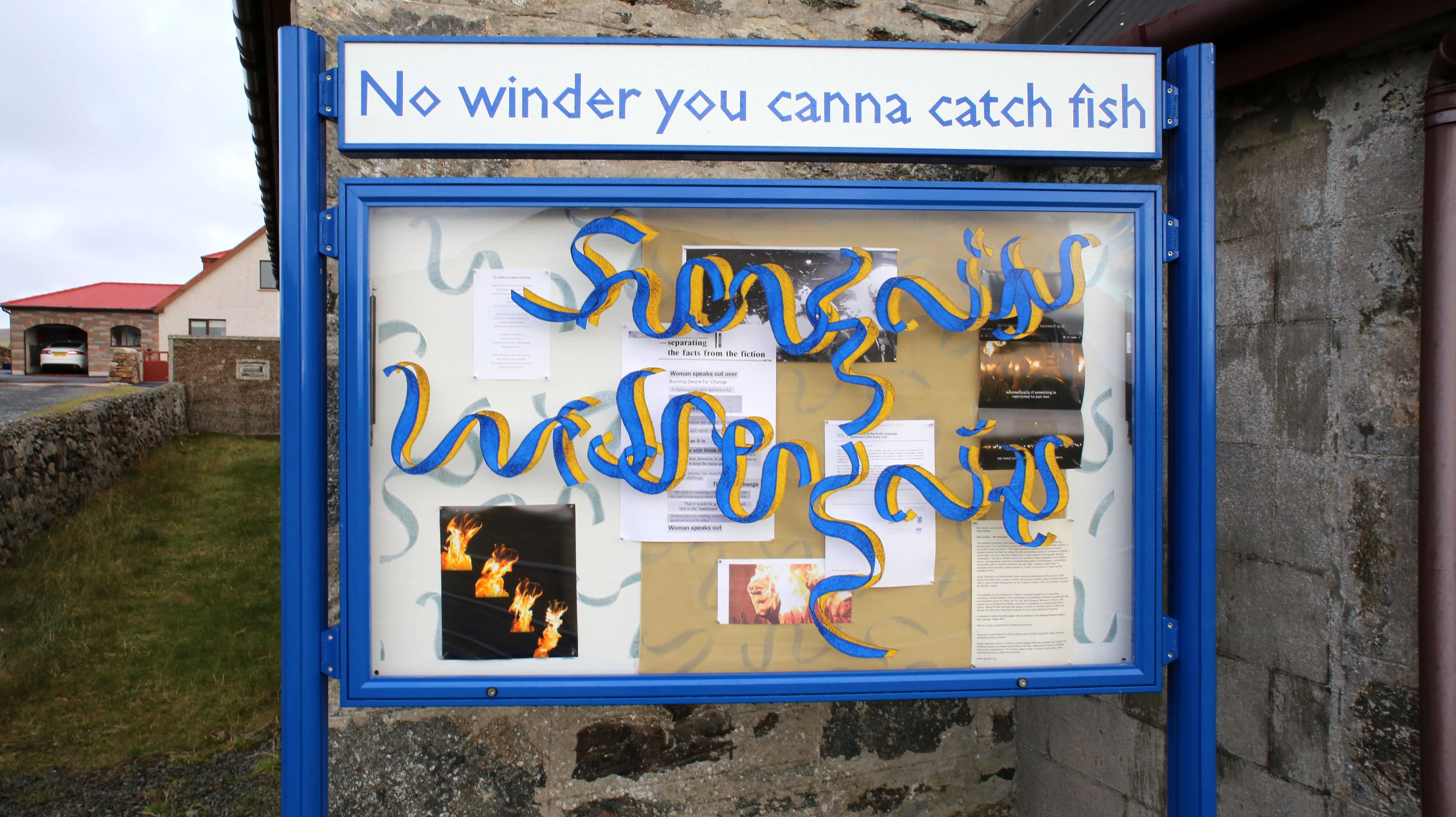
© Gaada
My chosen object is a short audio extract, an excerpt of a longer oral history interview with Shetlander, Katie Laurenson; held within the School of Scottish Studies online collection of archive audio. I came across it while delving through another gathering of materials that has become an archive collection in its own right, hosted online by Shetland-based art space Gaada. Over the past year or so, Gaada have been working closely with local activist group Up Helly Aa for Aa (UHA4A) to collect a range of matter that together tells a story of the island’s annual local fire festival and its historic exclusion of women.
This assemblage of scanned press-cuttings, screen-shots of Facebook posts, drawings, videos, photographs and more, exists as a Google drive of digitised ephemera, documentation and artworks built collaboratively with contributions from UHA4A members. I had been invited, alongside a small selection of other artists, to explore this collection and to develop some accompanying artwork in the form of a flag design, and pieces for a display unit – outdoor structures that could allow for socially distanced viewing in the context of Covid19. A selection of these artworks were later donated to Glasgow Women’s Library.
As I read and surveyed images, a picture of the festival and what it meant to local people built in my mind – firearms, tar barrels, guizing, Vikings, community. The earliest festivals were “a highly ritualised form of mis-rule governed by the people” according to writer Callum G. Brown (Up-Helly-Aa: Custom, Culture and Community in Shetland, 1998); a show of what Brydon Leslie calls “disruption, devilment, and above all, flame” (New Shetlander, 2011). Brian Smith debunks the authenticity of what he terms the ‘bogus name “Up Helly Aa”’ and the festival’s links to Viking history, saying its inventors – young working men in Lerwick – ‘had their tongues firmly in their cheeks’ (The Shetland Times, 1993). Recent article headlines from local papers jostle and joust: ‘Is Up-Helly-A’ brazenly sexist, or is ‘the way it’s always been’ still acceptable?’ asks Peter Johnson in a 2017 issue of The Shetland Times; there’s a ‘Burning desire for change’ says Zara Pennington for The Orkney News in 2018; ‘Leave it as it is’ reads the opener of a letter from Lerwick resident Jolene Tindall for The Shetland Times in a year later; ‘Up Helly Aa sexism under the spotlight’ reads a headline of a 2020 Sunday Times article written by Shetlander Sally Huband; ‘They call us backward’ claims a staunch member of the ‘remain the same’ camp in a short video feature by Huck Magazine posted on their site in the same year.
There was a lot to look through, and I spent a number hours-worth of screen-time squinting at and zooming in on minute columns of newspaper text, lined by pixelated image boarders. The link to Katie’s sound file on the School of Scottish Studies website stood out to me as one of the only items in the Google drive present existing in audio format. It was a welcome pause from the glowing screen and I closed my eyes while I listened. Katie’s lilting narrative told of roots of the festival, steeped in sun-worship rituals. She spoke of flaming tar barrels and the healing properties of tar. She told her own anecdotes of being chastised for wandering to a neighbour’s house via a forbidden route.
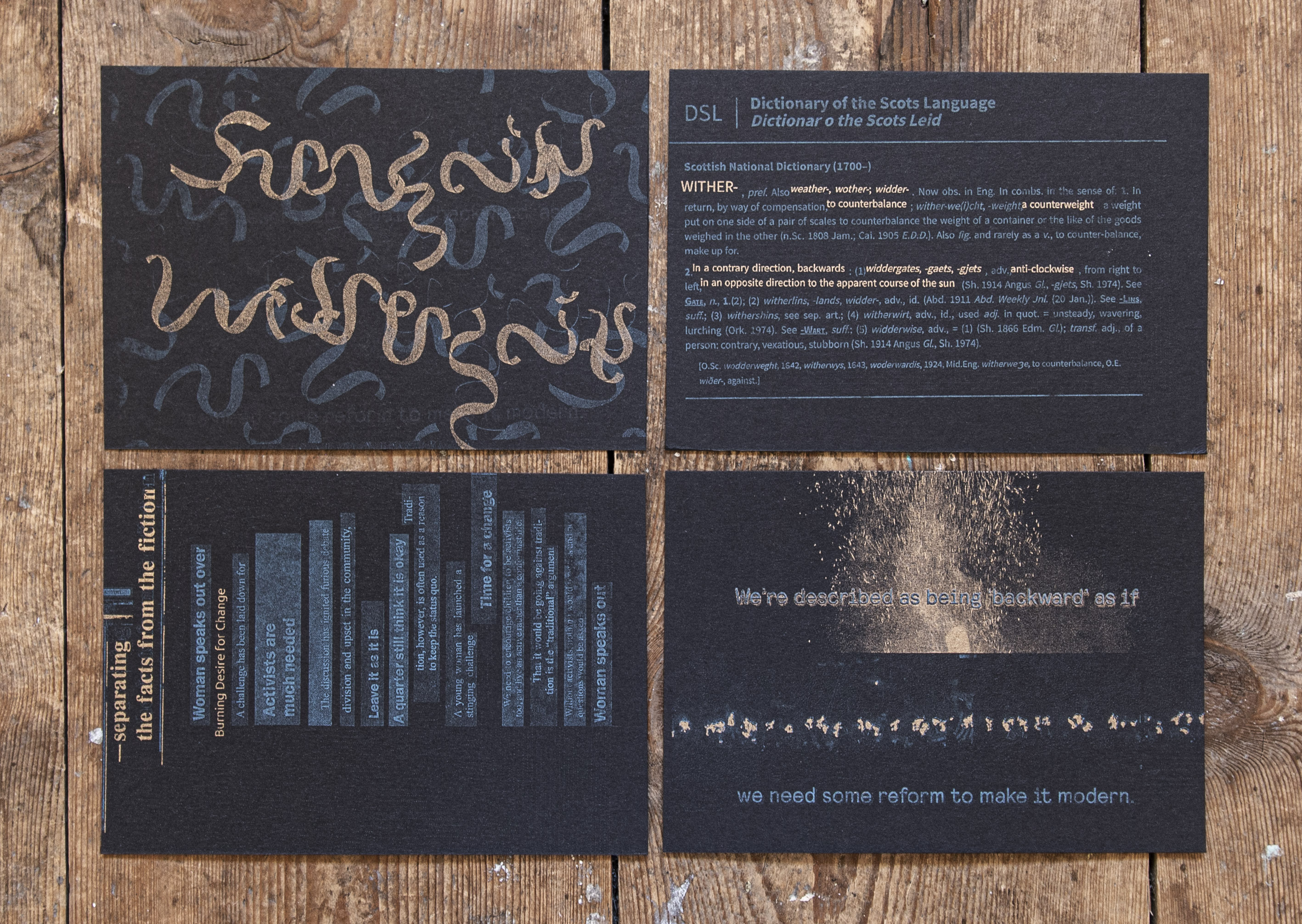
Postcards by Holly Graham
I often work with audio. I’m interested in story-telling and how individual voices present singular subject views, that listened to along-side others, can layer to build complex and nuanced narratives, versions of histories. I was intrigued by Katie’s recounting of her journey to the neighbour’s house and of how that mapped onto histories of the Up Helly Aa procession route, steeped in the superstitious belief that there was only one correct direction to move. Through Katie I learnt vocabulary that was new to me – ‘sungaits’, the way of the sun, also known as clockwise; and ‘widdergaits’, against the sun, or anticlockwise. She laughed at what ‘the old folks’ would say if they saw the present day Lerwick Up Helly Aa procession, weaving a figure of eight back and forth through the town centre. They’d think it was bad luck to travel in such a direction – they’d say ‘no winder you canna catch fish’. I liked this idea of tradition, superstition, direction, push-back and change.
From what I’d read in the Gaada and UHA4A collections of text, the main argument against women’s participation in the annual procession was one founded in tradition, in the notion that things had not changed before and should therefore not change now. But in light of Katie’s memories of the festival this case falls short. Katie was speaking in 1961, and her voice reaches us intact 60 years later, to speak some home truths to ‘this modern Up Helly Aa that you see nowadays’. And while speaking to us from the 20th century, Katie was born in 1890, just 9 years the first organised torch-light procession took place in Lerwick. Viewed through the span of a life and a voice – human for scale – we see the festival past as not so old, not so distant and concrete, impervious to change. We make traditions collectively, collaboratively. They are often built around small truths that in turn expand foam-like to form myths, and we pack further myths in around them, insulatory protective wrapping to transport them. They morph and change with time. Why would we not desire our traditions to be flexible enough to accommodate us, and to suit us societally as we move and shift, rather than remaining rigid restraints that constrict our collective growth?
The work I made for the project pivoted around a verbatim poem I assembled from Katie’s words, channelling the push and pull, forward and backward notions held by the terms ‘sungaits’ and ‘widdergaits’. The flag featured a mass of spiralling ribbons, and the two words – one on either face – constructed from these ribbons and enmeshed within them. The display case held a collection of prints: a collage of newspaper headlines, a dictionary definition of ‘widder-’, screenshots of a subtitled documentary on the festival and it’s accompanying calls for change. I also worked with other fragments of archive from the Scottish School of Studies collection; field recordings of songs sung and music played in the processions, recorded by Peter R. Cooke in 1982 [SA1982.010.011].
I pieced together an audio piece or ballad of sorts, that combined Katie’s voice with those of contemporary UHA4A women – Debra Nicolson, Joyce Davies, Lindsey Manson, and Frances Taylor – who echoed her words to form a chorus. The audio cycles, returning to familiar melodies played in reverse, words layered and repeated, the narrative is slippery. Together, tongues in cheeks, Katie and the UHA4A women chant: ‘No winder you canna catch fish!’
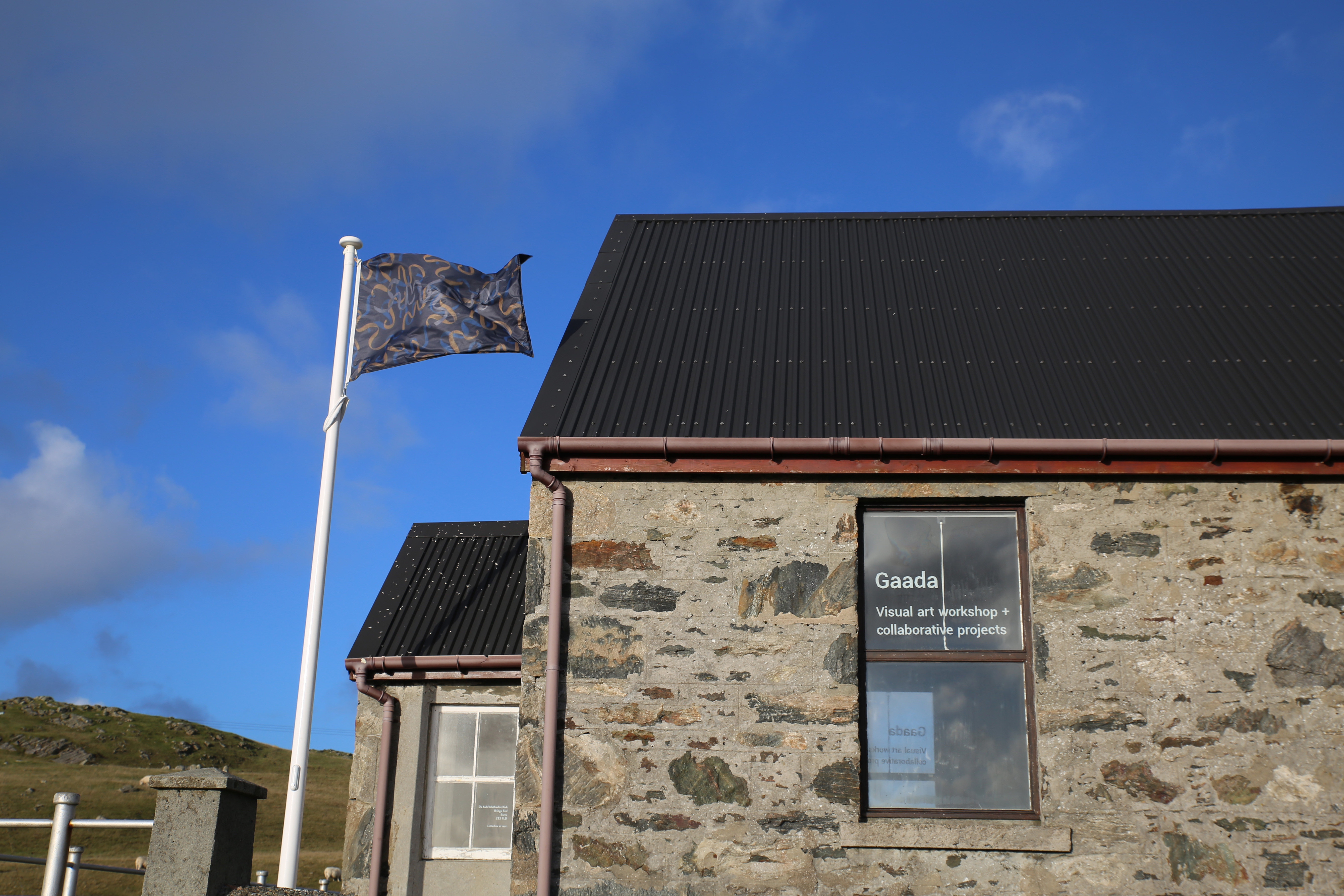
Holly’s flag flying at Gaada, in Bridge-End, Burra Isle.
________With thanks to Amy Gear and Daniel Clark at Gaada; Caroline Gausden at Glasgow Women’s Library; Louise Scollay at The School of Scottish Studies Archives and Library; Debra Nicolson, Joyce Davies, Lindsey Manson, and Frances Taylor of Up Helly Aa for Aa; Katie Laurenson and her family, and Peter R. Cooke.
______________
Thanks to Holly and Gaada for use of their images.
You can visit Holly’s website here: https://www.hollygraham.co.uk/
You can find out more about the project on Gaada’s website: https://www.gaada.org/weemins-wark
Up Helly Aa for Aa campaign: https://www.facebook.com/S4UHAE/about/
Glasgow Women’s Library: https://womenslibrary.org.uk/
A guide to subject guides

Image by ijmaki on Pixabay
One of the key parts of our role as librarians is to help staff and students find the things they need to complete their work. One way in which we do this is to create subject guides, which are like mini websites which collate all kinds of useful links and information we think will be helpful to those working and studying at the University.
You can find a full list of the subject guides we’ve made here, but some of our most popular during 2020-2021 have been the guides for Law, Business, East Asian Studies, English Literature and Engineering. As you’ll see from this list we have guides dedicated to each School and sometimes very specific guides which deal with subjects within those schools.
However we’ve also created guides which we believe are helpful resources for all students in any subject. For example our Exam and Revision guide is aimed at any student looking for top tips and news on the help that’s available from the library and university services to help make their studying more successful.
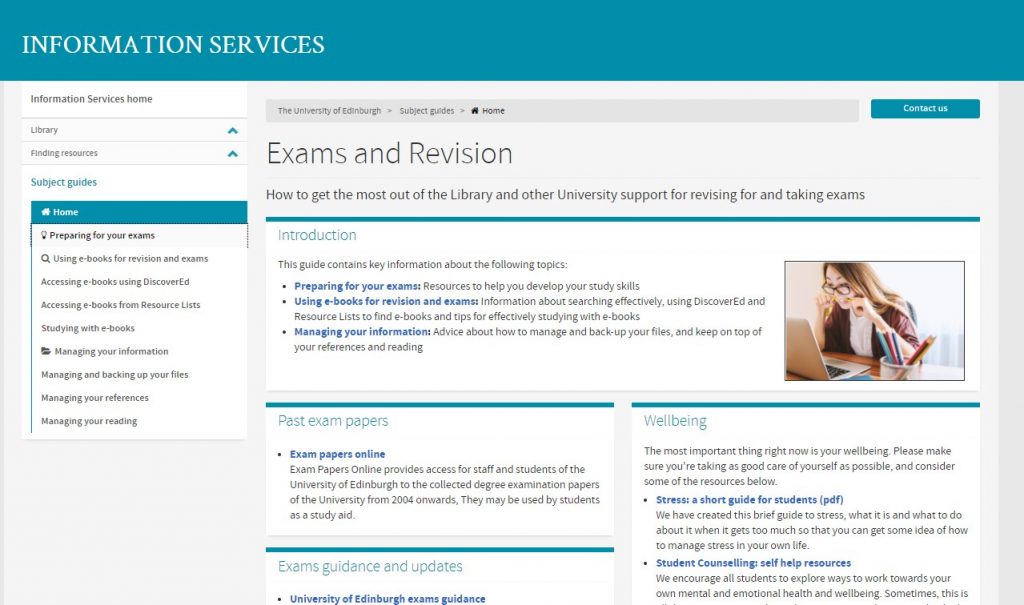
A screen capture of the Exams and Revision subject guide
Our Dissertation Festival guide contains loads of useful resources for students based on the events that took place in our recent Dissertation Festival (March 2021). Check it out if you’re looking for advice on how to get started with your dissertation research, or are interested in finding out more about some of the collections available from our library suppliers. Just like a face-to-face event you can also pick up your Festival Bag from this page, jam-packed with videos, information and helpful tips. You’ll hear more about the Dissertation Festival from one of our student interns in the coming weeks so watch this space!
Over the summer we’re working on guides relating to Disability and Open Resources which will be published in the coming months.
Did you know we take requests?
If you think that there’s a previously untapped topic we should make a guide for, please let us know by leaving a comment on this post or emailing your Academic Support Librarian using the links on this page. We’d love to hear from you!
SarahLouise McDonald, Academic Support Librarian
Welcome to Research Data Stewards – a new role
This week the team is pleased to welcome two University of Edinburgh PhD students who have joined Research Data Support in a new Research Data Steward role. We were even able to meet in person and grab a coffee for a little stroll in the Meadows together! In addition to curating metadata records for datasets in Edinburgh DataShare, DataVault and Pure (Edinburgh Research Explorer), the pair will assist the rest of the team in assisting users with data management planning and related enquiries, and will contribute to our outreach and training programme, especially in the new area of Open Research.
 Gina Maria Geffers is a final year PhD student in the School of GeoSciences. Her current focus is on studying statistical patterns in large sets of earthquake data including real, volcanic and induced (‘man-made’) earthquakes, in the hope that this information can help in quantifying the hazard associated with these events! Outside of university work, she enjoys travelling (pre-pandemic) and swimming and during the pandemic she has found renewed interest in the outdoors, especially cycling around Edinburgh.
 Sam Hillman is a 2nd year PhD student in the Institute of Evolutionary Biology. His research focuses on how changes in environmental conditions affects how animals interact with each other and how this alters disease transmission in wild mammals, using a combination of field work and statistical modelling. Outside of work he is a keen musician.
You made it! End of AY 2020-2021

It’s felt like a sluggish crawl to the finish line, but we made it! (Image by Jarmoluk via Pixabay)
Monday 24th May 2021 marks the beginning of the summer vacation, meaning that for the majority of students teaching has finished for the year and exams are over. Everybody who has completed a period of study during this confusing, stressful, and difficult year deserves recognition of the incredible effort they’ve put in. We want to acknowledge the great flexibility and adaptability our students in the School of Law (and across the University) have shown by managing to work on, submit assignments and complete courses of study. We’re proud to have played a part in keeping your education on track.
Library Services has been working incredibly hard behind the scenes to make swift transitions as seamless as possible, and while we know it hasn’t been an entirely smooth ride we appreciate the patience and grace shown to us by staff and students while we managed the changes as best we could.
Although the pandemic isn’t over yet we hope that when the next academic year begins in September we’ll be looking at a very different landscape, with a robust vaccination programme, more freedom and therefore a much anticipated return to normal opening for our beautiful and well-used libraries.
We recognise that many staff and students will be continuing to research throughout the summer and would like to highlight that we’re available to support your work all year round, not just in term time! If you require support or have questions about resources during the summer months please use our email address (law.librarian@ed.ac.uk) to contact us.
~ Donna and SarahLouise
SSSA in 70 Objects: Psalm 118 to ‘Coleshill’
Contributor: Murdina and Effie MacDonald, Psalm 118 to ‘Coleshill’
Fieldworker: Thorkild Knudsen
Reference: SA1965.031
Link to recording on Tobar an Dualchais
Response: Clare Button
Visiting the Isle of Lewis with my parents at age fifteen seemed the ideal chance to use my newly acquired pieces of Gaelic. Back home in England I was a fervent convert, listening to all the Gaelic music I could find and devouring a book titled (more than a little misleadingly, as it turned out) Scottish Gaelic in Three Months. Thrilled as I was to hear the language around me on the streets of Stornoway, I lost the bottle to try it myself, save for a shyly squeaked ‘madainn mhath’ to a lady behind the counter in a charity shop. Bolstered by her kind reaction, I thought to repay her by purchasing something, and my eye was caught by a record titled Gaelic Psalms from Lewis, the cover emblazoned with J.H. Lorimer’s dramatic painting The Ordination of Elders in the Scottish Kirk.
Closer inspection revealed that it was Volume 6 in Greentrax’s Scottish Tradition Series, which showcased recordings from the School of Scottish Studies, a new name to me at that time. I hardly knew what to expect, but it was only twenty pence, and would just about fit in our suitcase. I suspect the lady behind the counter was somewhat bewildered to see this earnest English teenager expressing an interest in the devotional singing of her island.
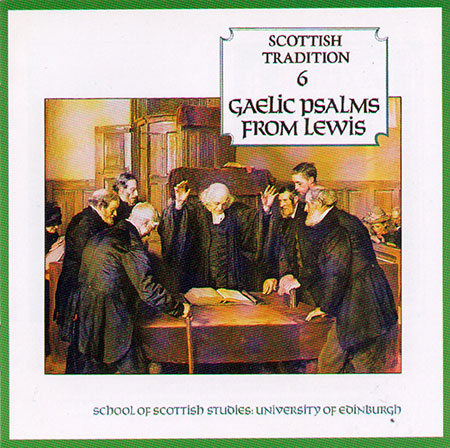
It was around a month or two before I played the LP on my dad’s record player, but when I did, my musical landscape was changed forever. I had heard sacred music before, of course, but nothing like this, with the psalm being ‘lined out’ by the precentor, and the congregation following after in a heavily ornamented style, each person at their own pace. The effect was an ocean of sound, both alien and familiar, human voices locked in private devotion yet joined in communal worship.
I loved the richly dramatic congregational recordings, but I was especially struck by the singing of two sisters, Murdina and Effie MacDonald, of Balantrushal, north west Lewis. Recorded at their home in 1965 by Thorkild Knudsen, a Danish musicologist then on the staff of the School of Scottish Studies, they intone verses 15-23 of Psalm 118 to the tune ‘Coleshill’, their brittle voices trilling, soaring and swooping together in two barely separable strands. ‘Guth gàirdeachais is slàinte ta / am pàilliunaibh nan saoi…’ Their singing is particularly touching because it is domestic, sisterly, intimate. The notes to the recording mention that, although it was quite unheard of for women to precent, they may often ‘be heard singing Gaelic Psalms while at household chores.’ Now, years later, with many recordings of the MacDonald sisters available online via Tobar an Dualchais, the extent and depth of their skill at psalm singing can be truly appreciated.
A year or two later, I heard the same recording sampled by Martyn Bennett on another album which changed my life, Grit (2003). In the sleeve notes, Bennett tells the story of travelling to Balantrushal to see Murdina, then in her late eighties, to get her blessing to use the recording. She confided to Martyn her own initial misgivings back in the 1960s on recording these religious songs, a confession which he found reassuring. Of the resulting composition, ‘Liberation’, Martyn wrote:
‘I could not find any other way to express the profound feeling of losing faith, and the determination to find it again.’
It is both touching and strange to think of the sisters giving their blessing to this epic mashup of their voices with clashing rave beats, euphoric sonic whirls and Michael Marra’s best (and, I suspect, his only) attempt at being a minister. The track is radically different from Murdina and Effie’s world, but it does, I think, retain the kernel of purity found in Knudsen’s original recording.
Now, many years later, I have been entranced by sacred music of all kinds, from the astonishing Canu Pwnc tradition of Wales, to the heart-bursting ecstasy of Sacred Harp, to the simple grace of medieval plainchant, but the billowing swells of the Scottish Gaelic style hold a unique magic. My Gaelic may still not be much improved, but this recording grows with me all the time.
Clare Button is Archivist at Barts and The London School of Medicine and Dentistry, Queen Mary University of London.
Listen to Murdina and Effie MacDonald here: http://www.tobarandualchais.co.uk/fullrecord/67880/1
More about Martyn Bennett here: https://realworldrecords.com/artists/martyn-bennett/
Find out about the Gaelic Psalms from Lewis here: http://www.greentrax.com/music/product/Various-Artists-Gaelic-Psalms-From-Lewis-Scottish-Tradition-Series-vol-6-CD
Dissertation Festival Blog: Engineering Village resources for dissertations

Introduction
The day has finally arrived, the end of my Dissertation Festival Blog series. To recap, the Library’s Dissertation Festival is a collaborative effort from the Library, Digital Skills department and Institute of Academic Development (IAD). They united to host a series of virtual sessions spanning over two weeks to provide students with the knowledge and resources required to make the most out of their dissertations. The Festival is a fantastic opportunity to learn tips and tricks to help you write, reference and uncover what support is available to you at the University. In this blog series, I review sessions I have attended and share my thoughts.
The Session
For my final event, I went subject-specific, as I attended “Engineering Village resources for dissertations” hosted by a staff member from Elsevier. The session began with an explanation of Engineering Village and how it can help with your dissertation. To summarise, Engineering Village is a powerful search platform that provides access to multiple engineering literature databases. These reliable sources range from journals to conference proceedings and trade publications to press articles. It is essentially a one-stop-shop for all things engineering literature. If you are confused about how you could have missed such a powerful platform, don’t worry – you may already be aware of some of the databases found within Engineering Village; these include Knovel, Compendex and Inspec!
During the session, short tutorials of Knovel, Compendex and Inspec were given with their key features highlighted. I found Knovel to be most interesting as the database provides you with the opportunity to search materials’ properties, pulling this numeric data from handbooks, manuals, and databanks so you can access what you need quickly. It also allows you to search for equations and contains tools such as a unit converter and interactive graphs to aid your research.

Screenshot from Knovel website taken to illustrate the Material Property Search feature
Both Compendex and Inspec are comprehensive bibliographic databases of engineering research covering engineering and applied sciences. Compendex is more holistic and is the broadest, most complete engineering database in the world. On the other hand, Inspec provides engineering research information on physics, electrical engineering and electronics, computers and control, production engineering, information technology, and more. Using Engineering Village, you can search both databases simultaneously, ensuring you are getting the most relevant and up to date information.
Thoughts and Conclusion
The session was highly informative and helped me understand how to use the unique search features and specialised Engineering Village tools to improve my research productivity. I believe Engineering Village is a resource relevant to all STEM students or students whose work requires reliable scientific data. For dissertation use, the database can have a range of applications, so it is well worth further inspection. You can directly access Knovel, Compendex and Inspec from the University Library Databases page!
Thank you for reading this blog, and I hope you enjoyed it. Unfortunately, a recorded version of the session is not available, so you have to wait until the next Dissertation Festival to see the event live! However, you can access other Dissertation Festival recordings from a dedicated playlist HERE and read previous blogs in the series HERE and HERE.
Collections
 Hill and Adamson Collection: an insight into Edinburgh’s past
My name is Phoebe Kirkland, I am an MSc East Asian Studies student, and for...
Cataloguing the private papers of Archibald Hunter Campbell: A Journey Through Correspondence
My name is Pauline Vincent, I am a student in my last year of a...
Hill and Adamson Collection: an insight into Edinburgh’s past
My name is Phoebe Kirkland, I am an MSc East Asian Studies student, and for...
Cataloguing the private papers of Archibald Hunter Campbell: A Journey Through Correspondence
My name is Pauline Vincent, I am a student in my last year of a...
Projects
Cataloguing the private papers of Archibald Hunter Campbell: A Journey Through Correspondence
My name is Pauline Vincent, I am a student in my last year of a...
Archival Provenance Research Project: Lishan’s Experience
Presentation My name is Lishan Zou, I am a fourth year History and Politics student....