Home University of Edinburgh Library Essentials
December 17, 2025
Voices, Voices, Voices! Fieldwork, Creative Practice and The School of Scottish Studies
Written by Louise Scollay, Archive & Library Assistant
Back in August, we held an online seminar and Q&A with Dr Hugh Hagan, Martine Robertson and Hannah Wood where they discussed their fieldwork and research into the lived experience of women in the shipbuilding community of Port Glasgow.
Dr Hugh Hagan, Head of Public Records Act Implementation at the National Records of Scotland, is passionate about the shipbuilding communities of Port Glasgow and Greenock on the lower reaches of the River Clyde, particularly in the inter-war period. These towns, being removed by some distance from the large and diverse economy of Glasgow, depended entirely on shipbuilding and they developed a very particular sense of community. This was the subject of his PhD research at the School of Scottish Studies in the 1990s and he drew from that research for the talk, specifically the role of women in these communities.
Martine Robertson and Hannah Wood, of GaelGal Productiions, were undertaking studies at the Department of Celtic and Scottish Studies, when they attended a lecture by Hugh about his Port Glasgow work. They were galvanised to revisit this fieldwork, recording new material with the family of Cassie Graham, one of Hugh’s contributors. They have also been inspired to take these stories to centre stage, lifting the voices and experience of women of the Port Glasgow community and using these recordings in their creative practice. At this event, they presented a post-card sized version of their creative project, What a Voice.
The event was well attended and we had some excellent questions for the panel. However, because our speakers were all connected with SSSA through their studies and fieldwork, we decided to arrange a further conversation for our blog, as part of our ongoing celebrations of our 70th Anniversary.
As Hannah, Hugh, Martine and myself are all alumni of The School of Scottish Studies, you can imagine that there was a lot of shared memory and a lot of enthusiasm for oral history – we talked for over an hour and so we have split this conversation into three parts to be more digestible. Included throughout these are extracts of the original fieldwork recordings and excerpts from Hannah and Martine’s work What a Voice.
A point to consider: This is a zoom recording, so we were at the mercy of connections. As such there are one or two frozen images and moments of patchy audio.
If you are a University of Edinburgh Ease-user, you can also view these on our Media Hopper Channel.
Memories of The School of Scottish Studies and studying at The University of Edinburgh
Fieldwork Practices
Creative use of Oral History Recordings and the future for OH in Scotland
It is always incredible to see how people interact and respond to oral history recordings in the archive.
As we discuss here, the experiences of women in Port Glasgow aren’t found in official statistics or in public records. Memories and lived experience can only be captured by talking to someone from that community, someone who experienced that life. It is an incredible privilege to have these recordings in the collection at SSSA and it is thrilling to see how archive material can be used creatively – opening up the lives and experience of Port Glasgow women to new audiences.
As we stand on the cusp of Scotland’s Year of Stories in 2022, whose are the voices and what are the stories that you want to hear or draw out of archives? Indeed, whose are the voices and stories you wish to put into the archives, with your own fieldwork or creative practice? Do you have a story to tell? We would love to hear from you. Contact us via email , or leave us a comment on this post.
New feature in Edinburgh DataShare: the REST API
Ever wanted to get a table of the details of all the datasets on DataShare to do with Scottish history? Or matching some other criteria, possibly on specified fields? If so, the new API (Application Programming Interface) can help.
DataShare now has a REST API, which you can use to query our metadata. An API makes the database’s contents accessible for requests from external servers, through a command-line, which allows external users to script such requests. The DSpace API also provides its own web-based query client and report client. These pages allow users to use a graphical interface to quickly build a query and see the results in a table, all in the browser.
The DataShare REST API page starts with a link to our plain-English explanation of how the API can be used:
Edinburgh DataShare DSpace REST API
We would like to hear from anyone who wants to use the API. Please try it out and let us know what you find useful! Email us at data-support@ed.ac.uk .
Examples using the graphical query builder
I wanted to find datasets where I could add a link to the associated publication. This is a bit of a challenge for us, since users typically deposit their data with us under embargo before the associated paper has been published, and we do not have an automatic way to detect when or whether an associated publication has appeared. I used the query builder to find the IsReferencedBy value for deposits accessioned in 2017. The plain-English guide on the wiki provides the steps I went through to do so:
How to use the DataShare REST API
This feature may be of use to colleagues who support organisational units at University of Edinburgh which don’t align precisely with the Collections structure of DataShare – the API lets you query on multiple collections through the reporting tool. We’d love for colleagues to contact us if their teams have published a new paper containing a data citation of their DataShare deposit, so we can add the details of the publication to the DataShare Item’s metadata, resulting in a hyperlink appearing on the dataset landing page.
I wanted to find datasets with an embargo date in December. This is a challenge for us because users often set their embargo expiry date to Hogmanay, which means their one-week reminder would arrive on Christmas Day right in the middle of the university’s winter break. But many other fields contain dates with December in them, so it has not been practical for me to search for this using the graphical interface. So I used the API to search specifically in the dc.date.embargo field. See the screenshot below. The API helped me find the datasets whose embargo date we needed to extend, or else lift the embargo outright, allowing us to contact the depositors in good time to ask them whether a paper had been published or more time was needed.
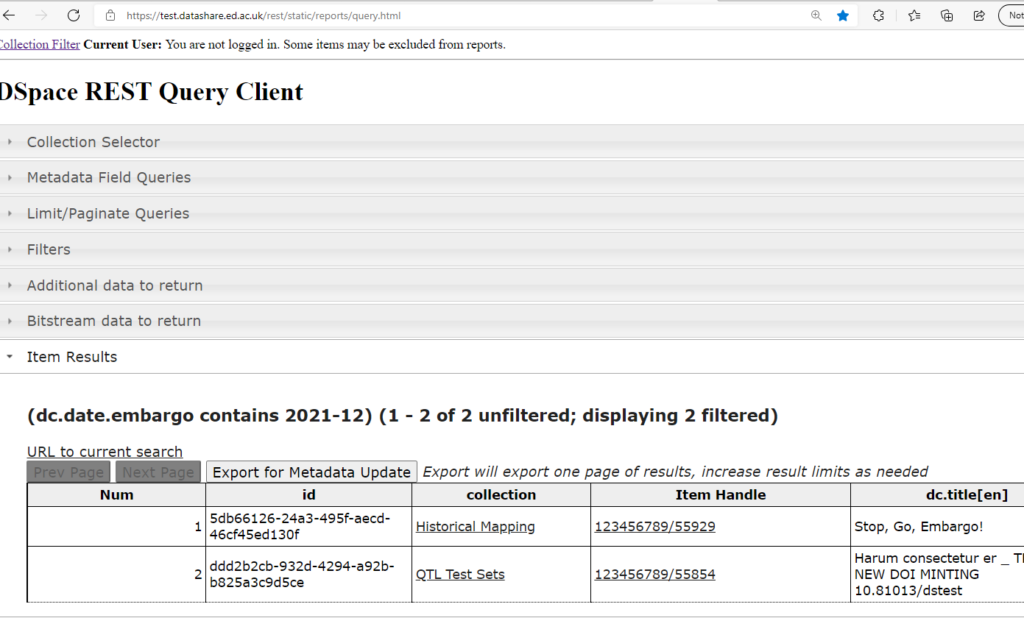
Results showing datasets with an embargo date in December 2021
Thirdly, to demonstrate the power of this tool relative to the non-specific Search I chose a topic with very common words to show how to use the query builder to focus in on results avoiding spurious matches.
Using the existing ‘Search’ function on the homepage I searched for ‘history Scotland’. This produced 39 matches, some of which have nothing to do with historical research or Scotland, but merely mention a funder “NHS Research Scotland”, and mention the history of the research field in passing to provide a little context. Most of the matches are interesting, but some are not relevant.
Whereas when I set the API query builder to search for ‘history’ in the research area (subject classification), and ‘Scotland’ in the field for geographical metadata ie dc.coverage.spatial. This provided me with a short list of high quality matches, three datasets of historical research to do with Scotland – see the screenshot. This is a useful tool for narrowing a search.
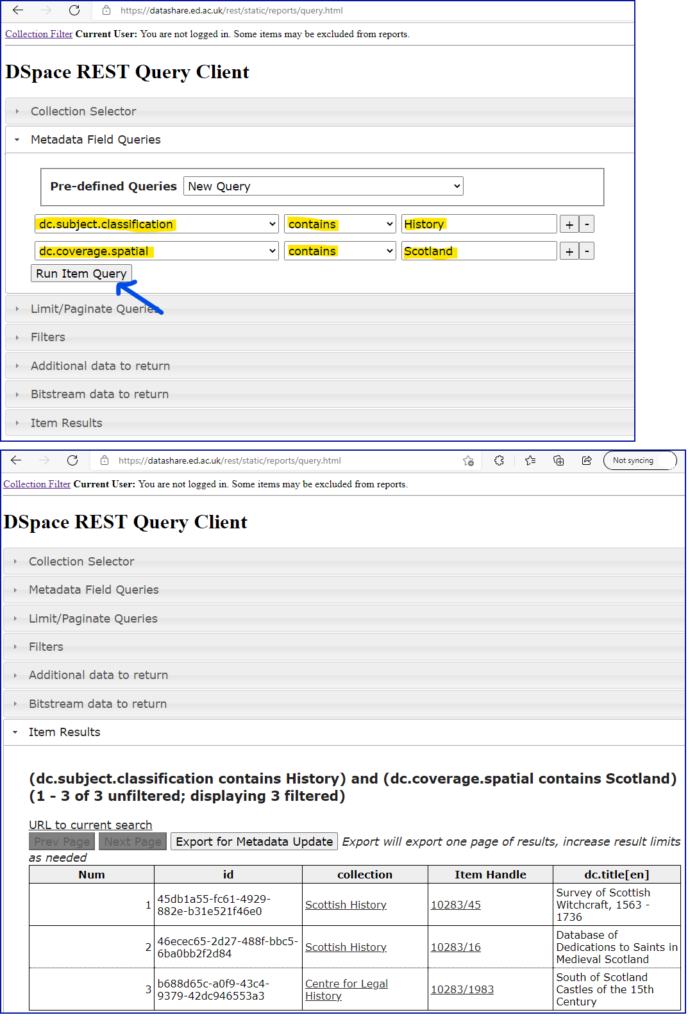
A search for two very common words in specific fields produces high quality results
Enabling the API
The REST API is a feature of the underlying DSpace repository software. Our sysadmins configured the API with great care to block certain commands and enable only the ‘GET’ commands that are needed for appropriate queries using DSpace config settings (further info DSpace 6 Documentation on the Lyrasis wiki ).
The Future
In the international DSpace repository community, we’re aware the API is used for integration with at least one CRIS (Current Research Information System) and quality tool applications (Andrea Bollini, 4Science, private communication). We understand the API of the newer DSpace 7 contains significant changes compared to that of DSpace 6, which we’re using for Edinburgh DataShare.
We’re aware of only a few examples of the API being used by individuals for occasional metadata queries. But we will watch with interest to see how the DSpace 7 API will be used.
Pauline Ward
Research Data Support Assistant
Library and University Collections
University of Edinburgh
Celebrating a 70th Anniversary Acquisition!
Earlier this year, the School of Scottish Studies Archive and the Centre for Research Collections teamed up with renowned Scottish photographer, Jeremy Sutton-Hibbert, to add a landmark collection of photos to the School’s documentary collections. Sutton-Hibbert has worked as a freelance photographer and photojournalist for over 30 years and in 2012 co-founded Document Scotland – a collective of Scottish documentary photographers.

Photo 1 Tam Gay repairs torn nets aboard the Mairead, North Sea, February 1993 SSSA/JSH1/20
Sutton-Hibbert’s documentary work focusing on Scotland filled a natural gap in the Archive’s extensive photographic holdings, and the team worked with him to identify three series of photographs which would best suit the collection. Selections were made from his North Sea Fishing (1992-1995), the recently demolished Longannet Colliery (2001), and Paddy’s Market (2000) which echoed with coastal working life, Scottish industrial cultures, and urban living which can be found throughout the School’s archive.

Photo 2 Miners getting on the trolley train to the underground of Longannet Colliery, Fife, April 2001 SSSA/JSH3/3
The SSSA70 acquisition includes over 50 beautifully hand-made prints by Sutton-Hibbert and digital files of each of these images which can be viewed on our digital image database. Our teams have been busy behind the scenes to catalogue this collection and make the digital images available in our anniversary year.
“I have immensely enjoyed listing the 50 photographic prints acquired from Jeremy Sutton-Hibbert,” say Elliot Holmes, Archives & Library Assistant, School of Scottish Studies, “The collection has been listed in original order to three series, which includes the life aboard seine-netter boats within the North Sea Fishing prints, the historic Paddy’s Market in Glasgow, and depictions of the life of people working underground at Longannet Colliery. Each itemed photograph depicts such a dynamic portrayal of the social and working lives of Scottish people that you can clearly see and feel the emotion of each photographic subject through the prints. Being from a mining town in south Wales, I particularly enjoyed listing the images of Longannet Colliery as that is a history and way of life that I grew up with and will always feel a grand connection to. Each individual print is a valuable addition to our collection as they are such a clear portrayal of the dynamics of Scottish working life and people.”
In May of this year, Jeremy sat down with our Head of Special Collections, Daryl Green, to talk about his work and this new collection. As part of this acquisition, we’re very pleased to make this conversation available to all, too:
In Conversation with Jeremy Sutton-Hibbert
You can also see some of our photographic collections digitised online, including the Robert Atkinson collection of St. Kilda photographs here: St. Kilda
To stay in touch with the School of Scottish Studies Archive and Library, you can find us on Twitter at @EU_SSSA
Our information and contact details can be found here: School of Scottish Studies Archive
Finding International Legal Resources
Following on from our last post about Finding Material for your Research and Study, we’ve just recorded a new video to introduce some of the databases we subscribe to for international law. If this is an area that is relevant to your study, grab a cup of tea and spend eight and a half minutes finding out more about how library subscription services can support your work.
Is there an area of legal research you’d like to know more about, or would like to find resources for? Email us on law.librarian@ed.ac.uk to discuss, or book a one-to-one appointment with us via the MyEd booking system; search for “Literature search clinic” and select the Law specific event, or search for “Law” and select provider group “IS Library and University Collections” to find all our Law related training.
Finding material for your research and studies

It is nearing the end of semester and the pressure to complete dissertations and study for exams is on. The Law Subject Guide is one place where you can find quick links to useful resources.
As well as linking to the databases we also have a section on where to find the key eBooks and Law Reports. This provides a helpful at-a-glance guide to where to find particular reports or statutes, and we’ve also added a document which shows which books are available via each of our databases.
TIP: When you download the PDF, open the document use the CTRL+F shortcut on your keyboard to search for the name of the book you’re looking for to see which database has it!

Don’t forget there are also videos demonstrating how to use the law databases more effectively available on the Law Librarian Media Hopper Channel, and you can always email for advice if you encounter any issues: Law.Librarian@ed.ac.uk
LibSmart: Popular modules
By now we hope the name LibSmart is familiar to you. Whether you’ve seen a slide in a presentation from an Academic Support Librarian, a page on the display screens in the library, or you’re just an avid reader of this blog, we hope you know that our online information literacy course is up and running, ready for any staff or students at the University of Edinburgh to self-enrol via Learn.
You may also know that for every module you complete in LibSmart you receive a Digital Badge, issued to you by the ASL team via Badgr. We’ve been keeping an eye on the number of students enrolled and also the number of badges we’ve issued for each module, and we’re starting to see some trends emerge even though it’s still early in the academic year.

LibSmart badges
For LibSmart I, we’ve definitely seen the most badges issued for the first module Getting Started With The Library. This isn’t a great surprise as it is the first module and therefore a logical place for people to start. We’re also seeing great numbers in our Your Information Landscape module which helps students orientate themselves with the resources that are helpful for their subject area. We’ve also seen the most growth month-to-month in our Referencing and Plagiarism module, perhaps because we’re getting close to assessment time now and people are making sure they’re familiar with how to reference correctly for their assignments.
When it comes to LibSmart II, we’ve had a nice even spread of badges being awarded across all modules. The most popular so far has been Data mindfulness: finding and managing data for your dissertation, which shows a real appetite for assistance with dissertation and thesis work. This is great news as this is exactly what we hoped LibSmart II would do – help those at an advanced stage of study complete the big pieces of work! We’ve also got a three-way tie in second place for the Health Literature, Digital Images and Special Collections Fundamentals modules all having the same number of badges awarded. Because we assume these would appeal to students of quite different disciplines, it’s great to see the word is getting out to different schools!
Have you had a look to see what LibSmart can offer yet? Check the website for more information, or watch our self-enrol demonstration video to help you get started.

Law Library: Changes to opening times
As the end of semester approaches, you may be concerned about the hours the library will be open in the run up to exams. We’ve increased weekend hours as we get closer to the exam period by opening later on Sundays in December:
Monday 29th November 2021 to Monday 20th December 2021
| Monday – Thursday | 9am – 9:50pm |
| Friday | 9am – 6:50pm |
| Saturday | 9am – 4:50pm |
| Sunday | 12 noon – 6:50pm |
There will also be changes to the opening hours over the winter break, as follows:
Tuesday 21 December 2021 to Sunday 16 January 2022
| Tuesday 21 – Thursday 23 December 2021 | 9am – 4:50pm |
| Friday 24 December 2021 – Tuesday 4 January 2022 | Closed |
| Wednesday 5 – Friday 7 January 2022 | 9am – 4:50pm |
| Saturday 8 & Sunday 9 January 2022 | Closed |
| Monday 10 – Friday 14 January 2022 | 9am – 4:50pm |
| Saturday 15 & Sunday 16 January 2022 | Closed |
Normal semester opening hours will resume on Monday 17th January 2022.
If you find the times above don’t suit your schedule for study, you may want to look at the Main Library opening hours, or for a complete list of library opening information please check the Library website.
Finding Resources: Subject Guides

Where to start?
Following on from my general tips for finding resources and navigating the online library, this blog post will cover why you should check out Subject Guides, and highlights some resources, old and new, that you may not already know about for studies.
When you are looking for resources, remember not everything in the Library collection is on DiscoverEd, so it’s best to check out your Subject Guide.
Subject Guides bring together all the most relevant library resources for a subject or topic. These guides, put together by Academic Support Librarians (ASLs), are always a good place to start when you’re looking for resources. Read More
Mixed Methods Reviews
Most researchers have heard of and understand the needs of a systematic review (SR), however the concept of a mixed methods review (MMR) can be confusing. The types of questions students and researchers ask can include:
- Can I do this type of research?
- How do I combine the data?
- My quantitative and qualitative data are different – how do I make sense of this?
MMRs differ from the traditional model of SR as they aim to answer complex interventions and social policy type questions. They go beyond what works and look to highlight the complexity of what is happening, to explain why things make an impact and what may influence how an intervention works, offering context to interventions.
To answer such questions MMRs need to draw from both quantitative and qualitative material (Pearson et al, 2015), but this does not mean they cannot be systematic!
To be systematic they should demonstrate the same transparent and explicit approach that established SR methods require – so have a protocol, as well as detailed reporting of methods. There would need to be appraisal and analysis of the included literature. They would need to show a rigorous research process (Gough et al, 2017).
There are different review approaches included in this type of research, but it is important that the research question uses both qualitative and quantative data. If the research question does not then it may be better to use another type of review method. An overview of review types can be found in an article by Sutton et al (2019).
How the types of data are combined depends on the research objectives of the review.
The resource SAGE Research Methods (which is available to all staff and students at the University via our Library Databases pages) has lots of information and advice on the ways that the differing data can be analysed and combined, as well as an overview of this family of research methodology.


Donna Watson
Academic Support Librarian
SSSA in 70 Objects: Linguistic Survey of Scotland: Gaelic grammar materials
By Dr Teàrlach Wilson
The first time I ever visited the SSSA, I was being given a tour by my supervisor to-be. I hadn’t officially submitted an application to do a PhD at the University of Edinburgh yet, but I had come up to Edinburgh from London to meet with my supervisor to-be, Dr Will Lamb, and to have an introductory tour of the University and the resources I hoped to work with. The SSSA was one of the reasons that attracted to me to Edinburgh. It was especially the moment that Will was showing me the Linguistic Survey of Scotland materials (collected between 1951 and 1963), and my eye was caught by a folder on which was written ‘St Kilda’. Anybody with an interest in Scottish history, culture, and identity will be fascinated by St Kilda, and there is often a nostalgia for what once was. As a linguist with a particular interest in geographical variation (‘dialects’), I was immediately excited and saddened by a very simple fact represented by the words ‘St Kilda’ on a document containing linguistic material: when a community ceases to exist, its special variety of speech also ceases to exist. The loss of the St Kilda dialect is not just a loss of localised language and cultural knowledge, it is also a reduction of the Scottish Gaelic language more generally. We have to be eternally grateful to the organisers and fieldworkers of the Linguistic Survey, or else this dialect – and others – could have been lost forever. We may never regain these dialects, but at least we have some idea of the linguistic patterns that existed within them. A great frustration for those studying linguistic variation is the lack of data available from previous periods of history, and it would be a great shame to have failed to collect this data in the 20th century when recording methods and technologies were available.
St Kilda isn’t, of course, the only ‘lost’ dialect to have been captured for posterity in the Linguistic Survey of Scotland. Another painful fact for those interested in Gaelic – be they linguists or from other disciplines – academic or not – is the generally northwesterly withdrawal of Gaelic across Scotland, so that the majority of mainland dialects are now obsolete and the Outer Hebrides are the last stronghold of the language. If you open the Linguistic Survey materials, or the only publication to come of the Linguistic Survey – ‘The Gaelic Dialects of Scotland’ (Ó Dochartaigh (ed.) 1997) – you will find this map of Scotland that represents the location of speakers who contributed their speech to the archive material:
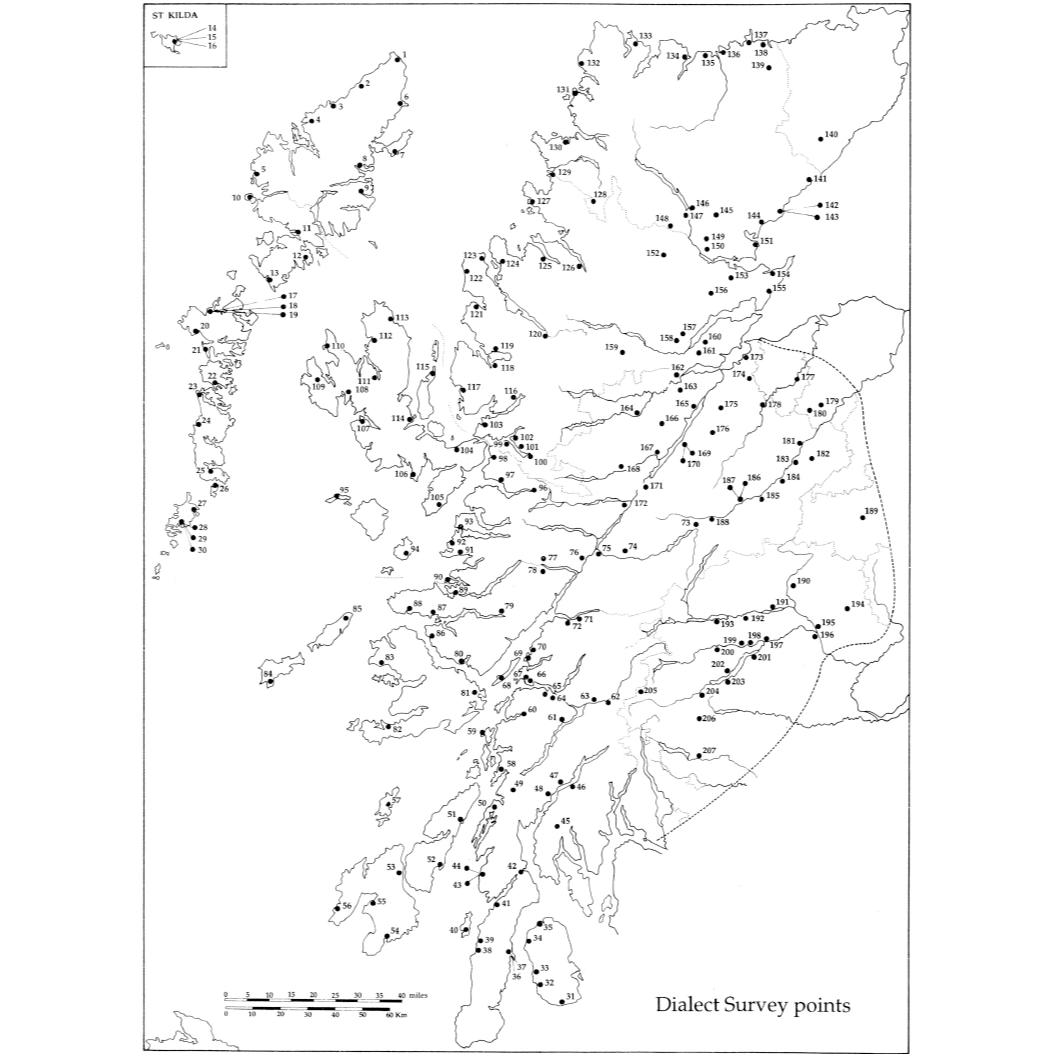
click on image for larger size
Look at the geographic extent of the fieldwork activity! From as far north as Srathaidh (Strathy) in Sutherland to Sean-achaidh (Shannochie) at the most southerly tip of the Isle of Arran – and from as far west as Hiort (St Kilda) to Bràigh Mhàrr (Braemar) in Aberdeenshire – the entire Gàidheatachd (‘Gaelic-speaking region’) seems to be represented (except Loch Lomond, the Cowal peninsula, the Isle of Bute, and the south end of the Kintyre peninsula). By looking at this map and not looking at census data, you’d be forgiven for thinking that Gaelic was in a strong position – having so many speakers across the Scottish territory. However, the Linguistic Survey fieldworkers were also quite thorough in their note-taking and hints at the impending shift can be found in the notes that they took. On a number of occasions, fieldworkers talk about struggling to find speakers or note that the speakers have few, if any, fellow Gaelic speakers within their local social networks. Take into consideration that the majority of the contributors to the Survey were elderly (most being born in the 1880s), and you realise that the fieldworkers arrived at the cusp of a tipping point where traditional local Gaelic dialects go from ‘just holding on’ to ‘no longer existing’. Some fieldworkers even suggest that ‘linguistic decay’ (a term I absolutely loathe) is observable in the speech of those Gaelic speakers who represent the last speakers of their areas and who have perhaps not spoken Gaelic for years, even decades. The implication of this is that some of the material in the Survey don’t not, in fact, represent the traditional local dialects of some areas (Another term used is ‘linguistic attrition’, but I describe it as ‘contact-influenced change’ in my work to show that linguistic changes are natural and that ‘contact’ with the dominant language – English in our case – are driving some of those changes).
When I commenced my fieldwork – with the intention of comparing dialects of the Linguistic Survey with the dialects of speakers of a similarly elderly age today (who represent the grandchildren – or at least the grandchildren generation – of the contributors to the Survey), I found that the geographical extent of my fieldwork was going to be far more restricted than the range had by the fieldworkers who collected the Survey data around 60 to 70 years ago. Imagine the excitement of seeing historical linguistic forms mixed with an overwhelming sadness that they are lost. The emotions were, and still are, sometimes debilitating. I’d be looking at materials in the SSSA, with people around me in silence also looking at materials, and the rollercoaster of emotions would go from wanting to scream, “WOW!” to wanting to cry. I’m sure I wasn’t alone. There is sometimes a melancholy in the SSSA (which should never put you off going there) because visitors and researchers are all feeling the pain of loss – a loss that was so unnecessary. Sometimes you did not speak to fellow visitors or researchers, and so you had no idea what they were looking at or that they were feeling loss. Yet you still sometimes knew. As though a united purpose of capturing loss and criticising the unnecessary causes of loss was reverberating around the building. As I said: don’t let the melancholy put you off – it is a form of human bonding and communication. And that silent bonding is sometimes the most powerful.
It should go without saying that it’s not always melancholy. As I said, there are some moments of almost extreme excitement. One of the things that I enjoyed most about my research was finding contributors to my fieldwork who remembered or were related to contributors to the Linguistic Survey in the 1950s and 1960s. Reading fieldworkers’ notes about people – probably based on short experiences with the people and making assumptions sometimes driven by the fieldworkers’ own assumptions – and hearing stories about the same people from their neighbours and descendants made my cheeks hurt from smiling so much. Seeing a name written in the Survey and then asking a contributor, “did you know X?”, which then led to information not recorded in the Survey was like finding a precious treasure trove – the dialectological equivalent of finding Tutankhamun’s tomb. The similarities or differences between the accounts of people’s personalities and type of Gaelic was always amusing. I remember in particular one fieldworker noting how a female contributor had been quite conservative – almost archaic – in her use of Gaelic grammar, and then a neighbour of this woman (who must have died some half a century ago) recounting how forced her Gaelic sometimes seemed, how pious she was, and how miserable she was! She’d apparently often come to the door as she saw people passing her bothy on her croft just to lament at the state of the world! Something not noted in the fieldworker’s accounts, but you could certainly sense that it was the same woman! Maybe the fieldworker hadn’t been around long enough to witness her lamentations, or maybe she was on her best behaviour with the fieldworker, or the fieldworker wasn’t a member of her close social network. Nonetheless, the fieldworker’s comments about her Gaelic being old-fashioned made me think as I heard stories about her, “yes, it makes sense that someone like that would have some very old-fashioned speech!”
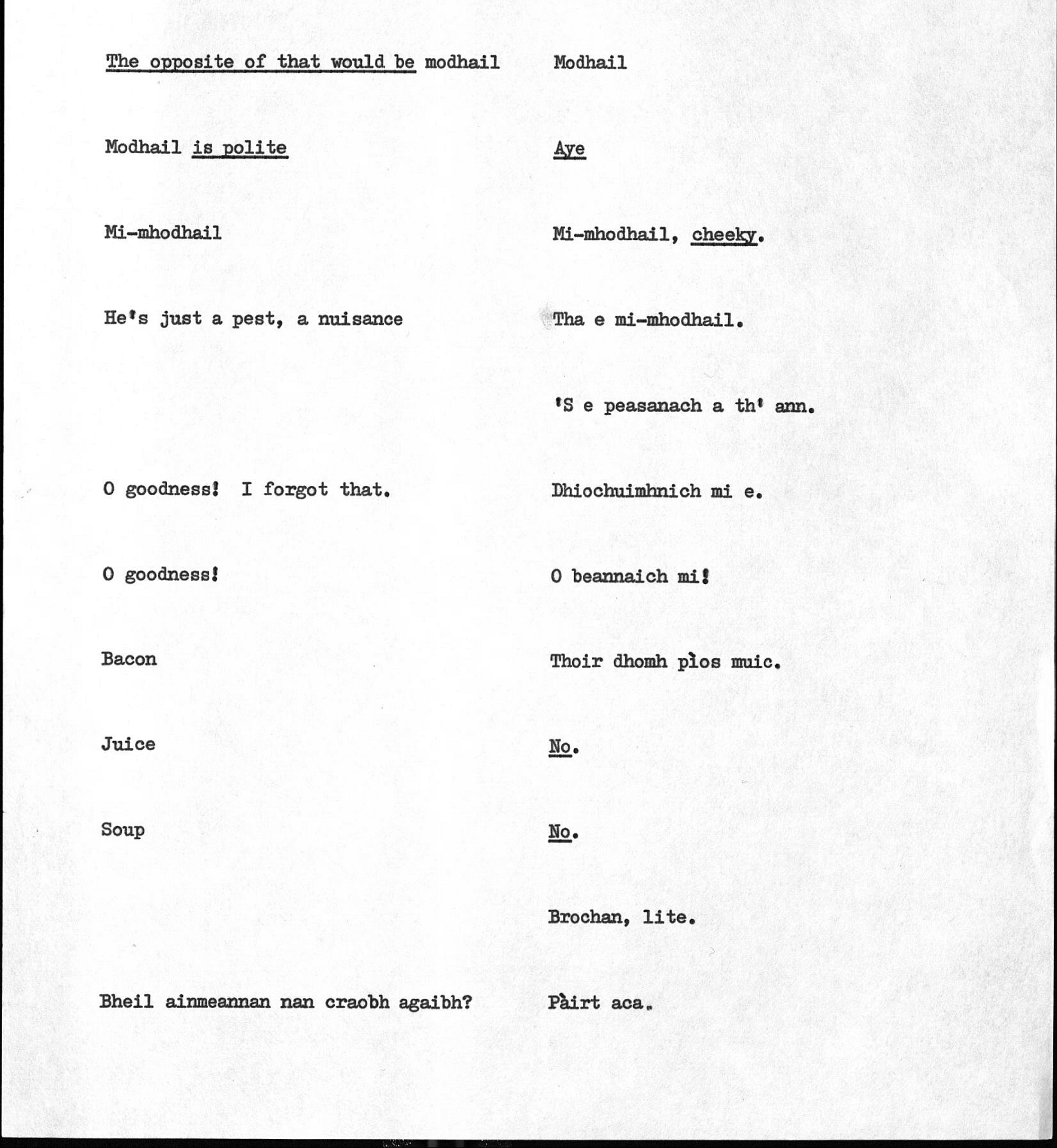
An example from Gaelic Linguistic Survey Transcriptions from speaker from St Kilda (GLS0987)
My fieldwork ended up being restricted to the Hebrides – both Inner and Outer. I went to the most northerly inhabited point of the Hebrides (Nis, Leòdhas, or Ness, Lewis in English) and to one of the most southerly (Port na h-Abhainne, Ìle, or Portnahaven, Islay). It was not easy to find contributors and my fieldwork is not as exhaustive as the Linguistic Survey. But combining Archive research with fieldwork in rural island communities has certainly been one of the most enriching experiences of my life, that has really informed who I am today and helped me develop my views and feelings about rural island communities, minority languages, and the importance of cultural – tangible and intangible – in a post-colonial, urban-centric, and land-facing society. I didn’t look at these people’s contributions to Lowland life, but make no mistake about it: rural island communities know how to survive when most Lowland urbanites only know how to go to a supermarket. Island communities are at the forefront of action against climate change because they know how to work their land sustainably while they will be the first to see the consequences of the climate crisis, as big cities invest in infrastructure to protect themselves from rising sea levels. All the while, the members of these communities are the guardians of our cultural and agricultural heritage, who provide us with food and energy. It’s not just their speech that needs to be protected. Their speech is just one facet of their entire way of life that needs to be protected. You may not see that when you look in the St Kilda folder and see that the typical Hebridean pronunciation of bàta ‘boat’ (sounds a bit like paaaaahhhhtuh) was not a feature of St Kilda dialect, even though St Kilda is a considered a Hebridean island (they said something more like baaaatuh). But all these issues are interlinked and the voices calling for respect and understanding of our world ring out through the records of their speech. This is worth thinking about while COP26 is going on in Scotland’s biggest city, i.e. how linguistic minorities protect the planet and what those (mainly male) world leaders need to do to protect them. Linguistic diversity is a part of our planet’s biodiversity, and so the loss of a dialect is like the extinction of a species and the SSSA like the Natural History Museum in those terms.
Dr Teàrlach Wilson is a former University of Edinburgh student, who completed his PhD in Celtic and Scottish Studies in 2021, looking at the links between Gaelic grammar, dialects, and geography. He now lectures Scottish Gaelic at Queen’s University Belfast and is the founding director of An Taigh Cèilidh, a nonprofit Gaelic community hub in Stornoway, Outer Hebrides.
Collections
 Hill and Adamson Collection: an insight into Edinburgh’s past
My name is Phoebe Kirkland, I am an MSc East Asian Studies student, and for...
Cataloguing the private papers of Archibald Hunter Campbell: A Journey Through Correspondence
My name is Pauline Vincent, I am a student in my last year of a...
Hill and Adamson Collection: an insight into Edinburgh’s past
My name is Phoebe Kirkland, I am an MSc East Asian Studies student, and for...
Cataloguing the private papers of Archibald Hunter Campbell: A Journey Through Correspondence
My name is Pauline Vincent, I am a student in my last year of a...

Projects
Cataloguing the private papers of Archibald Hunter Campbell: A Journey Through Correspondence
My name is Pauline Vincent, I am a student in my last year of a...
Archival Provenance Research Project: Lishan’s Experience
Presentation My name is Lishan Zou, I am a fourth year History and Politics student....