Home University of Edinburgh Library Essentials
December 15, 2025

On trial: Vetus Latina Database
*The Library now has access to this resource. See New to the Library: Vetus Latina Database*
Thanks to a request from staff in HCA the Library currently has trial access to Vetus Latina Database from Brepols. This is an online index to all Greek and Latin patristic citations or allusions to the pre-Vulgate editions of the Bible, collected by the Vetus Latina Institut in Beuron, Germany.
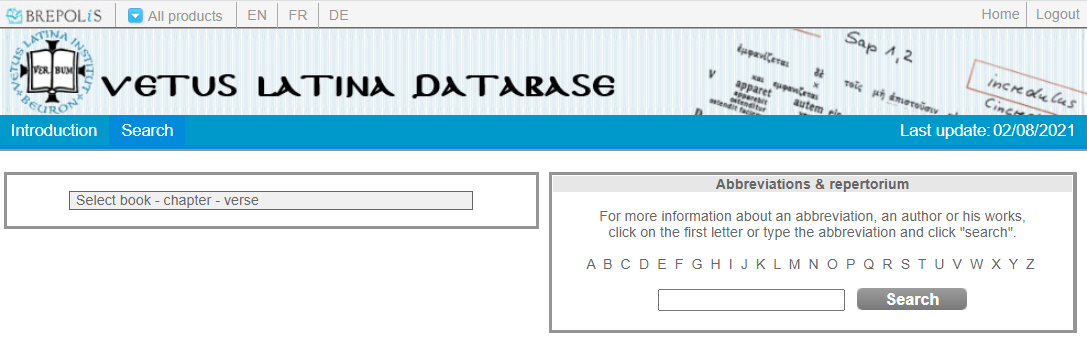
You can access Vetus Latina Database via the E-resources trials page.
Access is available on and off-campus.
Trial access ends 26th February 2022. Read More
New content in MANTRA: ‘Keeping research data safe’
We are pleased to provide an update on MANTRA, the free online research data management training resource.
The MANTRA course was developed around ten years ago to provide knowledge and training on a number of key research data management topics, including data management plans, effective organisation of data and files, and archiving and sharing research data at the end of a project.
As part of an ongoing update to MANTRA, six of the eight training modules have now been updated in order to refresh content and introduce new concepts and topics to better reflect current research data management practices and conventions.
Our most recent update is the new Unit 6: ‘Keeping research data safe’, which replaces the original ‘Storage and security’ unit covering how to store research data effectively, including keeping backups and methods to safeguard data. The new unit updates that content, and introduces a number of new topics including data classification, networked and cloud storage, password management tools, data access controls, transferring files securely, and working remotely.
Additionally, the new unit has been refreshed to include new images, videos and links to further reading to ensure it remains relevant and interesting to anyone looking to learn more about storing their research data safely and effectively.
In addition to this latest update, over the past year we have also reviewed and updated a further three modules:
- Unit 2: ‘Data management planning’ – Main updates include: new videos on the topic of data management planning from the Research Data Service, and new content covering planning of a broader range of research outputs (e.g. software code, workflows, methods and protocols), and information on software management planning.
- Unit 3: ‘Organising data’ – Main updates include: restructuring the content to make it easier to read and understand, and new pages on collaboration and working in teams, versioning files and using versioning tools, and managing software and code.
- Unit 8: ‘FAIR sharing and access’ – Main updates include: new videos, new pages on open data, the FAIR principles, making data FAIR, open data repositories, and data access statements, plus revisions to unit summary activities.
You can also read previous blog posts about updates to Unit 1: ‘Research data in context’ (blog post) and Unit 7: ‘Protecting sensitive data’ (blog post).
We hope you find time to visit MANTRA to see what is new and to learn more about looking after your research data effectively. We will be sharing more news on MANTRA as further updates are released.
Bob Sanders
Research Data Support Assistant, L&UC
Legal resources: taking care of quizness!

Image from USA-Reiseblogger on Pixabay.
It’s week one of semester two and we’ve already run several induction sessions for our January starts (and refresher sessions for current students who need them). Now would be a perfect time to put your newfound legal information resource skills to the test, and what better way than to with our quiz?
tinyurl.com/lawlibquizjan2022
Twelve questions with no time limit to test what you’ve learned about searching and using the library catalogue and databases. Have a go, and let us know how you get on!
New Resources on HeinOnline: Covid-19 Research

HeinOnline is one of the most used legal resources that staff and students have access to. It offers access to a large number of resources including:
- Full text legal journals
- U.S Treaties and Agreements
- U.S. Supreme Court decisions
- Over 15 million pages of image-based, fully searchable material.
- Access to several smaller collections for example:
- Law Journal Library,
- Criminal Justice Journals,
- European Centre for Minority Issues,
- Scottish Legal History,
- Selden Society Publications and the History of Early English Law,
- Slavery in America and the World
- History, Culture & Law
- The Open Society Justice Initiative.
- Law Journal Library,
The most recent addition is a collection on Covid-19: Pandemics Past and Present. This covers materials on the global, societal and economic impact of COVID-19, and also has material on past pandemics and vaccinations.
Worth a look for those staff and students who are undertaking research in this area. You can access HeinOnline using the link above, or via the Law Databases A-Z page.

Putting the Pieces Together: The Challenges of Working on Architectural Models (Part 1)
Today we have the first instalment of a two-part series from our Projects Conservator, Mhairi Boyle. In this first instalment, Mhairi discusses the assessment and the first treatment steps involved in the conservation of three large architectural models created by Percy Edwin Alan Johnson-Marshall (1915-1993) (Accession numbers PJM/PJMA/EUD/B/9.1; PJM/PJMA/EUD/E/1; and PJM/PJMA/EUD/B/1.5).
Since beginning my contract as Projects Conservator, I have been involved in a wide variety of work. From meeting and greeting art couriers from Greece to examining a frog muscle specimen, there’s never been a dull moment. One of the great things about working with the Centre for Research Collections is the collaborative nature of my job. I work with archivists, curators, librarians, and anyone and everyone who needs the advice and assistance of a conservator.
Most recently, I have been working with Collections Care Assistant Sarah Partington, Preventive Conservator Katharine Richardson, and Archivist Grant Buttars to assess and treat three large architectural models of the University of Edinburgh. The models were created by the architect and previous Professor of Urban Design and Regional Planning, Percy Edwin Alan Johnson-Marshall (1915-1993), between 1962 and 1976. They provide a fantastic snapshot into the developing landscape of Edinburgh during this period – Grant pointed out several building proposals which had never gone ahead, and most excitingly, the location of the Burke and Hare Tunnel which is visible from the within the Law School building in Old College. The aim of the conservation treatment is to stabilize the models so that they can be safely transported to another University building, keeping them accessible to researchers who wish to view them.


The models provide a snapshot of potential extensions and changes to the University from 1962-1976.
As a paper conservator, I usually work on flat objects such as letters and maps, as well as repairing books in-situ when required. It has been challenging, and very interesting, to examine and treat such large composite objects.
The models have several inherent vices, which means that there are elements which will inevitably decompose and become more fragile over time. They can be considered ephemeral objects: like film posters and newspapers, the materials used to create the models were never intended to stand the test of time. The lichen used to create the trees has become very brittle and fragile over time, and in some cases, now has a post-apocalyptic feel to it. Low-quality papers, cards, and adhesives have been attached to the wooden components of the models. One of the models was exposed to the elements in one of the University’s lobbies, wherein a rogue bird popped in to leave its ‘mark’ on the roof of one of the models.

Poor quality adhesive hardens and fails over time.

The lichen used to create the trees has decomposed, becoming brown and blackened.

The hole on the bottom left of this photo is a peg hole, where a loose element was once attached.
The largest model is composed of removable elements, attached in place by wooden pegs. We had a lot of fun locating the proper sites for some of the detached elements, hearkening back to my first ever lockdown days which were filled with jigsaws and puzzles. The loose and missing elements of the models were extensively documented, and most pieces were reattached after consultation with Jonathan Santa Maria Bouquet, the University’s Musical Instruments Conservator and resident wood expert. This will be discussed in detail in the second blog of this series.
After removing loose debris with a Museum Vacuum and using a smoke sponge to remove surface dirt, Sarah and I got to work reattaching loose paper elements with wheat starch paste, and thicker card elements with EVA adhesive.

Collections Care Assistant Sarah Partington re-adhering loose paper elements.
Working on these models has been a great chance to work closely with colleagues from different departments. In the second and final blog of this series, I will examine the different adhesives used in this project and the reattachment of some of the loose elements.
The power of preprints: an omicron case study
 Much has been recently been written about the value of preprints which facilitate rapid and open dissemination of research findings to a global audience (if you’d like to read more about the rise of preprints in the life sciences I would recommend this editorial published in Nature Cancer). However, much of the discourse surrounding the benefits of preprints has been anecdotal. Of course sharing research findings early is a good thing, but what actual impact can a preprint have?
We present here a mini case study which highlights the initial effects of sharing a topical preprint during a pandemic. I plan to track the preprint over the next few months to see how this will translate into future publications.
Case Study: the EAVE II project
There were various headlines in the media on 22 and 23 December which reported the the discovery that the Omicron variant of COVID-19 appears to be much milder than Delta. This news was prompted by research from the EAVE II study carried out at the Usher Institute. The EAVE II team only finished their analysis on 22 December and were very keen to get their results out in a transparent manner as part of a media briefing they had agreed to do later that day.
Our Scholarly Communications Team helped the EAVE II project to post the results in the University of Edinburgh’s repository as a preprint. Subsequently, the University’s Press Office contacted us to say that this was initially beneficial when the world’s media contacted them to request the underlying data. The preprint is available here:
The reaction was quick as the preprint was picked up and reported by the mainstream media like the BBC (this article in the BBC Science Focus Magazine is a good read), and also specialised services like the Science Media Centre:
Various national advisory groups (e.g Australian Technical Advisory Group on Immunisation) were then quickly able to read the research and fold it into their evolving guidance on boosters.
To date the preprint has 22,535 downloads, of which the majority were within the final week of December 2021. 21, 005 downloads in 10 days – that sure is RAPID communication!

If the EAVE II project team had sat on their results and waited for publication in a traditional journal article then all of this activity would have been not possible. I’m extremely interested to see what happens next to the publication.
Questions….
At the moment I mainly have many questions that I don’t have the answer for. Will this piece of research be submitted for publication in a journal? Publication in a journal and the peer review process will add validation of the results and subsequent kudos from basking in the reflected glow of an esteemed journal title and possibly good citation metrics. But how can the value of preprints be more widely recognised and rewarded? For me, this is a missing part of the process. Or, perhaps the benefit of rapid communication is good enough?
New Year, New UoE Library Services training sessions

Rays of sun through houses at sunset, Morningside, Edinburgh (@eilisgarvey via Unsplash)
Welcome back to Edinburgh! Although we don’t yet know what 2022 has in store for us, we do know that we’re keen to make sure our students are the best prepared they can be! For the Law Library team that means offering you a full range of induction and refresher sessions on how to use the library. If you’re feeling like you could do with a little update on the best ways to find resources, book on to one of our upcoming events using the links below.
Library Refresher: Wednesday 12th January, 11am to 11.50am (online)
Aimed at all undergraduate and postgraduate students, this session is a whistle-stop tour of all the things we told you at the start of the year. We’ll rattle through the resources and links relatively quickly so that we’ve lots of time to answer your questions, and if you’re feeling confident by the end of the session we’ve also got a quiz for you!
Come along if… you found researching your assignments just a little bit tricky at the end of last term, and you can’t remember where to go to find help.
PG Using the University Library – Law: Wednesday 19th January, 10am to 11am
Join us for an introduction to using library resources at the University of Edinburgh. Topics covered will include how to find and access books, journal articles and legal databases using library resources, and how to get help if the library doesn’t have what you need. The second part of this presentation will take a closer look at major legal databases including Westlaw and Lexis Library where you will learn how to find full text cases, legislation and commentary, and tips on how to use these resources efficiently and effectively.
Come along if… you’re a PG Online student starting in January 2022 at the School of Law.
Library Support for the School of Law (STAFF): Wednesday 19th January, 12noon to 12.30pm (online)
We don’t just work directly with students, we’re keen to speak to fellow staff members about how we can support their work too. We’re running a short session where we’ll present a bit and chat to anyone who works with the School of Law to make sure they know about all the ways we can help enhance their teaching or support throughout the year.
Come along if… you’re a member of staff and want to find out more about how we can help you!
PhD Sources, Materials & Bibliography: Wednesday 26th January, 11.30am to 12.30pm
(contact the Law PhD office for a link to the Collaborate room)
This session is aimed directly at PhD and PGR students, and takes the form of a one hour session featuring top tips on how to conduct complex research and construct your projects. We also look at some of the key resources you will need and signpost some bespoke materials that may be useful for students at this level.
Come along if… you’re a PhD students starting in January 2022 at the School of Law.
An exciting year for Queering the Archive
This year saw the development of the Queering the Archive initiative as part of our 70th Anniversary.
Join Elliot as he takes you through an exploration of the initiative as well as updates and upcoming plans.

Winter wishes from the Law Library team
As 2021 draws to a close, we realise this has been another unusual term for staff and students at the University. While the Law Library is still open until 4.50pm tomorrow (Thursday 23rd December), we will then close our doors until Wednesday 5th January 2022. If you are studying or conducting research over the winter break you will find our online resources remain accessible via the usual channels, but should you run into difficulties we will not be able to respond to any messages until we return in January.
On behalf of the team at the Law Library Helpdesk and the Academic Support Librarians we wish you all a restful and restorative break, and hope for your health and happiness during your time away from the University. We look forward to welcoming you back (whether in-person or remotely) in January.

SarahLouise and Donna, festive Law Librarians
Voices, Voices, Voices! Fieldwork, Creative Practice and The School of Scottish Studies
Written by Louise Scollay, Archive & Library Assistant
Back in August, we held an online seminar and Q&A with Dr Hugh Hagan, Martine Robertson and Hannah Wood where they discussed their fieldwork and research into the lived experience of women in the shipbuilding community of Port Glasgow.
Dr Hugh Hagan, Head of Public Records Act Implementation at the National Records of Scotland, is passionate about the shipbuilding communities of Port Glasgow and Greenock on the lower reaches of the River Clyde, particularly in the inter-war period. These towns, being removed by some distance from the large and diverse economy of Glasgow, depended entirely on shipbuilding and they developed a very particular sense of community. This was the subject of his PhD research at the School of Scottish Studies in the 1990s and he drew from that research for the talk, specifically the role of women in these communities.
Martine Robertson and Hannah Wood, of GaelGal Productiions, were undertaking studies at the Department of Celtic and Scottish Studies, when they attended a lecture by Hugh about his Port Glasgow work. They were galvanised to revisit this fieldwork, recording new material with the family of Cassie Graham, one of Hugh’s contributors. They have also been inspired to take these stories to centre stage, lifting the voices and experience of women of the Port Glasgow community and using these recordings in their creative practice. At this event, they presented a post-card sized version of their creative project, What a Voice.
The event was well attended and we had some excellent questions for the panel. However, because our speakers were all connected with SSSA through their studies and fieldwork, we decided to arrange a further conversation for our blog, as part of our ongoing celebrations of our 70th Anniversary.
As Hannah, Hugh, Martine and myself are all alumni of The School of Scottish Studies, you can imagine that there was a lot of shared memory and a lot of enthusiasm for oral history – we talked for over an hour and so we have split this conversation into three parts to be more digestible. Included throughout these are extracts of the original fieldwork recordings and excerpts from Hannah and Martine’s work What a Voice.
A point to consider: This is a zoom recording, so we were at the mercy of connections. As such there are one or two frozen images and moments of patchy audio.
If you are a University of Edinburgh Ease-user, you can also view these on our Media Hopper Channel.
Memories of The School of Scottish Studies and studying at The University of Edinburgh
Fieldwork Practices
Creative use of Oral History Recordings and the future for OH in Scotland
It is always incredible to see how people interact and respond to oral history recordings in the archive.
As we discuss here, the experiences of women in Port Glasgow aren’t found in official statistics or in public records. Memories and lived experience can only be captured by talking to someone from that community, someone who experienced that life. It is an incredible privilege to have these recordings in the collection at SSSA and it is thrilling to see how archive material can be used creatively – opening up the lives and experience of Port Glasgow women to new audiences.
As we stand on the cusp of Scotland’s Year of Stories in 2022, whose are the voices and what are the stories that you want to hear or draw out of archives? Indeed, whose are the voices and stories you wish to put into the archives, with your own fieldwork or creative practice? Do you have a story to tell? We would love to hear from you. Contact us via email , or leave us a comment on this post.
Collections
 Hill and Adamson Collection: an insight into Edinburgh’s past
My name is Phoebe Kirkland, I am an MSc East Asian Studies student, and for...
Cataloguing the private papers of Archibald Hunter Campbell: A Journey Through Correspondence
My name is Pauline Vincent, I am a student in my last year of a...
Hill and Adamson Collection: an insight into Edinburgh’s past
My name is Phoebe Kirkland, I am an MSc East Asian Studies student, and for...
Cataloguing the private papers of Archibald Hunter Campbell: A Journey Through Correspondence
My name is Pauline Vincent, I am a student in my last year of a...

Projects
Cataloguing the private papers of Archibald Hunter Campbell: A Journey Through Correspondence
My name is Pauline Vincent, I am a student in my last year of a...
Archival Provenance Research Project: Lishan’s Experience
Presentation My name is Lishan Zou, I am a fourth year History and Politics student....