Home University of Edinburgh Library Essentials
October 27, 2026
Approaching critical library practice : CALC25
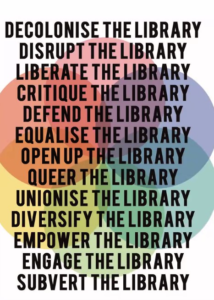
Critical Approaches to Libraries Conference poster
I attended the online CALC25 [Critical Approaches to Libraries] Conference from 13 – 15 May 2025. The programme, slides and recordings are available at https://sites.google.com/view/calcconference/calc2025 It was great to see Alice our Strathclyde placement student there too.
As you would expect from a conference on critical librarianship the programme topics were wide-ranging and diverse. Topics included professional identity, slow librarianship, supporting neurodivergent colleagues, information imperialism, and justice-orientated librarianship. I would highly recommend this affordable conference. It is £15 for 3 days and you can choose to donate a £15 entrance fee for another participant who can then attend for free. Most of the sessions were recorded and are on Youtube or the above website.
Reflections on Attending the BIALL Conference: Exploring AI and Legal Librarianship

University of Edinburgh Law Library Senate Room to Mezzanine View with Students
This year, I was lucky enough to attend the British and Irish Association of Law Librarians (BIALL) conference for the very first time—and I hope it won’t be my last! From the moment I arrived, I was struck by how welcoming and friendly the event was. Thanks to the buddy scheme, I connected with librarians from across the profession, opening doors to future opportunities for sharing knowledge and ideas.
One of the big themes at all library conferences this year is Artificial Intelligence (AI), and BIALL was no different. As one of the AI leads in our team, I was keen to learn how AI tools are being used in legal practice and library-led support. The sessions didn’t disappoint.
Reflections on CoLIS 2025
The end of May and start of June is always a busy time for conferences and this year has been no exception. Luckily, at the start of June, I was able to attend the International Conference on Concepts of Library and Information Science (CoLIS). CoLIS is a series of international conferences aiming to provide a broad forum for the exploration and exchange of ideas in the field of Library and Information Science, Information Studies, and related disciplines. The events took place in Glasgow and were hosted by the Department of Computer and Information Science at the University of Strathclyde, which rather neatly was where I studied for my MSc in Information and Library Studies, as well as my PhD. Proceedings included a civic reception at Glasgow City Chambers and a dinner and ceilidh at Oran Mor.
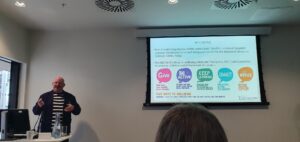
Keith Munro giving his presentation at the conference – Photo credit: Perla Innocenti
I was grateful to be able present findings from my PhD, where I discussed the wellbeing benefits observed amongst hikers on the West Highland Way and how they can be linked to concepts in information science, receiving thoughtful feedback and questions from expert researchers. I was also very fortunate to help facilitate a workshop on embodied information alongside Jenna Hartel (University of Toronto) and Laura Williams (University of Sheffield), and wonderfully led by Shannon Crawford Barniskis (University of Kentucky). This event featured everything from amateur (well certainly from me) dramatics, olfactory surprises (pleasant ones, in the form of essential oils), stretching exercises, vlogs about running, music playlist creation and more besides, highlighting in a short space of time the wealth of directions that future research on embodied information can take.
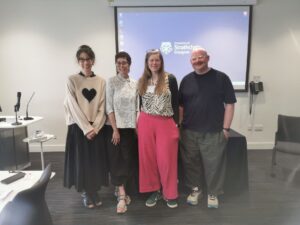
From left to right: Jenna Hartel, Shannon Crawford Barniskis, Laura Williams and Keith Munro – Photo credit: unknown
The three keynote speeches were highlights of the conference and covered a wide range of concepts in Library and Information Science. Firstly, Jenna Hartel used Marcia Bates’ concept of the red thread of information to weave a fascinating, though-provoking picture of how consideration of the serious leisure perspective, the study of hobbies, interests and activities that people devote a great deal of their life to, can continue to generate new insight into information behaviour, symbiotically creating innovative research methodologies and novel ways to teach concepts in Library and Information Science. Their talk also showcased their skill as researcher and as a teacher, using multimedia elements to relate key concepts and meaningfully engage with their audience.
On the second day of the conference, Dr Adele Patrick gave a very inspiring talk about the history and present-day activities of the Glasgow Women’s Library. I greatly appreciated the way they described the care they gave to people in the library’s physical space and how it was experienced by visitors, this seemed to be of equal importance as the contents of the collection. This perfectly illustrates how the consideration of people’s bodies in library and other information spaces, is vital to making collections accessible, as well as being a practical example of how embodied information is not just an academic concept, but something that should be central to the provision of library services. I was also struck by how large institutions, such as national or university libraries, can learn from the best practice of independent organisations, where values and approaches are developed from grass-roots upwards.

Toma Tasovac delivering his keynote speech – Photo credit: Keith Munro
The final keynote was given by Dr Toma Tasovac, Director of the Belgrade Center for Digital Humanities (BCDH) and Director of the pan-European Digital Research Infrastructure for the Arts and Humanities (DARIAH-EU), who took the opportunity to question whether libraries are still “imprisoned by the print mind”. This talk really resonated with me in my role in the Research Data Support team as it raised fascinating issues and concepts around whether library collections themselves are data, as well as what can be considered supporting digital data in the Arts and Humanities. I find the latter in particular to be an area of great interest, that there could be a wealth of supporting material for Arts and Humanities research that doesn’t get captured digitally because researchers think that data just means spreadsheets. Finding ways to advocate for the inclusion of novel research outputs, less commonly encountered types of data, is a means to promote a greater understanding of the value of researchers’ work in totality, rather than just by the metrics of publishing. This can help create archives that will be of significant cultural value as time progresses.
I also greatly enjoyed attending two of the conference’s alternative events on Information Art, organised by Andrea Kampen (University of British Columbia) and Rebecca Noone (University of Glasgow), and on information practices during transitional, life-changing events, facilitated by Jenny Bronstein (Tel Aviv University), Perla Innocenti (University of Strathclyde) and Jette Seiden Hyldegård (University of Copenhagen). Both had in common creative ways to encourage participants to engage with the concepts, from creating art using collage techniques to mapping from memory. These creative and collaborative activities were a refreshing way to engage the brain in a different way in between the many fascinating presentations.
It is hard to narrow down all the interesting talks I heard, but I would like to at least briefly mention the following, in no particular order: Genre knowledge: a metacognitive approach to exploring document practices in science by Samuel Dodson; The knowledge organisation of sub-subgenres: the curious case of the collaborative works of Gilbert and Sullivan by Deborah Lee (University College London); Geographical information ranges: conceptualising holistic information landscapes by Kaitlin Montague (Humboldt University); Reciprocity in information exchange: how social exchange enriches collaborative research partnerships by Joann Cattlin (RMIT University) and Lisa Given (RMIT University); Informational self-deception: deconstruction and reconstruction within philosophy of information by Juliana Mestre (Rutgers University); ‘It’s a wide cluster of noise’: experiencing and describing information from environmental sounds by Owen Stewart-Robertson (McGill University); and The multispecies perspective in library and information science by Niloofar Solhjoo (Charles Sturt University). I haven’t even touched on the wonderful posters I saw, but in the interest of some attempt at brevity, I will stop here. I encourage you to look at the proceedings online.
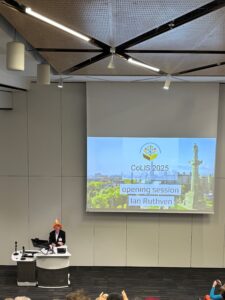
Ian Ruthven giving the welcome speech – Photo credit: Keith Munro
Thanks go to the Conference Chairs, Ian Ruthven, Perla Innocenti and Emma Nicol, as well as the wonderful team of volunteers from the PhD and Masters programmes from the Department of Computer and Information Science at the University of Strathclyde. Congratulations on such a memorable, rewarding experience for all!
All the full and short papers from the conference can be viewed through the following link: Vol. 30 No. CoLIS (2025): Proceedings of CoLIS: 12th International Conference on Conceptions of Library and Information Science – University of Strathclyde, Glasgow, UK, 2nd-5th June 2025 | Information Research an international electronic journal
The abstracts for the alternative events, papers and posters can be viewed in the following link: Adjunct Proceedings of CoLIS : 12th International Conference on Conceptions of Library and Information Science
Keith Munro,
Research Data Support Assistant
Hill and Adamson Collection: an insight into Edinburgh’s past
My name is Phoebe Kirkland, I am an MSc East Asian Studies student, and for the last 4 months, I have been a Digital Collections Assistant working on digitising and improving information available regarding the Hill and Adamson Collection. Although my own research does not deal with conservation or Scottish heritage, I have a lot of experience working with archives and archival documents. Further, as my research area is based in East Asia, many of the documents I need are stored in archives that would require a long and expensive flight, thus the power of digitisation in conservation is very valuable to me personally as it allows me access to vital documents. Therefore, I was thrilled to be able to improve the metadata of and help facilitate access to the digitised images from the Hill and Adamson Collection as part of my role as Digital Collections Assistant.

Phoebe at work in the CRC office.
The Hill and Adamson Collection is made up of 701 calotype photographs that were taken between 1843-1847 by photographers David Octavius Hill and Robert Adamson. They are some of the earliest photographs in history. As calotypes, they are different in their process from the more famous daguerreotypes which became the chosen process for photography. Calotypes are negatives which are made using paper coated with silver iodine, and specifically for Hill and Adamson, they used a type of ‘silver salted’ paper created by William Henry Fox. These calotypes in our collection are mostly of the 1843 Disruption, an event in which the Church of Scotland split, and the Free Church of Scotland was founded. The ministers who signed the Act of Declaration and Deed of Demission that signified this split are showcased in the portraits in this collection.
Other photographs in the collection include scenery of Edinburgh, such as Calton Hill and the Scott Monument, and laypeople of Edinburgh such as fishwives. It is an incredible collection that provides a snapshot into both the lives of clergymen, academics and laypeople in the 1840s in Edinburgh. Particularly, as photography was extremely expensive, and usually portraiture was at the expense of the subject, it is rare to find older photographs of laypeople. Therefore, this collection is very special in providing rare insight into these lives. Hill and Adamson were a powerful duo in the field of photography, but unfortunately Hill’s untimely death at the age of 26 in 1847 prematurely ended their partnership. Other collections of their works are kept at many different archives and museums around the world, further signifying the importance of their work to the fields of photography and history.
The aim of the project was to help provide better access to the digitised images of the Hill and Adamson Collection on the Library’s digital collections platform by providing fuller metadata for each photograph. The photographs’ descriptions were incomplete, and needed expanding upon. Creating information about the provenance and the people in the photographs, and then connecting this information to the existing digitised copy of the photograph was required. This was accomplished by looking through the physical collection, which is made up of 6 bound volumes, 4 loose-leaf collections kept in boxes, and one further box of photographs reproduced from the negative calotypes at a later time, from 1906 to 1920.
Most of the photographs were of white, upper-class men, who were members of the gentry, clergy, academia, or any combination of all three. Furthermore, the women in these photographs were very rarely identified by name, or even by relation to the man in the photograph, leading to confusion over their identities. Therefore, I made it my mission to identify as many of the women in the photographs as possible. However, within the collection, there were certain photographs that stood out to me as particularly interesting or novel, or providing key insight into politics and religion in the 1840s.
The Scott Monument

Coll-1073/7/45: Photograph of the Scott Monument in the 1840s.
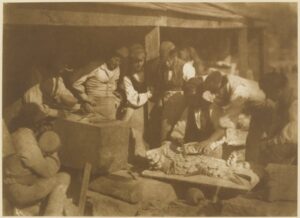
Coll-1073/6/9: Group portrait of workers building the Scott Monument, Edinburgh.
These photographs show the Scott Monument, and the masons working on carving a griffin for the construction of the Monument. These are beautifully shot and composed photographs that show a snapshot of 1840s Edinburgh, particularly the photograph of the Scott Monument, which we can see shortly after its completion in 1845, but before its inauguration in 1846. Many of the masons who worked on the construction of the Monument passed due to incredible back-breaking labour or respiratory issues from the stone dust. It is estimated that the monument killed half of all the masons that were employed to construct it due to lung disease.[1] Therefore, it is incredible to be able to see a photograph of those who worked on the construction, so they can be identified in some small way as those who contributed to such an iconic Edinburgh landmark.
Isabella (Burns) Begg
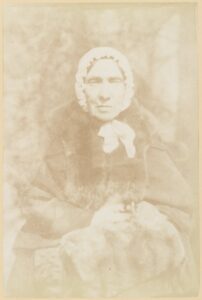
Coll-1073/1/24: Portrait of Isabella Begg (Burns).
This calotype shows Isabella Begg (Burns), youngest sister to Robert Burns, national poet of Scotland. She was born on 27 June 1771 and died on 4 December 1858, aged 87. She married John Begg at age 22, and had nine children with him. He died in 1813, leaving Begg a widow for 35 years.
Isabella was a valuable source of information into Burns as a poet, clarifying details of obscurity around his poems and stories, and identifying individuals in question. Her brother died when she was 25 years old. Begg has been identified as being 72 in this photograph, meaning it was taken around 1843.
This photo is one of the few photographs of women in the collection, especially one that has already been identified by the compiler. This portrait reveals a continued interest in Begg, despite the fact that Robert Burns had died nearly 50 years prior, and showed that she remained relevant to the Edinburgh community, as her photo was one of the first taken in the period of Hill and Adamson’s partnership.
Fishwives
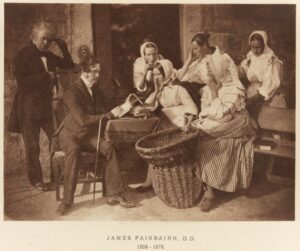
Coll-1073/3/8: Group portraits of James Fairbairn, James Gall Sen.r, and fishwives.
This group portrait is one of a number in the collection which showcases the fishwives of Edinburgh. As previously expressed, it is rarer to find photographs of the laypeople from this period due to the expense of photographic production. Fishwives were women who helped catch, prepared (i.e. cleaned and gutted), and sold fish. They were not always married, as wife here meant ‘woman’ and not ‘wife’. They were famed for being loud and outspoken, often swearing and presenting ‘uncouth’ behaviour that was not expected from women of the period. They were often self-sufficient as men were away fishing for long periods, therefore needing to help provide for themselves by successfully selling their wares. The Newhaven Fishwives (as shown in these photographs) were famous, even known to royalty. They were admired by Queen Victoria, and George IV thought they were ‘handsome’ (in the historical sense).[2]
Incredibly, four of the five women in this photograph are identified by name – Carnie Noble, Bessy Crombie, Mary Combe, and Margaret (Dryburgh) Lyall. The two men are identified as Reverend Dr James Fairbairn and James Gall. The calotype has been named ‘The Pastor’s Visit’ for this reason. This photograph potentially showcases James Fairbairn reading a pamphlet, perhaps religious, to the women, who sit in contemplation around him – focused? Or perhaps bored? – we cannot tell exactly. The posing for these photographs took around 3 minutes, a dramatic improvement from daguerreotypes which could take up to 15 minutes plus for exposure.[3]
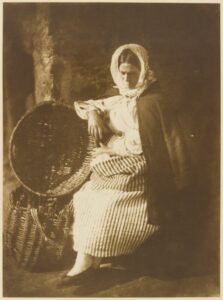
Coll-1073/5/34: Portrait of a fishwife.
Another portrait of a fishwife, this time an individual, also remarkably identified as Mrs Elizabeth Hall (Johnstone). This portrait, although posed again, provides insight into the typical clothing of fishwives of the 1840s. Although the photos are in black and white, we know that the Newhaven fishwives wore blue duffle coats and striped colourful petticoats, as well as a cap or headdress, and carried a creel which would have their fish.[4] All these items can be seen in this photograph, although unfortunately not in their striking colour.
[1] Tomlinson, Charles, “Stone”, in The Cyclopaedia of Useful Arts. Mechanical and Chemical, Manufactures, Mining and Engineering. Vol 2 Hammer to Zirconium, edited by Charles Tomlinson (London: James S. Virtue, 1854), pp.741–52.;
Donaldson, Ken, et al. “Death in the New Town: Edinburgh’s Hidden Story of Stonemasons’ Silicosis.” The Journal of The Royal College of Physicians of Edinburgh, 47.4 (2017), pp.375-383, doi:10.4997/JRCPE.2017.416.
[2] Bertram, James Glass, The Harvest of the Sea; a Contribution to the Natural and Economic History of the British Food Fishes, with Sketches of Fisheries & Fisher Folk (London, 1869), p.424.
[3] The Editors of Encyclopaedia Britannica (ed.), “Calotype”, Encyclopædia Britannica. Available at: <https://www.britannica.com/technology/calotype> [Accessed: 08 July 2025].
[4] Bertram, James Glass, The Harvest of the Sea; a Contribution to the Natural and Economic History of the British Food Fishes, with Sketches of Fisheries & Fisher Folk (London, 1869), p.429.
Challenges, Changes and Collaborations– American Theological Library Association conference, Pittsburgh June 18-21 2025
I was delighted to be invited to Pittsburgh, Pennsylvania this year to speak at the Atla 2025 Annual meeting. It’s actually the second time I have been to a library conference in Pittsburgh “the steel city”, the first was to an ARLIS art librarians conference over 20 years ago. This time Pittsburgh was looking very green with cool damp weather, cooler than the June heatwave happening at home in the UK.
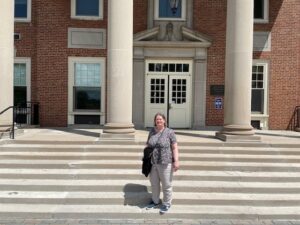
On the steps of Pittsburgh Theological Seminary
My conference experience began with a visit to Pittsburgh Theological Seminary (PTS)’s Clifford E. Barbour Library. Having just shown a group of PTS Doctor of Ministry students around my library, New College Library, the previous week, I was keen to visit the library of this partner institution. Like New College Library back at the University of Edinburgh, this library had recently been completely decanted for a full refurbishment, with priorities including increased light, improved air conditioning and redeveloped learning and social spaces. This was not the only similarity between PTS’s Library and my own library, which both use Library of Congress classification and support training for Presbyterian ministry. Read More
Getting a jump-start on Resource Lists!

Image from RosZie via Pixabay
If you’re an academic working in the School of Law, you may have seen several emails flying back and forth about Resource Lists and getting them created for new courses, or updating those for courses due to run in the next academic year. You may be curious about what all the fuss is about and whether they even actually help our students find the things they need. If you’re a Course Organiser we’d love to encourage you to set up a list, if you haven’t already, and make it as helpful as possible for the incoming cohort. We’re keen to bust some myths which might be putting people off so let’s look at some common concerns below.
I’m too busy, I really don’t have time to make up a list or learn how Leganto works!
We appreciate the huge time pressure that our academic colleagues face, but it doesn’t mean you need to duplicate work or construct a list from scratch. Here are some ways we can help:
- If the Course Organiser already has their reading list in a word document and can indicate priority on this (Essential/Recommended/Further Reading) then this can be sent to the Library via the online form and they will create the list.
- If the materials which make up the reading list are contained in the Course Guide, or one or more other documents, handouts or presentations, we Law Librarians will be happy to help collate these into a Resource List and work with COs to finalise the list.
- If the Course Organiser has the time and wishes to, they can create the list themselves. Full guidance is available on the library website.
I’ve missed the deadline, is there any point in still submitting a list?
Yes absolutely. The deadlines the Library sets for submission or review of Resource Lists is deliberately early so that they can guarantee to have lists and purchases ready for the start of teaching. However, missing the deadline should not be a reason not to create or review a list at all. Lists can be submitted at any time and the Library will do their best to get them ready as quickly as they possibly can. Lists submitted after the deadline will be dealt with first come, first served so there is a benefit to getting them in as early as possible! Where possible, Course Organisers are strongly encouraged to send their lists to the Library by the stated deadlines.
But I don’t know everything I’ll need right now. Some of my guest tutors may have things to add later.
Lists are not set in stone once submitted to the library. Course Organisers can add to and amend the list at any time, even during teaching if necessary, but getting the bulk of your list organised now means it’s more likely to be ready before your students need it.
I am concerned that this is ‘spoonfeeding’ our students. If they get links to every resource they need, they won’t investigate on their own.
There is no expectation that every possible resource related to the course topic will be included in the list. The Essential readings must be included, but the Course Organiser can choose to include Recommended and Further Readings as appropriate (with the caveat, of course, that items not included on lists can’t be taken into account in the Library’s planning for purchases and digital subscriptions, so they wouldn’t be able to guarantee availability).
Resource Lists foster student library skills, by keeping them within the Library ecosystem of tools and services rather than in Google Scholar or ChatGPT. Furthermore, the Library offers their LibSmart online course to help build these skills.
Use of a Resource List does not de-skill our students, or hinder the development of research skills. If one of the key tasks on a course is for students to research and discover materials by themselves, then of course those materials need not be included on the course Resource List. The key accessibility need is to remove barriers to students finding and engaging with their essential readings – the ones they cannot do without – and allowing them to plan their time accordingly (they are also under, at times, extreme pressure). Student feedback on Resource Lists demonstrates how much the system helps with this and how valuable our students find it.
I’ve never had a Resource List before and I don’t want one now. My methods of teaching have always been fine in the past!
Providing a Resource List does not force a Course Organiser to change the way they teach. It simply provides the students with their readings and other resources in the same place and in a consistent way across all their courses, whichever School they might be in. In fact, use of the Resource List system frees up staff time, as they no longer need to provide and maintain their own lists of references and links – they can simply refer the students to the Resource List atthe appropriate places and have the Library review the list each year to keep it current.
Hmm, I’ll think about it, but I do have more questions.
Great, no problem. We have actually created a guidance document specifically for the School of Law which goes into more depth on what you may or may not wish to include on your list: Law Resource List guidance v3
You could have a look at that first, and if you still have questions just let us know. We’re happy to discuss resource lists via email at any time. You can also contact the Library Learning Services team (who run the Resource List service) directly for assistance with creating and editing lists.
We hope this has been convincing. We love Resource Lists here at the library because they help us keep our fingers on the pulse of what’s being used to teach. It helps us keep the Law Library stocked with the right texts for the right student numbers, which is of crucial importance to supporting our users in their study and research.
Watch this space for more on Resource Lists as we launch into the new academic year, where we’ll be posting up recommended user guides for students as well as stats on the top used Resource Lists for the school.
This post was created using material written by Neil Davidson, Learning Technologist for the School of Law. Neil is an expert in the creation and use of Resource Lists and can be contacted via email.
Edinburgh Open Research Conference 2025 Highlights
On 4th June 2025, we held the 4th annual Edinburgh Open Research Conference. The conference welcomed anyone who is part of a research community, from researchers and technicians to support services and curious citizens. This year almost 300 people joined us from around the world to discuss challenges, success stories, and next steps to further open research.
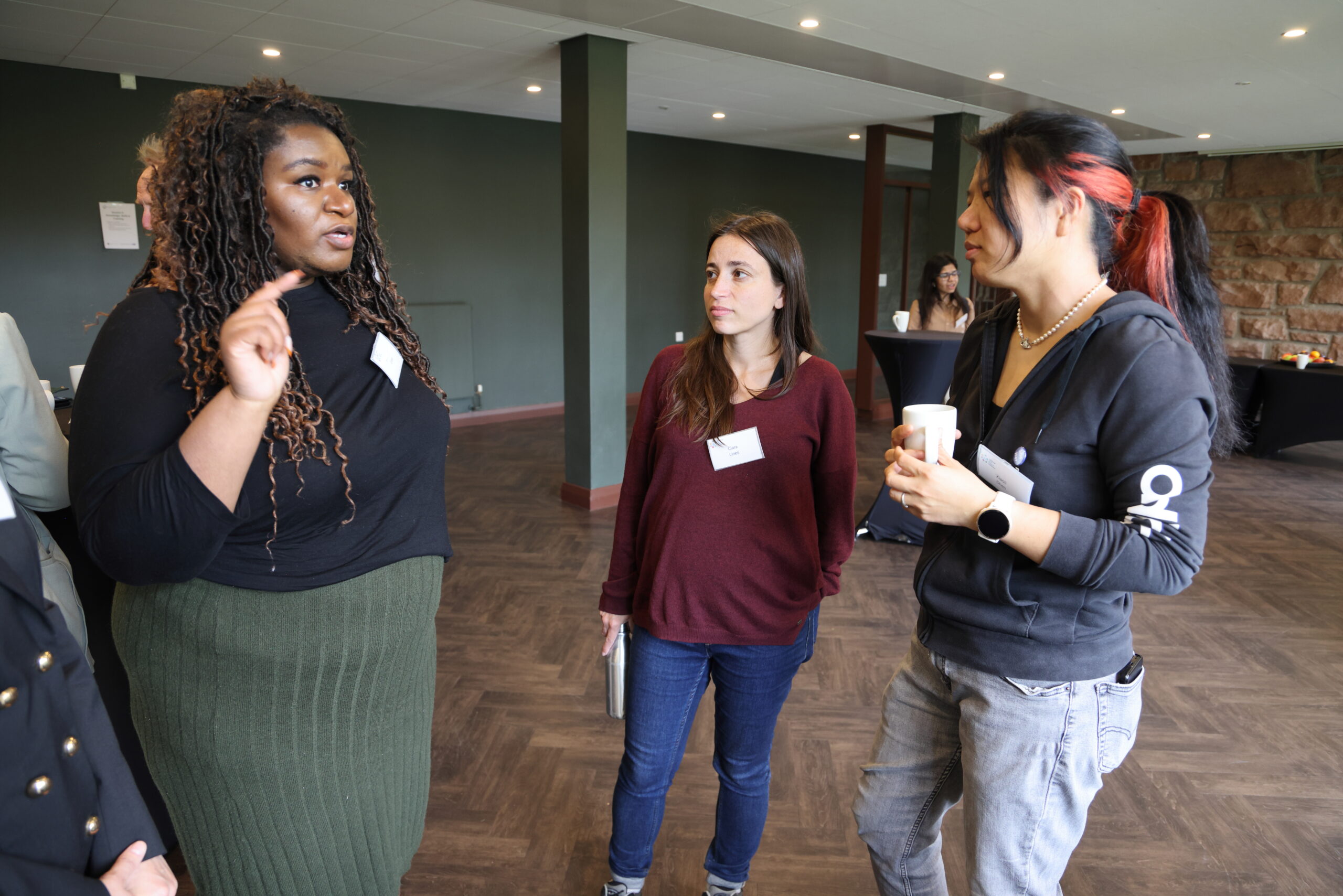
Attendees chatting. Photo by Eugen Stoica.
This year’s theme was “What’s stopping us?” and centred around barriers to making progress in Open Research. We had a full-on bill of events, with 18 speakers presenting their work and ideas throughout the day. We were honoured to host many speakers who had travelled to attend the conference, especially those who travelled from as far as India and the USA. In case you couldn’t join us, all sessions were recorded – you can find the videos on our Media Hopper:
https://media.ed.ac.uk/channel/Edinburgh+Open+Research/259602172
And you’ll find the proceedings from this year’s conference here:
https://journals.ed.ac.uk/eor/issue/view/696
Session 1: Communities and collaborations
In the first session we heard about different methods for understanding the barriers to adopting open research (Ailsa Niven and Zuzanna Zagrodska). I was particularly interested in Zuzanna’s finding that people become less enthusiastic about Open Research with more experience as a researcher. We also heard about some personal experiences of engaging with Open Research. Judith Fathallah spoke about how Open Access publishing models centre author agency, while Fiona Ramage talked about putting her career on the line to stand up for academic integrity.
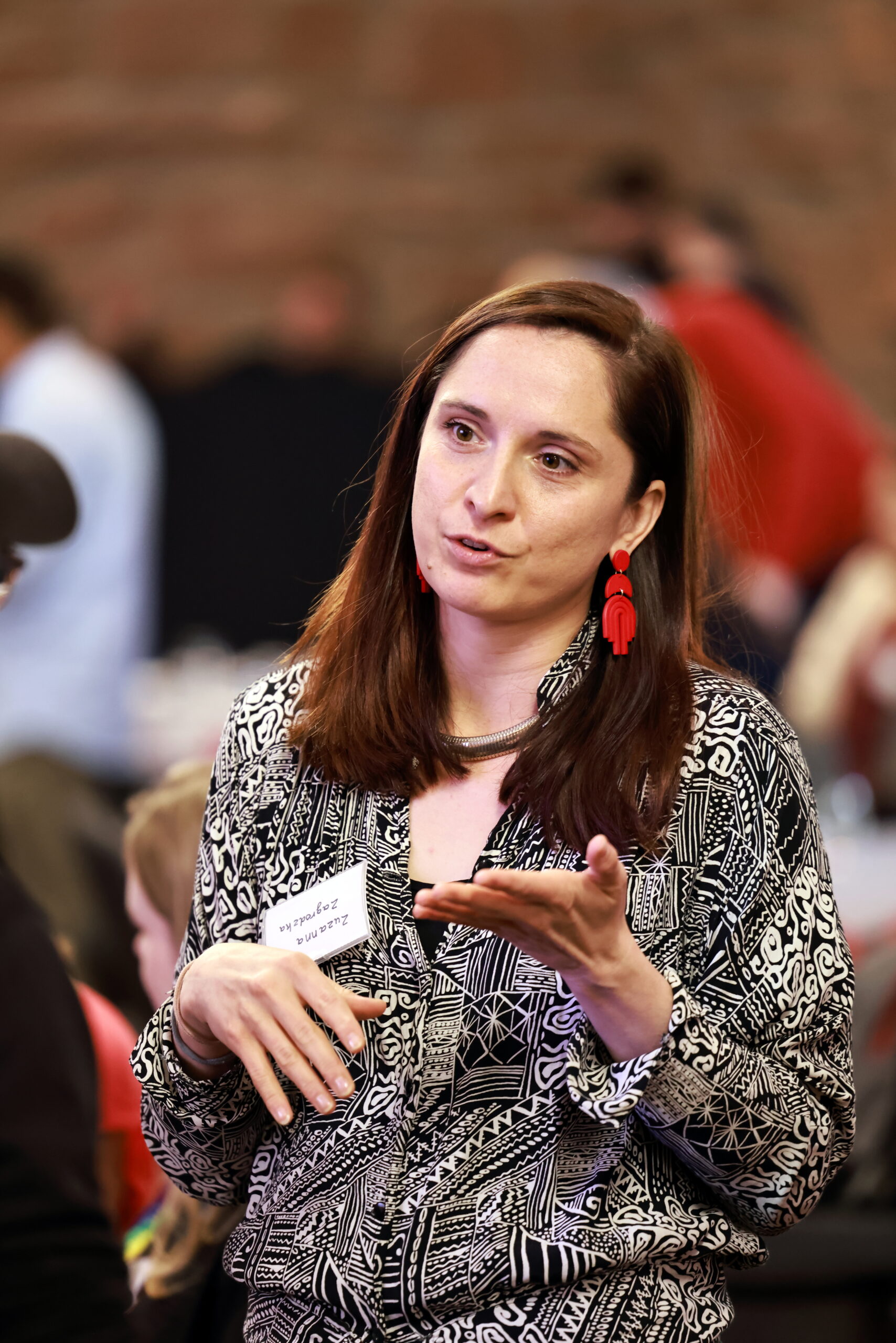
Zuzanna Zagrodzka. Photo by Eugen Stoica.
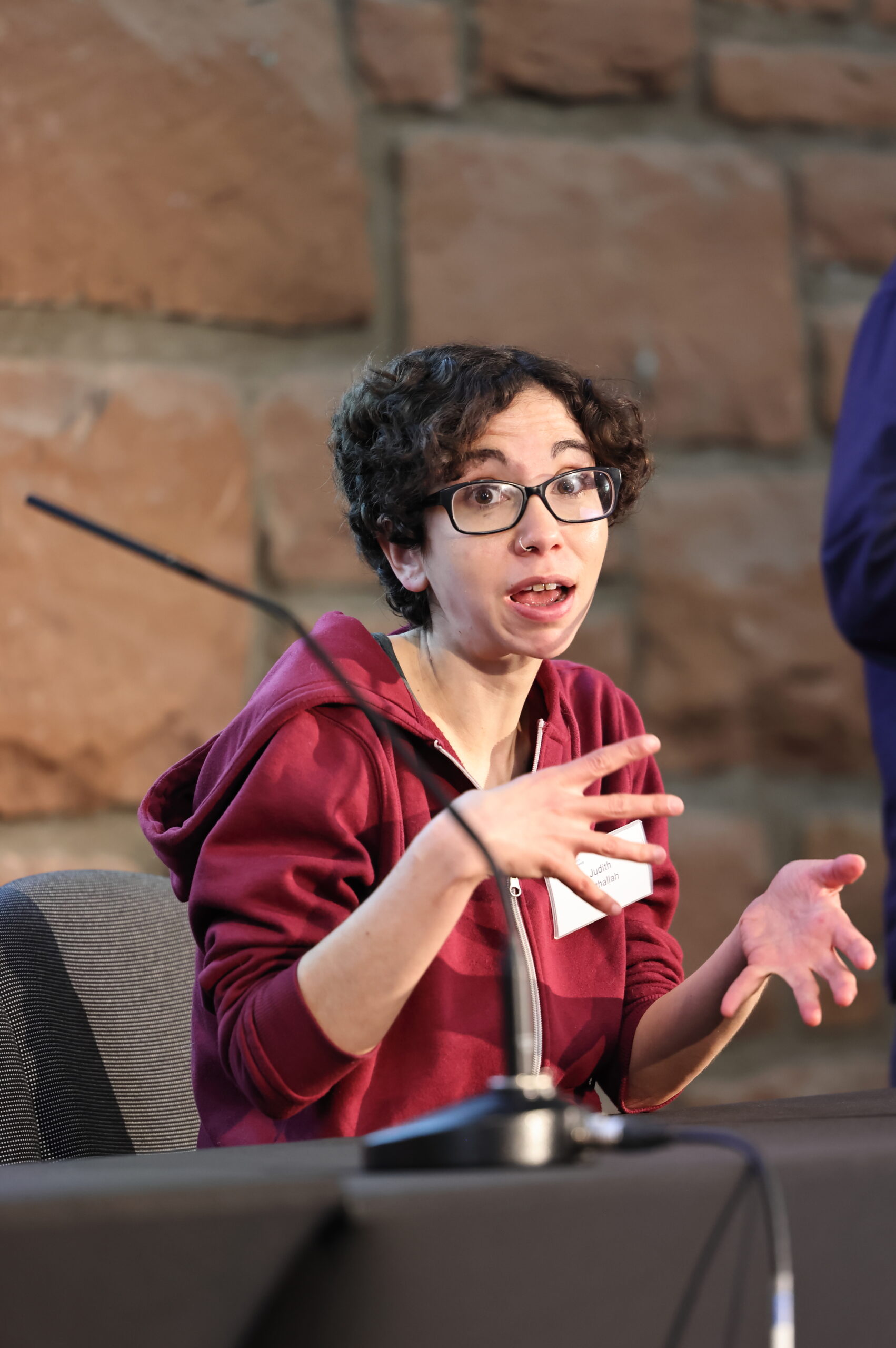
Judith Fathallah. Photo by Eugen Stoica.
Session 2: Policy and Procedures
In the second session we heard lightning talks on how the Diamond Open Access model can help early career researchers (Varina Jones-Reid and Sarah Sharp), applying FAIR data principles to institutional data (Damon Querry), and whether open research mandates work in the context of the 2021 REF Open Access Policy (Ali Kay). The final talk was on the Research Culture Action plan at Edinburgh and how Research Culture and Open Research intersect (Crispin Jordan and Will Cawthorn).
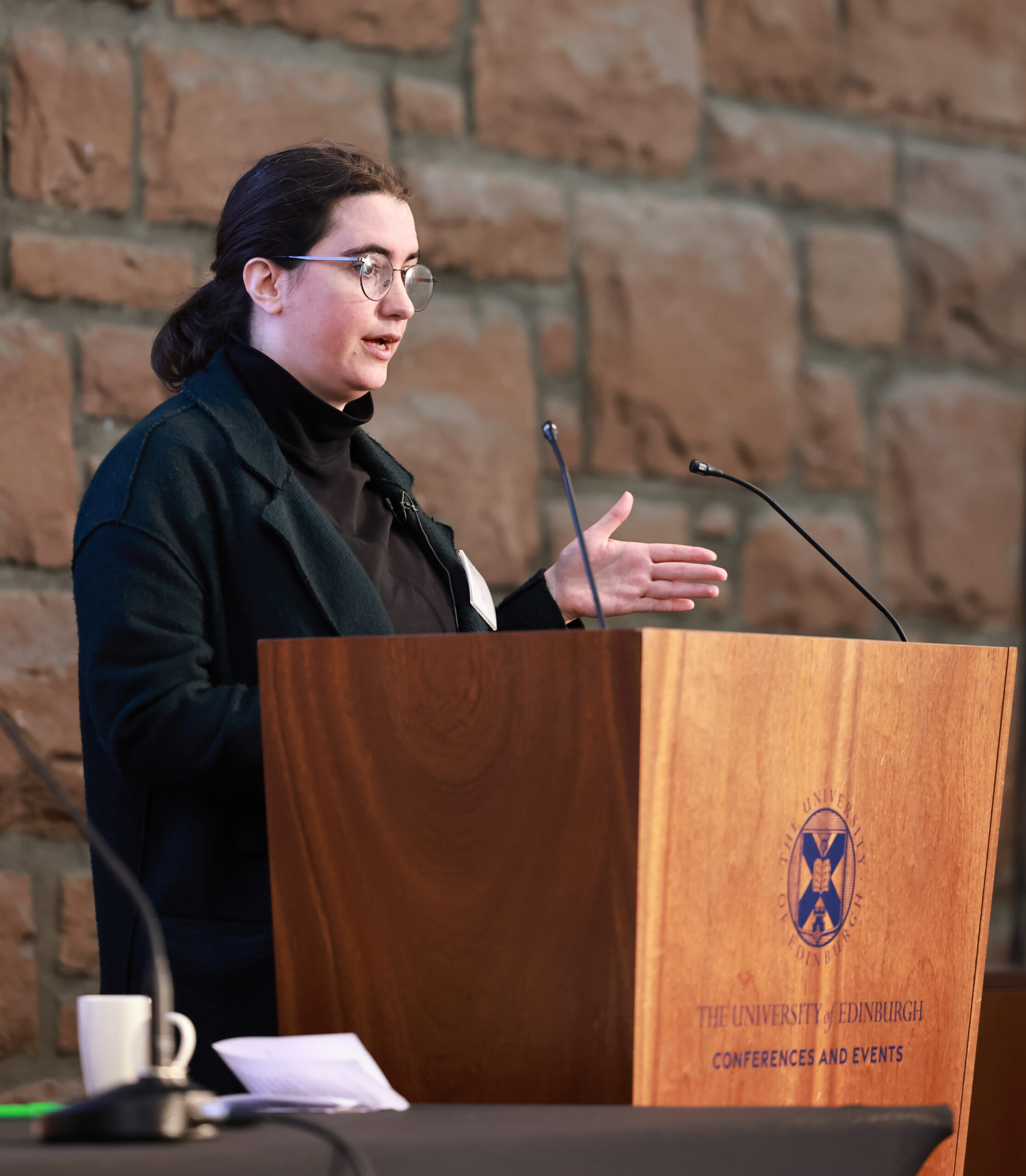
Ali Kay. Photo by Eugen Stoica.
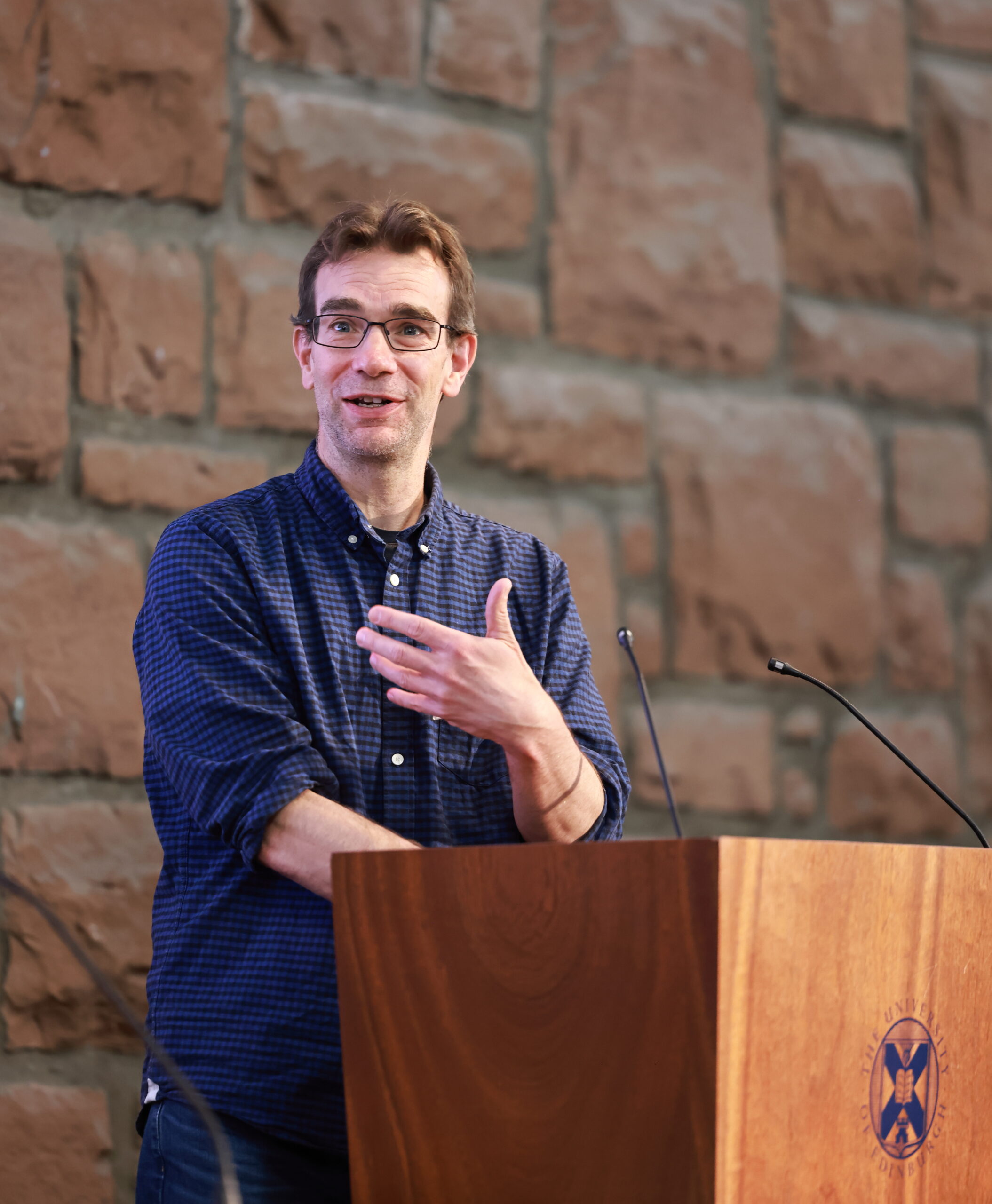
Crispin Jordan. Photo by Eugen Stoica.
Lunch: Research Cafe / Networking
During the lunch break, we had the opportunity to gather and network or to attend this month’s Research Cafe event, held monthly by our wonderful Academic Support Librarians. Ruthanne Baxter, Civic Engagement Manager for our Heritage Collections, joined us to talk about prescribing heritage-based social support programs as a non-clinical health intervention for students and Edinburgh locals.
Ruthanne Baxter. Photo by Eugen Stoica.
Session 3: Systems and Infrastructure
After lunch, a couple of speakers talked about open-source software, one for automating lab work and for divesting from Big Tech corporations whose values are not aligned with our own. We also heard about new tools aimed at solving specific obstacles to Open Access – one tool for helping researchers identify and overcome barriers to sharing qualitative research data, and a new platform to make publication in neuroscience more accessible using preprint peer-review. I liked that the speakers in this session provided practical solutions and tools.
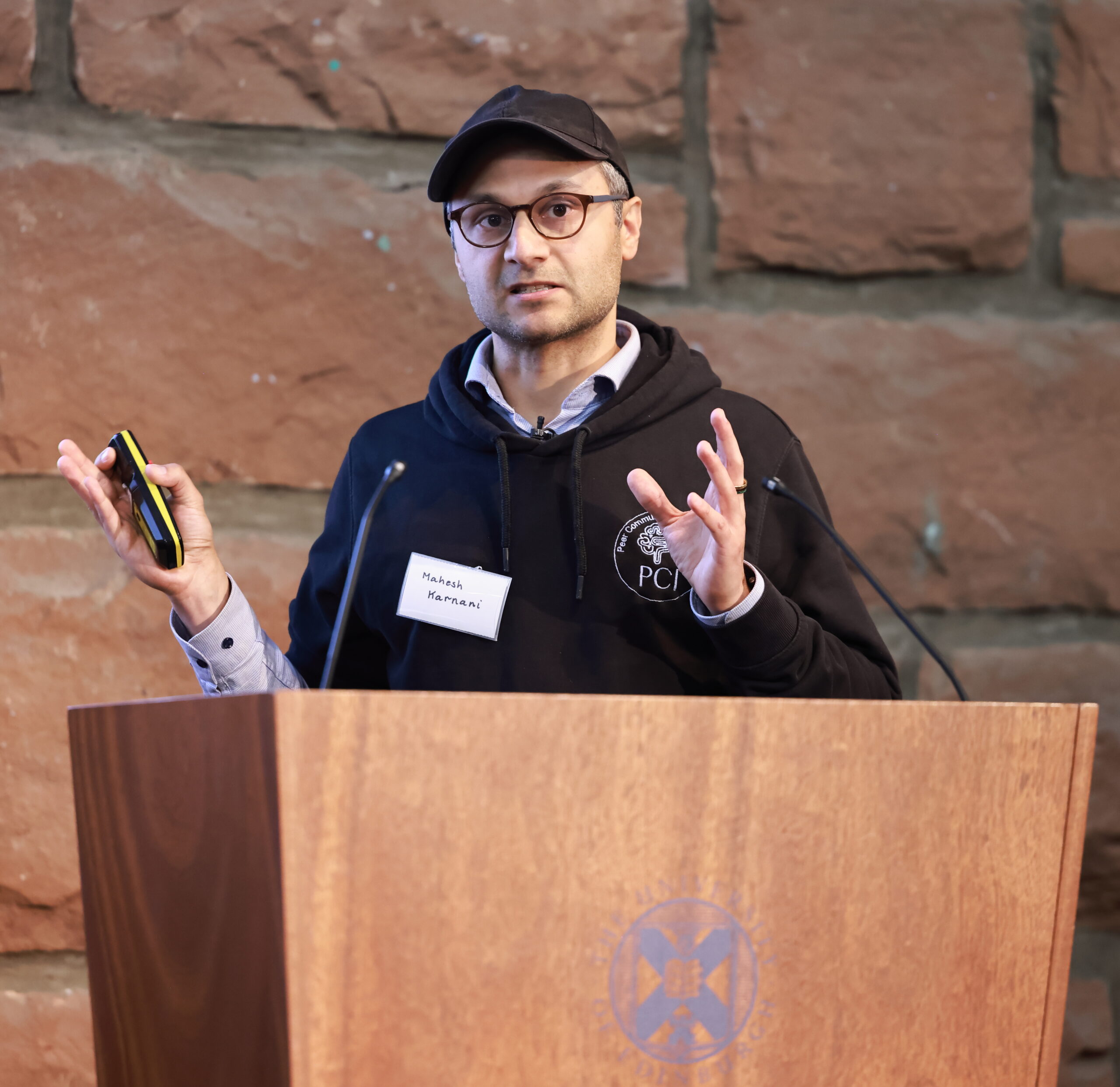
Mahesh Karnani. Photo by Eugen Stoica.

Audience member listening. Photo by Eugen Stoica.
Session 4: Knowledge, Skills & Training
During the final session, speakers discussed Open Research in a global context: Milena Dobreva shared her reflections on her knowledge exchange in Bulgaria, and our old friend Tapas Kumar Mohanty talked about building a culture of Open Science in a Global South context through the NIHR Global Health Research Unit on Respiratory Health (RESPIRE) project. We also heard about new training-related innovations. Louise Saul discussed reward and recognition for research-enabling staff who provide Open Research training, and Camilla Elphick presented a new interactive and accessible Open Research learning resource she co-developed at the Open University.

Milena Dobreva. Photo by Eugen Stoica.
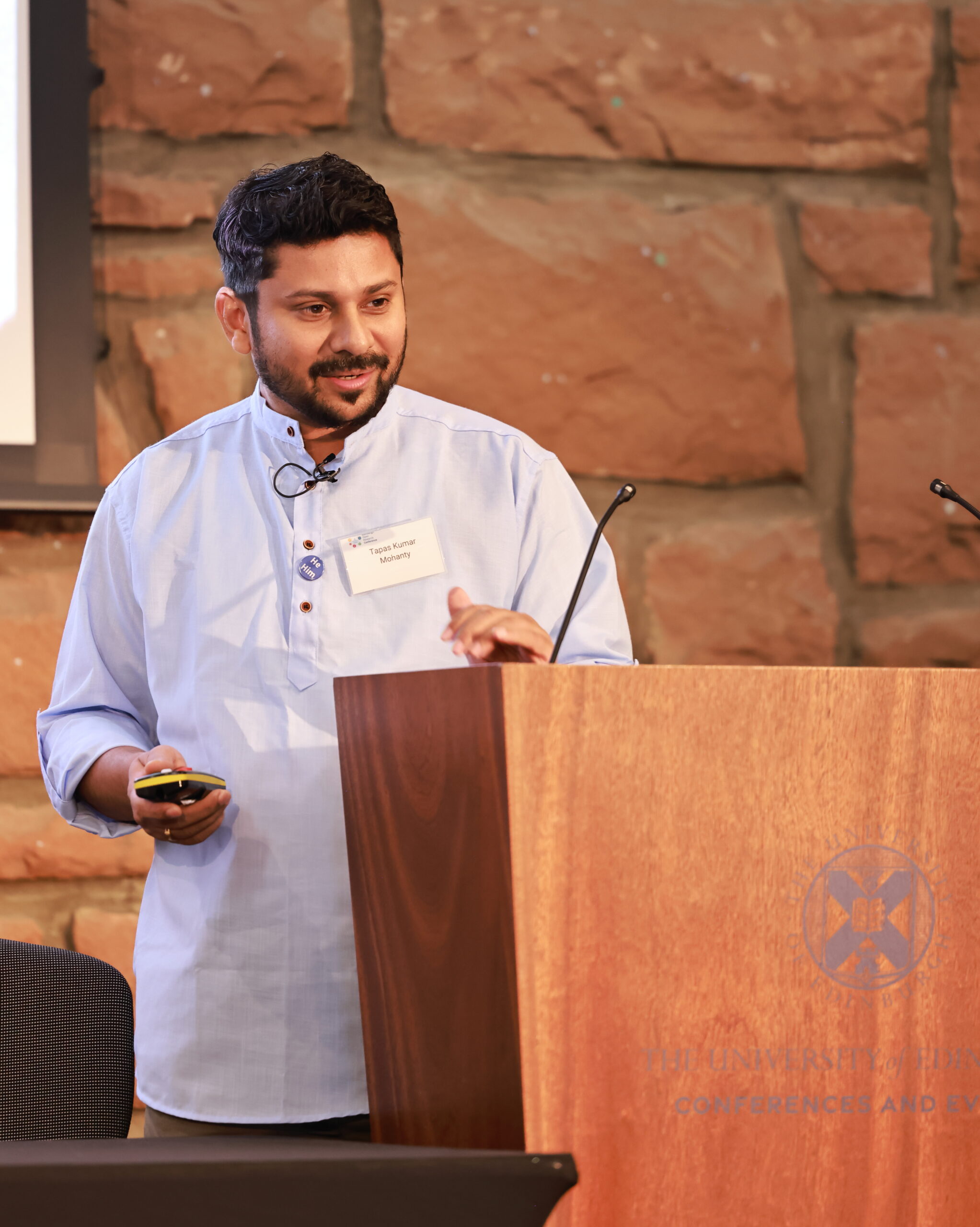
Tapas Kumar Mohanty. Photo by Eugen Stoica.
For me, the day highlighted the benefits of including a patchwork of voices in discussions around open research. Hearing personal stories and case studies alongside quantitative methods and formal analysis provided great insight into the state of Open Research now, the obstacles different research communities face, and ways we can enable people to embrace more open research practices. I left the day with a much clearer picture of where we are along the path of progress and where we should go next.
Thank you to all our speakers, our staff volunteers, and everyone who attended. A huge thanks to Kerry Miller and Nel Coleman, who pulled it all off without a hitch!
You can find all this year’s sessions as videos on MediaHopper: https://media.ed.ac.uk/channel/Edinburgh+Open+Research/259602172
To read more about Edinburgh Open Research and sign up for the newsletter, where we’ll notify you about future events: https://library.ed.ac.uk/research-support/open-research
To read more about Edinburgh ReproducibiliTea and Open Research Initiative: https://library.ed.ac.uk/research-support/open-research/reproducibilitea-eori
Evelyn Williams
Research Data Support Assistant
Research Data Service
Fieldwork Internship Journey
Written by Katie Shepherd
As the RESP continue to add to their collection of oral history archival material, Ailsa and I were commissioned as fieldwork interns to conduct interviews with a community group based at the John Gray Centre in Haddington. Our internship project intended to record a series of interviews with the ambition of producing a publication based on the audio recordings content.
The last six months has been a whirlwind of interviews, writing, editing, and of course, lots of meetings over tea and coffee. As the internship draws to a close, I thought it would be a good time to reflect on the goals we have surpassed since November 2024 and the processes involved in an oral ethnography project.

One of many meetings over coffee!
Ailsa and I developed a skeleton plan for the publication but were encouraged be flexible in our approach, so the interviewees felt able to discuss their own interests. With this guidance, we decided to theme the interviews around ‘working life’ – a broad topic that allowed participants to speak about their careers and industries, social lives in and out of work, alternative streams of income and even unpaid labour.
Having been prompted to consider possible outputs for the recording content, Ailsa and I decided on creating a publication similar to Jumpers for Goalposts – the publication created by the group in 2016 – in its structure but also to create some digital content to increase accessibility and awareness of the project. This hybrid approach has proved successful so far, as the publication gives the group members a tangible product of their interviews, and their relationships, but the digital products are engaging to a wider audience through social media, web pages and in person presentations.
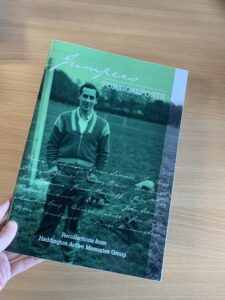
Jumpers for Goalposts, the groups first publication (2017).
After an initial few weeks of planning in the office at the Centre for Research Collections, Ailsa and I’s first meeting with the group occurred at their Christmas party which involved a competitive quiz and plenty of refreshments. This informal introduction set the tone for what was to be an extremely fruitful series of interviews that are vernacular and informative, and at times emotional and poignant as memories left untouched for years are rekindled.
January involved a fieldwork training session from the EERC’s senior research fellow Mark Mulhern, prepping us for the following weeks of interviews. Between late January and early March Ailsa and I interviewed 12 group members – with some assistance from Caroline Milligan and Ruth Fyfe, who interviewed group members who reside in a local care home – mostly at the John Gray Centre in Haddington, although one or two took place on university grounds. Alternating roles as sound technician/active listener and interviewer, Ailsa and I efficiently curated over 14 hours of interview recordings.

Vikkie, Dick, Ailsa and Katie (left to right) looking at some photographs provided by Vikkie and Dick.
Much of March was absorbed by the task of reviewing interviews, taking notes and transcribing passages for potential use in the publication, and organising this information on a thematic basis. Inputting interview quotations and time stamps into a spreadsheet accelerated this process and although it was an – unexpectedly – intensive task, it deepened our understanding of the groups individual and collective histories and allowed us to more accurately represent their spoken testimonies in prose.
Pic of spreadsheet/planning (no GDPR breaches :D)
In due course, Ailsa and I began to write the main body of the publication by splitting the book into seven chapters: Careers and Industries, Politics, International Interactions, Sporting Life, Social Life and Festivities, Family, and Reflections on Change and Continuity. Entrusted by the group members to interpret their oral reflections into the written word was an honour, and a responsibility that I took seriously. I enjoy this part of the internship immensely; watching the group’s memories unfold and intertwine in the book as it was written was enthralling.
During this time, I led team liaisons with internal and external colleagues from RESP, East Lothian Council and an independent designer commissioned to create the publication. As the group had already been involved in the publication Jumpers for Goalposts, we wanted All in a Day’s Work to feel like another instalment in the same series, thus we worked with the same designer and used a similar design. Ailsa also got to work on creating a short film with snippets of the interviews to showcase some excerpts spoken by the group themselves – you can watch that here.
The editorial process was another rigorous stage; one that I undertook with enthusiasm powered by a desire to acquire copy-editing and proofreading skills. After completing a first draft, Caroline and Lesley reviewed the content and suggested edits on a hard copy. I then implemented the majority of these edits into the digital copy, further tweaking, correcting and re-writing as I went. Issues of style and consistency are inevitable in a co-authored book, and by compiling a style sheet with all discrepancies, I worked through this with Caroline to ensure the book read in a cohesive and accessible manner. The nature of oral ethnography requires a specific ‘editing voice’ to balance the readers comprehension while staying as close to the spoken word as possible.
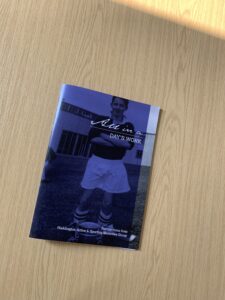
A sneak-preview of All in a Day’s Work!
At the time of writing (28th of May 2025), All in a Day’s Work, the fruits of this rapid, fantastic internship, is due to be launched next week. The publication will first be presented to the Haddington Active Memories and Sporting Memories Groups at their meeting on the 3rd of June, and then to staff at the Centre for Research Collections later that afternoon.
Watch official RESP channels for digital copies of the book and more!
Digitising the Bulletin
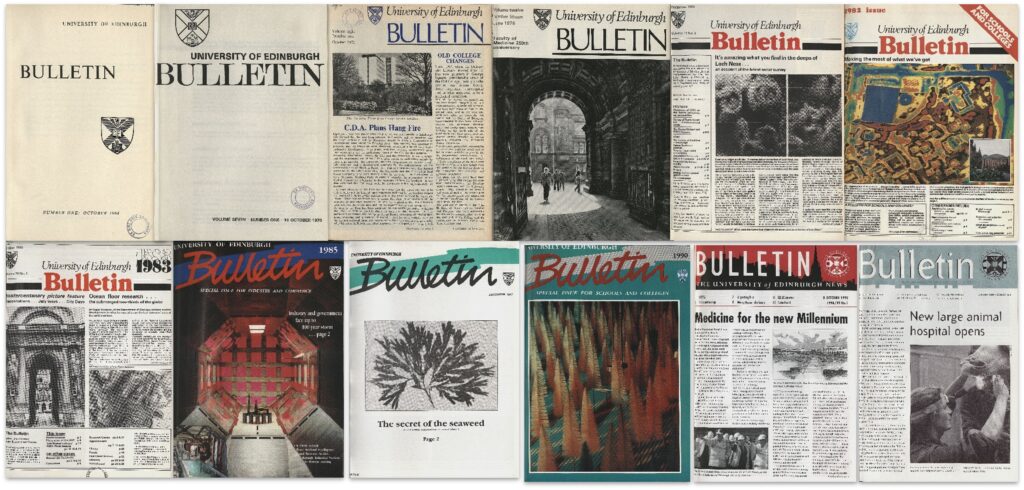
“The University of Edinburgh Bulletin (EUA IN1/PUB/4) is the institution’s internal magazine, covering news from around the University. It was established in 1964, succeeding the University of Edinburgh Gazette which had been running since 1952. Since 2009, it has been available in digital form and is now a wholly digital publication.” Grant Buttars, University Records Archivist
Protecting University Repositories from Aggressive Web Scraping – Using Database Rights to Retain Control Over Academic Content
Universities have long served as custodians of knowledge, investing heavily in infrastructure that ensures research outputs are preserved, discoverable, and freely available to all. Institutional repositories, designed to host open access publications, embody this ethos. They support transparency, reproducibility, and public accountability in science and scholarship. But today, that infrastructure is under silent siege.
The rapid growth of generative AI and large language models (LLMs) has created insatiable demand for high-quality text data. Academic repositories – open by design and rich in peer-reviewed research – have become prime targets for automated scraping by commercial actors. These entities often extract content at scale without permission, transparency, or attribution, repurposing it for proprietary model training. This phenomenon undermines the ethical foundations of open access and leaves repository managers in an impossible position: maintain openness, or protect against exploitation?
At the University of Edinburgh, this dilemma has become tangible. Automated scraping activity has been detected targeting DSpace-hosted repositories, while similar content on the Elsevier-managed Pure platform has seen no such traffic. The likely explanation lies in technical and legal asymmetry: commercial platforms benefit from robust infrastructure, gated access, and formal licence agreements, whereas open-source systems tend to lack such safeguards. As a result, repositories maintained by public institutions – those most committed to the ideals of open science – are paradoxically the most vulnerable to abuse.
This blog post proposes a legally grounded, technically feasible solution to this challenge. By asserting database rights – an often-overlooked intellectual property tool under UK and EU law – universities can regain agency over the reuse of their repository content. Importantly, this strategy does not undermine openness for legitimate scholarly users. Rather, it introduces enforceable conditions that deter commercial exploitation, demand accountability, and promote ethical reuse.
The Limits of Copyright
Many institutions assume that copyright will provide sufficient protection against unauthorised scraping. In practice, this is a misconception. UK law permits non-commercial text and data mining under Section 29A of the Copyright, Designs and Patents Act 1988. This exception allows users to mine copyright-protected works without needing a licence, provided the purpose is non-commercial research and the user has lawful access. Contractual terms attempting to override this exception are unenforceable.
Yet most web scraping for AI training is not non-commercial research. It is often undertaken by commercial entities with minimal transparency and no academic oversight. Still, enforcement is difficult. Many repositories host works under open licences – typically Creative Commons – that explicitly allow reuse. Furthermore, universities frequently do not own the copyright in deposited articles, especially if authors have signed publishing agreements assigning rights to third parties. In such cases, institutions cannot lawfully impose additional restrictions.
Compounding the problem is jurisdiction. Scraping bots often originate outside the UK or EU, complicating enforcement of domestic copyright law. Even where copyright is potentially infringed, pursuing action requires a claimant with legal standing – typically the copyright holder – and a clear, attributable violation.
All of this makes copyright, while important, an unreliable instrument for protecting repository infrastructure from automated harvesting. Universities need a different legal lever – one rooted not in the authorship of individual works, but in the stewardship of the repository as a curated dataset.
Database Right: A Strategic Opportunity
Under UK and EU law, creators of databases enjoy a sui generis “database right” if they make a substantial investment in obtaining, verifying, or presenting the contents. This right protects the structure and contents of the database, regardless of whether the individual items are themselves protected by copyright.
Institutional repositories almost certainly qualify. Universities dedicate significant staff time and technical resources to the ingest, verification, metadata creation, and ongoing maintenance of their repositories. These systems are curated with care, often over decades, and represent a considerable investment in public infrastructure. Accordingly, universities are well-positioned to assert database rights over their institutional repositories.
This right is powerful for several reasons. First, it is separate from copyright and not subject to the non-commercial TDM exception. Second, it allows rights holders to impose access conditions, including click-through licences, as a prerequisite for reuse. Third, infringement occurs not at the level of individual documents, but through the extraction or reuse of a substantial part of the database. This makes enforcement more practical against actors engaging in large-scale scraping.
Database right thus offers universities a new legal basis for governing access, especially by commercial AI developers. When paired with licensing, metadata, and technical safeguards, it can form the backbone of an ethical and enforceable access framework.
A Practical and Ethical Framework
To make this legal strategy operational, institutions must adopt a layered approach. The first step is to formally assert their database rights. This can be done through policy statements on repository homepages, in metadata schemas, and within publicly available documentation. Such declarations do not create rights but affirm existing ones and signal intent to enforce them.
Next, universities should introduce access licences. These agreements, ideally implemented as click-through terms or API conditions, should specify acceptable uses. For instance, they might permit free reading and non-commercial research, while requiring separate permission for AI training or other commercial uses. Critically, these licences should reference the university’s database right and clarify that unauthorised mass reuse constitutes infringement.
To ensure that licences are understood and respected by automated agents, metadata must be made machine-readable. Standards such as schema.org, Dublin Core, or SPDX can be adapted for this purpose, enabling bots to detect and interpret the terms of access. This will counter claims of ignorance and strengthens institutions’ legal position in the event of disputes.
Technical deterrents are also essential. Rate limiting, IP monitoring, CAPTCHA, and token-based authentication can reduce the feasibility of mass harvesting without affecting genuine users. Providing structured API access – with terms of use, authentication keys, and logging – offers a controlled alternative for those with legitimate research needs.
Finally, universities should collaborate. A shared registry of rights-asserted repositories, standardised licence taxonomies, and coordinated enforcement mechanisms would amplify impact. Just as Crossref and ORCID have transformed scholarly metadata, a collective infrastructure for licensing and access governance could fortify the open research ecosystem.
AI Training and Open Content: What Can Be Licensed and for What Purposes?
Enabling access to repository content for commercial AI training is complex – but not beyond reach. The key is ensuring that any such use is lawful, ethical, and based on valid permission. Institutions should assess their legal position carefully and decide if this route is appropriate in their particular context.
Under UK law, the text and data mining (TDM) exception apply only to non-commercial research. Commercial AI training by for-profit developers falls outside this scope and therefore requires a separate licence. However, most universities do not hold the copyright in the scholarly works deposited in their repositories – rights typically remain with authors or publishers. This means institutions cannot authorise commercial reuse, including for AI training, unless they control the rights or have obtained explicit permission. In practice, securing such permissions is often unfeasible, especially where publishers may have existing deals with generative AI companies.
That said, two categories of content remain viable: (1) works for which the university holds the copyright – such as internal reports, policy documents, certain funded project outputs, or staff-authored works created in the course of employment – and (2) works made available under open licences, particularly Creative Commons Attribution (CC BY).
On 15 May 2025, Creative Commons published updated guidance confirming that CC BY–licensed works may be used for AI training, provided copyright law permits it and proper attribution is given. Attribution can be fulfilled by linking to datasets or using retrieval-augmented generation (RAG) technologies that surface original sources – now widely implemented in commercial AI tools.
More restrictive licences present limitations. CC ND prohibits derivative uses and is generally incompatible with training. CC NC and CC SA may permit training, but only under specific conditions that could prove difficult to operationalise at scale.
This could be a potential foundation for developing responsibly licensed, cleverly advertised AI-ready datasets – particularly in collaboration with other institutions. As open licensing continues to grow under rights retention and policy incentives, so too does the opportunity to shape ethical, transparent models for AI engagement that preserve academic values while enabling innovation.
Looking ahead, it is not inconceivable that UK universities – facing mounting financial pressure and increasing demands for accountability – may reconsider their long-standing policy of waiving copyright claims over scholarly works authored by employees. While this deference has supported academic freedom and ease of publication, it has also enabled publishers to assert broad rights over publicly funded research, often through exclusive contracts. With the rise of commercial AI training as yet another form of value extraction, institutions may begin to question the logic of handing over copyright – only to see content monetised again and again, through publishing fees, access charges, and now data licensing for machine learning. A policy shift asserting institutional copyright ownership, at least in specific contexts such as AI training, could allow universities to retain a stake in the downstream use of the knowledge they fund, support, and steward. Such a move would not be without controversy, but it would reflect a growing awareness that the current model may no longer serve the interests of researchers, institutions, or the public they aim to benefit.
Strategic Alignment and Future Readiness
This legal and technical approach aligns with broader national and international goals. The UK Government’s National Data Strategy, the proposed National Research Data Cloud, and the Department for Science, Innovation and Technology’s recent policy statements all emphasise the need for trusted data custodianship. Similarly, the UNESCO Recommendation on Open Science and EU initiatives like the Data Governance Act highlight the importance of legal clarity and ethical stewardship in digital research environments.
By asserting database rights, universities can position themselves as active participants in these agendas. They can help shape how AI interacts with scholarship, build public trust, and defend the principles of openness without becoming passive data sources for opaque commercial systems.
Perhaps most importantly, this strategy requires no legislative change. The legal tools already exist. What is needed is awareness, coordination, and the political will to use them.
Conclusion
The open access movement was built on generosity, cooperation, and a belief in the public value of knowledge. But generosity without boundaries invites exploitation. As AI systems grow more powerful and data-hungry, universities must act to protect their repositories – not by locking them down, but by making access conditional, transparent, and fair.
Database right provides a powerful foundation for this effort. It allows universities to assert ownership of their repository infrastructure, impose access conditions, and take meaningful action against unauthorised mass reuse. When paired with technical safeguards and collaborative licensing models, it offers a path to resilient, ethical, and sustainable open access.
This is not a rejection of AI or innovation. It is a call to define the terms under which academic knowledge is used in machine learning systems. With care, clarity, and coordination, universities can uphold their values while embracing the future – on their own terms.
Collections
 Love, Loss, and Literature: Cataloguing the Papers of Irene Jessie Young
My name is Nancy Britten, and I’m in my fourth year of studying History at...
Hill and Adamson Collection: an insight into Edinburgh’s past
My name is Phoebe Kirkland, I am an MSc East Asian Studies student, and for...
Love, Loss, and Literature: Cataloguing the Papers of Irene Jessie Young
My name is Nancy Britten, and I’m in my fourth year of studying History at...
Hill and Adamson Collection: an insight into Edinburgh’s past
My name is Phoebe Kirkland, I am an MSc East Asian Studies student, and for...

Projects
Cataloguing the private papers of Archibald Hunter Campbell: A Journey Through Correspondence
My name is Pauline Vincent, I am a student in my last year of a...
Archival Provenance Research Project: Lishan’s Experience
Presentation My name is Lishan Zou, I am a fourth year History and Politics student....