Home University of Edinburgh Library Essentials
May 10, 2026
Students’ wellbeing and ways to escape exam

Study spaces in the Veterinary Library by Zofia Matuszczyk
Yes, exams are important. We know. But we also want you to remember that at the end of the day, it is your wellbeing that is the most important.
We all know how stressful exams can be and how they can negatively affect our wellbeing. As the Library, we try not only to support you in learning but also to support your wellbeing, especially at these times. Thus, we’ve put together some resources from the Library that you might find helpful when trying to escape your exams for a moment, get some well-deserved rest and gain the energy and strength to continue with your revisions and exams.
Listen to music
Did you know the Library offers you access to databases that allow you to listen to millions of songs from pop and rock to classical music? You can check them out here.
Visit our museum and art collections
While it’s not always possible to physically visit a museum or gallery, you can still do a lot of exploring of the University collections online. If you, however, have some time to physically go somewhere, we also recommend the National Museum of Scotland or the Scottish National Gallery. Both are free and within the walking distance of George Square! Remember that to visit Scottish National Gallery, you must book a ticket beforehand.
Enjoy a film or drama performance
You can access a wide range of TV programmes, documentaries, films, drama, and theatre performances through the Library. Check out what Box of Broadcasts (BoB) has to offer!
Read some fiction
Reading may be the perfect escape from your exams. Our databases give you access to millions of positions!
Meditate
Meditation is one of the best ways to relax. Have you tried mindfulness or spiritual meditation? Maybe now is the time to do so!
And if you feel stressed because you cannot get a seat in the main library, make sure to check out the additional study spaces available.
Zofia Matuszczyk
Communications Officer Intern
Project Reboot!
The last few years has seen us all face challenges and embrace change – and the Charles Lyell Project is no different. The Project has said farewell to Elaine and Elise – and we thank them both for all their efforts and wish them well. We also need to thank existing University of Edinburgh, CRC and Digital Library staff for keeping the aims and objectives alive – and we can report that there’s been significant progress on recruitment, funding, digitisation, and, in conservation.
So – more blogs are GO!
Starting with conservation, we are delighted to signpost you to two brilliant blogs, detailing the work of the fantastic Interns who have been working on the Lyell papers and specimens.
Supported by Project Conservator Claire (her blog forthcoming) their light but expert touch has greatly enhanced the health and well-being of the collection. Find out more here:
Righting Letters – Conserving the Lyell Collection | To Protect and (Con)serve (ed.ac.uk)
and
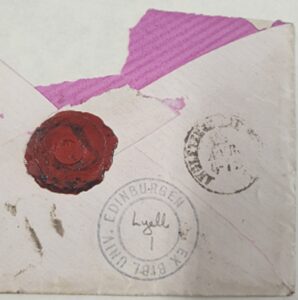
Reverse of an envelope addressed to Charles Lyell, part of the Acceptance in Lieu deposit. Photograph taken by Sarah McLean.
Homes for Rocks – Rehousing the Lyell Geological Specimen Collection
Today we have the first installment of a two-part series from Joanne Fulton. Joanne is here on an 8-week internship funded by the John R. Murray Charitable Trust to help with the conservation of the collection of Sir Charles Lyell (1797 – 1875).
It is a privilege to handle objects that have been worked on by people in the past, to experience the connection and witness their working and learning processes. Therefore, it has been a fascinating opportunity to work on the rehousing of the Lyell Geological Specimen Collection which consists of various specimens from flint implements and axe heads, to shells and raindrop traces.
As previously outlined in these blogs, Sir Charles Lyell (1797-1875) was a hugely significant scientific figure in the 19th century. Amongst others, Lyell corresponded and was a close friend of another well known figure, Charles Darwin, a name closely linked to a number of the shell specimens within the collection I’m rehousing.
These specimens were collected or given to Charles Lyell on his many geological excursions. They were then used to inform his geological research, and they continue to inform learning and research within the University of Edinburgh today. When observing the many documents in the Lyell collection, I’ve found drawings of the same specimens I’m rehousing, illustrated by Lyell in his papers and notebooks.
In the first week I calculated I should be aiming to complete at least 5 objects per day to finish within the 8 weeks of my internship, as I had to bear in mind that within the 168 objects to be rehoused there are groups of items – here I’m largely referring to the shells – that make up a single object. However, as I reach the end of week 4, I’ve found I’m now completing over 10 a day due to more efficient preparation.
The materials I have been using to rehouse the specimens includes card tray compartments and plastazote, a type of foam used in archival repackaging. I have several sizes of trays, however there are 6 specimens which are too large for the largest of trays and need their own custom boxes. I’ve made these myself with card and corrugated card.
My process for rehousing a specimen begins having prepared the tray and two layers of plastazote to fit within. I then cut into the plastazote as appropriate to the rock. Using a white pencil I mark out where I need to cut through the top layer of plastazote, and then using a sharp scalpel, I carve into the thicker bottom layer. This carving is continued until the specimen sits tight and will continue to do so in the future when the specimens are returned to their storage.
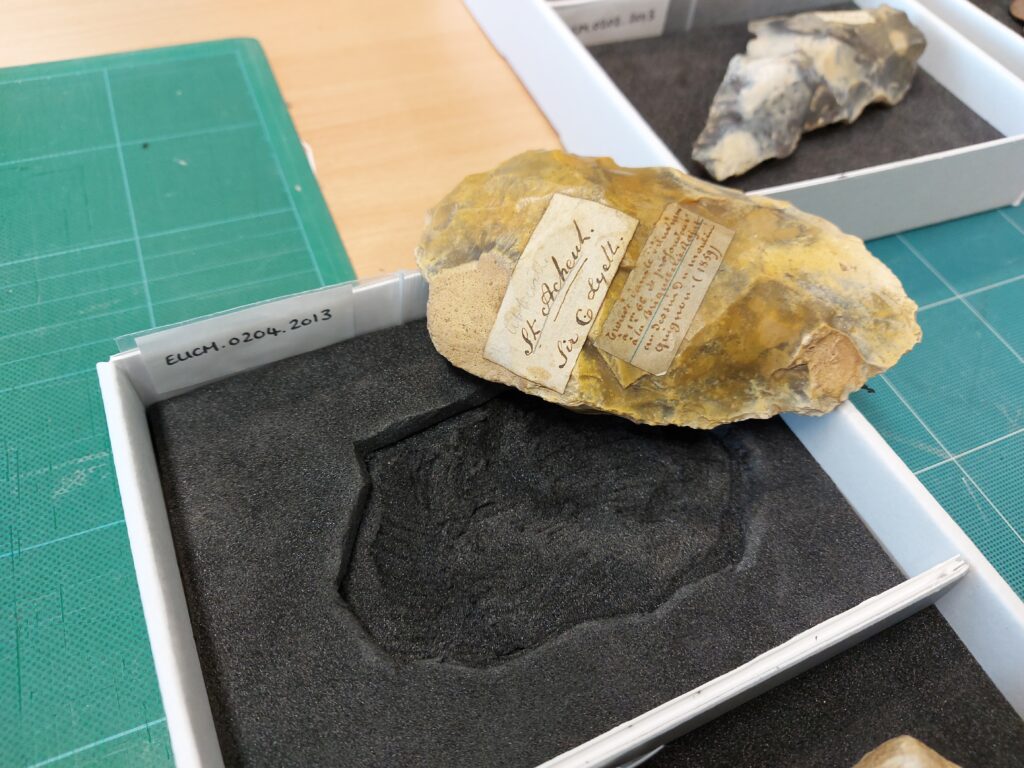
A sharp scalpel is needed to create a neatly cut support for each specimen (EUCM.0204.2013)
All this cutting creates a lot of off-cuts from the plastazote. Rather than wasting them, I shall be reusing them as padding for a Tyvek book cushion in order to make my project more sustainable.
Previous to my rehousing, some of the rocks were held in small green trays of a standard size, often not suited to the actual size of the specimens and offering no added protection. The shells, which I shall be rehousing next week, are in small red boxes.
Included with many of the specimens are extra notes and labels of various origins – some of Lyell’s own handwriting – which also need to be housed with the object as part of their history. When this is the case, I create a third layer of plastazote to house this paper note slipped in a melinex sleeve, carving a little recess for it to sit flat. I then attach cotton tape to the middle layer so the user can lift the object to see the paper note when needed.
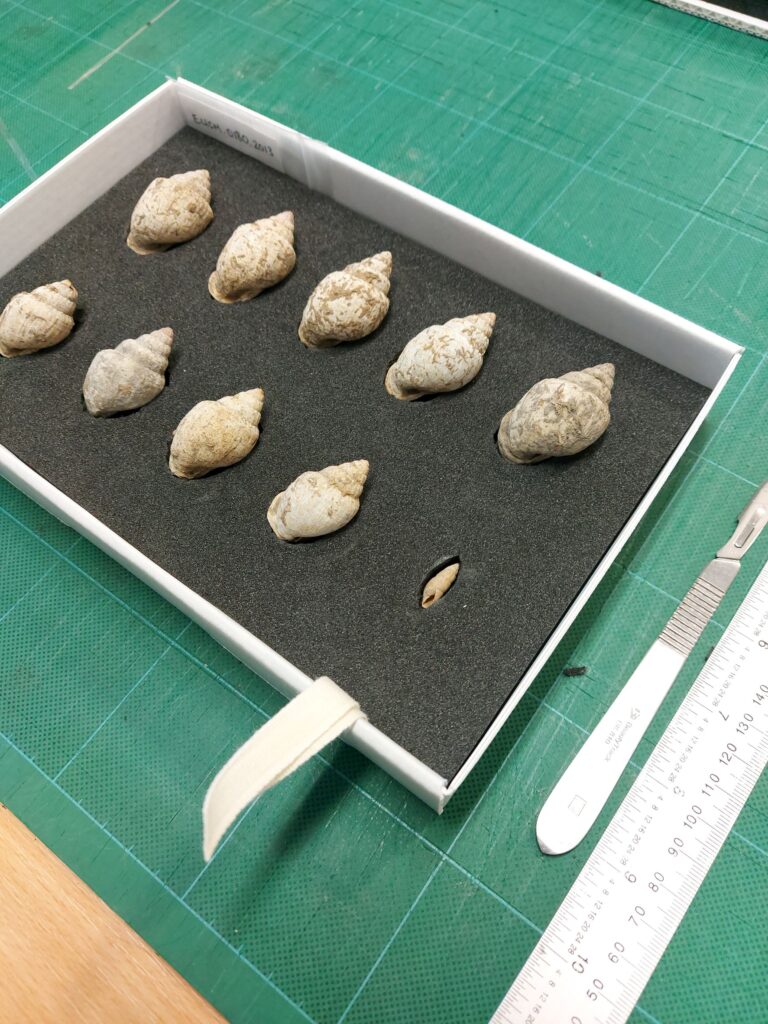
Shells after rehousing: A note stating these shells were collected by Darwin is stored underneath (EUCM.0180.2013)
The majority of these specimens are in good condition – they are rocks and so robust by their composition- the labels, many handwritten by Lyell, and other attachments to the object are less so. Many are in need of repair having suffered losses, crumpling, and have become detached from the specimen. This is a problem I shall be tackling in the second half of my internship; repairing the tears and losses, as well as reattaching the labels with an adhesive.
There have also been a few messy surprises and oddities in the collection, with one rock having a large amount of white tack attached, unfortunately this was also stuck to the rock’s labels. This white tack was removed, and the same tack was used to remove the tiny amounts left in the small crevices on the rock surface. I carefully removed the labels from the rock and the tack, removing the unwanted and potentially damaging tack mechanically from the paper labels.
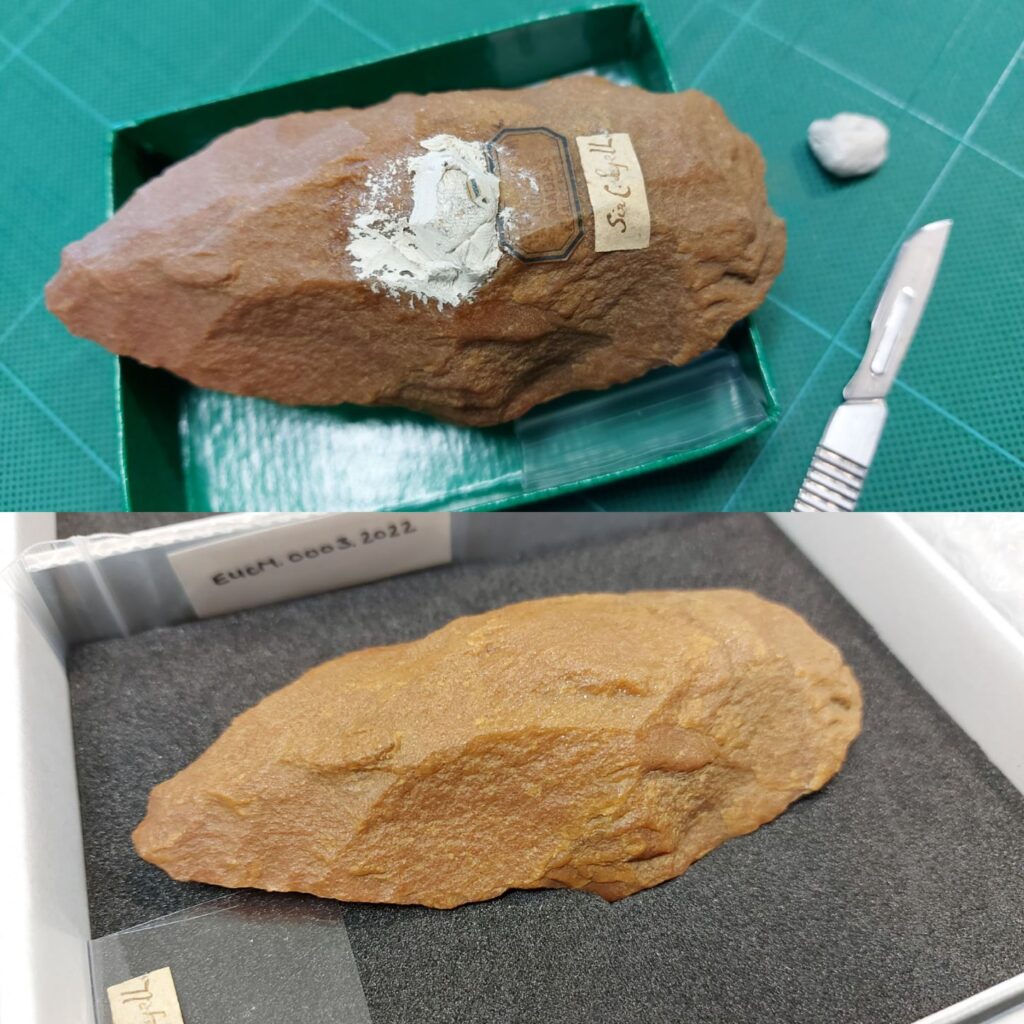
Photo during and after removing white tack from one of the specimens (EUCM.0003.2013)
Having recently graduated from the paper conservation course at Northumbria University, its been a rich learning curve working with objects such as the geological specimens. In my second blog, I plan to examine the method of reattaching the loose labels to the specimens as well as the finalisation of the rehousing within the second half of my internship.
Disability Studies: A New Subject Guide
The Subject Guides are a useful tool in getting started with your research. Whether you’re an Engineer or a Classicist, they contain a wealth of information for navigating library resources, including journals, databases, and bibliographies, available to students here at the University of Edinburgh. Part of my role as Digital Engagement Intern involves reviewing and creating guides within the remit of Equity, Diversity, and Inclusion, and I’m delighted to share our newest Subject Guide in Disability Studies.
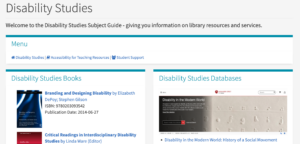
This guide has been created to both assist students in the academic study of Disability and highlight ways the University can support you with any additional learning needs you might have. We’ve included access information for students using the Main Library, advice on how to make your device more accessible, and details of several groups and societies for students to get involved with. As well as supporting students, we’ve also included various materials to assist staff in creating more accessible learning environments, signposting additional training and resources available at the University.
We hope that this guide will serve as a helpful tool for students and staff to access the support that’s available by bringing these resources together in one guide that will continue to grow over time. If you have any feedback or suggestions on ways this guide can be improved, then we would love to hear from you!
You can access the Disability Studies Subject Guide to clicking on the link or navigating to the webpage at the following URL: https://edinburgh-uk.libguides.com/disabilitystudies.
Tristan Craig
Digital Engagement Intern (Equity, Diversity and Inclusion)
The Skene Album – An artistic partnership between author and artist

Collection: Walter Scott Image Collection; Persons: Scott, Walter; Event: N/A; Place: Scotland; UK; Category: Art; Description:
James Skene was a close friend of one of Scotland’s greatest and most influential writers. By profession he was a lawyer, but he was also a keen amateur artist. Skene and Scott first met as fellow Advocates at the Scottish Bar and were brought together by their common love of German literature. They were subsequently joint co-founders of the Light Horse Regiment and the pair formed a close friendship.
This particular album appears to have fallen into obscurity over the years, as it had been in private collections and out of public view. Skene made these sketches for Scott to use as a reference or aide-memoire when writing his novels. Knowledge of its existence does not appear in any research or exhibitions relating to Scott or Skene. We were very fortunate to have this new acquisition and it was a pleasure to personally handle this beautiful album and see every drawing up close.
On trial: Research Methods Primary Sources
I’m happy to let you know that the Library currently has trial access to Research Methods Primary Sources from Adam Matthew. This new resource is an online learning tool for primary source literacy that can be used in classroom-based and online teaching, as well as for independent study.
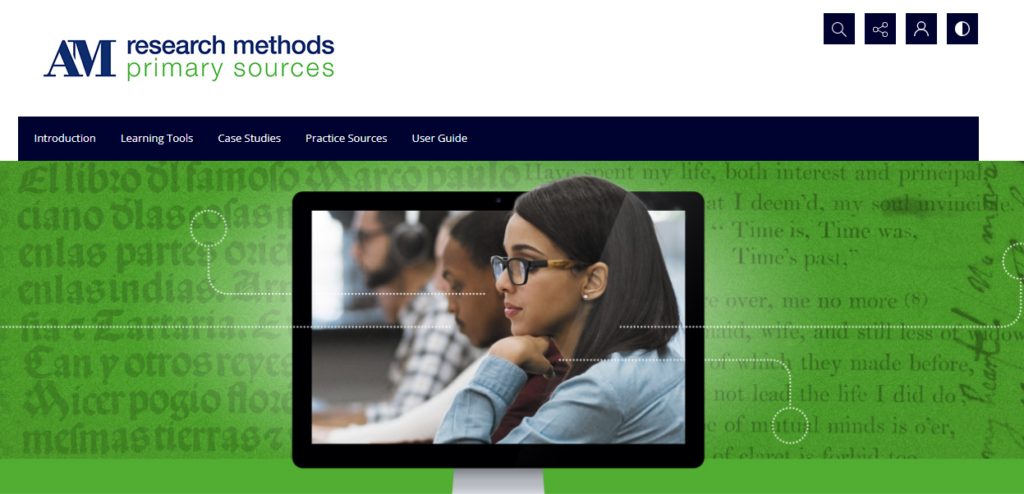
You can access Research Methods Primary Sources for an extended period via the E-resources trials page. Access is available on and off-campus.
Trial access ends 16th June 2022. Read More
Getting resources not available in the Law Library Collections
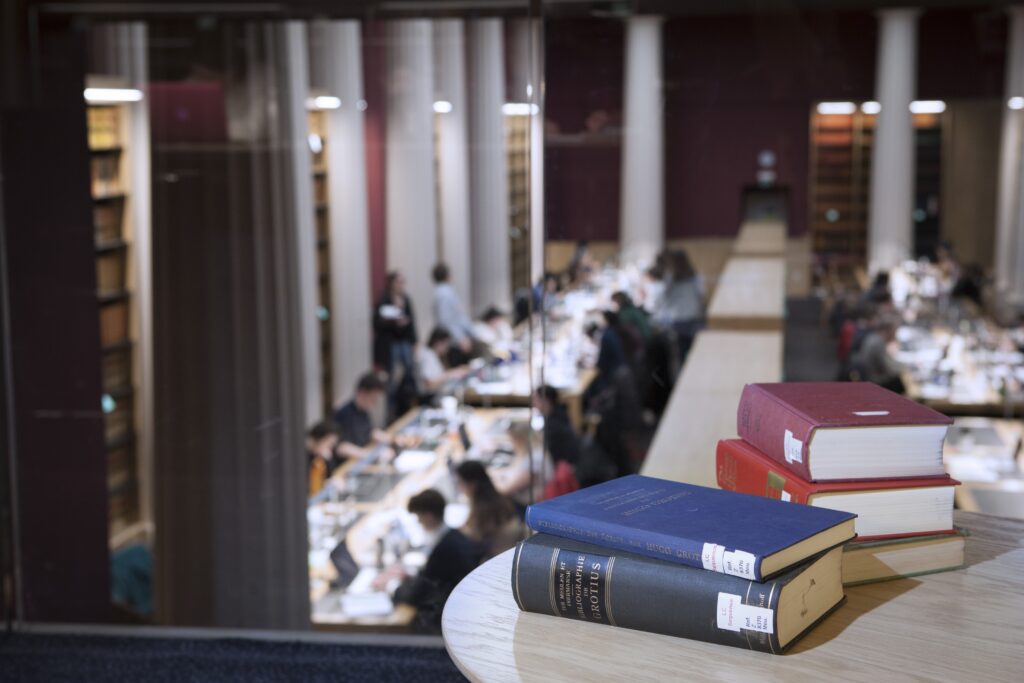
Books stacked on a table on the Law Library mezzanine. Photo by Sam Stills, copyright University of Edinburgh.
We often get asked by students how they get access to a particular item that we do not have in the Law Library collection. So here are a few ideas about how and where to get access!
Online or in print?
Some items are available both online and in print, others are only available in one format. It is worthwhile searching to see if the item is available in another format.
It’s useful to check on the databases (especially Westlaw, Lexis and HeinOnline) to see if we have online access. Although some material from these databases is added to DiscoverEd- not everything is!
Some print copies of key texts are in other libraries across the university (as well as the law library) so it may be that the item you want is available in another location.
- For items outside the central area you can place a hold and collect them centrally.
- For items held in the central area you need to visit the holding library and borrow from there.
We do not add all print journal article details to DiscoverEd, so if you cannot find the article online then it’s worthwhile looking to see if we hold the print journal.
Scan and Deliver
If you cannot come on to campus (you are studying online or perhaps self-isolating) then you can request a scan of a book chapter or journal article be emailed to you. There are limits (due to copyright law and if it has been requested previously) but the service has been well used during lockdown periods.
The library does not post out books to users, so if you want a full print book you would need to come in and borrow the item. Full detail of the service are at:
Interlibrary loans
Interlibrary loans (ILLs) are where you request an item and we see if we can borrow it on your behalf from a partner library. On campus students can request journal articles and book chapter scans and also print books (which will be collectable from a campus library). Online students can request book chapter scans and journal articles.
For journal articles and book chapters we request a scan and send it via email. There is a limit per academic year about how many you can request, but usually the amount is sufficient. The library does not post out books to users. Full detail are at:
Borrowing locally from another library
If you are living in/near Edinburgh then joining the National Library of Scotland might be an option. The National Library has access to the Advocates Library collection, which is an extensive legal collection. Full details of how to join are at:
Requesting a purchase for the library
Students can request that the Library purchases an book for research or study. The Request a Book scheme (RaB) has been running for several years and the majority of the items requested have been purchased. Library staff may get back in touch with questions or suggestions depending on the item and the cost, but more often than not items are purchased. Full details are at:
If there is a journal that you think the library should get then contact us on law.librarian@ed.ac.uk to chat it over.
More details on each of these services and more are available on the Library webpages:

Dissertation Festival from the student perspective
Dissertation. A word that scares and confuses many students, including me. It seems like a difficult and mysterious concept that most of us must deal with at some point on our academic journey. I have been wondering for a long time if there is any way I can make the whole experience of writing it at least a bit easier and less scary. I must admit that this year’s dissertation festival has provided me with a lot of tools and information to do just that.
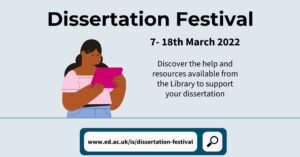
During the dissertation festival, I attended three sessions: Introduction to reference managers, Improve your research skills with SAGE Research Methods, and DataLiteracy for Beginners. They were all very informative, both for students currently writing their dissertation, but also for students like me, who are only beginning to think about their dissertation now.
The first event was an overview of four reference managers. I really enjoyed the fact that the presentation did not only cover one reference manager but as many as four. This gave me a chance to get a feel of all of them and choose my favourite one (which, I must admit, has got to be EndNote). The second event covered SAGE Research Methods database, which I was not aware of before, yet I found it to be a very useful resource. The last event I attended emphasized the importance of critical thinking while dealing with various kinds of information, especially the statistics part of it.
I enjoyed all the events a lot! The only thing I would change about these, would it be their form. I prefer to attend in-person events, especially after covid ‘trauma’ that we have all experienced – it would be nice to see all the presenters and attendees offline. But well, one cannot have everything, maybe next time!
Overall, I recommend every student to attend the next edition of the dissertation festival, whether they are in their fourth, third or second year. All events provided me with great tools that I will not only use while writing my dissertation but also other coursework.
Zofia Matuszczyk
Communications Officer Intern
Simon Smith joins the Research Data Support Team
It has been a long pandemic, and some bright spots are beginning to appear on the horizon. One of them is that we have a new professional joining our team, to work with Kerry Miller in the role of Research Data Support Officer – Simon Smith.
The University’s Digital Research Services programme makes it possible to fund this post for the Research Data Service – deemed an essential addition following a period of reduced resource, because of the need to increase outreach, training and awareness, and take-up of services in the light of the new Research Data Management Policy.
 Simon has worked in Research Data Management since 2015, when he joined the Open Research Team at the University of Surrey. He has spent his time helping to develop a range of research data management (RDM) services, implementing two repositories, and learning to love data management planning. He is genuinely interested in issues around data licencing and sensitive/personal data. His teaching and research background is in philosophy, in the service of which he edited a scholarly journal. Now, however, he is slightly obsessed with James Joyce’s Ulysses.
Simon has been in post for nearly 2 weeks, and is keen to meet researchers and their supporters from all corners of the university – please send any and all invitations to come chat about RDM to data-support@ed.ac.uk! We look forward to gaining from Simon’s insights and experience.
Robin Rice & Simon Smith
Library & University Collections
Righting Letters – Conserving the Lyell Collection
Today we have the first installment of a two-part series from Sarah MacLean. Sarah is here on an 8-week internship funded by the NMCT to help with the conservation of the collection of Sir Charles Lyell (1797 – 1875).
As my career in conservation progresses, I find myself drawn most to objects and collections that give insight into the more personal, human aspects of history and heritage. Kings and Queens and famous faces are all very well but I’m more interested in the lives of everyday people – in their passions and machinations, and in how they interacted with the world around them.
Throughout my studies and previous work, I have had ample opportunity to see and conserve this kind of history. Most recently, I worked on the conservation and digitisation of the 1921 Census of England and Wales where I saw first-hand the lives of ordinary people, a snapshot of the nation captured in a single day. And now, as an intern working on the Sir Charles Lyell Collection, I see similar opportunities to preserve and elevate the more unique and personal aspects of the great man’s life.
Sir Charles Lyell (1797 – 1875) was a Scottish geologist and scholar whose discoveries informed a significant shift in our understanding of the Earth and its history. Lyell posited that the geological processes that shaped the Earth are still active in the modern era and through extensive fieldwork, travel, popular lectures, and his best-selling books, he became internationally famous and respected by many scientific communities.
He also corresponded with near-innumerable members of these communities with professional and personal relationships often spanning the entirety of his career in the same way that his precious notebooks do. It is this varied and extensive correspondence that I have been working steadily to conserve and rehouse during my time at the Centre for Research Collections.

A letter from Lyell’s correspondence before and after conservation treatment
This part of the Lyell Collection comprises 22 boxes containing thousands of letters and other documents. Typically, I assess and conserve 1-2 boxes in an average working day and so anticipate completing this work by my 6th week here at the CRC. I re-label each folder of correspondence individually before assessing and conserving its contents as needed. Typically, this work extends to flattening folds and plane distortions, surface cleaning using chemical sponge, undertaking tear repairs, and infilling small lacunae using Remoistenable Tissue (lightweight Japanese paper impregnated with an adhesive that is reactivated with moisture).
My work on the 1921 Census prepared me well for my work on the Lyell correspondence – not only have I built considerable aptitude with my chosen repair material, but I also greatly enjoy the nitty-gritty remedial nature and consistency of the work. However, this consistency and regularity is not to say that the Lyell correspondence has not already yielded some wonderful surprises.
Often, these surprises have come in the form of unique drawings, maps, and other larger format works coloured with an array of aesthetically pleasing pigments. From the coastline of Louisiana to coal deposits in the Scottish Highlands, these works have the potential to tell us not only about Lyell’s working processes and the areas of study he thought most important, but to give greater insight into his personal quirks alongside those of the people with whom he corresponded.

A small drawing showing an erupting volcano illustrating Lyell’s interest in volcanology.
These larger works often pose interesting conservation challenges too. Their scale means that they have been folded to fit their envelopes or other housings and the mechanical stresses this puts on the paper has led in many places to weakness and tears. The repairs that I undertake must not only be neat and visually pleasing but must also be robust enough to withstand handling and consultation as well as the object itself being carefully folded again and returned to its housing.
I have also had the opportunity already during my time at the CRC to tackle Lyell’s collection of geological specimens and discovered a heretofore unknown little example of such a specimen within his correspondence – another pleasant surprise.
Crumpled within a small envelope, I have been unable yet to discover what type of stone these pieces are comprised, but I have been able to rehouse them, encapsulating them in Melinex for the time being so that they can be viewed and consulted without the need for direct handling.

Two small geological samples discovered within an envelope in Lyell’s correspondence.
All the work I have undertaken thus far on the Lyell correspondence has been done with that knowledge that the collection is, at its core, is to be used and learned from. This need for accessibility interests me just as much as the unique and personal stories within Lyell’s correspondence because I believe strongly that the more accessible we are able to make the Lyell Collection and others like it, the greater the impetus will be for such treasures to be preserved and protected in the future.
Collections
 Hill and Adamson Collection: an insight into Edinburgh’s past
My name is Phoebe Kirkland, I am an MSc East Asian Studies student, and for...
Cataloguing the private papers of Archibald Hunter Campbell: A Journey Through Correspondence
My name is Pauline Vincent, I am a student in my last year of a...
Hill and Adamson Collection: an insight into Edinburgh’s past
My name is Phoebe Kirkland, I am an MSc East Asian Studies student, and for...
Cataloguing the private papers of Archibald Hunter Campbell: A Journey Through Correspondence
My name is Pauline Vincent, I am a student in my last year of a...
Projects
Cataloguing the private papers of Archibald Hunter Campbell: A Journey Through Correspondence
My name is Pauline Vincent, I am a student in my last year of a...
Archival Provenance Research Project: Lishan’s Experience
Presentation My name is Lishan Zou, I am a fourth year History and Politics student....