Home University of Edinburgh Library Essentials
April 8, 2026
Digital Humanities at Oxford Summer School
Last month I was lucky enough to attend a week long Summer School in Oxford- and being the week that the heat wave kicked in, it really did feel like a Summer School! The course managed to be both varied and intensive, with large lectures, group workshops, surgeries where specialists would help you with your own project, evening events & even a guided tour of the Ashmolean.
The range of topics covered was staggering, but I think the ones that stuck out for me were Crowd Sourcing, Public Engagement/Knowledge Exchange, Social Media, ‘Openness’ in the Digital Humanities and Measuring Impact. I’d really like to share with you a couple of the wonderful Crowd Sourcing projects:
 Robert Simpson of the Zooniverse team https://www.zooniverse.org/ gave a fascinating talk about the crowd sourcing portal they have developed. What started out as an experiment to see if they could find enough people interested in identifying planets from raw astrophysics data, developed into 17 separate projects across 5 Research fields & around 860,000 people taking part world-wide. Some of the projects include transcribing 2000yr old Papyri, identifying Whale language & mapping Martian weather- not a bad way to spend your lunch break! Robert thought the key to a good Crowd Sourcing project was a subject where human beings can interpret the data better than a computer & a hook that makes people want to be involved- even if it is as simple as the desire to contribute to the worlds knowledge. Zooniverse are great believers in the Open Source community & are happy to share both their knowledge & code.
 While Zooniverse is centred on developing online virtual data, another Crowd Sourcing project started out with a real crowd and analogue objects- Kate Lindsay really bought the Re-Imagining WWI project to life http://www.oucs.ox.ac.uk/ww1lit/ . This started out almost like an Antiques Road Show where the public was invited to bring along their family WW1 history: stories, letters, photo’s & memorabilia. Experts were on hand to look at the items & photographers to document them. In the first 12 weeks it proved so popular that they had 6500 submissions, and led onto an online submission system & further road shows across Europe- the submissions now are well into the tens of thousands.
All in all, the Summer School was an enjoyable & inspiring week which should prove invaluable as we endeavour to develop the potential of our digital archive.
http://digital.humanities.ox.ac.uk/dhoxss/
Susan Pettigrew
(Open) Heaven is a Place on Earth – or How to Get to Utopia Without Really Trying
A guest post from Gareth J Johnson (@llordllama) on the Open Access and Academia Round Table led by Gareth and Dominic Tate on Thursday 1st August. Gareth is a former repository manager and is currently working towards a PhD that is examining issues of culture, influence and power related to open scholarship within UK academia at Nottingham Trent University.
In all the hubbub and hullabaloo of the Repository Fringe about wondrous technological solutions and efforts to bring us to the dawn of a new age of openness in scholarship, we thought it would be worth spending sometime asking the question “So just what would the utopian end point of open access within academia be?” It was, I think you can agree a fairly large question to tackle and one that I don’t think we’ll claim we made conclusive headway in during the 90 minutes. However, as an exercise in attempting to get everyone in the room to step back for a moment from concerns about the REF and having to meet senior institutional management’s expectations, and to consider what the end point of open access would ideally be I think it was a reasonable success.

Brief introductions from those present revealed a constituency comprising mostly repository workers, with a smattering of more technical staff and a publisher or two; which would likely bias the results of the discussions in a certain direction. We started with the precept that the current OA situation in academia couldn’t be perfect, given people’sinterest in attending the session and conference. And at this point asked the first key question:
- What could or would the utopian open access situation in academia look like?
- What is involved?
- Who is involved?
Early suggestions included ensuring that OA was simply built into academics’ natural practice and ensuring that openness in scholarship wasn’t siloed into simply research papers but embraced data, education, sculptures and other expressions of scholarship too. At this point everyone was broken into small groups to discuss these issues.
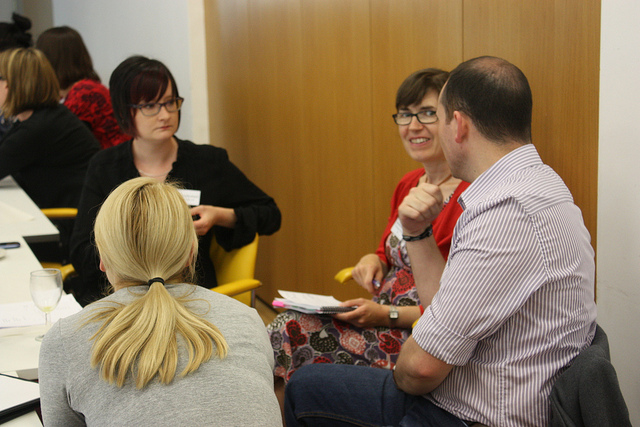
A broad range of ideas came back from the groups, some of which it was noted are potentially mutually interdependent or diametrically opposed. But as we’d said at the start, this was a utopian view where not everything could or would be achieved. Aspirations ranged from the holistic to the specific with desires for open licences, no embargo periods through transparency for Gold OA pricing to XML over PDF as the standard format. Interestingly given the current UK situation and prevalence of Gold OA, there was some considerable desire for transformation of the scholarly dissemination environment too with calls for open peer review or for institutions to take over the management of the same.
Overall thought the discourse from the groups seemed to suggest a sense that OA should become the norm for academia, that it should be so regular and normal as to almost be engaged with without comment. Embedded and invisible in this way calls for research community engagement would likely find near total compliance.
We asked the groups next to consider which of these activities were in their eyes the most significant, and then to go back and think more about the second of our key questions in relation to it.
- How could or would this be achieved?
- What needs to change?
- What needs to stay the same?
- What needs to happen next?
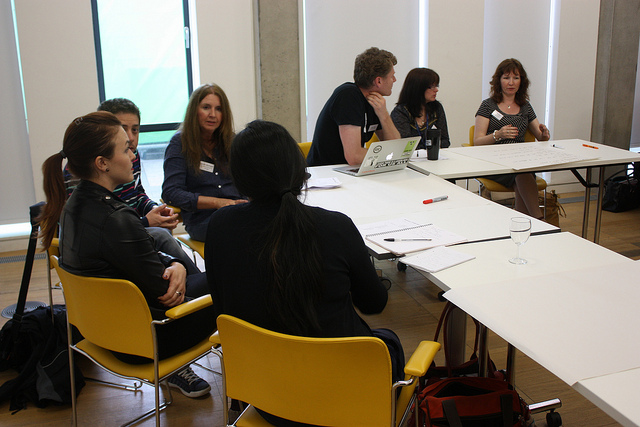
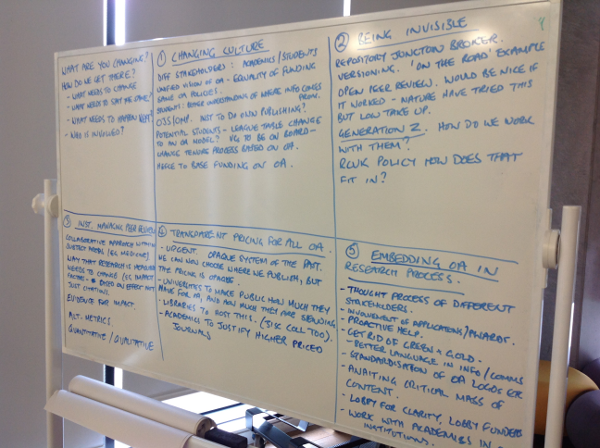
For the record none of the groups picked the same key task (interesting…) which meant we had 5 separate areas of OA utopia to be worked on as follows:
- Changing the culture
- OA achieving invisibility
- Institutional management of peer review
- Transparent pricing for all OA
- Embedding OA in the research process
What follows are some of the main points that came out:
Culture
- Considering the needs of different stakeholders – students and academics – in scholarly discourse and access.
- Same funding and policies for open access for all disciplines.
- Students to have a more embedded understanding of where their research information comes from – thus not just library led training session on information skills.
- Institutions to do their own publication of monographs and journals, thus everyone would have the same level of understanding.
- OA league tables rather than traditional measures of excellence for recruited new students
- VCs need to be on board with OA as it should impact on every decision made at the university.
- Changing internal promotional for academics through greater recognition of OA outputs.
- HEFCE to fund universities equally based on OA and not funding universities based on traditional institutional outputs.
Invisibility
- Repository Junction Broker making harvesting easier from a centralised point.
- Capturing multiple-versions (ala Jack Kérouac ‘s On the Road which existed in multiple forms) as some scholars want to interact and use earlier/later versions of research.
- Open peer review could support OA. Noted the Nature experiment where this was tried and hadn’t really been taken up by the academic community.
- Issues about who does this peer review and if issues of age/generation of academic impacts on this – would Generation Z academics fit more naturally into an open scholarly culture than Gen X and Baby Boomers.
- Are there penalties for failure to comply with RCUK mandate.
Discussion
Suggestion from the other groups that future generations might not want to reach the same goals for OA as the current movement members – might this mean a shift in an hitherto unexpected direction? Should students be consulted about how and where OA should go was another thought.
Managing Peer Review
- Collaborative approach to be taken within disciplines with champions nominated by institutions to take this forward.
- Academics and editors need to continue to maintain their involvement in peer review, to retain rigour and quality
- The way that research outputs are evaluated needs to be revised and changed, seeing that research has an impact beyond academia and that simple citation counts are insufficient judging criteria of excellence alone. Thus embracing of impact evidence, alt-metrics and a rethink of the whole qualitative vs quantitative value of research outputs is needed.
Discussion
A discussion point that Social Sciences/Humanities work less with citation counts and this would help them to be viewed in an “as valuable as” science way by senior faculty and external auditors. There was also a discussion around the time it takes for non-STEM subjects to become recognised as having achieved impact is much longer; although a counterpoint is that some pharmaceutical research only becomes recognised as significant many years after it has been done as well.
Issues around the ability of scholarly dissemination to transformation and evolve through the auspices of OA were examined as well. In particular a point was raised that methods and routes of communication have evolved considerably in the past couple of decades and yet dissemination of scholarship has not kept pace, a point near to this author’s heart in his own current researches. That researchers it was suggested still function within a print mentality in a digital world was suggested as being perpetuated by the way impact is calculated currently.

Transparent Pricing
- A transparent pricing system for OA is very urgent. The past is an opaque system whereby the library spent money but academics were unaware of the levels. Right now is a golden (no pun intended) opportunity to make the cost of scholarly dissemination made transparent, but it seems there continues to be a danger that we will continue to operate in an opaque system.
- Universities should make public how much funding it has for open access, and exactly what the APCs are for each of the publishers that are available for people to publish with.
- JISC Collections should do this as well, with their memberships to say “This is exactly how much the average APC will be”.
- A nationally coordinated database with this information in, so it would be possible to see who has the best deals with publishers in this respect. This is a role it was suggested for libraries, and be the advisory point within the university for publishing in OA, or publishing in full stop.
- Universities should recommend average APCs for each discipline, so it would be possible for authors to see where they were paying over the odds. And where academics went over the limit, they would have to make a case justifying this – thus allowing other options to be presented to them as well, rather than simply publishing irrespective of cost.
- Fears over burning through APC funds at some institutions too quickly. If universities came in under-costs, then this APC funding could be released back to the research funding streams.
Discussion
Some universities present admitted they were going to be as open as they could be about their funding received and expended, although the level of granularity would vary. It was suggested that the RCUK would not be as transparent as individual universities would be in terms of funding levels. The problem though was that the value quoted and the value paid for APCs could vary due to the time between submission and invoice, and fluctuations in publisher policy and currency exchange. It was highlighted that some publishing work-flows drawn up by some universities locked academics in the route of publishing down more expensive gold routes rather than cheaper gold or green options as a matter of policy. However, other universities countered this with a policy that went down the route of achieving funder policy satisfaction without necessarily taking the “easy” APC route.
Embedding OA
- OA should pervade academic thinking at all stages – from teaching 1st Year Undergrads, or information literacy training. Awareness raising and education about scholarly dissemination should be embraced at every opportunity.
- Getting the finance and research office staff educated about deals and options is key. Researchers might only make the odd publication, but these people deal with the wider institutional publishing framework. If they know about the options they might be able to help steer academics down an OA route that might otherwise be missed.
- Better terminology – green and gold cited as needed to be gotten rid of as terms. Not helped by publishers who it was suggested espoused different views or terms of what OA is, which added to the confusion of academics.
- FOI suggested helps this process, as researchers might have to consider clarity in their work in advance of potential openness down the line.
- Getting independent researchers, those based outside of universities aware and involved in OA was important. Currently we lack a critical mass of OA contents, but in time this could be reached and help them to become aware of it.
- Call for lobbying from academia to lobby for clarity from publishers and funders and attempt to use our influence on academics to help standardised the way they talk about OA.
By the end had we reached utopia? Sadly no, if anything I think we’d underscored the long way there is to go to achieve the final evolution of open scholarly discourse. There are a lot of issues, but at least within the room there was a collegiality and positivity about working towards perhaps achieving some of the goals. Were we to revisit this workshop next fringe – it would be indeed interesting post-REF to see what steps towards achieving some of these hopes, dreams and ideas had actually been made within the UK.
My thanks for our wonderful delegates for their thoughts, the Fringe organisers for giving us the space the run this session; and last but most certainly not least my co-workshop chair Dominic Tate without whom none of this would have been possible.
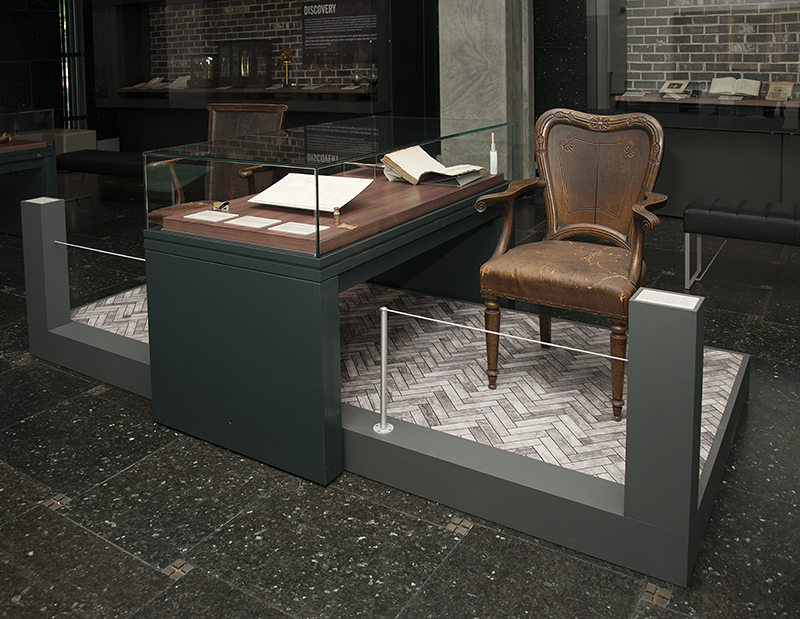
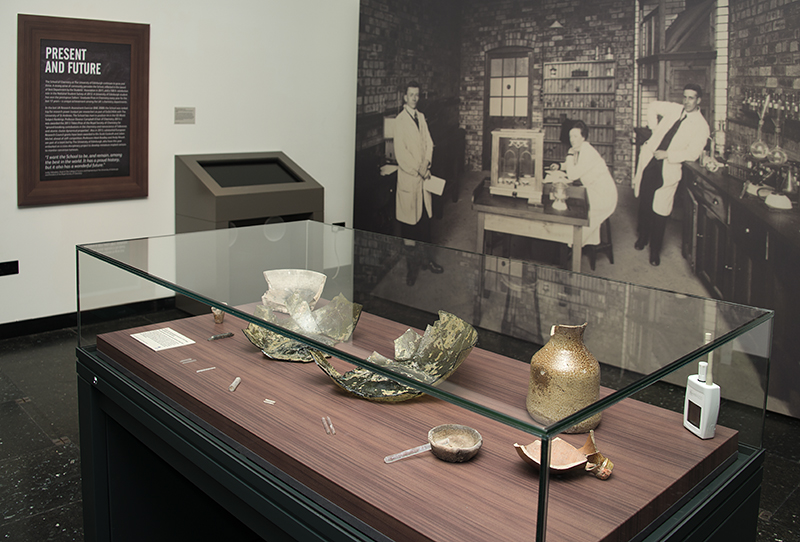
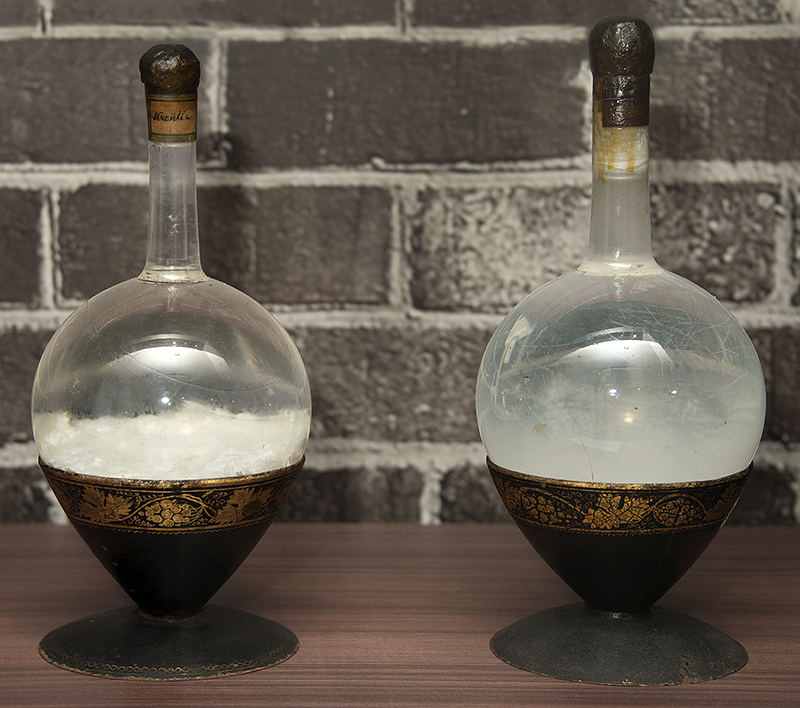
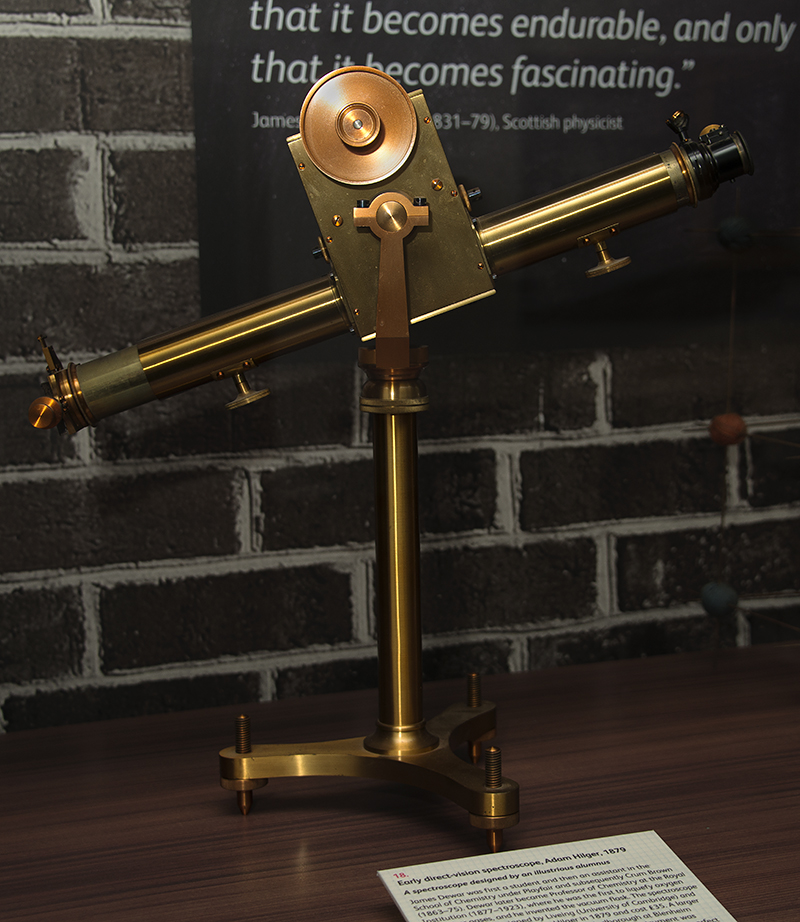
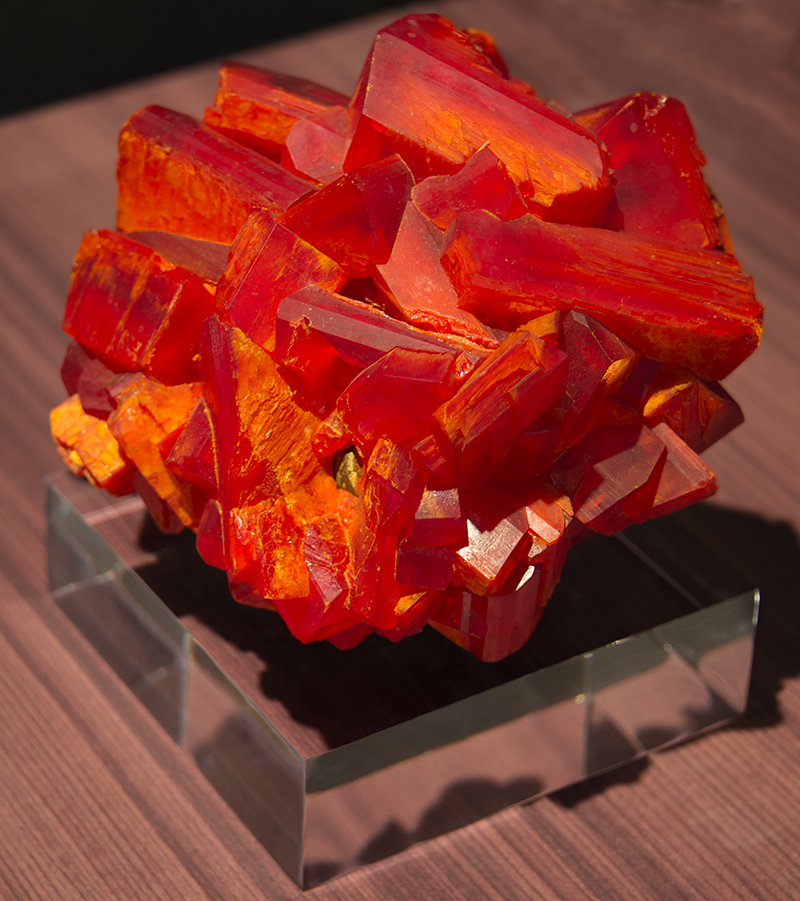
Edinburgh 300 : Cradle of Chemistry
Western General Hospital Library and the Annexe
The University of Edinburgh Library operates on a number of sites around the city. One of these is the Western General Hospital Library which holds part of the University’s medicine collections, including literature covering oncology, gastroenterology and neurology.

Libraries are not only about books. Staff and students at the Western General Hospital Library can also make use of this Brain Model.
The Western General Hospital Library is open to both staff and students of the University of Edinburgh and NHS Lothian staff. There are computers connected to both the University’s network and NHS Knowledge Network to provide a great range of information access.
The Library Annexe has been working closely with the Western General Hospital Library to identify duplicate runs of journal series, or gaps in runs held by either the Western General Hospital Library and the Annexe. By identifying where duplicate runs are held and moving an entire run from the Western General Hospital Library to the Library Annexe, or using items held in the Library Annexe to fill gaps in journal runs being held at the Western General Hospital Library we are able to provide a more comprehensive and complete information experience for our readers.

Exciting new space on the shelves from de-duplication means more room for additional materials.
Stephanie Farley (Charlie), Library Annexe Assistant
Open Access Summit a great success
Organised by the Open Access Im plementation Programme the Summit took place on 24 July in the Main Library. William Nixon, Digital Library Development Manager at Glasgow was the guest speaker, freshly returned from his world travels. His talk was humorous, engaging and well received by Open Access project staff. It was clear from his visit that Edinburgh’s project scale and organisation is unique with a greater volume of paper uploads and focus on finding rich seams of existing open access material. On the other hand Glasgow has a lot of expertise with metrics and their repository’s impact on the public visibility of research. Many useful ideas were shared on implementation problems, concerns and opportunities. We hope there might be a similar meeting later this year once the Scholarly Communications Team Open Access advocacy campaign has rolled out across the campus. The Edinburgh slides are available on SlideShare.
Open Journals Forum event report
We were very pleased that the OJS Forum was so popular. The event was fully booked and we were delighted to welcome 50 delegates from around the UK to the Main Library to hear presentations from practitioners with a depth of experience – from Publications Managers through Systems Administrators to Journal Editors.
Our invited speakers included: Vanessa Gabler from Pittsburgh University, Jackie Proven & Gillian Duncan from St Andrews University, Brian Hole from Ubiquity Press, Franziska Moser from Universität Zürich, Adam Rusbridge from Edina and Kevin Ashley and Alex Ball from the Digital Curation Centre, plus speakers from the University of Edinburgh.
All of the presentations are available for download from the Edinburgh Research Archive.
Some of the key themes that the speakers of the Forum touched upon were:
1. Resources
2. Learning curves
3. Managing expectations
4. Quality control
5. Licensing
6. System configuration
7. Positive student engagement
1. Resources
Although the OJS software is open source, the time and effort required to set up and support a service are difficult to quantify. Pittsburgh University currently have 3.05 FTE working on their service, whilst the University of Edinburgh estimate it be in the region of 0.5 FTE (although it’s probably more once you factor in time spent from everyone involved). All involved in current hosting services agreed that it was a valuable service for the library to provide to students and academics who want an affordable alternative to traditional commercial publishing.
2. Learning curves
Everyone who uses OJS spoke about the steep learning curve for staff and students in learning how to use OJS. And how it’s just as much a learning curve for library staff who learn as the encounter new challenges and requests form students. However, the common experience was that, although there was a large commitment to training and support at the start of the process, after a short while journal publishers become self sufficient and require minimum ongoing support.
3. Managing expectations
For all institutions with journal services managing expectations was crucial. It is essential at the start of the process to make it clear what the service will provide and what it will not. Some questions to ask are:
* If a service provided FREE of charge what does that include/exclude?
* Is it merely system support?
*Will there be training & ongoing support for design/layout/copyright?
*What conditions will the service impose- use of standards, licenses, policies?
*Are editors prepared to manage submissions & peer review process?
The institutions providing a service have a range of processes and documentation in place– not only does this help manage customer expectations but it standardise the services and makes it far easier to manage.
4. Quality control
To what level does the service provider become involved in the quality of the journal? It may be useful to set up a publishing advisory board accepts new journals for publication and the service assesses the peer review process of each journal. Quality shouldn’t be compromised just because a journal is Open Access.
5. Licensing
All of the OJS services publishing and hosting open access journals recommended using a Creative Commons Attribution (CC-BY) license. Many people found the standar Creative Commons Attribution Non-Commercial (CC-BY-NC) license too restrictive as it effectively prohibits licencing content to EBSCO and ProQuest or other commercial aggregators.
Furthermore, in the UK the CC-BY format is appealing as many funders of research – for example the Wellcome Trust and RCUK- require this flavour of license as part of their Open Access policy.
6. System configuration
Changes to underlying code and heavy customisation are to be avoided – out the box OJS is not particularly pretty but it can be improved using CSS and good design. The question of one installation versus multiple installations was discussed – depending on the number of titles there are benfits to each approach.
7. Positive student engagement
Many of the speakers talked about the process of setting up and/or editing journals as being a positive way to engage with young career academics and make them aware of peer review processes, copyright and open access at the early stages of their career. Gillian Duncan, from St Andrews University and Editor of the Journal of Terrorism Research mentioned the benefits for all parties of having PhD students as guest-editors for special editions.
If you want to find out more about the Journal Hosting Service please contact onlinejournals@mlist.is.ed.ac.uk

New books at New College Library – August

 New College Library has a regular display of new books at the far end of the Library Hall, close to the door to the stacks.
New in this month is Caesar and the Lamb : early Christian attitudes on war and military service by George Kalantzis, on the shelf at BT736.2 Kal.
Also new is Migrations of the holy : God, state, and the political meaning of the church by William Cavanaugh, at BV630.3 Cav.
These titles were purchased for Theology & Ethics at the School of Divinity, Edinburgh University.
You can see an regularly updated list of new books for New College Library on the Library Catalogue – choose the New Books Search and limit your search to New College Library. Here’s a quick link to new books arriving in the last few weeks. A word of caution – some of the books listed here may still be in transit between the Main Library (where they are catalogued) and New College Library, so not on the shelf just yet.
Baldwin Brown Images of Old Edinburgh
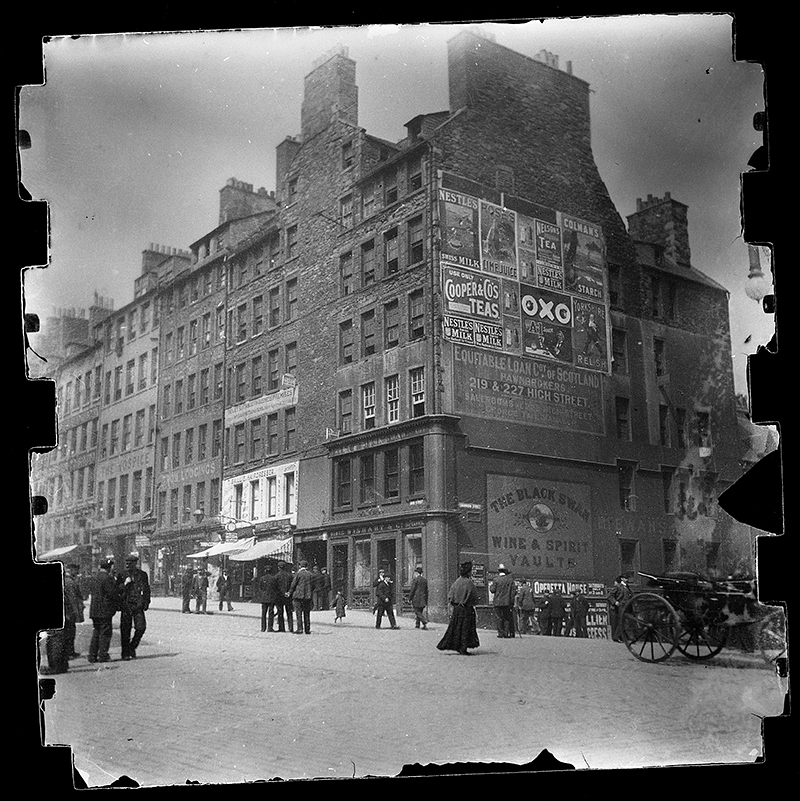
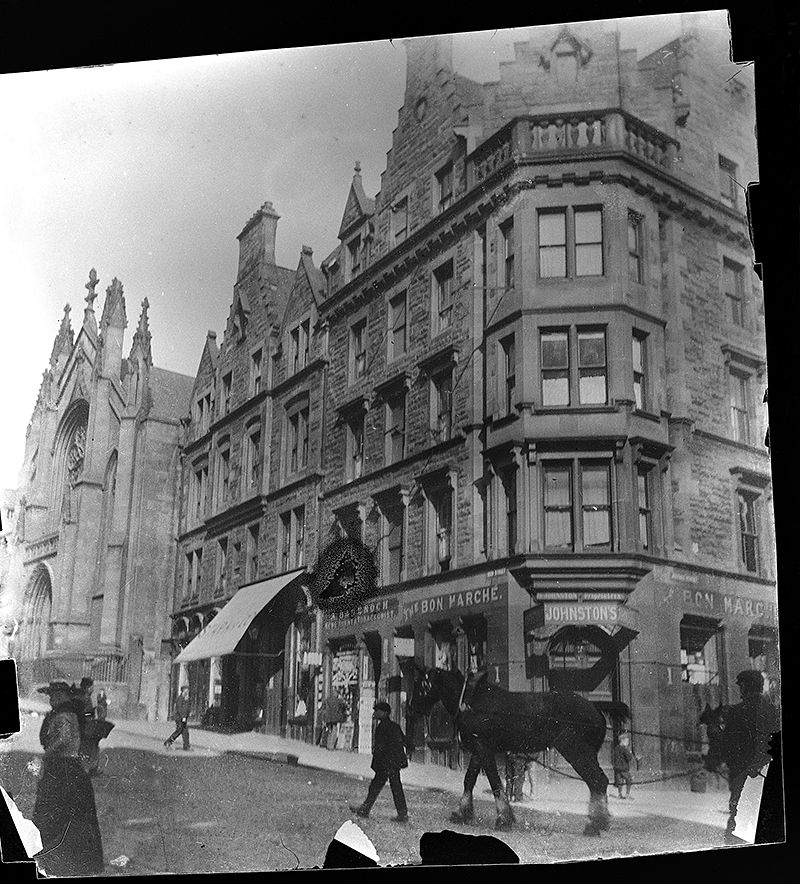
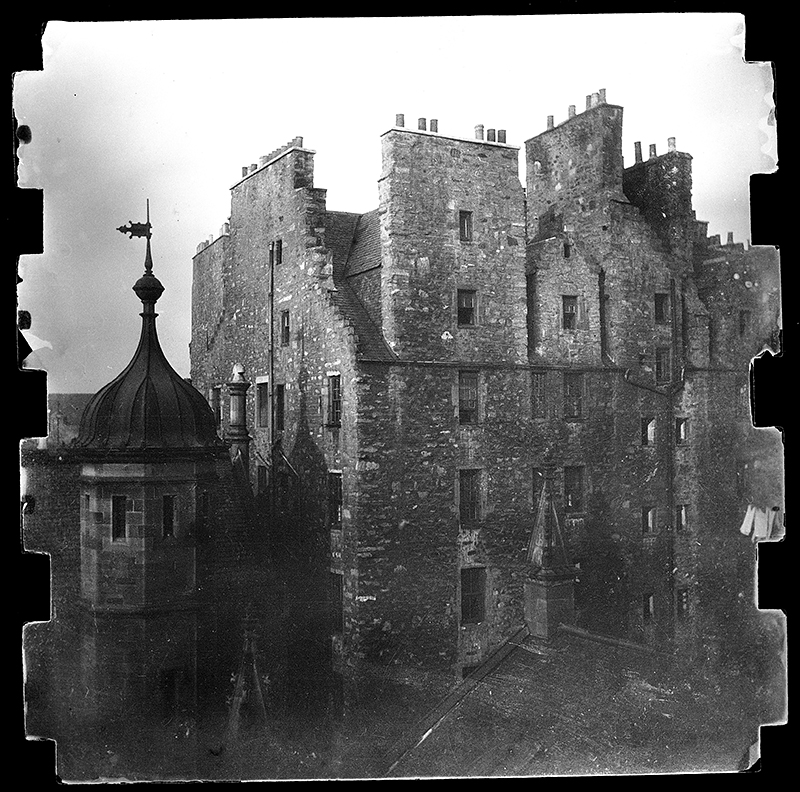
Recently in the DIU we have been digitizing 21 negatives of images described on their box Shelf-mark – E2005.1 Box 5, as ” Old Edinburgh.” We are aware that some members of Library staff enjoy the challenge of locating parts of the town from old photographs or unusual view points. We think some of these will present a challenge to even the keenest location spotting geeks and we would like to add any juicy information gathered to our related metadata fields. Over the next few weeks we shall post our “Old Edinburgh” images. No prizes for guessing except the smug air of recognition that a superior mind is at work. So as Bamber used to say , “Starter for ten ” anyone?
Making research ‘really reproducible’
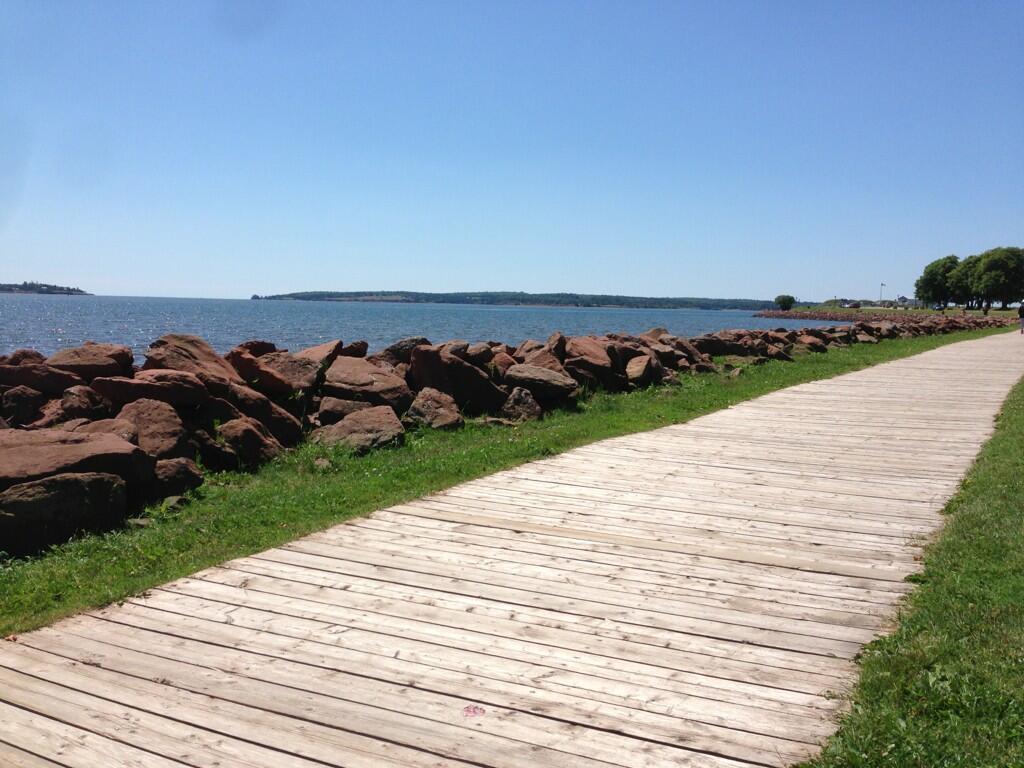
Listening to Victoria Stodden, Assistant Professor of Statistics at Columbia University, give the keynote speech at the recent Open Repositories conference in lovely Prince Edward Island Canada, I realised we have some way to go on the path towards her idealistic vision of how to “perfect the scholarly record.”
Charlottetown, Prince Edward Island
As an institutional data repository manager (for Edinburgh DataShare) I often listen and talk to users about the reasons for sharing and not sharing research data. One reason, well-known to users of the UK Data Archive (now known as the UK Data Service), is if the dataset is very rich and can be used for multiple purposes beyond those for which it was created, for example, the British Social Attitudes Survey.
Another reason for sharing data, increasingly being driven by funder and publisher policies, is to allow replication of published results, or in the case of negative results which are never published, to avoid duplication of effort and wasting public monies.
It is the second reason on which Stodden focused, and not just for research data but also for the code that is run on the data to produce the scientific results. It is for this reason she and colleagues have set up the web service, Run My Code. These single-purpose datasets do not normally get added to collections within data archives and data centres, as their re-use value is very limited. Stodden’s message to the audience of institutional repository managers and developers was that the duty of preserving these artefacts of the scientific record should fall to us.
Why should underlying code and data be published and preserved along with articles as part of the scholarly record? Stodden argues, because computation is becoming central to scientific research. We’ve all heard arguments behind the “data deluge”. But Stodden persuasively focuses on the evolution of the scientific record itself, arguing that Reproducible Research is not new. It has its roots in Skepticism – developed by Robert Boyle and the Royal Society of the 1660s. Fundamentally, it’s about “the ubiquity of error: The central motivation of the scientific method is to root out error.”
In her keynote she developed this theme by expanding on the three branches of science.
- Branch 1: Deductive. This was about maths and formal logic, and the proof as the main product of scientific endeavor.
- Branch 2: Empirical. Statistical analysis of controlled experiments – hypothesis testing, structured communication of methods and protocols. Peer reviewed articles became the norm.
- Branch 3: Computational. This is at an immature stage, in part because we have not developed the means to rigorously test assertions from this branch.
Stodden is scathing in her criticism of the way computational science is currently practiced, consisting of “breezy demos” at conferences that can’t be challenged or “poked at.” She argues passionately for the need to facilitate reproducibility – the ability to regenerate published results.
What is needed to achieve openness in science? Stodden argued for the need for deposit and curation of versioned data and code, with a link to the published article, and permanence of the link.This is indeed within the territory of the repository community.
Moreover, to have sharable products at the end of a research project, one needs to plan to share from the outset. It’s very difficult to reproduce the steps to create the results as an afterthought.
I couldn’t agree more with this last assertion. Since we set up Edinburgh DataShare we have spoken to a number of researchers about their ‘legacy’ datasets which – although they would like to make them publicly available, they cannot, either because of the nature of the consent forms, the format of the material, or the lack of adequate documentation. The easiest way is to plan to share. Our Research Data Management pages have information on how to do this, including use of the Digital Curation Centre’s tool, DMPOnline.
– Robin Rice, Data Librarian
New Darwin discovery
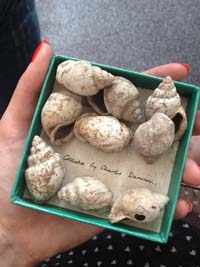
This appears to be a previously-unknown collection of shells formed by Charles Darwin. Whilst cataloguing chosen exhibits for an upcoming exhibition, myself and Gillian McCay the geology curator tipped out a small green box of what appeared at first to be some rather dirty looking gastropods. You can imagine our surprise when we found a slip lining the box which informed us the specimens were collected by Charles Darwin.
Darwin’s shells
When we considered we were looking through the collection of his close and influential friend Charles Lyell, there appeared little reason to believe otherwise. After some research I discovered that St Helena (the given location of the find) was one of the stops Darwin made on HMS Beagle, the five year voyage he made investigating geology and making natural history collections, many of which were sent back to Cambridge. Somehow these specimens have gone from the shores of St Helena, through some of the most important figures of early natural science, to delighting a couple of unsuspecting and very excited curators.
Emma Smith, Exhibitions Intern
Collections
 Hill and Adamson Collection: an insight into Edinburgh’s past
My name is Phoebe Kirkland, I am an MSc East Asian Studies student, and for...
Cataloguing the private papers of Archibald Hunter Campbell: A Journey Through Correspondence
My name is Pauline Vincent, I am a student in my last year of a...
Hill and Adamson Collection: an insight into Edinburgh’s past
My name is Phoebe Kirkland, I am an MSc East Asian Studies student, and for...
Cataloguing the private papers of Archibald Hunter Campbell: A Journey Through Correspondence
My name is Pauline Vincent, I am a student in my last year of a...

Projects
Cataloguing the private papers of Archibald Hunter Campbell: A Journey Through Correspondence
My name is Pauline Vincent, I am a student in my last year of a...
Archival Provenance Research Project: Lishan’s Experience
Presentation My name is Lishan Zou, I am a fourth year History and Politics student....