Home University of Edinburgh Library Essentials
April 5, 2026
Hydra, SPSS journal, publishes second issue
Hydra, the postgraduate journal for the School of Social and Political Science has published its second issue on the University’s Journal Hosting Platform.
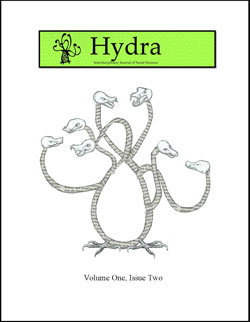
Hydra’s mission is to strengthen dialogue in SSPS by drawing attention to the excellent postgraduate work going on in the School. The articles in this second issue address a variety of topics, but they do so in a way that is accessible and engaging for a non-specialist audience.
Jacque Clinton begins the issue by examining how historical institutionalism and path dependency have influenced the development of healthcare policy in the UK and US. Nida Sattar follows this with a deconstruction of the complexities of citizenship, focusing on the multi-layered situation faced by the “rejected Biharis” of South Asia.
The final four articles all engage with issues around international aid and development; Katharine Heus critiques the construction of evidence of aid effectiveness in global health interventions, while Megan Wanless examines the World Bank’s approach to dealing with corruption. Katherine Allen interrogates the M-PESA money transfer initiative in Kenya, and Serena Suen rounds off this issue of Hydra by questioning accepted wisdom about the role of women’s education in global development initiatives.
Hydra is a student publication supported by the graduate school. We hope Hydra, like its namesake, will endure and regenerate for years to come.
Welcome to the new Research Data Management Service Coordinator: Kerry Miller
We have great pleasure in welcoming a new member of staff to the research data management programme. Kerry Miller has joined us in the role of Research Data Management Service Coordinator.
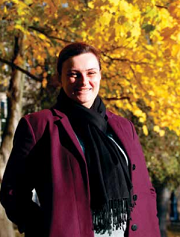
Kerry is featured in the latest BITS magazine, sharing details of her new role:
What’s your background?
I’ve undertaken research for various organisations, in industry and charity sectors –
including what is now GlaxoSmithKline and Cancer Research UK as well as the
Ministry of Defence and the British Council. I then joined the Digital Curation
Centre (DCC) in 2011 as an Institutional Support Officer. This involved working
with Higher Education institutions across the UK to help them improve their
Research Data Management policy and practice, in response to Research
Councils UK and other similar requirements.
Tell us about the new position.
My new post, RDM Service Co-ordinator, is a newly-created post, aiming to
bring together and co-ordinate all the different aspects of the research data
management work that’s currently being undertaken throughout the University: lots of
infrastructure improvements, and new tools and support for researchers. There
are things like DataShare, which has been active for a while now, but which we’re
promoting, so more researchers are aware of it and know when to use it. There
are also a few more services that are still in the design phases. You can read all
about the RDM work that is going on via the RDM Blog: datablog.is.ed.ac.uk
What particularly excites you about the new role?
The work we do at the DCC is in many ways quite theoretical; we go out and talk
to institutions about what they ought to be doing, what they need to do to meet
requirements, and that sort of thing, but this new role will be going from talking
the talk to walking the walk; I’ve got to actually do what I’ve been telling people at
other institutions to do! It’s quite scary but also quite exciting; just to see whether
or not I can actually turn that into a real, successful service.
Where exactly will you be based?
I’m within the Research and Learning Section of Library & University Collections, on the lower ground floor of the Main Library. There is a huge number of people involved in the area, but the RDM team itself is small and there aren’t that many people full-time at the moment. RDM is part of a lot of people’s jobs – people like Stuart Lewis and John Scally from the library side, Tony Weir in IT Infrastructure and Robin Rice in the Data Library, but I’ll be one of the few people for whom it’s a full-time, dedicated role.
What do you enjoy doing outside work?
I watch a lot of films, and do a lot of cooking and baking. I’ve been doing a recipe
a week from The Great British Bake Off, with greater or lesser success. I often use
my office colleagues as a waste disposal system!
New staff member: Kerry Miller
Library & University Collections has great pleasure in welcoming a new member of staff to its ranks. Kerry Miller has joined us in the role of Research Data Management Service Coordinator.
Kerry is featured in the latest BITS magazine, sharing details of her new role:
What’s your background?
I’ve undertaken research for various organisations, in industry and charity sectors –
including what is now GlaxoSmithKline and Cancer Research UK as well as the
Ministry of Defence and the British Council. I then joined the Digital Curation
Centre (DCC) in 2011 as an Institutional Support Officer. This involved working
with Higher Education institutions across the UK to help them improve their
Research Data Management policy and practice, in response to Research
Councils UK and other similar requirements.
Tell us about the new position.
My new post, RDM Service Co-ordinator, is a newly-created post, aiming to
bring together and co-ordinate all the different aspects of the research data
management work that’s currently being undertaken throughout the University: lots of
infrastructure improvements, and new tools and support for researchers. There
are things like DataShare, which has been active for a while now, but which we’re
promoting, so more researchers are aware of it and know when to use it. There
are also a few more services that are still in the design phases. You can read all
about the RDM work that is going on via the RDM Blog: datablog.is.ed.ac.uk
What particularly excites you about the new role?
The work we do at the DCC is in many ways quite theoretical; we go out and talk
to institutions about what they ought to be doing, what they need to do to meet
requirements, and that sort of thing, but this new role will be going from talking
the talk to walking the walk; I’ve got to actually do what I’ve been telling people at
other institutions to do! It’s quite scary but also quite exciting; just to see whether
or not I can actually turn that into a real, successful service.
Where exactly will you be based?
I’m within the Research and Learning Section of Library & University Collections, on the lower ground floor of the Main Library. There is a huge number of people involved in the area, but the RDM team itself is small and there aren’t that many people full-time at the moment. RDM is part of a lot of people’s jobs – people like Stuart Lewis and John Scally from the library side, Tony Weir in IT Infrastructure and Robin Rice in the Data Library, but I’ll be one of the few people for whom it’s a full-time, dedicated role.
What do you enjoy doing outside work?
I watch a lot of films, and do a lot of cooking and baking. I’ve been doing a recipe
a week from The Great British Bake Off, with greater or lesser success. I often use
my office colleagues as a waste disposal system!
CENSORED!
Last week I was sent a wonderful book, Deletrix – a collaboration between the artist Joan Fontcuberta, Catalan PEN and Arts Santa Mònica and it explores censorship and violence done to books. Thought provoking, and beautifully illustrated with images that have a strange haunting quality- indeed Fontcuberta challenges the audience as to whether the inherent beauty of the object can redeem the violence done to them. It has got me thinking about the items in our collections that have suffered changes at the hands of censors over the years.
Perhaps the one that immediately springs to mind is Micheal Servetus’ Christianismi Restitutio http://images.is.ed.ac.uk/luna/servlet/s/tv7257. It is thought to be the copy Servetus sent to Calvin; incensed by Servetus’ theories, Calvin ripped out the first 16 pages before he set the wheels in motion to have Servetus burned at the stake using his own books for the fire! (See http://en.wikipedia.org/wiki/Michael_Servetus for more information).
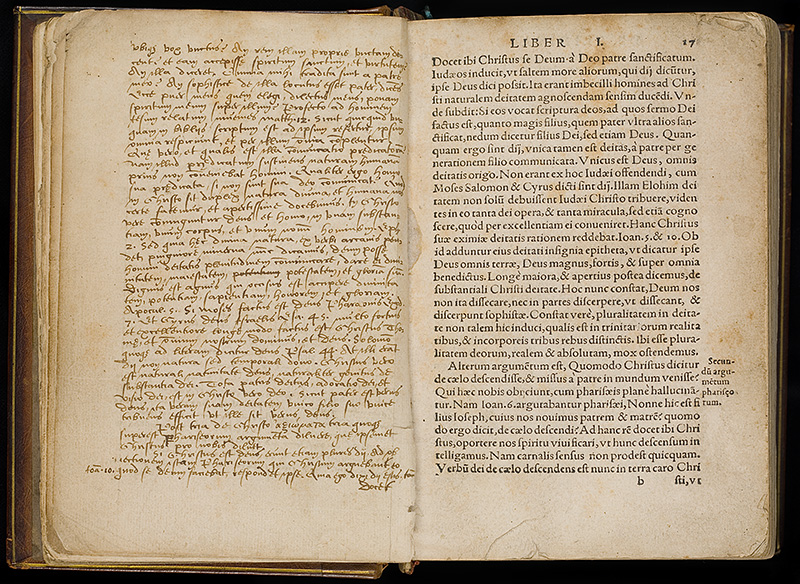
However, there are many more censored images in the collection, often the result of religious belief & moral concerns. All the illustrations in the Genesis chapter of this French Bible appear to have God covered with Gold paint http://images.is.ed.ac.uk/luna/servlet/s/q28182
 And there are many examples of people being defaced http://images.is.ed.ac.uk/luna/servlet/s/ir0qfd

Further examples can be found below
http://images.is.ed.ac.uk/luna/servlet/s/75ig3v – perhaps an example of Victorian vandalism?
Or how about this one, where it looks as though the owners name and anathema has been deliberately erased http://images.is.ed.ac.uk/luna/servlet/s/55b726
More information on Deletrix can be found at the links below
http://nathaliepariente.wordpress.com/2012/11/05/nouvelle-exposition-joan-fontcuberta-deletrix/
http://www.flickr.com/photos/pencatala/sets/72157635582961896/with/10022317404/
http://www.youtube.com/watch?v=vr_AP8dK18w&feature=youtu.be
Many thanks to Ana González Tornero for the beautiful book, the links and information about the Deletrix Project.
Susan Pettigrew
BAG: The Student Magazine
Exciting morning so far! We’ve been sorting through prints and posters for the ECA collections and found something interesting…
Earlier in the year we posted a story in the archives about BAG, the concept for a joint art colleges student magazine between Edinburgh, Glasgow and Dundee in 1970. The magazine was to be called BAG and it would be sold in a polythene bag.
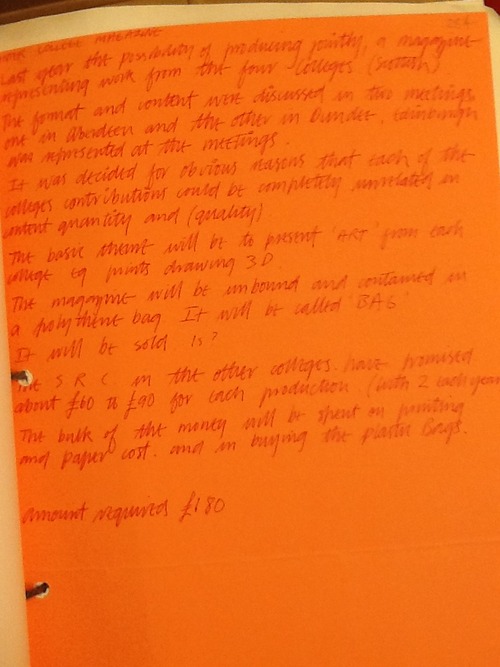
Well we found the prototype ‘BAG’ this morning! And here it is…
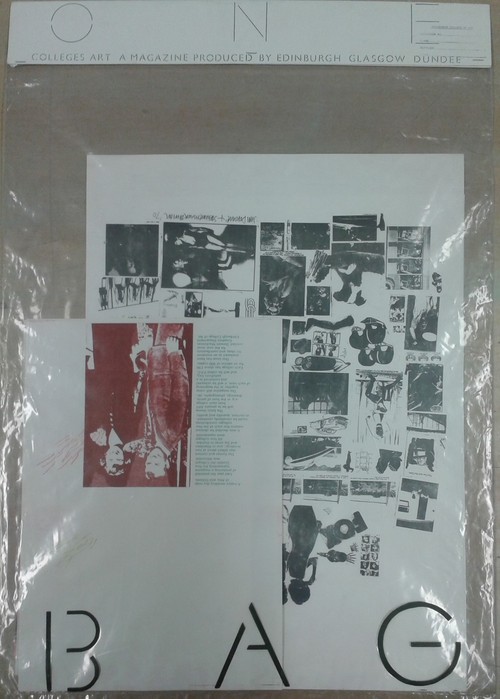
We think this is the only one created. The idea was that the contents would be unbound. This prototype contains poetry, illustrations and comment.
Anyone remember talk of BAG at ECA in 1970? If so let us know!
New research data storage
The latest BITS magazine for University of Edinburgh staff (Issue 8, Autumn/ Winter 2013) contains a lead article on new data storage facilities that Information Services have recently procured and will be making available to researchers for their research data management.

“The arrival of the RDM storage and its imminent roll out is an exciting step in the development of our new set of services under the Research Data Management banner. Ensuring that the service we deploy is fair, useful and t transparent are key principles for the IS team.” John Scally
Information Services is very pleased to announce that our new Research Data Storage hardware has been safely delivered.
Following a competitive procurement process, a range of suppliers were selected to provide the various parts of the infrastructure, incl. Dell, NetApp, Brocade and Cisco. The bulk of the order was assembled over the summer in China and shipped to the King’s Buildings campus at the end of August. Since then IT Infrastructure staff have been installing, testing and preparing the storage for roll-out.
How good is the storage?
Information Services recognises the importance of the University’s research data and has procured enterprise-class storage infrastructure to underpin the programme of Research
Data services. The infrastructure ranges from the highest class of flash-storage (delivering 375,000 IO operations per second) to 1.6PB (1 Petabyte = 1,024 Terabytes) of bulk storage arrays. The data in the Research Data Management (RDM) file-store is automatically replicated to an off-site disaster facility and also backed up with a 60-day retention period, with 10 days of file history visible online.
Who qualifies for an allocation?
Every active researcher in the University! This is an agreement between the University and the researcher to provide quality active data storage, service support and long term curation for researchers. This is for all researchers, not just Principal Investigators or those in receipt of external grants to fund research.
When do I get my allocation?
We are planning to roll out to early adopter Schools and institutes late November this year. This is dependent on all of the quality checks and performance testing on the system being completed successfully, however, confidence is high that the deadline will be met.
The early adopters for the initial service roll-out are: School of GeoSciences, School of Philosophy, Psychology and Language Sciences, and the Centre for Population Health
Sciences. Phased roll-out to all areas of the University will follow.
How much free allocation will I receive?
The University has committed 0.5TB (500GB) of high quality storage with guaranteed backup and resilience to every active researcher. The important principle at work is that the 0.5TB is for the individual researcher to use primarily to store their active research data. This ensures that they can work in a high quality and resilient environment and, hopefully, move valuable data from potentially unstable local drives. Research groups
and Schools will be encouraged to pool their allocations in order to facilitate shared data management and collaboration.
This formula was developed in close consultation with College and School representatives; however, there will be discipline differences in how much storage is required and individual need will not be uniform. A degree of flexibility will be built into the
allocation model and roll-out, though if researchers go over their 0.5TB free allocation they will have to pay.
Why is the University doing this?
The storage roll-out is one component of a suite of existing and planned services known as our Research Data Management Initiative. An awareness raising campaign accompanies the storage allocation to Schools, units and individuals to
encourage best practice in research data management planning and sharing.

Research Data Management support services:
www.ed.ac.uk/is/data-management
University’s Research Data Management Policy:
www.ed.ac.uk/is/research-data-policy
BITS magazine (Issue 8, Autumn/ Winter 2013)
http://www.ed.ac.uk/schools-departments/information-services/about/news/edinburgh-bits
The New College Strong Room revealed
A guest post from our Museums Studies student volunteers, Charlotte Johnson and Liz Louis.
We are two postgraduate students studying for an MLitt in Museum and Gallery Studies at the University of St Andrews. As part of our course we’re undertaking a practical placement and as such we are very pleased to be working on a project here at New College, in the strong room. When we started, we didn’t know what sort of collection to expect, and we quickly realised that the sheer variety of objects we discovered, would send us on a whistle-stop tour of New College’s history and give us insights into the lives and relationships of the eminent Doctors of Divinity who served here. It is our task to document, research and properly store the collection and we have come across some fabulous items over the last 6 weeks.


Perhaps one of our favourites is a casket and scroll presented to the Rev. John Sinclair McPhail by his parishioners on Skye, on his having served 50 years in the clergy. It is a beautiful piece of craftsmanship, with wood, silver, purple velvet, raspberry-coloured silk and a hand-painted declaration of their appreciation.

Another interesting piece is a large silver fob-watch which belonged to Thomas Chalmers, one of the leaders of the Disruption which led to the creation of the Free Church of Scotland and first principal of New College; it looks as though it was much used and much loved.
At this point, we don’t know much about any of the items, but each one of them has a story to tell, and our conservation and research efforts will make sure that they don’t stay silent. We wanted to take this opportunity to share some photographs of these treasures with you.
Clerk Ranken
Clerk Ranken was born in 1880, Edinburgh. Educated at George Heriot’s School, he then went to Edinburgh University, graduating BSc (Pure Science) in 1902, then DSc in 1907. He was recipient of both the Hope Prize and Mackay Smith Scholarships. At the age of only 21 he read a paper before the Royal Society of Edinburgh.
As a Carnegie Fellow, he worked with Georg Bredig at Heidelberg University. On his return from Germany he became lecturer in Chemistry at the Heriot-Watt College, Edinburgh, and later Assistant Professor in Chemistry. In 1917 he left academia to take up as post with Messrs. T. & J. Bernard, Ltd., the Edinburgh brewers.
We recently became aware, thanks to Dr. Andrew Alexander (Chemistry) that two photographs we had labelled as “Dr. Rubens?” are actually of Ranken and taken (most likely) during his student days.

Chemistry students c1905
The first is a group photograph and we assume it is a group of Chemistry students. The doorway has been identified as one of those leading into the Reid Concert Hall (adjacent to the Medical School, where Chemistry was based). Clerk Ranken is in the front row, furthest left.

Clerk Ranken in Chemistry laboratory
The second shows Ranken in a laboratory. In 1903 the number of Chemistry laboratories had been increased and, although we have yet to place this specifically, it is of a similar style to laboratories known to be known in the Medical School building.
Clerk Ranken died in May 1936. An obituary can be found in the Journal of the Institute of Brewing, Volume 42, Issue 4.
Postgraduate Arts journal launches on hosting service
FORUM, University of Edinburgh Postgraduate Journal of Culture & the Arts officially launched on Friday 6th December 2013 to coincide with the publication of their seventeenth issue, Rites & Rituals.
FORUM editors (past and present) Victoria Anker, Dorothy Butchard, Laura Chapot and Lizzie Stewart worked in conjunction with Angela Laurins (Library Learning Services Manager) and Robin Taylor (Digital Library Development) to make the transition from the old journal site to the Journal Hosting Service.
This is the first time we have worked with an existing online journal to migrate (with all back issues and their existing URL) to the Journal Hosting Service.
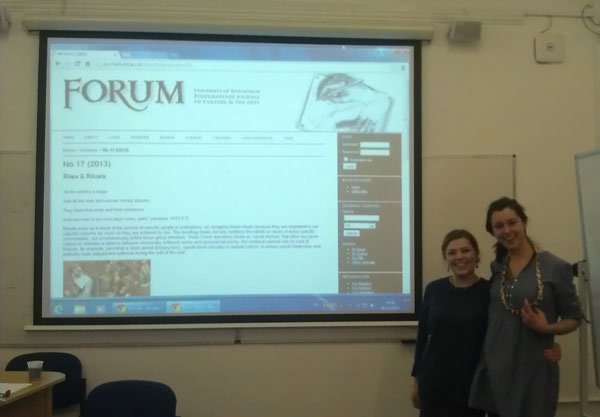
FORUM, which publishes bi-annually exclusively online, aims to create and foster a network for the exchange and circulation of intellectual ideas within the postgraduate community. Founded in 2005, FORUM’s interdisciplinary approach continues to welcome submissions from the global postgraduate community that challenge the boundaries of conventional disciplines.
Forum: http://www.forumjournal.org
For further information please contact: Victoria Anker and Laura Chapot on editors@forumjournal.org
LibQual iPad mini winners
Congratulations to Robin Cathcart and Christina Mackie who won the two iPad minis we offered as prizes for completing the recent LibQual+ survey.
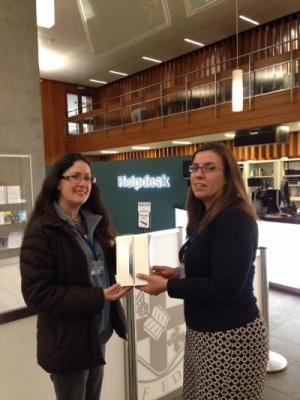
Receiving her iPad mini, Robin thanked the Library team for the ‘amazing’ survey prize and said, “I was happy to fill out your survey, as you all undertake very important work that is truly at the heart of the university. I have always had a great experience with online library services and inside the main library itself here at the University of Edinburgh, and I hope my and other survey responses help you all to continue improving the high-quality services provided across the university”.
Robin is a Network Manager and Research Manager for the UK Carbon Capture and Storage Research Centre (http://www.ukccsrc.ac.uk/people Twitter: @ukccsrc)
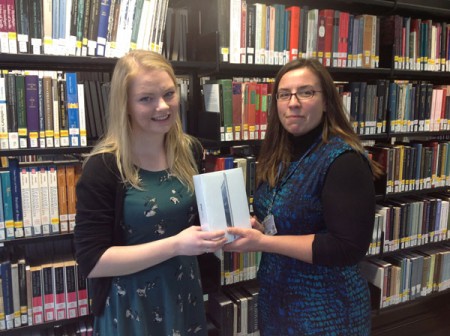
Christina, a third year Biology student who uses the Main Library most often, couldn’t believe her luck and was’ really, really pleased to have won such a ‘lovely surprise’.
Thanks to everyone who took the time to complete the survey. The LibQual report will be published in the New Year.
Collections
 Hill and Adamson Collection: an insight into Edinburgh’s past
My name is Phoebe Kirkland, I am an MSc East Asian Studies student, and for...
Cataloguing the private papers of Archibald Hunter Campbell: A Journey Through Correspondence
My name is Pauline Vincent, I am a student in my last year of a...
Hill and Adamson Collection: an insight into Edinburgh’s past
My name is Phoebe Kirkland, I am an MSc East Asian Studies student, and for...
Cataloguing the private papers of Archibald Hunter Campbell: A Journey Through Correspondence
My name is Pauline Vincent, I am a student in my last year of a...
Projects
Cataloguing the private papers of Archibald Hunter Campbell: A Journey Through Correspondence
My name is Pauline Vincent, I am a student in my last year of a...
Archival Provenance Research Project: Lishan’s Experience
Presentation My name is Lishan Zou, I am a fourth year History and Politics student....