Home University of Edinburgh Library Essentials
December 15, 2025
CRC Cataloguing Interns
Beth and Fiona have recently started as cataloguing interns in the CRC, and tell us about their first experiences…
Thesis cataloguing comes with its perils, for a start, until the beginning of February we were both blissfully unaware of the horror of the unnumbered page. Few sights can strike fear into the heart of the intrepid rare books cataloguer quite like erratic pagination!
However, we are glad to report that this internship is not exclusively page counting, and every now and again something, or someone, truly exceptional comes along.
Among the hidden gems of the past couple of weeks, we found a 1930’s PhD thesis in physics that was submitted by a woman named Gladys Isabel Harper. A woman submitting a thesis in 1930 may not be particularly unusual, especially thanks to the progressive thinking in Edinburgh at that time, but this woman’s career certainly took an exceptional trajectory and one that even by today’s standards would appear highly impressive.
Born Gladys MacKenzie, she was the daughter of an iron founder and teacher from Edinburgh and was educated at Craigmount School in the city. She graduated with an MA in 1924, with a first in Mathematics and Natural Philosophy (now known as the physics department). As part of her PhD on J-phenomenon in x-radiation, Gladys submitted an article co-written with E. Salaman during her time at Newnham College in Cambridge where she was appointed a lectureship in 1926. In 1929 she resigned her post at Cambridge and married Wallace Russell Harper (PhD) who was a fellow physicist and published two books in the subject in 1961 and 1966.
Gladys’ PhD was granted in 1930, after she was married and while she was working in the natural philosophy department at Edinburgh University with Charles Glover Barkla, who won a Nobel prize for his work in a the field of x-radiation. Together, they wrote two articles published in Philosophical Magazine in 1926. The final leaf of Gladys’ PhD is a letter from her to the librarian at Edinburgh University stating her address in Bristol University where she was a lecturer in the department of Physics until 1947.
As we continue our quest to organize the intellectual heritage of EU, we may get shudder at the thought of chemistry PhD students who apparently had only a loose idea of how page numbers work (hint: they generally go up, one at a time), but it’s all worth it to make the work of people like Gladys Isabel Harper visible to more students today.
Inspiring Research – International Women’s Day 2014
 International Women’s Day (IWD) was celebrated on 8th March 2014. IWD has been celebrated for over 100 years and this year’s theme was Inspiring Change.
The Library subscribes to a number of databases that may inspire you when researching women’s or gender studies. You can find a full list of Recommended databases for women’s studies but a few highlights are:
Women, War & Society: the First World War had a revolutionary and permanent impact on the personal, social and professional lives of all women. Their essential contribution to the war in Europe is fully documented in this collection of primary source materials sourced from the Imperial War Museum, London. These unique documents – charity and international relief reports, pamphlets, photographs and press cuttings – are published for the first time in fully searchable form, along with interpretative essays from leading scholars.
 The Vogue Archive: contains the entire run of Vogue magazine (US edition) from 1892 to the present day, reproduced in high-resolution colour page images. More than 400,000 pages are included. Vogue is a unique record of international popular culture that extends beyond fashion. The Vogue Archive is an essential primary source for the study of fashion, gender and modern social history.
Encyclopedia of Women & Islamic Cultures Online: an interdisciplinary, trans-historical, and global project embracing women and Islamic cultures in every region where there have been significant Muslim populations. It crosses history, geographic borders and disciplines to create a ground breaking reference work reflecting the very latest research on gender studies and the Islamic world.
Project Muse: provides access to almost 200 full text journals from 30 scholarly publishers, covering the fields of literature and criticism, history, the visual and performing arts, cultural studies, education, political science, gender studies, economics, and many others.
For the full list see databases for women’s studies.
To celebrate International Women’s Day, the editors of the journal Parliamentary Affairs have drawn together recent publications examining the representation of women in parliamentary democracies around the world. All papers are free to access until the end of June 2014. See Virtual Issue: Women’s Representation.
The Library has full access to the journal Parliamentary Affairs available to students and staff of the University, search the Library Catalogue for the Journal Title to get access.
For information on events held at University of Edinburgh to celebrate International Women’s Day 2014 see:
http://www.ed.ac.uk/schools-departments/equality-diversity/news-events/events/international-women
To watch previous International Women’s Day lectures at the University see:
http://www.ed.ac.uk/about/video/lecture-series/international-womens-day
A Passage to India: J.B.S. Haldane and the Journal of Genetics
 The C.H. Waddington collection contains a folder of correspondence with J.B.S. Haldane, who died 50 years ago this year, concerning the Journal of Genetics. The correspondence, which covers 1956 to 1957, expresses Waddington’s concern at the decision made by Haldane to take the Journal, of which he was editor, out to India with him when he retired.
The Journal of Genetics had a long-standing, although somewhat fraught, relationship with Edinburgh’s Institute of Animal Genetics. Established in 1910 by two men who could be called the ‘founding fathers’ of the science in Britain, William Bateson (who coined the term ‘genetics’ to encompass its present scientific meaning), and Reginald Punnett (who held the first Chair of Genetics in Britain), it is the oldest English language journal in that field of science. However, in its first few decades it was felt to be inaccessible and somewhat limited in its publication remit by certain more experimental scientists, including those at the Institute of Animal Genetics. This was so much the case that the Institute’s director, F.A.E. Crew and his colleagues at the Institute, Julian Huxley, Lancelot Hogben and others, teamed together in 1923 to establish the Journal of Experimental Biology along with an associated Society of Experimental Biology. As hinted at in its title, the new Journal aimed to publish papers of a more experimental nature covering a wider range of genetical and evolutionary biology theories and hypotheses than covered by the Journal of Genetics at that time.
However, when editorship later passed to physiologist, geneticist, mathematician and general polymath J.B.S. Haldane, his remarkable breadth of interest and abilities and sharp, colourful personality transformed the Journal’s remit and potential (although Waddington claimed he was ‘a rather niggling editor about details and notoriously bad at answering letters’ [part of GB 237 Coll-41/5/2/9 ]).
However, when Haldane decided to retire to India in the late 1950s, where he would become a naturalised citizen, his decision to take the Journal with him caused some consternation in Britain. Waddington, who was Crew’s successor as director of the Institute of Animal Genetics, felt that the editorship should pass over to him and his colleagues and that for Haldane to continue in India would be ‘chaotic’. But Haldane would not be dissuaded, writing with characteristic wryness to Waddington on 19 January 1957:
You can, of course reply that I am an old man and may soon die or lose such intellectual powers as I still possess. I may. But my systolic pressure is 120-130mm Hg. And I have not lost a day’s university teaching through illness since 1930. And meanwhile a thermonuclear bomb or a major economic crisis may affect British publication. When I die or become too senile to edit, there need be no more difficulty in transferring the Journal back to Britain than in transferring it to India.
(part of GB 237 Coll-41/5/2/9).
Following Haldane’s death in 1964, his widow Helen Spurway continued publication in India with Madhav Gadgil, H. Sharat Chandra and Suresh Jayakar until she died in 1977. In 1985, the Indian Academy of Sciences resumed publication of the Journal, which still continues to this day in association with Springer publishing.
Look out for a longer piece here on J.B.S. Haldane late this year!
Searcher Review 2014: Refine your search
When you use Searcher, you’ll usually return a large amount of results. The limiters on the right of the screen make it easy for you to refine your search results. As part of the ongoing Searcher review, and to make it easier to understand what you’re searching, we‘ve changed the wording of the limiters on the results screen.
New limiter labels:
- Library Catalogue
- All Library Resources (print and e-content)
- Full Text (e-content)

What does this mean?
Limit to Library Catalogue: more or less the same as doing a search on the Classic Catalogue. You search books, ebooks, print journal titles and ejournal titles but NOT ejournal content. Books (both print and e-books) are weighted to appear at the top of a results list.
Limit to All Library Resources (print and e-content): this searches the Library Catalogue (as described above) PLUS the e-content (ejournals and databases) to which we subscribe. Again, books and ebooks are weighted to appear at the top of the results list.
Limit to Full Text: Check this box to find results for which the Library provides full text access. This includes ejournal and database content as well as e-books, but NOT print books.
Checking this box DOES NOT search the full text of an article or e-book. To search full text use the expander, ‘Also search within the full text of the articles’ which you’ll find in ‘Search Options’, under the search box on the Searcher homepage, or by clicking ‘Show More’ under the ‘Limit to box’ on the results page.
There will be further changes to Searcher over the next few weeks. If you’ve any feedback or suggestions please get in touch: library.learning@ed.ac.uk
Gaelic week in Centre for Research Collections
To celebrate the University’s first-ever Seachdain na Gàidhlig, or Gaelic Week, yesterday CRC displayed a number of treasures from the rare book and manuscript collections. These included notebooks of folklorist Alexander Carmichael, the 11th-century manuscript known as the “Celtic Psalter”, and the first book printed in any Gaelic language – the 1567 liturgy Foirm na nurrnuidheadh agas freasdal na sacramuinteadh, agas foirceadul an chreidimh Christuidhe andso sios. We are the only library in Scotland to have a copy of this little book; only two other copies are known to survive.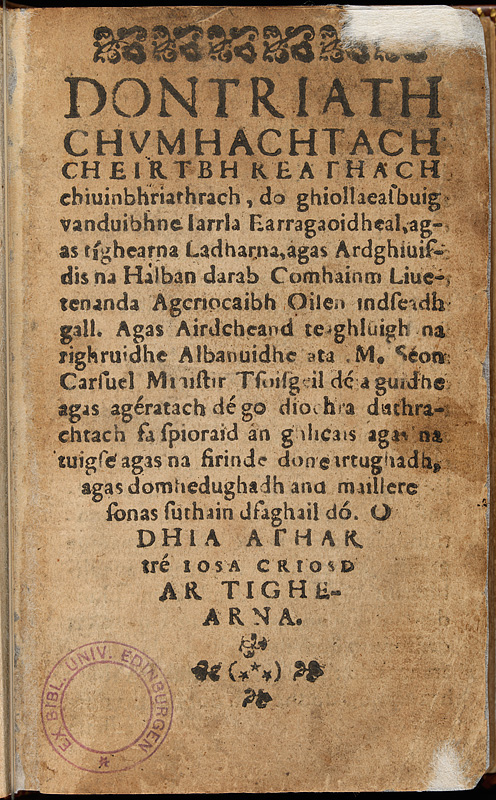
New Books at New College Library – March (recommended by students)

 Student recommendations are in at New College Library! New in this month is Newman and his family, by Edward Short, available as an ebook via the library catalogue. Also new is The Oxford guide to the historical reception of Augustine, by Karla Pollmann, at Folio BR65.A9 Oxf.
Students are encouraged to recommend books for the library using the online form at http://www.ed.ac.uk/is/RAB.
You can see an regularly updated list of new books for New College Library on the Library Catalogue – choose the New Books Search and limit your search to New College Library. Here’s a quick link to new books arriving in the last few weeks. A word of caution – some of the books listed here may still be in transit between the Main Library (where they are catalogued) and New College Library, so not on the shelf just yet.
Yesterday’s News? Find out more about historic newspapers online

Image courtesy of ProQuest Historical Newspapers
Do you want to read about history in the making? University of Edinburgh users have access to large collections of online newspaper archives, going back to the nineteenth century and beyond.
UK broadsheet titles include the Times, Sunday Times, Scotsman, Guardian and Observer. We also now have access to UK Press Online, an archive of popular press newspapers including the Daily Mirror, Daily Express, Daily Star and Daily Worker.

Image courtesy of UK Press Online
For worldwide coverage, you will find the New York Times, Pravda, Asahi Shimbun, People’s Daily and more.
Explore what’s available in the Newspaper Databases guide, or come to the Finding Historic Newspapers IS Skills Seminar on Thursday 13 March, bookable via MyEd.
We feel very Olympic today
Our newest Library Assistant at the Library Annexe is Marko Mlakar, who joins us at Edinburgh from Ljubljana, Slovenia. Marko worked at the University of Edinburgh last year as an intern within the Scholarly Communications team and brings a wealth of experience to the Collections Management team. Marko settled into his new role just in time for the 2014 Sochi Winter Olympics, and with enough Olympic spirit still in the air, reflects on the competition in his first blog entry.
Carl Jones, Library Annexe Supervisor
—
With the Olympic Games now behind us, it’s time to reflect a little on the fun we had at the Annexe over these past few weeks. Honestly, we could not hold our excitement about the Games so we got involved with every single Olympic day – falling short of watching TV during our work hours, of course! Since that super Olympic spirit hadn’t really left us we wanted to track down the oldest item about the Olympics in our collection for the Annexe blog… but it turned out to be neither that interesting nor that old – a bit of an anti-climax, for sure! Our advice is if you really want to know more about the Games, Moray House Library seems to be the place to visit.

- The Library Annexe Sochi Winter Olympics board. Slovenia punch above their weight to bring the “Team Annexe” medal count up to 15.

We did, however, manage to introduce a bit of playful competition to the office during the games! Cheering for our united athletes of “Team Annexe” the Olympic spirit was running high from the get go, to the extent that we even created our Annexe Team Olympic medal board, which we put up to follow the achievements of our Olympians. Our united Team of Australia, United Kingdom and Slovenia won no less than 15 medals altogether (3 gold, 5 silver and 7 bronze) beating China and some other great winter sporting nations such as Finland, Italy and Sweden. WOW! That is without a doubt an extraordinary achievement for such a small team. And as every story has to have a moral at the end, we would like to make sure you get this one right – never underestimate the power of team effort, no matter how small the team.
About the Scholarly Communications Team
Marko Mlakar, Library Annexe Assistant
New books for SPS in Main Library – February
Over 150 books from subject areas within SPS were added to the Library collections last month. Here is just a small selection:

Cybersecurity and cyberwar : what everyone needs to know, by P.W. Singer and Allan Friedman at QA76.9.A25 Sin.
The inequality reader: contemporary and foundational readings in race, class, and gender, edited by David B. Grusky and Szonja Szelény at HM821 Ine.
Meaning in life : an analytic study, by Thaddeus Metz at BD431 Met.
The outsourced self: what happens when we pay others to live our lives for us, by Arlie Russell Hochschild at HQ536 Hoc.
Party & society : reconstructing a sociology of democratic party politics, by Cedric de Leon at JF2051 Leo.
The quest for socialist Utopia : the Ethiopian student movement, c.1960-1974, by Bahru Zedwe at DT387.95 Bah.
 Recognizing and helping the neglected child : evidence-based practice for assessment and intervention, by Brigid Daniel [and others] at HV713 Rec.
Return : nationalizing transnational mobility in Asia, edited by Xiang Biao, Brenda S.A. Yeoh, and Mika Toyota at JV8490 Ret.
Routledge international handbook of social and environmental change, edited by Stewart Lockie, David A. Sonnenfeld and Dana R. Fisher at HM856 Rou.
The rule of law, Islam, and constitutional politics in Egypt and Iran, edited by Saïd Amir Arjomand and Nathan J. Brown at KMC514 Rul.
Seeing like a feminist, by Nivedita Menon at HQ1742 Men.
The social life of achievement, edited by Nicholas J. Long and Henrietta L. Moore at BF503 Soc.
 State and society in the Gambia since independence : 1965-2012, edited by Abdoulaye Saine, Ebrima Ceesay and Ebrima Sall at DT509.8 Sta.
Ten crises, by Peter Montiel at HB3722 Mon.
Vande mataram : the biography of a song, by Sabyasachi Bhattacharya at ML3748 Bha.
You may find some of these books in the New Books display on the 1st floor of the Main Library, where a selection of new books from all subjects across the University are held. Books on these display shelves can be borrowed as normal.
In the Library Catalogue there is also an option to search for new books added to the Library’s collections from the last four weeks, just click on the “New Books” tab.
If looking for a book that has just been newly added to the Library’s collections and you can’t find it on the shelf please ensure you check the New Books display on the 1st floor and/or the Recent Returns shelves on the appropriate floor (shelfmarks starting A-N on 2nd floor, P-Z on 3rd floor). You may want to also double-check the Catalogue record to see if the item is actually in the HUB Collection (ground floor).
Have you heard of BoB?
It’s a bit like BBC iPlayer but can offer you much, much more.

BoB (Box of Broadcasts) National is an online off-air recording and media archive service for UK higher and further education institutions. The University of Edinburgh subscribes to BoB so all staff and students at the University can get access to this fantastic service when working anywhere on the UK mainland.
BoB makes the finding and use of important TV and radio content for education simple and instant. It allows you to choose and record any broadcast programme from 60+ TV and radio channels, including over 10 foreign language channels. Recorded programmes are kept indefinitely and added to a media archive, with content shared by users across all subscribing institutions.
With BoB you can:
- Record and catch-up on missed programmes on and off-campus.
- Schedule recordings up to seven days in advance.
- Edit programmes into clips.
- Embed clips into VLEs.
- Search the database for content that other users have recorded (over 1 million programmes currently available).
- Request programmes from the BBC Archive dating back to June 2007.
- Manage off-air recordings in your own playlists, which can be shared with others.
- Access the website both on and off campus, limited to UK mainland only.
For more information on the service and how to access and use it see Box of Broadcasts (BoB).
Collections
 Hill and Adamson Collection: an insight into Edinburgh’s past
My name is Phoebe Kirkland, I am an MSc East Asian Studies student, and for...
Cataloguing the private papers of Archibald Hunter Campbell: A Journey Through Correspondence
My name is Pauline Vincent, I am a student in my last year of a...
Hill and Adamson Collection: an insight into Edinburgh’s past
My name is Phoebe Kirkland, I am an MSc East Asian Studies student, and for...
Cataloguing the private papers of Archibald Hunter Campbell: A Journey Through Correspondence
My name is Pauline Vincent, I am a student in my last year of a...
Projects
Cataloguing the private papers of Archibald Hunter Campbell: A Journey Through Correspondence
My name is Pauline Vincent, I am a student in my last year of a...
Archival Provenance Research Project: Lishan’s Experience
Presentation My name is Lishan Zou, I am a fourth year History and Politics student....