Home University of Edinburgh Library Essentials
June 18, 2026
The Piper Magazine Photography
For many years the Digital Imaging Unit have been the primary photographers for The Piper Magazine. The Piper is The Friends of Edinburgh University Library twice-yearly illustrated newsletter. The DIU enjoy the challenge of photographing a diverse range of fascinating material that comes our way for the magazine. This has included the friends purchase of Holinshed’s Chronicles on one occasion and this new edition demonstrates particularly good marriage between the layout design of Mark Blackadder and the photography of DIU photographer Susan Pettigrew.


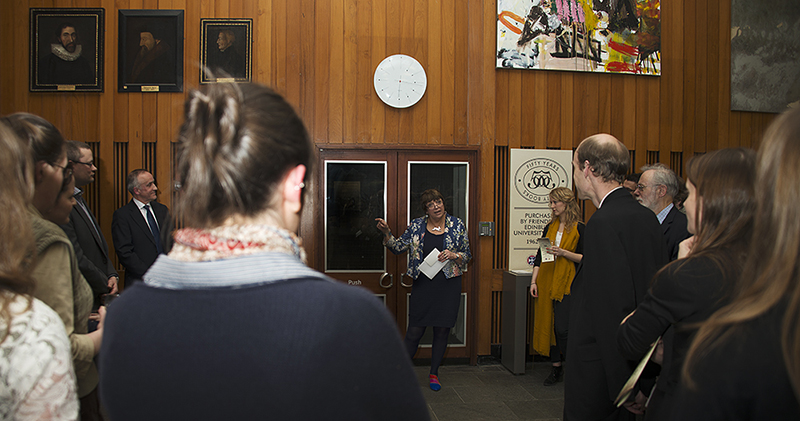
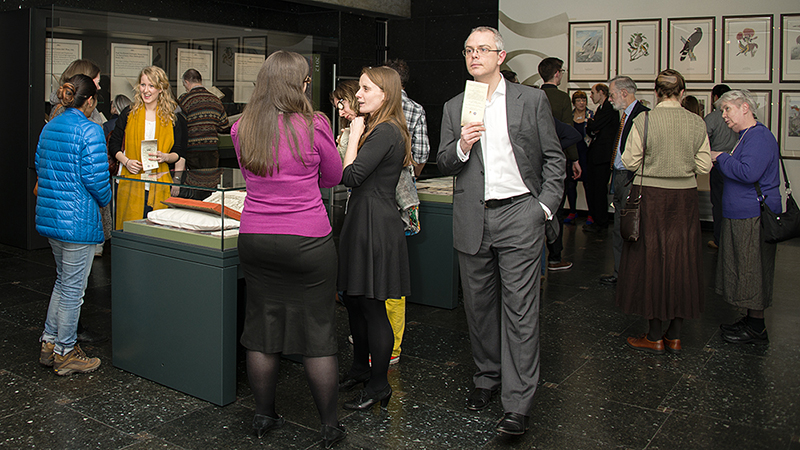
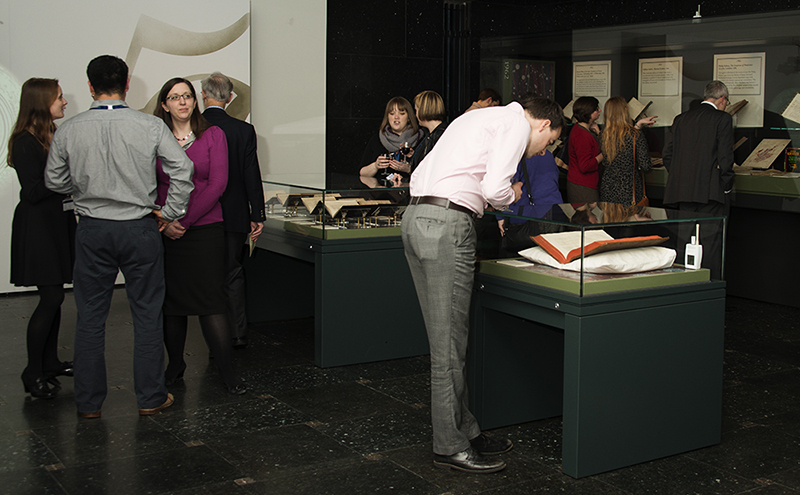
It would be a terrific resource to have the previous issues of The Piper made available as pdf downloads from The Friends website. The current exhibition in the Main Library celebrates Fifty Years, Fifty Books: purchases by the Friends of Edinburgh University Library, 1962-2012 Exhibition Gallery, Main Library, George Square 28 March to 14 June 2014. The exhibition is well worth a look and illuminating as usual. The DIU also photograph all exhibition openings in the Library. Below are some images from the 50/50 opening night.
Malcolm Brown, Deputy Photographer.
The simple art of reference writing
As I am now coming to the end of my time in Edinburgh cataloguing the papers of Professor Sir Godfrey Thomson, references aren’t terribly far from my mind! But I had some pause for thought after a conversation with my eighty-one year old Grandmother. While most of my Grandmother’s contemporaries now shop, talk, and bank online, she remains resolutely uninterested. When I explained I would never see my references – they would be e-mailed, uploaded, etc, my Grandmother was particularly disdainful.
For once, I found myself rather agreeing with her. References were often treasured by the subject, years after they no longer had use for them. They were a courtesy, a kindness. While their primary function was to allow the receiver to gain further employment, they were also an acknowledgement of their hard work, and usually written by someone the receiver respected and admired. References are still, undoubtedly, all of these things – but now, of course, the subject rarely has a copy, and employees rarely keep them for any length of time.
Thomson’s collection contains two – one from the Nobel Prize winning physicist, Karl Ferdinand Braun, and one from educator and historian of music, Sir William Henry Hadow:
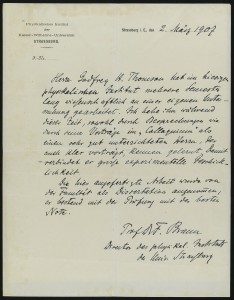
- Reference from Professor Ferdinand Braun


Reference from Sir William Henry Hadow
Both are highly complimentary. Hadow describes Thomson as ‘one of my most distinguished students…a man of very pleasant manners and address…extremely popular in college’, and praises his ‘remarkable power of influencing others for good’.
Hadow was Professor of Education at Armstrong College while Thomson was in turn a student then lecturer. Both had in common a love of music – Hadow frequently wrote on the topic, while Thomson was a skilled pianist. We know that both Thomson and Hadow were interested in the role that music could play in a liberal education, and Thomson’s lectures on teaching music survive in his collection. The notes written on the reverse of the reference are in Lady Thomson’s hand, and comment on Thomson and Hadow’s harmonious friendship and working relationship.
Braun was Professor of Physics at Strasbourg while Thomson was undertaking his DSc, supervised by Braun. He was an inventor, and experimented widely with wireless telegraphy. No doubt he would have been an exiting person for the young Thomson to work with, and it would appear the feeling was mutual – he describes him as well informed, and showing great ‘experimental ingenuity’.
Part of the reason these references meant to much to Thomson is because they were unique, and written in the hand of men whom he had a great deal of respect for. While archivists are widely encouraged to see the beauty in bit code as much as they can illuminated letters (a gross exaggeration on my part!) I’m not quite sure how this will translate in our current day record creation. Laying the ever evolving issues of digital preservation aside, references simply aren’t prescribed with long term value. Which is a shame, because however biased they may be (which they are supposed to be – they are, after all, the opinion of the writer!) they certainly tell us a good deal about the subject.
With thanks to Simone Müller and Christina Schmitz for their translations, and to Serena Frederick for pestering them for said translations!
Confusing Green Open Access policies
Elsevier’s Green Open Access policy on self-archiving is so confusing even the Elsevier Customer Service department don’t know what it is.
A few weeks ago one of my colleagues was trying to find out whether they could self-archive a paper published in an Elsevier journal in our institutional repository. The normal procedure is to check the SHERPA RoMEO database, followed by looking at the journal’s webpages. In this particular case there was no information from either sources:
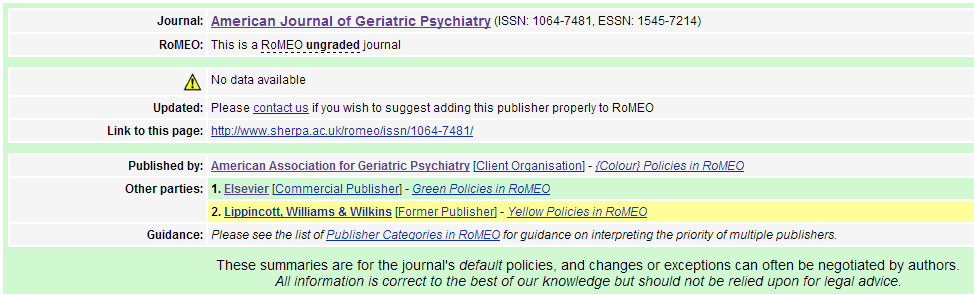
Given the lack of information my colleague took the reasonable step of contacting Elsevier via their ‘Help & Contact’ web form on 7th April 2014 to ask what is the self-archiving policy for the Journal of Geriatric Psychiatry. The following response was received (names have been pixelated to preserve anonymity):

The same response was sent again on 16th and 22nd April. Finally my colleague received the following email asking why they wanted to know: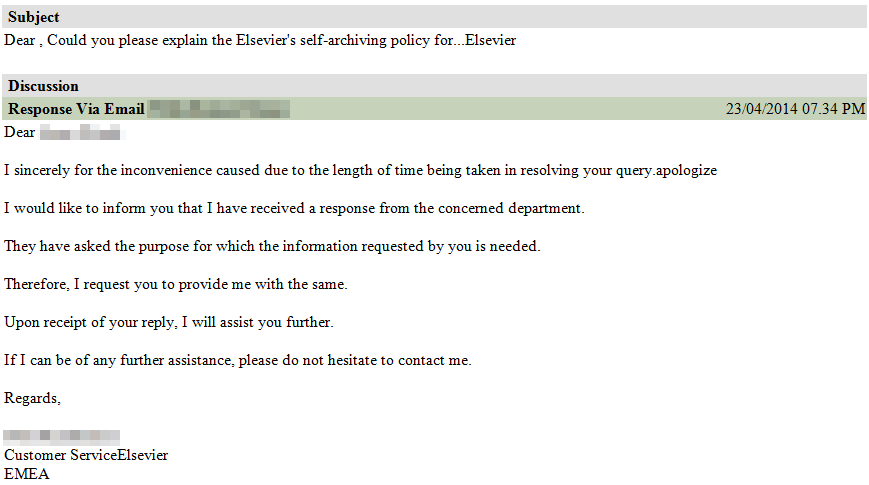
So far it has taken 12 working days to not answer a simple question.
If Elsevier’s customer support staff don’t know what the Green Open Access policy of one of their own journals is then how is an academic author supposed to find out?
As it turns out the journal in question has a 12 month embargo period. After digging round the Elsevier webpages we found the information is buried in a link to a PDF.
The length of embargo periods is a contentious area. Most reasonable people would agree that a period of exclusivity is required for publishers to reap some financial benefit from their subscription-based business model. The majority of UK based funders of research (Research Councils and Charities) recognise this and typically implement a 6 month time period in their open access policies to accommodate any journal embargo periods. It is telling to note that many hybrid publishers have increased journal embargos to periods longer than those recommended by research funders. This in effect forces many researchers to choose paid for open access services offered by publishers.
UPDATE
After more than 3 weeks the enquiry was finally passed to the correct Customer Support Team who provided a full satisfactory response on 30 April 2014:
Please accept my apologies that your original enquiry dated 7th April has just been brought to the attention of the Open Access Customer Support Team. I believe that your enquiry was regarding an explanation as to ‘s self-archiving policy for The American Journal of Geriatric Psychiatry and the relevant embargo period, but to date you have yet to receive a full response. I would like to provide you with the following information.Elsevier
The process in which an Author can share their research by self-archiving a draft copy to a repository or website, is referred to as Green Open Access. The following link will provide you with full information and clear instructions as this approach to Open Access http://www.elsevier.com/about/open-access/green-open-access. The website also provides clear details of ’s journal specific posting policy Elsevierhttp://www.elsevier.com/about/open-access/open-access-policies/article-posting-policy and confirms that the embargo period for this journal title is 12 months.
Outdoor Exhibition Bristo Square
Images created by the Digital Imaging Unit feature in a new exhibit outside the Dugald Stewart Building in Bristo square. It is fantastic to see how well our images respond to being enlarged many times beyond the original object size. It justifies our workflow of capture once at high quality re-purpose many times. Indeed these images were created at various times and were pulled together from our online resource for this exhibit. This exhibit also makes us keenly aware of the importance of our colour management workflow. We use hardware to colour calibrate our monitors after every 200 hours of use and it pays off when you see the images in an unusual format greatly enlarged and in broad daylight.
Malcolm Brown, Deputy Photographer


Study space during exams
 Need help finding study space?
In order to help ease pressure on study spaces in the Main Library during the exam period, Information Services (IS), EUSA and the University central room bookings team have worked together to identify alternative study spaces in the Central Area.
The map includes information on how far each alternative study space is from the Main Library and also information on opening hours, what kind of study space is available, if pcs and/or cloud printing is available, etc. These spaces are all available from 21 April-9 May 2014, with access to the libraries and open access computing labs mentioned available outwith this period as well.
*The extra study space in the David Hume Tower (DHT) is being opened on weekend of Saturday 3 and Sunday 4 May, 9am-9pm. See map for room details.*
You can access the map at http://www.ed.ac.uk/schools-departments/information-services/students/study-space
The map is also on display in the concourse of the Main Library as you come through the entrance gates (next to the plasma screen).
Outwith the central area there are other site libraries with study space available. You can find a full list of site libraries at http://www.ed.ac.uk/is/library-locations
Remember there is a free shuttle bus service that runs between the Central Area and King’s Buildings (KB) campus during semester Mon-Fri 8.18am-6.25pm. Shuttle bus timetable: http://www.ed.ac.uk/staff-students/students/shuttlebus
The Main Library is open as always 7.30am-2.30am seven days a week and during revision and exam periods there are restrictions placed on external reference/consultation users access to the building during the day, to ensure that optimal study space is available to University of Edinburgh students.
Caroline Stirling – Academic Support Librarian for Social and Political Science.
IDCC 2014 – take home thoughts
A few weeks ago I attended the 9th International Digital Curation Conference in San Francisco. The conference was spread over four days, with two days for workshops, and two for the main conference. The conference was jointly run by the Digital Curation Centre and the California Digital Library. Unsurprisingly it was an excellent conference with much debate and discussion about the evolving needs for digital curation of research data.

The main points I took home from the conference were:
Science is changing: Atul Butte gave an inspiring keynote that contained an overview of the ways in which his own work is changing. In particular he explained how it is now possible to ‘outsource’ parts of the scientific process. He gave two particular examples. The first is the ability to visit a web site to buy tissue samples for specific diseases which were previously used for medical tests, but which have now been anonymised and collected rather than being discarded. Secondly it is also now possible to order mouse trials to be undertaken, again via a web site. These allow routine activities to be performed more quickly and cheaply.
Big Data: This phrase is often used and means different things to different people. A nice definition given by Jane Hunter was that curation of big data is hard because of its volume, velocity, variety and veracity. She followed this up by some good examples where data have been effectively used.
Skills need to be taught: There were several sessions about the role of Information Schools in educating a new breed of information professionals with the skills required to effectively handle the growing requirements of analysing and curating data. This growth was demonstrated by how we are seeing many more job titles such as data engineer / analyst / steward / journalist. It was proposed that library degrees should include more technical skills such as programming and data formats.
The Data paper: There was much discussion about the concept of a ‘Data Paper’ – a short journal paper that describes a data set. It was seen as an important element in raising the profile of the creation of re-usable data sets. Such papers would be citable and trackable in the same ways as journal papers, and could therefore contribute to esteem indicators. There was a mix of traditional and new publishers with varying business models for achieving this. One point that stood out for me was that publishers were not proposing to archive the data, only the associated data paper. The archiving would need to take place elsewhere.
Tools are improving: I attended a workshop about Data Management in the Cloud, facilitated by Microsoft Research. They gave a demo of some of the latest features of Excel. Many of the new features seem to nicely fit into two camps, but equally useful and very powerful to both. Whether you are looking at data from the perspective of business intelligence or research data analysis, tools such as Excel are now much more than a spreadsheet for adding up numbers. They can import, manipulate, and display data in many new and powerful ways.
I was also able to present a poster that contains some of the evolving thoughts about data curation systems at the University of Edinburgh: http://dx.doi.org/10.6084/m9.figshare.902835
In his closing reflection of the conference, Clifford Lynch said that we need to understand how much progress we are making with data curation. It will be interesting to see the progress made and what new issues are being discussed at the conference next year which will be held much closer to home in London.
Stuart Lewis
Head of Research and Learning Services
IDCC 2014 – take home thoughts
A few weeks ago I attended the 9th International Digital Curation Conference in San Francisco. The conference was spread over four days, with two days for workshops, and two for the main conference. The conference was jointly run by the Digital Curation Centre and the California Digital Library. Unsurprisingly it was an excellent conference with much debate and discussion about the evolving needs for digital curation of research data.

The main points I took home from the conference were:
Science is changing: Atul Butte gave an inspiring keynote that contained an overview of the ways in which his own work is changing. In particular he explained how it is now possible to ‘outsource’ parts of the scientific process. The first is the ability to visit a web site to buy tissue samplesfor specific diseases which were previously used for medical tests, but which have now been anonymised and collected rather than being discarded. Secondly it is also now possible to order mouse trials to be undertaken, again via a web site. These allow routine activities to be performed more quickly and cheaply.
Big Data: This phrase is often used and means different things to different people. A nice definition given by Jane Hunter was that curation of big data is hard because of its volume, velocity, variety and veracity. She followed this up by some good examples where data have been effectively used.
Skills need to be taught: There were several sessions about the role of Information Schools in educating a new breed of information professionals with the skills required to effectively handle the growing requirements of analysing and curating data. This growth was demonstrated by how we are seeing many more job titles such as data engineer / analyst / steward / journalist. It was proposed that library degrees should include more technical skills such as programming and data formats.
The Data paper: There was much discussion about the concept of a ‘Data Paper’ – a short journal paper that describes a data set. It was seen as an important element in raising the profile of the creation of re-usable data sets. Such papers would be citable and trackable in the same ways as journal papers, and could therefore contribute to esteem indicators. There was a mix of traditional and new publishers with varying business models for achieving this. One point that stood out for me was that publishers were not proposing to archive the data, only the associated data paper. The archiving would need to take place elsewhere.
Tools are improving: I attended a workshop about Data Management in the Cloud, facilitated by Microsoft Research. They gave a demo of some of the latest features of Excel. Many of the new features seem to nicely fit into two camps, but equally useful and very powerful to both. Whether you are looking at data from the perspective of business intelligence or research data analysis, tools such as Excel are now much more than a spreadsheet for adding up numbers. They can import, manipulate, and display data in many new and powerful ways.
I was also able to present a poster that contains some of the evolving thoughts about data curation systems at the University of Edinburgh: http://dx.doi.org/10.6084/m9.figshare.902835
In his closing reflection of the conference, Clifford Lynch said that we need to understand how much progress we are making with data curation. It will be interesting to see the progress made and what new issues are being discussed at the conference next year which will be held much closer to home in London.
Stuart Lewis
Head of Research and Learning Services
Library & University Collections, Information Services
1940s Dunfermline College of Physical Education: We’ve Found Another One!
Last week I was having a chat with our conservator Emma Davey who sits at the desk next to mine. In passing she mentioned that she thought her Grandmother, Bettina, went to Dunfermline College of Physical Education in the 1940s before becoming a P.E. Teacher.
Towards the end of the afternoon I suggested we go and have a quick look in the DCPE archives for anything that she could take a copy of and show her Granny, when she visited. We didn’t expect to find much, just perhaps an idea of what she studied and a few photographs of buildings.
Within minutes we found a reference to her in the Old Student Association reports about her sharing a flat with another Douglas (they shared the same surname) and getting called locally as the ‘Twa Dugs’!
Another minute later and I had found a photograph of her that had been sent with her application when she was about 18. Here is Bettina with that photograph, now aged 90.
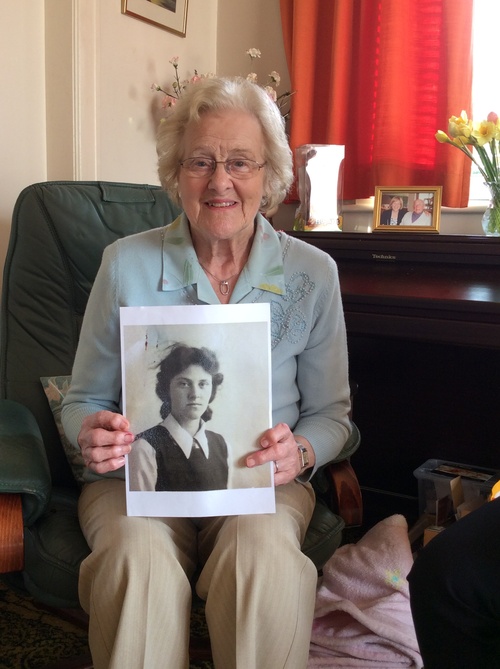
She thinks the picture she is holding was taken while she was still at school and before she went to college in the early 1940s. She told Emma that she had a lot of fun at her “digs” with the other girls, and she remembers that she ended up having to oil a squeaky door in her digs so the landlady wouldn’t hear them coming back from the “local hops”!
Thanks to Emma and Bettina for sharing this with us!
Rachel Hosker
International Earth Day
Tuesday 22nd April has been designated by the UN as International Mother Earth Day. It is a day of action where people from all over the planet do something on behalf of the environment – through local campaigns to pick up litter, plant trees and clean up their communities, to online activism to contact their elected officials and influence policy changes. The University of Edinburgh contributes in part by carrying out original research and freely sharing this knowledge with the world adding to the growing global body of knowledge.
We wanted to highlight some of the materials in our Open Access collections that looks at research themes closely related to #MotherEarthDay – including sustainable development, renewable energy and global climate change:
1. Reducing uncertainty in predictions of the response of Amazonian forests to climate change (Lucy Rowland, PhD 2013)
Our understanding of global climate change is mainly based on computer modelling. To date there are few studies which have comprehensively tested vegetation models using ecological data from Amazon forests. Using data this thesis presents an investigation of how tropical forests respond to changes in climate and with what certainty scientists can model these changes in order to predict the response of Amazon forests to predicted future climate change.
2. Climate change uncertainty evaluation, impacts modelling and resilience of farm scale dynamics in Scotland (Michael Rivington, PhD 2011)
Climate change is a global phenomena that will have a wide range of local impacts on land use. The work undertaken in this PhD thesis indicates that agriculture in Scotland has the potential to cope with the impacts but that substantial changes are required in farming practices
3. Making sustainable development a reality: A study of the social processes of community-led sustainable development and the buy-out of the Isle of Gigha, Scotland (Robert Didham, PhD 2007)
This PhD thesis examines the concept of sustainable development with a primary focus on its advancement and implementation at a local level. This work is based on original ethnographic research that was conducted on the Isle of Gigha, Scotland following the community buy-out of the island that occurred in 2002.
4. Climate change and renewable energy portfolios (Dougal Burnett, PhD 2012)
The UK has a commitment to reduce greenhouse gases by at least 80% from 1990 levels by 2050. This will see the proportion of energy generated in the UK from renewable resources such as wind, solar, marine and bio-fuels is increasing and likely to dominate the future energy market over the next few decades. This PhD thesis explores the influence of climate change on renewable electricity generation portfolios and energy security in the UK, with the aim of determining if climate change will affect renewable energy resource in such a way that may leave future low carbon generation portfolios sub-optimal.
5. An Assessment of the Impact of Climate Change on Hydroelectric Power (Gareth Harrison, PhD 2001)
This PhD thesis describes a methodology to assess the potential impact of climatic change on hydropower investment, and details the implementation of a technique for quantifying changes in profitability and risk. A case study is presented as an illustration, the results of which are analysed with respect to the implications for future provision of hydropower, as well as our ability to limit the extent of climatic change.
Blood, Sweat and Photoshop – Preparations for the Degree Show
Tiina Lilja is a final year Painting student at Edinburgh College of Art. Earlier this year, we acquired two of Tiina’s paintings for the University Art Collection as she was an artist we had been following with interest for some time. As well as the physical art works, Tiina will also be providing us with unique insights into her career after graduation so that we get a sense of her working life post-Art School. In the first of these updates, Tiina writes about the lead up to the ECA Degree Show – the final and most significant part of the Art Student’s studies.
The Degree Show is due to open in just few weeks time and things here in the ECA are heating up: we, me and my fellow graduates to be, have been working hard to finish the pieces that are to be exhibited, we have met the external examiners, had our final tutorials and hopefully, yet not definitely, are all set to proceed with the installation of the show in the 5th of May.
First step in getting the degree show ball rolling is choosing the space you wish to use and writing a proposal outlining the reasons why you (or your group) should be given this particular spot. The Degree Show in ECA, mainly takes place in converted studios: partitions get taken down, new ones get built and everything gets a fresh lick of paint. The spaces vary, fortunately, so do the needs of different artists: some studios have more light, some have higher walls, some can be darkened etc.
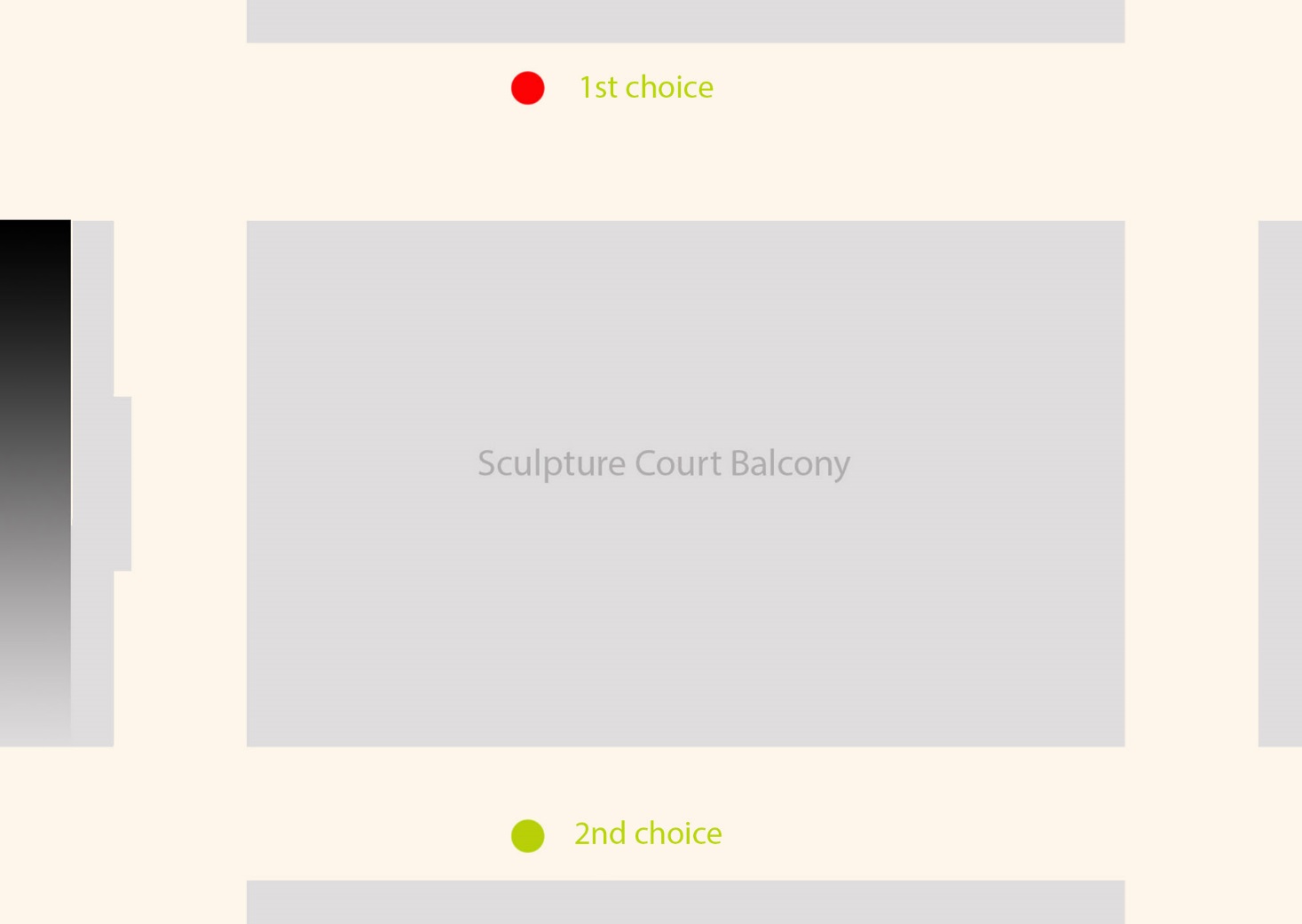
I chose to apply for the Sculpture Court balcony, as my wish was to show my pieces on a single wall. The space seemed ideal for me regarding the length and height of the walls, lighting and visibility. Therefore my proposal contained technical details of the space I wanted, a list pieces I wished to exhibit, a justification, a map, and some very, hmmmn, skilfully photoshopped mock-ups on what the hanging would look like. A drawn plan would have been sufficient, but I liked the idea of seeing what the pieces would look like in that space.
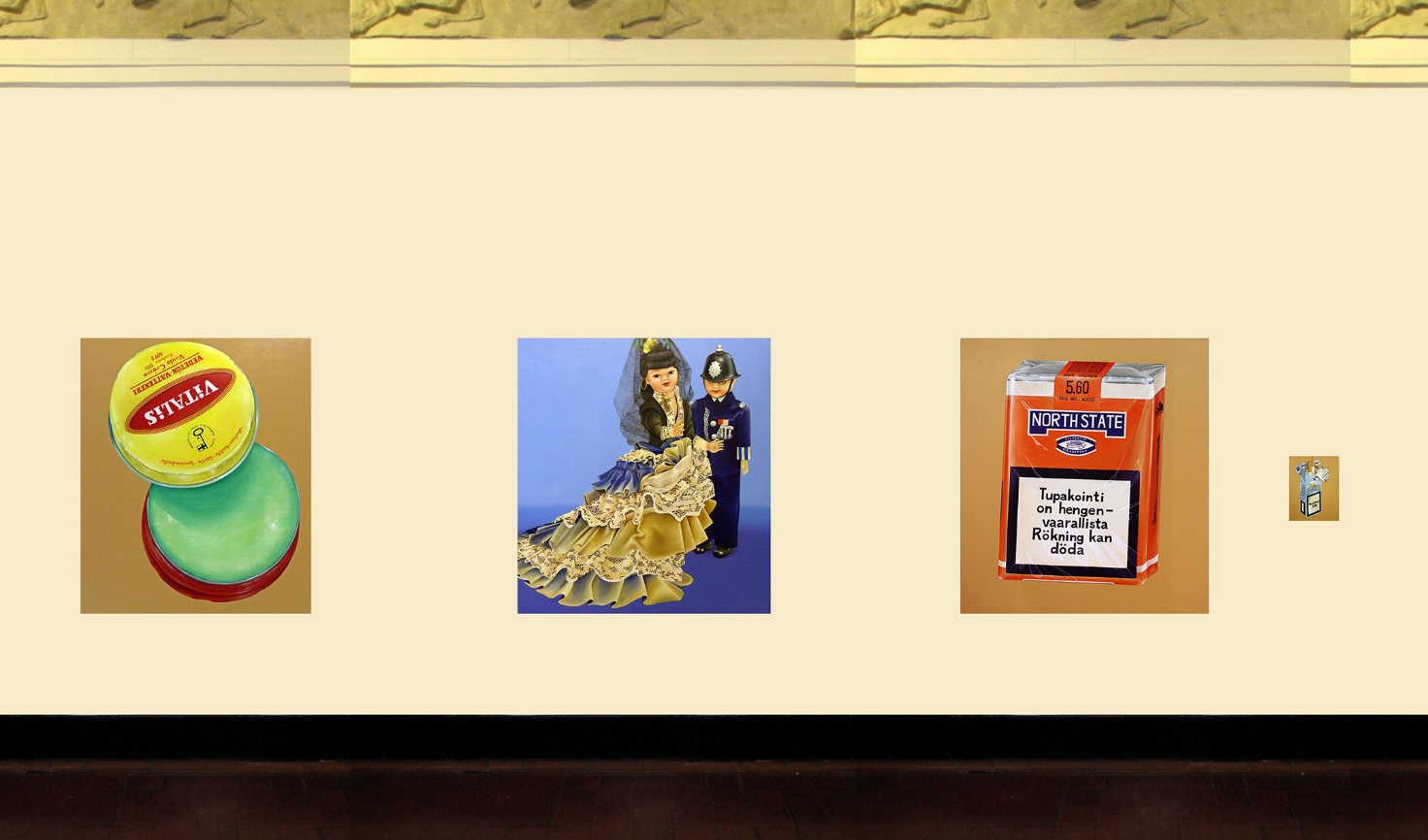
Degree Show Proposal: hanging mock-up
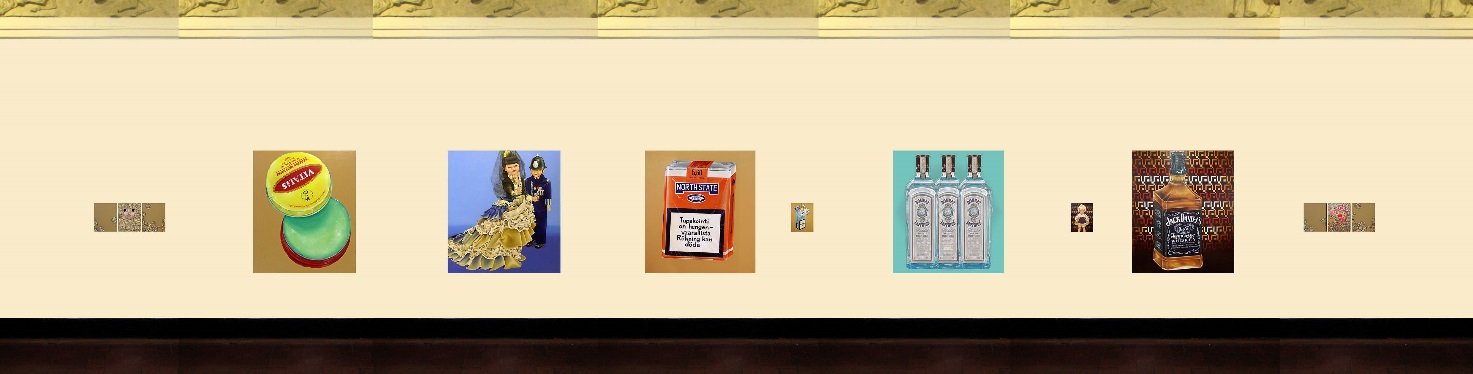
Degree Show Proposal: Full mock-up
Naturally, some proposals need more information that mine. Every feature that is not already in the space needs to be mentioned: if you want a wall built, write that you want a wall – if you need seven hundred dancing racoons, write that you are going to get some racoons. Be sensible, the College is not Santa – they will built partitions and give you paint for the walls, but the racoons, projectors, monitors etc. you need to sort out on your own.
Yeah, and the Health & Safety Man might need a word about those racoons…
When spaces have been appointed, things get a little simpler. I finished my last painting couple days ago and touched up all of the grotty corners and edges of old pieces. Then I let myself go nuts with bubble wrap. Like mommy used to say, better be safe than sorry when storage is concerned.
By now, I have also said goodbye to the studio I worked in since September for the clearing out to take place. But after being booted out, we can still work towards the show by ordering business cards, sorting out invites, planning the pricing of the work etc. There will be a week to get our spaces in order: a week of dense curating, fixing the walls, building our exhibits, crying, polishing, hammering, crying… and if I survive, I am hoping to see you all at the show!
Tiina Lilja
Collections
 Hill and Adamson Collection: an insight into Edinburgh’s past
My name is Phoebe Kirkland, I am an MSc East Asian Studies student, and for...
Cataloguing the private papers of Archibald Hunter Campbell: A Journey Through Correspondence
My name is Pauline Vincent, I am a student in my last year of a...
Hill and Adamson Collection: an insight into Edinburgh’s past
My name is Phoebe Kirkland, I am an MSc East Asian Studies student, and for...
Cataloguing the private papers of Archibald Hunter Campbell: A Journey Through Correspondence
My name is Pauline Vincent, I am a student in my last year of a...
Projects
Cataloguing the private papers of Archibald Hunter Campbell: A Journey Through Correspondence
My name is Pauline Vincent, I am a student in my last year of a...
Archival Provenance Research Project: Lishan’s Experience
Presentation My name is Lishan Zou, I am a fourth year History and Politics student....