Home University of Edinburgh Library Essentials
June 15, 2026
Trial – Film Industry Data
 We have trial access to Film Industry Data from Academic Rights Press until the 9th March.
Film Industry Data enables the gathering of information about film trends and research into the impact of film across countries and cultures. Films tell us about global culture, politics and society. Now you can get the facts behind the film industry with the exclusive Nielsen backed Film Industry Data collection. This database synthesises movie industry data to help you make new connections, gain valuable insights and tell new stories
Feedback and further info
We are interested to know what you think of this database as your comments influence purchase decisions so please do fill out our feedback form.
A list of all trials currently available to University of Edinburgh staff and students can be found on our trials webpage.
Managing data: photographs in research
In collaboration with Scholarly Communications, the Data Library participated in the workshop “Data: photographs in research” as part of a series of workshops organised by Dr Tom Allbeson and Dr Ella Chmielewska for the pilot project “Fostering Photographic Research at CHSS” supported by the College of Humanities and Social Science (CHSS) Challenge Investment Fund.
In our research support roles, Theo Andrew and I addressed issues associated with finding and using photographs from repositories, archives and collections, and the challenges of re-using photographs in research publications. Workshop attendants came from a wide range of disciplines, and were at different stages in their research careers.
First, I gave a brief intro on terminology and research data basics, and navigated through media platforms and digital repositories like Jisc Media Hub, VADS, Wellcome Trust, Europeana, Live Art Archive, Flickr Commons, Library of Congress Prints & Photographs Online Catalog (Muybridge http://hdl.loc.gov/loc.pnp/cph.3a45870) – links below.

From the Library of Congress Prints and Photographs Online Catalog
Then, Theo presented key concepts of copyright and licensing, which opened up an extensive discussion on what things researchers have to consider when re-using photographs and what institutional support researchers expect to have. Some workshop attendees shared their experience of reusing photographs from collections and archives, and discussed the challenges they face with online publications.
The last presentation tackling the basics of managing photographic research data was not delivered due to time constraints. The presentation was for researchers who produce photographic materials, however, advice on best RDM practice is relevant to any researcher independently of whether they are producing primary data or reusing secondary data. There may be another opportunity to present the remaining slides to CHSS researchers at a future workshop.
ONLINE RESOURCES
- Jisc Media Hub http://jiscmediahub.ac.uk/
- Visual Arts Data Service (VADS) http://www.vads.ac.uk/
- Wellcome Trust Image Collection http://wellcomeimages.org/
- British Library Catalogue of Photographs http://www.bl.uk/catalogues/photographs/
- Europeana http://europeana.eu/
- UK Data Service discover http://discover.ukdataservice.ac.uk/
- Library of Congress Prints & Photographs Online Catalog http://www.loc.gov/pictures/
- Live Art Archive http://www.bris.ac.uk/theatrecollection/liveart/liveart_archivesmain.html
- Flickr Commons Project https://www.flickr.com/commons
LICENSING
- Intellectual Property Office (IPO) https://www.gov.uk/government/uploads/system/uploads/attachment_data/file/305165/c-notice-201401.pdf
- Bern Convention http://www.wipo.int/treaties/en/ip/berne/index.html
- WIPO Copyright Treaty http://www.wipo.int/treaties/en/text.jsp?file_id=295166
- Copyright lengths: http://en.wikipedia.org/wiki/List_of_countries%27_copyright_lengths
- Creative Commons License http://creativecommons.org/
- Flickr (CC or Copyright)https://www.flickr.com/explore
- Wikimedia (CC) http://commons.wikimedia.org/wiki/Category:Photographs
- Wikimedia Licensing guide http://commons.wikimedia.org/wiki/Commons:Licensing
Recycling at the Annexe (It’s easy bein’ green)
We’re happy to report that the Library Annexe has joined University’s (recycling) efforts to make our planet a wee bit more sustainable. Every little step in the right direction helps, so next time when at the Library Annexe please recycle your litter.
“No dogma taught by the present civilization seems to form so insuperable an obstacle in the way of a right understanding of the relations which culture sustains to wildness, as that which declares that the world was made especially for the uses of men. Every animal, plant, and crystal controverts it in the plainest terms. Yet it is taught from century to century as something ever new and precious, and in the resulting darkness the enormous conceit is allowed to go unchallenged.”
John Muir
John Muir was a Scottish-American advocate of preservation of wilderness, born in Dunbar, East Lothian. If you want to know more about John Muir the University Library has a small collection of his works or you can visit his birthplace in Dunbar.

Recycling bins at the Library Annexe
Find “John Muir : apostle of nature” on the library catalogue
The University of Edinburgh’s Waste & Recycling department
Information on the John Muir Way
Marko Mlakar, Library Annexe Assistant
Cite Them Right – downtime
 Cite Them Right will be unavailable between 08:00am and 10:00am on Thursday 12th February. This is due to essential maintenance.
Recent acquisition – Sketch-books of Scottish architect Charles Lovett Gill (1880-1960)

Cover to the sketchbook ‘British Embassy design 1905’, by Charles Lovett Gill. Coll-1603.
Recently, a group of 13 sketch-books by the Scottish architect Charles Lovett Gill were acquired by the Centre for Research Collections (Special Collections) for Edinburgh University Library. Gill was notable for his long-term architectural partnership with Professor Sir Albert Edward Richardson (1880-1964).

Notes about the ambition for the sketch-book ‘British Embassy design 1905’, by Charles Lovett Gill. Coll-1603.
Gill was born in 1880. He trained as an architect with E. G. Warren of Exeter, and he studied at the Royal Academy Schools. In 1904 he was the Ashpitel Prizeman (an annual architectural award in the name of Arthur Ashpitel) of the Royal Institute of British architects (RIBA), and he became an Associate of RIBA in 1905, and a Fellow in 1915 in recognition for his contribution to architecture in England.

One of the edifices in the sketch-book ‘British Embassy Design 1905’ by Charles Lovett Gill. Coll-1603.
Gill started a practice in London in 1908 and did much work in central London. With Professor Sir Albert Richardson he was joint architect for the Duchy of Cornwall estate in Devon. The Richardson & Gill architectural partnership was eventually dissolved in 1939.

One of the edifices in the sketch-book ‘British Embassy Design 1905’ by Charles Lovett Gill. Coll-1603.
Gill presented a design in the competition for the rebuilding of the Regent Street Quadrant in London, and he was responsible for the facade of the then Regent Street Polytechnic (now part of University of Westminster). Much of his work was in the City of London where he designed Moorgate Hall, Finsbury Pavement and other buildings in Moorgate and elsewhere. Charles Lovett Gill died on 26 March 1960.

One of the edifices in the sketch-book ‘British Embassy Design 1905’ by Charles Lovett Gill. Coll-1603.
The recently acquired collection of Gill sketch-books contain pencil and watercolour tinted sketches of various places done between 1904 and 1941. One of the sketchbooks bound in linen is titled British Embassy Design 1905 and it may be a project set by his tutors. It contains sketches of a number of buildings in Paris and London with neatly finished elevations of a planned and very large Beaux-Arts edifice – a British Embassy in a foreign capital – that would dominate any chosen site. It was a grand building which, according to Gill’s notes in the sketch-book, was to ‘face a public park or square’.

One of the edifices in the sketch-book ‘British Embassy Design 1905’ by Charles Lovett Gill. Coll-1603.
Other sketch-books contain drawings, sometimes colour tinted, of buildings and architectural features in Paris, London and in other parts of Britain.

Water-colour of Notre Dame, Paris, by Charles Lovett Gill. Coll-1603.

St. Paul’s, Covent Garden, London, by Charles Lovett Gill. Coll-1603.

Parish Church of St. Alfege, Greenwich by Charles Lovett Gill. Coll-1603.

Gutterings and down-pipes, by Charles Lovett Gill. Coll-1603.
Dr. Graeme D. Eddie, Assistant Librarian Archives & Manuscripts, Centre for Research Collections
Tackling a Library time capsule : The Longforgan Free Church Ministers Library
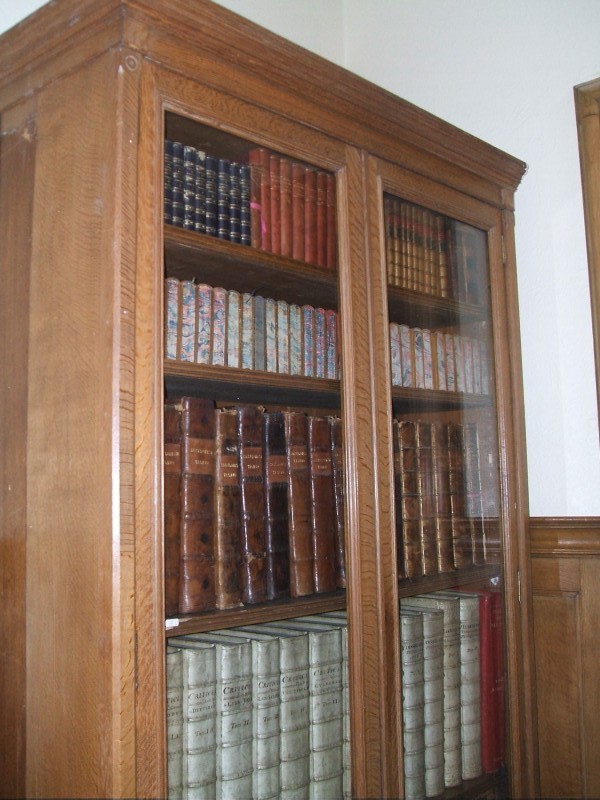 Regular visitors to New College Library have probably walked past the Longforgan Free Church Ministers Library many times. It sits in custom made glazed bookcases, which are sited on the landing of the entrance to the Library Hall and in the David Welsh Reading Room. The cataloguing of this collection is in progress as part of the Funk Projects, and we’ve recently been pleased to welcome Patrick Murray as our cataloguer, replacing Finlay West who has moved on to new projects.
The Longforgan Library is an attractive part of the New College Library environment, but it’s probably true to say that for many years it has been just that – the books themselves have rarely been consulted. This may have been so from the very beginning – we’ve noticed that books being catalogued recently are in mint condition, some with pages uncut, as though they have never been read. This may fit with the Longforgan Library’s provenance as a gift to the Free Church at Longforgan, Dundee by Mr David Watson, owner of Bullionfield Paperworks at Invergowrie. Part of the Longforgan Library could have begun life as a showpiece collection for David Watson to illustrate his skills in printing and binding to clients.
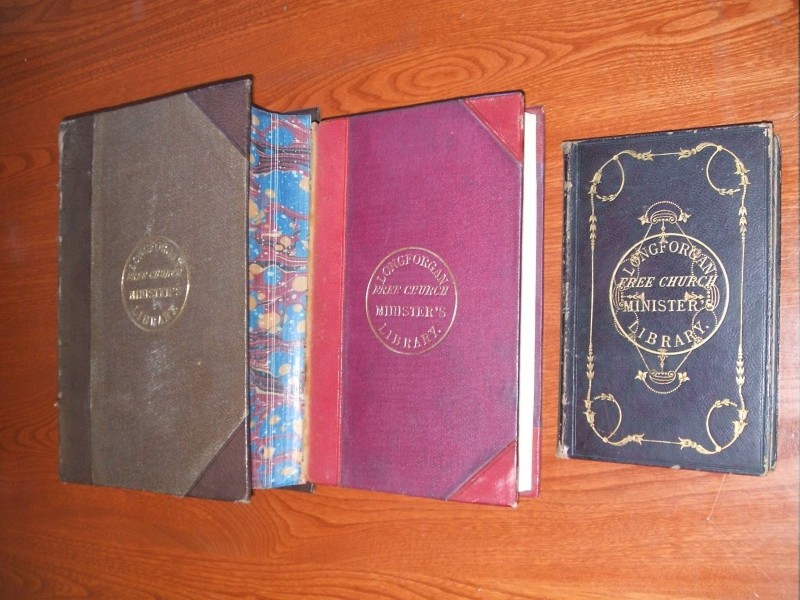 All this is changing with the benefits of online cataloguing. The Longforgan Library contains many volumes of the Acts of the General Assembly of the Church of Scotland from the seventeenth century onwards and the reports of the General Assembly of the Free Church of Scotland in the nineteenth century. For the first time these are being requested by readers, with telltale paper slips the evidence that the volumes are in use.
More than that, online cataloguing has revealed the richness of this collection of patristic and theological books, the earliest text printed in 1618. The works of Eusebius of Caesarea and Irenaeus of Lyon sit alongside those of Jean Calvin and John Foxe in a microcosm of New College Library’s historic collections as a whole. And it’s held surprises for us – one of them being that we discovered additional books hidden in concealed compartments in the back of the bookcases.

Castori romanorum cosmographi : tabula quae dicitur Peutingeriana / recognovit Conrad Miller. Ravensburg : Otto Maier, 1888
New College Library LON. 416
This included this fantastic facsimile of the Tabula Peutingeriana or Peutinger’s Tabula. Based on an early fourth or fifth century original, the map covers the area roughly from southeast England to present day Sri Lanka and shows the Roman road network. When we unfolded the map it stretched the length of the office!

The Longforgan Free Church Ministers Library still has treasures to discover. There are cupboards yet to unlock which have books stacked back to back in them, plus there is a further sequence of Longforgan books in a more secure location which includes three early editions of the Babylonian Talmud. Watch this space.
Christine Love-Rodgers – Academic Support Librarian, Divinity
Edinburgh’s first geneticist: Arthur Darbishire (1879-1915)
 In 1911, the University of Edinburgh appointed its first Lecturer in Genetics. The Lectureship was the first academic genetics post in Britain – the Balfour Chair in Genetics at the University of Cambridge did not come into existence until a year later. The incumbent of the Lectureship was a man called Arthur Dukinfield Darbishire, a scientist who had already caused a stir in the so-called ‘Mendel Wars’.
Darbishire was educated at Balliol College, Oxford, where he studied zoology. But in 1899, a discovery (or, rather, rediscovery) was made which changed the face of science forever. Three scientists independently stumbled across the findings of an Augustinian monk, Gregor Mendel, who had conducted a perfectly-designed study of inheritance and transmission of characteristics by cross-breeding peas growing in his monastery garden. Mendel’s ideas – his discovery of the 3:1 ratio of dominant to recessive types (terminology which he coined) and his hypothesis of invisible ‘factors’ – which we now call ‘genes’ – causing certain traits in predictable ways, were published in 1866, but remained virtually unknown for over three decades. When they were finally rediscovered, the science of ‘genetics’ was born.

Page from Notebook of Arthur Darbishire (c.1902), Edinburgh University Library Special Collections, EUA 1N1/ACU/A1/3/6
Excitedly, Darbishire soon deviated from pure zoological studies to pursue problems of heredity. In the first few years of the twentieth century he began a series of breeding experiments, crossing Japanese waltzing mice with albinos to demonstrate the variability in the distribution of inherited coat colour. One of his research notebooks (pictured) from around this time, which exists in Edinburgh University Library Special Collections, reveal his neatly outlined hybridisations and notes from research and reading. At this point, Darbishire’s interests lay in the biometric rather than a Mendelian approach to heredity (the premise that heredity relies on continuous rather than discontinuous variation), but when he became Demonstrator in Zoology at the University of Manchester in 1902, he began to reassess the Mendelian approach. He continued his experiments with mice in the light of his earlier biometric position, and concluded that the supposed contradiction between the two theories was due more to differences of opinion rather than inherent theoretical incompatibilities, despite the heated and bitter debates between various scientists from both theoretical camps. Caught in the crossfire, Darbishire cut himself adrift from both schools of thought, maintaining an independent and critical distance.

Darbishire in uniform (1915), Edinburgh University Library Zoology collection
Darbishire left Manchester for a spell as Senior Demonstrator and Lecturer in Zoology at the Royal College of Science before his appointment to the University of Edinburgh. Once he took up his position as Lecturer in Genetics, Darbishire had the run of the University’s Experimental Farm for his breeding experiments. By 1914, Darbishire was delivering lectures at the University of Missouri, Columbia, and was so successful that he was offered professorships from two American universities. However, Darbishire felt he could not leave England after the outbreak of war. Upon returning, he was pronounced unfit for the Army (due to ‘physical delicacy’) but in July 1915 he tried a second time at a recruiting office, where he was accepted and enrolled as a private in the 14th Argyll and Sutherland Highlanders. His sister Helen wrote that ‘[h]e devoted himself to his duties as a soldier with the same zest and the same meticulous attention to detail that marked his work in other spheres, and he won the love and admiration of his comrades.’ However, within less than six months, Darbishire contracted cerebral meningitis whilst in military camp at Gailes. He died on Christmas Day 1915. Three days after his death, he was gazetted Second Lieutenant in the Royal Garrison Artillery.
Had he lived, Darbishire would doubtless have taken on the directorship of the Animal Breeding Research Station, established in 1920 to apply the new science of genetics to the practical improvement of the farming and livestock industry. The directorship of the Station (later the Institute of Animal Genetics) passed instead to one of Darbishire’s students, Francis Crew, who transformed the Institute into one of the foremost centres of genetics research in the world, and laid the foundations for Edinburgh’s continuing excellence in the biological sciences. Edinburgh University Library Special Collections holds various items relating to Arthur Darbishire, many of which have been catalogued as part of the Wellcome Trust-funded ‘Towards Dolly’ project. As well as his notebook, there are some photographic portraits and his collected offprints, many bearing his signature. These items are intimate souvenirs of the life and legacy of Edinburgh’s first geneticist.
Helen Darbishire, who was later Principal of Somerville College Oxford, wrote of her brother in 1916:
All who knew him will keep in memory a personality alive and young to a rare degree, fulfilling itself in a passion for music, much laughter, a perfectly disinterested love of truth, a delight in producing delight in others, and the keenest possible interest in life itself whichever way it led him.
Reference:
Helen Darbishire, Preface to An Introduction to Biology and other papers by A.D Darbishire (Cassell and Company Ltd, 1917)
Clare Button
Project Archivist ‘Towards Dolly: Edinburgh, Roslin and the Birth of Modern Genetics’
SPS have top Resource List of semester one!
Sociology 1A had the most used Resource List of semester one, 2014/15, with an average of 67.3 visits per student.
Find out what the course organisers, tutors and students thought about their Resource List and how useful it was for them.
Sociology 1A – Students and Tutors
Interested in creating a successful Resource List for your course? Or just want to find out more about Resource Lists?
See the Resource Lists @ Edinburgh website or their blog: https://libraryblogs.is.ed.ac.uk/resourcelists/
Caroline Stirling – Academic Support Librarian for Social and Political Science
The Working Lives of Ordinary Scots
We know shockingly little of how ordinary Scottish people spent their working lives in the past. We know even less about the work women did. An intriguing comment by the minister of Rogart in the 1790s suggests that whatever it was, it was important. He maintained that a family working for one of the ‘farmers in better circumstances’ were as well off as their masters if, but only if, the wife was industrious. What was it that these industrious women did that was so vital?
I am a great fan of the thick descriptions of life in the 1790s contained in the drily-entitled First Statistical Account of Scotland. They contain surprisingly few statistics and are fantastic sources for glimpsing into the experiences of ordinary people. I thought I would find out how women were spending their time and energy in the eight Sutherland parishes near my home: Creich, Lairg, Rogart, Dornoch, Golspie, Clyne, Loth and Kildonan.
How work was divided up between the sexes was not an issue that was of particular interest to people in the 1790s so was not usually commented on. This leaves historians with the task of identifying little pieces of the jigsaw, the inadvertent remarks of long-dead commentators, and joining them up to create some sort of an incomplete picture. There are a few jobs, like spinning, which seem to be exclusively female and a lot where we don’t really know how labour was divided.
The late eighteenth century was the time of the first industrial revolution. Textile manufacturing on a commercial scale was developing all over Scotland, including in south-east Sutherland. Some Dornoch women processed flax on a small scale, but the biggest impact of this industry was in Brora and Spinningdale. By the 1790s two Brora men were in business as merchants. They imported goods from Aberdeen and London for sale in their shop, and they also imported lint. They paid as many as two to three thousand women to spin the lint in their own homes and then re-exported the yarn to the south. On the banks of the Kyle of Sutherland, David Dale tried to take the textile business one step further by manufacturing, rather than just preparing, raw materials. The venture came to a fiery end, but it provided an income not only for those who worked in the cotton factory, but for women who could earn up to four or fivepence a day in their own homes. One remarkable spinner allegedly produced 10,000 spindles annually.
Fishing boats pulled up in Brora harbour, 1890. From here the two merchants would have shipped the lint processed by local women.

Photo credit: Historylinks Image Library http://www.historylinksarchive.org.uk/picture/number6307.asp
Other women left the region to earn wages. Many young people migrated seasonally to the big arable farms of the Lowlands. Apparently as soon as the boys of Rogart and Creich were strong enough for heavy work they took off in search of higher wages, returning in the winter, to ‘live idle with their friends’. The young, single girls went south later in the summer ‘to assist in cutting down and getting in the crop’. Presumably when they were a little older they put these skills to use getting in their own harvests.
Most of the information in the Statistical Accounts about work does not distinguish between what men did and what women did. Most likely they worked together, or broke big jobs down into smaller tasks: some for men and some for women.
Housebuilding, peat digging, crop raising and tending livestock were probably all shared tasks. Most of these involved hard, physical work and the co-operation of all family members. Houses in east Sutherland were built with turf and ‘thatched with divot’. To build a house you needed to dig turf, transport it, build, then after three or so years when the house was somewhat falling into disrepair and the materials were coated with soot, pull it down and spread the materials on the fields as fertiliser.
Providing heat and light also required the hard labour of all who could provide it. In the parish of Dornoch, the peat mosses which supplied winter fuel were awkwardly distant from the fertile coastal strip where the bulk of the population lived. If nineteenth-century practices of peat digging are anything to go by, men dug and women stacked. By the end of the summer when the peats had dried, the people and their ‘small, half-starved horses’ trekked into the upland areas. They walked from their homes in the evening, camped out in the open, and loaded up the baskets tied to the horses’ backs the next morning.
Monochrome negative of photograph of the harvesting in the Highlands. From Miss Lyon’s collection. (1920)

Photo credit: Historylinks Image Library http://www.historylinksarchive.org.uk/picture/number3158.asp
Women and men spent most of the year in agricultural tasks. There is no way that men alone could do all the ploughing, planting, sowing, manuring, weeding, harvesting, threshing, storing or drying for the oats, bere, pease, potatoes, beans and rye that people grew and ate in Sutherland. These crops fed themselves and the stock of pigs, goats and sheep which provided for the family, plus the black cattle whose sale in the southern markets raised cash for goods and rent. As elsewhere in the Highlands, women played crucial roles in summering these cattle on the low hills of east Sutherland, especially through dairying.
We still don’t really know precisely why Rogart’s minister thought an industrious wife was so vital. However, the clues in the Statistical Accounts at least suggest what tasks women did, and why communities divided work in the gendered ways that they did.
Dr Elizabeth Ritchie, Centre of History, University of Highlands and Islands
We hope you have enjoyed this post: it is characteristic of the rich historical material available within the ‘Related Resources’ section of the Statistical Accounts of Scotland service. Featuring essays, maps, illustrations, correspondence, biographies of compliers, and information about Sir John Sinclair’s other works, the service provides extensive historical and bibliographical detail to supplement our full-text searchable collection of the ‘Old’ and ‘New’ Statistical Accounts.
Mary Lyon (1925-2014) – Edinburgh connections
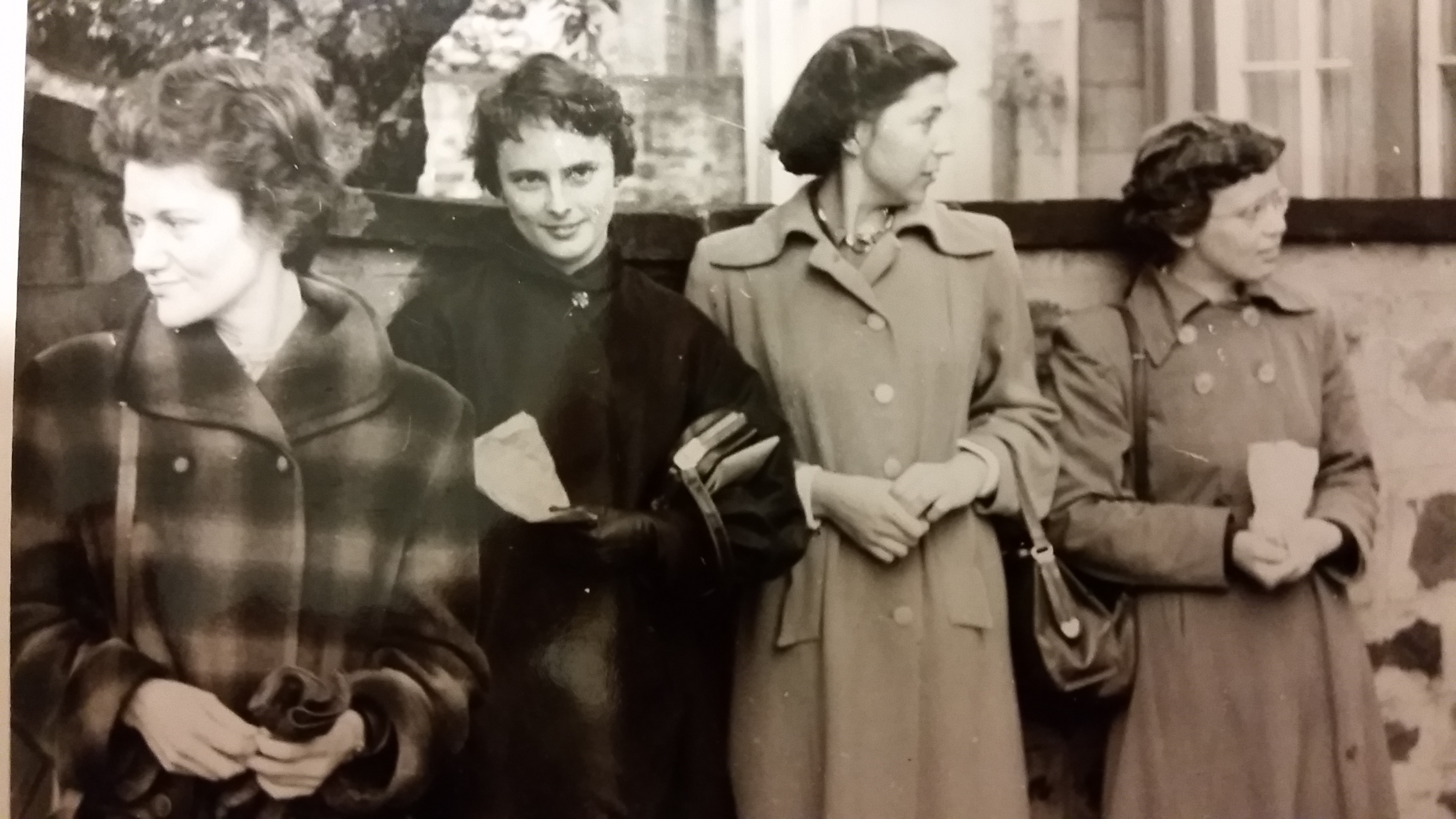
M.M. Perry, R. Phillips, S. Dare-Delaney, M. Lyon, Edinburgh (1950s), from EUA IN1/ACU/A1/5/7
We were saddened to hear recently of the passing of Mary Lyon, a distinguished mouse geneticist. Born in 1925 in Norwich, Mary was best known for her X-chromosome inactivation hypothesis, which proposed that one of the two X chromosomes in every cell of female mammals is inactivated. Mary worked at the MRC Radiobiology Unit in Harwell from 1955 until her death, becoming head of the genetics division (later the Mammalian Genetics Unit) in 1995. What is perhaps not so well-known is that her early work took place in Edinburgh, at the Institute of Animal Genetics.
Mary began at the Institute in 1948 to continue her PhD on mouse genetics, which she had begun in Cambridge under R.A. Fisher. This was after studying zoology at Girton College, Cambridge (although, as women were not allowed to be official members of the University until 1948, Mary was only awarded a ‘titular degree’). The Institute of Animal Genetics, then under the directorship of C.H. Waddington, possessed superior histology facilities, which she needed for her work. Mary ended up staying for a further five years after her PhD, working with Toby Carter on a project funded by the Medical Research Council to study mutagenesis in mice (this was at a time, following the Second World War and atomic bombs in Japan, of great concerns about the effects of nucelar fallout in the atmosphere). In a 2010 interview, Mary Lyon stated that, out of her whole career, it was her time in Edinburgh that she enjoyed the most: ‘It was a very lively academic atmosphere…a big genetics lab and a lot of able and enthusiastic geneticists.’ The above photograph, from the Institute of Animal Genetics archives, shows Mary (far right) with (right to left) Institute Librarian Stella Dare-Delaney, Mary’s assistant Rita Phillips, and distinguished molecular geneticist and embryologist Margaret Perry.
Toby Carter’s Mutagenesis Unit moved south to Harwell in order to find more space in which to breed and keep mice, taking Mary with it, as well as Rita Phillips. Scientists working with Douglas Falconer in Edinburgh had been the first to discover X-linked mutants in mice. With this discovery in mind, Mary, noticed that female mice carrying X-linked coat colour mutations had mottled coats. Male mice which inherited a mottled coat (i.e. a mutant gene on their single X-chromosome) all died, but the females survived. This must mean that the female possessed one, inactivated, mutant gene on one X-chromosome, but a normal gene on the other chromosome, which was activated – therefore a female mouse needs only one X chromosome for normal development. This inactivation of one of the two X chromosomes in the cells of females is still called ‘Lyonisation’, and the discovery had profound implications for understanding the genetic basis of X-linked diseases such as Duchenne Muscular Dystrophy. Grahame Bulfield, later director of the Roslin Institute, first positioned the mouse muscular dystrophy mutant on the X-chromosome using Mary’s stock of mouse X-chromosome mutants.
Over the next six decades, Mary also made important studies of Chromosome 17 and ‘the t-complex’, which had significant bearings on the understanding of non-Mendelian inheritance (a departure from the expected one-to-one ratio due to the abnormal segregation of chromosome pairs). Mary’s work pioneered the use of the mouse as a model organism for advances in cell and developmental biology as well as molecular medicine, and laid the foundations for comprehending the human genome. She chaired the Committee on Standardised Genetic Nomenclature for Mice from 1975 to 1990, was made a foreign associate of the US National Academy of Sciences, and was a Fellow of the Royal Society (being the 28th woman to be elected such). In 2004, the Mary Lyon Centre opened at Harwell, a leading international centre for mouse genetics, and in 2014 the UK Genetics Society created the Mary Lyon medal.
Mary died on Christmas Day 2014, aged 89, ‘after drinking a glass of sherry, eating
her Christmas lunch and settling down in her favourite chair for a nap’.
The University of Edinburgh’s remembrance of Mary Lyon can be read here: http://www.ed.ac.uk/news/staff/obituaries/2015/mary-lyon-030215
Clare Button
Project Archivist
Sources:
– ‘The Gift of Observation: An Interview with Mary Lyon’, Jane Gitschier (2010), http://journals.plos.org/plosgenetics/article?id=10.1371/journal.pgen.1000813
– ‘Mary F. Lyon (1925-2014): Grande dame of mouse genetics’, Sohaila Rastan, Nature, 518, (05 February 2015)
Collections
 Hill and Adamson Collection: an insight into Edinburgh’s past
My name is Phoebe Kirkland, I am an MSc East Asian Studies student, and for...
Cataloguing the private papers of Archibald Hunter Campbell: A Journey Through Correspondence
My name is Pauline Vincent, I am a student in my last year of a...
Hill and Adamson Collection: an insight into Edinburgh’s past
My name is Phoebe Kirkland, I am an MSc East Asian Studies student, and for...
Cataloguing the private papers of Archibald Hunter Campbell: A Journey Through Correspondence
My name is Pauline Vincent, I am a student in my last year of a...
Projects
Cataloguing the private papers of Archibald Hunter Campbell: A Journey Through Correspondence
My name is Pauline Vincent, I am a student in my last year of a...
Archival Provenance Research Project: Lishan’s Experience
Presentation My name is Lishan Zou, I am a fourth year History and Politics student....