Home University of Edinburgh Library Essentials
June 14, 2026
Auden, Dame Edna and Bletchley Park
Welcome to the first Rare Books & Manuscripts blog of the University of Edinburgh’s Centre for Research Collections. And what better way to start than a post on W.H. Auden’s Poems (1928) …
One of the University of Edinburgh Library’s rarest 20th-century printed items is W.H. Auden’s Poems (1928). This item was part of the Archibald Hunter Campbell collection which was presented to the Library in 1984. Campbell studied at Oxford and was a contemporary and friend of Stephen Spender, Christopher Isherwood and W.H Auden. During the Second World War he served at Bletchley Park as a codebreaker and, on returning to Edinburgh, he held the post of the University’s Regius Chair of Public Law and the Law of Nature and the Nations from 1945 to 1972.
Printed by Auden’s fellow undergraduate at Oxford, Stephen Spender, Poems purports to be number 11 of “about 45 copies” subsequently Spender admitted that the actual number of copies was nearer 30.

Although a large part of the book was printed by Spender in his parents’ house on an Adana label printer, it would seem that either the printer or Spender (or possibly both!) weren’t up to the task and the book was finished and bound in its strong reddish orange wrapper by the Holywell Press. Evidence of the handover from Spender to Holywell is apparent in the immediate improvement in printing quality from page 23 onwards.
Some of the poems were never republished and Auden himself excluded most of the contents from the canon establishing Collected Shorter Poems, 1927-1957 (Faber, 1966).
The University of Edinburgh’s copy has few annotated corrections but has been signed by both Auden and Spender on the title page and is in remarkably good condition.
It truly is one of the University’s finest rare books and a fitting subject for the first Rare Books blog.
The library has a collection of W.H. Auden material, which we have recently completed cataloguing. This was purchased in 1982 from Barry Bloomfield (co-editor with Edward Mendelson of W.H. Auden: A Bibliography, 1924-1969), and has been added to by generous donations from Mendelson and others as well as purchases from book sales. Although Poems is not part of that collection we have taken the opportunity to improve the cataloguing of Auden material elsewhere in the collections.
Oh, and Dame Edna? Stephen Spender’s daughter married Barry Humphries!
Finlay West: Rare Book Cataloguer
You’ve Been Unframed!
At the start of April, I started conservation work on the Edinburgh University Art Collections. I had previously been working at the Lothian Health Services Archive on a 12-month project to conserve their HIV/AIDS collections. When this came to an end, I was delighted to be offered the chance to work on a new collection at the University.
I started off by unframing a selection of works of art on paper. These items has been previously framed using low quality mountboard. This can be damaging to the artwork as this board can become acidic over time, which can migrate to the artwork and cause staining.

Acidic migration from mount causing brown staining on artwork
Unframing artworks is great fun as you never know what you will find underneath. Sometimes, you can find interesting inscriptions or hidden sketches, however, often you find more conservation problems! In this collection, I found that many artworks had been adhered into frames using pressure sensitive tapes, such as masking tape and sticky tape. Tapes such as this can become stuck on to the paper and be very difficult to remove. To remove these tapes, I used the gentle application of heat which softens the adhesive and makes it easier to peel off using tweezers and a spatula.
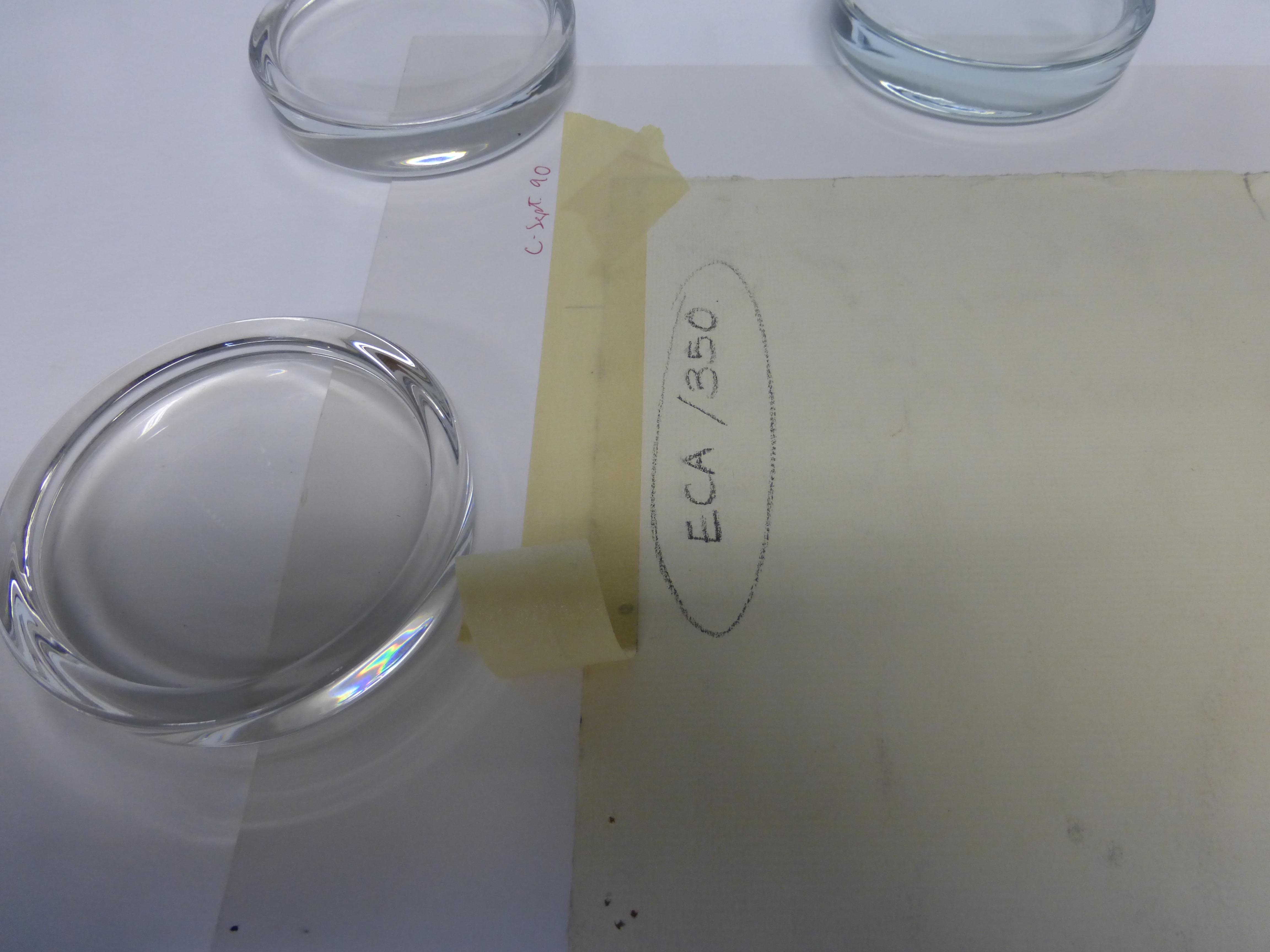
Removal of masking tape using heat
As these tapes age, it becomes even harder to get them off and the adhesive can soak into the paper causing staining. To remove these aged tapes, solvents can be applied using a poultice. However this can be time consuming, and has health and safety issues due to the exposure to solvents.

Staining of verso of artwork due to aged pressure sensitive tape
Another problem I encountered was that some artworks were adhered overall to a piece of mountboard. This can be problematic if the mountboard is acidic as this acid can migrate to the paper and cause weakening and discolouration of the sheet. Also, if the artwork is stored in high or low humidity, the mountboard and paper will react differently to moisture, and potentially cause cockling (paper conservation term for rippling of the sheet) and tearing. Boards such as this can be removed in small pieces by using a scalpel with a number 22 blade. The layers closest to the artwork can then be removed using a poultice such as the one described in Samantha Cawson’s blog.
When an artwork is unframed, it can give you clues to it’s original condition. For example, when I unframed this artwork by Anne Redpath, I found that there was a clear difference between the areas that could be seen and the areas underneath the window mount. The paint that was white in the exposed area, is pink in the hidden areas; the blue in the visible area is red underneath the mount! The difference in colours could be caused by the effect of light on the exposed areas of the artwork, which has caused the pigment to fade. Equally, the pigments may have changed colour due to contact with an acidic window mount. More research is needed to find out the exact cause. As you can see this discolouration has completely changed the look of this painting and it is hard to imagine how it could of looked originally.
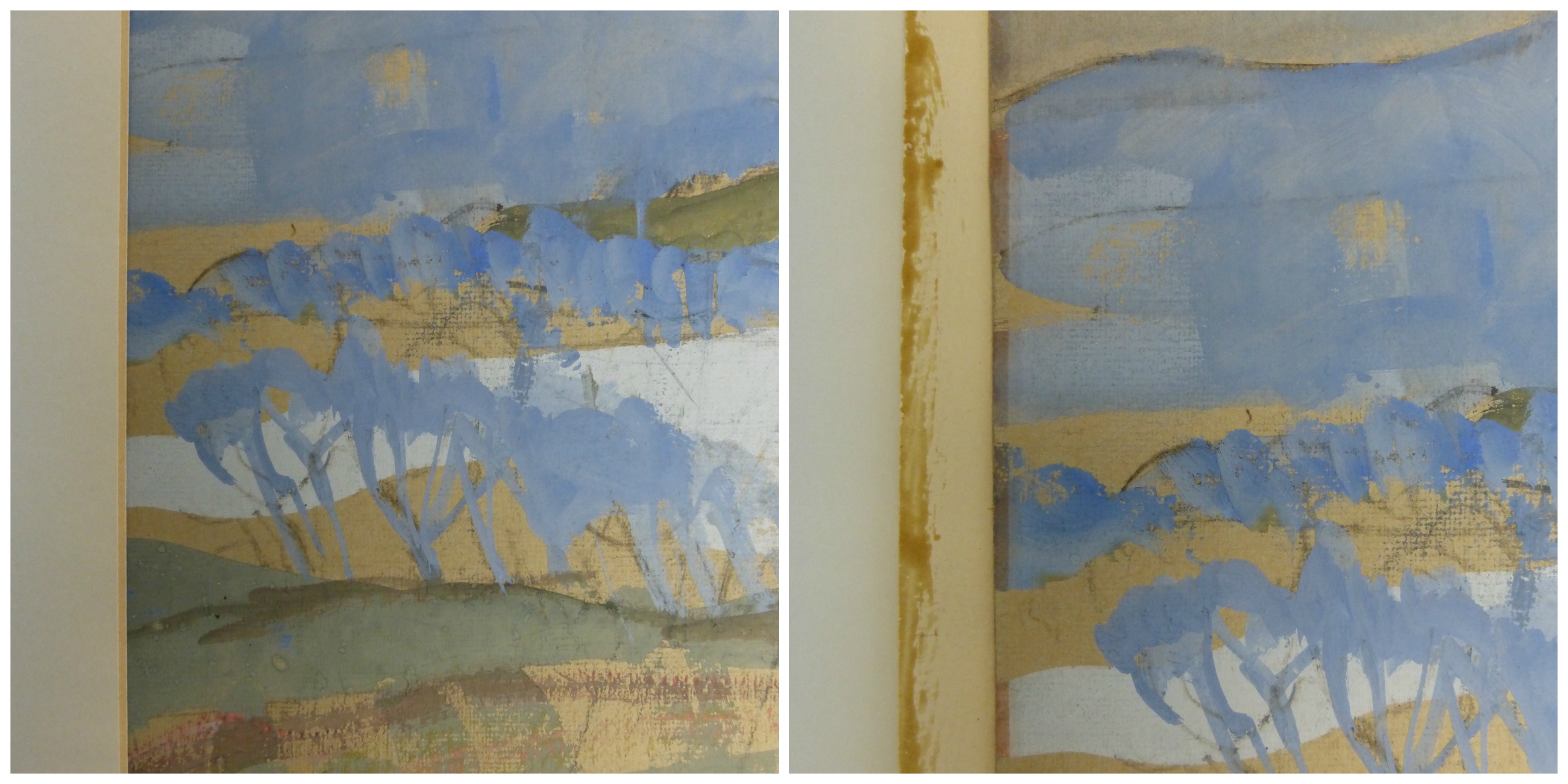
Painting by Anne Redpath, before (left) and after (right) unframing. Note the difference in colour between the areas hidden and exposed to light
Sometimes during unframing you can also discover things that are completely new. For example, after I had unframed this watercolour by Alan Davie, I found another watercolour painted on the other side! This watercolour has been protected from the light, and so the colours have remained very bright and vibrant.
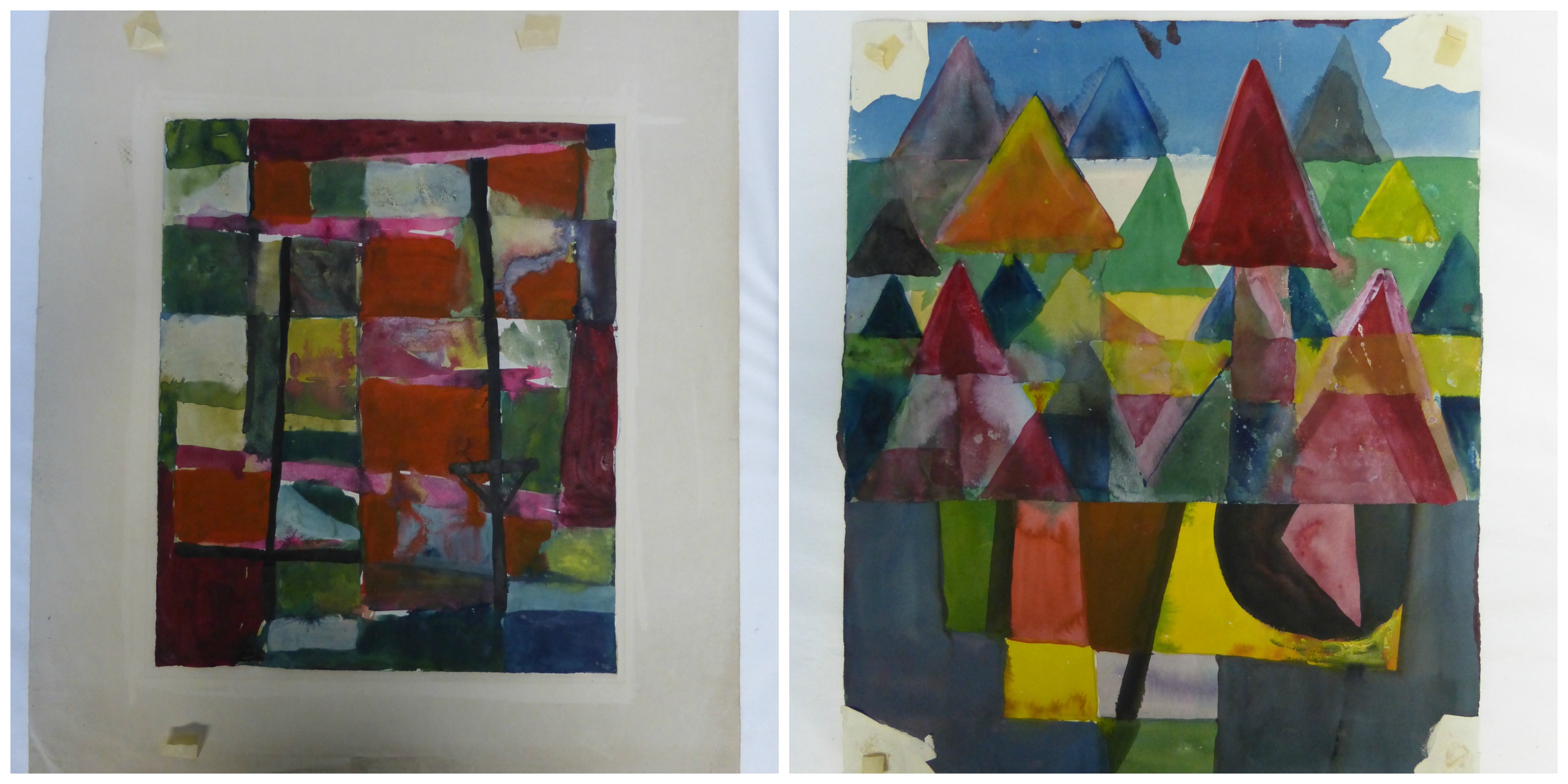
Alan Davie Watercolour before (left) and after (right) unframing. New watercolour found on verso
Here is another sketch I found underneath a mount. The card mount had been adhered to the back of the artwork with multiple dots of glue. I removed the card mount using a scalpel which revealed another sketch of a similar model on the recto, and then removed the adhesive residue using a CMC poultice. This reuse of the sheet is common among artists as a way of making the most of expensive art materials!
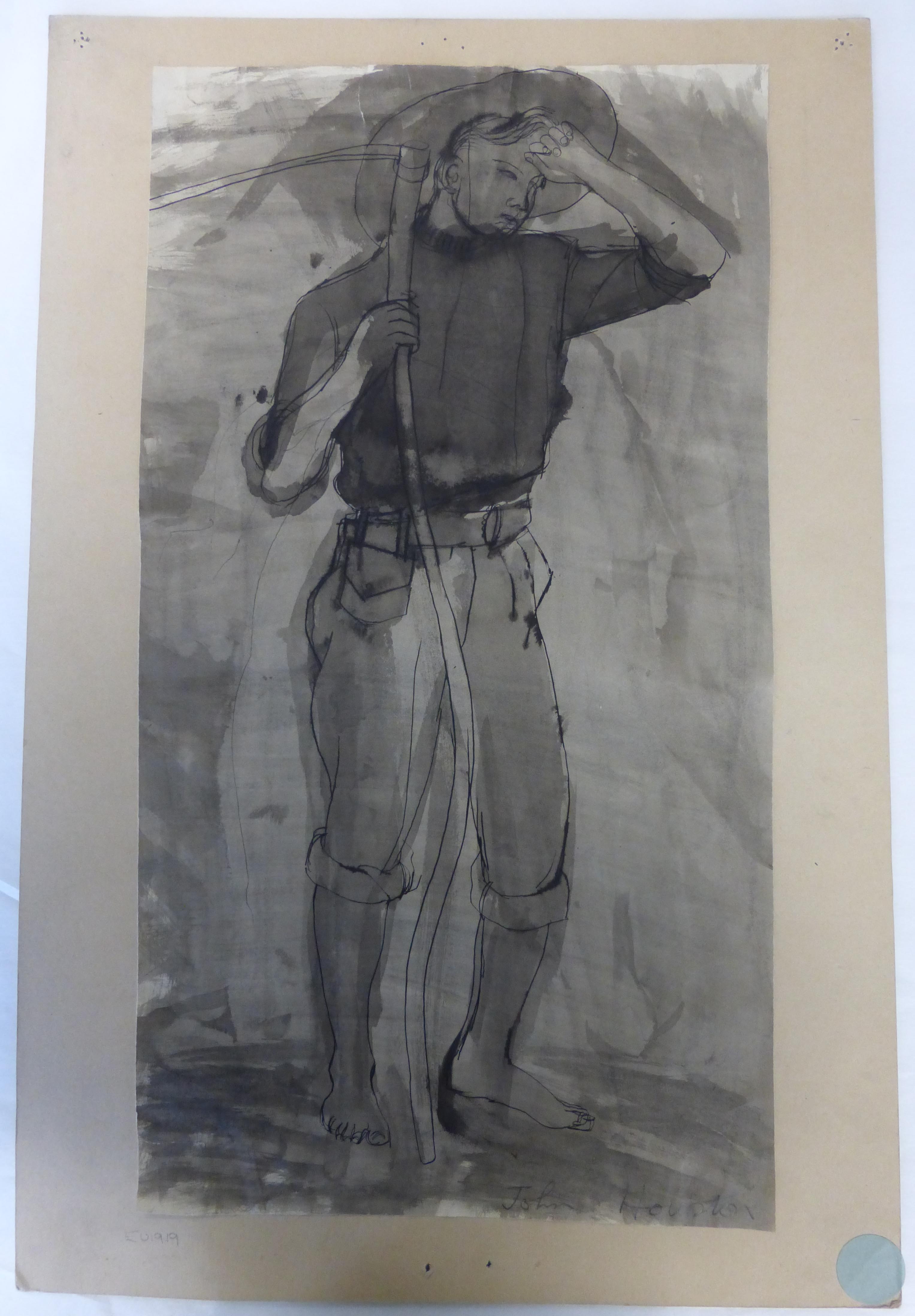
Recto of Houston, before removing mount
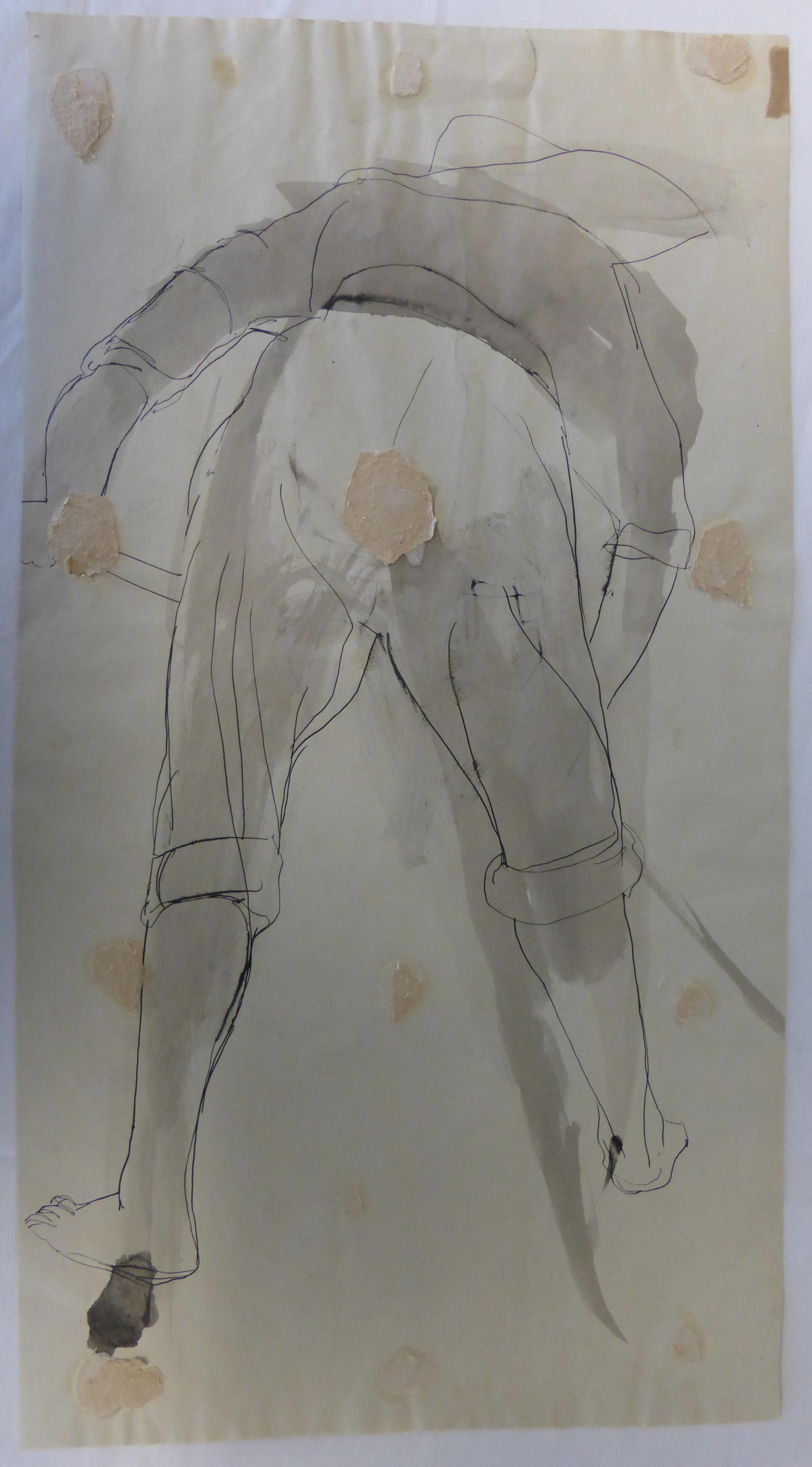
Verso of Houston, after removing mount. Another sketch found beneath
Good framing is essential to the longevity of an artwork. When framing works of art on paper, always use good quality inert materials, such as 100% cotton rag mountboard, and use reversible adhesives such as wheat starch paste. Never adhere artworks directly to a secondary support, instead use hinges made from Japanese paper. And please do us paper conservators a favour, never use pressure sensitive tapes on paper artworks!
If you would like any advice on framing artworks, please do get in contact or check out this website: http://www.conservationregister.com/PIcon-Mounting.asp
Emily Hick
Paper Conservator
Emily.hick@ed.ac.uk
Fairbairn as Student
In the academic year 1907/8, the 17 year old WRD Fairbairn matriculated to study in the Arts Faculty at the University of Edinburgh. This followed 11 years schooling at Merchiston Castle (6 in Preparatory and 5 in the Upper School), gaining a leaving certificate comprising English, Latin, Greek, French and Mathematics. He continued both Latin and Greek during his first year of study at university, and took on Zoology as a third subject. Subsequent years comprised courses in Logic, Moral Philosophy, Advanced Metaphysics, Moral Philosophy, Advanced Logic and Greek Philosophy.
In 1918, at the age of 29, Fairbairn returned to Higher Education. This time, he enrolled to study in the Faculty of Medicine. Part of the intervening period had included war service. The Roll of Honour records that he had served in the Merchiston Castle Officer Training Corps while a pupil there and that he had served in the OTC Engineers between May and November 1915 as a cadet. From November 1915, he was 2nd Lieutenant in the Royal Garrison Artillery (Territorial), achieving Lieutenant the following year.

He graduated MBChB in 1923. His marks show strengths in some areas and perhaps a lower ability in others.
View Fairbairn’s full graduation record (pdf)
He continued his studies and achieved his MD in 1926, his thesis being Relationship of dissociation and repression considered from the point of view of medical psychology.
Trials – New E-Resources on trial
Acland’s video atlas of human anatomy – until 14th April
This newer version of Acland’s video atlas provides an online platform for accessing more than 300 narrated videos of real cadaver specimens. The detailed table of contents for each video allows you to go directly to specific points of relevance inside each video. PDF transcripts for each video can be downloaded. Videos can be bookmarked for teaching a learning activities. Self-test quizzes are available for revision and exam preparation, with revision links in the answer for each question.
Church Missionary Society Periodicals Collection – until 30th April
From its roots as an Anglican evangelical movement driven by lay persons, this resource encompasses publications from the CMS and the latterly integrated South American Missionary Society. Documenting missionary work from the 19th to the 21st century, the periodicals include news, journals and reports offering a unique perspective on global history and cultural encounter. *Please note that PDF download options are not available during trials.
Enhanced Electronic Grammars – An Advanced Research Tool for Linguistics- until 19th May
Enhanced Electronic Grammars (EEG) features comprehensive descriptions of languages from around the world. Through this unique online resource, full grammars are made available together in an interlinked and semantically-annotated format, allowing granular access to the grammatical data and enabling cross-language research of several grammars at the same time. In addition to cross-linguistic queries, each grammar can also be read and researched individually. The electronic format allows for multimodal enhancement of language descriptions, such as audio and video supplements.
Japan Times Archive 1897-2013 – until 31st May
The Japan Times is the oldest English-language newspaper in Japan, founded in March 1897 (Meiji 30). It has been published to promote mutual understandings between Japan and other countries. This newspaper Includes unique articles which cannot be read in Japanese-language newspapers. The Japan Times Archives Online includes articles from 1897-2013. A trial for the Japan Times Online, which includes articles from 1999-Present, will also be available very soon.
Political Science Complete – until 24th April
Political Science Complete provides extensive coverage of global political topics with a worldwide focus, reflecting the globalisation of contemporary political discourse. The database gives you access to nearly 340 full-text reference books and monographs and more than 44,000 full-text conference papers, which includes those from the International Political Science Association. Subjects covered include comparative politics, humanitarian issues, international relations, law and legislation, non-governmental organizations and political theory.
Prosopographie der mittelbyzantinischen Zeit – until 30th April
The Prosopographie der mittelbyzantinischen Zeit Online/Prosopography of the Middle Byzantine Period Online (PMBZ Online) is a comprehensive biographical dictionary for the Byzantine Empire in the early Medieval Period (641-1025 AD) documenting more than 21,000 persons. PMBZ Online is based on the print edition of the Prosopographie der mittelbyzantinischen Zeit which appeared in two parts 1998 and 2013. PMBZ Online documents all persons mentioned either by name or anonymously in the relevant Byzantine and non-Byzantine sources, and secondly all persons mentioned in the Byzantine sources both from Western Europe and from the Arabic and Slavonic areas, together with those from the Christian East.
SIPRI Yearbook Online – until 30th April
The SIPRI Yearbook, written by authors who are experts in their field, is known worldwide as an essential and independent source for issues on armaments and arms control, conflicts and resolutions, security arrangements and disarmament, as well as longer-term trends in international security. SIPRI Yearbook Online offers access to the SIPRI Yearbooks published from 2010 and onwards, all available on one, easy-to-use and fully cross-searchable resource.
Feedback and further info
We are interested to know what you think of these e-resources as your comments influence purchase decisions so please fill out our feedback form.
A list of all trials currently available to University of Edinburgh staff and students can be found on our trials webpage.
Financial Times access issue
Our access to Financial Times via http://www.ft.com/home/uk is currently unavailable due to a renewal issue which is under investigation. Alternate access to the Financial Times via Factiva remains unaffected.
Update: How we access Financial Times has changed, our A-Z lists and catalogue have been updated with the new link which uses EASE login followed by individual user registration. The new access also allows you to set up the FT app on your mobile device. The new link is https://sso.ft.com/sso/auth?entityID=https%3A%2F%2Fidp.ed.ac.uk%2Fshibboleth.
Wireless access to e-resources
We are receiving a number of reports about loss of access to e-resources via the wifi network (Eduroam). If affected please use the library links which are set up to pass through our EZProxy server or the VPN rather than accessing the e-resource directly.
Access the e-journals A-Z, e-books A-Z, databases A-Z, catalogue or searcher webpages here: http://www.ed.ac.uk/schools-departments/information-services/library-museum-gallery/finding-resources
VPN info at: http://www.ed.ac.uk/schools-departments/information-services/computing/desktop-personal/vpn/vpn-service-summary
We will post further updates to this issue here.
Update 23/4/15: Most e-resource providers have now been updated with the new Eduroam IP addresses.
Fairbairn’s Dream Drawings #1
The composition of the Fairbairn Archive is rich, with a wide variety of materials from manuscripts to typescripts and photographs to correspondence. However, amongst the most striking of all the documents are a collection of dream drawings, made by Ronald Fairbairn in the 1950s.
Dreams have an important role to play when it comes to psychoanalysis. Alongside the exploration of fantasy and free-association, dreams offer analysts a means to gain insight into a patient’s symptoms and problems. Fairbairn made use of this technique when working with his own patients, but as these drawings reveal, he was also keen to record and analyse his own dreams.
That Fairbairn would be open to such self-analysis is no real surprise. Practitioners of Fairbairn’s generation were expected to undergo analysis as part of their training and in 1921, Fairbairn went into treatment with the analyst, E. H. Connell. With his obvious interest in the human psyche, understanding himself would be yet another means of furthering his knowledge of this complex subject.
Fairbairn’s dream drawings are, typically, simple line-drawings in pen, on lined paper. They give the impression of being made in haste, made as an aide-memoir rather than for any artistic purposes. There are recurring themes, recurring characters but much of the meaning is obscure and difficult to interpret.
For my first visit to this subject I have chosen a selection of images united by their depiction of landscape.

Symbols of hills, valleys, coasts and water, as seen above, are recurrent in Fairbairn’s dream drawings, particularly those made in October, 1950.
They are often devoid of people, although there are occasional exceptions, such as the drawing below.

And although most of the dream drawings depict plausible scenarios, there are occasional forays into the world of the supernatural, or at least the unusual, such as in the drawing below.

These drawings offer an extremely intimate window into the mind of Ronald Fairbairn. Researchers of archives most often need to make inferences from the documentary remains in order to be able to get this close to their subjects. The Fairbairn Archive is special because material of this nature is tantalisingly accessible, even if it does require a sophisticated degree of interpretation.
PURE Validation Training
Here at the University of Edinburgh we are gearing up for the implementation of the new REF Open Access requirements, and we are starting to trial new workflows. My colleagues Eugen Stoica and Fiona Wright have been working with the Humanities & Social Sciences College Office to put together some training for administrators to validate items in PURE. We are pleased to be able to publish some documentation we are using in current training sessions at http://hdl.handle.net/1842/10021.
As ever, we value feedback on our project outputs so please email me at dominic.tate@ed.ac.uk if you have questions or feedback.
Dominic Tate, University of Edinburgh
Data Vault project kickoff meeting
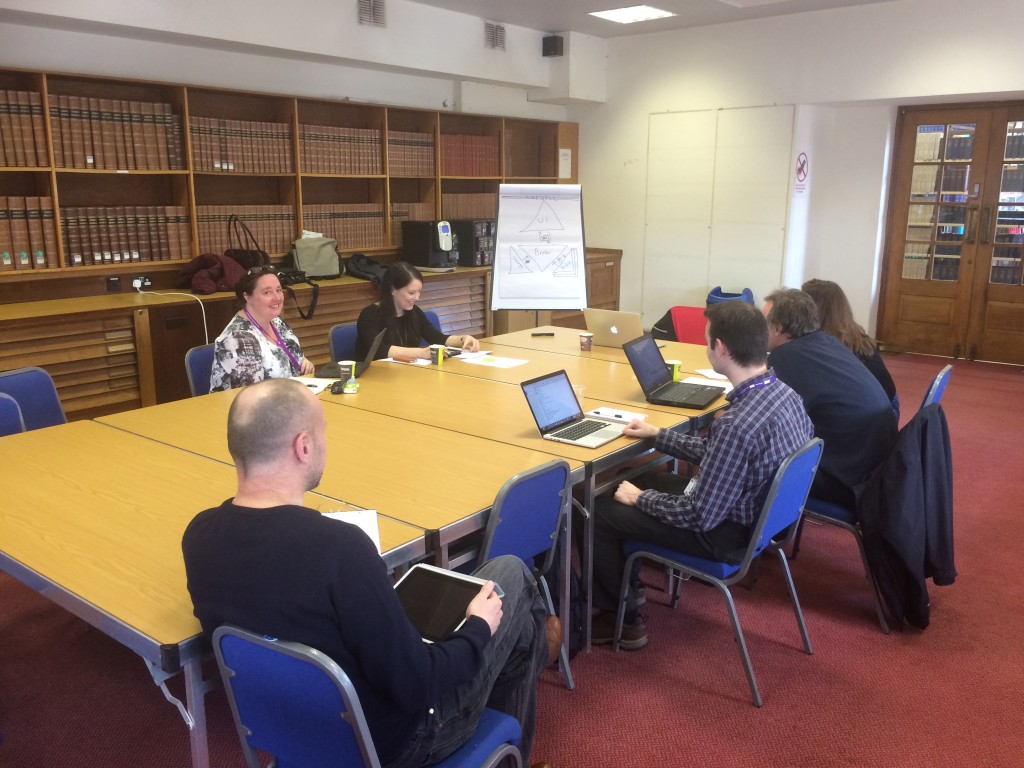
Last week, members of the Data Vault project got together for the kickoff meeting. Hosted at the University of Manchester Library, we were able to discuss the project plan, milestones for the three month project, agreed terminology for parts of the system, and started to assign tasks to project members for the first month.
Being only three months long, the project is being run in three one-month chunks. These are defined as follows:
- Month 1: Define and Investigate: This phase will allow us to agree what the Data Vault should do, and how it does it, Specifically it will look at:
- What are the use cases for the Data Vault
- How do we describe the system (create overview diagrams)
- How should the data be packed (metadata + data) for long term archival storage
- Develop example workflows for how the Data Vault could be used in the research process
- Examine the capabilities of archival storage systems to ensure they can support the proposed Data Vault
- Month 2: Requirements and Design: This phase will create the requirements specification and initial design of the system:
- Define the requirements specification
- Use the requirement specification to design the Data Vault system
- Month 3: Develop a Proof of Concept: This phase will seek to develop a minimal proof of concept that demonstrates the concept of the Data Vault:
- Deliver a working proof of concept that can describe and archive some data, and then retrieve it
At the end of month three, we will prepare for the second Jisc Data Spring sandpit workshop where we will seek to extend the project to take the prototype and develop it into a full system.
All of this is being documented in the project plan, which is a ‘living document’ that is constantly evolving as the project progresses. The plan is online as a Google Document:
Look out for further blog posts during the month as we undertake the definitions and investigations!
Vintage Conservation
Our conservation volunteers have been doing a fantastic job over the past months surface cleaning, repairing and re-housing the Library Correspondence from the University’s archive collection. There have been many interesting pieces uncovered during this work, but one such item in particular caught our eye, namely an advertisement for conservation services – 1940s style!

This advert for ‘PERMA’ treatment and its claims that it can make your important papers last forever with its “dirtproof, rotproof, waterproof, greaseproof” qualities just goes to demonstrate how far conservation has developed from the 1940s to the present day. Although the attached treated sample piece does certainly appear to have lasted the years (although whether it is “everlasting” awaits to be seen…) it is not a treatment method that we would employ today. Ethical considerations and guidelines, are much more ingrained in the modern-day conservation profession with the physical, historical and aesthetic integrity of the object now being placed at the forefront of our decision making. Alongside the development of the conservation profession, comes a greater understanding of the methods and materials that we use, allowing us to make much more informed decisions regarding appropriate treatment options. Two of the main principles that we work towards are the concepts of minimal interventive treatment and reversibility (ideas that are not particularly compatible with ‘PERMA’ treatment). This ensures that the risk of introducing anything which may adversely affect the object is kept to a minimum, whilst allowing for the chance that new, improved, techniques and materials may be developed in the future. However sound these principles may be, it can only go so far, for example, surface cleaning – although important – would not be necessarily be considered reversible and therefore must be taken into account when deciding on a treatment plan.
It is certainly apparent that our conservation priorities have changed over the years, and there are a few things which should perhaps stay in the past…
Post by Emma Davey, Conservation Officer
Collections
 Hill and Adamson Collection: an insight into Edinburgh’s past
My name is Phoebe Kirkland, I am an MSc East Asian Studies student, and for...
Cataloguing the private papers of Archibald Hunter Campbell: A Journey Through Correspondence
My name is Pauline Vincent, I am a student in my last year of a...
Hill and Adamson Collection: an insight into Edinburgh’s past
My name is Phoebe Kirkland, I am an MSc East Asian Studies student, and for...
Cataloguing the private papers of Archibald Hunter Campbell: A Journey Through Correspondence
My name is Pauline Vincent, I am a student in my last year of a...
Projects
Cataloguing the private papers of Archibald Hunter Campbell: A Journey Through Correspondence
My name is Pauline Vincent, I am a student in my last year of a...
Archival Provenance Research Project: Lishan’s Experience
Presentation My name is Lishan Zou, I am a fourth year History and Politics student....