Home University of Edinburgh Library Essentials
October 6, 2026
The Music of Archives
For the past few years, we have had one of our volunteers, Fiona Donaldson, working with Deputy University Archivist, Grant Buttars, to develop a usable catalogue to our Tovey Collection, one of our larger collections of personal papers we hold. We are now able to offer an unfinished but usable ‘pre-release’ to allow researchers and other users get a better handle on what’s in the collection while work continues.
Donald Francis Tovey
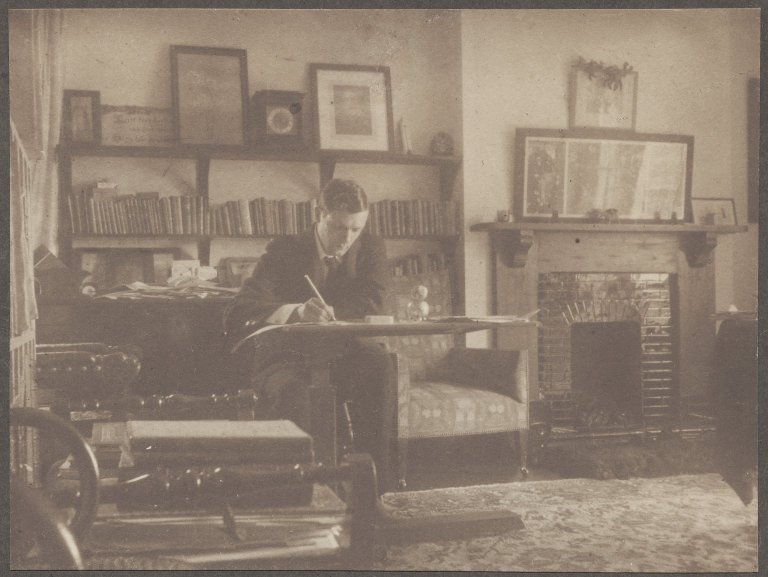
Donald Francis Tovey at work
Donald Francis Tovey was born at Eton on 17 July 1875. His father was an Assistant Master at Eton College. He was educated privately by the music and general teacher Miss Sophie Weisse (1851-1945) and later on studied under Sir Walter Parratt (1841-1924) and Sir C. H. Parry (1848-1918). Tovey then won a music scholarship to Balliol College, Oxford, graduating with a BA, Classical honours, in 1898. As a pianist, a series of chamber music concerts followed in London, Berlin and Vienna where he played with Halle, Joachim, Hausmann, Casals, and other artists. He also composed.
In 1914 he was appointed to the Reid Chair of Music at Edinburgh University in succession to Professor Niecks (1845-1924). As Professor he broadened the music curriculum by instituting classes in musical interpretation, orchestration, history and analysis, thorough-bass, score reading, and advanced counter-point and composition.
Tovey also established and conducted the Reid Orchestra and organised an annual series of concerts. His musical compositions were in many forms including chamber music, symphony, grand opera and concerto, and probably the most famous was his opera The bride of Dionysus produced in Edinburgh in 1929. His literary publications include the six volumes of Essays in musical analysis (1935-1939), and A musician talks (1941). Tovey was knighted in 1935. He died on 10 July 1940.
The Collection
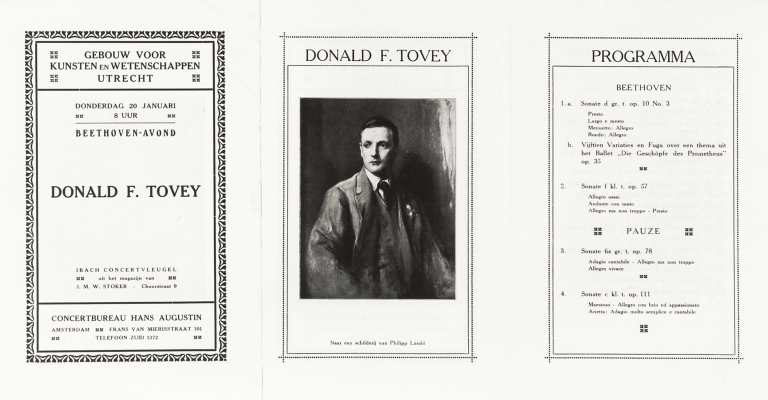
Concert programme
The largest part of the collection is the papers of Tovey himself. Following his death, the collection appears to have remained in what became the Tovey Memorial Rooms at 18 Buccleuch Place, from where they were taken to Alison House sometime after the Faculty of Music took up occupancy there in 1964. During its time in those locations it appears to have been augmented, with the addition of particularly correspondence and notes of Tovey’s biographer, Mary Gardner Grierson (1896-1964) and post-Tovey records relating to the Reid Orchestra and Choir. Tovey’s teacher and mentor, Sophie Weisse (1851-1945), is also well-represented. Perhaps the clear boundaries between what simply began as adjacently shelved material became indistinguishable; by the time the collection was transferred here from the Reid Music Library in 2001, it was all seen as one overall collection and it has not proved possible to fully disentangle it.
The work
We have concentrated on sorting out obvious disorder but with a light-touch approach, creating a meaningful arrangement and, as far as possible identifying what is clearly Tovey’s papers from what is not. Basic repackaging has been undertaken where needed.
The catalogue benefits from earlier cataloguing work that was undertaken when the collection was still in the Reid Music Library. It focussed on the correspondence (the largest single series within the collection) and the database created than has been converted and imported into the new catalogue.
Our volunteer Fiona is currently a PhD student but also a former administrator from within the former Faculty of Music. Drawing on this and other related collections here, she has been creating a database to Reid Orchestras as part of her PhD research.
Find out more
Mass Observation Parts III and IV now available
We have recently purchased two extra collections within Mass Observation – Mass Observation Parts III and IV. Access this resource via the database A-Z list and DiscoverEd.
Detailed information about the contents of Mass Observation can be found at http://www.amdigital.co.uk/m-collections/collection/mass-observation-online/detailed-information/ and a quick tour of the resource is shown in the YouTube clip below.
“You’ll never guess who I met today…”
At the beginning of August I took on the role of New College Collections Curator looking after the archives held at New College Library and in the Centre for Studies in World Christianity (CSWC). As the CSWC archives rooms were essentially out of action during the festival, the Rainy Hall being a Festival Fringe venue, I spent my first month concentrating on acquainting myself with the archives in New College Library (NCL).
As inevitably happens with archives, almost as soon as you are trying to establish the facts around your collections you find yourself with questions. So it was in my third week of work.

The Rev Thomas Chalmers (1780 – 1847) is a mighty figure in Presbyterian Church history and his collection of papers is no less substantial than the man himself. The first Principal of New College, his papers (ref GB238 CHA) contain correspondence with many individuals, including notable figures of the era; family papers dating back to the 18th century; sermons and lectures. There are also several boxes marked as an Appendix to the collection. Within one of these boxes are photocopies noted as having been taken from records belonging to a descendant of Thomas Chalmers. Intent on finding out who this descendant was and where the originals of these documents might be now, I set about searching the records of New College Library itself (ref. GB238 AA2) to see if there was any mention in minute books or correspondence about making and receiving these photocopies.
This proved to be a useful exercise in itself as I was able to get a sense of how the Library operated, key points in the history of the collections, and the sort of cataloguing work that had been done on the manuscripts during the twentieth century. Gleaning the names of different members of staff over the years – Mrs Margot Butt seems to have become the expert on Thomas Chalmers – I was quickly able to start scanning documents for them, which was why I gave a start when my own grandfather’s signature, as bold as the man himself, jumped out at me from some correspondence. The second surprise came when I realised that he had written to the Library on behalf of my father (ref. GB238 AA.2.1.108).


As the images above show, it transpired that in the late 1960s when my father was a missionary in Kenya, he had a colleague, called Simon, who used a particular book to help him while evangelising. He had noticed that the book was falling apart, pages were missing and the covers torn and so he wanted to get him a new copy but all he had to go on was part of the title page. He sent this fragment to my grandfather (incidentally a New College graduate) to see if he could find out what the full title was and if a new copy could be purchased. My grandfather duly wrote to the New College Librarian and the enquiry resulted in success with contacts in London being able to identify the book: The Treasury of Scripture Knowledge, by Samuel Bagster. From a note on the first letter it seems that the Librarian actually visited my grandfather but whether they were friends or he just happened to be in the vicinity I’ll never know. My father has no recollection of the matter although he does remember Simon. For me it was quite touching to encounter my late grandfather and be reminded of my own father’s characteristic thoughtfulness amidst a completely different quest altogether.
As for the Thomas Chalmers photocopies and originals, I eventually discovered records of the Thomas Chalmers Bicentenary Exhibition, which Margot Butt had prepared in 1980, along with the name of not one but twenty-one descendants and discussion on the disputed inheritance of his papers (ref. GB238 CHA Appendix 5). A blog for another day.
Kirsty M Stewart, New College Collections Curator
L.H.S.A. is A-OK!
Throughout 2015, I have been involved in many different projects within the CRC. However, I have mostly been working with collections from the Lothian Health Services Archive (LHSA). Overall I have spent 4 months carrying out conservation work on their main collection, and spent 1 month working on a public engagement project.
The majority of the work I have carried out has been on bound volumes. I have spent 25 days working on these items and have conserved 321 volumes. The conservation work aimed to stabilise the objects and prevent them from deteriorating further. Techniques carried out included surface cleaning, consolidation of red rot using Klucel G in IMS, inner joint repair to reattach loose or detached boards, and reattaching damaged spines to volumes using a hollow.
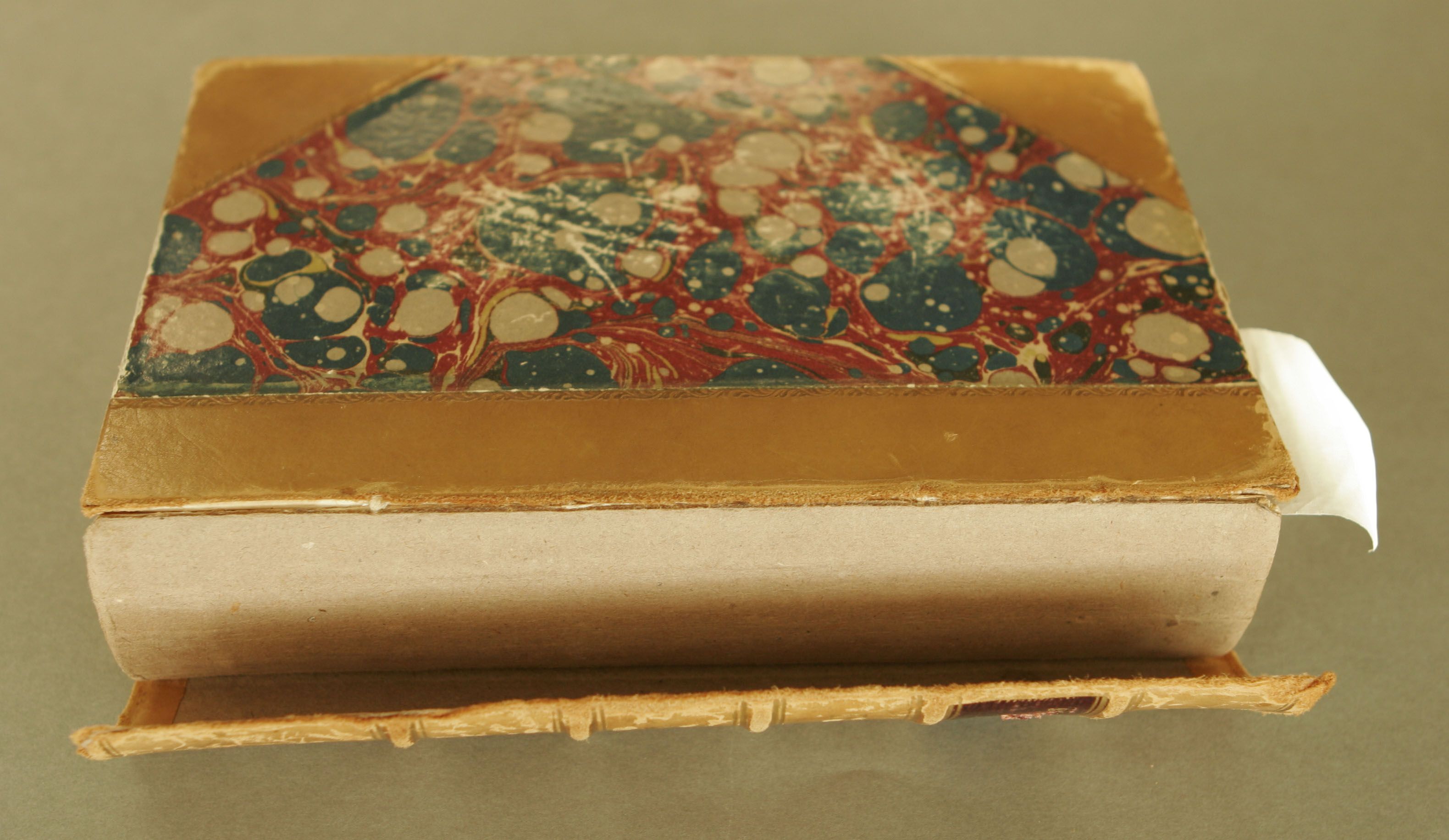
Bound volume before conservation. Spine has become detached
During this time, I have also worked on a few photo albums and scrapbooks. Often, the photographs had fallen out of the albums as the adhesive failed, so I reattached the photographs using hinges made from Japanese paper and wheat starch paste. Although the paper the album is made from is not ideal for the storage of photographs, I wanted to conserve the album as a whole, and keep the way it was originally intended to be viewed. I particularly enjoyed working with a scrapbook that belonged to Yvonne Fitzroy. The pages of the book had become cockled over time, which allowed for the ingress of surface dirt. I cleaned each page using a smoke sponge and was delighted to come across a note and doodle from H.G. Wells on one page of the book.
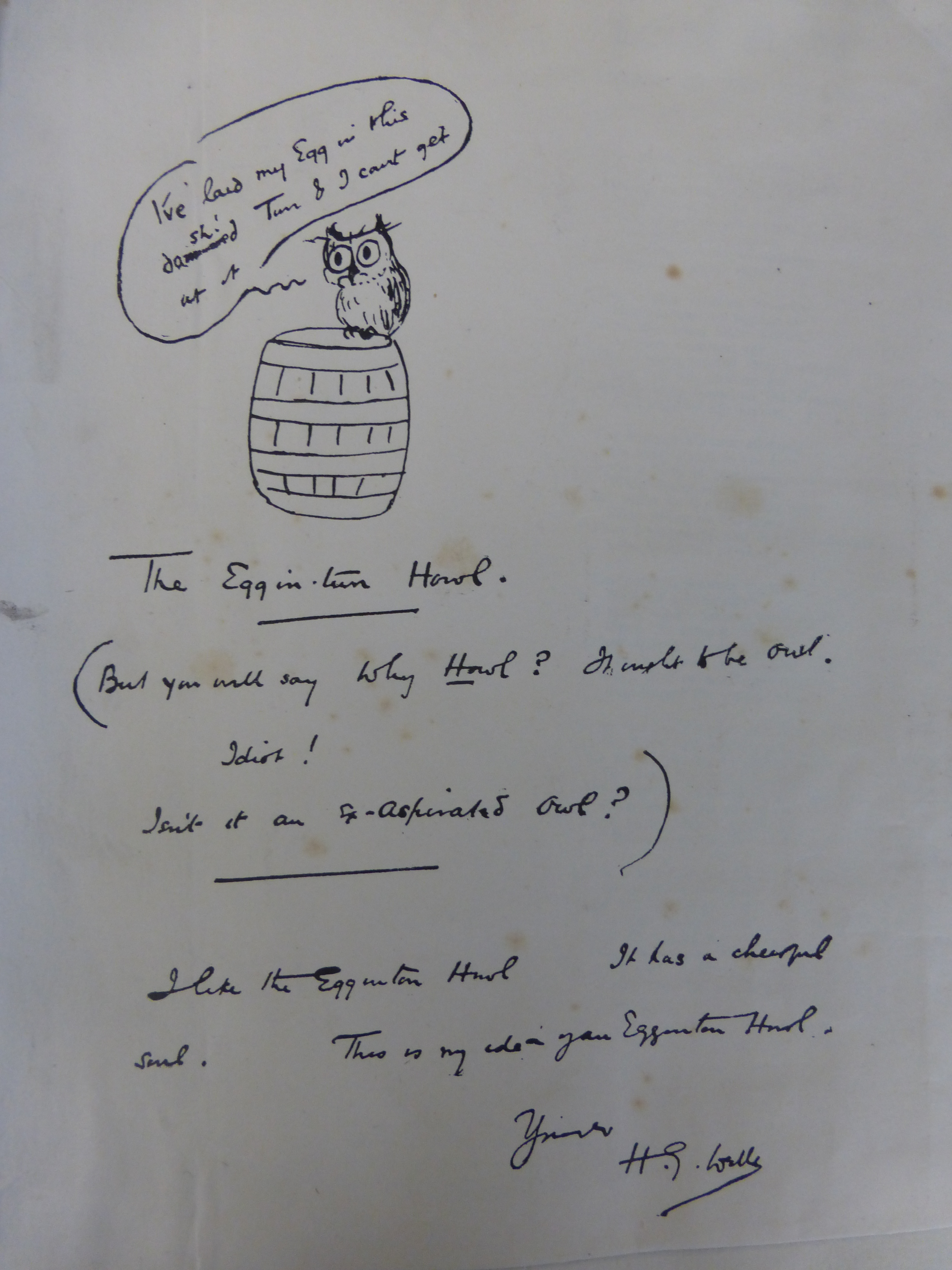
Note from H.G. Wells in Yvonne Fitzroy’s scrapbook
I have also rehoused 16 boxes of case notes, which had previously been stored in their original folders, loose on the shelf. I removed all the metal fasteners (paper clips, staples), realigned any creases and carried out tear repairs if necessary. I then rehoused the case notes in acid free single crease folders and placed them in an acid free box.
X-rays are another collection I have been working with. I have sorted through 15 boxes of X-rays in preparation for frozen storage. You can read more about the deterioration and storage of X-rays in the LHSA blog.
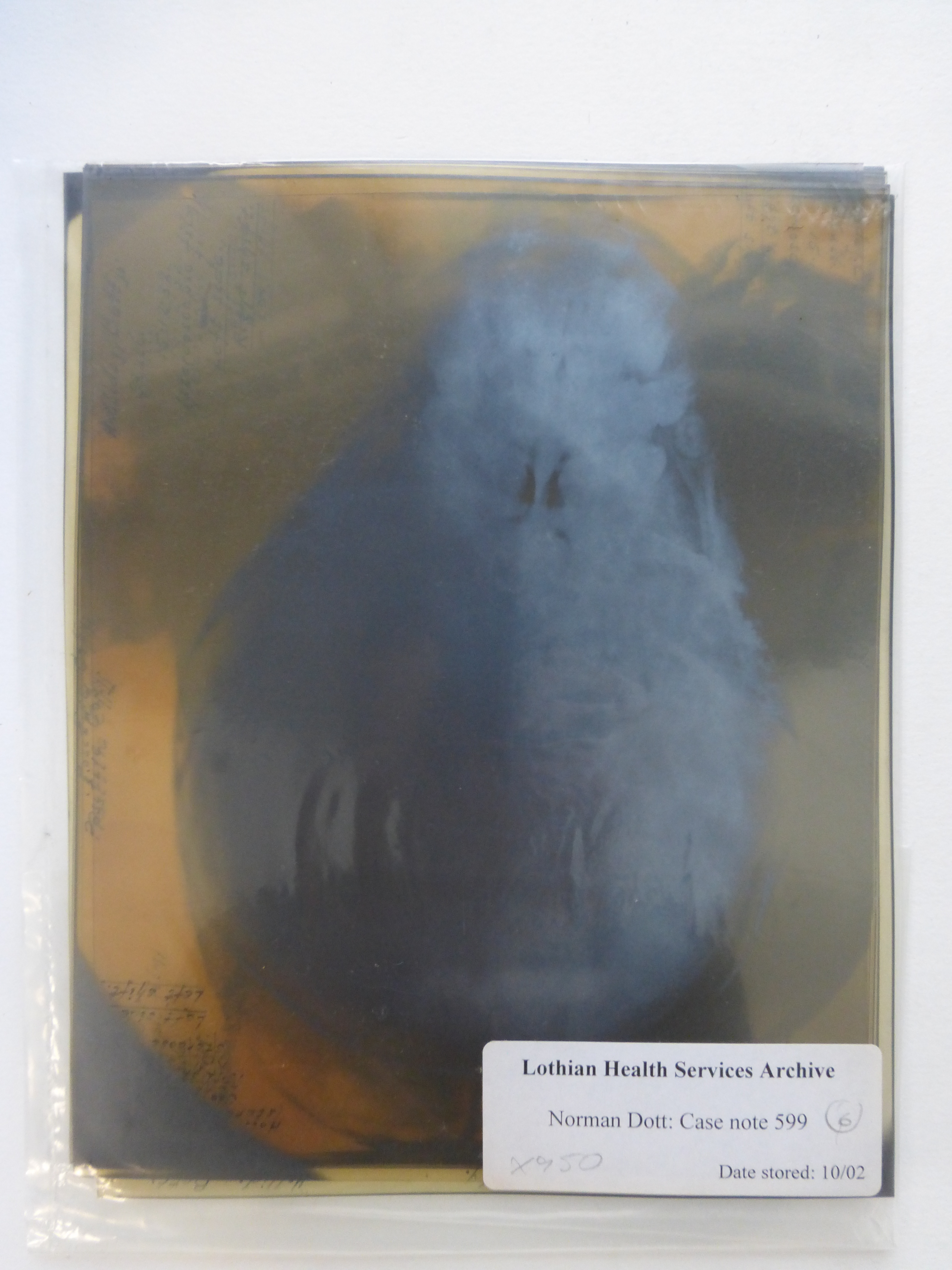
X-ray from LHSA’s collection
During this time, I have also been supervising conservation volunteer, Colette Bush, who has been working on a collection of architectural plans. She has surface cleaned each plan, repaired any tears and removed any paper accretions using a poultice. When this was complete, I humidified and flattened the plans and rehoused them in a polyester sleeve. Together we have conserved 16 plans in this way.
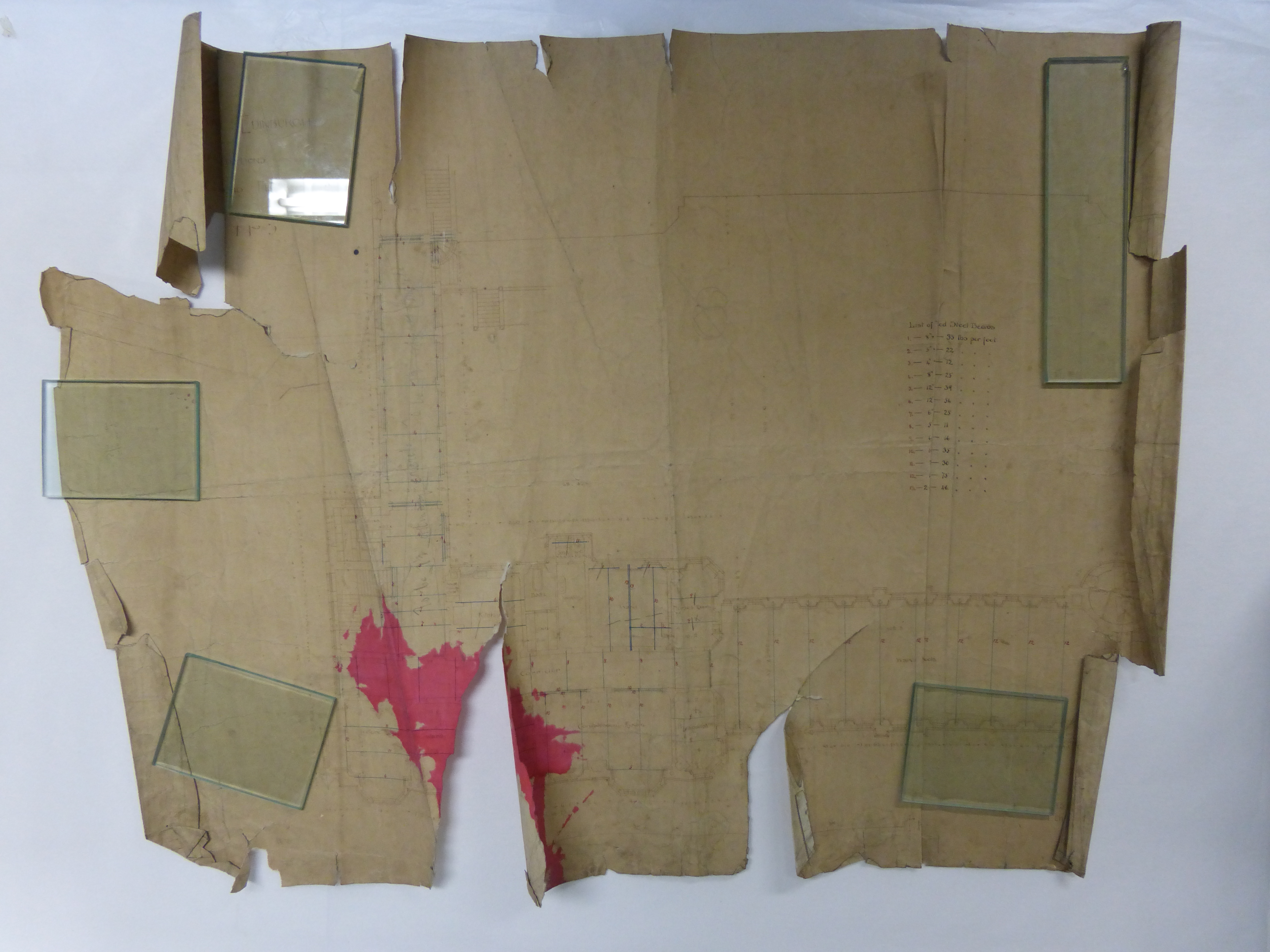
Architectural plan, before conservation

Architectural plan, after conservation
I’ve really enjoyed working with such a diverse collection and have learnt a lot on the way. I’m looking forward to seeing what new conservation challenges arise over the next year as I start working with new collections.
Project makeover
Now that the Data Vault project has received second round finding, we thought it was time for a makeover!
We’ve been working hard with our designers, and now have a project logo and URL:

Data Vault receives round 2 funding!
We’re pleased to announce that following the second round of project pitching in London on the 13th and 14th of July, the Data Vault project has been awarded further funding.
The first round of funding provided three months of effort, during which time the project developed a working proof of concept system that could archive and restore data. At the pitching session, team members demonstrated the prototype, and explained what would be achieved in the second round:
- Critical success factor: Deliver a first version of a complete data vault platform
- Implement the remaining requirements:
- Authentication and authorisation
- Integration with more storage options
- Management / monitoring interface
- Example interface to CRIS (PURE)
- Development of retention and review policy
- Scalability testing
- Two community engagement events (Manchester: 7th October, Edinburgh: 5th November)
We are grateful to Jisc for providing this second round of funding which will provide effort from August to November.
Second General Military Hospital, Craigleith
In this edition of Untold Stories, Louise (Archivist at Lothian Health Services Archive) looks at the history of one of the many military hospitals in our region:
During the current centenary of the First World War, LHSA has received a number of requests for records of patients in the many military hospitals in and around Edinburgh: from Red Cross auxiliary hospitals to specialist units and existing medical facilities that were requisitioned by the authorities. Due to the fact that medical records of service patients were returned to the custody of the Public Record Office in London (many of which were subsequently destroyed in a Second World War bombing raid), we are unable to help with these enquiries, even if we have custody of patient records generated by requisitioned local hospitals in peacetime. If you are researching the individual records of a forces’ patient or member of military medical staff, there are some resources that may help you at the end of the blog. However, LHSA holds a number of privately donated resources that uncover the realities of hospital life for First World War patients and medical staff alike, supplementing the ‘official’ military record.
One of Edinburgh’s military hospitals was the Second General Military Hospital, Craigleith. The hospital was run by a Territorial Unit, who requisitioned the hospital wing of the Craigleith Hospital and Poorhouse. The first patient was received as early as August 1914, and the hospital was handed back to Edinburgh Town Council in Spring 1919. When the Local Government (Scotland) Act (1929) came into force, control of poorhouses and poorlaw hospitals transferred to the municipal authorities. The poorhouse at Craigleith became an institution that is still very much alive today – the Western General Hospital (WGH).

Exterior of the Second General Military Hospital, Craigleith (GD28)
LHSA is lucky enough to hold a number of items that bring the days of the Second General Military Hospital more sharply into focus for researchers. In addition to his specialism of gastroenterology, WGH Consultant Dr Martin Eastwood was also a hospital historian – in 1995, a book on the development of the WGH was published, written by Eastwood and his secretary, Anne Jenkinson. The sources used by Dr Eastwood were donated to us in 2009, and form a largely visual collection on the history of the hospital, starting from its opening as a poorhouse in 1867.
Among Dr Eastwood’s donation was a photograph album from the Second General Military Hospital. We do not know who gave the album to Dr Eastwood, but its images give a unique insight into hospital life.

The Craigleith photograph album (GD28/8/1)
For example, we can see the operating theatre that was built for the new military patients, and used by the WGH up to 1950 (though hopefully conditions had moved on a bit by then!):

New operating theatre in action, c. 1914 (GD28/8/1)
The hospital was headed by Colonel Sir Joseph Fayrer and its clinical staff made up of Edinburgh doctors, many of whom had (or were to have) distinguished medical careers (such as neurologist Edwin Bramwell and pioneer of modern dentistry William Guy). Nurses were for the most part untrained – local women who were members of Voluntary Aid Detachments (VADs):


Nurses and male medical staff at Craigleith in the Eastwood album (GD28/8/1)
Recuperation was not always solely medical – the hospital laid on various activities in order to make the soldier patients’ time more pleasurable. We have evidence of this in surviving copies of the hospital magazine, the Craigleith Hospital Chronicle. You can see a complete edition on the LHSA website, here. The Chronicle was a monthly publication started in 1914 by Craigleith nurse Annie Paulin. The copies that LHSA hold show images of hospital life, patients and staff, publish informational pieces on Scottish regiments, tell of social occasions at the hospital, showcase story serials and commemorate major events in the war, such as the rail disaster at Quintinshill (Gretna), which claimed the lives of 216 Royal Scots soldiers and 12 civilians:
 Poem to the victims at Gretna, June 1915 edition (GD28/6/1)
The Chronicle also had a regular feature (cue plug for my last blog!) titled A Nurse’s Notes from Serbia written by ‘M.T.F’ (one of the infuriating things about trying to trace authors in this magazine is that many contributions were only signed by initials!). M.T.F wrote about life at the front as a Scottish Women’s Hospital nurse:
 Craigleith Hospital Chronicle, December 1915 (GD1/82/11)
If you’d like to guess the identity of M.T.F, the excellent nursing history website Scarlet Finders lists all Scottish Women’s Hospital nurses.
However, not all Chronicle articles took such a serious note. For example, comic poems and occasionally cartoons took a turn to supplement more ‘educative’ material:


Lighter material from the same December 1915 edition (GD1/82/11)
Unless patients signed articles or poems in the Chronicle, we have little idea of who they actually were from the material that we hold at LHSA. Fortunately, we do hold another piece of evidence in an autograph book created by Craigleith nurse Sister Ethel Miller from 1916 to 1919.
Rather than the celebrity signatures that fill autograph books of the modern day, these small volumes were passed from nurses to soldier patients on the wards, who contributed sketches, cartoons, anecdotes and poetry. Keeping these books appears to have been common practice for nurses, and many survive in archive collections across the United Kingdom (including this one in the National Museum of Scotland).
Born in 1888 in Edinburgh, Ethel was a professional nurse before the war, qualifying from the Royal Infirmary of Edinburgh School of Nursing and from the wartime Territorial Nursing Service in 1916. Along with photographs, printed material and nursing certificates, Ethel’s scrapbook was generously bequeathed to LHSA in 2012 by her son.
 Sister Ethel Miller (Acc12/025)
Sister Miller issued instructions to her potential contributors: according to a poem in the volume, she wanted ‘not just a name’, but ‘something else besides’, a more personal contribution from her charges in the form of a verse, a joke or a drawing. The result of her instructions is a fascinating insight into the often battle-scarred and weary ordinary ‘Tommy’ – we know that most contributors in the book were from the rank of private by the signatures after each drawing, poem or anecdote
Although not all of the completed pages are signed, there were at least 43 different contributors. The soldiers (for the contributors were largely from the army) wrote poems, limericks, drew original cartoons, traced published images with blotting papers and sketched regimental badges and front-line experience. Some praised the bravery of their regiment, as did Private A. Lane of the Kings Own Scottish Borderers in October 1916, which was ‘a credit to his friends and a terror to his foes’. However, the main themes of the book do not concentrate on heroism on the field of battle, but on war’s drudgery and the after effects of conflict, whether that was the domestic regimes of hospital life, reaction from civilians at home to returning war wounded (as new technologies of battle left maimed soldiers as physical reminders of the effects of war) and the misery of life in the trenches.


Cartoons from Ethel’s autograph book (Acc12/025)
In 2013, LHSA Research Intern Kirstin Cunningham saw the potential of Ethel Miller’s book for use in education, as an object that could bring the war directly to students through ordinary soldiers’ experiences. As a photography and film graduate, Kirstin painstakingly re-created the scrapbook page by page through digital imaging, fixing each image into a modern, similar sized book that she distressed to resemble its original. Soldiers’ stories can now be literally taken out of the archive, even if we will never know all of their names.
 Craigleith soldier patients at a concert in the recreation room (GD28/8/1)
Further resources on tracing military records from the First World War:
http://bit.ly/1NUdbde
http://bit.ly/1NUdrZR
http://www.scarletfinders.co.uk/125.html
http://bit.ly/1U6maz1
Elsevier E-Books – new titles available

We have added over 600 new Elsevier E-Books into DiscoverEd. These new titles cover most subject areas. A list of the new titles can be found here.
Further info
Further information about our e-books is available from http://www.ed.ac.uk/information-services/library-museum-gallery/finding-resources/ebooks
If a book you require is not held by the library, please visit our Library Resources Plus webpage.
Trial Access to Oxford International Encyclopedia of Peace
 We have trial access to the Oxford International Encyclopedia of Peace until 23/9/15.
This innovative and comprehensive encyclopedia charts the interdisciplinary field of peace studies from ancient times to the present day, offering a comprehensive survey of the full range of historical, political, theoretical and philosophical issues relating to peace and conflict. All major figures are covered, as well as major events, organizations, theories, and much more.
Feedback and further info
We are interested to know what you think of this e-resource as your comments influence purchase decisions so please do fill out our feedback form.
A list of all trials currently available to University of Edinburgh staff and students can be found on our trials webpage.
Foreign Office Files For China – extra collections now available!
We have recently purchased two extra collections within Foreign Office Files for China.
Foreign Office Files for China, 1949-1980: 1957-1966, The Great Leap Forward

Foreign Office Files for China, 1949-1980: 1967-1980, The Cultural Revolution

Further Info
Both of these collections are listed on our East Asian Studies A-Z list and History A-Z list as well as our main database A-Z list and DiscoverEd.
Collections
 Love, Loss, and Literature: Cataloguing the Papers of Irene Jessie Young
My name is Nancy Britten, and I’m in my fourth year of studying History at...
Hill and Adamson Collection: an insight into Edinburgh’s past
My name is Phoebe Kirkland, I am an MSc East Asian Studies student, and for...
Love, Loss, and Literature: Cataloguing the Papers of Irene Jessie Young
My name is Nancy Britten, and I’m in my fourth year of studying History at...
Hill and Adamson Collection: an insight into Edinburgh’s past
My name is Phoebe Kirkland, I am an MSc East Asian Studies student, and for...
Projects
Cataloguing the private papers of Archibald Hunter Campbell: A Journey Through Correspondence
My name is Pauline Vincent, I am a student in my last year of a...
Archival Provenance Research Project: Lishan’s Experience
Presentation My name is Lishan Zou, I am a fourth year History and Politics student....