Home University of Edinburgh Library Essentials
March 27, 2026
Lynda.com: now launched!
Following its recent ‘soft launch’, Lynda.com, a new service that provides access to an extensive library of high quality video courses in technology, creative and business skills, is now available for staff and students of the University.
New to the Library: British Politics and Society
I’m happy to let you know that following a successful trial and positive feedback the Library has now purchased access to Nineteenth Century Collections Online: British Politics and Society from Gale Cengage.

You can access Nineteenth Century Collections Online: British Politics and Society via the Databases A-Z.
British Politics and Society brings together primary source documentation that enables a greater understanding and analysis of the development of urban centers and of the major restructuring of society that took place during the Industrial Revolution. Read More
New to the Library: Papers of Neville Chamberlain
I’m pleased to let you know that the Library has recently purchased the Papers of Neville Chamberlain, an online resource containing political papers documenting Chamberlain’s policies as Chancellor of the Exchequer and Prime Minister and highlighting his personal correspondence with his family.
You can access the Papers of Neville Chamberlain via the Databases A-Z list. This collection is made available to us via Archives Unbound from Gale Cengage.

Digital explorations in New College Library : James Kirkwood’s vision today
A guest post from Chloe Elder – New College Library Special Collections Digitisation Intern
Considering the ease with which most of us have access to information, it can be easy to forget the long way society has come in its efforts to provide resources for the public. For example, I’ve written this post on my very portable laptop in my Wi-Fi enabled flat and with my iPhone in constant peripheral vision. As we all know, before the days of the internet, our search for information required a trip to the library, but public libraries as we know them today did not exist before the middle of the nineteenth century. In the centuries preceding, the library has evolved from storehouses for records and archives, to ecclesiastical and academic cloisters, and the private collections of the elite and learned. And beginning in the late seventeenth century history, history saw a shift from the relative seclusion of these repositories toward a trend that supported the public dissemination of knowledge. One pioneer in this effort in Scotland was James Kirkwood, who is best known for his determination to provide Bibles to the parishes of the Scottish Highlands and for advocating for the establishment of parish libraries throughout Scotland in the late seventeenth and early eighteenth centuries.
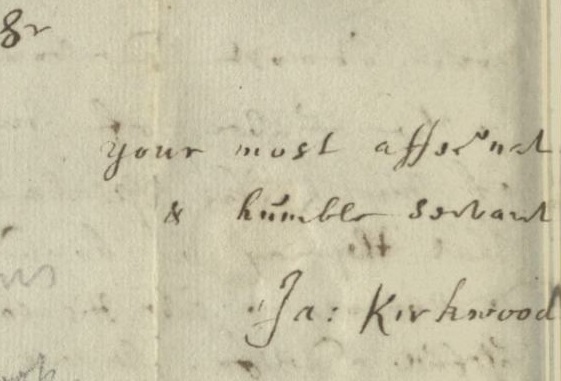
James Kirkwood’s signature. MSS KIR 3.1, New College Library
Cambridge Shakespeare: free book chapters and articles
As we mark the 400th anniversary of the death of William Shakespeare, Cambridge University Press is offering free chapters from their prestigious books and articles from Shakespeare Survey every month to celebrate the reach of Shakespeare’s global reputation. The selected publications all focus on Shakespeare’s fellow playwrights and writers. All of this content can be accessed freely on the publisher’s Shakespeare’s 400th Anniversary homepage, or click the link straight to either the free book chapters or Shakespeare Survey articles.
 If you wish to read the whole books, our University’s Main Library has the printed version of most of these books. Please search in Discovered. We also have a full run of the journal Shakespeare Survey from 1948 onwards, though we haven’t subscribed to the online version yet.
Compressing collections to create more study spaces – update 14 July 2016
Over recent weeks we have been progressing well with our project to compress the Library collections on the 2nd floor.
We now have lots of empty shelves (photo below) so are able to begin to move some books down from the 3rd floor to the 2nd floor; this will continue with the plan to free up space throughout all floors so that we can introduce additional study spaces.

During this move access to lifts and collections may be restricted, but we will have staff available to help you if necessary.
Apologies for the continuing disruption at this time.
ATLA – You’re more than a database to me! #ATLA2016
I arrived in Long Beach on Tuesday 14 June, after a 22 hour journey, and checked into the conference hotel at Long Beach, California. I was there to attend the American Theological Library Association (ATLA) conference 2016, and I was fortunate enough to have the support of my institution, the University of Edinburgh, and a professional development grant from the Chartered Institute of Library and Information Professionals Scotland.
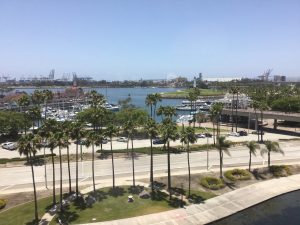
View from my hotel window
My key objective was to share New College Library Edinburgh’s unique story and talk about our recent work unwrapping its hidden collections through cataloguing projects in my conference paper. I was also keen to experience the wider library, information and knowledge sector context of theological libraries in the US, as many of the postgraduate students I meet come from the USA. Learning about collection management in theology and religious studies was also important, particularly raising my awareness of new digital resources in theology and religious studies. Finally I wanted to hear more about the US approach to library projects, including partnership working and working with decision makers. Read More
CRC Summer School: Day 3
 After a morning spent with project conservator Emily Hick who introduced us to conservation theory, we had the chance to try out some of the techniques in practice. From surface cleaning to tear repair, we were able to take the first steps in learning how to conserve paper and understand the practical and ethical considerations involved in conservation.
Fin West and John Glass then led a session on the fascinating world of rare books. As  cataloguers themselves, they picked out items in collection they had worked with personally. As well as seeing items dating back to the 16th century, we were surprised to learn that the department also features examples of graphic novels and comics. To give us a flavour of their roles at the university, we were each given a varied selection of donated books to assess by checking for duplicate records within the library catalogue.
The final session brought a complete change in tone with a visit to the Anatomy Museum, where we were greeted by two giant elephant skeletons. Ruth Pollitt then introduced us to the university’s extensive collection of specimens. We came face to face with the skeleton of William Burke, of the notorious murderers Burke and Hare. Once part of the teaching resources for Edinburgh’s medical school, the collections are still invaluable for visiting researchers and historians.
As part of the summer school, we were each assigned projects to complete over the week. Our role has been to investigate the significance of social media within the heritage sector. Other projects include designing events to promote the recently acquired Paolozzi mosaics; planning an exhibition using items from the collection around the theme ‘Green’; and learning about the different methods used in collections documentation. Each group will present their findings at the end of the week.

Volunteer Voice – Laura Keizer
In this week’s blog, we interview a conservation volunteer to find out what they do in the studio and the benefits of volunteering….
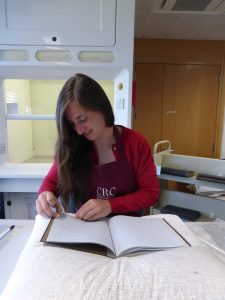
Laura Keizer surface cleaning a bound volume in the conservation studio
1.What is your name?
Laura Keizer
2. Where are you from?
I’m originally from the Netherlands, but – following a short stint in Reykjavík – have been an Edinburgh resident for over three years now
3. What do you do when you are not volunteering?
Despite currently being swamped in dissertation research for the MSc in Book History and Material Culture, I love to go hiking in the Scottish hills and highlands, hunting for castles or other medieval vestiges on my bike, or simply reading a book or knitting.
Oxford Scholarly Editions Online: 18th century prose
We now have access to the 18th century prose module of the splendid Oxford  Scholarly Editions Online (OSEO), which provides full-text access to several hundred authoritative Oxford editions of major English works from the humanities written between 1485 and 1830, and has a wide-ranging subject coverage that includes philosophy and linguistics. Read More
Collections
 Hill and Adamson Collection: an insight into Edinburgh’s past
My name is Phoebe Kirkland, I am an MSc East Asian Studies student, and for...
Cataloguing the private papers of Archibald Hunter Campbell: A Journey Through Correspondence
My name is Pauline Vincent, I am a student in my last year of a...
Hill and Adamson Collection: an insight into Edinburgh’s past
My name is Phoebe Kirkland, I am an MSc East Asian Studies student, and for...
Cataloguing the private papers of Archibald Hunter Campbell: A Journey Through Correspondence
My name is Pauline Vincent, I am a student in my last year of a...
Projects
Cataloguing the private papers of Archibald Hunter Campbell: A Journey Through Correspondence
My name is Pauline Vincent, I am a student in my last year of a...
Archival Provenance Research Project: Lishan’s Experience
Presentation My name is Lishan Zou, I am a fourth year History and Politics student....