Home University of Edinburgh Library Essentials
March 27, 2026
I: ‘The Times’ History and Encyclopaedia of the War – its early issues and ambition
‘…AN ACCOUNT OF THE GREAT CONTEST NOW IN PROGRESS…’

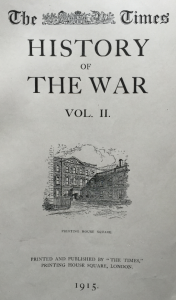
Printed and published by The Times newspaper, The Times History and Encyclopaedia of the War was a British weekly periodical first issued on 25 August 1914, only three weeks after the outbreak of war on 4 August. In the Preface to the first issue, the object of the enterprise was defined.
The Preface claimed that it would be ‘an account of the great contest now in progress’, and it would be ‘at once popular and authoritative’. It would be ‘popular in the best sense of the word’, and discuss the political factors which have led up to the crisis’, and serve ‘as a work of reference’.
As far as writing was concerned, the publisher spoke of its ‘staff of foreign correspondents […] celebrated for the knowledge and insight into political and social conditions’. These correspondents had made ‘the foreign pages of The Times the most accurate review of current foreign affairs published in any paper in the world’. The Times had ‘succeeded in obtaining the services of writers well versed in Military and Naval affairs and foreign political matters’.
The Times History and Encyclopaedia of the War was to be issued ‘weekly in sevenpenny parts’ (7d in 1914 being roughly £3.00 in 2016), and thirteen parts were to form one volume. Special bindings were to be offered ‘in three different qualities’ – cloth, half leather, and full leather – to be ‘sold by every bookseller’. Modern 2016 prices for these various ‘qualities’ would be cloth £7.75, half leather £14.25, and full leather £26, roughly.
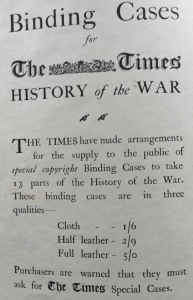
Ad’ for the special binders that were available in which to gather the weekly parts of ‘The History’. From Volume 1, Part 2, p.ii.
The weekly parts would also carry advertisements within the covers, and not just for The Times own products such as its binders, a weekly edition of the newspaper, a war atlas etc. Here is an advertisement for a tobacco – Player’s Navy Mixture – which was a ‘Combination of Bright Virginia, Louisiana perique, Latakia, and other scarce Eastern Tobacco’…:
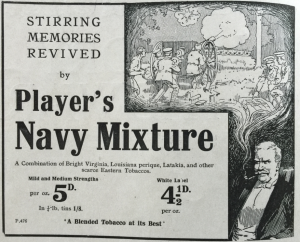
Tobacco advertisement from the cover of one of the weekly issues of ‘The History’, in Part 21, Volume 2.
At first, the publication was known as The Times History of the War but as the war progressed it would be known by the much more descriptive title of The Times History and Encyclopædia of the War. The earlier Parts 1-63 used the earlier title, and Parts 64-273 formed the later title. By war’s end the history/encyclopaedia would consist of twenty-one volumes. The individual parts of Volumes 1-21 were issued from 25 August 1914 to 27 July 1920, and Volume 22, published in 1921, formed a general index.
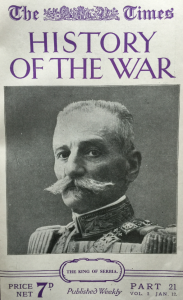
King Peter I of Serbia was featured on the front cover of Part 21 of Volume 2.
The earliest component parts featured graphic work on the front covers of the individual issues. Those in Volumes 1 and 2 featured the German Emperor, George V, Earl Kitchener, Field-Marshall Sir John French, Lt-Gen. Sir Douglas Haig, Peter I, General Gallieni, and Nicholas II, amongst others. The front cover was not always a statesman or military figure though…:
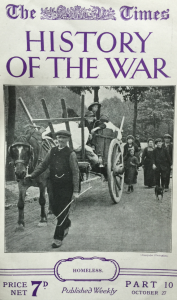
‘Homeless’ probably from communities in northern France or Belgium, featured on the front cover of Part 10, Volume 1.
Refugees fleeing assault on their communities were featured on a front cover in Volume 1, and in Volume 2 a cover features an enlistment poster ‘appealing’ for recruits after attacks on the east coast of England. It was an appeal to the ‘Women of Scarbro’ (Scarborough) to help ‘avenge slaughter of the innocent women and children’ of the town and ‘encourage’ men to ‘Enlist at Once’…
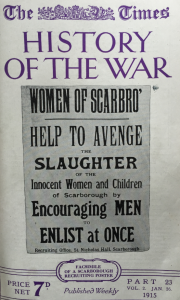
In the ‘East coast raid number’ this poster was featured on the front cover of Part 23, Volume 2.
The Preface to the first issue also commented on its maps. These were to be reproduced from those appearing in the pages of the daily newspaper – The Times – though ‘in some cases special maps will be prepared for particular purposes’. It went on, ‘special pains have been taken to secure their accuracy in every particular’.
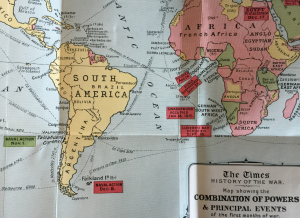
World map showing Africa and South America in 1915, appended to part 23, Volume 2, p.357.
An insert world map appended to Part 23 (February 1915), Volume 2, showed ‘the combination of powers and principal events of the first months of the war’. The map impressed on the reader how global the war had become, with naval action around the Falkland Islands in December 1914, naval action in the south eastern Pacific off Chile, and actions in south western Africa and west Africa.
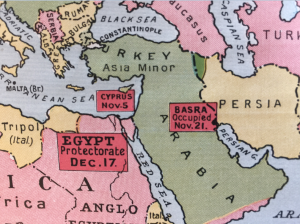
Same map showing action in the Middle East in 1915, appended to part 23, Volume 2, p.357.
The same map showed action taking place in Cyprus, Egypt, and Basra (then simply a city in the Ottoman Empire, rather than in the yet to be configured Iraq), and action in the Indian and western Pacific Oceans, and in China.
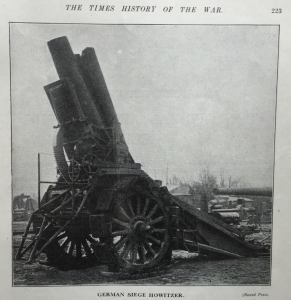
Siege Howitzer illustrated in Part 6, Volume 1, p.223.
Very early in the work too, it would become clear to the reader how ‘modern’ and ‘industrial’ warfare had become. The issues would feature pictures of aeroplanes of all warring parties, the siege howitzer and other heavy artillery, airships…:
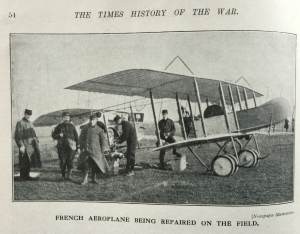
French aeroplane illustrated in Part 15, Volume 2, p.54.
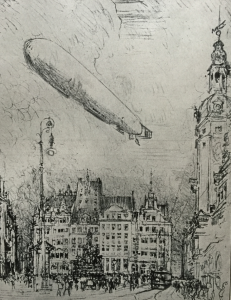
‘Zeppelin’ illustrated in Part 16, Volume 2, p.81.
and bombing…:
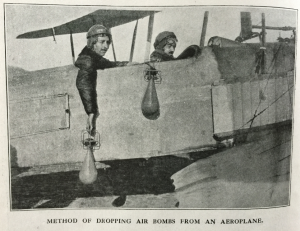
‘Air bombing’ illustrated in Part 18, Volume 2, p.196.
A further look at the content of The Times History and Encyclopædia of the War will be taken in the next few months.
Dr. Graeme D. Eddie, Assistant Librarian Archives & Manuscripts, Centre for Research Collections (CRC)
Planning for the REF at Surrey: a visit from the LOCH project
The REF Open Access Planning workshop, which took place in Manchester in December 2015, was oversubscribed. This was quite disappointing for many of us who were in the process of setting up workflows in preparation for April 2016 and were keen to attend.
Our open access team here at Surrey was therefore delighted to receive a visit from Dominic Tate, Scholarly Communications Manager at the University of Edinburgh and project manager of Lessons in Open Access Compliance for Higher Education (LOCH), to offer advice and start a dialogue on open access and the REF. The visit took place in January, when we were still shaping our implementation plans.
The session was interactive, which allowed us to talk about how Surrey has been supporting open access in the last 10 years and what challenges we face in terms of embedding open access, managing workloads and reporting on compliance. Here are some of the key things we addressed:
Planning for the REF.
- Different models work for different Universities; but while there is no one-size fits all solution, exchanging ideas with others is always beneficial. Dominic put us in touch with nearby institutions with this in mind.
- It is important to keep the model simple. A ‘devolved’ or ‘centralised’ model – or a combination of both, can be chosen to fit the institution’s size, culture, and existing practices. Here at Surrey we are combining both approaches, identifying champions at School or research group level to help spread the messages, but also supporting a ‘top-down’ approach, e.g. emails from senior members of staff.
- It is important to create a really clear understanding of what is meant by ‘on acceptance’ and provide succinct guidance regarding this.
Staffing and workflows
- It is difficult to evaluate the FTE needed to work on Open Access if it is not yet fully embedded or adopted in the institution.
- Thinking about what tasks need extra resource is essential. We took this advice to put forward a business proposal for a specific workflow that we believed would work best for Surrey.
- It is worth considering the relatively low cost of Green OA in making a case for funding: this is approximately £33 to deposit a manuscript compared to £88 to pay an invoice – plus the invoice cost of approx. £1750 (based on SPARC figures). this, too, has been very informative when putting forward a business case.
Changing Culture / key messages
- Having an open access policy in place, which Surrey has had for many years now, is only the first step towards implementation. A clear operational plan is necessary to implement the policy. In this respect Surrey has made a lot of progress, but this now needs to be aligned with HEFCE priorities.
- We need to start thinking about open access as part of the research lifecycle. If, for example, we treat open access like we treat research ethics, then it will become much harder for researchers to ignore.
- The emphasis should be on the added value of OA, rather than on compliance.
Four months after Dominic’s visit, and with REF compliance as our top priority, we have drawn considerably on that day’s discussions to:
- Formulate key messages around compliance;
- Plan, set up and start implementing a heavily mediated workflow for REF compliance, supported by advocacy available at many levels and through several communication channels;
- Make sure that key ideas around the value of open access are not lost among funders’ mandates, supporting systems and copyright jargon.
Surrey has been supporting open access since the setup of our first repository in 2005. GFollowing the introduction of HEFCE’s open access policy we have reviewed our practices, moving to more mediated procedures, and strengthened the messages with compliance in mind. Discussing this within the LOCH project context has helped us see more clearly what others have tried and what is most likely to work for our institution. Even more importantly, we have also addressed support of open access beyond compliance with HEFCE.
Posted on behalf of Christine Daoutis – University of Surrey
New Furniture Arriving
We are almost there – thanks for your continued patience!
New furniture for the 358 additional study spaces will start to arrive next week – please see below for details.
Tuesday 13th September – 2nd & 4th Floors
Thursday 15th September – Lower Ground Floor
Tuesday 20th September – 1st & 3rd Floors
Whilst every attempt will be taken to avoid the minimum of disruption to users as the new furniture is assembled there will be an element of unavoidable noise as these works get carried out.
The installation of the new desk top power modules will be installed quickly after the new study desks have been assembled, the desktop power will enable you to charge your devices via a plug or a USB port. These works will be carried out in the evening as there will be an element of drilling work involved. As with previous works, barriers will be put in place to alert users of the areas where the contractors will be working in.
Tuesday 13th , Wednesday 14th & Thursday 15th September – 2nd & 4th Floors
Monday 19th September – Lower Ground Floor
Tuesday 20th & Wednesday 21st September – 1st & 3rd Floor
Conservation Placement – Northumbria University
Lisa Mitchell, conservation placement student from Northumbria University, describes her experience of working at the CRC in this week’s blog post…
Over the past two weeks I have had the pleasure of working with the conservation team at the CRC as part of my summer placement for my Master’s degree in conservation on works of art on paper.
Following an intense but fulfilling first year studying at Northumbria University, the summer has provided a very welcome respite from assignment writing and the opportunity to put some of my newly taught conservation skills into practice!
Working alongside Emily Hick, the Special Collections Conservator, I have been fortunate enough to assist her in the completion of the final stages of the conservation treatment of a collection of 32 portraits from India, which Emily has recently written about in her Passage to India blogs (part 1 and part 2 can be read by clicking on the highlighted text).
New to the Library: Nineteenth Century Collections Online
Over the summer the Library was able to purchase the British Politics and Society collection, part of Nineteenth Century Collections Online (NCCO) from Gale Cengage. This is a major new resource for the Library and provides a fascinating look at this period of great change.

British Politics and Society brings together primary source documentation, allowing a greater understanding and analysis of the development of urban centers and of the major restructuring of society that took place during the Industrial Revolution.
You can access Nineteenth Century Collections Online: British Politics and Society via the Databases A-Z. Read More
New to the Library: Africa-Wide Information
I’m pleased to let you know that after a successful trial earlier this year the Library has now subscribed to Africa-Wide Information from EBSCOhost. Bringing together 50 databases sourced from Africa, Europe and North America, Africa-Wide Information provides comprehensive, multidisciplinary information which documents research and publications by Africans and about Africa.

You can access Africa-Wide Information from the Databases A-Z list. Read More
Alice’s Adventures in the Rare Book Stacks
Happy 150th anniversary of the second edition of Alice’s Adventures in Wonderland!
(This week’s blog post has been contributed by Tess Goodman, a doctoral student in the Centre for the History of the Book, who has been volunteering with us.)

The second edition? Wait—what about the first edition? Well, the first edition of Alice, printed in 1865, was suppressed before publication. But don’t get too excited: this isn’t a tale of censorship. It’s a tale of quality control.
The 1860s are now sometimes called the golden age of book illustration. Cheap illustration technology was relatively new, and illustrated books were very, very popular. Even fiction for adults was usually illustrated: the first editions of works by Dickens and Thackeray, for example, were full of pictures. In the 1860s, even well-reputed painters like Dante Gabriel Rossetti and John Millais were producing work for books, and the average quality of illustration was higher than ever. Illustration could make or break a title.
Alice was illustrated by John Tenniel, a well-known cartoonist for Punch. The first copies were printed in the summer of 1865, and Charles Dodgson (who went by the pseudonym Lewis Carroll) began sending presentation copies to his friends before the official release.
But then Tenniel saw a copy. He thought that his illustrations had been badly printed. In fact, he found the printing so poor that he complained to Dodgson, who complained to the publisher, who canceled the entire edition. Macmillan reprinted all 2,000 copies. Dodgson sent letters to friends who had already received copies, apologizing for the quality. The rejected sheets were sold to a publisher New York, who published them in America with a new title page.*

The second edition, published in 1866, was the first to appear in Britain. The pictures in this post are from Edinburgh’s copy of this edition, which is bound with a first edition of Through the Looking-Glass. Hopefully these pictures demonstrate what the fuss was about: these illustrations are spectacular.
Tenniel did forty-two illustrations for Alice. They were so popular that for Through the Looking-Glass, he did fifty. These pictures brought, and bring, joy to everyone who sees them—except their creator. Tenniel found Dodgson so pernickety and difficult that he almost refused to work on Looking-Glass; it took Dodgson and Macmillan years to convince him. Afterwards, he wrote: ‘with Through the Looking-Glass the faculty of making drawings for book illustration departed from me… I have done nothing in that direction since…’. ** (60). And he never did again.

Nevertheless, we’re glad to have these books at Edinburgh. As you can see from these pictures, our copies are in slightly poor condition. But most children’s books are very hard to find in good condition: the children reading them don’t worry about preserving them for future generations. In the case of Alice in Wonderland and Through the Looking-Glass, the binding might be rubbed and the joints might be shaky, but the printing is still impeccable.

*That makes them the second issue of the first edition, if you are bibliographically-minded enough to care. The presentation copies that still had the British title page were the first issue of the first edition. Only fifteen are extant.
** Quoted in Sydney Herbert Williams and Falconer Madan. The Lewis Carroll Handbook: being a new version of A handbook of the literature of the Rev. C. L. Dodgson. Revised by Roger Lancelyn Green. London: Oxford University Press, 1962. P. 60.
Textiles and threads – samples and catalogue
ANOTHER SPLASH OF COLOUR FOR THE COLLECTIONS – FROM EUROPE, CHINA AND JAPAN

Towards the end of the 2015-2016 financial period, CRC acquired a small number of items relating to textiles and the textile trade, bringing another small splash of colour to the collections.
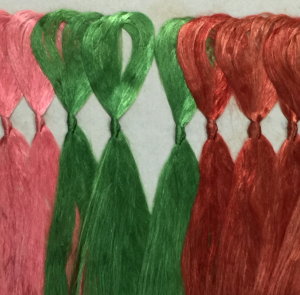
Threads from Kwangtung (Guangdong), China, in Coll-1766.
The items reflect both English and French textile production and the textile production of the Far East (Japan and China). The items in question are samples of textiles and threads.
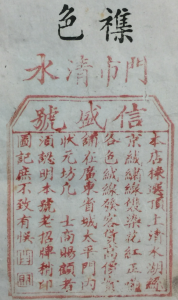
Wrapper from a sample of threads from Guangdong, China, in Coll-1766.
We acquired a collection of silk thread samples from Kwangtung (Guangdong), China, a city in which which silk production is an important sector of the economy, and which began the export of silk during the Han dynasty.
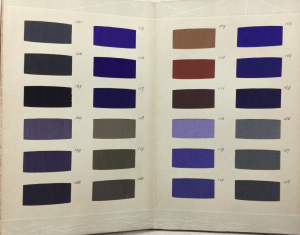
Catalogue of silk samples from Kyoto, Japan, in Coll-1762.
The collection of 15 wrappers offers silk threads in various colours, all housed in paper with ties. The name of the producers are on the upper covers, which state that the silk is produced by natural colours and washed in clear water. They were produced by Shun Shing Ho and Tian Da Lao Dien.
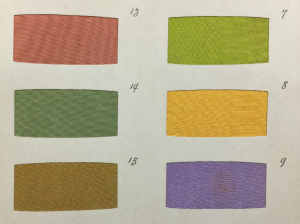
From the catalogue of silk samples from Kyoto, Japan, in Coll-1762.
We also acquired a catalogue of a silk manufacturer or kimono maker based in Kyoto, which in the 1900s was the centre of the Japanese textile trade. The catalogue has board covers in purple soft fabric with Japanese script which may once have been gilded.
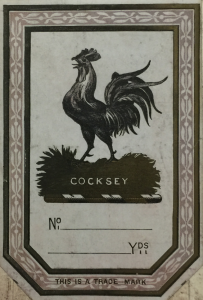
‘Cocksey’ trademark on bookplate in album of textile samples, in Coll-1769.
The album contains 198 mounted and different silk samples in various colours or shades.
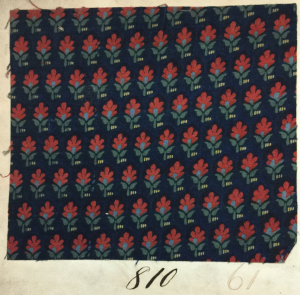
Textile sample from album, Coll-1769.
Finally, we now have the remains from two albums which contained mounted textile samples… English (possibly Lancashire) and French. These are mainly printed cottons pasted on stiff paper with numbers and annotations in ink.
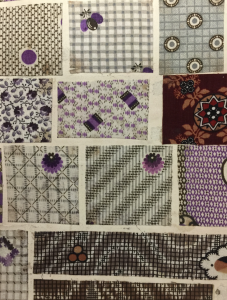
Textile samples from album, Coll-1769.
Some have annotations in French and are dated 1862. Some have the book-plate ‘Cocksey’, a registered trademark.
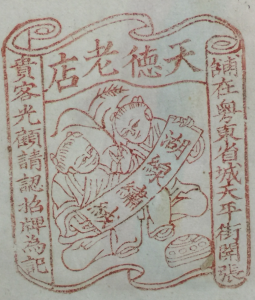
Wrapper from a sample of threads from Guangdong, China, in Coll-1766.
On our archives and manuscripts catalogue these collections are known as: Coll-1762 Catalogue presenting 198 different mounted fabric silk samples, Kyoto, Japan; Coll-1766 Collection of samples of Chinese silk threads for embroidery, Kwangtung; and, Coll-1769 Collection of British / French textile samples and designs on printed cotton.
Dr. Graeme D. Eddie, Assistant Librarian Archives & Manuscripts, Centre for Research Collections
Destructive scanning of duplicate theses
Hello, I’m Pete Marsden one of the digitisation assistants working out at the Gyle in West Edinburgh, and this is what I get up to……..
Here is a sneak peek behind the scenes at the library annexe where the thesis digitising team are hard at work. We have over 15,000 theses, most of which are duplicates, to scan over the next 18 months.
The theses are double checked on our spreadsheet to ensure that they are indeed duplicates and haven’t previously been scanned, when we are happy with this, the thesis has its boards removed with a sharp knife.
![_DSC0008[1]](https://libraryblogs.is.ed.ac.uk/phddigitisation/files/2016/09/DSC00081-300x199.jpg)
Removing the boards with a Stanley knife
The next stage is to remove the binding using a manual guillotine and a bit of elbow grease. The thesis is now ready to move on to the scanning stage.
![_DSC0013[1]](https://libraryblogs.is.ed.ac.uk/phddigitisation/files/2016/09/DSC00131-300x199.jpg)
Removing the binding with a manual guillotine
![_DSC0017[1]](https://libraryblogs.is.ed.ac.uk/phddigitisation/files/2016/09/DSC00171-300x199.jpg)
Kodak i4250 document scanner
Next time we will look at the image processing using Limb software.
Evening Floor Closures
As part of the ongoing electrical enabling works to accommodate the new study desks as part of the library refurbishment works, our contractors have scheduled a series of essential power shut downs from Monday 5th September 2016. The shut downs will be taking place from 21:00 to minimise disruption to library users. On these dates, the following floors will be closed to both staff and library users whilst the works are being carried out:
Mon 5th September: 4th and 3rd floors closed from 21:00 (to 06:00 Tues 6th)
Tues 6th September: 2nd floor closed from 21:00 (to 06:00 Weds 7th)
Weds 7th September: 1st floor and Lower Ground Floor closed from 21:00 (to 06:00 Thurs 8th)
There will be no access to the closed floors from 21:00 until the library opens the following morning. Please be advised to collect items in advance of or after the dates and times above. Staff have been advised of any preparation required in advance of the power shut downs.
Apologies for the disruption caused – thank you for your patience while work is underway.
Collections
 Hill and Adamson Collection: an insight into Edinburgh’s past
My name is Phoebe Kirkland, I am an MSc East Asian Studies student, and for...
Cataloguing the private papers of Archibald Hunter Campbell: A Journey Through Correspondence
My name is Pauline Vincent, I am a student in my last year of a...
Hill and Adamson Collection: an insight into Edinburgh’s past
My name is Phoebe Kirkland, I am an MSc East Asian Studies student, and for...
Cataloguing the private papers of Archibald Hunter Campbell: A Journey Through Correspondence
My name is Pauline Vincent, I am a student in my last year of a...
Projects
Cataloguing the private papers of Archibald Hunter Campbell: A Journey Through Correspondence
My name is Pauline Vincent, I am a student in my last year of a...
Archival Provenance Research Project: Lishan’s Experience
Presentation My name is Lishan Zou, I am a fourth year History and Politics student....