Home University of Edinburgh Library Essentials
October 26, 2026
Winter Vacation at New College Library
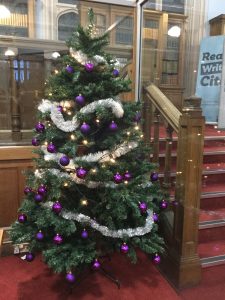 New College Library will close at 1pm on Friday 23 December 2016 and reopen again at 9am on Wednesday 4 January 2017. More details on opening hours for all University of Edinburgh Library sites over the holidays are available at : http://www.ed.ac.uk/is/library-opening. Read More
End of an Internship
Victoria Haddock, the second in a series of interns working on the Thomson-Walker collection, reviews her time spent at the CRC in this week’s blog post. If you’d like to find out more about this project, you can view Victoria’s end of internship Powerpoint presentation at the bottom of this article.
As I watch another beautiful sunset from the window of the CRC conservation studio, it seems a good moment to reflect back on the past 10 weeks of my internship here, which have absolutely flown by.
Although I did think on my first day that I was looking forward to 10 weeks of solid tape removal, the internship has been very busy, varied and with lots of opportunities beyond what I first expected.
New College Library books recommended by students
 Student recommendations are in at New College Library! The recently purchased Inherit the Holy Mountain: Religion and the Rise of American Environmentalism, edited by Mark Stoll, is available as an ebook via DiscoverEd.

Other student recommendations in the library include: Worship on the way : exploring Asian North American Christian experience by Russell Yee, at BR563.A82 Yee.
Read More
2nd C. Sculpture to Star Wars Props: 3D, a Force Awakens?
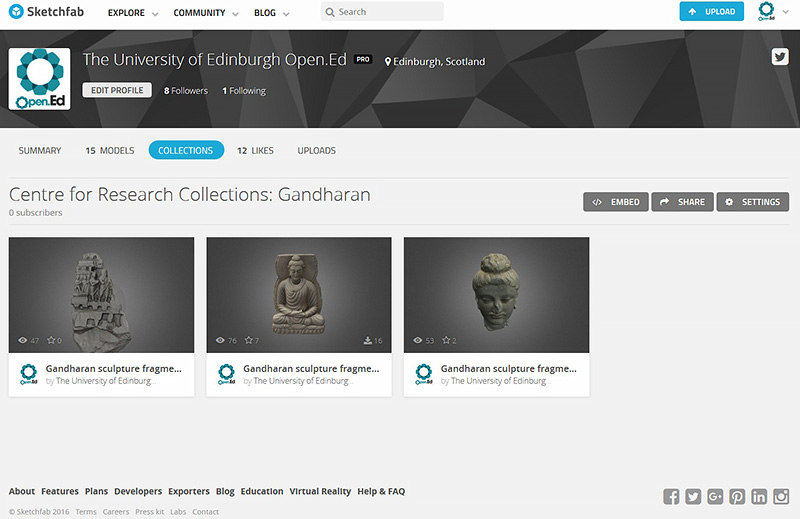
During a photogrammetry training session with Clara Molina Sanchez, we were recommended to choose objects with a matt surface, small to medium in size, and which didn’t have many holes or occlusions. We settled on a Gandharan Buddha from the Art Collection, a Paolozzi maquette from the Edinburgh College of Art collection and, just to test what would happen, a thigh bone trumpet wrapped in shiny metal filigree from the Musical Instruments collection.
The Statistical Accounts of Scotland Online – My statacc
This is the last in a series of blog posts about some of the functionality you may have come across (or may not have yet discovered!) in the new Statistical Accounts of Scotland Online. Here we concentrate on the new My statacc feature.
We have now introduced functionality to enable more personalisation when using the service. If you are a subscriber you can now save, annotate and tag individual pages, whole sections, illustrations and maps. You can use the star button to save. The label icon allows you tag items with one or two words of your choice, so that you can find them easily when you next visit (just type your words into the box), and the post-it note to write longer annotations which are stored alongside the item. If you are planning to coming back to a particular page, image or section, you can store information about why it is interesting, how it relates to your research or how you might want to use it.
These new features are designed to allow you to easily find and review content of particular interest to you. Tags and annotations are stored against your profile, and will remain there until you delete them. Just sign in and click on the My statacc red button on the top right of the page to find everything you have saved.

A page of the Statistical Accounts of Scotland showing personalisation features and the transcript. Screen-shot captured on Thursday 1st December 2016.
You can tag, annotate and save both sections and individual pages. Individual pages can be printed out and whole sections of the Statistical Accounts can now be downloaded as PDFs. You can even share what you have found on social media by clicking on the sharing icon and follow the links. Using these features is so easy – just click on the relevant icon and away you go!
We are particularly pleased to be able to offer such personalisation, which will help you to get the most out of your searching and browsing of the Statistical Accounts of Scotland Online. Please let us know what you think.
More information on all the features mentioned above, as well as others, can be found in the Statistical Accounts of Scotland Help Pages and the How to get the most out of the Statistical Accounts of Scotland online page. If you have any comments or queries please contact the EDINA Help Desk (edina@ed.ac.uk).
The Statistical Accounts of Scotland Online – Images and Words
This is the second in a series of blog posts about some of the functionality you may have come across (or may not have yet discovered!) in the new Statistical Accounts of Scotland Online. Here we concentrate on the images and maps, as well as the transcripts found on the website.
Images and maps
The new service contains a number of illustrations and maps published with the original accounts. Your search may result in a box containing the thumbnail views of related images or maps. As a subscriber you would be able click on these to view them (in a gallery view) in a much higher resolution than before. You are also able to zoom in and out, which is fantastic to be able to do! All other relevant images are on the left-hand side of the gallery view, making it easy to scroll and browse related illustrations and maps.
There are a number of interactive maps available in the service, which we are able to feature courtesy of the National Library of Scotland. One example is the map of Scotland on the homepage, where you can click on the map to open out a larger version, and as the mouse cursor moves over the map you will see the names of counties highlighted. There are also interactive maps available on the county pages, showing each of the parishes clearly within the county and allowing you to click through to more information on the parish.

The interactive map for the southern part of Northern Part of Ross and Cromarty Shires. Screen-shot taken from the Statistical Accounts of Scotland Online on Thursday 1st December 2016.
Transcriptions
Another greatly improved feature is that of the transcripts, which are available for most pages in the Statistical Accounts. The reading quality of the transcription has been improved through rendering the text in html, making it an even more useful to aid understanding when reading the Statistical Accounts.
We hope that these new features mean you get even more out of the wonderful wealth of information found in the Statistical Accounts of Scotland. More information on all the features mentioned above, as well as others, can be found in the Statistical Accounts of Scotland Help Pages and the How to get the most out of the Statistical Accounts of Scotland online page. If you have any comments or queries please contact the EDINA Help Desk (edina@ed.ac.uk).
Spotlight on Archives Unbound
This is the second in a (very) occasional series highlighting some of the online resources available at the Library that will be of interest to students and staff in History, Classics and Archaeology.
Archives Unbound from Gale Cengage provides access to topically-focused digital collections of historical documents. This is a vast array of valuable primary source material covering a broad range of topics from the Middle Ages onwards and the material supports the research and study needs of students and scholars. Most of collections are chosen for Archives Unbound based on requests from scholars, archivists, and students.

At present the Library has access to 9 collections from Archives Unbound, primarily covering topics and events from the twentieth century with one exception. Descriptions of these collections comes from the Archives Unbound site. Read More
Edinburgh University Students in Spain
It is 80 years since the Spanish Civil War broke out. Unlike both World Wars, we have no record of University of Edinburgh students who fought (and died) in Spain and this is the start of a process of trying to identify who did. This is very much work-in-progress and will be updated as we find additional information.
If you know of anyone missing from the list below, please contact the Deputy University Archivist, Grant Buttars
George Drever
George was born 31 March 1910 in Leith, the son of George Drever and Louisa (Balfour). He spent 6 years at Leith Academy before enrolling to study Science at the University of Edinburgh, gaining a First Class Honours BSc in Pure Science in 1933. Two years later he was awarded a PhD, his thesis being, Electrochemical studies in oxide formation on some metals.

First Matriculation: George Drever
Links
- A more detailed biography can be found on the Chess Scotland website.
- George features in
Frances Hughes Drew
Frances was born 12 May 1914 in Southampton. She was educated at Falmouth High School then at Blackpool Girls’ Secondary, enrolling to study medicine at the University of Edinburgh in 1932 and graduating MBChB in 1937.
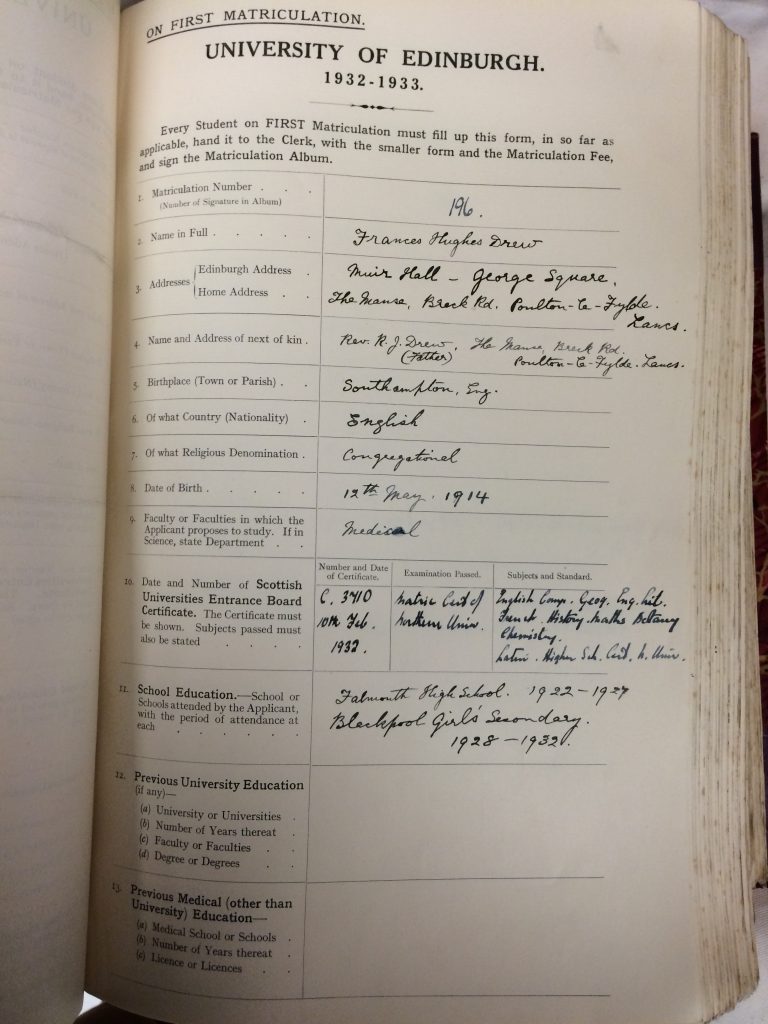
First Matriculation: Frances Hughes Drew
She was a member of the International Students’ delegation and one of six students in the British delegation of the (strongly Communist) World Student Association who visited Spain in the 1936/7 Christmas vacation and campaigned for the Republicans on her return.
John Peter Cowan Dunlop
Born 2nd July 1915 in Winnipeg, Canada, John was an accountancy student (non-graduating).
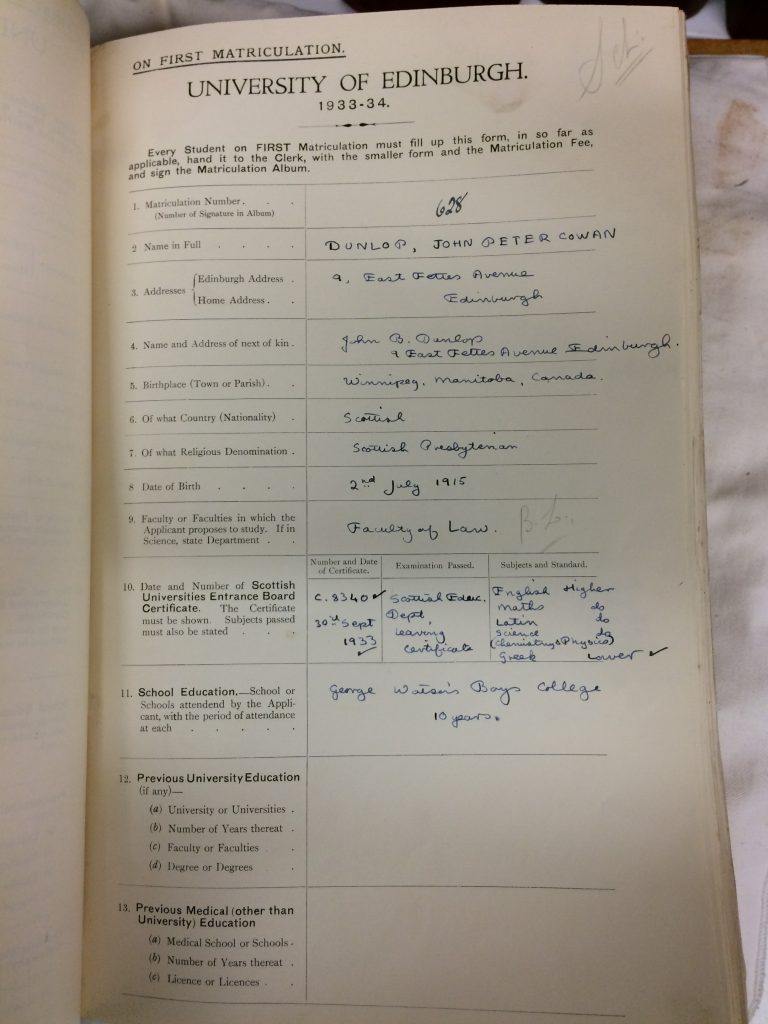
First Matriculation: John Peter Cowan Dunlop
John is listed on the International Brigades website:
Born: 2/7/1915, Winnipeg, Canada. Enlistment Address; 9 East Fettes Avenue, Edinburgh University Accountancy student. CPGB (1936) OTC in England. Single. Age 22. Arrived in Spain 19/5/1937. Enlisted in Battalion 22/5/1937. Joined the British Anti Tank-Gun Battery. Action’s participated in: Jarama, Brunete, Teruel, Belchite, Ebro. Wounded at Brunete in July 1937, (between the 6th and 12th) by shrapnel in the back. Recovered in hospital at Barcelona. Joined British Battalion on 10/11/1937. Wounded on 20/1/1938. In Hospital February-April 1938. Rifle No; 98101. No. 4 Company, Section 2, platoon 2. Confirmed Corporal on 30/4/1938. Sergeant. Wounded during the Ebro Offensive on 31/7/1938. In hospital 3/10/1938? Invalided home in October 1938. Set up his own printing business in Edinburgh upon his return.
He later became accountant to the International Brigade Association.
Links
- His entry on the International Brigades website.
- His papers are held by the National Library of Scotland: He died in 2006.
- An oral history interview is held at the Imperial War Museum
Hamish Fraser
Hamish was born 16 August 1913 in Inverness. He was educated at Preston School, Duns, Duns Public School, Berwickshire High School and at the Royal High School, Edinburgh. In 1931/2, he enrolled at the University of Edinburgh to study Technical Chemistry. The fact that his record specifies the subject rather than, as was the norm, simply recording the Faculty, suggests he was not enrolled in a full degree programme.
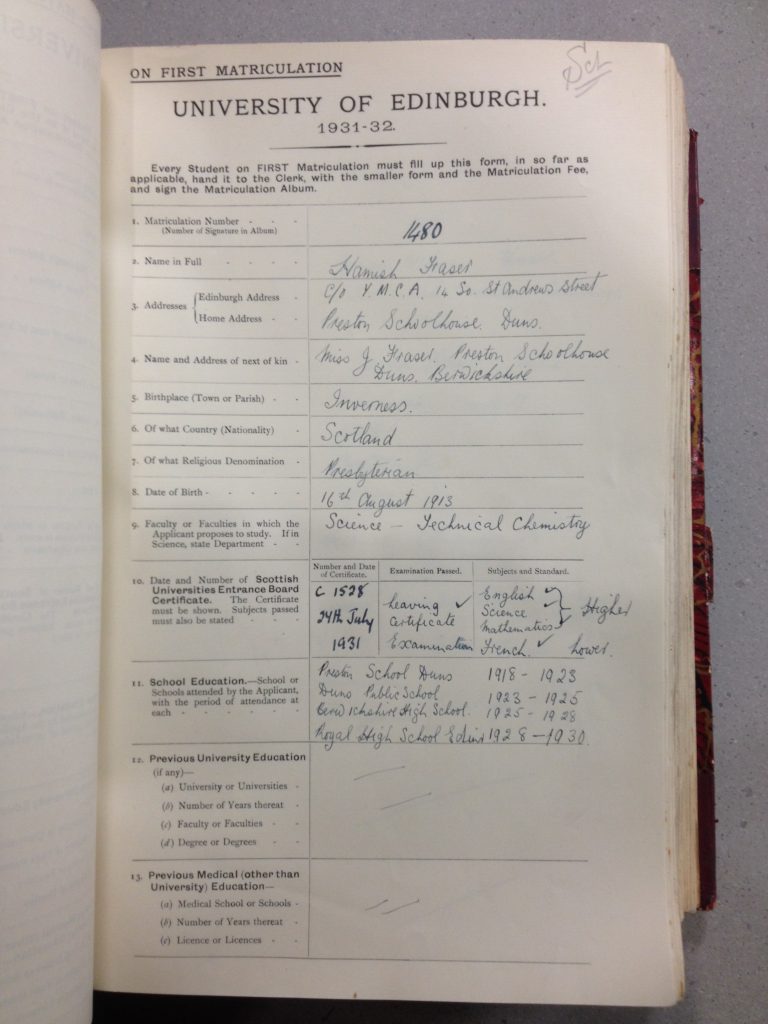
First Matriculation: Hamish Fraser
He claimed to have joined the Young Communist League while at University; he was certainly Propaganda Secretary of the Central London Federation of the YCL by the time the Spanish Civil War erupted in 1936,
Links
- Biographical sketch at Apropos (a magazine of which he served as editor after his conversion to Roman Catholicism)
Margot (Marguerite Rosabelle) Gale (later Kettle)
Margot was born in 1916. She was educated at King Arthur School, Musselburgh and St. Bride School, Edinburgh, enrolling at the Univerity of Edinburgh in 1934. While at University, she served as President of the Women’s Union, 1937-38. She graduated MA in 1938. In August 1938, she joined the Young Communist League.
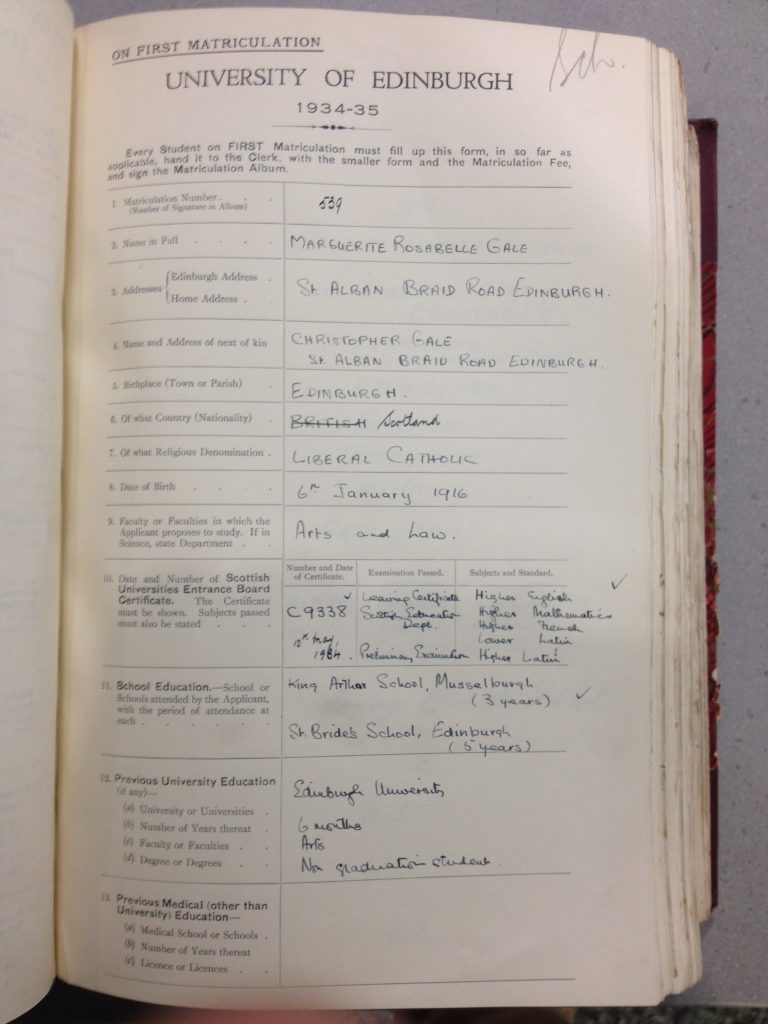
First Matriculation: Margot Gale
She was mother of Guardian journalist Martin Kettle.
Links
- Her papers are held at the Labour History Archive and Study Centre (Manchester)
David Mackenzie
His full name was William David Beveridge Mackenzie and he was born 14 November 1916, the son of Rear Admiral W. B. Mackenzie, in Rock, Cornwall. He was educated at Copthorne School, Sussex and at Marlborough College. He enrolled as a summer term only medical student at the University of Edinburgh in 1935, having previously studied history at Oxford.
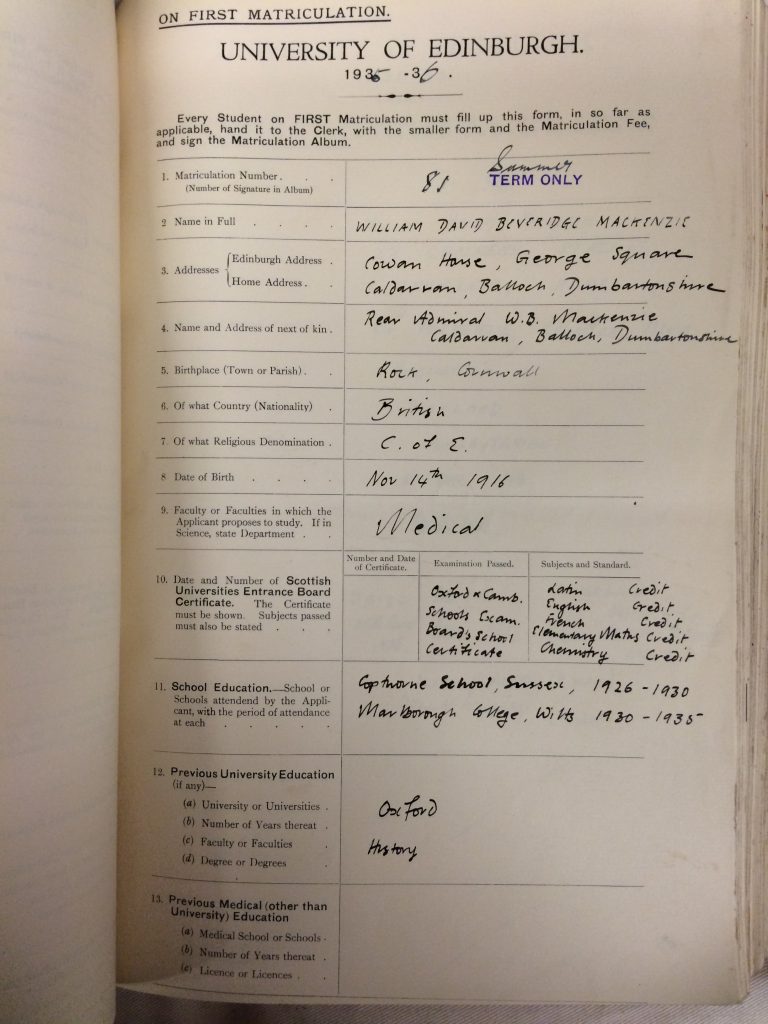
First Matriculation: William David Beveridge Mackenzie
David is listed on the International Brigades website:
c/o 16 King Street, London. (CPGB HQ) Oxford University. (History & Law) Medical Student at Edinburgh University. YCL. CPGB. Age: 20. Spain, 09/10/1936. French Commune de Paris Battalion, (Dumont Battalion) 11th International Brigade. Reported killed in error (25/11/1936) at the University City, Madrid, in the Daily Worker dated 05/12/1936. Returned to UK on 05/01/1937. (V.11 37a PF 45600) Battalion No. 947.
Links
- His entry on the International Brigades website
- Mentioned in an obituary of Bernard Knox (1977)
- Account of career in ‘Scottish Labour History’, 11 May 1977, p 41
Acknowledgements
I am very grateful to a number of people who have provided various leads on this subject, particularly Mike Arnott and Fraser Raeburn and of the Scotland and the Spanish Civil War Facebook Group.
2017 Library and University Collections calendar: Images from the Directory of Collections
The 2017 Library & University Collections calendar, which features a wide range of images from the Library’s Directory of Collections, is available to buy now from the Main Library and the University Gift Shop.
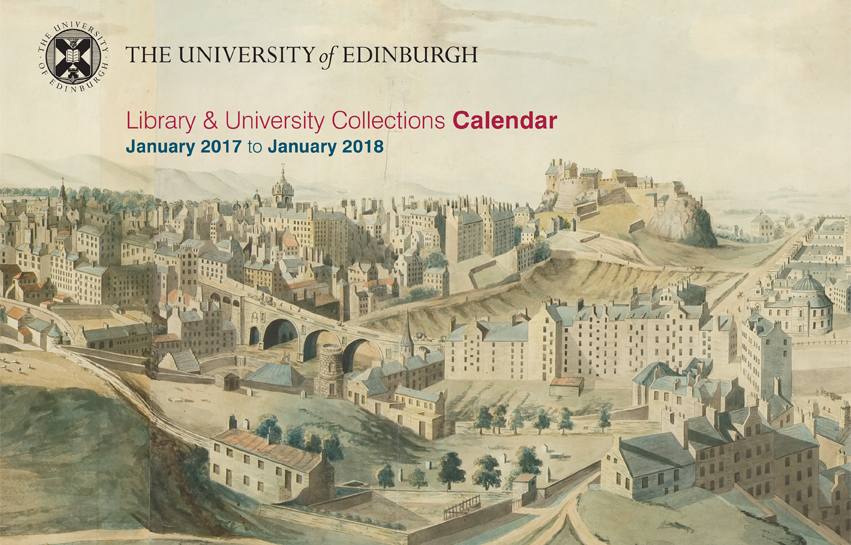
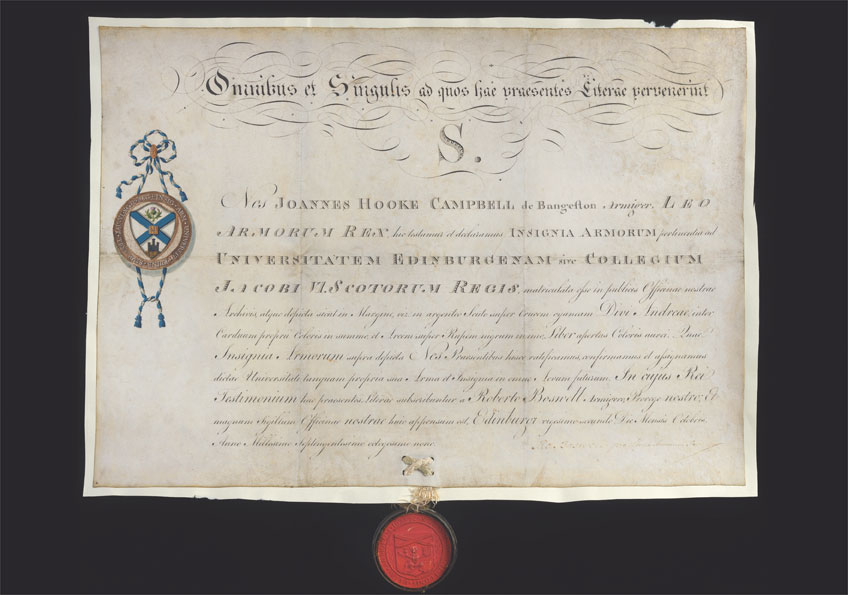
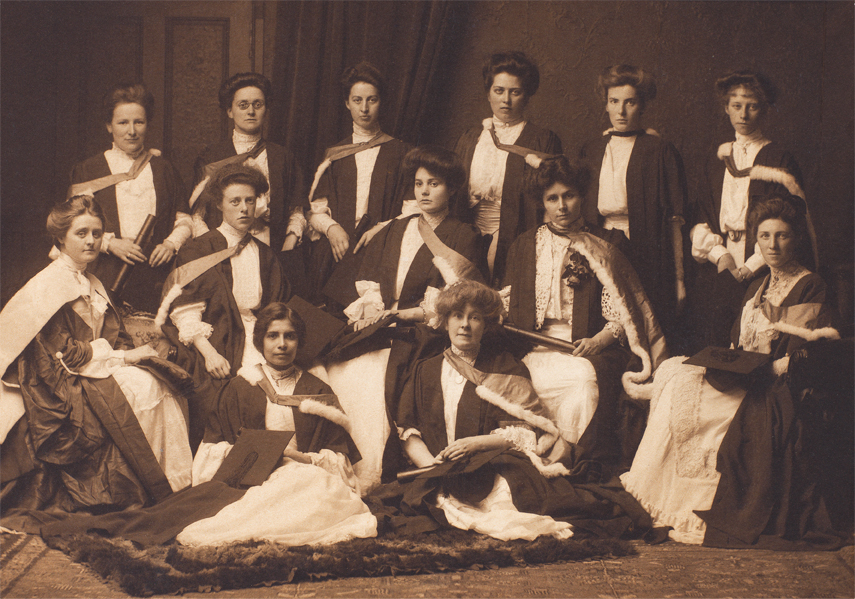
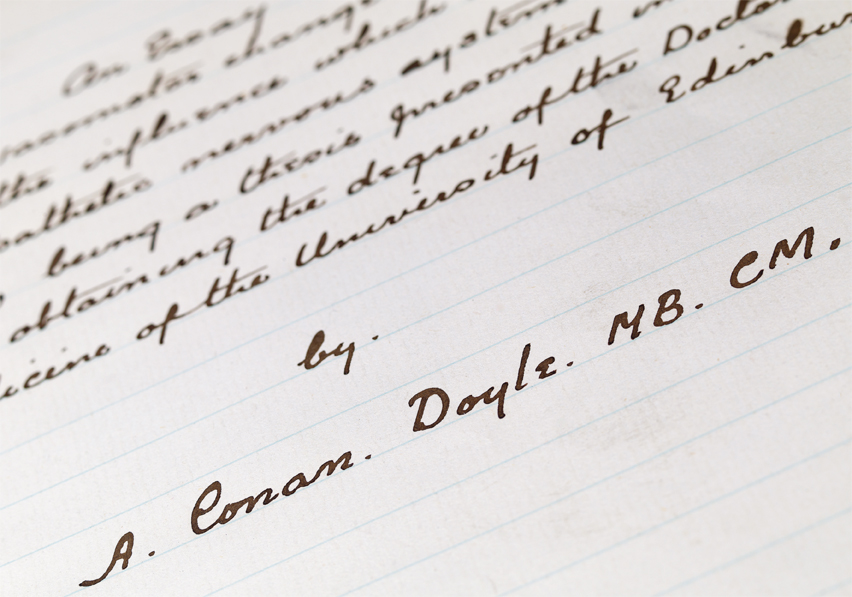
The Directory is a guide to the main named heritage collections of the University of Edinburgh and highlights some of the items the Library considers to be ‘iconic’ Some highlights include:
- The University Coat of Arms, which was formally granted in 1789 after the city’s seals were deemed ‘inconvenient and unsuitable to the dignity of the University.
- Class of 1906: the University’s earliest group photograph of female medical graduates
- Sir Arthur Conan Doyle’s PhD thesis, which discusses syphilis from a literary as well as a medical perspective.
- And much much more…
DataShare upgraded to v2.3 – The embargo enhancement release
The latest upgrade of Edinburgh DataShare, from version 2.2 to 2.3, brings in several useability improvements.
- Embargo expiry reminder
If you want to deposit your data in DataShare, but you want to impose a delay before your files become freely downloadable, you can apply an embargo to your submission – see our “Checklist for deposit” for a fuller explanation of the embargo feature. As of DataShare v2.3, if you apply an embargo to your deposit, DataShare will now send you an email reminder one week before the embargo is due to expire. This gives you time to make us aware if you need the embargo to be extended, or to send us the details of your paper if it has been published, so that we can add those to the metadata, to help users understand your data. - DOI added to the citation field immediately
When your DataShare deposit is approved by the curator, the system mints a new DOI for you. As of version 2.3, DataShare now immediately appends the URL containing that DOI into the “Citation” field, which is visible at the top of the summary view page of your item. The “Citation” field makes it easy for others to cite your data, because it provides them with text which they can copy and paste into any manuscript (or any other document where they want to cite the data). Previously you would have had to click on “Show full item record” to look for the DOI in the “Persistent identifier” field, or wait for an overnight script to paste the DOI onto the end of the “Citation” field.
- Tombstone records
We now have the ability to leave a ‘tombstone’ record in place for any DataShare item that is withdrawn. We only withdraw items in exceptional circumstances – for example where there is a substantive error or omission in the data, such that we feel merely labelling the item as “Superseded” is not sufficient. Now, when we tombstone an item, the files become unavailable indefinitely, but the metadata remain visible at the DOI and handle URLs. Whereas until now, every withdrawn item has become completely invisible, so that the original DOI and handle URLs produced a ‘not found’ error.
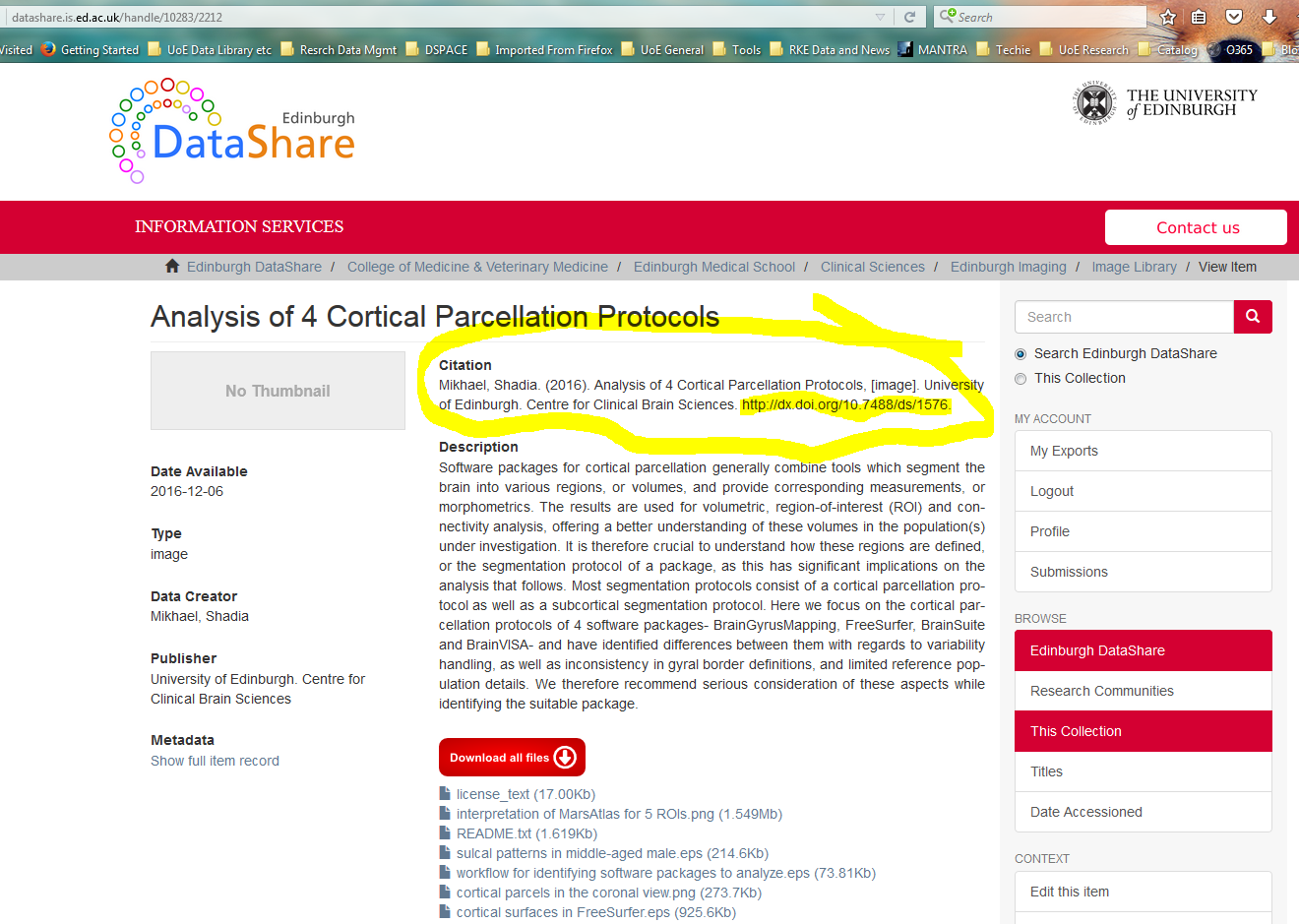
Cortical parcellation citation – now with DOI!
Enjoy!
Pauline Ward
Research Data Service
P.S. Many thanks to our software developer at EDINA, George Hamilton, who actually coded all these enhancements to DataShare, which uses the open-source DSpace system. EDINA’s DataShare code is available at https://github.com/edina/dspace .
Collections
 Love, Loss, and Literature: Cataloguing the Papers of Irene Jessie Young
My name is Nancy Britten, and I’m in my fourth year of studying History at...
Hill and Adamson Collection: an insight into Edinburgh’s past
My name is Phoebe Kirkland, I am an MSc East Asian Studies student, and for...
Love, Loss, and Literature: Cataloguing the Papers of Irene Jessie Young
My name is Nancy Britten, and I’m in my fourth year of studying History at...
Hill and Adamson Collection: an insight into Edinburgh’s past
My name is Phoebe Kirkland, I am an MSc East Asian Studies student, and for...
Projects
Cataloguing the private papers of Archibald Hunter Campbell: A Journey Through Correspondence
My name is Pauline Vincent, I am a student in my last year of a...
Archival Provenance Research Project: Lishan’s Experience
Presentation My name is Lishan Zou, I am a fourth year History and Politics student....