Home University of Edinburgh Library Essentials
April 11, 2026
“Dear Mr President…” Robert Wallace’s letters to Woodrow Wilson, 1914-1917
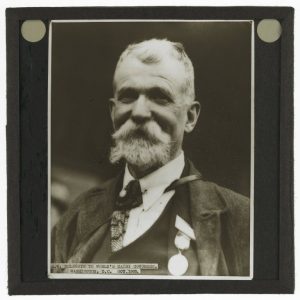
Professor Robert Wallace, from the glass slide collection partially amassed by him (Coll-1434/3200)
Robert Wallace (1853-1939) is not a widely-known name today, although in his time he was an important agriculturalist who travelled the world. He was Professor of Agriculture and Rural Economy at the University of Edinburgh between 1885 and 1922, and established the Edinburgh Incorporated School of Agriculture. Edinburgh University Library Special Collections holds some material relating to Wallace, namely, a collection of glass slides partly amassed by him and some written material. Among these papers is a collection of Wallace’s copies of a number of letters sent to President Woodrow Wilson during the First World War.
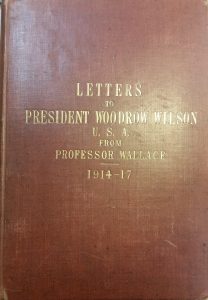
‘Letters to President Woodrow Wilson…’ (Gen.867F)
Over the course of 27 letters dating between 30 August 1914 and 3 April 1917, Wallace addresses the President on the perceived dangers to allied prisoners of war under the system of “frightfulness” (a term which was used to describe an assumed military policy of the German Army towards civilians in World War I, particularly during their invasion of Belgium in 1914). Wallace also expresses concern about the dangers of starvation to the Belgian people, and about what course of action America, who was then neutral, ought to take. In his first letter, Wallace sets out his aims:
My object is to inform you of the root-causes of the present war and of the nature of the German autocracy with which the civilised world is confronted, for it is to my mind certain that America is destined to play an important part in that compact among the leading nations which must make a gigantic war in the future an impossibility.
Wallace enclosed a number of press cuttings and pamplets, such as Morals and German Policy by Arthur Conan Doyle and an article on the Neutrality of the United States in relation to the British and German Empires by Joseph Shield Nicolson, then Professor of Political Economy at the University of Edinburgh.
These letters were by no means Wallace’s first brush with American political figures. He had visited the United States on a number of occasions as part of his work, and on a visit in 1898 he met James Wilson, Minister of Agriculture at Washington (who had emigrated from Scotland aged 18 and, it was discovered, happened to be related to Wallace). Wilson introduced him to President McKinley, the 25th President of the United States, who spoke warmly to Wallace of Britain’s support of America during the Cuban War. Wallace clearly hoped that his letters to the 28th President would encourage a return of this favour.
However, although the White House confirmed that his letters had been received, it appears that Wallace was never granted a response from the President himself. Undeterred, he continued to collect and send press cuttings and articles, and as the war progressed his tone became more urgent. In a letter dated 5 February 1917, Wallace expressed his “profound disappointment and my public, as well as private, regret” at the President’s address to Congress on 3 February that his country was “sincere friends of the German people and earnestly desire to remain at peace with the Government which speaks for them.” This statement was made following Germany’s proposal to form a military alliance with Mexico in the event of the US entering the war (the ‘Zimmerman telegram’), and many were critical of Wilson’s minimal reaction. After the sinking of several American ships, however, Wilson called a cabinet meeting on 20 March, in which America’s entry into the war received a unanimous vote.
Wallace himself did not necessarily believe that entering the war was the desired solution. In his final letter to the President (which he titled his “final supreme effort”) dated 3 April 1917, Wallace urged Wilson to commission all German and Austrian ships in USA harbours to carry food to Belgium, and suggested that America should unite with the Chinese Republic as a deterrent to Germany.
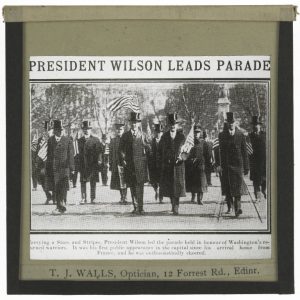
‘President Wilson Leads Parade’ – a glass slide from the collection partially amassed by Wallace (Coll-1434/3261)
Yet on the following day, a declaration of war by the United States against Germany passed Congress by strong bipartisan majorities.
In 1919, Woodrow Wilson spent six months in Paris at the Peace Conference, where he was a staunch advocate of the creation of a League of Nations. He was awarded the Nobel Peace Prize in the same year. Wallace published his letters to Woodrow Wilson in book form in 1931.
Although Woodrow Wilson’s reaction to Wallace’s letters remain unknown, they provide a fascinating insight into the subject of America’s entry in the First World War, as well as an unusual insight into Wallace’s personality against a backdrop of international conflict.
Clare Button
Project Archivist
Academic Book Week 2017
The Library has organised three events for Academic Book Week this year. Places are limited, so be sure to sign up soon!
Academic Book Week celebrates the academic book, with events happening around the country looking at the influence and future of the form. For more information, take a look at the Academic Book Week website: Academic Book Week
23 January: Does the Academic Book have a Future? (Dr Tom Mole, UoE) – event for all staff, 1230-1330, G.05, 50 George Square http://edin.ac/future-academic-book
This year’s Academic Book Week coincides with the completion of the AHRC project on the Academic Book of the Future. In this talk, Tom Mole, Director of the Centre for the History of the Book at the University of Edinburgh, will bring a book-historical perspective to bear on debates about the future of academic books. Examining the academic book as a socially-embedded media artefact, he will ask how our current moment of media change produces challenges for the academic book and creates both threats and opportunities for the future.
24 January: – Close-up on collections: behind the scenes at the Centre for Research Collections (CRC) – event for postgraduates, 1200-1300, CRC, 6th floor Main Library http://edin.ac/collections-close-up
During this session, you will have a rare chance to go behind the scenes at the University of Edinburgh’s Centre for Research Collections (CRC), home to the University’s historic collections, spanning rare books, museum objects, musical instruments, fine art and archives. Alice Doyle, Access Officer at Lothian Health Services Archive (LHSA), will let you know how the CRC can help in your studies and lead a tour of the places researchers don’t normally get to see. You’ll have the opportunity to see some star collection items ‘up-close’ and visit an archive store and conservation studio, learning how staff preserve the treasures of the CRC. In a visit to the Digital Imaging Unit, you’ll see University collections reaching global audiences and technology helping evidence of the past be understood in new ways.
27 January: The Truth About Publishing? (Professor Alistair McCleery, Napier) – event for undergraduates, 1230-1330, LG.06 DHT http://edin.ac/truth-about-publishing
Alistair McCleery, Director of the Scottish Centre for the Book at Edinburgh Napier University, offers, as part of Academic Book Week, to uncover the Truth about Publishing. He begins with popular perceptions of publishing, as found in a number of media representations from The Substance of Fire (1996) through 13 Going On 30 (2004) to The Post Grad (2009) and others, before looking at the nature of contemporary publishing. He will examine the scope of the industry as well as looking to its future prospects.
Please direct any queries to sarah.ames@ed.ac.uk
IIIF is live!
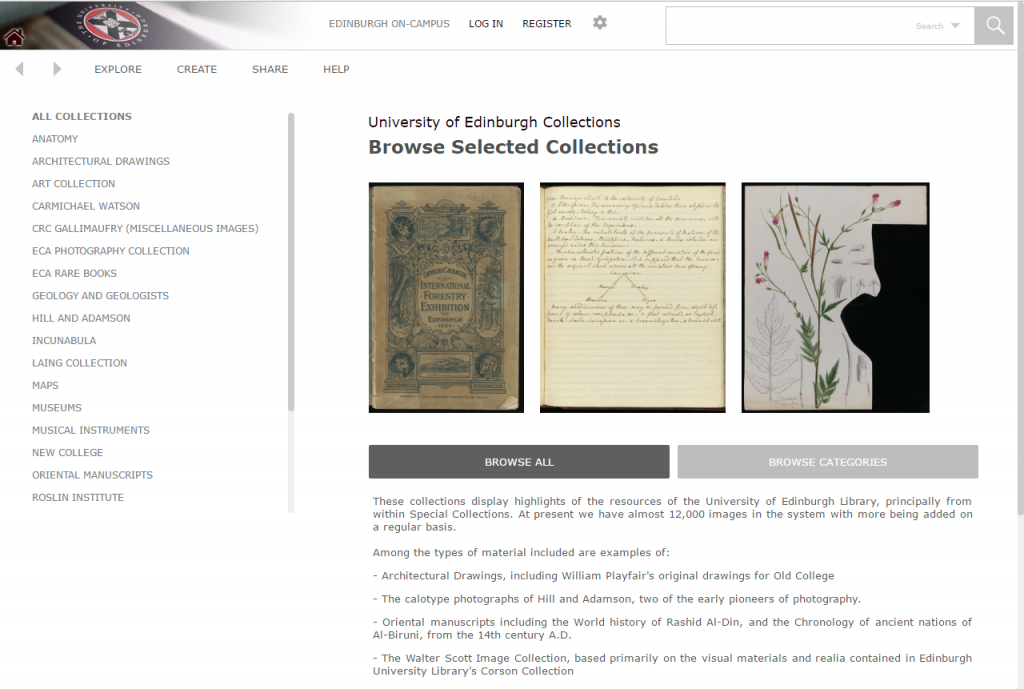
This week, and just scraping in before the end of the year, we upgraded the LUNA imaging platform to version 7.2. This is important to us for two reasons: the first is aesthetic, as the front-end interface has been completely overhauled and is much cleaner, more responsive and (basically) more modern; the second is that its implementation means we are now a IIIF-compliant institution. As always, the site can be found at http://images.is.ed.ac.uk.
What is IIIF?
There have been a few blogposts about IIIF this year, but they’ve been prospective and theoretical; now, we can talk about it as something we can genuinely offer. IIIF- the International Imaging Interoperability Framework- is a toolkit which allows open exchange with images, meaning that an image need only be hosted once for it to be disseminated anywhere. Yes, since the birth of the internet, we’ve been able to pull images into webpages using http links, but IIIF takes this to another level: its parameter driven URIs allow formatting to take place on the image without downloading it, taking it into (e.g) Photoshop and working on it there. A range of image viewers are IIIF-compliant, and these allow high-resolution zooming directly onto a webpage, or the performance of comparisons with other institutions’ content.
Since the Image API, which addresses the above, was written, new layers of IIIF have appeared:
- The Presentation API gives a shorthand which determines sequencing and display of selections of images, and lends itself well to comparisons. It includes Open Annotation extensions to allows users to, well, annotate images. The information that they add is stored in such a way that it can be discussed and rated by other users.
- The Authentication API gives users control over how items are accessed- not everything is able to be completely open.
- The Search API allows deeper search into the facets of the surfaced images.

How will we use it?
With LUNA as our IIIF server, we expect to be able to streamline a lot of our collections content. For example:
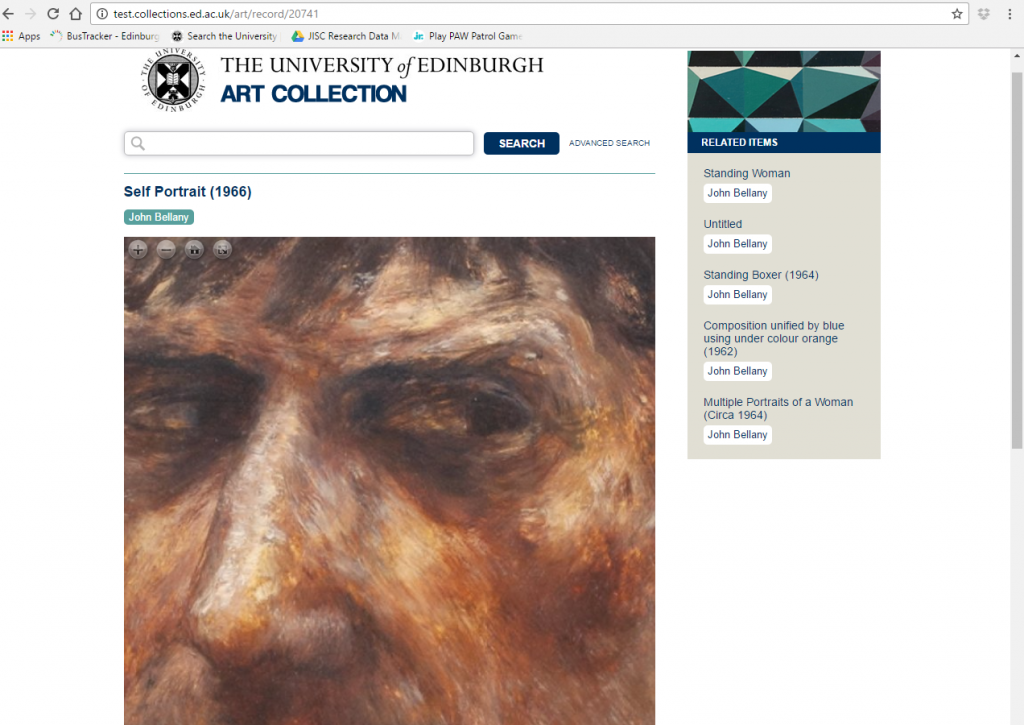
- collections.ed.ac.uk sites. Where we have a high-res image, we need an extra click to LUNA to see the full image. Using an embedded viewer such as OpenSeadragon or Leaflet, we will be able to zoom and pan the image directly on the page. This means we can effectively retire the LUNA front-end for these collections (and don’t need to worry about metadata getting out of sync!). This screenshot from the Art collection on test shows we’re working towards making this happen.
- Vernon/metadata games/anything that needs jpegs. These systems can reference URIs rather than storing images directly on the filesystem. This will save a lot of disk space and a lot of donkey work moving things around.
- Scottish Session Papers. This project is a collaboration among three institutions, and we intend to use the Mirador viewer as a front end to allow comparison across the content and to view the papers holistically.
- Polyanno. This amazing transcription and translation tool was developed in the summer by intern Erin Nolan, and will be available in the new year. It makes really good use of the Open Annotation extensions.
Try it!
This is a bit technical, but it’s verging on fun once you get your head round it.
Pick an item in LUNA and copy the URL (obviously we do all of this programmatically!), for example:
http://images.is.ed.ac.uk/luna/servlet/detail/UoEwmm~3~3~61321~166317:Photograph-Album-%E2%80%9CChina%E2%80%9D,-f-57r,-de
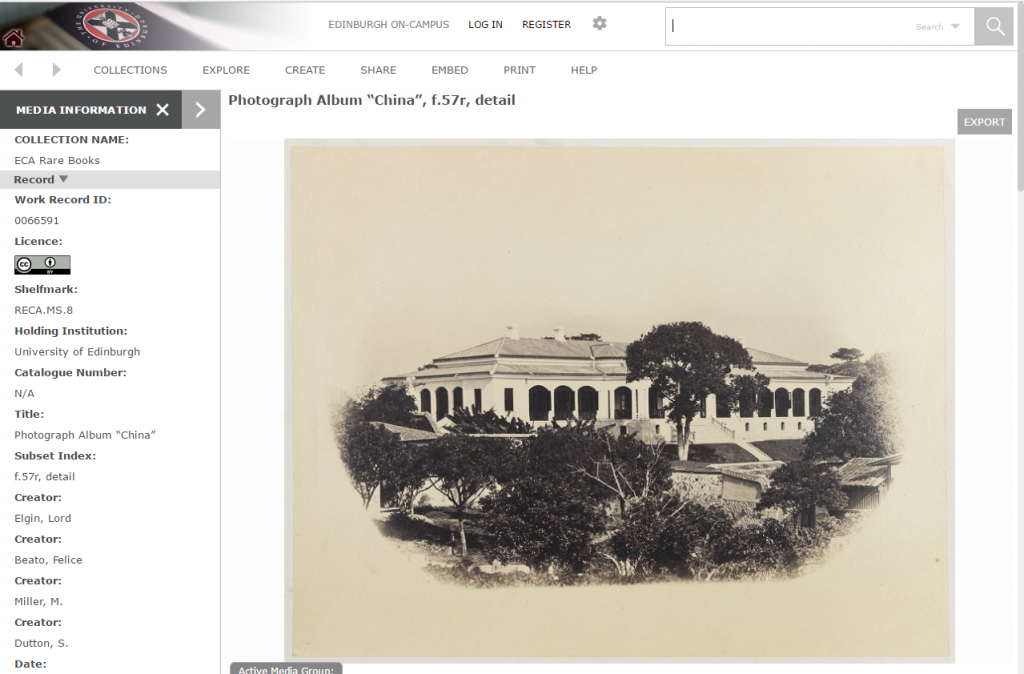
…cut off the trailing text…
http://images.is.ed.ac.uk/luna/servlet/detail/UoEwmm~3~3~61321~166317
…replace ‘detail’ with ‘iiif’..
http://images.is.ed.ac.uk/luna/servlet/iiif/UoEwmm~3~3~61321~166317
…then add the parameter “path”, to get a working vanilla IIIF URL:
http://images.is.ed.ac.uk/luna/servlet/iiif/UoEwmm~3~3~61321~166317/full/full/0/default.jpg
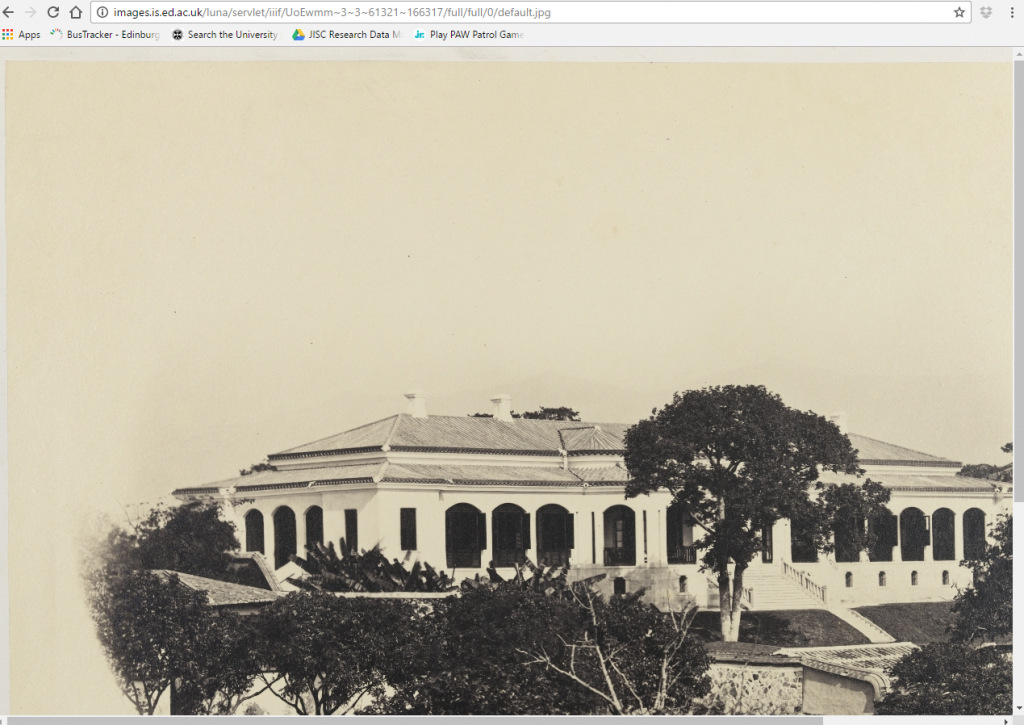
Now you can start formatting. Some of the things you can do follow, but you can see the full spec here.
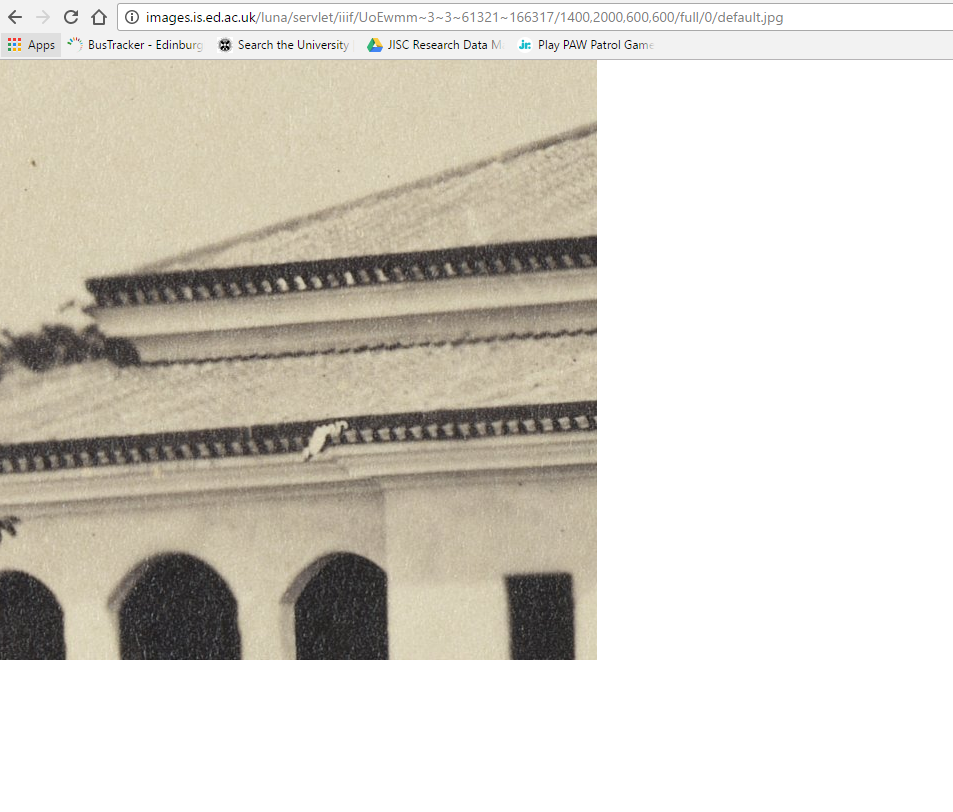
- Crop it (parameter 1):
http://images.is.ed.ac.uk/luna/servlet/iiif/UoEwmm~3~3~61321~166317/1400,2000,600,600/full/0/default.jpg
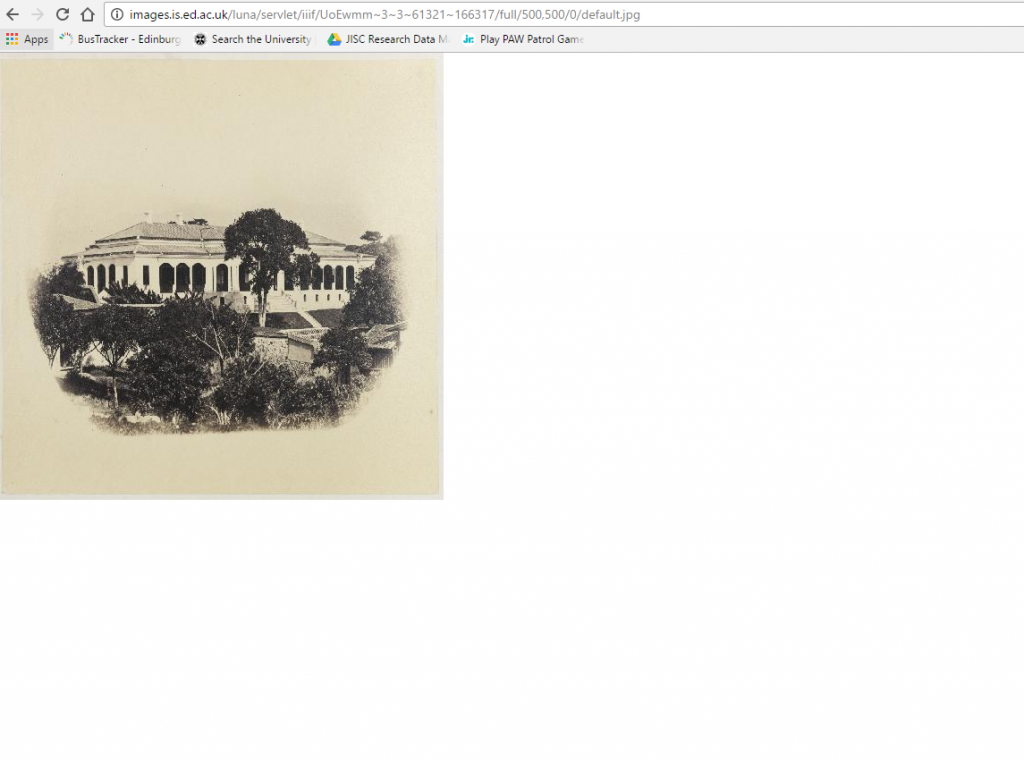
- Resize it (parameter 2):
http://images.is.ed.ac.uk/luna/servlet/iiif/UoEwmm~3~3~61321~166317/full/500,500/0/default.jpg
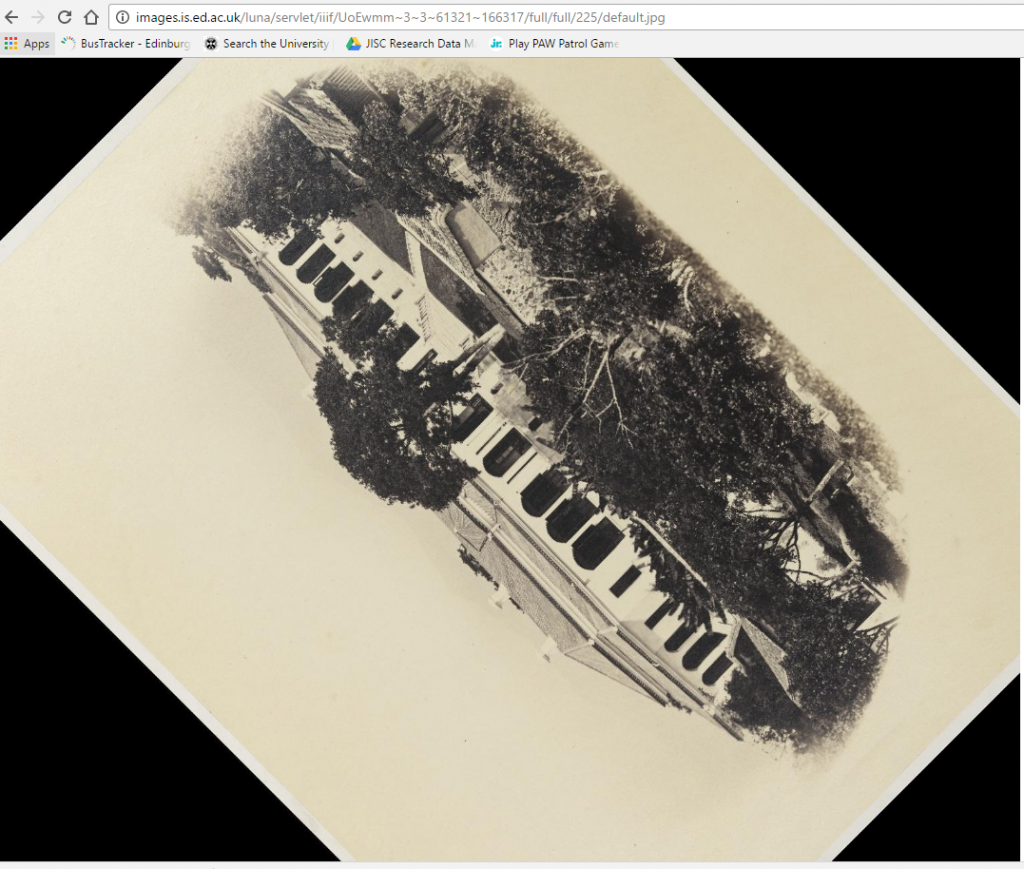
- Rotate it (parameter 3):
http://images.is.ed.ac.uk/luna/servlet/iiif/UoEwmm~3~3~61321~166317/full/full/225/default.jpg
I hope this sheds a bit of light on what we’re now able to do. We will try to keep everyone informed as IIIF developments happen over the coming year.
Scott Renton, Digital Development
Evaluation of Digital Cultural Resources in Glasgow
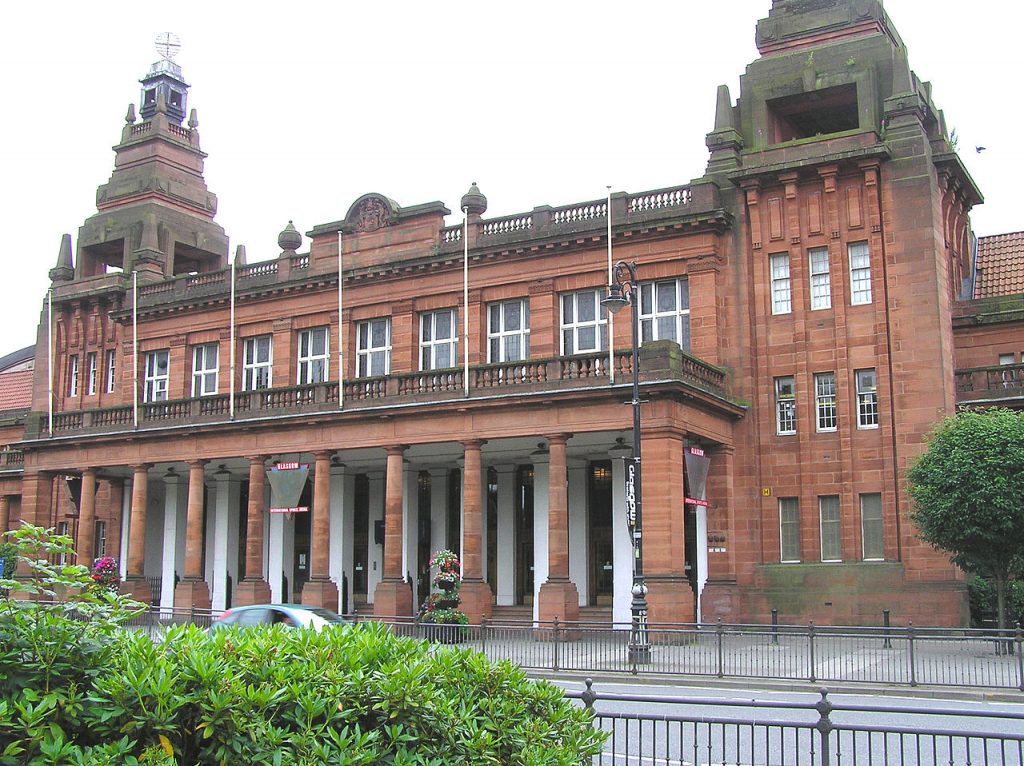
The revamped Kelvin Hall in Glasgow was the destination for the Scottish Digital Cultural Heritage Evaluation Network’s winter symposium, on December 12 and 13. Now the home of much of the University of Glasgow’s Hunterian Museum collection and the National Library’s Moving Image Archive, the Kelvin Hall is becoming the ultimate community space, continuing to host its leisure facilities amidst a burgeoning collection of museums objects. The juxtaposition, in fact, seemed particularly quirky to me, as I was sitting in a lecture theatre next to the 5-a-side courts I used to play on as a boy!
The thrust of the network, and thus the conference, was really about measuring the unmeasurable: how to find out the impact of digital discovery of museums objects beyond obvious KPIs such as analytics data and website hits. We are generally able to get this surface information quite easily, but it is much harder to quantify the social or legacy impacts and outcomes of putting cultural content online.
A number of institutions put forward papers highlighting their varied attempts to solve this problem. We became acquainted- thanks to Marco de Niet with the ENUMERATE framework which Europeana have integrated into their evaluations. It measures impact through a combination of quantifiable data, surveys and questionnaires. Laura Gottlieb at the imminently-opening Swedish Museum of Performing Arts, meanwhile, demonstrated the MIQS (Mixed Interactive Quality Study) toolkit, which used very useful approaches (again, largely survey-based) to this evaluation.
A much-photographed Europeana-run workshop put us in the shoes of museums decision-makers to think of different ways of looking at impact (they spoke of five lenses- utility, learning, legacy, existence, and community), to really consider how tools deliver outputs, outcomes, and ultimately impacts. I hadn’t really thought, before about the social cohesion, potentially leading to health benefits, that a digital collection could bring, but a strong case was made for it! Here’s the report.
It’s important for us to consider these questions, especially just now, with the re-opening of St Cecilia’s Hall upon us. The digital surfacing of the content is expected to be an integral component of the museum’s presence, so it’s important that we get it right. It’s also good to know that we can talk to the Hunterian- in the light of their recent major overhaul- about their experiences of a major change project.
Scott Renton, Digital Development
New books in the Library for History, Classics and Archaeology
Thanks to recommendations from members of staff and requests via RAB from students the Library is continually adding new books to its collections both online and in print. Here are just a (very) small number of the books that have been added to the Library’s collections in semester one, 2016/17 for the School of History, Classics and Archaeology and these demonstrate the wide range of subjects being taught, studied and researched within School.
–> Find these and more via DiscoverEd.
 From Constantinople to the Frontier edited by Nicholas S. M. Matheou, Theofili Kampianaki; Lorenzo M Bondioli (e-book)
Iron age hillfort defences and the tactics of sling warfare by Peter Robertson (shelfmark: GN780.22.G7 Rob.)
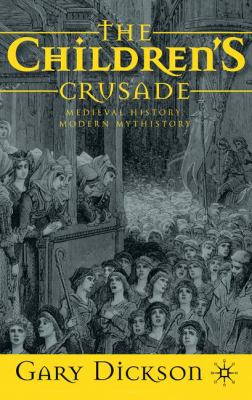
The Children’s Crusade: medieval history, modern mythistory by Gary Dickson (Shelfmark: D169 Dic. Also available as e-book).
Masculinity, class and same-sex desire in industrial England, 1895-1957 by Helen Smith (Shelfmark: HQ1090.7.G7 Smi.)
Classics renewed: reception and innovation in the Latin poetry of Late Antiquity edited by Scott McGill, Joseph Pucci (e-book). Read More
Oxford Handbooks Online – new e-books added

We have added the following Oxford Handbooks to DiscoverEd:
| The Oxford handbook of the Aztecs / edited by Deborah L. Nichols and Enrique Rodríguez-Alegría. |
| Oxford handbook of contemporary Buddhism / edited by Michael Jerryson. |
| The Oxford handbook of international climate change law / edited by Kevin R. Gray, Richard Tarasofsky, and Cinnamon Carlarne. |
| Late Victorian into modern / edited by Laura Marcus, Michèle Mendelssohn, and Kirsten E. Shepherd-Barr. |
| The Oxford handbook of British poetry, 1660-1800 / edited by Jack Lynch. |
| The Oxford handbook of the theory of international law / edited by Anne Orford and Florian Hoffmann. |
| The Oxford handbook of Islamic philosophy / edited by Khaled El-Rouayheb and Sabine Schmidtke. |
| The Oxford handbook of developmental linguistics / edited by Jeffrey L. Lidz, William Snyder, and Joe Pater. |
| The Oxford handbook of language and society / edited by Ofelia García, Nelson Flores, and Massimiliano Spotti. |
| The Oxford handbook of organizational identity / edited by Michael G. Pratt, Majken Schultz, Blake E. Ashforth and Davide Ravasi. |
| The Oxford handbook of Roman law and society / edited by Paul J. du Plessis, Clifford Ando, and Kaius Tuori. |
| The Oxford handbook of the economics of prostitution / edited by Scott Cunningham and Manisha Shah. |
| The Oxford handbook of Shakespearean tragedy / edited by Michael Neill and David Schalkwyk. |
| The Oxford handbook of the law and regulation of technology / edited by Roger Brownsword, Eloise Scotford, and Karen Yeung. |
Further Info.
The following Oxford Handbook subject collections are available to the University of Edinburgh – Archaeology, Business & Management, Classical Studies, Criminology and Criminal justice, Economics and Finance, History, Law, Linguistics, Literature, Music, Philosophy, Politics, Psychology, Religion up to the end of 2016 copyright year.
Winter Vacation at New College Library
 New College Library will close at 1pm on Friday 23 December 2016 and reopen again at 9am on Wednesday 4 January 2017. More details on opening hours for all University of Edinburgh Library sites over the holidays are available at : http://www.ed.ac.uk/is/library-opening. Read More
End of an Internship
Victoria Haddock, the second in a series of interns working on the Thomson-Walker collection, reviews her time spent at the CRC in this week’s blog post. If you’d like to find out more about this project, you can view Victoria’s end of internship Powerpoint presentation at the bottom of this article.
As I watch another beautiful sunset from the window of the CRC conservation studio, it seems a good moment to reflect back on the past 10 weeks of my internship here, which have absolutely flown by.
Although I did think on my first day that I was looking forward to 10 weeks of solid tape removal, the internship has been very busy, varied and with lots of opportunities beyond what I first expected.
New College Library books recommended by students
 Student recommendations are in at New College Library! The recently purchased Inherit the Holy Mountain: Religion and the Rise of American Environmentalism, edited by Mark Stoll, is available as an ebook via DiscoverEd.

Other student recommendations in the library include: Worship on the way : exploring Asian North American Christian experience by Russell Yee, at BR563.A82 Yee.
Read More
2nd C. Sculpture to Star Wars Props: 3D, a Force Awakens?
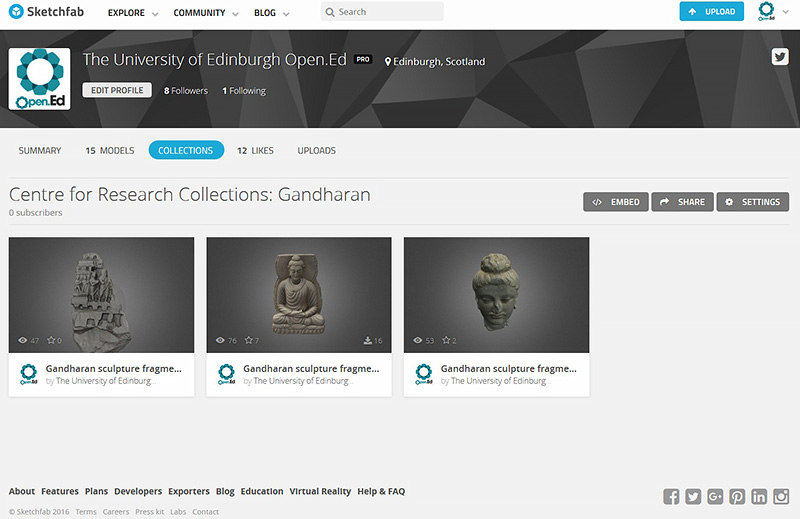
During a photogrammetry training session with Clara Molina Sanchez, we were recommended to choose objects with a matt surface, small to medium in size, and which didn’t have many holes or occlusions. We settled on a Gandharan Buddha from the Art Collection, a Paolozzi maquette from the Edinburgh College of Art collection and, just to test what would happen, a thigh bone trumpet wrapped in shiny metal filigree from the Musical Instruments collection.
Collections
 Hill and Adamson Collection: an insight into Edinburgh’s past
My name is Phoebe Kirkland, I am an MSc East Asian Studies student, and for...
Cataloguing the private papers of Archibald Hunter Campbell: A Journey Through Correspondence
My name is Pauline Vincent, I am a student in my last year of a...
Hill and Adamson Collection: an insight into Edinburgh’s past
My name is Phoebe Kirkland, I am an MSc East Asian Studies student, and for...
Cataloguing the private papers of Archibald Hunter Campbell: A Journey Through Correspondence
My name is Pauline Vincent, I am a student in my last year of a...
Projects
Cataloguing the private papers of Archibald Hunter Campbell: A Journey Through Correspondence
My name is Pauline Vincent, I am a student in my last year of a...
Archival Provenance Research Project: Lishan’s Experience
Presentation My name is Lishan Zou, I am a fourth year History and Politics student....